

Social Media Marketing Agency Sydney: Drive 2026 ROI
Last Updated

You're probably in one of two situations right now. Either your team is posting consistently and getting polite engagement with no obvious lift in leads or sales, or you're talking to agencies that promise “brand growth” without showing how that turns into revenue.
That's the core problem with hiring a social media marketing agency in Sydney. Most pitches sound polished. Fewer explain how the work connects to pipeline, sales, repeat purchases, or customer acquisition efficiency.
Sydney is not a forgiving market for vague marketing. Competition is tighter, buyers are more comparison-driven, and platform costs punish weak strategy fast. If an agency can't explain how budget, targeting, creative, landing pages, and reporting work together, you're not buying a growth system. You're buying activity.
Your Sydney Business Needs More Than Just Social Media Posts
A feed full of decent posts can still produce poor commercial results. That's common. A lot of Sydney businesses confuse motion with traction because social platforms make visibility feel like progress.
The main issue isn't effort. It's commercial clarity.
Many agency pages talk about content calendars, platform management, community engagement, and “data-driven” execution. What they often don't answer is the buyer question that matters most: what drives ROI in Australian social campaigns, and how should social work alongside PPC instead of pretending to replace it? That gap is noted in this overview of Australian social media marketing agency positioning.
What business owners usually feel
You might recognise this pattern:
- Content is going out: Instagram, LinkedIn, Facebook, maybe TikTok too.
- The numbers look active: likes, views, comments, follower growth.
- Sales don't clearly move: enquiries stay patchy, lead quality varies, and revenue attribution is fuzzy.
- The agency report feels shallow: lots of screenshots, very little decision-making.
That disconnect is why many businesses become sceptical about social. Fair enough. Social media can drive real outcomes, but only when it's built as a commercial channel rather than a publishing routine.
Practical rule: If your agency reports more on engagement than on actions that affect revenue, they're managing a channel. They're not managing a business outcome.
The shift that changes the conversation
A good agency doesn't start with “What do you want to post?” It starts with sharper questions:
- What action do you need the audience to take?
- Which platform fits that buying journey?
- Where does social sit relative to search, remarketing, email, and sales follow-up?
- What counts as a qualified lead or profitable sale?
Organic content still matters. Messaging still matters. But without a clear path from attention to conversion, social becomes expensive theatre.
If your internal team is also trying to improve content quality, this guide to boosting content performance on X is a useful tactical resource because it forces tighter thinking around message fit, structure, and audience response rather than posting for the sake of it.
The Two Sides of Social Media Marketing Organic vs Paid
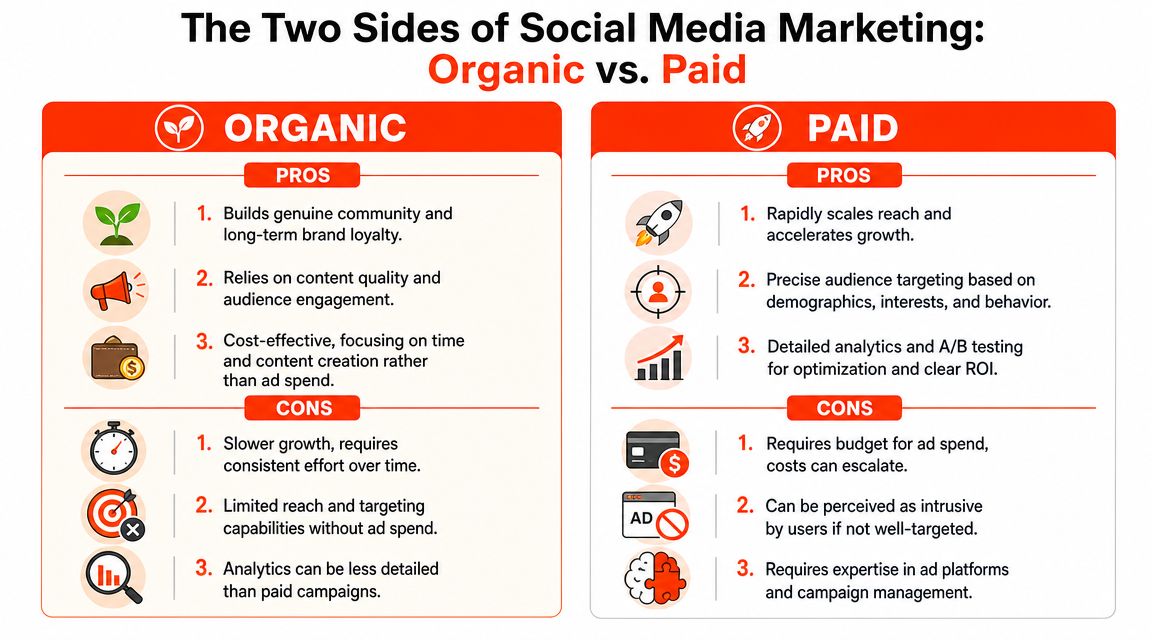
Organic and paid social do different jobs. Treating them as interchangeable is one of the fastest ways to waste budget.
Organic social is your shop front. It shows people who you are, how you think, what your brand sounds like, and whether you look active and credible. Paid social is your outbound sales engine. It lets you target specific audiences, test offers, and push people towards a measurable action.
What organic social is good for
Organic helps when your business needs to build familiarity and trust over time.
It's useful for:
- Brand credibility: showing your work, team, process, and point of view
- Audience warming: giving buyers repeated exposure before they're ready to enquire
- Customer retention: keeping current customers engaged after purchase
- Proof of legitimacy: making sure your business doesn't look dormant
But organic has limits. Reach is inconsistent, platform algorithms change often, and good content can still underperform if the audience pool is too small or the offer is weak.
What paid social is good for
Paid social is where agencies earn their keep. This is where strategy, audience selection, creative testing, and budget control matter.
Paid helps when you need to:
- Generate demand: reach people who don't know you yet
- Retarget warm traffic: bring back visitors who didn't convert
- Control scale: increase spend behind campaigns that are working
- Measure outcomes: tie spend to leads, sales, or booked calls
For businesses comparing service structures, it helps to review what sits inside dedicated social media ad services rather than assuming all “social management” includes serious paid execution.
Organic builds trust slowly. Paid gives you control. Most Sydney businesses need both, but they shouldn't fund them equally at every stage.
Where businesses go wrong
The common mistakes are predictable:
| Approach | What happens |
|---|---|
| Organic only | The brand looks active, but growth stalls because reach is limited |
| Paid only | Traffic arrives, but weak brand signals lower conversion efficiency |
| Same message on every platform | Creative feels generic and channel performance drops |
| Boosted posts instead of structured campaigns | Spend goes out without clear targeting, testing, or reporting |
A balanced setup usually works better. Organic earns attention and trust. Paid creates predictable distribution and faster learning.
Key Services a Sydney Social Media Agency Should Offer
A real agency scope goes far beyond posting graphics three times a week. If you're hiring a social media marketing agency in Sydney, you should expect a system that covers strategy, production, media buying, audience management, and reporting.
If the proposal is vague on any of those, expect weak accountability later.
Strategy and funnel design
Strong agencies start by mapping the buying journey. They define who the business is targeting, what the audience needs at each stage, and which platform should carry which message.
Good strategy work includes:
- Audience segmentation: not just broad demographics, but clear customer groups
- Offer alignment: matching message to buying intent
- Channel roles: deciding where Meta, LinkedIn, or other platforms fit
- Funnel logic: separating cold traffic, warm traffic, and retargeting
This is the part many buyers skip because it feels less tangible than content. It's also the part that prevents random activity later.
Content and creative production
Creative quality matters, but relevance matters more. A polished ad that speaks to the wrong audience still fails.
What good looks like:
- short-form video built for feed behaviour
- static creative with a clear message hierarchy
- copy that leads with the offer, not brand fluff
- platform-native formats rather than one resized asset everywhere
For a broader view of deliverables, compare your proposal against a structured list of social media marketing services.
Community management and response handling
This gets overlooked until leads start arriving in comments, DMs, or post replies.
An agency doesn't always need to own customer service, but it should define:
- who responds
- how quickly they respond
- what gets escalated internally
- how social enquiries are recorded and followed up
If nobody owns that workflow, warm leads slip through.
Paid media management and analytics
At this point, strong agencies separate themselves from content shops.
Paid management should cover campaign builds, audience exclusions, retargeting logic, budget shifts, creative testing, and reporting tied to business outcomes. Analytics shouldn't be an afterthought bolted on at the end.
The agency's job isn't to “run ads”. It's to make budget allocation decisions with better signal quality than you can make on your own.
A Sydney agency worth hiring should be able to show how creative, media buying, and reporting connect. If they treat reporting as a monthly PDF of top-line metrics, they're probably optimising too slowly.
What Actually Works in the Sydney Market
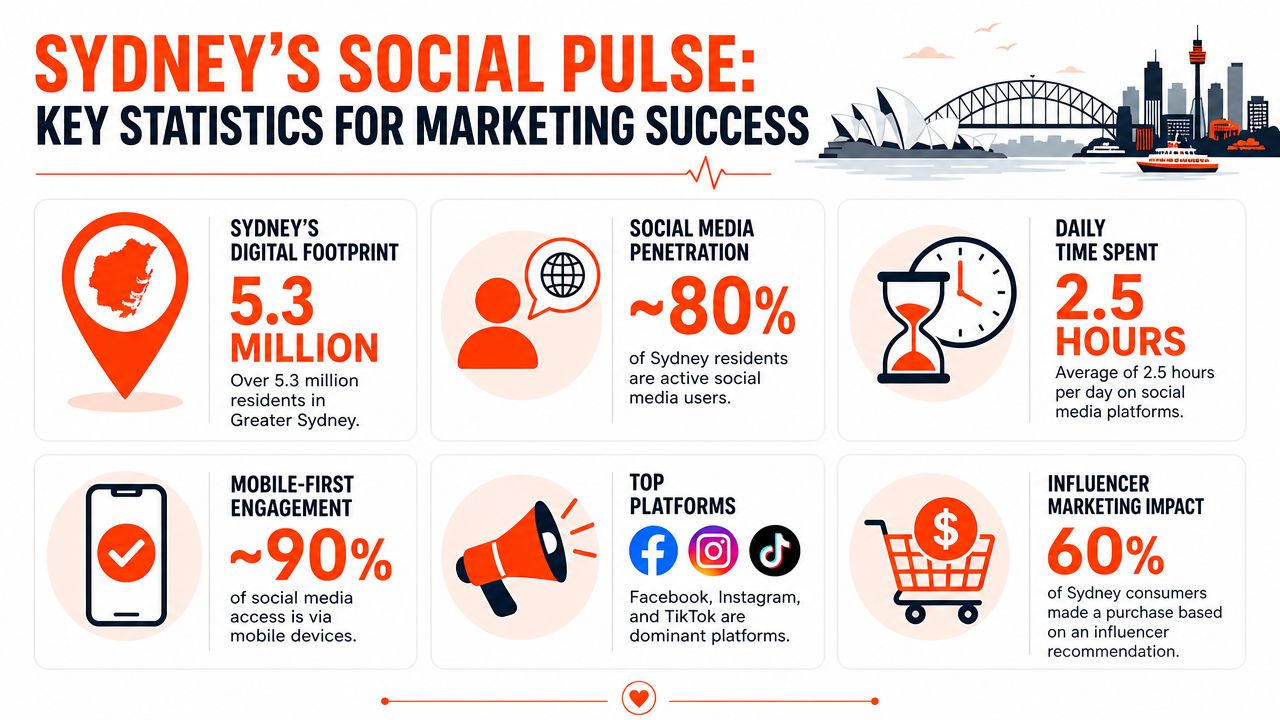
Sydney has enough demand, enough competition, and enough agency density to make generic social strategy a bad bet. The market is mature. Buyers have options, and agencies specialise hard.
Australia had 20.9 million social media user identities in January 2026, equal to 79.4% of the population, and the average user spent 1 hour 51 minutes per day on social platforms according to DataReportal figures cited here. That scale matters because it confirms social is not a fringe channel. It's a mainstream attention environment.
At the same time, Sydney agency directories show a crowded provider market. Clutch lists 15 top agencies, Semrush lists 23 Sydney agencies, and Clutch rate cards span from $100 to $149 per hour for some firms and $200 to $300 per hour for others according to Sydney agency listings on Clutch. That spread tells you something important: buyers aren't choosing from one standard service. They're choosing between very different operating models.
B2B and B2C should not look the same
A Sydney B2B firm selling high-consideration services usually needs a narrower, more deliberate approach. LinkedIn often matters more for audience quality, but the campaign still needs proper offer design. Promoting bland “learn more” content to a broad professional audience rarely works.
A local retailer, hospitality venue, or consumer brand often benefits from more visual, faster-feedback platforms. Meta tends to carry more of the conversion and retargeting workload, especially when the business has enough traffic to build warmer audience pools.
What tends to work better
Here's the commercial pattern I see most often:
- Clear local relevance: creative that reflects Sydney context, buying habits, or service area
- Platform fit: LinkedIn for specific B2B audiences, Meta for broader demand capture and retargeting
- Offer-led messaging: not “awareness content” for buyers who are already in market
- Funnel separation: one campaign for prospecting, another for retargeting, with different creative and expectations
What usually underperforms
The failures are repetitive:
| Weak approach | Why it struggles in Sydney |
|---|---|
| Same content across all platforms | It ignores channel behaviour and buying intent |
| Organic-first growth plan | Competition is too strong to rely on reach alone |
| Broad audience targeting | Budget gets diluted quickly |
| No local nuance | Ads feel interchangeable with competitors |
If an agency can't tell you why a Sydney prospecting campaign should differ from a Sydney retargeting campaign, they probably don't have enough control over spend.
In this market, specialisation matters more than buzzwords. The right agency should understand your business model, not just your platform list.
Choosing Your Social Media Agency A Checklist
Hiring an agency is less about who sounds confident and more about who can reduce uncertainty. You're not buying posts. You're buying judgment, process, and accountability.
The Australian market already signals that social is handled as an ongoing optimisation function. Typical pricing sits around AUD 800 to 4,000 per month for social media management and AUD 1,000 to 5,000 per month for paid social execution, according to Sydney agency market listings. That should tell you something upfront: if an agency positions social as a one-off setup or a posting package without optimisation, it's out of step with how the market works.
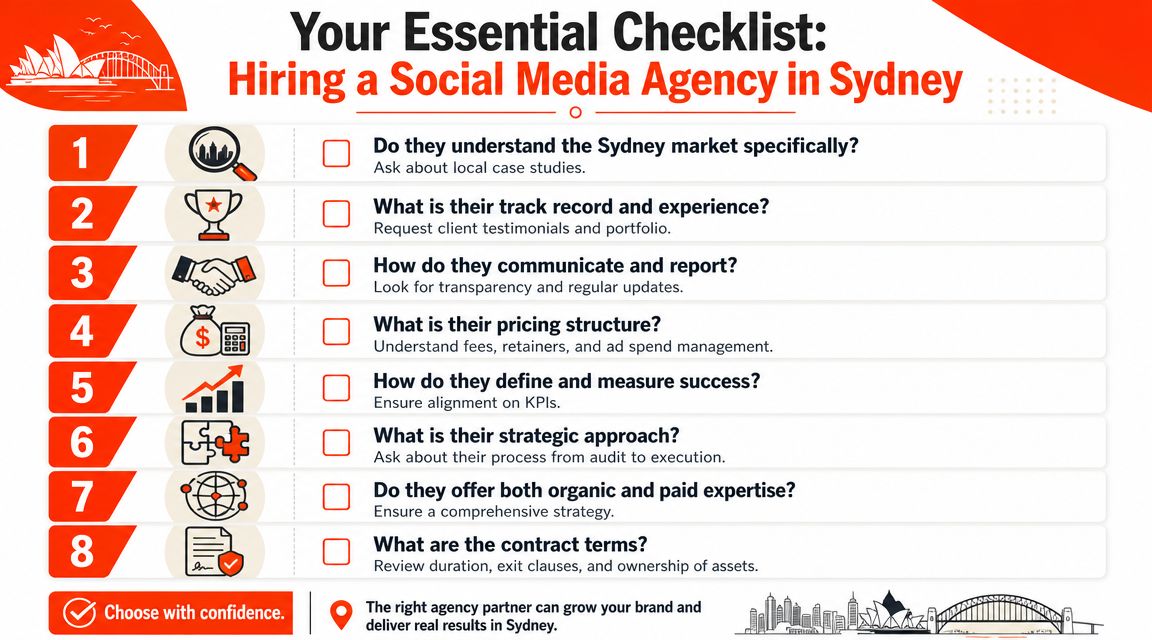
Questions worth asking before you sign
-
What do you believe will drive results for our business specifically?
A useful answer mentions audience, offer, funnel stage, creative approach, and tracking. A weak answer stays at the level of “consistent content”. -
Who actually does the work day to day?
You want to know whether you'll deal with a strategist, account manager, media buyer, or a rotating junior team. -
How do you handle paid and organic together?
If those functions are split with no shared strategy, reporting often becomes fragmented. -
What happens in the first month?
Good agencies can describe onboarding, access requests, technical setup, initial testing, and reporting cadence clearly.
Pricing and contract reality
Most agencies use one of three structures:
| Model | Best for | Watch out for |
|---|---|---|
| Monthly retainer | Ongoing management and optimisation | Undefined scope |
| Project fee | Setup, audit, or creative production | No long-term improvement loop |
| Performance-linked model | Mature accounts with clean tracking | Incentives can get distorted |
Long contracts aren't automatically bad. But if the agency wants a long commitment before it has proved its process, that's a risk you don't need to carry alone.
Red flags that matter
A few signs should slow you down:
- No hard discussion about attribution
- No questions about your sales process
- No distinction between leads and qualified leads
- No clarity on asset ownership or account access
- No reporting examples tied to decisions
The best proposals are usually less flashy and more precise. They tell you what the agency will test, what it will measure, and how it will respond if results are weak.
Measuring What Matters Real KPIs vs Vanity Metrics
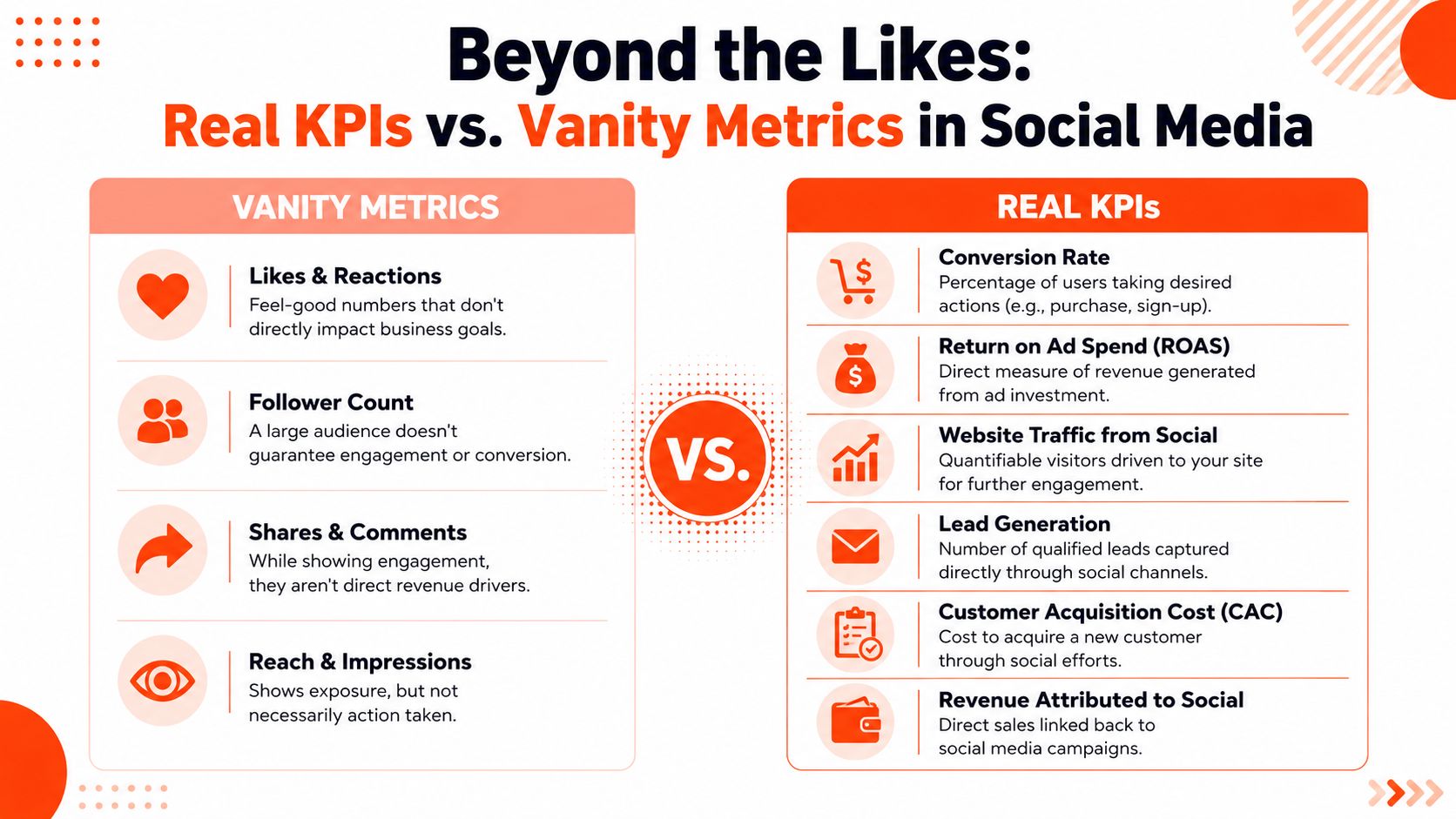
A lot of businesses stay in bad agency relationships because the reporting sounds positive. Reach is up. Engagement is healthy. Followers are growing. None of that guarantees commercial value.
The most technical lever in paid social performance is measurement architecture. Campaigns need clear KPI definitions and conversion tracking to optimise ROAS, conversion count, and downstream lead quality. That means separating prospecting from retargeting and using event-level tracking so revenue is attributed to the right touchpoint. Without that setup, decisions get made on poor signal quality, which leads to wasted spend, as outlined in this explanation of measurement architecture for social performance.
Vanity metrics have a place, but not the top place
Likes, comments, shares, reach, and follower count can be useful diagnostics. They can tell you whether content is resonating or whether a creative angle is attracting attention.
They become dangerous when they replace commercial KPIs.
A post with heavy engagement can still drive poor traffic quality. A campaign with modest engagement can still deliver strong enquiries if the targeting and offer are right.
The KPIs that deserve boardroom attention
Look for reporting built around metrics like these:
- ROAS: whether ad spend is producing attributable revenue
- Conversion count: how many desired actions the campaign generated
- Lead quality: whether the sales team wants more of these leads
- Cost efficiency over time: whether optimisation is improving results, not just maintaining activity
If you need a baseline for what serious reporting should include, review these digital marketing performance metrics.
Good reporting should answer three questions: what happened, why it happened, and what changes next because of it.
Before and after the KPI shift
When a business focuses on vanity metrics, the strategy usually drifts towards broad content, cheap engagement, and safe creative.
When the focus shifts to commercial KPIs, the campaign changes shape:
| Vanity-led account | KPI-led account |
|---|---|
| Optimises for likes | Optimises for conversions or qualified leads |
| Uses broad audiences | Segments by intent and stage |
| Reports top-line activity | Reports decisions and business impact |
| Treats all traffic equally | Distinguishes cold, warm, and retargeting behaviour |
That's the difference between looking busy and running a real acquisition channel.
The Agency Onboarding Process From Handshake to Results
A well-run onboarding process should feel organised from day one. If the first few weeks are messy, the account usually stays messy.
What a professional onboarding flow looks like
Most strong agencies follow a sequence like this:
-
Discovery and commercial alignment
The agency asks about revenue goals, sales process, margins, customer types, and current channel mix. If the conversation stays at brand tone and posting frequency, it's too shallow. -
Account access and tracking setup
This includes platform access, ad accounts, analytics, Business Manager structures, and conversion tracking. This stage is less glamorous, but it affects every reporting decision later. -
Campaign build and creative preparation
Audiences are mapped, campaigns are structured, and creative assets are adapted to the intended funnel stage. -
Launch and early optimisation
The first reporting cycle should focus on signal quality, early learning, and what gets adjusted next.
What to expect from communication
You should know:
- who your main contact is
- when reporting arrives
- how urgent issues are handled
- what decisions need your approval
- what the agency can change without asking every time
This sounds basic, but plenty of frustration comes from murky ownership rather than bad media buying.
A practical benchmark
One operating model in the market is Click Click Bang Bang, which uses an in-depth questionnaire, strategist consultation, technical setup, a launch timeline within seven days, and a live reporting portal based on the publisher information provided. That kind of process is useful as a benchmark because it ties onboarding to tracking, launch speed, and reporting access rather than vague “getting to know your brand” workshops.
The point isn't that every agency must look identical. It's that the process should be explicit, accountable, and commercially grounded.
Frequently Asked Questions
What's a realistic starting budget for paid social in Sydney
There isn't one universal number because budget should follow your sales model, margin, offer strength, and buying cycle.
What matters more is whether your budget can support proper testing. If spend is too low to test audiences, creative angles, and retargeting separately, the account learns slowly. A better question to ask an agency is this: how much budget is needed to produce enough signal for decision-making in our category?
Also separate management fees from ad spend in every proposal. Businesses often think they're comparing agencies on price when they're comparing completely different scopes.
How long does it take to see results from social media marketing
Organic and paid operate on different timelines.
Organic usually takes longer because it depends on repeated exposure, content quality, and audience development. Paid can generate data and early conversions faster, but that doesn't mean the first campaign structure is the final one. A serious agency uses the early phase to improve audience quality, creative fit, and tracking accuracy.
If someone promises immediate certainty, be cautious. Early traction is possible. Clean predictability takes testing.
Can't my junior marketing coordinator just handle this
They might be able to handle parts of it.
A capable coordinator can help with content scheduling, community replies, asset collection, and basic platform operations. Where internal teams often struggle is in the more technical layer: campaign architecture, audience exclusions, attribution, event tracking, landing page alignment, budget reallocation, and reading weak signals before spend gets wasted.
That's why many businesses keep social coordination in-house but bring in outside help for paid strategy and performance management.
Should social replace Google Ads or other PPC channels
Usually no.
Social and PPC do different jobs. Search captures existing demand. Social can create demand, warm audiences, and support retargeting. In many accounts, social works better as a complement to PPC than as a replacement for it.
If an agency frames social as the only channel you need, that's usually a sign they're selling their delivery model rather than advising on channel fit.
If you want a clearer view of whether your current social setup is driving revenue or just generating activity, Click Click Bang Bang offers PPC and paid social support with conversion tracking, live reporting, and flexible monthly plans. It's a practical option for businesses that want measurable performance rather than vague social media management.
Read NeXt
Or Read Our Latest
- Manual vs Automated Bidding for PPC Success
- Conversion Tracking Setup: A Complete AU Guide
- Instagram Advertising Australia: Complete 2026 Guide
- Pay Per Click: A Beginner’s Guide for Australian Marketers
- Display Advertising on Google: The Complete Australian Guide
- Stakeholder Communication Plan How to Build One That Works
Click. CLick. Subscribe.
Get our best PPC insights, industry updates, and power moves delivered straight to your inbox. No fluff, just high-caliber strategies that actually work.
Don’t Leave Just Yet
Try Us For 30-Days,
Risk Free!!
We guarantee that you’ll love our work within the first 30 days, if not you’ll get your money back.
What have you got to lose?