

Boost Sales with Expert eCommerce PPC Services
Last Updated

You're probably in one of two situations right now. Your store has grown past the easy wins, but sales have flattened, or you're already spending on ads and you're not convinced the account is being managed with enough rigour to justify the budget.
That's where ecommerce PPC services stop being a generic marketing line item and start becoming an operating decision. Done properly, they give you a repeatable way to capture purchase intent, control spend, and tie ad activity back to revenue. Done badly, they drain margin through weak targeting, poor feed quality, loose tracking, and reporting that looks busy but says very little.
A smart buyer doesn't just ask, “Can this agency run ads?” The better question is, “Can this team help me make better commercial decisions with paid traffic?”
Why Your Ecommerce Store Needs PPC Services
A lot of ecommerce businesses hit the same ceiling. Organic traffic grows slowly, email works well but only for people you've already acquired, and social content can be inconsistent. Meanwhile, buyers are still searching for the products you sell every day. If you're not visible when that demand appears, a competitor will be.
That's why ecommerce PPC services matter. They let you place your products in front of shoppers at the exact moment they're comparing options, checking price, or ready to buy. In Australia, that opportunity is substantial. Australia's online retail turnover reached about A$63.8 billion in 2024, with online sales accounting for roughly 16.2% of total retail spend, and Google Ads users see an average 7.52% conversion rate according to SEO.com's PPC statistics roundup.
The commercial point is simple. There is enough online demand in the Australian market to justify serious acquisition investment, and PPC is one of the few channels where spend, traffic, and sales can be measured in a disciplined way.
PPC turns intent into revenue
SEO helps you build long-term visibility. PPC helps you show up now. For ecommerce brands, that matters most when someone is already searching with intent. A person looking for a specific product type, brand, or model is much closer to purchase than someone passively scrolling a feed.
Professional management matters because the platform won't protect your margin for you. An agency or specialist service should decide which products deserve budget, how aggressively to bid, where branded traffic should sit, and how to keep reporting focused on profit rather than activity.
Practical rule: If your store has proven demand but your growth is inconsistent, PPC is usually not a traffic problem. It's a management problem.
In-house effort often breaks at scale
Many stores start with founder-managed campaigns. That's normal. It also usually breaks once product ranges expand, seasonality kicks in, and platform automation starts making decisions you don't fully control.
At that point, ecommerce PPC services become less about “running ads” and more about managing a system:
- Demand capture: Search and Shopping campaigns catch buyers who are already looking.
- Budget control: Spend is directed to products, categories, and queries that support margin.
- Testing discipline: Ads, feeds, audiences, and landing pages get reviewed continuously.
- Commercial reporting: The account is judged on sales quality, not just click volume.
If your ambition is to scale, paid traffic needs the same seriousness you'd apply to stock, fulfilment, or pricing.
The Core Components of an Ecommerce PPC Service
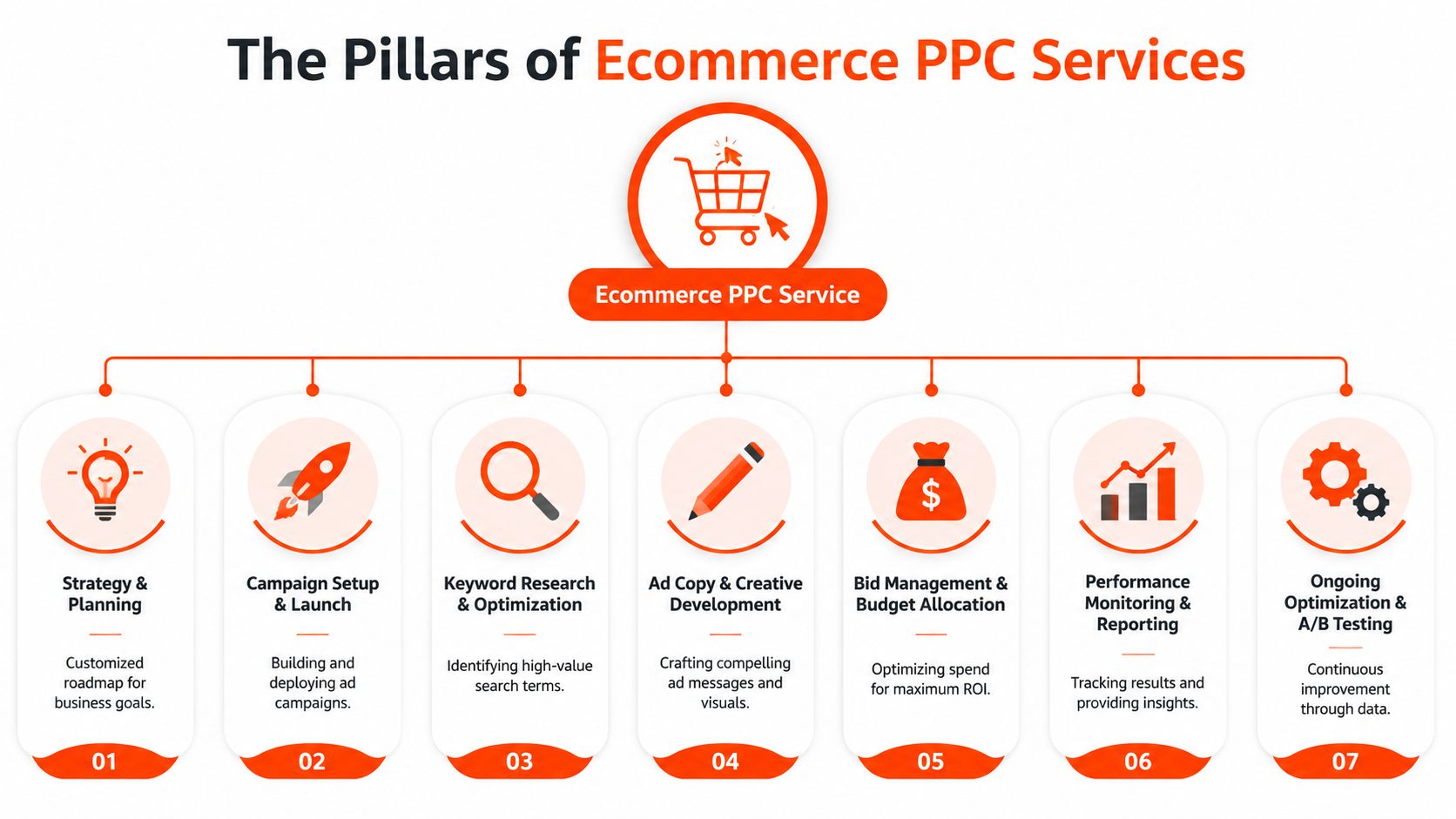
A proper PPC service isn't one task. It's a stack of connected disciplines. The easiest way to think about it is like building and running a performance car. Strategy is the design. Campaign setup is the build. Tracking is the dashboard. Optimisation is the pit crew. Reporting tells you whether the whole machine is winning.
Strategy and planning
Before any campaign goes live, the agency should understand what the business is trying to achieve. That sounds obvious, but many accounts are still built backwards from platform defaults rather than commercial priorities.
Good strategy work usually covers:
- Product priorities: Which ranges have the strongest margins, repeat purchase potential, or stock depth.
- Demand mapping: Where buyers search by brand, category, problem, or competitor.
- Offer alignment: Whether pricing, delivery, bundles, or promotions support paid acquisition.
- Channel role: Which platform should capture demand, generate it, or retarget it.
If an agency jumps straight into launch without clarifying these points, you're not buying strategy. You're buying administration.
Campaign build and creative setup
This is the visible part of the work. Search campaigns, Shopping structures, Performance Max builds, remarketing audiences, ad copy, creative variations, exclusions, naming conventions, and account hygiene all sit here.
The difference between a rushed setup and a strong one usually shows up later in wasted spend. Poor structure makes it harder to see what's working. Weak ad copy lowers click quality. Messy campaign grouping hides product-level problems.
Feed management is not optional
For ecommerce, the product feed is the technical foundation. Google Merchant Center depends on a structured feed and accurate business information. Shopping performance is closely tied to high-quality images, precise titles, and accurate product data, and feed issues can cause disapprovals or weak relevance, which then hurts impression share and limits access to high-intent clicks, as outlined in American Eagle's overview of ecommerce PPC.
Many underperforming accounts fail when critical underlying factors are overlooked. The agency may talk about bidding and automation, but if titles are vague, images are weak, or inventory and pricing aren't synced properly, the campaigns are built on bad inputs.
Your feed isn't admin. It's the product catalogue the ad platform uses to decide whether your items deserve to appear.
Tracking and analytics
No serious ecommerce PPC service should operate without dependable measurement. That includes purchase tracking, revenue attribution, product-level visibility, and clean integration between ad platforms and analytics.
What matters here isn't only whether tracking exists. It's whether the setup supports decisions. Can you separate branded from non-branded demand? Can you see category performance clearly? Can you identify whether a product attracts clicks but rarely converts?
Ongoing optimisation and reporting
This is the part businesses often underestimate. Launching is easy. Improvement is the work.
A good service reviews:
- Search terms and query quality
- Budget distribution across products and campaigns
- Feed health and Merchant Center issues
- Ad copy and creative fatigue
- Audience quality in remarketing and prospecting
- Landing page mismatch or friction
Reporting should then translate platform data into business language. Not “CTR went up.” More like: this category is spending efficiently, this campaign is overclaiming branded demand, these products need feed work before further scale.
Choosing the Right Advertising Platforms for Your Products
Platform choice shouldn't start with hype. It should start with buying behaviour. Where does intent appear first, and what kind of ad experience helps that buyer move forward?
For most Australian ecommerce brands, the answer begins with Google. The ACCC said Google held about 94% of general search services in Australia in 2019, which explains why most ecommerce PPC services in Australia centre on Google Search, Google Shopping, and remarketing. Broader PPC benchmarks also note that businesses often see around $2 in revenue for every $1 spent on Google Ads, commonly framed as 200% ROI, as summarised in HigherVisibility's ecommerce PPC guide.
Start with Google when demand already exists
If people already know what they want, Google is usually the first priority.
Google Shopping is strong for product-led intent. Buyers see image, price, retailer, and product detail before they click. That pre-qualifies traffic better than many other formats.
Google Search is useful when queries are broader, more problem-led, or brand-sensitive. It also gives you tighter control over messaging for branded, category, and competitor terms.
If you sell physical products in Australia and want a practical overview of campaign structure, product feeds, and setup realities, this guide to Google Shopping in Australia is worth reviewing before you shortlist agencies.
Use Meta to create and recover demand
Meta plays a different role. It's usually less about harvesting explicit search intent and more about generating interest, supporting launches, and bringing back visitors who didn't buy on the first visit.
That makes it useful for:
- Visual products: Fashion, homewares, beauty, gifting, lifestyle accessories
- New customer acquisition: Especially when brand awareness still needs work
- Retargeting: Cart viewers, product viewers, and previous site visitors
- Offer-led campaigns: Bundles, promotions, seasonal pushes
The mistake is treating Google and Meta as interchangeable. They're not. Google captures existing intent. Meta often helps create or revive it.
Marketplace ads need their own strategy
If you sell through Amazon as well as your own site, don't let an agency treat that as a side note. Marketplace PPC has different economics, search behaviour, and content requirements. If your wholesale or trade catalogue also needs work, this piece on optimizing Amazon for B2B sellers gives useful context on how product discovery and buyer expectations differ in a marketplace environment.
Pick platforms by job, not by trend. Search captures demand. Social shapes demand. Remarketing recovers demand.
The strongest ecommerce PPC services don't push every client onto every platform. They choose the mix that fits the product, margin profile, and stage of growth.
Measuring Success What KPIs Actually Matter for Ecommerce
Clicks are easy to report. Impressions are easy to inflate. Even CTR can look healthy while the account underdelivers commercially.
For ecommerce, the useful metrics are the ones that help you decide where to keep spending, where to pull back, and whether paid traffic is bringing in profitable customers.
The KPIs that deserve attention
At a working level, most retailers should watch a short set of metrics closely:
- ROAS: Revenue returned relative to ad spend
- CPA: What it costs to acquire a sale or customer
- Conversion rate: How efficiently traffic turns into purchases
- Revenue by campaign or category: Which parts of the account drive sales
- Margin context: Whether reported performance still works after product economics
If you want a clearer refresher on how return on ad spend is calculated and where it can mislead, this explanation of what ROAS means in practice is useful.
There's also tactical value in reducing waste at the click level. If you're reviewing cost control, this resource on strategies to lower CPC is a helpful companion to campaign-level optimisation.
Why surface metrics can fool you
A store can show strong ROAS and still have a weak acquisition strategy. That happens when campaigns mostly harvest branded searches, repeat buyers, or retargeting traffic that was already likely to convert.
This is why the more serious question is incrementality. Many agencies still focus on ROAS without addressing whether campaigns are creating new demand or merely taking credit for existing demand. A better question is, “What share of sales would disappear if this PPC spend stopped?” That framing, highlighted in OuterBox's discussion of ecommerce PPC, gets much closer to real value.
A high ROAS doesn't automatically mean your agency is growing the business. It may just mean the platform is claiming easy sales.
What better measurement looks like
You don't need perfect attribution to think clearly. You need a disciplined view.
Ask your agency to separate performance by traffic type and campaign role. Branded search shouldn't be lumped in with non-branded prospecting. Retargeting shouldn't be used to make prospecting look stronger than it is. Product-level analysis matters too, because some items carry acquisition better than others.
An ecommerce account gets more useful when reporting answers commercial questions such as:
- Which campaigns bring in net-new customers?
- Which products can absorb more budget?
- Where are we paying for demand we already own?
- Which campaigns support revenue, but not incrementally enough to justify scale?
That's the level where PPC stops being a dashboard exercise and becomes a management tool.
Understanding Pricing Models for PPC Management
Pricing tells you a lot about how an agency thinks. It also tells you where incentives may drift away from your commercial goals.
No model is perfect. The right one depends on your ad spend, the complexity of the catalogue, how much strategic input you need, and how closely you want fees tied to performance.
The main pricing approaches
Some agencies charge a percentage of ad spend. That's common because it scales with account size and is simple to understand. The upside is that management effort often does rise as spend, product range, and platform mix increase. The downside is obvious. If the fee rises every time budget rises, the agency has a built-in incentive to push spend upward.
A fixed monthly retainer gives you cost predictability. This suits businesses that want stable forecasting and a defined scope of work. The risk is that either side can outgrow the agreement. A large, complex account may need more attention than the retainer supports, while a simple account may end up overpaying for light management.
A performance-based fee sounds attractive because it appears aligned with outcomes. In practice, it can get messy. Performance depends on factors outside the ad account, including pricing, stock availability, conversion rate, and repeat purchase behaviour. Unless the model is tightly defined, it can create arguments about what should count as agency-driven success.
For a more grounded look at the trade-offs, this guide to PPC pricing models is a useful reference when reviewing proposals.
PPC Agency Pricing Models Compared
| Pricing Model | How It Works | Best For | Potential Downside |
|---|---|---|---|
| Percentage of ad spend | Agency fee rises or falls with monthly media spend | Growing brands increasing budgets across multiple campaigns | Encourages spend growth even when efficiency should come first |
| Fixed monthly retainer | Set monthly management fee for an agreed scope | Businesses wanting budget certainty and simpler forecasting | Scope can become vague or misaligned over time |
| Performance-based fee | Fee linked to agreed outcomes such as revenue or acquisition targets | Mature businesses with strong tracking and clear definitions | Attribution disputes and difficult incentive design |
What to ask before signing
The proposal should answer basic commercial questions without any dancing around them.
- What is included: Feed work, creative refreshes, reporting, tracking support, landing page input, and strategy reviews.
- What is excluded: Extra creative production, analytics fixes, platform migrations, or one-off audits.
- Who owns the account: You should retain access to ad accounts, Merchant Center, and historical data.
- How scope changes: If spend, catalogue size, or platform mix grows, the contract should explain what happens.
A clean fee structure doesn't guarantee good work, but vague pricing often predicts vague delivery.
How to Choose an Agency and Audit Your PPC Performance
You review last month's ad spend, see sales coming through, and still can't tell whether PPC is creating new revenue or just claiming credit for demand that would have happened anyway. That is the point where choosing an agency becomes a commercial decision, not a marketing admin task.
A good ecommerce PPC partner should make your account easier to understand, not harder. They should be able to explain where growth can come from, what is limiting performance now, and which fixes are likely to change profit, not just dashboard metrics.
Start with an audit before you take a pitch
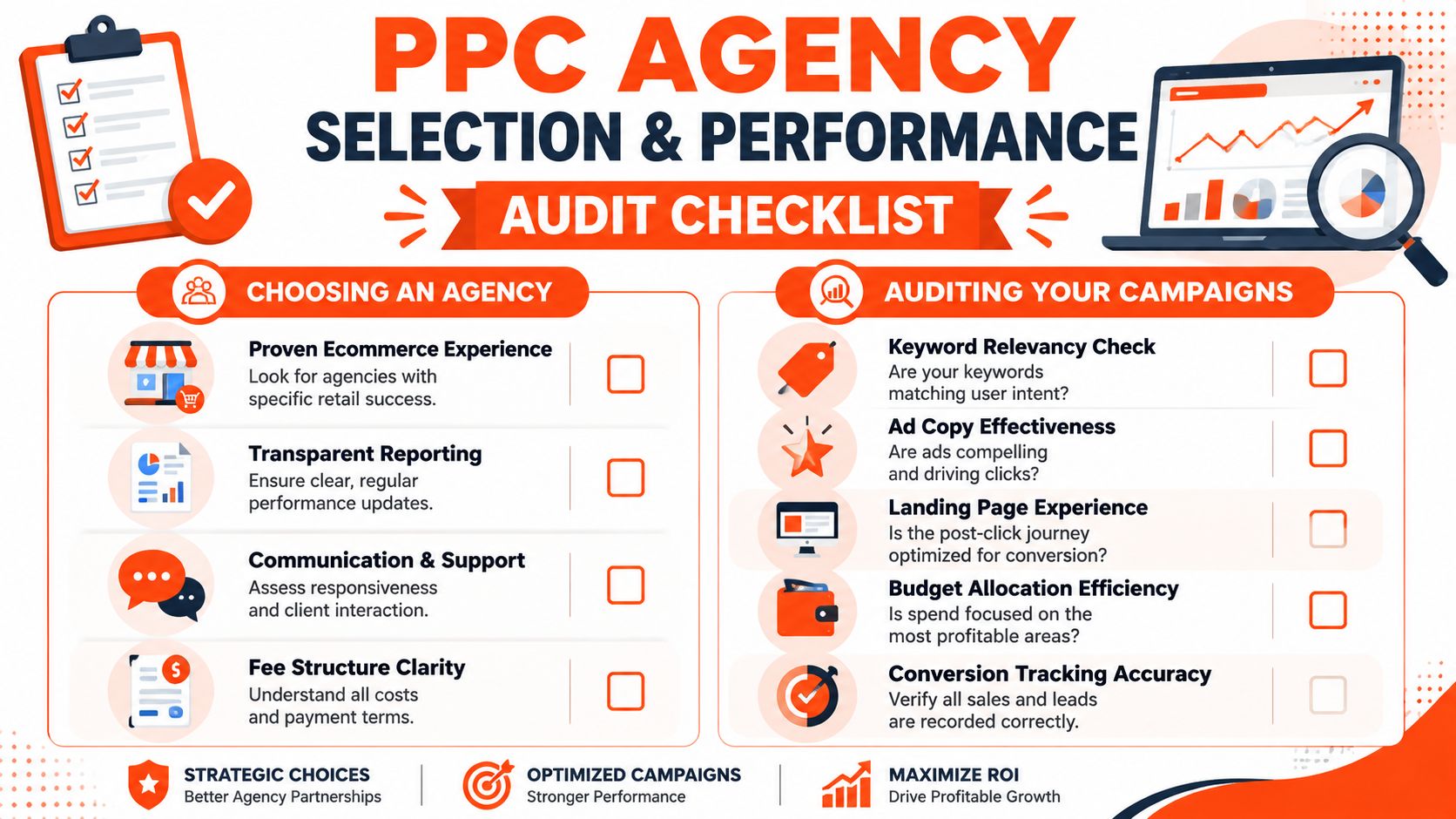
Before you compare agencies, pressure-test your current setup. If no one can give you clean answers on account structure, tracking, and product economics, you are not evaluating providers from a strong position.
Check these areas first:
- Feed quality: Product titles, descriptions, images, GTINs, and category data should reflect how shoppers search.
- Merchant Center health: Disapprovals, warnings, and suppressed products limit reach.
- Campaign visibility: Branded search, non-branded search, Shopping, Performance Max, remarketing, and paid social should be separated clearly enough to judge intent and contribution.
- Budget allocation: Spend should follow margin, stock levels, seasonality, and category priorities. Not just top-line revenue.
- Tracking accuracy: Platform-reported sales should line up closely enough with your ecommerce platform and finance view to support decisions.
- New customer visibility: You should know which campaigns are generating acquisition versus harvesting existing demand.
If several of those points are unclear, that is already an audit finding.
Questions that reveal how an agency actually works
Sales teams can describe features. Strong operators can explain trade-offs.
Ask questions that force detail:
- How would you improve Shopping and Performance Max results for this catalogue? Look for answers about feed structure, title logic, custom labels, product grouping, exclusions, and Merchant Center diagnostics.
- How do you separate brand capture from genuine incremental growth? A serious answer should cover search query analysis, geo or audience testing where possible, holdout logic, and caution around platform attribution.
- How do you handle privacy-related data loss? They should be comfortable discussing consent mode, enhanced conversions, first-party data capture, server-side tagging, and the limits of each.
- What happens before you increase budgets? Good agencies look for stable tracking, efficient query coverage, conversion quality, stock reliability, and evidence that more spend will produce profitable volume.
- How do you report to management? You want commercial reporting tied to revenue, gross margin, customer mix, and trend direction. Not a slide deck full of channel metrics without context.
- Who is doing the work day to day? Strategy sold by a senior person and execution handed to a junior coordinator is a common failure pattern.
One question matters more than it used to. How do they maintain decision quality when attribution gets weaker? A capable team should explain how they use first-party data, server-side tracking, and controlled testing to reduce overstatement and make better budget calls, as noted in Diginius' discussion of ecommerce PPC and measurement.
Here's a useful explainer on the broader thinking behind account evaluation and agency standards:
Red flags and green lights
The best agencies are usually plain-spoken. They do not hide behind platform jargon or automated reporting.
Red flags include:
- Vague audit findings: They talk about “optimisation opportunities” without showing where money is being wasted or blocked.
- Platform-first recommendations: They push channels or campaign types before understanding your margin profile, repeat rate, and stock position.
- Overconfidence in ROAS: They treat platform-reported return as the final truth, even when branded demand, remarketing, and view-through attribution are inflating results.
- Weak account ownership terms: You lose access to ad accounts, historical data, audiences, or creative assets.
- No testing discipline: They make frequent changes but cannot explain what was tested, why it mattered, or what was learned.
Green lights look different:
- Clear diagnosis: They can show what is broken, what is underused, and what should stay untouched for now.
- Commercial judgement: They talk about contribution to profit, customer acquisition, and scale limits.
- Measurement maturity: They acknowledge reporting gaps and still offer a practical plan for better decision-making.
- Channel-specific skill: They understand that Google Shopping, Meta prospecting, and Amazon ads require different structures and expectations.
- Operational clarity: You know who owns feed fixes, tracking, creative requests, reporting cadence, and approvals.
If Amazon sits alongside your DTC store or marketplace mix, reviewing outside perspectives on scalable Amazon growth strategies can help you judge whether an agency understands channel-specific execution rather than treating all PPC as one interchangeable service.
A final test is simple. Ask the agency what they would audit in the first two weeks, what they expect to find, and which issues they would fix before trying to scale. The quality of that answer usually tells you more than the case studies.
Your First 90 Days What to Expect from Your PPC Partner
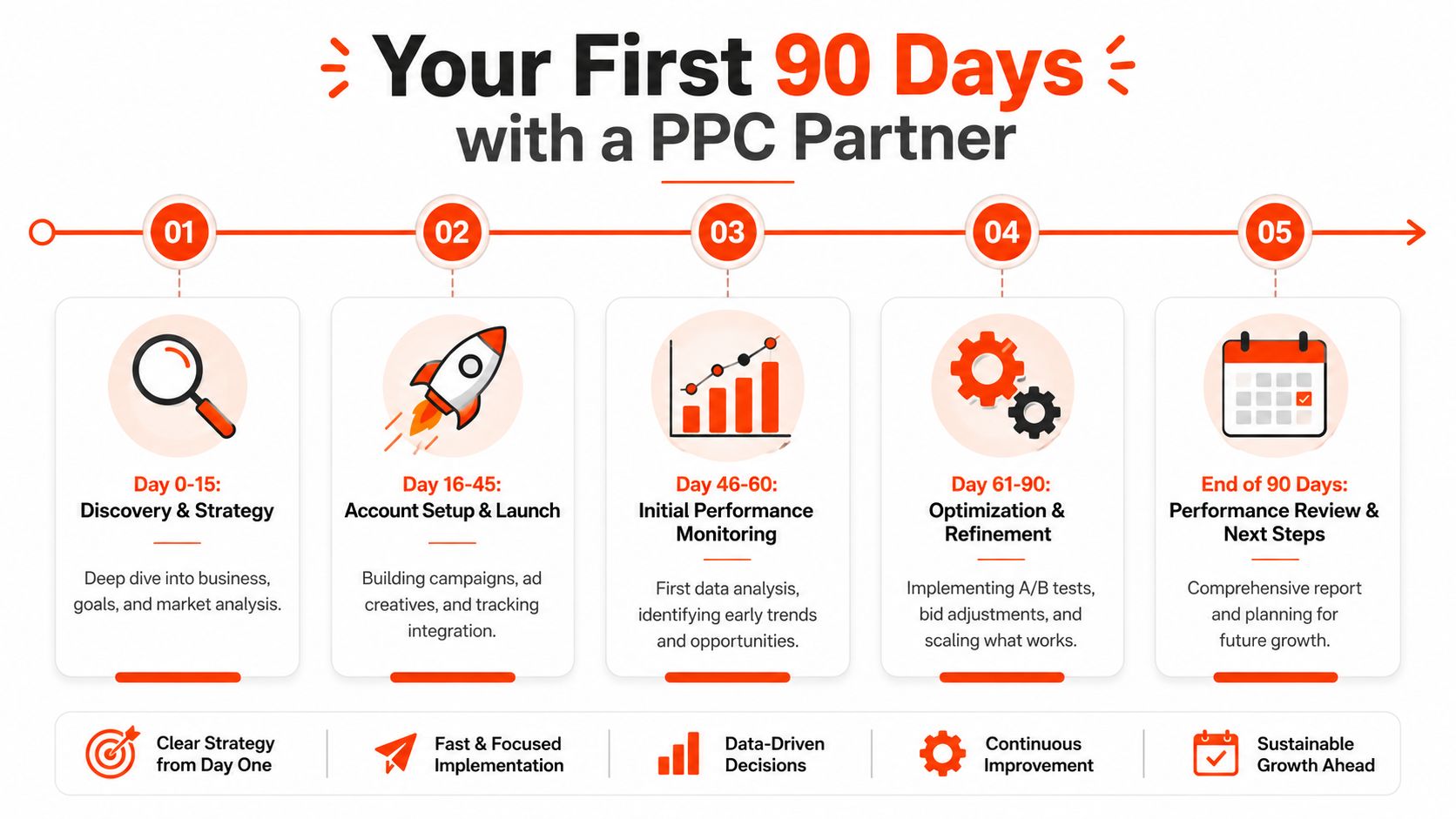
The first three months should feel organised, not mysterious. You don't need instant perfection. You do need a clear sequence of work, visible progress, and evidence that the agency is learning from live data rather than just letting automation run.
Days 1 to 30
The early phase is about foundations. The agency should audit the account or build one cleanly, confirm tracking, review the feed, check Merchant Center status, and align campaigns to products and goals.
This period often includes fixing inherited problems. Broken conversion actions, poor campaign naming, weak product titles, messy negatives, and unclear budget logic are common. If the partner is serious, they won't rush past these basics.
Days 31 to 60
Now the account starts producing enough signal to act on. The team should review search terms, tighten product priorities, adjust bids and budgets, refine creative, and identify where traffic quality doesn't match intent.
You should also expect sharper conversations by now. Which categories are responding. Which campaigns are overclaiming credit. Which products deserve more exposure. Which parts of the account need feed improvement before more spend goes in.
Days 61 to 90
With a competent PPC partner, the process of separating learning from scaling commences. Better-performing campaigns can be expanded, weaker ones can be cut back, and testing becomes more deliberate.
By the end of this period, you should have three things: a cleaner account structure, more trustworthy performance data, and a clear view of the next growth decisions. That's what a useful PPC partnership looks like in practice. Not magic. Not vague momentum. A better system for buying revenue.
If you want a PPC partner that works with Australian businesses on Google, Meta, Shopping, and tracking-led campaign management, Click Click Bang Bang is one option to review. Use the criteria in this guide, ask hard questions, and make sure the agency you choose can explain how it will improve feed quality, measurement, and commercial decision-making before it asks for more budget.
Read NeXt
Or Read Our Latest
- Manual vs Automated Bidding for PPC Success
- Conversion Tracking Setup: A Complete AU Guide
- Instagram Advertising Australia: Complete 2026 Guide
- Pay Per Click: A Beginner’s Guide for Australian Marketers
- Display Advertising on Google: The Complete Australian Guide
- Stakeholder Communication Plan How to Build One That Works
Click. CLick. Subscribe.
Get our best PPC insights, industry updates, and power moves delivered straight to your inbox. No fluff, just high-caliber strategies that actually work.
Don’t Leave Just Yet
Try Us For 30-Days,
Risk Free!!
We guarantee that you’ll love our work within the first 30 days, if not you’ll get your money back.
What have you got to lose?