

SaaS Customer Acquisition: Strategies for Growth in 2026
Last Updated

You've got a product that solves a real problem. The demo lands well. Trial users say the platform makes sense. But the pipeline still feels patchy. One month paid search drives signups, the next month costs jump. LinkedIn brings in leads, but sales says too many are curious rather than ready. SEO traffic grows, yet revenue doesn't move at the same pace.
That's the normal state of SaaS customer acquisition in Australia. The problem usually isn't a lack of channels. It's a lack of fit between the market, the message, the funnel, and the economics behind the spend.
Generic SaaS advice rarely helps much here. Most of it assumes deep funding, huge category demand, or a US-style market where large TAM narratives can cover sloppy acquisition. Australian SaaS teams don't get that luxury. You need channels that reach the right buyers, offers that reduce friction, and measurement that shows which spend is creating revenue rather than just activity.
The SaaS Growth Paradox in Australia
Australian SaaS founders often hit the same wall. The product is solid, the positioning seems clear, and there's enough market feedback to suggest demand is real. Yet acquiring customers still feels harder than it should, especially once the first wave of referrals and founder-led selling starts to taper off.
Part of the issue is structural. The Australian market is dominated by small businesses. The Australian Bureau of Statistics reported that 98% of Australian businesses are SMEs, which means most SaaS buyers are price-sensitive, time-poor, and less likely to tolerate long sales cycles. That changes everything about channel choice, offer design, and how quickly your product has to prove value.
Why standard SaaS playbooks break here
A lot of imported advice assumes you can spend heavily to “build pipeline”, nurture leads for months, and absorb waste while waiting for the model to mature. That can work in a large enterprise motion with high contract values and patient capital. It breaks fast when your market is full of operators, office managers, founders, and small teams who want a useful answer now.
In Australia, buyers often do a shorter evaluation, involve fewer people, and ask a blunt question early. Will this save time, reduce admin, or help us make more money?
If your acquisition relies on long forms, vague messaging, or a sales process that asks too much too early, those buyers leave.
The channel isn't the strategy. The strategy is how you make buying feel lower risk and easier to justify.
What efficient acquisition actually looks like
For most local SaaS firms, efficient acquisition has a few common traits:
- Tight ICP definition: You're not targeting “small businesses”. You're targeting a type of buyer with a repeatable pain point.
- Clear commercial messaging: The site explains what the product does, who it's for, and why it's worth changing tools.
- Low-friction entry points: Demo, trial, pricing, or consultation paths match the complexity of the product.
- Closed-loop measurement: Marketing can see which source produced revenue, not just leads.
That's the paradox. Australian SaaS teams need growth, but they can't afford broad, noisy acquisition. They need a model that's selective enough to preserve CAC discipline and flexible enough to scale once they find traction.
Building Your Customer Acquisition Blueprint
Most acquisition problems show up in the channel data. Most of them start much earlier.
If your ICP is fuzzy, your offers will be generic. If your value proposition is soft, paid traffic won't convert. If your growth motion doesn't match the product, you'll create friction before the buyer ever gets to value.

Start with a commercially useful ICP
A useful ICP doesn't stop at industry and company size. It identifies the conditions that make a prospect likely to buy and likely to stick.
That usually means defining:
- Firmographic fit: Team size, business model, sector, and level of operational complexity.
- Trigger events: Hiring growth, system changes, reporting pressure, compliance needs, or a broken manual process.
- Buying friction: Budget sensitivity, internal approvals, technical hesitation, or migration anxiety.
- Success criteria: What the buyer needs to believe before they'll switch.
A strong ICP gives your acquisition team a filter. It tells Google Ads what search intent matters. It tells LinkedIn what job titles to prioritise. It tells your landing pages which pains deserve the headline.
Tighten the value proposition
Founders usually know the product too well. That creates messaging that describes features accurately but fails to create urgency.
A practical value proposition answers four things in plain language:
| Question | What your page should make clear |
|---|---|
| What is it? | The category or function of the product |
| Who is it for? | The buyer or team it serves |
| What problem does it remove? | The operational or commercial pain |
| Why choose this over alternatives? | The differentiator that actually matters |
If your homepage needs a sales call to become understandable, it's underperforming.
Practical rule: If a prospect can't tell within a few seconds whether the product is relevant to them, your media spend is working harder than it should.
Choose the right growth motion
Not every SaaS product should use the same acquisition path. The wrong motion creates downstream inefficiency.
A product-led motion works when the product can demonstrate value quickly, the user can self-educate, and the buying risk is low enough to let someone start without talking to sales. This usually needs tight onboarding, simple setup, and a clear in-product “aha”.
A sales-led motion makes more sense when adoption affects multiple stakeholders, implementation is heavier, or the buyer needs reassurance before committing. In that case, the acquisition funnel should qualify intent early and help sales focus on fit rather than volume.
Some teams sit in the middle. They use self-serve trials for smaller accounts and a demo-led path for larger ones. That can work well, but only if the paths are clearly separated and measured independently.
Build the blueprint before you buy traffic
Before launching campaigns, get these fundamentals in place:
- One ICP per campaign set: Don't force multiple audiences into one message.
- One core promise per landing page: Mixing outcomes weakens relevance.
- One primary conversion goal per funnel: Trial, demo, or consultation. Pick one main action.
- One clear handoff into product or sales: No dead ends, no “someone will follow up” ambiguity.
When those pieces are aligned, channels become amplifiers. Without them, channels just expose the weaknesses faster.
Choosing Your High-Impact Acquisition Channels
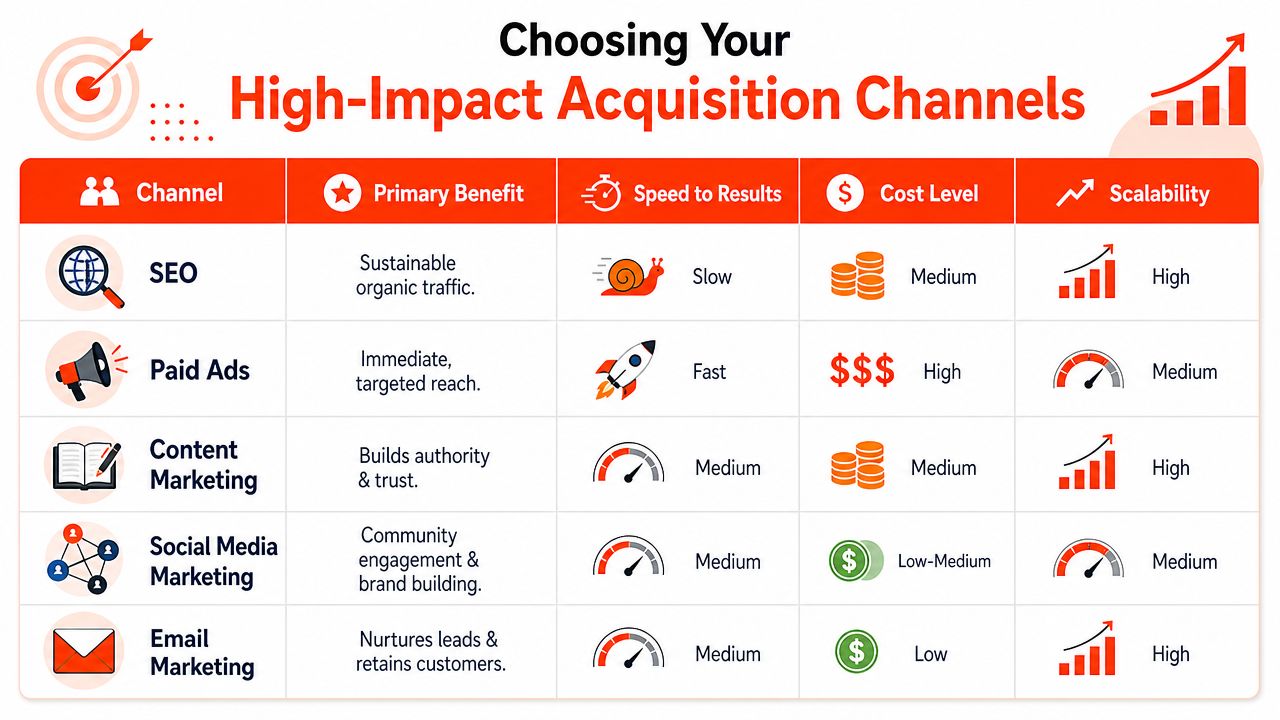
The right channel mix depends on deal size, buying intent, sales friction, and how fast you need feedback. Too many SaaS teams choose channels by trend. A better approach is to judge each one by cost pressure, speed, scalability, and targeting control.
SEO and content for compounding demand
SEO still matters, but the job has changed. It's no longer enough to publish broad articles and wait for rankings to do the heavy lifting. Discovery is shifting into AI-assisted experiences, and that changes how content earns attention.
Google's Australian consumer study found that 55% of Australians now use AI-powered search features at least weekly, according to this Maxio summary of customer acquisition strategy changes. That matters because buyers may get answers before they ever click through to a website.
For SaaS, the content most likely to help acquisition now tends to be:
- Comparison pages: Product vs product, internal build vs SaaS, spreadsheet vs platform
- Use-case pages: Role-specific and problem-specific pages tied to buyer intent
- Category education with commercial depth: Not generic thought leadership, but practical content linked to evaluation
- Trust-rich pages: Case examples, integration details, pricing logic, implementation guidance
SEO is slower than paid search. But when it works, it reduces your dependence on rented attention and gives sales better-informed leads.
Google Ads for high-intent capture
Google Ads is usually the fastest way to test intent. It works best when buyers already know the problem they need to solve and are actively searching for a solution.
This is often a strong fit for:
- SMB SaaS with urgent pain points
- Products replacing spreadsheets or manual workflows
- Tools with clear category language
- Brands validating messaging and offer-market fit
It's a weak fit when the category is new, the pain is latent, or the search terms are too broad to separate good-fit buyers from everyone else.
The biggest mistake here is treating clicks as proof of opportunity. Search demand can look strong while commercial fit is weak. You need tight keyword grouping, ad-to-page relevance, and exclusion discipline to keep budget focused.
LinkedIn for higher-value B2B deals
LinkedIn usually works better when you know exactly who needs to see the offer and the sales value justifies a more expensive click. It's less about harvesting existing demand and more about reaching specific functions, seniority levels, or account types before they search.
This tends to suit:
| Best fit | Why it works |
|---|---|
| Mid-market B2B SaaS | You can target role and company characteristics directly |
| Complex buying cycles | Messaging can educate before intent peaks |
| Higher ACV products | More room to absorb premium media costs |
| Sales-assisted funnels | Strong handoff into demo or consultative follow-up |
For teams exploring this route, LinkedIn ad management services are one option when internal resources are thin and campaign structure, audience control, and CRM feedback loops need more rigour.
Paid social doesn't fix weak positioning. It exposes it to a more expensive audience.
Content and email for consideration-heavy journeys
Content marketing and email sit in a different category. They rarely create immediate pipeline on their own, but they can improve every other channel by shortening trust-building time.
This matters most when buyers need education before they commit. Think workflow change, finance tooling, reporting platforms, operations software, or products that require internal buy-in.
Good nurture content does a few things well:
- It answers objections early
- It segments by role or use case
- It connects product value to a real business outcome
- It gives sales warmer, better-contextualised conversations
A practical way to choose
If your product has obvious, active demand and a shorter path to purchase, start with search. If your deal size is higher and the audience is narrow, test LinkedIn with tight offer positioning. If your market needs more education, build content and nurture before trying to force scale.
Most strong SaaS customer acquisition systems don't rely on one channel. They combine intent capture, demand creation, and remarketing in a way that fits the sales motion rather than fighting it.
Mastering the Economics of SaaS Growth
A familiar SaaS scenario in Australia looks like this. Paid search is producing demos. LinkedIn is generating lead volume. Sales is busy. Yet cash gets tighter each quarter because too much spend sits in-market too long before it returns, and too many new customers never expand enough to justify the acquisition cost.
That is the core economics problem. Channel activity can look healthy while growth quality gets worse.
For Australian SaaS businesses, especially those selling to SMEs, the margin for error is smaller. Deal sizes are often lower than in the US. Sales cycles can still drag when multiple stakeholders get involved. AI-first search is also changing how buyers discover and compare products, which puts more pressure on every click to convert into revenue, not just traffic.
The useful way to assess acquisition is by cash efficiency and customer quality. A channel that delivers a low headline CAC can still be a poor investment if those customers churn early, require heavy support, or never move beyond the entry plan. A more expensive source can be the better growth engine if payback is faster and retention is stronger.
Early benchmarks help set expectations. According to Oliver Munro's SaaS marketing benchmark roundup, the median SaaS company now spends $2.00 to acquire $1.00 of new ARR, and the same roundup cites an average SaaS CAC of $702. Those numbers are not planning targets for every Australian SaaS company, but they are a clear warning against scaling on lead volume alone.
What to track instead of vanity efficiency
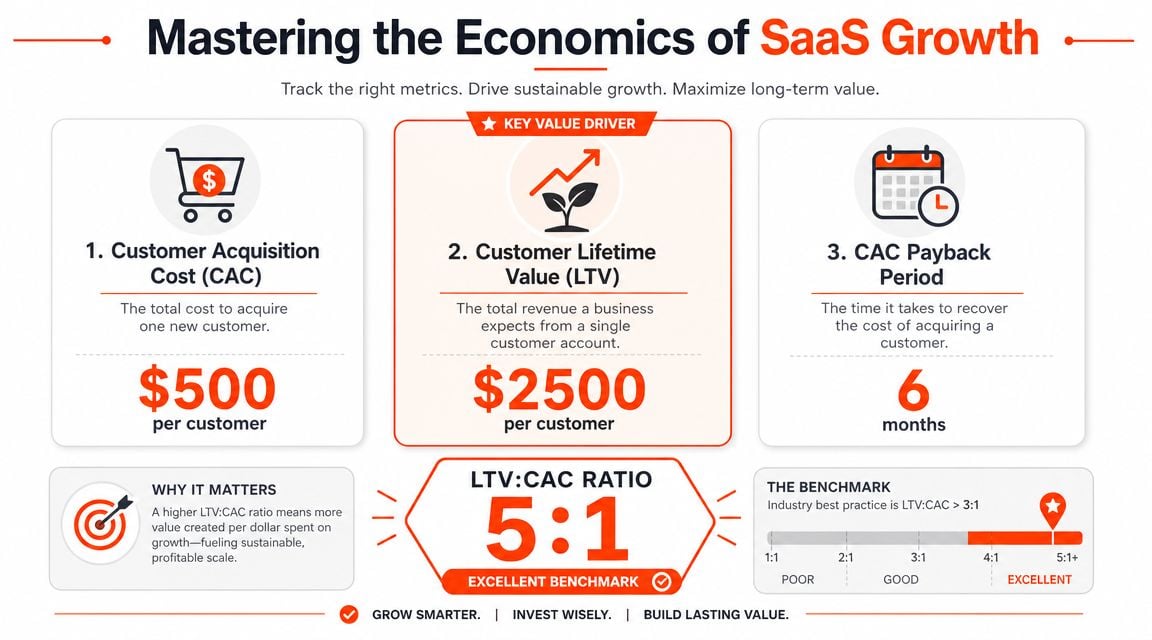
Basic CAC is only a starting point. Sales and marketing spend divided by new customers gives a clean number, but it does not tell you whether the business can keep funding growth.
Three metrics matter more in budget decisions:
- CAC by channel and segment: Shows where acquisition is efficient, rather than hiding weak sources inside a blended average.
- LTV/CAC ratio: Shows whether the revenue profile justifies the upfront cost.
- CAC payback period: Shows how long cash is tied up before acquisition spend is recovered.
These numbers need to be reviewed by channel, customer type, and product line. An Australian SaaS company selling to tradies, professional services firms, and mid-market operations teams should not expect one CAC profile across the board. The buying behaviour, retention curve, and support burden are usually different.
Closed-won revenue data is the line between useful reporting and dashboard theatre. If CRM attribution stops at lead source, budget decisions get distorted fast. Search can look expensive at the click level but produce higher-intent buyers. Paid social can look efficient on CPL while sending sales a pipeline full of weak-fit accounts.
How to use these numbers in practice
A disciplined review usually starts with four questions:
- Which channels bring in customers who retain for 12 months or more?
- Which campaigns create pipeline that stalls after demo or trial?
- Which segments convert well but never expand beyond the base plan?
- Which sources recover spend fast enough to keep CAC under control as budgets rise?
Those questions change how teams allocate budget. The goal is not the cheapest front-end conversion. The goal is repeatable acquisition that returns cash on an acceptable timeline and holds up as spend increases.
A simple operating view looks like this:
| Metric | What it tells you | Common mistake |
|---|---|---|
| CAC | Cost to win a customer | Judging performance on blended averages |
| LTV/CAC | Whether revenue justifies acquisition cost | Ignoring retention differences by source |
| Payback period | How quickly spend returns through subscription revenue | Backing channels that tie up cash too long |
For teams comparing paid programs across campaigns or products, this cost per user acquisition guide is a useful reference point.
A short explainer helps put these metrics in context:
What disciplined teams do differently
They set CAC guardrails before scaling. They separate trial volume from qualified pipeline. They review payback against actual customer revenue, not forecast expansion that may never arrive.
They also make trade-offs early. In Australia, that often means accepting slower top-line volume from a tighter channel mix if it produces better retention and shorter payback. It can also mean reducing spend in channels that look promising in-platform but fail once sales cycle length, onboarding effort, and churn are included.
The teams that grow cleanly are usually the ones willing to cut a channel that flatters the dashboard but weakens the business.
Cheap acquisition only matters when the customer stays long enough, pays enough, and creates enough margin to justify the spend.
Optimising Your Funnel from Click to Customer
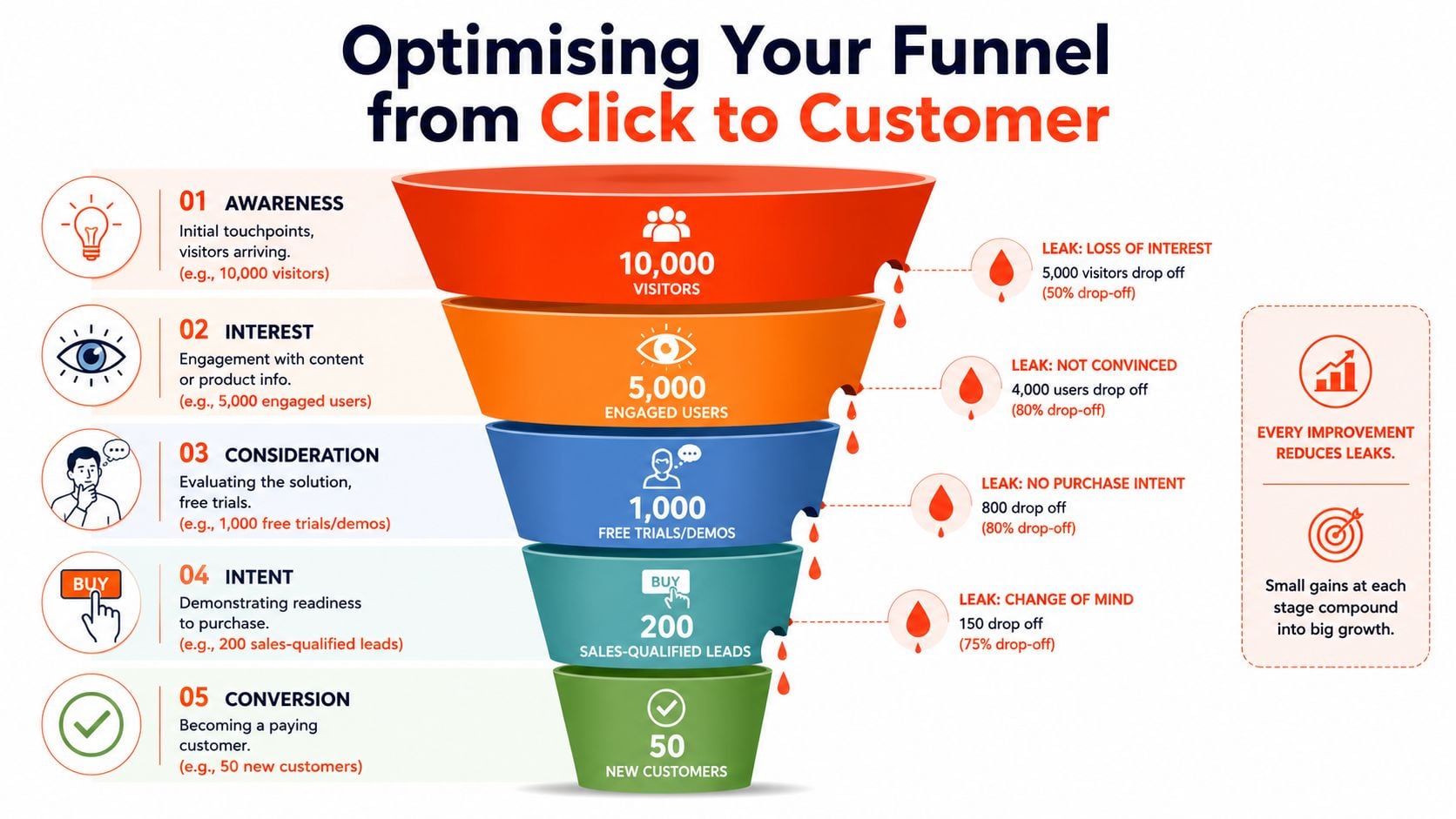
Most SaaS funnels don't fail at one dramatic point. They leak at every step. Slightly weak ad relevance. Slightly vague landing page copy. Slightly too much friction in the form. Slightly confusing onboarding. By the time that compounds through the funnel, CAC looks worse and nobody can agree why.
That's the leaky bucket problem. You keep pouring spend in, but too little revenue comes out.
Fix the post-click experience first
A landing page has one commercial job. Match the intent behind the click and make the next action feel obvious.
That usually means:
- Clear message match: The page should reflect the promise in the ad or search query.
- Specific buyer language: Speak to the role, problem, or workflow the visitor cares about.
- Focused CTA structure: Don't ask a cold visitor to choose between six actions.
- Trust signals near decision points: Product screenshots, integration context, customer proof, and onboarding clarity matter.
If you need a reference point for structure and UX decisions, this landing page guide covers the essentials in a practical way.
Pricing and packaging shape conversion more than teams admit
Many acquisition teams treat pricing as a product issue. It's an acquisition issue too.
Confusing tiers, hidden feature limits, or unclear implementation requirements create hesitation at the exact point where intent should convert. The buyer starts asking questions your page doesn't answer. Do I need the sales team to get a real quote? Is setup painful? Will I outgrow the entry plan immediately?
The best pricing pages reduce cognitive load. They frame the commercial choice in a way that matches the buyer's context.
For SME-focused products, clarity usually beats cleverness. For higher-value B2B products, guided pathways often outperform forcing everyone into a self-serve pricing grid.
Onboarding is part of acquisition
For trial-led or freemium SaaS, acquisition doesn't end at signup. It ends when the user reaches meaningful value and has a reason to continue.
That means the onboarding flow should remove three common blockers:
- Setup anxiety: Show the first step clearly and reduce perceived effort.
- Feature overload: Don't reveal everything at once.
- Delayed value: Move the user toward a useful outcome, not a completed checklist.
A free trial that creates lots of accounts but few active users is not an acquisition win. It's paid leakage.
Field note: If marketing says volume is healthy but revenue isn't moving, look at onboarding before buying more traffic.
Full-funnel tracking is not optional
Attribution gets messy fast in SaaS. Someone clicks a search ad, reads comparison content later, returns through branded search, books a demo, then closes after several sales touches. Last-click reporting won't tell the full story.
That's why Cometly's guide to tracking SaaS customer acquisition is directionally important. The advanced model tracks the funnel from landing pages, pricing pages, signup forms, and thank-you pages through CRM stages such as Lead, MQL, SQL, Opportunity, and Closed Won. It also recommends server-side tracking and conversion sync back to ad platforms so the platforms optimise toward revenue rather than lead volume.
In practice, that changes campaign behaviour. Ad platforms stop chasing cheap form fills and start learning from actual commercial outcomes.
Actionable Acquisition Playbooks for 2026
A Melbourne SaaS team can spend six months copying US playbooks, drive a pile of demos, and still miss target because the channel mix does not match how Australian buyers buy. The fix is usually less about adding tactics and more about choosing the right operating model early.
For 2026, three acquisition playbooks stand out for Australian SaaS companies. Each suits a different sales motion, buyer behaviour, and CAC profile. The mistake is trying to run all three at once before one is working.
The B2B lead engine
This playbook suits SaaS products with higher ACV, a defined buying committee, and a sales process that benefits from demos. Finance platforms, compliance tools, reporting software, and operational systems often fit here.
In Australia, this model works best when targeting is tight and messaging is specific. The available audience is smaller than in the US, so wasted reach gets expensive fast. LinkedIn usually does the job for targeted visibility, retargeting keeps the brand in the consideration set, and paid search captures active demand once the buyer starts evaluating options.
The sequence is straightforward:
- Define the audience tightly: Filter by role, seniority, industry, company size, and exclusions. Broad audiences usually inflate lead volume and lower sales quality.
- Lead with the business problem: Cost pressure, compliance risk, manual work, and operational delays get attention faster than product features.
- Build landing pages by segment: A finance leader, an operations manager, and an IT stakeholder do not need the same proof points.
- Optimise from CRM outcomes: Use pipeline stage, opportunity creation, and closed revenue to refine campaigns, not just form fills.
This model rewards patience and discipline. It breaks when teams optimise for cheap leads instead of qualified pipeline.
The SMB scaler
This is the playbook for SaaS products selling to small and mid-sized businesses with shorter buying cycles and clearer intent. Categories like scheduling, quoting, field service admin, lightweight CRM, and niche business tools often sit here.
Google Ads usually carries the acquisition load first. SEO builds compounding value around commercial pages, use-case content, and comparisons that answer buying questions. In the Australian market, this works well because SME buyers tend to search with a problem in hand and a shorter evaluation window.
A practical setup looks like this:
| Element | What to prioritise |
|---|---|
| Search campaigns | High-intent, problem-aware keywords with clear commercial value |
| Landing pages | Fast load times, clear offer, strong proof, simple CTA |
| SEO content | Category, comparison, and use-case pages that support evaluation |
| Retargeting | Visitors who viewed pricing, features, or key commercial pages |
The trade-off is volume versus intent. Broader keywords can make the account look healthy at the top of the funnel, but they often bring in low-fit traffic that burns budget and drags down CAC efficiency. For Australian SaaS, disciplined keyword filtering matters more than traffic growth screenshots.
The nurture-and-convert model
Some products need more trust before a buyer is ready to act. The problem is real, but the buyer needs internal approval, implementation confidence, or category education before booking a demo or starting a trial.
This playbook uses content, email, and remarketing to move prospects through consideration with more context and better timing.
A strong version usually includes:
- Problem-led content: Pages and assets tied to real buying questions, process issues, and implementation concerns
- Role-based nurture: Different follow-up paths for founders, operators, marketers, finance leads, or technical stakeholders
- Behavioural triggers: Email and remarketing based on viewed pages, downloaded resources, or product actions
- Sales enablement content: Comparison pages, rollout guidance, ROI framing, and objection-handling assets
There is a real trade-off here. More content does not automatically mean more pipeline. Content that attracts the wrong audience, or never helps a buying decision, creates reporting noise instead of revenue. The standard for every asset is simple. Does it help a prospect choose, justify, or progress?
How to decide which playbook fits
Choose based on buying behaviour, not internal preference.
- Short sales cycle and obvious demand: Prioritise search and direct-response execution.
- Higher ACV and narrow ICP: Build around targeted paid social, remarketing, and strong sales feedback loops.
- Longer consideration cycle and multiple stakeholders: Use nurture, educational content, and timed follow-up.
The measurement standard stays the same across all three. Review CAC, payback period, and retention by channel and segment, not only in blended totals. A source that looks efficient on lead cost can still be a poor acquisition channel if those customers churn early or never reach meaningful expansion potential. As noted earlier, that is why CRM-to-source visibility needs to be in place before serious scaling begins.
Building Your Scalable Acquisition Flywheel
One-off tactics create spikes. Systems create growth.
That distinction matters because SaaS customer acquisition rarely gets easier on its own. Competition rises. Paid channels get noisier. Search behaviour shifts. Offers that worked last year start losing traction. Teams that rely on a single winning campaign eventually run into a ceiling.
The better model is a flywheel built on four connected parts. Strategy defines who you want and why they should care. Channels bring the right people into the funnel. Economics tell you whether growth is healthy. Optimisation improves the path from first click to closed revenue.
When those parts are connected, each one strengthens the others. Better ICP work improves paid performance. Better onboarding improves CAC efficiency. Better attribution improves budget decisions. Better content helps both SEO and sales conversations.
That's what sustainable growth looks like in practice:
- Start narrower than feels comfortable
- Measure revenue quality, not just lead volume
- Keep acquisition and product experience closely linked
- Scale proven paths, cut weak ones early
- Review channel performance by segment, not in aggregate
Most Australian SaaS firms don't need more tactics. They need less waste, sharper positioning, and a cleaner operating model for growth.
If a channel can't produce the right customers at a justifiable cost, don't protect it because it once worked. If a message attracts clicks but weak deals, rewrite it. If onboarding reduces conversion after signup, fix that before increasing spend.
That discipline is the advantage. Not hype. Not hacks. Not another growth loop diagram with no commercial reality behind it.
If you need support turning these ideas into an actual acquisition system, Click Click Bang Bang works on PPC and AI-first SEO with a strong focus on tracking, channel discipline, and revenue-focused optimisation for businesses that want clearer performance from digital acquisition.
Read NeXt
Or Read Our Latest
- Data Privacy Compliance: 2026 Guide for Marketers
- Your 2026 Remarketing Campaign Strategy Blueprint
- Customer Lifetime Value: Calculate & Increase It in 2026
- Contextual Targeting Advertising: A Guide for 2026
- Best Seo Agency Australia Guide 2026
- Cross Domain Tracking: A Practical Guide for GA4 in 2026
Click. CLick. Subscribe.
Get our best PPC insights, industry updates, and power moves delivered straight to your inbox. No fluff, just high-caliber strategies that actually work.
Don’t Leave Just Yet
Try Us For 30-Days,
Risk Free!!
We guarantee that you’ll love our work within the first 30 days, if not you’ll get your money back.
What have you got to lose?