

Mastering Social Media Marketing Digital Marketing 2026
Last Updated
You’re probably in one of two situations right now.
Either your team is posting on Instagram, LinkedIn, or Facebook every week and getting polite engagement but weak sales. Or you’ve run paid campaigns, seen traffic come through, and still struggled to tie that spend back to profit with any confidence.
That tension sits at the centre of social media marketing digital marketing in 2026. Social is not a side channel anymore. It is not the intern’s task list, the “brand awareness” bucket, or the place where nice creative goes to live after the essential work happens in Google Ads. Social now sits inside the performance system. It shapes demand, informs search intent, feeds remarketing audiences, and can either strengthen or weaken your broader PPC and SEO results.
The businesses that scale do one thing differently. They stop treating social media as a publishing calendar and start treating it as part of an integrated acquisition engine.
Your Starting Point in Social Media Marketing
A common pattern shows up in audits.
An e-commerce brand posts product shots, runs a few boosted posts, gets some comments, and assumes the platform is working because people seem interested. A B2B firm publishes company updates on LinkedIn, maybe gets a few likes from staff, then concludes social media “doesn’t really generate leads for us”.
Usually, the problem is not the platform. The problem is isolation.
Social media works poorly when it has no connection to landing pages, no alignment with search demand, no conversion tracking, and no role inside the wider funnel. It works much better when it helps you learn what messaging resonates, who engages, which offers deserve budget, and where your paid retargeting should focus.
That matters in Australia because social adoption is already embedded in buyer behaviour. In Australia, social media penetration reached 86.3% of the internet population in early 2025, which is why it has become a foundational channel for businesses targeting buyers on platforms such as Meta and LinkedIn, according to Dreamgrow’s social media marketing statistics.
That number should change how you think about social.
It does not mean every business should pour money into every platform. It means your buyers are there, your competitors are there, and your content, ads, and offers need to work in that environment without losing sight of revenue.
Key takeaway: Social media should not be judged by likes alone. Judge it by what it contributes to pipeline, sales, audience insight, and retargeting strength.
The useful shift is simple. Stop asking, “How do we post more?” Start asking, “How does social support the buyer journey from discovery to conversion?”
Where Social Media Fits in Your Digital Marketing Engine
Think of your marketing as an engine with three interlocking parts.
SEO captures existing intent.
PPC buys speed and precision.
Social media builds familiarity, tests messages, and creates audience signals you can use elsewhere.
If one part is weak, the whole system loses efficiency.
Social media as your audience signal layer
Social tells you what buyers respond to before they search, convert, or book a call.
When a product demo gets saves, when a founder post attracts comments from the right job titles, or when a short-form video drives quality traffic to a category page, you have a signal. That signal is useful well beyond the platform itself.
You can use it to:
- Refine ad angles by turning strong organic hooks into paid creative
- Improve landing page copy when recurring objections show up in comments or direct messages
- Shape content strategy by building SEO articles around themes your audience already engages with
- Segment retargeting pools based on who watched, clicked, visited, or engaged
That is where social starts behaving like infrastructure rather than content for content’s sake.
SEO as the conversion stabiliser
Social can generate interest fast. It is less reliable when your site cannot convert or your organic visibility is weak.
If a user discovers you on Instagram or LinkedIn, they often validate that impression through search. They look for reviews, pricing, service pages, category depth, product details, and evidence that your business is real and competent. SEO supports that validation stage.
A weak website turns strong social attention into wasted spend. A strong website lets social act as the spark.
PPC as the accelerator
PPC gives you control.
Once social tells you which audience or message is worth backing, paid search and paid social can scale it. Search campaigns capture high-intent traffic. Paid social reaches cold audiences with targeted creative. Retargeting follows people who have already shown interest.
The best performance comes from using each channel for what it does well instead of forcing one channel to do everything.
How the engine works in practice
A practical model looks like this:
| Channel | Core job | What it feeds |
|---|---|---|
| Social media | Attention, trust, creative testing, audience insight | PPC audiences, SEO topics, landing page messaging |
| SEO | Intent capture, authority, conversion support | Lower CPA over time, stronger site performance |
| PPC | Immediate reach, precise targeting, controlled scale | Fast testing, lead volume, sales acceleration |
What works and what fails
What works is coordination.
A retailer runs Meta ads to a product collection page, publishes short-form product education on Instagram, and supports that with category and product SEO. A B2B company publishes opinion-led LinkedIn content, runs lead generation ads to senior roles, and backs it with service pages built for commercial search intent.
What fails is fragmentation.
- Social content with no landing page strategy
- Paid campaigns with no retargeting structure
- SEO content that ignores what buyers discuss on social
- Reporting that separates channels so completely that no one can see the buyer journey
Practical rule: If your social team, paid media team, and SEO team cannot explain how their work supports the same conversion path, your engine is leaking budget.
Choosing Your Path Organic Versus Paid Social
Businesses often ask which matters more. Organic social or paid social.
The honest answer is that they solve different problems.
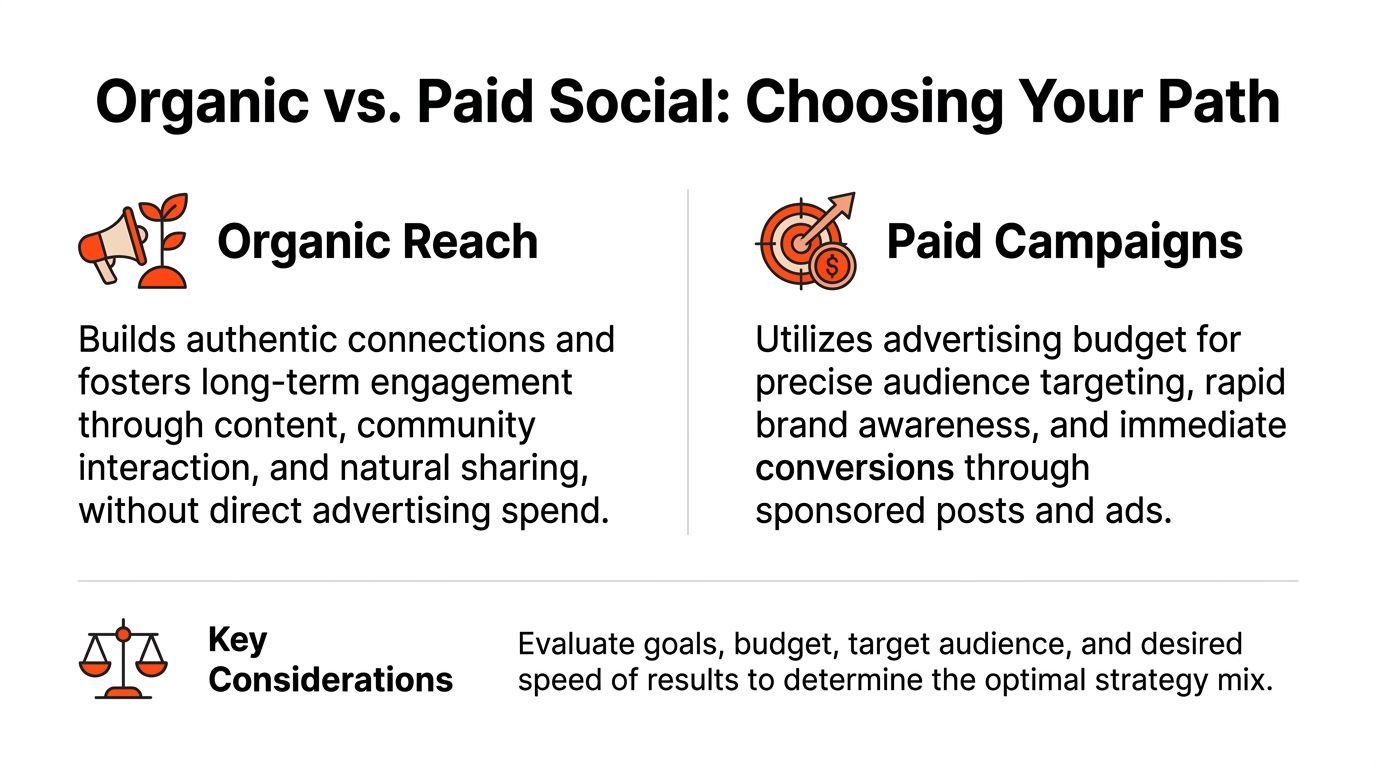
Organic social builds trust over time. Paid social buys targeted reach on demand. One creates the brand environment. The other creates controlled distribution.
Organic social builds the asset
Organic social is your owned voice on rented platforms.
It helps buyers get familiar with your category, your tone, your expertise, and your products before they are ready to buy. It is where you answer objections, show proof, publish useful opinions, and build repetition without paying for every impression.
For e-commerce, that usually means product education, user-generated content, creator collaborations, behind-the-scenes material, and repeatable short-form video.
For B2B, it usually means point-of-view posts, document carousels, commentary on market shifts, customer pain points, and expert-led content from actual operators.
Organic works well when you need to:
- build credibility
- understand what language resonates
- create content assets that paid can amplify later
- support branded search and direct traffic over time
It works poorly when you need immediate pipeline and have no patience for testing.
Paid social buys speed
Paid social lets you target by audience, behaviour, interest, role, and remarketing stage, depending on the platform and your account setup.
That is why serious investment has continued to grow. Social media ad spending overtook paid search as the top global channel in 2025, with global spend reaching $208.08 billion and projected to grow to $234.34 billion in 2026, according to ClearVoice’s social media statistics roundup.
That scale matters because it reflects how many advertisers now rely on paid social not just for awareness, but for direct response.
Paid works well when you need to:
- launch a product or offer quickly
- reach a narrow audience segment
- retarget site visitors or engaged viewers
- test multiple creatives at speed
- control reach instead of waiting for platform algorithms
It works poorly when your creative is generic, your offer is weak, or your landing page does not match the ad promise.
The trade-offs side by side
| Decision factor | Organic social | Paid social |
|---|---|---|
| Speed | Slower build | Immediate launch |
| Cash cost | Lower media cost, higher time cost | Direct ad spend required |
| Targeting | Broad and algorithm dependent | Precise and controllable |
| Longevity | Can compound into brand equity | Stops when spend stops |
| Testing value | Good for early message feedback | Better for structured conversion testing |
| Best use | Trust and community | Scale and acquisition |
The hybrid model is usually the right one
Most businesses should not choose one or the other. They should use both deliberately.
Organic tells you what deserves amplification. Paid puts budget behind the posts, hooks, and offers that already show traction.
That hybrid model prevents a common mistake. Teams often run ads built in a vacuum, with no proof that the message matters to buyers. A stronger approach is to let organic content act as your first testing ground, then move the winners into paid campaigns with cleaner targeting and stronger calls to action.
If you want a broader framework for how paid social is evolving, Your Guide to Paid Social Marketing in 2026 is a useful companion read.
When to prioritise each path
Use organic-first when:
- your budget is tight
- your positioning is still unclear
- your founders or subject matter experts can create useful content
- you need to build trust before scaling ad spend
Use paid-first when:
- you already know your audience and offer
- you need demand quickly
- you have conversion tracking in place
- you can support traffic with strong landing pages and follow-up
Tip: Do not boost random posts because they “look good”. Promote content that already shows audience fit, or build campaigns with a clear conversion role from the start.
Platform-Specific Tactics for High Impact
A channel strategy only becomes useful when it turns into platform behaviour.
Posting the same asset across every platform wastes context. The user mindset on Instagram is not the same as the user mindset on LinkedIn. The format, the hook, the offer, and the conversion path need to respect that.
Meta for e-commerce growth
Meta platforms work best when you pair discovery content with a clean path to purchase.
Instagram and Facebook can introduce products, create repeated exposure, and recover abandoned interest through retargeting. That combination is powerful for retailers because buyers often need more than one touchpoint before they purchase.
What to do on Instagram and Facebook
Start with a three-part structure.
-
Discovery content
Reels, creator clips, short demos, before-and-after visuals, and fast “how it works” posts attract attention at the top of funnel. -
Consideration content
Carousels, FAQs, product comparisons, customer use cases, and objection-handling posts help the buyer decide. -
Conversion content
Shopping ads, dynamic product ads, offer-led campaigns, and remarketing creatives move warmed audiences back to product pages.
A practical setup for many retailers looks like this:
- Cold audience ads built from your strongest product angle
- Video view retargeting to people who engaged but did not click
- Site visitor retargeting for product viewers and cart abandoners
- Email capture offers for visitors who are not ready to buy immediately
Creative that usually performs better
The content that wins on Meta is often less polished than brands expect.
Studio-quality assets can help, but overproduced creative often loses to simple videos that show the product clearly, explain why it matters, and answer a buyer objection in the first few seconds.
Focus on:
- problem and solution framing
- product in use, not just product on white background
- social proof without bloated testimonials
- fast hooks that name the benefit or pain point early
LinkedIn for B2B lead generation
LinkedIn rewards relevance and clarity, not corporate noise.
For B2B, it is one of the few platforms where your content and paid targeting can stay closely aligned with job function, seniority, and business context. That makes it useful for firms selling services, software, or high-consideration offers.
Organic LinkedIn that does real work
Most B2B teams post updates about awards, office culture, or generic industry commentary. Those posts rarely move pipeline.
More useful formats include:
- Document posts that break down a process, framework, or market shift
- Short opinion posts that challenge a lazy assumption in your category
- Problem-led posts that describe a buyer frustration with precision
- Client question posts built from sales conversations, minus confidential details
The aim is not to “go viral”. The aim is to create recognition among the right people.
Paid LinkedIn that supports sales
LinkedIn ads become more effective when they are narrow.
Instead of broad targeting, build audiences around clear buying groups. Think by job title, function, company type, or market segment. Then align the offer to buying stage.
Examples:
| Audience stage | Better offer | Weak offer |
|---|---|---|
| Cold | Industry insight, benchmark, checklist | Hard sales call |
| Warm | Webinar, guide, comparison resource | Generic company brochure |
| Hot | Consultation, demo, audit, pricing discussion | Another awareness post |
Lead gen forms can work. So can landing page campaigns. The right choice depends on your follow-up process.
If your sales team moves quickly and qualifies tightly, form-based ads can be useful. If you need stronger buyer intent, send traffic to a focused page with a clear value proposition and fewer distractions.
For teams that want a more specialised approach to this channel, https://clickclickbangbang.com.au/linkedin-ads-management/ outlines how LinkedIn Ads management can be structured around targeting, tracking, and lead quality rather than surface-level engagement.
Platform fit matters more than platform presence
A business does not need to be active everywhere.
An e-commerce retailer with strong visual merchandising may get more from Meta and short-form video than from LinkedIn. A B2B consultancy may get far more value from LinkedIn than from trying to force productless content into Instagram.
Choose platforms based on buyer behaviour and conversion paths, not on what feels modern.
Rule of thumb: If a platform cannot support either qualified discovery or measurable retargeting, it should not take priority.
Measuring Success with the Right KPIs
The fastest way to waste social budget is to report on activity instead of outcomes.
Follower growth can feel encouraging. Reach can look impressive. Engagement can create false confidence. None of those metrics mean much on their own if the campaign does not produce commercial movement.
Start with business objectives, not dashboards
A proper measurement setup begins with a business goal.
That could be more product sales, more qualified leads, more demo requests, or stronger return customer activity. Once the objective is clear, your KPIs should map to it directly.
Effective social media analytics infrastructure aligns business objectives with S.M.A.R.T. KPIs, then uses baseline metrics, ongoing monitoring, and engagement and conversion insights to refine content, schedules, and budgets, as outlined in Piwik PRO’s digital marketing analytics guide.
That sounds straightforward, but most reporting still breaks down because teams measure what platforms make easy to see rather than what the business needs to know.
The KPIs that matter more
The useful metrics depend on the campaign type.
For e-commerce, pay close attention to:
- Conversion rate
- Return on ad spend
- Cost per purchase
- Add-to-cart and checkout behaviour
- Landing page performance by traffic source
For B2B, the stronger KPI set usually includes:
- Qualified lead volume
- Cost per qualified lead
- Lead-to-meeting rate
- Landing page conversion rate
- Pipeline contribution by campaign or audience
The core conversion formula matters here. Conversion rate is calculated as total conversions divided by the chosen metric, such as clicks, visits, or impressions, multiplied by 100. The point is not the arithmetic. The point is to track whether attention turns into a monetisable action.
Vanity metrics versus decision metrics
| Metric type | Example | Usefulness |
|---|---|---|
| Vanity metric | Likes, raw impressions, follower count | Limited on its own |
| Diagnostic metric | CTR, video views, saves, bounce rate | Useful for optimisation |
| Business metric | Leads, purchases, conversion rate, ROAS | Essential |
Vanity metrics are not useless. They are just incomplete.
A post with modest engagement can still drive strong assisted conversions if it attracts the right people and sends them to a strong page. A post with huge engagement can still fail if the traffic is low intent or poorly matched to the offer.
Build one reporting view across channels
The most useful reporting combines platform data with site data.
That means your Meta Ads Manager or LinkedIn Campaign Manager numbers should not live in isolation from your analytics platform, CRM, call tracking, or e-commerce reporting. You need to see what happens after the click.
Use one reporting layer to answer:
- Which audiences convert best
- Which creative themes attract high-intent visitors
- Which landing pages leak demand
- Which channel assists conversions even when it is not the last click
If you want a sharper framework for that, https://clickclickbangbang.com.au/mastering-digital-marketing-performance-metrics/ is a practical reference on how performance metrics should connect to business decisions.
Practical tip: Review KPIs weekly for optimisation and monthly for strategic decisions. Weekly checks help you adjust creative, bids, and targeting. Monthly checks tell you whether the channel deserves more budget.
Amplifying Results with AI and Integration
AI is useful in social media when it reduces manual work and improves decision quality.
It is not useful when it floods your channels with generic copy, interchangeable creative, or automated content that sounds like every other brand in the feed.
The primary gain comes from combining AI support with integrated channel data.
Where AI helps in day-to-day execution
AI can speed up repetitive parts of the workflow:
- drafting ad variations from proven hooks
- clustering comment themes and customer objections
- identifying high-engagement formats by audience segment
- suggesting posting windows from historical behaviour
- summarising performance patterns across campaigns
That saves time, but time savings are not the main prize. Better decisions are.
A team that can identify winning messages faster can move those messages into paid campaigns sooner, update landing pages earlier, and expand SEO content around customer language.
This is also where integrated strategy starts to outperform siloed execution. In Australia, only 15% of SMBs effectively combine Meta or LinkedIn PPC with organic social efforts, and that gap is associated with 30% lower ROAS compared with integrated campaigns. The same source notes that AI-first PPC tools have shown a 22% boost in conversion rates for AU e-commerce retailers using hybrid strategies, according to Sooner Marketing.
That is the commercial case for integration.
To see the broader AI discussion in action, this video is a useful starting point.
The integration loop that drives better ROI
A strong loop looks like this:
-
Social content generates engagement signals
You learn which angles, objections, and offers get attention. -
PPC campaigns validate commercial intent
You put spend behind the strongest messages and test them against conversion actions. -
SEO content absorbs recurring demand
You create or improve pages around the themes buyers keep asking about. -
AI tools speed up iteration
They help your team process more data, test more variations, and act faster.
This loop keeps each channel accountable to performance.
What implementation looks like
A practical setup often includes:
- Meta and LinkedIn pixel or insight tag deployment
- conversion events mapped to business outcomes
- audience segments built from site visits, video views, and lead actions
- search term and on-site behaviour reviews feeding future content
- creative testing cycles built around offer, hook, and audience, not random design changes
For businesses that want AI support tied directly to ad execution, https://clickclickbangbang.com.au/artificial-intelligence-ads/ is one example of how AI-led ad workflows can be applied to paid media management.
The important point is not the tool itself. It is whether the system turns data into faster, sharper action.
Your Starter Playbooks for E-commerce and B2B
Most businesses do not need a huge social programme to get traction.
They need a focused starting plan with a clear audience, a few repeatable assets, and one KPI that tells them whether the effort is commercially useful.
E-commerce starter playbook
For an online retailer, the fastest path is usually a tight Meta-led system.
Your first month
Week one
Set up your tracking properly. Confirm product feed quality, Meta pixel events, catalogue structure, and landing page alignment. Build audience pools for site visitors, product viewers, and video viewers.
Week two
Create a small batch of short-form creative. Prioritise product-in-use clips, one clear product benefit, one objection-handling Reel, and one simple founder or creator explanation.
Week three
Launch cold audience campaigns with two or three distinct angles. Retarget video viewers and site visitors separately. Keep ad copy direct and matched to the page.
Week four
Cut weak creatives fast. Move spend toward the strongest audience and message combinations. Review product page friction before blaming the ad account.
Content mix that tends to work
- Short-form video for discovery
- Customer proof for trust
- Offer-led retargeting for conversion
- Creator or influencer content for scalable variation
Influencer partnerships deserve serious attention here. For SMBs and startups, influencer marketing delivers a strong return, which is why it remains a strong tactic for e-commerce brands that need credible content and broader reach.
If you need a simple tool to organise early content and workflow ideas, the lunabloomai starter app can help structure initial planning.
Primary KPI: conversion rate from social traffic.
B2B starter playbook
For B2B, the objective is usually not volume. It is lead quality.
Your first month
Week one
Clarify the audience. Choose one or two buying groups by role, function, or industry. Tighten your offer so it speaks to a business problem, not a vague service promise.
Week two
Publish a small set of authority-building LinkedIn content. One document post, one opinion post, and one pain-point post is enough to start if the thinking is strong.
Week three
Launch a narrow LinkedIn campaign to either a lead form or a focused landing page. Use a practical asset such as a checklist, benchmark, short guide, or consultation hook.
Week four
Review lead quality with sales, not just platform metrics. If the form fills are weak, narrow the targeting, improve qualification, or change the offer before increasing spend.
B2B content mix that tends to work
- Expert commentary from someone credible in the business
- Document posts that make a complex issue easy to scan
- Lead magnets tied to a real buying concern
- Retargeting ads aimed at engaged visitors and content consumers
Primary KPI: qualified lead rate, not total lead count.
Final operating principle: Start narrower than you think. One audience, one offer, one conversion goal, one reporting view. Complexity can come later. Clarity needs to come first.
If your business needs a clearer link between social activity, PPC spend, and SEO performance, Click Click Bang Bang can help build that system. The agency works across Google, Meta, LinkedIn, and AI-first SEO with conversion tracking, live reporting, and flexible monthly plans, so businesses can scale with tighter visibility on what is driving results.
Read NeXt
Or Read Our Latest
- What Is Brand Positioning and Why It Drives Growth
- Push vs Pull Marketing: A 2026 Decision Guide
- Ad Relevance Score Explained: How It Impacts PPC Performance
- Best ROI Digital Marketing: 10 Channels Ranked for 2026
- Localization Strategy: How to Win in Any Market
- Phone Call Tracking: Methods, Metrics, and Best Practices
Click. CLick. Subscribe.
Get our best PPC insights, industry updates, and power moves delivered straight to your inbox. No fluff, just high-caliber strategies that actually work.
Don’t Leave Just Yet
Try Us For 30-Days,
Risk Free!!
We guarantee that you’ll love our work within the first 30 days, if not you’ll get your money back.
What have you got to lose?