

Real Estate Digital Marketing: The 2026 AU Guide
Last Updated

96% of Australian home buyers start their property search online (amraandelma.com real estate agent marketing statistics). That single shift changes how a real estate business competes.
The old model treated digital as support. The current market treats it as the front door. Buyers search Google, browse portals, compare listings on mobile, and judge credibility before they ever speak to an agent. Sellers do the same when choosing who to trust with a campaign.
That is why real estate digital marketing is not just ads, social posts, or a better website. It is a connected system. Search creates discovery. Portals generate enquiry. content builds trust. Email keeps a prospect warm. Tracking ties every touchpoint back to a commercial outcome.
For Australian agencies, the hard part is no longer deciding whether to market online. The hard part is proving which channel moved the lead forward, which campaign created the appointment, and which activity deserves more budget. In a category with long consideration windows and multiple touchpoints, weak attribution leads to bad decisions fast.
Why Digital Marketing Is No Longer Optional in Real Estate
Nearly every serious property journey now starts on a screen. Buyers compare listings, inspect agents, review suburb content, and decide who looks credible before they make contact. Sellers follow the same pattern when they shortlist agencies for an appraisal.

The market starts online
As noted earlier, Australian property demand now forms online first. That changes the job of marketing. Agencies need to show up early, present well across devices, and make every enquiry path easy to complete.
The shift is commercial, not cosmetic.
Digital marketing in real estate now covers the full route from first impression to signed authority. Search captures active demand. Paid media creates reach in suburbs and service areas that matter. Portals generate enquiry at scale. Email and remarketing keep undecided prospects engaged during a long consideration period. Measurement connects those touches to appointments, listings, and settled revenue.
A useful reference point is broader digital marketing in Australia, but real estate has a harder attribution problem than many other categories. One buyer might discover a listing on a portal, return through Google a week later, click a remarketing ad after that, then enquire only after reading suburb content. One seller might see your brand on social, search your agency name later, and convert through direct traffic. If those interactions are tracked in isolation, the reports over-credit the last click and underfund the channels that created demand in the first place.
Channels matter less than connection
Separate channel reporting creates bad budget decisions. Portal teams optimise for lead volume. Paid media managers optimise for form fills. SEO reports on rankings. None of that answers the question a principal asks. Which activity produced qualified appraisals and commissionable work?
That is the standard to use.
For Australian agencies, the hard part is not choosing whether to market online. The hard part is setting up one measurement framework across portals, paid media, organic search, email, CRM stages, and offline outcomes. Without that structure, high-intent leads get counted twice, assisted conversions disappear, and branded search gets credit for demand created somewhere else.
The agencies that outperform are usually better at three things:
- Capturing source data cleanly: Every form, call, portal lead, and valuation request needs consistent tracking into the CRM.
- Mapping touchpoints to pipeline stages: Enquiry is only the start. The useful milestones are contact made, appraisal booked, listing won, and sale completed.
- Reviewing channel contribution, not just last-click conversions: Real estate decisions take time, so assisted influence matters.
This is why digital marketing has become a revenue system, not a promotion task. If the tracking is weak, good channels look average and average channels keep getting budget. If the tracking is clean, agencies can see what drives listings, adjust spend faster, and defend marketing investment with numbers that hold up in the boardroom.
Building Your Digital Foundation for Success
Before spending on traffic, fix the destination. Most real estate campaigns fail for ordinary reasons. Slow mobile pages, weak local signals, clumsy forms, and no clear path from visit to enquiry.
Your website is your operational asset
In the Australian market, mobile-optimised websites drive a 120% increase in search results visibility, and 89% of property searches occur on mobile devices because Google prioritises mobile usability in ranking according to this real estate digital marketing infographic summary.
That means your website is not a brochure. It is an acquisition asset.
A real estate website has to do a few things well:
| Priority | What to check | Why it matters |
|---|---|---|
| Mobile speed | Listing pages, suburb pages, and forms must load cleanly on mobile | Mobile users abandon friction fast |
| Conversion path | Every page should have a clear next step | Buyers and sellers need low-friction enquiry options |
| Page structure | Service pages, agent profiles, area pages, and listing detail pages need distinct intent | Google and users both need clarity |
| Trust signals | Reviews, sales proof, team profiles, and local expertise should be easy to find | Real estate decisions carry high trust requirements |
Use Google Analytics 4, Google Search Console, and your CRM from the start. If those systems are added later, you lose the early signals that explain what happened before leads entered the pipeline.
Local SEO is not optional
Real estate is local by definition. Ranking broadly for “real estate agent” is far less useful than appearing for suburb-level searches, branded searches, and map-driven discovery.
A practical local SEO setup includes:
- Google Business Profile accuracy: Keep trading details, service areas, categories, and imagery current.
- Suburb intent pages: Build pages around real service demand, not thin keyword variations.
- Review flow: Ask for reviews consistently and route them to the right profile.
- Internal linking: Connect listing pages, suburb pages, blog content, and contact pages in a way users can follow.
Your visual identity matters here too. Good local SEO brings the click. Brand consistency helps convert it. Agencies that invest in real estate branding usually create a cleaner handoff between search visibility and trust.
Foundations that waste budget when ignored
Some fixes are dull. They are still decisive.
-
Broken forms kill attribution
If a form fails, the campaign often still receives the click data. The business just never receives the lead. -
Generic landing pages lower intent
A paid search visitor looking for an appraisal should not land on the homepage. -
Portal-only dependency weakens control
Portals are important, but they do not replace owned assets or first-party data.
Practical tip: If your team cannot answer where each enquiry lands, who follows up, and how source data is captured in the CRM, the foundation is not finished.
Core Channels for High-Intent Lead Generation
In Australian real estate, lead volume is easy to inflate. Qualified seller and buyer intent is harder to produce, and even harder to attribute across a sales cycle that can stretch for weeks or months. That is why channel choice matters less than channel fit, tracking discipline, and how well each source feeds your CRM.

Google Ads, paid social, and property portals usually do the heavy lifting. They serve different stages of intent. If they are measured in separate silos, budget decisions drift toward whichever platform reports the nicest top-line numbers rather than the channel that produces listings, appraisals, or settled deals.
Google Ads captures the clearest commercial intent
Search is still the cleanest signal of immediate demand. Someone searching for a property appraisal, a selling agent in a specific suburb, or an agency by name is giving you a direct clue about timing and intent.
Account structure decides whether that demand turns into qualified enquiries. Broad campaign builds usually waste spend because they mix seller searches, buyer research, and branded traffic into one reporting bucket. A tighter setup separates campaigns by commercial objective, then sends each click to a page built for that action.
A practical structure usually includes:
- Seller intent campaigns: Appraisal, sell my house, local selling agent, auction campaign terms.
- Buyer intent campaigns: Project, suburb, or property-type searches where there is clear buying demand.
- Brand campaigns: Agency names, agent names, and common misspellings.
- Remarketing support: Search and display audiences based on previous site visits and key page views.
The landing page matters as much as the keyword. An appraisal ad should send users to an appraisal page. A suburb-specific seller campaign should not end on a generic services page. That alignment improves conversion rates and makes attribution cleaner inside the CRM because the source, audience, and offer are all obvious.
A strong lead generation digital marketing strategy usually starts with search because intent is easier to qualify, score, and route to the right follow-up workflow.
Paid social builds demand and strengthens assisted conversions
Paid social rarely behaves like search, and it should not be judged by search standards. Meta and similar platforms are strongest when used to create attention, stay visible in target postcodes, and reintroduce your brand to people who already engaged with your site, listings, or video content.
That changes both the creative brief and the measurement model.
Use social for:
- Listing promotion
- Seller education offers
- Agent profile awareness in target suburbs
- Video views that build remarketing pools
- Retargeting users who visited appraisal, listing, or contact pages
- Lead forms for low-friction offers with fast follow-up
The trade-off is simple. Native lead forms usually increase volume because they remove friction. Website conversions usually produce better context because users choose to visit your page, read the offer, and complete the action there. I would not optimise those paths the same way. If the sales team responds within minutes and works leads well, platform forms can be useful. If follow-up is inconsistent, lower-friction social leads often become a reporting win and a revenue miss.
Social also plays an attribution role that agencies often undercount. A seller may see three market update videos, click a retargeting ad two weeks later, then search your brand name before booking an appraisal. If search gets all the credit, social looks weaker than it is. In practice, social often assists conversion rather than closes it outright.
Portals drive enquiry, but they also create an attribution gap
Realestate.com.au and Domain still hold a large share of buyer attention. For active listings, they are part media channel, part trust signal, and part lead source. They deserve the same operational discipline as paid media because listing quality, response speed, and follow-up process have a direct effect on outcomes.
Portal optimisation often breaks down in ordinary places:
| Portal element | What strong execution looks like | What weak execution looks like |
|---|---|---|
| Headline | Specific and benefit-led | Generic and repetitive |
| First image | Clear, bright, emotionally strong | Dark, cluttered, or low-impact |
| Description | Written for buyer intent and lifestyle fit | Stuffed with clichés |
| CTA path | Clear enquiry handling and follow-up | Slow response or no tracking |
| Media set | Photos, floorplan, video, virtual tour where appropriate | Incomplete asset mix |
The harder issue is measurement. Portal leads often sit outside the same reporting structure as website forms and call tracking. Then the agency reviews channel performance in fragments. Search reports one story, portals report another, and the CRM contains only partial source data. That makes budget planning harder than it should be.
The fix is operational, not theoretical. Standardise source naming, push portal enquiries into the CRM with campaign-level tags where possible, use dedicated phone numbers for major channel groups, and record lead stage progression against original source and latest source. In real estate, last-click reporting hides too much value. You need first touch, last touch, and qualified lead progression to judge channel quality properly.
Channel selection only works if measurement is unified
The best-performing agencies do not ask which channel is best in the abstract. They ask which channel produces the highest share of qualified appraisals, listing presentations, buyer inspections, and deals in their market. That requires one tracking framework across all major acquisition sources.
What works
- Search campaigns built around local commercial intent
- Social campaigns designed for attention, retargeting, and assisted conversion
- Portal listings with strong media assets and fast, trackable follow-up
- Landing pages matched to one audience and one action
- CRM tagging that carries source data from first enquiry through to outcome
What fails
- Sending every click to the homepage
- Running the same message for sellers, buyers, investors, and landlords
- Judging paid social on cheap leads alone
- Treating portal spend as impossible to measure
- Reviewing channels inside platform dashboards instead of against pipeline quality
Channel rule: Use Google Ads to capture existing demand, paid social to build and re-engage audiences, and portals to convert listing visibility into enquiry. Measure all three inside one attribution framework, or you will overfund the channel with the cleanest dashboard instead of the one producing the best commercial result.
Nurturing Prospects with Content and Email Marketing
Most real estate leads do not transact on first contact. Some are researching. Some are waiting for finance, timing, or family decisions. Some are comparing agencies before requesting an appraisal.
That is why lead generation on its own rarely delivers stable growth. If your process ends at the first enquiry, your pipeline depends on perfect timing. That is not a strategy.
Content earns trust before the sales call
Useful content gives prospects a reason to return before they are ready to speak. In real estate, the strongest content usually sits close to buyer or seller uncertainty.
The most useful formats are often simple:
- Suburb guides: Help buyers understand streets, lifestyle cues, and practical local differences.
- Seller education pages: Explain campaign options, agent selection factors, and what happens after an appraisal.
- Market update videos: Keep your agency visible without sounding promotional.
- Property-type insights: Tailor advice for apartments, family homes, investors, or downsizers.
Good content is not written to impress other marketers. It is written to answer the next question a buyer or seller has before they ask it directly.
Email keeps warm leads from going cold
Email still matters because it reaches people who already know your brand. It also gives you a way to organise follow-up instead of relying on memory and manual effort.
A basic nurture setup should include different flows for different intent types.
For example:
-
New buyer enquiry flow
Send listing updates, suburb content, and practical next-step guidance. -
Seller lead flow
Follow up with appraisal information, campaign expectations, and proof of local expertise. -
Longer-term nurture
Deliver market commentary, recent results, and useful reminders without constant selling.
The key is relevance. A first-home buyer should not receive investor content. A seller considering an appraisal should not be sent generic listing alerts.
Practical tip: Build your email logic around the question the prospect is trying to answer, not around the internal structure of your agency.
Nurture also improves attribution
Content and email do more than build trust. They create measurable touchpoints between first click and final action.
If someone arrives through a Google ad, reads two suburb guides later, and eventually books a consultation from an email, that journey reveals something important. Paid media created the first visit. Content maintained interest. Email closed the loop. Without nurture, that middle layer disappears from reporting and the final conversion gets oversimplified.
That is one reason real estate digital marketing should be planned as a full-funnel system. Immediate lead capture matters. So does staying visible until the lead is ready.
Measuring What Matters for True ROI
Most real estate reporting still gives too much credit to the last visible click and too much attention to metrics that feel busy but say little about revenue. Impressions, reach, video views, and click volume can all be useful diagnostics. None of them prove return on investment by themselves.

The bigger problem is fragmentation. SEO sits in one report. Paid media sits in another. Email sits elsewhere. Portal leads may not be joined to either. Then someone asks which channel is performing best.
The honest answer, in many agencies, is that no one can prove it cleanly.
Channel reports are not enough
A useful external observation comes from Threshold Agency’s article on why digital marketing underperforms, which notes that digital marketing underperforms when SEO, paid media, and content are not aligned as a single strategy with shared performance measurement. That matters even more in real estate because the decision cycle is long and rarely linear.
A buyer might:
- Click a paid search ad
- Return later via a branded search
- View a listing from a portal
- Open an email update
- Call after seeing a remarketing ad
A seller journey can be even messier. They may compare agencies over time, revisit your site directly, and convert through a branded search months after the first interaction.
If you only review channel-specific dashboards, each platform claims partial victory and no one sees the whole path.
What to track instead
For real estate, the tracking model should follow commercial stages, not platform vanity metrics.
A cleaner framework looks like this:
| Stage | Example tracked action | Why it matters |
|---|---|---|
| Discovery | First site visit, landing page entry, portal referral | Shows how demand entered the system |
| Engagement | Repeat visits, key page views, time between visits | Indicates active consideration |
| Lead capture | Form submission, phone click, booked appraisal, enquiry | Marks conversion into known contact |
| Qualification | CRM status, lead type, suburb, property category | Distinguishes quality from noise |
| Outcome | Appointment, listing won, sale-related milestone | Connects marketing to business value |
Google Analytics 4 matters here. GA4 can track events such such as form submissions, calls, and key page interactions. But GA4 alone is not enough. The CRM must capture source, campaign context, and progression through the pipeline. If the source data is stripped out when the lead becomes an opportunity, the final report becomes guesswork.
Key takeaway: A key KPI is not “which ad got the click?” It is “which combination of touchpoints created a qualified lead and moved it toward revenue?”
Build a workable attribution model
Real estate does not need a perfect attribution model. It needs a practical one that the agency can maintain.
Start with these rules:
-
Capture first touch
This shows how the relationship began. -
Capture lead creation touch
This identifies what drove the enquiry event. -
Capture qualified opportunity source
This reveals which channels create leads worth pursuing. -
Review assisted conversions
This protects SEO, content, email, and remarketing from being undervalued. -
Match online and offline outcomes in the CRM
Appraisals, inspections, and won listings need to flow back into reporting.
A simple naming convention across Google Ads, Meta, portal landing pages, and email links makes this far easier. So does one agreed definition of what counts as a lead, a qualified lead, and a commercial outcome.
A useful training aid for teams working through setup and reporting is below.
The trade-off most agencies need to accept
Unified measurement takes work. It forces sales and marketing to use the same definitions. It exposes weak follow-up. It highlights which channels generate activity without value.
That is exactly why it is worth doing.
Without integrated attribution, agencies usually overfund the channels that create visible clicks and underfund the channels that build trust, assist conversion, or support branded demand over time. In a long-cycle category like property, that is one of the fastest ways to misread ROI.
Example Workflows for Agents and Brokerages
Theory becomes useful when it turns into repeatable actions. Two workflows show how real estate digital marketing should operate when acquisition, nurture, and attribution are connected.
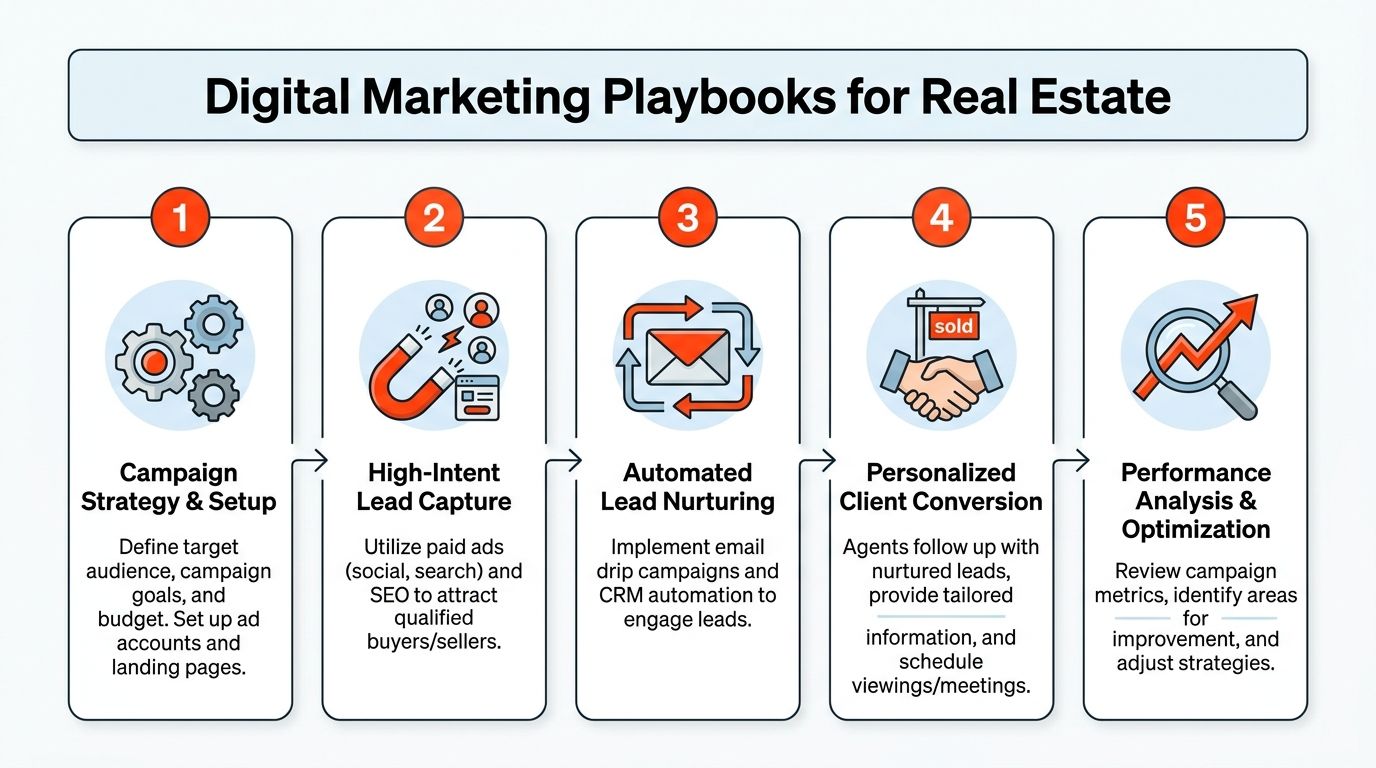
New listing launch workflow
A new listing needs urgency, reach, and fast feedback. The first move is internal preparation, not media spend.
Step one
Build the campaign asset set. Finalise photography, video, floorplan, copy, landing page, enquiry routing, and CRM tags before launch. If the listing is going live across multiple channels, the source tracking should be ready first.
Step two
Launch on portals and publish the dedicated listing page on your site. The website page gives you a controllable destination for ads, remarketing, and analytics.
Step three
Run Google Ads only where direct search demand makes sense. This is more relevant for high-interest locations, branded developments, or seller-facing campaigns tied to the listing’s local visibility.
Step four
Use Meta for distribution. Lead with the strongest visual asset, then build retargeting audiences from site visitors and video viewers. The early social goal is attention and return traffic, not just instant form fills.
Step five
Trigger follow-up quickly. Every enquiry should enter the CRM with source detail, campaign tag, and status. Then segment by buyer readiness, not only by channel.
This workflow works because each platform has a defined job. Portals create immediate listing exposure. Social expands reach. Search catches active demand. Email and CRM carry the follow-up.
Digital farming workflow
Digital farming is slower and more strategic. It is how an agent builds relevance in a suburb before the listing opportunity appears.
The pattern is different.
You publish suburb pages, market updates, sales proof, and seller-focused content. You run always-on branded and local-intent search campaigns where budget allows. You use paid social to keep your agency visible to homeowners and buyers in the target area. You collect signals over time through repeat visits, email sign-ups, and appraisal enquiries.
The win is not one campaign spike. The win is accumulated familiarity.
A practical digital farming rhythm often includes:
- Local search presence: Service pages and suburb pages built around real buyer and seller intent
- Recurring content: Market updates, local insights, and recent campaign activity
- Audience retargeting: Re-engage previous site visitors and content readers
- Database nurture: Send suburb-relevant email updates, not generic broadcasts
- Quarterly review: Check which touchpoints assisted appraisals, qualified leads, and listing conversations
Practical tip: In digital farming, consistency beats intensity. Agencies usually gain more from sustained suburb relevance than from occasional bursts of broad awareness.
Building Your 2026 Digital Marketing Plan
The right plan depends on business model, team capacity, and market segment. One reason many agencies struggle is that generic advice leans too heavily toward prestige listings and lifestyle-driven campaigns. That leaves a gap for firms targeting more practical segments.
As noted in Enhance Media’s discussion of why real estate companies cannot ignore digital marketing in 2025, much of the content in this space is skewed toward luxury, while mid-market, first-time buyer, and commercial segments need more cost-efficient PPC and SEO strategies customized for specific buyer intent.
Choose the plan that fits the business
Solo agent
Keep the system tight. Start with a clean website, Google Business Profile, suburb-focused service pages, basic GA4 tracking, and a small search campaign around seller intent. Add simple email nurture before layering more channels.
Boutique agency
Prioritise channel integration. Build landing pages for appraisals and local services, run structured Google Ads, support listings with paid social, and make sure the CRM captures first touch, lead source, and pipeline status.
Established brokerage
Focus on attribution maturity. Standardise naming conventions, connect portal leads with website and CRM data, segment reporting by office, suburb, and service line, and review budget decisions using qualified outcomes rather than top-line lead counts.
Match tactics to segment
A first-home buyer campaign needs different messaging from a prestige campaign. A regional market needs a different keyword and content mix from an inner-city office. A commercial agency often needs more education-led nurture because the buying cycle and information needs differ.
That is why real estate digital marketing should be built from buyer intent outward. Not from channel trends inward.
The practical order of operations
If the plan feels too large, use this order:
- Fix the website and tracking
- Tighten local SEO and Google Business Profile
- Launch high-intent search campaigns
- Support with social and retargeting
- Add content and email nurture
- Review attribution monthly and reallocate budget
Agencies that follow that sequence usually make better decisions because each step improves the quality of the next one. Good measurement sharpens budget allocation. Better budget allocation improves lead quality. Better lead quality makes sales follow-up more productive.
If you want a partner to build the tracking, search, SEO, and reporting side properly, Click Click Bang Bang offers AI-first SEO and PPC with transparent reporting, flexible plans, and a practical focus on measurable performance. For real estate businesses that need clearer attribution and stronger lead generation, that kind of execution can remove a lot of guesswork.
Read NeXt
Or Read Our Latest
- What Is Brand Positioning and Why It Drives Growth
- Push vs Pull Marketing: A 2026 Decision Guide
- Ad Relevance Score Explained: How It Impacts PPC Performance
- Best ROI Digital Marketing: 10 Channels Ranked for 2026
- Localization Strategy: How to Win in Any Market
- Phone Call Tracking: Methods, Metrics, and Best Practices
Click. CLick. Subscribe.
Get our best PPC insights, industry updates, and power moves delivered straight to your inbox. No fluff, just high-caliber strategies that actually work.
Don’t Leave Just Yet
Try Us For 30-Days,
Risk Free!!
We guarantee that you’ll love our work within the first 30 days, if not you’ll get your money back.
What have you got to lose?