

Master Search Voice Search for SEO & PPC in 2026
Last Updated
Your customers are already using search voice search behaviour, even if they never call it that.
They ask their phone for the best accountant near them while walking between meetings. They tell the car to find a supplier on the way to the warehouse. They ask a smart speaker to reorder pet food, compare prices, or check whether a store is open. Those moments are short, high-intent, and easy to lose if your SEO and PPC still rely on typed keywords alone.
Most businesses make the same mistake. They treat voice as an SEO add-on, then run paid campaigns with a separate keyword set, separate landing pages, and separate reporting logic. That split creates wasted spend. Voice search works better when organic and paid teams use the same query patterns, the same intent mapping, and the same landing page structure.
The New Search Landscape Why Voice Search Matters Now
A typed search often looks compressed. A spoken search is usually clearer.
Someone typing might enter “coffee beans Sydney”. The same buyer speaking will ask, “where can I buy strong coffee beans near me today?” That difference matters because spoken queries reveal urgency, location, and commercial intent in one sentence.
In Australia, this behaviour is no longer niche. Weekly voice assistant usage reached 33% among internet users aged 16 and older in the WeAreSocial Digital 2025 Report, and the same source notes that 91% of brands investing in voice report conversion lifts (seoprofy.com/blog/voice-search-statistics). That is the commercial signal. Voice is shaping how people discover, compare, and act.

Voice changes the shape of intent
Voice searches tend to be:
- More conversational: People speak in full questions, not fragments.
- More immediate: Many happen while driving, walking, cooking, or multitasking.
- More local: Users often want a nearby solution, fast.
- More decisive: Spoken queries often include modifiers like “best”, “open now”, “closest”, or “can I buy”.
That means your content and ads need to answer spoken intent directly. Generic category pages rarely do the job on their own.
For e-commerce, that affects product titles, FAQs, feed structure, and shopping campaign query handling. For B2B, it affects service pages, comparison pages, and the way you write answer-led copy for high-trust searches.
Voice is now part of everyday brand experience
Voice search is not just a search engine issue. It is a messaging issue.
If your website copy sounds robotic, but your audience searches in natural language, you create a mismatch. If your paid ad copy chases short-tail phrases while your SEO team publishes useful question-led pages, you miss the chance to reinforce the same buyer journey across channels.
That is why brand voice matters here too. Conversational search rewards brands that sound human, answer quickly, and remove friction. A useful reference point is this guide to voice and tone, because the same principles that make copy easier to read also make it easier to match spoken intent.
Key takeaway: Voice search is less about gadgets and more about customer behaviour. The winning brands answer natural questions faster than competitors do.
What businesses get wrong
The common failures are easy to spot:
| Mistake | What happens |
|---|---|
| Treating voice as a separate tactic | SEO, paid, and content teams optimise different query sets |
| Chasing only broad keywords | You miss question-based, high-intent searches |
| Sending all traffic to generic pages | Users do not get the direct answer they expected |
| Ignoring local and mobile context | You lose “near me” and action-focused searches |
The practical shift is simple. Stop asking, “How do we rank for this keyword?” Start asking, “What exact question is the buyer saying out loud, and where should we answer it?”
Mastering Conversational Keyword Research
Traditional keyword research underweights spoken language. It rewards brevity. Voice search rewards realism.
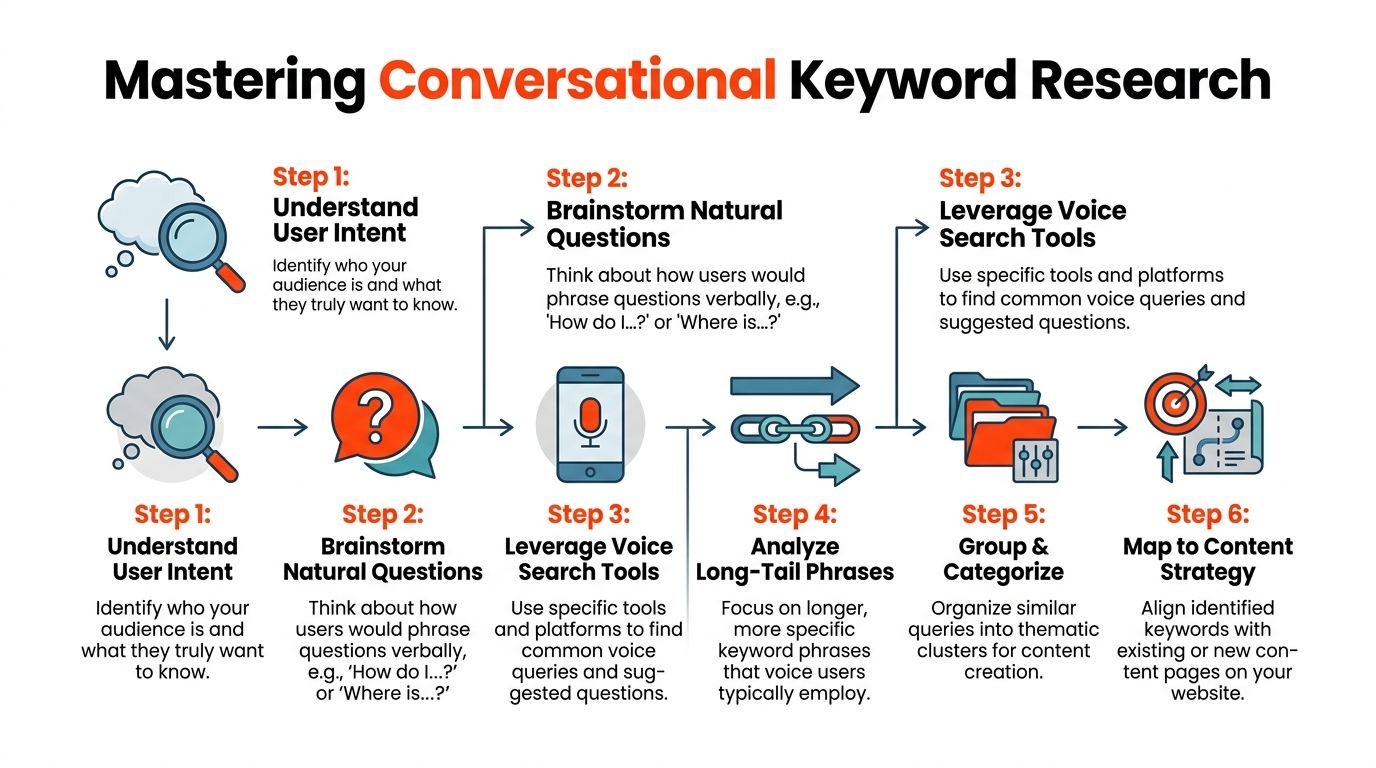
The fastest way to improve search voice search performance is to build your research around real questions, not just short phrases. That means listening for how customers ask, compare, and decide.
Start with spoken intent, not keyword volume
A useful workflow begins with customer language. Pull questions from:
- Sales calls: Objections, comparison questions, and “how does this work?” moments
- Support chats: Repeated questions about delivery, pricing, returns, setup, or timelines
- Search terms reports: Especially long-tail queries from Google Ads
- Google autocomplete and People Also Ask: Strong prompts for real phrasing
- AnswerThePublic: Useful for question clustering
- Internal site search: Often reveals plain-language intent
A good external primer is a consultant's guide to keyword research, which is worth revisiting if your process still starts and ends with volume and difficulty scores.
Build question clusters
Voice searches often map cleanly into six question types:
-
What questions
Good for definitions, product explainers, and service summaries. -
How questions
Strong for tutorials, processes, setup content, and problem-solving. -
Where questions
Useful for local intent, stockists, physical service areas, and availability. -
Who questions
Often tied to trust, authority, fit, and provider comparison. -
When questions
Good for delivery windows, business hours, booking periods, and turnaround expectations. -
Why questions
Useful for objection handling and early-stage education.
Do not force every question into a blog post. Some belong on product pages, some on service pages, some in FAQs, and some in ad copy.
Separate intent before you write anything
A lot of poor voice optimisation comes from mixing intents on one page.
Use a simple classification model:
| Query type | Example for e-commerce | Example for B2B | Best destination |
|---|---|---|---|
| Informational | how do I choose running shoes for flat feet | what does a LinkedIn ads agency do | FAQ, guide, explainer page |
| Commercial investigation | best standing desk for small office | best SEO agency for ecommerce | comparison page, category page |
| Transactional | buy protein powder near me | book a PPC audit today | product page, lead page |
| Navigational | call [brand name] customer support | [brand name] case studies | brand page, support page |
If you skip this step, you end up writing educational content for buyers who are ready to act, or pushing hard-sell pages at buyers who still need context.
Mine PPC data for voice patterns
Your paid search account often contains the clearest voice clues because users type and speak interchangeably across devices.
Look for:
- Longer search terms: Especially full questions and modifier-heavy phrases
- Local qualifiers: “near me”, suburb names, “open now”, “today”
- Urgency language: “same day”, “fast”, “best”, “closest”
- Problem framing: “how do I fix”, “why is”, “what is the best way”
Those terms often deserve both organic pages and paid ad groups. If they convert in search terms reports, they should influence content planning.
Tip: Write down the exact phrasing customers use. Do not “clean it up” too early. Natural syntax is often the advantage.
Turn research into a usable map
A practical keyword map for voice should include four fields:
- Spoken query
- Intent
- Target page
- Paid campaign use
That last field is where many teams fall short. If a query is strong enough to build content around, it may also be strong enough to test in Google Ads, shape Meta hooks, or inspire LinkedIn ad copy.
Voice research becomes more valuable when it feeds multiple channels, not just one article brief.
Optimising Your Website for Voice Search SEO
Most websites do not lose voice visibility because they lack content. They lose because the answer is buried, the structure is messy, or the page gives search engines too much work.
Voice SEO works best when the site is easy to interpret and easy to quote.

Make answers snippet-ready
In Australia, voice search is moving into B2B lead generation too. One cited trend says 22% of voice searches are local B2B, such as “best LinkedIn marketing agency Sydney”, while only 12% of top-ranking pages feature snippet-ready content for those kinds of lead generation queries (onlinemarketinginstitute.org/blog/2018/02/voice-search-best-practices-position-zero-optimization). That gap matters.
The pages that win usually do three things well:
- They put the question in a heading.
- They answer it immediately in plain English.
- They expand with supporting detail below the direct answer.
A simple structure works:
H2: How do LinkedIn Ads generate B2B leads?
Answer paragraph: Short, direct, and clear.
Supporting content: Steps, examples, use cases, objections, CTA.
Use structured data where it helps interpretation
Schema is not magic, but it reduces ambiguity.
The most useful types for voice-oriented pages are often:
- FAQPage: Good for common questions and concise answers
- HowTo: Useful when the query expects steps
- LocalBusiness: Important for local discovery
- Product: Useful for commercial product detail pages
- Organisation: Helpful for brand clarity and trust signals
Do not add schema just to tick a box. Mark up content that exists on the page and matches the visible answer.
Design pages for spoken retrieval
Voice assistants and AI systems prefer clean extraction. That means your page layout matters.
Use:
- Short answer blocks: One paragraph that answers the exact question
- Bullets and numbered lists: Easier to parse than dense prose
- Descriptive headings: Match natural phrasing where relevant
- Tight page hierarchy: Avoid burying answers beneath fluff
- Consistent entity details: Brand, location, services, and contact information should match across site assets
This is also where many service pages fall apart. They lead with brand slogans instead of answers. Voice search rewards usefulness before cleverness.
Local optimisation still carries huge weight
A large share of spoken searches are practical local decisions. If your local presence is weak, no amount of blog content will compensate.
Review your:
- Google Business Profile accuracy
- Opening hours
- Primary and secondary categories
- Service area details
- Review response quality
- Location landing pages
For a deeper look at local intent, this piece on the power of 'Near Me' searches within Google My Business is a helpful reference for how location signals influence discovery.
After your page structure is sorted, watch this for implementation ideas and a useful reset on answer-led formatting.
Mobile speed and clarity decide whether you stay visible
A voice search often begins on mobile, and the click after that still lands on a webpage. If the page loads slowly, shifts around, or hides key details, the visit loses momentum.
Prioritise:
| Area | What to check |
|---|---|
| Page speed | Compress heavy images, reduce clutter, simplify templates |
| Mobile UX | Keep forms short, buttons obvious, text readable |
| Page focus | One primary intent per page works better than mixed messaging |
| Contact pathways | Make calls, directions, and enquiries easy to complete |
Practical rule: If a user lands on the page and cannot find the answer in a few seconds, the page is not voice-ready.
Integrating Voice Search into Paid Campaigns
Many guides conclude prematurely here. They talk about rankings, featured snippets, and schema, then ignore media buying.
That is a mistake. Organic voice insights can sharpen PPC targeting, ad copy, landing page structure, and reporting. The best search voice search strategy is not SEO on one side and ads on the other. It is one intent map used across both.

Use voice queries to improve Google Ads structure
One cited Australian data point says 41% of adults using voice search daily struggle with PPC attribution in voice-driven traffic. The same source says voice search grew 25% YoY in 2025 among SMEs, yet only 15% of e-commerce sites have optimised Google Shopping for voice, leading to 30% lower conversion tracking accuracy due to zero-click answers (docommunication.io/blog/voice-search-optimization). The operational lesson is clear. If you do not structure campaigns around voice-like intent, your reporting and optimisation both get weaker.
In Google Ads, that means:
- Building ad groups around question-led or modifier-led themes
- Separating local urgency queries from generic category terms
- Sending traffic to answer-first landing pages
- Mining search term reports for spoken phrasing
- Using SEO insights to expand negative keyword logic
If your team needs a stronger process for this, this resource on Google Ads keyword research is useful for aligning search intent with campaign build decisions.
Feed organic insights into Shopping and Performance Max
For e-commerce, voice affects more than text ads.
Spoken product searches often include attributes such as:
- colour
- size
- compatibility
- urgency
- nearest availability
- price framing
- problem-solution language
Those attributes should influence your product titles, descriptions, feed labels, and landing page copy. If buyers ask, “what’s the best office chair for lower back pain”, your feed and category structure should help search engines and ad systems understand that relevance.
What does not work is relying on manufacturer copy, vague product names, or cluttered category pages with no clear answer content.
Apply voice learning to Meta and LinkedIn ads
You cannot target “voice search users” directly in Meta or LinkedIn. You can use voice insight to write better ads.
For Meta, voice research improves:
- Hook lines: Use the exact problem phrasing people say aloud
- Creative angles: Reflect urgency, convenience, or local relevance
- Retargeting copy: Answer the question that blocked the first conversion
For LinkedIn, it helps shape:
- Pain-point headlines
- Lead magnet topics
- Service page messaging
- Trust-building answer blocks on landing pages
This is especially useful in B2B because spoken searches often expose buyer anxiety more clearly than typed searches do.
Build one query system, not two
A practical integrated workflow looks like this:
| Input | Organic use | Paid use |
|---|---|---|
| Spoken questions from customers | FAQ pages, service content, product guides | Search ad groups, landing page copy |
| Search terms with local modifiers | Location pages, GBP updates | Geo-targeted campaigns, local ad variants |
| Comparison queries | Comparison pages, service pages | Competitor or alternative campaigns |
| Objection-based phrases | FAQ and support content | Retargeting and nurture creative |
When the same buyer language shapes both rankings and ads, the account gets easier to manage and the message gets more consistent.
Actionable Checklists and Quick Wins
Many teams do not need a complete rebuild to improve voice performance. They need a better order of operations.
Start with pages and campaigns closest to revenue. That usually means product pages, service pages, local pages, and core search campaigns.
E-commerce checklist
- Rewrite top product titles: Make them clearer, more descriptive, and closer to how shoppers speak.
- Add short FAQ blocks: Answer practical buying questions on product and category pages.
- Review feed language: Remove vague manufacturer wording and tighten product attributes.
- Create answer-led category intros: One short section that explains who the category is for and what to buy.
- Check mobile purchase friction: Make sure checkout, filtering, and add-to-cart work cleanly on phones.
- Align paid search terms with content gaps: If people search a question repeatedly, give them a page that answers it.
- Audit local intent pages if relevant: Especially for stores, pickup options, or location-based stock availability.
B2B lead generation checklist
- Turn sales questions into page headings: Use the exact questions buyers ask on calls.
- Add concise answers near the top of service pages: Do not hide the core explanation.
- Build dedicated FAQ content for objections: Pricing, timelines, fit, onboarding, and expected outcomes.
- Create location-aware service pages where relevant: Useful for local lead capture.
- Match landing page copy to query intent: Informational searches need clarity before conversion prompts.
- Use conversational language in LinkedIn offer pages: Buyers respond to clear answers, not agency jargon.
- Track form quality by landing page theme: Some question-led pages attract better-fit leads than others.
Quick win: Pick one high-value page and rewrite the first screen so it answers one real customer question directly. That often improves both SEO clarity and paid landing page relevance.
Quick wins you can do in under an hour
- Pull your last search terms report and highlight full-question queries.
- Add one FAQ section to your highest-traffic service or category page.
- Rewrite one page title so it reflects natural spoken language.
- Check your Google Business Profile for hours, categories, and contact accuracy.
- Shorten one landing page intro that currently leads with fluff.
- Group recurring buyer questions from sales or support into themes.
- Review one paid ad and replace generic copy with customer phrasing.
Small changes matter when they remove friction. Voice search rewards clarity before complexity.
Testing Analytics and Measuring Voice Search ROI
Voice search reporting is messy because platforms do not hand you a neat “voice” channel in analytics. You need to infer performance from patterns, page types, query language, and downstream actions.
That does not make measurement impossible. It just means the model must be practical.
Use query patterns, not vanity assumptions
Australian voice use has grown from about 2.5 million users in 2017 to 5.8 million by 2023, a 132% rise. The same cited source notes that 90% find voice easier than typing, and 66% of Australian brands report revenue gains from voice-optimised campaigns (buildingbrandsmarketing.com/voice-search-now-powers-40-of-online-queries-study-shows). That tells you voice behaviour is commercially relevant. It does not tell you how your account is performing.
To measure your own impact, look for signals such as:
- Question-based queries in Google Search Console
- Impression growth on FAQ, local, and answer-led pages
- Branded search lift after earning stronger search visibility
- Phone calls, direction clicks, and form submissions from those pages
- Search term alignment between organic queries and paid conversions
Build a voice measurement framework
A workable framework has three layers.
| Layer | What to measure | Why it matters |
|---|---|---|
| Visibility | Question queries, snippet presence, local impressions | Shows whether your answers are being surfaced |
| Engagement | Page engagement, call clicks, scroll depth, form starts | Shows whether the landing experience is useful |
| Business outcome | Leads, sales, qualified enquiries, assisted conversions | Shows whether voice-oriented traffic has commercial value |
If you only measure clicks, you will undercount impact. Voice often creates zero-click interactions, brand recall, and later branded conversions.
Set up tracking that supports the complete journey
In GA4 and your broader reporting stack, define conversions around outcomes, not just pageviews.
Track:
- Phone click events
- Form starts and completions
- Location interactions
- FAQ engagement on key pages
- Lead quality by landing page
- Assisted conversions from organic entry pages
A strong setup starts with disciplined implementation. This guide to website conversion tracking is useful if your reporting still misses key buyer actions.
Account for zero-click reality
Voice search often answers the question before the click. That can look like a loss if your model only values sessions.
A better question is whether visibility changed buyer behaviour. Did branded searches increase? Did calls rise? Did your local pages generate more direct contact? Did paid search perform better after content and landing pages became more answer-focused?
Key takeaway: Measure voice ROI as a blend of search visibility, on-site engagement, and offline or assisted outcomes. Last-click logic misses too much.
Frequently Asked Questions About Voice Search
Do I need a blog to win at voice search
No. A blog can help, but it is not mandatory.
Many voice opportunities belong on service pages, product pages, FAQs, local landing pages, and help content. If your best customer questions relate directly to purchase or lead intent, answer them on commercial pages first.
Is voice search only relevant for local businesses
No. Local intent is strong, but voice also affects e-commerce discovery, product comparison, and B2B research.
If buyers ask detailed questions before they act, voice search matters. That applies to national retailers and specialist service providers as much as local operators.
Should SEO and PPC teams manage voice separately
Usually not. They should share the same query intelligence.
Voice data becomes much more useful when the same customer language informs content briefs, search campaigns, shopping feeds, retargeting copy, and landing page design.
Does voice optimisation differ for Google Assistant, Siri, and Alexa
Yes, but the fundamentals stay consistent.
Clear answers, strong local data, structured content, and mobile-friendly pages help across platforms. Platform-specific differences matter later. Most businesses still have bigger gains available from fixing clarity, intent matching, and tracking.
How does AI search affect voice strategy
AI systems and voice systems both reward answer-led content.
If your page is easy to extract, easy to trust, and written in natural language, it is in a stronger position for both. The same foundations help across search voice search, AI summaries, and conventional search results.
If your team wants a practical SEO and PPC plan built around real search behaviour, Click Click Bang Bang can help. The agency combines AI-first SEO, Google Ads, Google Shopping, Meta, and LinkedIn strategy with transparent reporting and conversion tracking, so voice-driven insights turn into measurable revenue instead of sitting in a slide deck.
Read NeXt
Or Read Our Latest
- What Is Brand Positioning and Why It Drives Growth
- Push vs Pull Marketing: A 2026 Decision Guide
- Ad Relevance Score Explained: How It Impacts PPC Performance
- Best ROI Digital Marketing: 10 Channels Ranked for 2026
- Localization Strategy: How to Win in Any Market
- Phone Call Tracking: Methods, Metrics, and Best Practices
Click. CLick. Subscribe.
Get our best PPC insights, industry updates, and power moves delivered straight to your inbox. No fluff, just high-caliber strategies that actually work.
Don’t Leave Just Yet
Try Us For 30-Days,
Risk Free!!
We guarantee that you’ll love our work within the first 30 days, if not you’ll get your money back.
What have you got to lose?