

Top 7 Social Media Marketing Firms for 2026
Last Updated

You review another monthly agency report. Reach is up. Clicks are up. Video views look healthy. Sales and pipeline quality have barely moved.
That pattern usually points to an agency selection problem, not a channel problem. Many social media marketing firms are good at producing activity. Fewer are set up to connect paid social to revenue, lead quality, repeat purchase, or sales follow-up. In Australia, where social platforms shape discovery, comparison, and retargeting behaviour at scale, that gap gets expensive fast.
The shortlist below is built for marketers who need a buying framework they can use. It separates firms by likely fit, including e-commerce brands that need faster creative testing, B2B teams that care about qualified opportunities over cheap form fills, and SMBs that need clearer scope control. It also looks at integration points beyond social alone, including Google Ads, remarketing, attribution, and CRM handoff, because those are often where return is won or lost.
That distinction matters in practice.
A firm can generate strong platform metrics and still underperform commercially if it cannot manage the full path from impression to conversion. A Meta campaign might drive the first visit, branded search may capture later intent, and email or sales follow-up may close the deal. Agencies that understand that sequence usually make better budget calls than teams optimising one dashboard in isolation.
Each firm in this guide is assessed on fit, trade-offs, and commercial clarity. Where pricing is public, I’ve included it because transparent pricing helps teams shortlist faster and compare scope with less sales friction. Where pricing is hidden, I treat that as part of the evaluation, since opaque pricing often signals a longer buying cycle and wider variation in deliverables.
1. Click Click Bang Bang
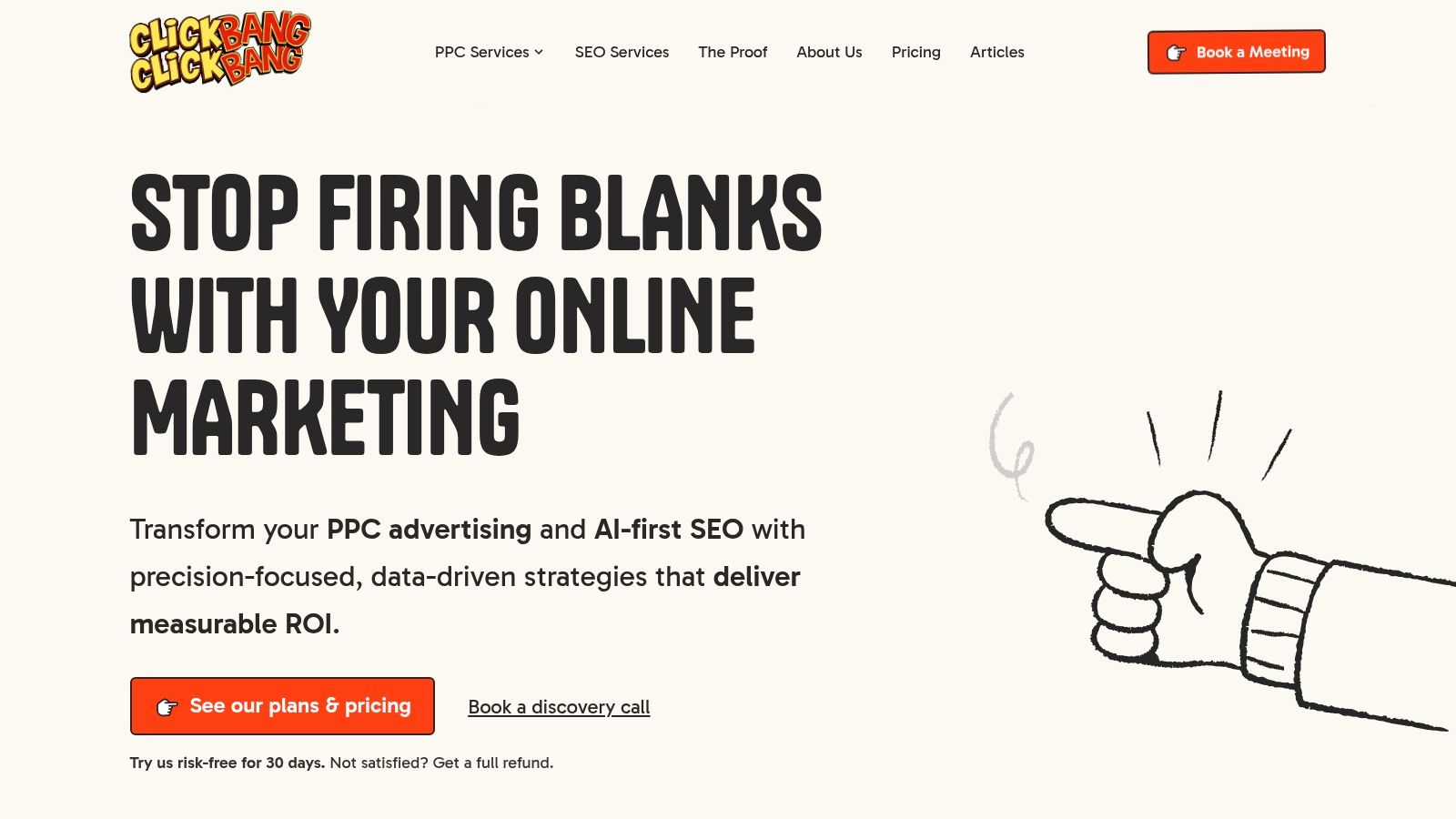
Click Click Bang Bang is the clearest option on this list if you want structure, speed, and visible commercial accountability from day one. A lot of social media marketing firms say they’re performance-led, then hide setup steps, reporting access, or contract terms until late in the sales process. This agency does the opposite. The offer is unusually explicit.
It runs paid campaigns across Google Search, Google Remarketing, Google Shopping, Meta, and LinkedIn, then pairs that with AI-first SEO. That matters because social rarely works best in isolation. Someone clicks a Meta ad, leaves, searches your brand later, then converts through a separate touchpoint. Agencies that understand that path tend to make better budget decisions.
Why it stands out for SMBs and mid-market teams
The onboarding process is simple. You complete a short questionnaire, meet a strategist, pay a one-off foundation setup fee of AU$997 + GST, and the team can have ads live within seven days. For lean teams, that’s a strong operating advantage. Long onboarding usually means internal drag, delayed learning, and wasted momentum.
The pricing is also public and unusually usable. PPC plans start with Click Starter at AU$997 + GST for one platform, up to three campaigns, and up to AU$5k ad spend. Campaign Surge is AU$1,497 + GST for up to two platforms, five campaigns, and up to AU$7.5k ad spend. Conversion Bang! is AU$2,497 + GST for up to three platforms, 10 campaigns, and up to AU$12.5k ad spend.
SEO packages start at AU$997 and scale to AU$3,597, with allocations for long-form articles and backlinks across the tiers. If you’re comparing social media marketing firms and trying to avoid a multi-call quoting process, that transparency is a real advantage.
Practical rule: If a firm can’t explain what happens in week one, what gets built in month one, and how reporting works before you sign, treat that as a risk signal.
Best-fit clients
Click Click Bang Bang suits three buyer types especially well:
- E-commerce brands: You need paid social tied to actual conversion behaviour, not just engagement.
- B2B teams: You want LinkedIn lead generation without paying enterprise agency overhead from the start.
- Startups and SMBs: You need flexibility, live reporting, and a way out if the fit isn’t right.
The no-lock-in structure helps here. So does the 30-day risk-free trial with a full refund if you’re not satisfied. That’s one of the more practical buying features in the category, especially for businesses that have already had one poor agency experience.
What works, and what to watch
What works is the combination of speed, local support, and measurable visibility. Clients get a live reporting portal plus monthly summaries, which is a better setup than static PDF reporting because it lets marketing managers check performance without waiting for the next meeting. The agency also has local support in Brisbane and recognition as an A Cemoh Approved Partner.
There’s also a documented client result: Australian Tours & Cruises reported 50% year-on-year growth after Click Click Bang Bang managed PPC across seven travel brands. I’d treat that as encouraging evidence, not a guarantee, but it’s still stronger than generic “we drive growth” language.
The main trade-off is scale. The public plans are ideal for small to mid-sized advertisers, but large enterprise teams with bigger budgets, broader compliance requirements, or more complex stakeholder structures will likely need bespoke scoping. The one-off setup fee can also feel heavy for micro-businesses with very tight cash flow.
If you want a direct, transparent option among Click Click Bang Bang’s social media marketing services, this is the firm on the list that makes the easiest first decision. You can understand the offer quickly, launch quickly, and judge performance without getting trapped in a long contract.
2. Megaphone
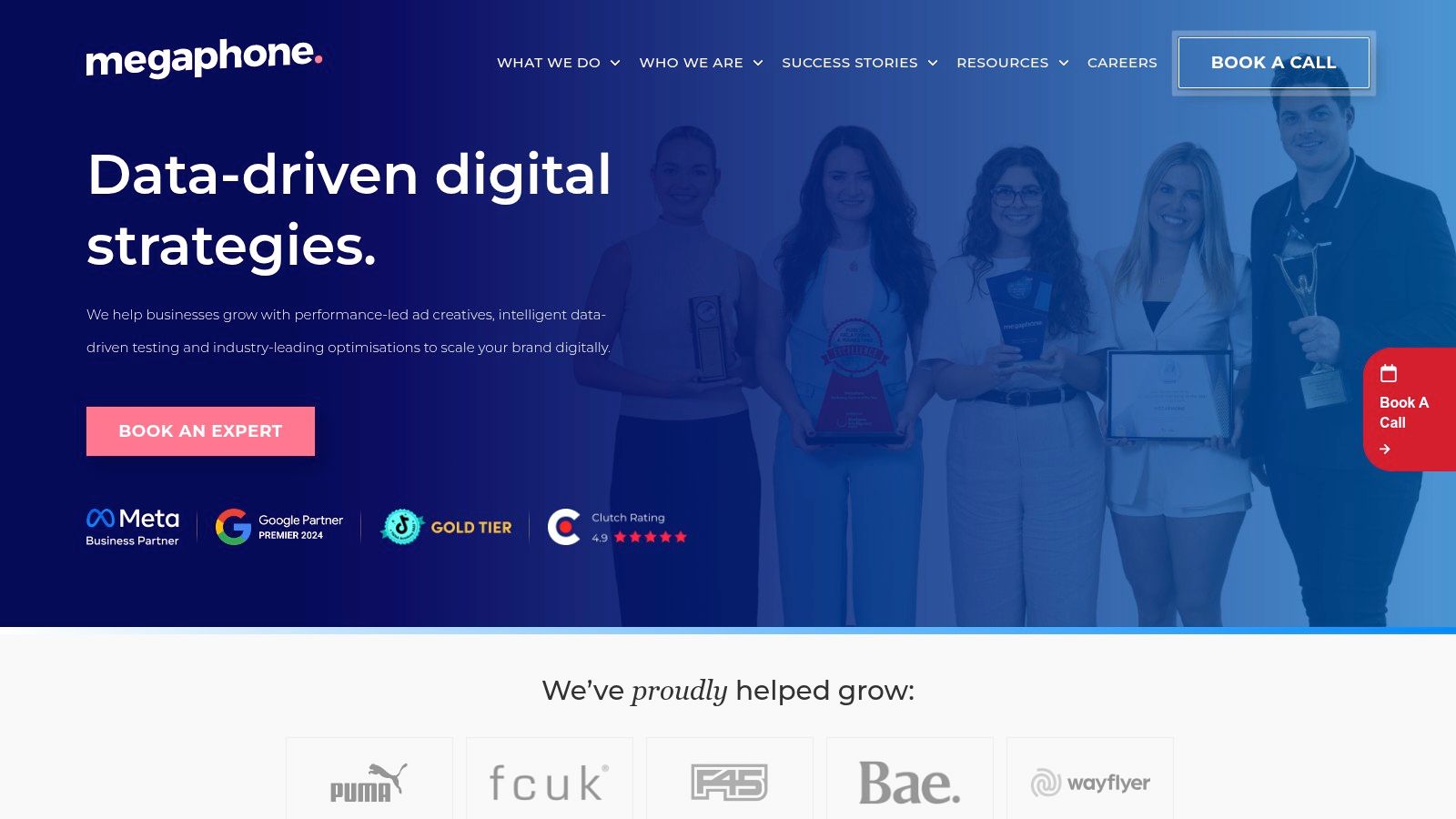
Megaphone is a strong fit if you want a social-first growth agency that speaks the language of momentum. Melbourne-founded and performance-oriented, it’s built for brands that need testing velocity across paid social, creative, content, and analytics rather than a narrow “we’ll manage your Instagram” service.
That matters because many social media marketing firms still separate content, media buying, and community work into disconnected functions. Megaphone’s positioning is more end-to-end. For e-commerce and service businesses, that can make execution cleaner.
Where Megaphone fits best
Megaphone makes the most sense for brands that need constant iteration. If your business model depends on testing offers, audience segments, creatives, and landing page angles quickly, a repeatable playbook matters more than flashy strategy decks.
Its public-facing materials also help buyers self-qualify. The firm states that working with Megaphone can start from about A$2,500, and it recommends total monthly marketing budgets roughly in the A$5k to A$10k range. That won’t suit every business, but I’d rather see realistic budget guidance than vague “packages from affordable rates” language.
A useful benchmark when planning spend is to compare agency fees against channel economics and media requirements. This social media advertising cost guide helps frame what brands should expect before they commit to management plus ad spend.
Strengths and trade-offs
Megaphone’s obvious strength is breadth inside social itself. It covers strategy, content, ads, influencer work, analytics, and community management. For brands that want one partner driving most social execution, that consolidation can reduce friction.
Its likely best use case is e-commerce or service brands that want fast creative and media feedback loops. Meta and TikTok tend to reward volume, learning, and adaptation. Agencies that are comfortable shipping, testing, and adjusting usually outperform agencies that over-plan.
Fast testing only helps if the firm can tie those tests back to revenue or lead quality. Otherwise, you just get expensive activity.
The trade-off is that broad client mixes can create fit issues for highly regulated sectors or more technical B2B categories. If your approval processes are heavy, or if every claim needs legal review, ask early how campaign velocity changes under those constraints. Not every social-first agency is equally comfortable there.
Another practical note: the disclosed budget guidance means very early-stage businesses may be too small for the model. That’s not a flaw. It’s useful clarity.
3. Reload Media
Reload Media sits in a different category from firms that sell social as a standalone service. Brisbane-headquartered and independent, it’s better understood as an integrated media partner with strong retail and e-commerce capability. If you already know your paid social shouldn’t be managed in a silo, Reload becomes more interesting.
That matters because one of the biggest gaps among social media marketing firms is integration. Many can run Meta campaigns competently. Fewer can connect Meta, Google, BVOD, programmatic, and retail-focused measurement into one coherent budget plan.
Best for in-house teams that need senior coordination
Reload is a strong candidate for brands with some internal marketing capability already in place. If you’ve got a marketing manager, e-commerce lead, or digital team that needs senior agency stewardship rather than basic platform help, this kind of model tends to work well.
The appeal is less about cheap execution and more about coordinated media thinking. Paid social often contributes strongly at discovery and remarketing stages, but it rarely deserves the entire credit. Reload’s integrated approach is useful when you need a partner who can judge channel role, not just channel performance.
There’s also a practical platform advantage in working with agencies that have strong partner ecosystems. Access to betas, platform support, and cross-channel learning can matter when brands are spending enough to justify advanced experimentation.
What to ask before signing
Reload doesn’t publish prescriptive pricing, so expect a discovery and scoping process. That’s normal for this tier of agency, but it creates two buyer tasks. First, pin down who will handle the account day to day. Second, make sure reporting translates media data into business decisions.
Ask questions like these:
- Channel role: How does the team decide what social should do versus search, programmatic, or other paid media?
- Retail fit: How do they handle product-led promotions, seasonality, and stock-driven changes?
- Operational cadence: Who joins weekly reviews, and who owns action items after reporting meetings?
Reload’s trade-off is straightforward. It likely tilts toward larger budgets and more mature teams. If you’re a small business that needs a flexible partner to launch paid social and prove traction quickly, this may be more agency than you need. But if you want senior coordination across channels, that’s exactly the point.
4. Sparro by Brainlabs
Your team is spending heavily on paid media, creative requests are backing up, and every weekly meeting turns into the same argument: which channel is driving revenue? That is the kind of operating environment where Sparro by Brainlabs tends to fit.
Sparro sits in the upper tier of social media marketing firms. It is built for brands that need paid social connected to search, creative, testing, analytics, and reporting across a larger performance program. For a marketing lead comparing social media advertising firms for complex paid media support, that positioning matters because it usually signals a different service model, team structure, and budget threshold than a specialist boutique.
Best fit: larger e-commerce brands, mature DTC teams, and complex mid-market accounts
Sparro makes more sense for businesses with established spend, internal stakeholders across marketing and ecommerce, and enough volume to benefit from faster testing cycles. The practical advantage is coordination. Social performance improves when creative feedback, audience learning, landing page issues, and reporting all move together instead of sitting in separate agency silos.
That matters most when social is no longer a side channel. Once it becomes a meaningful share of acquisition spend, weak coordination gets expensive fast.
The trade-off is straightforward. Firms at this level often work best with clients that already have clear approval processes, usable first-party data, and realistic production capacity. If the internal team cannot turn around offers, assets, or site changes quickly, an advanced agency setup will expose that bottleneck rather than solve it.
What you are really buying
With Sparro, the value is not just media buying. It is the ability to run paid social inside a broader performance system with tighter feedback loops and more senior cross-channel input.
For the right client, that can improve three things:
- Testing speed: More creative, audience, and offer iterations can go live without the account becoming chaotic.
- Decision quality: Reporting is more useful when social data is reviewed alongside search, site behaviour, and conversion trends.
- Operational control: Larger teams usually need clearer ownership across strategy, execution, and analysis.
This is why I would place Sparro higher on the shortlist for scaled e-commerce and growth-stage brands than for small businesses. SMBs usually need sharper prioritisation, lower minimums, and simpler account structures. Enterprise-oriented firms are stronger when the problem is coordination at scale.
Pricing and selection considerations
Sparro does not publish public pricing tiers, so expect a scoping process. That is normal for this category, but it shifts more responsibility to the buyer. Come prepared with monthly spend ranges, platform priorities, creative output capacity, and the commercial metric that matters most, whether that is MER, new customer acquisition, qualified leads, or blended ROAS.
Ask direct questions before signing:
- Who owns strategy versus day-to-day execution?
- How is paid social performance judged against broader business outcomes?
- What level of creative input is included, and what still sits with your internal team?
- What budget level gets senior attention consistently, not just during the pitch?
Sparro is a strong candidate for brands that need structure, pace, and cross-channel thinking. It is usually less suitable for early-stage advertisers that just need a lean team to launch campaigns, prove traction, and keep overhead under control.
5. Social Garden
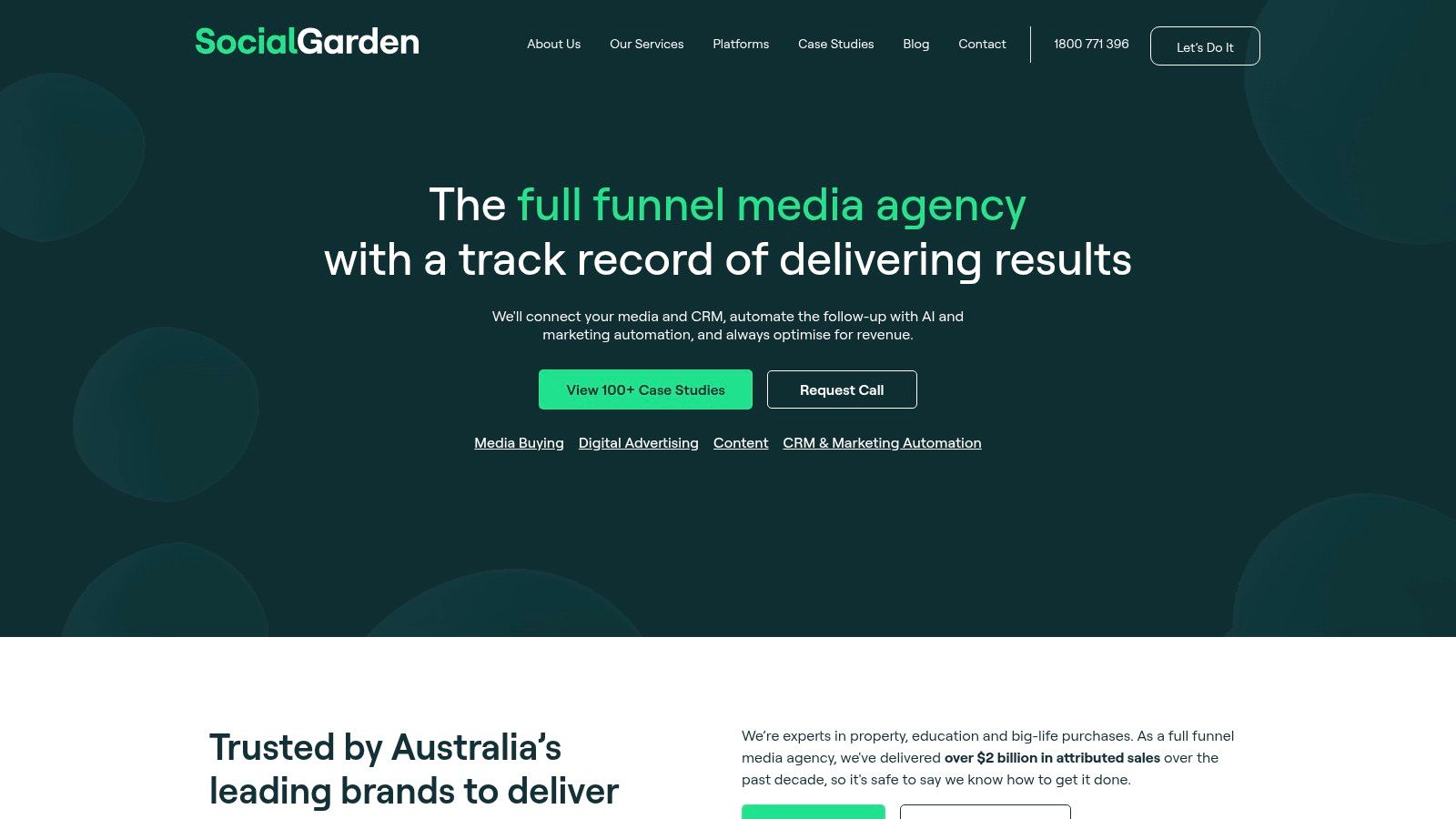
A familiar B2B scenario. Paid social is producing form fills, the dashboard looks healthy, and sales still says the leads are weak. The problem usually is not media delivery alone. It is the gap between ad platform reporting and what actually turns into pipeline.
That gap is why Social Garden stands out. Its appeal is less about producing a high volume of leads and more about connecting paid social to CRM, automation, and revenue reporting. For firms comparing social media marketing firms by client fit, this makes Social Garden easier to place in the B2B and considered-purchase category than in fast-turn e-commerce.
Why Social Garden fits B2B buyers
LinkedIn remains a serious channel for professional targeting in Australia, especially for brands selling into long buying cycles, higher deal values, and multi-stakeholder decisions, as noted in LinkedIn's Marketing Solutions resources for advertisers. That does not make LinkedIn the right answer for every account. It does mean agencies that understand audience quality, sales alignment, and attribution usually create more value than agencies focused on lead volume alone.
Social Garden's positioning around CRM and marketing automation integration matters because B2B teams rarely win on first-click conversion. They win by tracking which campaigns generate qualified opportunities, which audiences progress to meetings, and which messages assist revenue later in the cycle.
If you want a broader market view before shortlisting, this comparison of social media advertising firms helps clarify the difference between creative-first, media-first, and attribution-led agency models.
Best fit, trade-offs, and buying considerations
Social Garden is a stronger match for businesses that already have some internal discipline. Clean lifecycle stages, sales follow-up standards, and working CRM fields are not nice extras here. They are part of the operating model. Without them, attribution gets muddy fast and the agency ends up reporting activity instead of business impact.
The strongest fit usually looks like this:
- B2B or high-consideration brands: Longer sales cycles benefit more from closed-loop reporting.
- Teams using LinkedIn with Meta or Google: Cross-channel influence matters when buyers convert later.
- Marketing leaders under pressure to prove pipeline contribution: Qualified opportunities matter more than raw lead counts.
- Mid-market firms with sales and marketing ops support: Implementation is easier when the data foundation already exists.
The trade-off is readiness. Smaller SMBs or early-stage teams often need a leaner setup, fewer systems, and faster campaign feedback loops. Social Garden makes more sense when the business is prepared to connect platforms properly and judge performance on lead quality, pipeline, and downstream conversion. Public pricing is not available, so buyers should expect custom scoping and should ask exactly what level of reporting, integration, and strategic involvement is included.
6. Half Dome
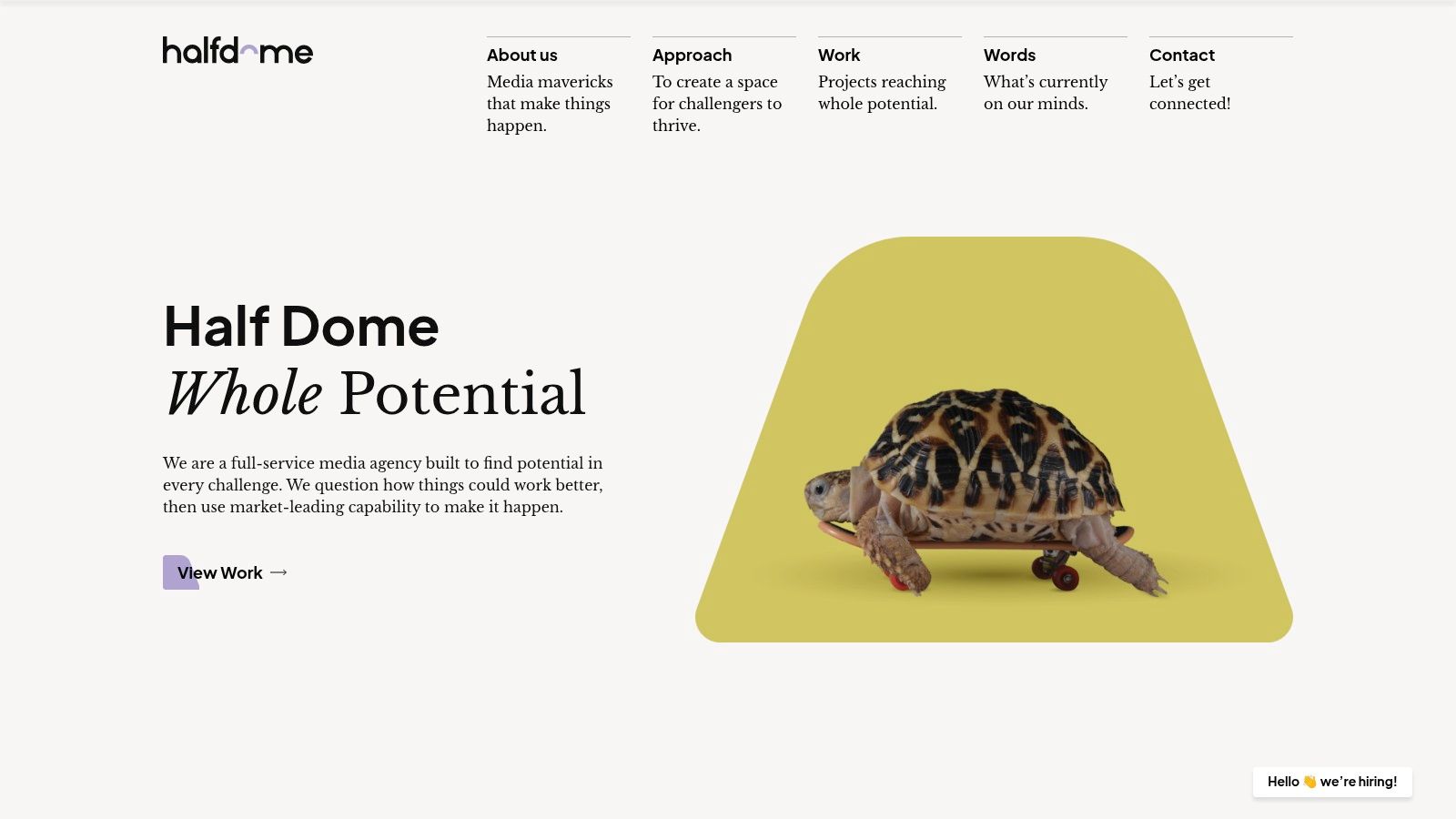
Half Dome is the option to shortlist when your real problem isn’t “we need someone to run social” but “our measurement and creative system isn’t mature enough to improve efficiently”. That’s a more advanced problem, and it’s why this agency tends to appeal to brands that want a consultative media partner rather than a task-based supplier.
Melbourne-headquartered and integrated across media, paid social, and SEO, Half Dome puts more emphasis on performance creative and digital maturity than many social media marketing firms do. That can be a major advantage when campaigns aren’t failing because of targeting, but because the creative testing process is weak.
What makes the model useful
Creative is often the hidden bottleneck in paid social. Teams obsess over audience targeting and bid settings, then run the same few ad concepts too long. A firm that treats creative as an optimisation lever, not just a production task, is generally easier to justify.
That approach lines up with where the market is heading. In the Australian social media management market, AI-powered platform adoption among SMEs stood at 67% in 2025 and is projected to reach 82% by 2027, while firms integrating AI saw 34% higher ROI on campaigns, according to the Australian social media management market data cited here. The practical takeaway isn’t “buy more AI”. It’s that teams need stronger systems for testing, interpretation, and iteration.
Half Dome’s broader media and SEO scope also helps if you’re trying to improve decision-making across channels rather than just improve one ad account.
The main consideration
This is not a bare-bones social management buy. Discovery is required. Scope is likely broader. If all you need is day-to-day social posting and simple paid support, Half Dome may be heavier than necessary.
For brands that need stronger measurement discipline, though, that extra weight is often the value.
Better reporting doesn’t come from prettier dashboards. It comes from cleaner tracking, sharper hypotheses, and teams that know what action to take next.
7. Attention Experts
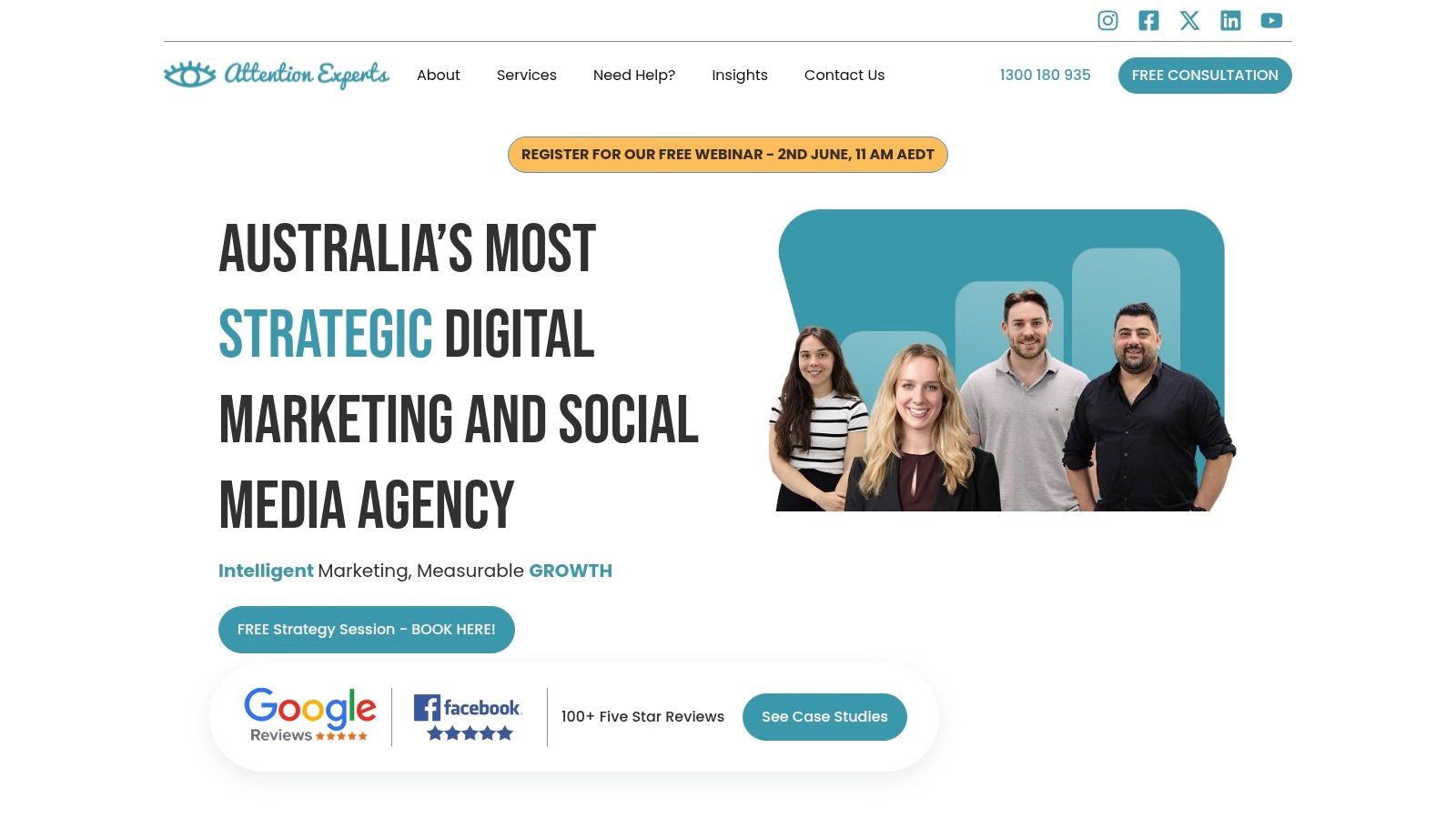
A common brief sounds like this. The business already has search, email, and sales support in place, but social is underperforming, reporting is shallow, and nobody can say which campaigns are producing qualified leads or revenue. In that situation, a specialist firm can be a better fit than a broad media agency.
Attention Experts sits in that specialist category. Based in Sydney with national coverage, it focuses on social strategy, social management, and paid social. That narrower scope matters for B2B teams using LinkedIn to build pipeline, and for consumer brands that need Meta campaigns tied to clear commercial goals rather than vanity metrics.
The practical value is focus. A specialist social firm is usually easier to assess when social is expected to carry real acquisition weight, not just support other channels. For marketers comparing options by client profile, Attention Experts makes more sense for B2B, service businesses, and brands that want a dedicated social partner. It is less obviously suited to companies that need a single agency to run search, SEO, creative, CRO, and social under one commercial plan.
If you are weighing a specialist against an integrated provider, compare the scope against social media marketing services. That gives you a cleaner benchmark for what is included, what stays in-house, and whether the extra channel coverage is worth the added management overhead.
Where the fit is strongest
Attention Experts looks strongest for teams that need channel expertise and tighter measurement inside social itself.
That usually includes:
- B2B marketers using LinkedIn for lead generation: Ask how they track lead quality after the form fill, not just cost per lead.
- SMBs that need strategic help, not just posting: Confirm whether strategy reviews happen monthly or only during setup.
- Brands investing heavily in Meta: Check how creative testing, audience refreshes, and reporting are handled week to week.
The trade-off is breadth. If your brief includes lifecycle email, landing page testing, search coordination, and broader attribution work, a social specialist can create handoff points that slow execution unless your internal team is strong.
Questions to settle before signing
Attention Experts' analytics-led positioning is a positive, but proposals should answer a few operational questions clearly.
- Creative production: Who makes the ads, who briefs them, and how many new concepts are expected each month?
- Account ownership: Will senior strategists stay involved after onboarding, or does the work shift quickly to junior account management?
- Measurement: Are reports built around pipeline, sales, and cost to acquire a customer, or mostly reach, clicks, and engagement?
- Channel limits: Will the agency advise on landing pages and conversion paths, or stop at platform performance?
Pricing and minimums are not public, so this belongs in the custom-quote tier of your comparison framework. Go in with a budget range, a channel priority, and a clear answer to one question. Do you need a specialist social operator, or a broader growth partner that can coordinate the full acquisition mix?
Top 7 Social Media Marketing Firms Comparison
| Agency | Implementation Complexity 🔄 | Resource Requirements ⚡ | Expected Outcomes ⭐📊 | Ideal Use Cases 💡 | Key Advantages ⭐ |
|---|---|---|---|---|---|
| Click Click Bang Bang | Low, fast, structured 7‑day onboarding 🔄 | Moderate, AU$997 setup + tiered monthly plans and ad spend caps ⚡ | Measurable ROI; improved paid+organic synergy 📊⭐ | E‑commerce, SMBs, startups needing rapid launches 💡 | AI‑first PPC+SEO, live reporting, month‑to‑month, 30‑day trial ⭐ |
| Megaphone | Medium, end‑to‑end social with fast testing cadence 🔄 | Medium, recommended total budgets A$5k–A$10k; entry ~A$2.5k ⚡ | Faster paid social iteration tied to revenue 📊⭐ | E‑commerce and services brands focused on growth 💡 | Transparent budgets, repeatable playbooks, revenue accountability ⭐ |
| Reload Media | Medium‑High, integrated omnichannel programs 🔄 | High, enterprise tilt, higher media spend minimums likely ⚡ | Strong retail/ecommerce performance and omnichannel reach 📊⭐ | Retail and ecommerce teams needing cross‑channel coordination 💡 | Retail credentials, Google Premier partner, partner betas ⭐ |
| Sparro (by Brainlabs) | High, cross‑functional squads and scalable programs 🔄 | High, significant annual ad spend and enterprise resources ⚡ | Enterprise‑grade measurement and high campaign velocity 📊⭐ | Mid‑to‑large marketing teams and major retailers 💡 | Scale, creative+performance integration, proven large‑brand track record ⭐ |
| Social Garden | Medium, paid social with CRM/automation integration 🔄 | Medium, requires CRM and marketing automation setup ⚡ | Improved lead quality and closed‑loop attribution for pipeline 📊⭐ | B2B teams and considered‑purchase funnels (LinkedIn) 💡 | CRM integration, B2B lead‑gen frameworks, LinkedIn expertise ⭐ |
| Half Dome | Medium‑High, measurement‑first with creative testing 🔄 | Medium‑High, full‑service media and SEO scope; discovery required ⚡ | Better paid social efficiency via measurement and creative iteration 📊⭐ | Brands needing consultative media partner and maturity roadmaps 💡 | Measurement excellence, performance creative, digital maturity roadmaps ⭐ |
| Attention Experts | Medium, social specialist with analytics focus 🔄 | Medium, multi‑location resources; confirm production needs for high volume ⚡ | Measurable social‑first growth for B2B and B2C 📊⭐ | Social‑first brands and B2B lead generation campaigns 💡 | Specialist social focus, analytics emphasis, national presence ⭐ |
Making Your Choice A Final Checklist and FAQ
You are on a shortlist call. The agency sounds sharp, the case studies look polished, and the price seems reasonable. Then the engagement starts, reporting is hard to use, creative approval takes a week, and nobody can explain whether social is driving revenue or just cheap clicks.
That is the selection problem.
The right choice depends on fit across budget, business model, team structure, and measurement standards. An agency that works well for a scaled e-commerce brand can be a poor fit for a lean B2B team with a long sales cycle. A founder-led SMB often needs speed, clarity, and flexible terms. A larger in-house team may need channel integration, clear escalation paths, and stronger attribution.
Use discovery calls as working sessions. Ask each firm to explain how they would handle your account in the first 30 days, what they need from your team, how they report results, and where they expect risk. That gives you a practical basis for comparison, which matters more than chemistry alone.
How to choose checklist
Score every firm against the same criteria. That is how you avoid choosing on personality, brand familiarity, or a polished pitch deck.
- Business goal fit: Match the agency to the outcome you actually need. E-commerce brands usually care about revenue efficiency, average order value, and repeat purchase signals. B2B teams usually care about lead quality, pipeline contribution, and sales acceptance.
- Client profile match: Check whether the firm is built for your stage and size. Some agencies are a better fit for SMBs that need fast execution and lower complexity. Others are structured for enterprise accounts with larger budgets, layered approvals, and cross-channel scope.
- Channel scope: Decide whether you need a social specialist or an integrated performance partner. If paid social is one piece of a wider acquisition system, weak coordination with search, CRM, remarketing, and email will limit results.
- Onboarding process: Ask what happens in days 1 to 7, 8 to 14, and 15 to 30. Good agencies can explain access requirements, tracking checks, creative workflow, testing priorities, launch timing, and review cadence without vague promises.
- Reporting quality: Ask for a live walkthrough, not a sample PDF. You need to see platform access, conversion tracking, business KPI visibility, and what decisions the team makes from the data.
- Commercial fit: Compare pricing structure with your budget and expected account complexity. A low fee can mean thin support. A high fee only makes sense if the firm brings stronger strategy, faster iteration, or better measurement discipline.
- Contract terms: Flexible terms reduce risk when you are still testing agency fit or channel fit. Longer commitments can work for larger programs, but only if scope, ownership, and success metrics are clear.
- Operational honesty: Good firms will tell you when your budget is too low, your offer is weak, or your tracking setup will block useful optimisation. That saves money.
One pattern shows up often with SMBs. The agency can report on ads, but not on the full path from click to sale. This analysis of how agencies underserve small and medium-sized businesses examines that gap well. It is a practical reminder to ask how the firm connects media performance to CRM, lead handling, and sales outcomes.
FAQ
How much should I budget for a social media marketing firm
Start with the economics of your business, not a generic percentage rule.
Your budget needs to cover agency fees, creative production if needed, and enough media spend to produce useful optimisation data. If spend is too low, even a capable agency will have limited room to test audiences, offers, and creative angles. That is why transparent pricing tiers are useful in a comparison guide like this one. They help you rule out firms that are structurally misaligned with your budget before you spend time in calls.
If pricing is not public, ask early for minimum monthly fees, ad spend expectations, and whether content production, landing page work, or reporting tools cost extra.
What’s the difference between a specialist social agency and a full-service agency
A specialist social agency focuses on paid social, content, platform strategy, community considerations, and social reporting. A full-service agency connects social with search, SEO, CRM, remarketing, email, and attribution.
The trade-off is focus versus coordination. A specialist can be strong when social is the main growth channel and the internal team already handles the rest. An integrated agency makes more sense when budget allocation, lead quality, and customer journey measurement depend on multiple channels working together.
Should I choose a firm with no lock-in contracts
Often, yes.
That is usually the safer option for SMBs, early-stage brands, and teams testing a new agency model. It keeps pressure on delivery standards and gives you room to correct a poor fit quickly. Longer contracts can still be reasonable for enterprise programs with complex setup work, but the value should be clear before you commit.
Also look beyond contract length. This piece on transparent ROI reporting and trial accessibility for SMBs points to a real market gap: many agencies emphasise reputation more than reporting usability, response time, and practical evaluation criteria.
How do I judge reporting quality
Ask the agency to walk you through a real account view before signing.
Good reporting shows spend, conversions, lead or revenue quality, trend lines, and the next actions the team plans to take. Weak reporting is full of platform metrics with no business context. If an agency cannot explain what changed, why it changed, and what they will test next, the report is not doing its job.
For brands where customer questions, lead handling speed, or sales follow-up affect conversion, reporting should also show what happens after the click. Sprout Social’s social media statistics and reporting analysis is useful context here. Visibility expectations are rising, and agencies need to show more than monthly top-line numbers.
The best choice is usually the firm that is explicit about fit, disciplined about measurement, and honest about trade-offs. If you need a practical benchmark, use the comparison above to narrow by client type first, e-commerce, B2B, or SMB, then compare pricing, scope, and reporting depth.
Click Click Bang Bang remains one of the clearer options for Australian businesses that want paid social tied to PPC, faster launch timelines, transparent pricing, and flexible terms, as noted earlier.
Read NeXt
Or Read Our Latest
- User Generated Content Strategies That Actually Convert
- Copyright and Infringement Guide for Business Marketers 2026
- What Is Brand Positioning and Why It Drives Growth
- Push vs Pull Marketing: A 2026 Decision Guide
- Ad Relevance Score Explained: How It Impacts PPC Performance
- Best ROI Digital Marketing: 10 Channels Ranked for 2026
Click. CLick. Subscribe.
Get our best PPC insights, industry updates, and power moves delivered straight to your inbox. No fluff, just high-caliber strategies that actually work.
Don’t Leave Just Yet
Try Us For 30-Days,
Risk Free!!
We guarantee that you’ll love our work within the first 30 days, if not you’ll get your money back.
What have you got to lose?