

Blogging and SEO: A Guide to Driving Organic Growth in 2026
Last Updated

You’re publishing blog posts, ticking the content calendar, and still not seeing meaningful organic growth. Rankings stall. Traffic trickles in from low-intent queries. Sales teams say the leads aren’t qualified. Paid media keeps carrying the pipeline while the blog sits in the background as a cost centre.
That’s a common failure mode in blogging and seo. The issue usually isn’t effort. It’s that content production has been separated from revenue strategy, technical SEO, and paid distribution. The result is a blog that publishes often enough to feel busy, but not strategically enough to build authority, earn visibility, or move buyers toward conversion.
A blog can do far more than fill your resources section. Companies that maintain active blogs earn 97% more inbound links, businesses using blogs as marketing tools see 13 times higher ROI, and websites that create blog content consistently achieve 434% higher indexation rates than those that don’t, according to Ryesing’s blog statistics and content marketing SEO roundup. Those outcomes don’t come from publishing whatever topic looks interesting this week. They come from a system.
Introduction Why Your Blog Isnt Generating Traffic
Most underperforming blogs have the same pattern. The team picks topics based on assumptions, briefs writers loosely, publishes without a distribution plan, and measures success with pageviews alone. Months later, there’s a library of articles but no clear lift in pipeline, revenue, or search visibility for commercial terms.
The hard part is that blogging and seo still look deceptively simple from the outside. Publish helpful content, add keywords, wait for Google. In practice, search is crowded, AI-generated summaries change how people click, and weak content architecture gets exposed fast.
Three problems usually sit underneath the traffic issue:
- Weak topic selection. Posts target broad themes with no clear link to buyer intent.
- Poor content structure. Articles aren’t built to rank, get cited, or guide readers to the next step.
- No integration with media spend. Paid teams and content teams operate separately, so useful articles never get amplified or used in retargeting.
Practical rule: If a blog post can’t support organic discovery, paid remarketing, or sales enablement, it’s probably the wrong topic.
A blog should work like an asset portfolio. Some posts capture early research intent. Others support comparison-stage buyers. A smaller set should help close demand by answering objections, clarifying use cases, or linking directly into product and service pages. That’s how blogging turns from a publishing habit into an acquisition system.
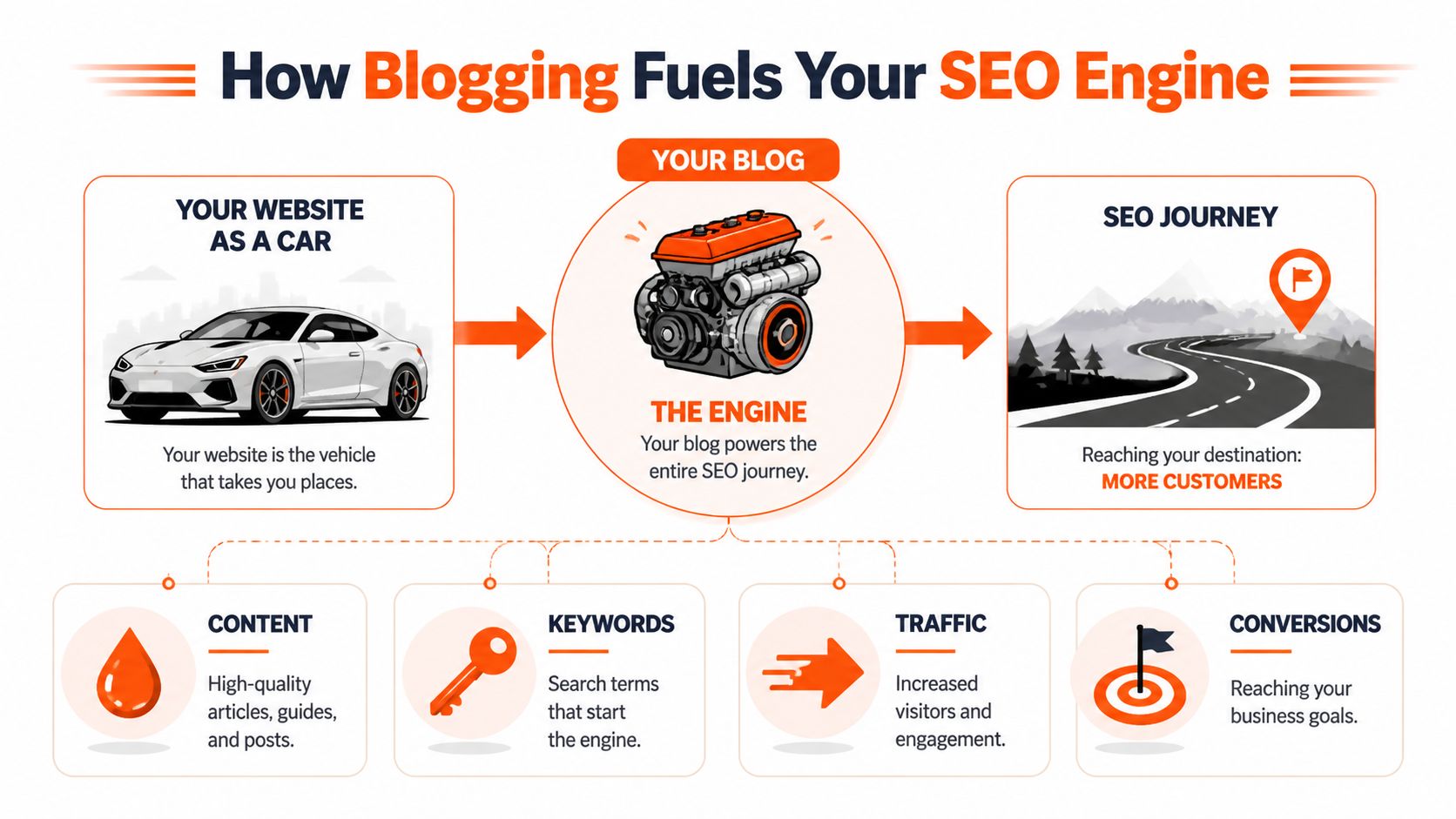
How Blogging Fuels Your SEO Engine
A website without a blog often looks finished to the business and incomplete to a search engine. Service pages explain what you sell, but they rarely cover the full set of questions, comparisons, objections, and subtopics your audience searches before they’re ready to buy. The blog fills that gap.
Topical authority starts with coverage
Each strong post adds another relevant entry point into your site. Over time, that creates depth around a commercial theme. If you sell running shoes, Google doesn’t just want to see product pages. It wants evidence that your site understands fit, surface type, gait, cushioning, sizing, and comparisons. If you sell B2B software, it wants to see implementation questions, feature trade-offs, role-based use cases, and integration issues covered clearly.
That depth matters because organic search still drives a large share of attention. Over 53% of all website traffic comes from organic search, while 60% of searches now end without a click due to AI Overviews, and 52% of sources cited in those summaries rank within the top 10 traditional results, according to AIOSEO’s SEO statistics. So ranking alone isn’t the whole job anymore. You need content that can both rank and be citeable.
Good blog content does three jobs at once
A useful post should satisfy three audiences:
- The reader needs a direct answer, clear structure, and confidence that your brand knows the topic.
- The search engine needs context, internal links, and enough topical relevance to understand where the page fits.
- AI summary systems need concise, extractable answers and supporting detail that’s easy to parse.
That changes how you write. Long intros hurt. Vague headings hurt. Thin commentary hurts. Strong blogging and seo work best when each section answers a distinct query cleanly.
Blogs support E-E-A-T through specificity
Experience and expertise aren’t established by claiming authority. They’re shown through the way content handles nuance. A senior marketer can spot the difference between a generic post on “SEO tips” and a practical guide that explains when to prioritise comparison keywords, how to route internal links from informational posts to commercial pages, and why some topics belong in paid campaigns before they belong in organic content.
Use examples rooted in real buying behaviour:
- For e-commerce. “Best trail running shoes for wet conditions” often sits closer to purchase than a broad educational article.
- For B2B. “How to choose project management software for distributed teams” can feed both organic demand and sales conversations.
A blog becomes an SEO engine when every post strengthens site understanding, not when every post chases a different keyword.
The compounding effect is structural
The payoff doesn’t come from one viral article. It comes from compounding internal links, improved crawl paths, deeper topical coverage, and more entry pages aligned to how buyers search. That’s why disconnected content calendars usually underperform. Search engines reward organised depth more than random volume.
Building Your Strategic Content Blueprint
Content planning gets easier when you stop treating keywords as topics and start treating them as buying signals. A term can have traffic and still be poor for the business. Another can look modest on paper and produce stronger revenue because the intent is tighter and the next step is obvious.

Start with business value, not vanity metrics
A lot of SEO planning breaks at the first step because teams chase search volume. That sounds rational and often leads to the wrong editorial priorities. As this critique of SEO-driven blogging points out, search volume can be misleading when a term attracts low click-through rates, weak intent, or visitors that never become customers.
A better filter is simpler:
- Is the query connected to a product, problem, or decision you influence?
- Would the right reader naturally take a next step after reading?
- Can sales or customer success use this content in real conversations?
If the answer is no, the topic may still have branding value, but it shouldn’t dominate the calendar.
Map topics to buyer stages
The fastest way to clean up a bloated blog strategy is to sort topics by funnel stage.
| Buyer stage | What the searcher wants | Blog format that fits |
|---|---|---|
| Early research | Understand a problem or category | Explainers, guides, frameworks |
| Mid consideration | Compare options or approaches | Comparison posts, checklists, use-case breakdowns |
| Decision stage | Reduce purchase risk | Objection-handling posts, implementation guides, pricing context, vendor-fit content |
Many teams need a formal process for developing a content blueprint, not just brainstorming article titles. The blueprint should show how each post supports a stage, links to a destination page, and earns a place in the wider cluster.
Build with a pillar and cluster structure
The pillar-cluster model is still one of the cleanest ways to organise blogging and seo.
Pillar pages
A pillar page covers a broad commercial theme. It’s the central reference point. For an e-commerce retailer, that might be “running shoes buying guide”. For a B2B software company, it could be “project management software for growing teams”.
Cluster posts
Clusters go deep on the subtopics people search before buying. These pieces link back to the pillar and to each other where relevant.
Example cluster ideas for an e-commerce running shoe brand:
- Fit-focused post. How to choose running shoes for wide feet
- Use-case post. Road vs trail running shoes
- Commercial comparison. Cushioned running shoes vs lightweight trainers
- Decision support post. How often should you replace running shoes
Example cluster ideas for a B2B SaaS brand:
- Role-based guide. What operations managers need from project management software
- Comparison post. Spreadsheet workflow vs project management platform
- Process post. How to onboard a distributed team to a new project system
- Objection post. Common implementation risks and how to avoid them
Connect content to service pages and revenue paths
A blog isn’t meant to trap readers in informational loops. It should move them.
That means linking cluster content into category pages, demo pages, product collections, and service pages when the context fits. If you need a benchmark for how this works inside a broader program, Click Click Bang Bang’s content marketing services outline the kind of integration many in-house teams end up needing once content volume grows beyond ad hoc publishing.
Use a simple planning template before every article is approved:
- Core query
- Search intent
- Buyer stage
- Primary conversion action
- Supporting internal links
- Paid amplification angle
- Sales enablement use
Give writers that brief before the draft starts. Fixing strategic gaps after publishing is slower and more expensive.
A short training resource often helps here, especially when multiple stakeholders are involved. Use the video below to align teams on the practical side of content planning before production scales.
Tactical Optimisation for Every Blog Post
A solid plan still fails if the page itself is weak. Good topics don’t rank on intent alone. They need strong execution at the page level, clean technical signals, and internal linking that helps both crawlers and readers move through the site.
Write for extraction, not just readability
In 2026-style search behaviour, a post has to work as a destination page and as a source page. That means each major section should answer a specific question directly near the top, then expand with evidence, examples, and next-step guidance.
A practical structure looks like this:
- Lead with the answer in the opening lines of the section.
- Explain the trade-off or context immediately after.
- Support with detail through examples, bullets, or a short table.
- Route the reader forward with an internal link or CTA where relevant.
This doesn’t make content robotic. It makes it usable. AI systems can extract clean definitions and summaries, while human readers still get depth.
Get the on-page basics right every time
These are still critical:
- Title tag. Put the main topic early and make the promise specific.
- Meta description. Write it for click intent, not for stuffing keywords.
- URL slug. Keep it short, descriptive, and stable.
- Headings. Use one clear H1, then logical H2s and H3s that reflect real subtopics.
- Image alt text. Describe the image accurately. Don’t force keywords into every asset.
A lot of in-house teams skip consistency here because each individual issue seems minor. In aggregate, those small misses weaken the page’s ability to compete.
Internal links are a ranking system and a user journey tool
Internal linking is where many blogs leave value on the table. Blog managers either barely link at all or they overdo it with generic anchor text like “learn more” and “read this article”.
Use internal links for three distinct jobs:
- Context links point to supporting educational content.
- Authority links point from cluster posts back to the pillar page.
- Commercial links move readers from educational content into category, product, demo, or service pages.
Here’s a simple anchor text rule. Name the destination clearly enough that a reader knows what they’ll get before they click.
Workflow tip: When a new article goes live, update at least two older relevant articles so they link into it. Publishing without reverse-linking leaves new content isolated.
If you want a practical reference point for how that content is written to rank and convert, this overview of SEO copywriting services is the kind of deliverable standard most blogs need at scale.
Schema and technical signals aren’t optional anymore
Schema markup gives search engines a cleaner understanding of the page. That matters for rich results and for machine-readable extraction. According to Neil Patel’s technical SEO checklist for bloggers, schema markup deployment for blog articles delivers a +14% CTR boost in Australian SERPs, and proper implementation can triple content citation in AI responses.
For blog articles, start with Article schema in JSON-LD and make sure the visible page content matches the schema fields. If your CMS injects dynamic elements, validate them. Mismatches create messy signals.
Use this technical checklist before publishing:
- Schema validation. Confirm Article markup is present and accurate.
- Indexability check. Make sure the page isn’t blocked or tagged incorrectly.
- Canonical review. Avoid accidental duplication signals.
- Mobile rendering. Read the page on a phone and check heading flow, spacing, and CTA placement.
- Image compression. Reduce file size before upload.
Repurpose formats that already prove intent
Not every audience prefers reading. Some prefer audio or mixed-media discovery, especially in B2B niches where long buying cycles involve multiple touchpoints. If you’re expanding a content cluster into audio, Podmuse’s guide to podcast SEO is a useful reference for carrying search principles into a different format without losing discoverability.
That matters because one strong article can become:
- A webinar outline
- A sales follow-up asset
- A podcast topic
- A retargeting destination page
- A short email sequence
The blog post should be the source asset. Everything else extends its life.
Leverage Advanced Content Plays for a Competitive Edge
Foundational SEO gets you indexed and competitive. It doesn’t keep you ahead. The advantage usually comes from how well a team refreshes, reuses, and amplifies content after publication.
Treat content decay as an operating issue
Older posts lose relevance for different reasons. Competitors update their pages. Product details change. SERP intent shifts. AI summaries pull cleaner answers from newer content. If no one owns the refresh cycle, even good articles fade.
That’s especially important in freshness-sensitive topics. Detailed’s analysis of profitable SEO niches notes that 99% of high-performing content on product review sites ranks for keyphrases where recency significantly outweighs backlink quality or on-page SEO factors.

Update with intent, not cosmetic edits
A proper refresh does more than change a date. Review:
- Search intent drift. Is Google rewarding a different format now?
- Commercial relevance. Does the post still route readers to the right page?
- Comparison quality. Are competitors answering a question more directly?
- AI extraction readiness. Are your answers concise enough to be cited?
A refresh can involve rewriting headings, tightening intros, improving examples, adding FAQs, or changing internal links to match current commercial priorities.
Refresh the posts that sit closest to revenue first. A marginal lift on a high-intent cluster usually matters more than a bigger lift on a broad awareness article.
Repurpose winners into paid media assets
When a blog post consistently attracts the right audience, don’t leave it in the organic lane. Put paid support behind it.
For e-commerce, a buying guide can feed retargeting audiences based on category interest. For B2B, a use-case article can become the landing page for LinkedIn traffic when the goal is education before demo conversion. Content also improves paid efficiency because it warms up visitors who aren’t ready for a hard offer.
With AI-assisted workflows, teams using a dedicated AI for SEO process can identify underperforming sections faster, surface refresh opportunities across clusters, and adapt copy for both organic and paid deployment without rebuilding the strategy from scratch.
Measuring Success and Reporting on Blog ROI
A blog can attract traffic and still fail commercially. That’s why reporting needs to move past sessions, impressions, and broad keyword wins. Those metrics are useful diagnostics. They aren’t the business outcome.
Stop judging success by search volume alone
Search volume is often the wrong centre of gravity for reporting. A term may look attractive but produce weak clicks, poor-fit users, or no commercial movement. That’s the gap many SEO programs never close.
The stronger question is this: did the content attract people who moved closer to revenue?
Use these filters when reviewing performance:
- Was the visit qualified? Look at landing pages, engagement quality, and downstream behaviour.
- Did the page influence pipeline? Track assisted conversions, form fills, product views, or demo starts.
- Did rankings improve for commercially useful topics? Not every ranking gain has equal value.
The KPIs that matter most
A reporting stack for blogging and seo should connect search visibility to business movement.
| KPI | Why it matters | What to check |
|---|---|---|
| Qualified organic landing sessions | Shows whether the right people are arriving | Landing page mix, engagement patterns, audience fit |
| High-intent keyword visibility | Indicates progress on money topics | Rankings for comparison, solution, and use-case terms |
| Conversion actions from blog entries | Ties content to outcomes | Demo requests, product visits, enquiry forms, email signups |
| Assisted revenue or lead influence | Shows blog impact beyond last click | Multi-touch paths in GA4 and CRM |
| Internal path performance | Reveals whether content moves users forward | Clicks from blog posts to commercial pages |
Use GA4 and Search Console together
Google Search Console tells you how the page is discovered. GA4 tells you what happens after the click. Neither tool is enough alone.
Build a simple monthly review process:
- Pull top blog landing pages from GA4.
- Compare them against Search Console queries and page-level impressions.
- Mark each article by intent tier: awareness, consideration, decision.
- Review whether internal pathing led readers into a commercial page.
- Identify which posts deserve refresh, redistribution, or paid support.
A post with modest traffic and strong commercial assists is often more valuable than a high-traffic post that attracts the wrong audience.
Report in a way stakeholders can use
Senior stakeholders rarely need a deep keyword export. They need clarity on what content is contributing to pipeline and what action comes next.
A strong monthly summary usually includes:
- What improved. Visibility, qualified traffic, assisted conversions
- What stalled. Pages with high impressions but weak engagement or low next-step movement
- What changed in the plan. Refreshes, new clusters, paid amplification, internal linking fixes
- What the business should expect next. Which topics are closest to revenue impact
That framing keeps the blog from being treated as an editorial side project. It becomes part of acquisition reporting.
Your Blogging and SEO Implementation Checklist
A workable system beats a perfect strategy deck. If the process is too complicated to repeat every month, it won’t survive contact with deadlines, campaign changes, and stakeholder requests.
Blogging for SEO implementation checklist
| Phase | Task | Status |
|---|---|---|
| Setup | Confirm GA4, Search Console, and conversion tracking are working | ☐ |
| Audit | Review existing blog posts for intent, rankings, and internal links | ☐ |
| Strategy | Define pillar topics tied to products, services, or core buyer problems | ☐ |
| Planning | Build cluster topics by funnel stage and business relevance | ☐ |
| Briefing | Create a content brief before drafting begins | ☐ |
| Production | Write with answer-first structure and clear heading hierarchy | ☐ |
| Optimisation | Add title tag, meta description, internal links, image alt text, and schema | ☐ |
| Publishing | Check indexability, mobile rendering, and CTA placement | ☐ |
| Distribution | Share via email, social, paid remarketing, or sales enablement | ☐ |
| Refresh | Review ageing posts and update high-value pages first | ☐ |
| Reporting | Measure qualified traffic, conversions, and assisted pipeline impact | ☐ |
One-page content brief template
Use this template for every new article:
- Primary topic
- Target query and intent
- Audience segment
- Buyer stage
- Core problem being solved
- Primary internal page to support
- Secondary internal links
- Desired conversion action
- Key objections to address
- Suggested SERP format (guide, comparison, checklist, category-support article)
- Distribution plan (organic only, paid remarketing, LinkedIn promotion, email use)
- Refresh trigger (product change, SERP shift, ranking drop, seasonal update)
Build a monitoring habit early
Most blogs don’t fail because the initial strategy was terrible. They fail because nobody monitors the system closely enough to spot slippage. If you need options for building that process, this round-up of top SEO monitoring tools is a practical starting point for deciding how you’ll track visibility, technical issues, and content changes over time.
The key is consistency. One clear workflow, one useful brief, one reporting rhythm.
Frequently Asked Questions About Blogging and SEO
How often should we publish blog content for SEO
Publish at a pace your team can sustain without lowering quality. A smaller number of strategically useful posts will outperform a high-volume schedule full of weak topics. Consistency matters more than bursts.
Does AI-written content work for blogging and seo
AI can help with research synthesis, outlines, content refreshes, and repurposing. It shouldn’t replace editorial judgement, subject-matter expertise, or factual review. The strongest use is acceleration, not autopilot.
How long does blog SEO take to show results
It depends on site authority, topic competition, technical health, and how close the content is to existing demand. Stronger internal linking, better intent targeting, and integrated paid support usually shorten the path to meaningful signals.
Should every blog post target a keyword
Every post should target an intent. That usually includes a primary query, but the bigger question is whether the article serves a real search need and a business goal. Keyword alignment matters. Intent alignment matters more.
Can blog posts help paid media performance
Yes. Blog content can warm cold audiences, support retargeting, improve ad relevance for educational campaigns, and give sales teams better follow-up assets after the click.
If your blog is publishing regularly but not contributing enough to rankings, leads, or revenue, it’s time to connect content strategy with technical SEO and paid media. Click Click Bang Bang works across AI-first SEO and PPC, which makes it easier to build a blog program that supports both organic visibility and full-funnel growth.
Read NeXt
Or Read Our Latest
- User Generated Content Strategies That Actually Convert
- Copyright and Infringement Guide for Business Marketers 2026
- What Is Brand Positioning and Why It Drives Growth
- Push vs Pull Marketing: A 2026 Decision Guide
- Ad Relevance Score Explained: How It Impacts PPC Performance
- Best ROI Digital Marketing: 10 Channels Ranked for 2026
Click. CLick. Subscribe.
Get our best PPC insights, industry updates, and power moves delivered straight to your inbox. No fluff, just high-caliber strategies that actually work.
Don’t Leave Just Yet
Try Us For 30-Days,
Risk Free!!
We guarantee that you’ll love our work within the first 30 days, if not you’ll get your money back.
What have you got to lose?