

Hire a Top SEO Consultant Adelaide in 2026
Last Updated

Your business probably isn’t failing because the service is weak. It’s more likely that your visibility is weak.
That’s the Adelaide pattern I see all the time. A solid business has repeat customers, a decent reputation, and a website that looks acceptable on the surface. Meanwhile, a competitor with sharper local search positioning keeps showing up for the queries that matter. They appear in Maps, they sit on page one for suburb-intent terms, and they collect the calls that should have gone elsewhere.
Searching for a seo consultant adelaide isn’t really about finding someone to “do some SEO”. It’s a hiring decision that affects lead flow, sales quality, marketing efficiency, and how much of your growth depends on paid channels. The right consultant builds an asset. The wrong one burns months, produces polished reports, and leaves you with no commercial lift.
Why Your Adelaide Business Can't Afford the Wrong SEO Hire
An Adelaide business owner usually starts this process after a frustrating run of missed opportunities. You know people want what you sell because the phone rings from referrals and existing customers. But online, you’re hard to find. When someone searches for a service in your suburb, or compares suppliers, your site either doesn’t appear or doesn’t persuade.
That gap matters more in Adelaide than many owners realise. The city rewards local relevance. Buyers often search with suburb intent, compare multiple providers quickly, and expect a fast, mobile-friendly experience. If your consultant treats Adelaide like a generic national campaign, you’ll get generic outcomes.
The risk isn’t only lost rankings. It’s wasted budget, weak strategy, and delayed growth. A poor SEO partner can spend months on reports, vanity keywords, or template content while ignoring technical issues, local search signals, and conversion paths. By the time you realise the engagement isn’t working, you’ve lost time you can’t recover.
A better way to approach the decision is to vet the consultant the way you’d vet a senior hire. Look at judgement, not just presentation. Look at process, not just promises. If you want a useful starting point for separating polished marketing from actual capability, these unbiased online marketing guru reviews are a practical reminder that reputation and results aren’t always the same thing.
A weak SEO hire rarely fails loudly. It fails slowly, in the form of flat enquiries, vague reporting, and another quarter gone.
In Adelaide, that mistake is expensive because local intent is often high. People searching for nearby providers aren’t browsing casually. They’re often close to action. If your consultant can’t turn that intent into visibility and visibility into leads, they’re not solving the problem you have.
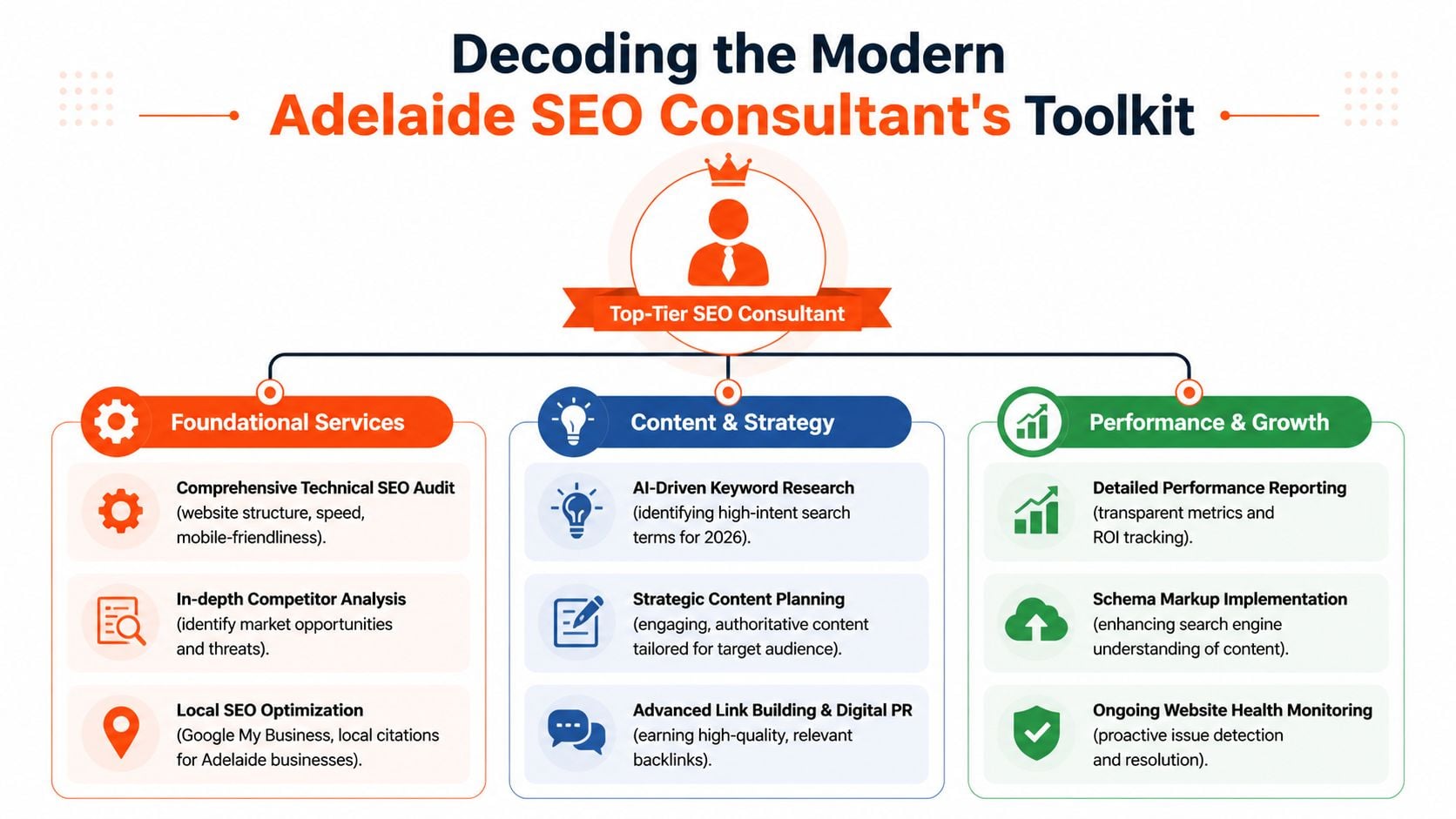
Decoding the Modern Adelaide SEO Consultant's Toolkit
You hire an SEO consultant, wait three months, and get a report full of ranking movement, a few new blog posts, and no clear lift in enquiries. That usually points to a toolkit problem. The consultant is working from an old SEO model, or they are hiding weak process behind busy work.
A capable seo consultant adelaide in 2026 needs to cover four areas at once: local search structure, technical performance, content strategy, and AI-assisted analysis. Miss one, and the rest underperform. Publish content on a site with indexing issues and Google will ignore part of it. Chase rankings without local intent mapping and the wrong traffic lands on the site. Use AI to speed output without editorial control and quality drops fast.
Local search has to reflect how Adelaide buyers actually search
Local SEO starts with market structure, not just setup tasks.
A consultant should know whether your customers search by suburb, by service area, by urgency, or by comparing nearby providers. Adelaide search behaviour often splits by category. A plumber, cosmetic clinic, commercial lawyer, and hospitality venue need different local page structures, different review strategies, and different conversion paths.
The practical work usually includes:
- Google Business Profile management with accurate core details, correct service categories, and regular updates that support map visibility.
- Location pages tied to real demand so the site targets service areas that matter commercially, not every suburb someone can list in a spreadsheet.
- Citation alignment across Australian directories and industry listings so business details stay consistent.
Good local SEO also involves restraint. Too many location pages create duplication, weak engagement, and index bloat. A serious consultant knows when to build new pages and when to strengthen the ones that already exist.
Technical SEO sets the ceiling
A lot of Adelaide sites are held back by avoidable technical issues. Slow templates, duplicate service pages, weak internal linking, bloated JavaScript, poor canonicals, and indexation waste are common. None of that gets fixed by publishing another article.
The right toolkit includes Google Search Console, GA4, PageSpeed Insights, Screaming Frog, and a research platform such as SEMrush or Ahrefs. The software itself is not the advantage. The advantage is knowing how to turn the findings into a priority list that affects revenue first.
One useful reference point is Babylove Growth’s Adelaide agency comparison, which describes a methodology built around AI-led keyword gap analysis, technical SEO fixes, and local authority building. That source attributes a 98% job success rate to agencies using that mix, and it is the same source behind the related claims about duplicate content reduction and traffic growth. Treat those figures as vendor-reported, not as an industry benchmark. The more important takeaway is the sequence. Audit first, fix structural issues second, then scale content and authority.
That order matters.
If a consultant starts by pitching content volume before checking crawlability, duplication, internal linking, and page speed, they are selling output. They are not diagnosing the site.
Practical rule: Ask what they check before writing a single new page. If the answer is vague, expect vague results.
Content should be mapped to intent and conversion
SEO content fails when it exists to fill a calendar. It works when each page has a job.
A modern consultant should be able to explain which pages target commercial intent, which support local relevance, which answer pre-purchase questions, and which are not worth producing at all. That last point matters. In many SME campaigns, cutting low-value content ideas improves performance because the budget shifts toward service pages, proof assets, and conversion improvements.
Here is the difference in practice:
| Content type | What it should do |
|---|---|
| Core service pages | Capture commercial intent and explain why the buyer should act |
| Location pages | Support local relevance without duplicating the main service copy |
| Support articles | Answer objections, comparisons, and pre-purchase research questions |
| Authority content | Build trust around expertise, process, and outcomes |
Strong consultants also connect content decisions to sales reality. A page for a high-margin service with clear buying intent often deserves more effort than ten low-intent blog posts that attract research traffic and never convert.
AI should speed the right work, not flood the site
AI now belongs in SEO operations. The question is whether the consultant uses it with discipline.
Used properly, AI helps with keyword clustering, SERP pattern analysis, content gap reviews, internal linking suggestions, brief creation, and faster competitive research. Used poorly, it produces generic pages, repeated phrasing, and thin copy that adds nothing to the market. That trade-off is now one of the clearest signs of consultant quality.
A good consultant can show where AI supports the workflow and where human review still carries the decision. For a practical benchmark, this guide on using AI in SEO strategy and execution breaks down what that looks like in real campaigns.
Reporting should tie activity to commercial outcomes
The toolkit is incomplete if reporting stops at rankings and traffic.
Those metrics still matter, but business owners in Adelaide do not hire SEO to collect graph screenshots. They hire it to get more qualified enquiries, more booked consultations, better lead quality, stronger close rates from organic traffic, or lower cost per acquisition over time. A consultant who cannot connect search work to those outcomes will usually fall back on vanity metrics, because they are easier to present and harder to challenge.
This is also where contract structure matters. Consultants who work on flexible terms and report against business outcomes tend to make cleaner decisions, because they have to keep earning the engagement. Lock a client into a long contract and weak reporting often follows.
The modern toolkit is not just software, checklists, or AI prompts. It is judgement. It is knowing what to fix first, what to ignore, what to test, and how to show whether the work is producing commercial return.
Vetting Your Shortlist With Questions That Matter
Most SEO sales meetings are too easy for the consultant.
They get to control the framing, show a few ranking screenshots, mention backlinks, and talk about “customized strategy”. If you want to hire well, change the dynamic. Make it an interview. Ask questions that reveal how they think under pressure, how they make trade-offs, and whether they’ve really done this in Adelaide before.

Ask for evidence of difficult work
A consultant can look polished and still be shallow. The cleanest way to test that is to ask about hard keywords, messy websites, and constrained environments.
One strong benchmark for credibility is longevity on tough local terms. As noted by Scott Shorter’s Adelaide SEO service page, some prominent experts in the region have maintained top rankings for highly competitive local keywords like “SEO Adelaide” since 2011, which demonstrates sustained performance on difficult terms.
Use that standard in your interviews. Ask things like:
- Which Adelaide keywords have you ranked that were particularly difficult? Don’t accept broad phrases like “lots of competitive terms”.
- Show me an example where the site had technical issues and explain what you fixed first.
- Tell me about a campaign where the original plan changed after the audit. Why did it change?
Good answers include sequence, rationale, and constraints. Weak answers sound rehearsed and abstract.
Push past “we use AI” and ask how
In 2026, almost every consultant will say they use AI. That statement is meaningless on its own.
What matters is whether AI improves planning and execution without lowering quality. A useful response should mention specific workflows such as keyword clustering, content gap analysis, SERP pattern review, internal linking suggestions, QA support, or reporting interpretation. If all they talk about is generating articles faster, you’re not hearing from a strategist.
Ask these directly:
- How do you use AI beyond content drafting?
- What parts of the process still require manual review from your team?
- How do you stop AI-assisted content from sounding generic or duplicative?
The strongest consultants won’t treat AI as a magic layer. They’ll treat it as an advantage inside a disciplined system.
If the answer to every AI question comes back to “speed”, quality probably isn’t being protected.
Test whether they understand commercial reporting
A surprising number of SEO providers still report as if rankings are the final product. They aren’t.
You want someone who can map search performance to actual business outcomes. That’s especially important for service businesses with longer sales cycles and for e-commerce brands where traffic quality matters more than raw sessions.
Use a shortlist table when you compare answers:
| Question | Strong sign | Weak sign |
|---|---|---|
| How do you report success? | Mentions leads, sales, conversion paths, and search visibility together | Talks mostly about impressions and keyword movement |
| What do you do if traffic rises but leads don’t? | Diagnoses intent mismatch, landing page issues, or offer friction | Says “SEO takes time” and moves on |
| How do you prioritise work? | Weighs impact, implementation effort, and business value | Lists generic monthly tasks |
Many business owners get trapped, hiring someone who’s good at SEO language but not at business diagnosis.
Ask about communication and accountability
The proposal matters less than the operating rhythm after the deal is signed. You need to know who’s doing the work, how often priorities are reviewed, and what happens if the strategy underperforms.
These questions expose a lot:
- Who will manage the account after onboarding?
- How often do priorities get updated based on results?
- What would make you change strategy in month two or three?
- How do you handle disagreement if we think the campaign is drifting away from business goals?
If you want a benchmark for what experienced search practitioners look like across disciplines, this round-up of search marketing experts gives useful context.
Pay attention to how they challenge you
This part gets overlooked. A capable consultant won’t just answer your questions. They’ll ask uncomfortable ones back.
They’ll want to know which services have the highest margin, which locations matter most, where leads currently break down, how your sales team handles inbound demand, and whether the website can convert the traffic you’re asking them to earn. That’s a good sign. It means they’re trying to solve the whole commercial problem.
The right shortlist candidate should leave you feeling clearer, not just impressed.
Understanding Adelaide SEO Pricing Contracts and ROI
A common Adelaide scenario goes like this. You get three SEO proposals, all priced differently, all full of confident language, and none of them make it easy to see what your money is buying. One promises authority building, another sells growth retainers, and a third offers a discounted 12 month contract if you sign this week. That is usually the point where bad hiring decisions get made.

Good pricing conversations are plain. You should be able to see the scope, the billing model, the work excluded from scope, and the business result the campaign is meant to influence. If any of that stays fuzzy, risk goes up fast.
What Adelaide businesses usually pay
SEO pricing varies because the work varies. A local service business trying to improve map visibility in a few suburbs has a different cost profile from a multi-location company cleaning up technical debt, rebuilding service pages, and connecting SEO activity to CRM revenue.
That is why hourly rates are a weak comparison tool on their own. A cheaper rate attached to junior execution, generic AI content, or reporting-heavy retainers can waste more money than a higher rate tied to technical skill and commercial focus.
Monthly pricing has the same problem. A low retainer can mean tight scope. A larger retainer can still be poor value if the consultant cannot explain where budget goes across technical fixes, content production, local optimisation, and authority work.
The question worth asking is simpler. What work will be done each month, who is doing it, and how does that work connect to leads, sales opportunities, or lower customer acquisition costs?
Retainers, projects, and flexible agreements
Most SEO engagements in Adelaide sit inside three commercial models.
| Model | Best for | Trade-off |
|---|---|---|
| Monthly retainer | Ongoing growth work where priorities need to change as data comes in | Easy to overspend if deliverables stay vague |
| Project-based work | Audits, migrations, site repairs, recovery work, or one-off strategy | Good for a defined problem, weaker for sustained growth |
| Flexible month-to-month | Businesses that want accountability and the option to change providers if progress stalls | Needs clear reporting, clear ownership, and an agreed review cadence |
Contract length matters because SEO takes time, but time is not a defence for weak delivery. A consultant may need several months to build traction. They should still be able to show what has been fixed, what has been published, what has been tested, and what early signals are improving.
That is where modern SEO buyers need to be stricter. If an agency is using AI to speed up research, briefs, content workflows, or technical pattern detection, that can improve output and lower waste. If AI is only being used to mass-produce thin pages and inflate activity reports, you are paying for noise.
A contract should define expectations, ownership, and exit terms. It should not rely on lock-in to hide performance.
What ROI should actually mean
Traffic is an input. Rankings are a signal. Neither is the end goal.
For an Adelaide SME, ROI usually shows up in a smaller set of business outcomes:
- Qualified leads from the services and suburbs that matter
- Booked jobs or sales opportunities attributed to organic search
- Higher conversion rates from better landing pages and tighter intent match
- Lower paid media dependency if organic search starts carrying more demand
- Better close rates because the traffic arriving is more commercially relevant
Many proposals still lag behind the market. They report impressions, clicks, and ranking movement, but they stop short of revenue contribution, lead quality, and sales feedback. An AI-first consultant should be able to connect SEO work to business systems more cleanly than old-school providers, not less.
A useful ROI discussion includes time horizon as well. Technical fixes may produce gains early. Local page improvements may need a few months. Competitive service terms can take longer. Any provider promising immediate commercial return without understanding your sales cycle is selling certainty they do not have.
For a broader perspective on how SEO investment is framed in practice, this video is a useful watch:
Contract red flags worth catching early
Some proposal language should slow the decision down.
- Undefined deliverables such as “ongoing optimisation” without a list of actual outputs
- Reporting that stays at visibility level and never reaches lead or sales metrics
- Ownership gaps around content, landing pages, analytics, CRM tracking, or ad accounts
- Large setup fees that produce documents but very little implementation
- Rigid long-term lock-ins before the consultant has proven judgement or execution quality
- No handover process if the relationship ends
One more red flag is easy to miss. Watch how the provider talks about AI. A credible consultant will explain where automation improves speed and where human judgement still matters. If they present AI as a reason to produce more pages with less strategy, quality usually drops.
The best pricing and contract discussions feel almost boring. Clear scope. Clear accountability. Clear measurement. That is what gives you a fair shot at positive ROI.
The First 90 Days What a Good Onboarding Process Looks Like
You hire an SEO consultant in Adelaide, hand over access, and two weeks later you get a ranking report, a few keyword targets, and vague language about momentum. That is not onboarding. A good first 90 days should leave you with cleaner data, a sharper commercial focus, and visible implementation work tied to leads, enquiries, or booked revenue.

Weeks one to four should be diagnostic
The first month is about getting the truth. That means technical problems, bad tracking, weak service pages, local visibility gaps, and conversion friction all need to surface early.
A capable consultant usually starts with four areas:
- Access and measurement setup across GA4, Google Search Console, your CMS, Google Business Profile, call tracking, and CRM or lead handling tools
- Technical assessment covering crawl issues, indexing, redirects, duplicate pages, internal links, template problems, mobile usability, and page speed
- Commercial discovery around your highest-margin services, strongest suburbs, sales cycle, close rate, and what qualifies as a good lead
- Search competitor review focused on who is winning profitable terms, what content they use, and where your site is underpowered
This stage matters more than many business owners realise. If tracking is wrong, the consultant can claim progress that never turns into revenue. If service priorities are wrong, the campaign can improve traffic while missing the work that directly pays the bills.
Months one to three should produce evidence, not hype
Early SEO gains are possible, but the shape of those gains depends on what the site already has. A business with strong domain history and obvious technical issues can improve faster than a new site in a crowded category. A consultant who understands the trade-off will set expectations around leading indicators first, then commercial outcomes as the data matures.
By the end of month two or three, you should be able to point to concrete movement such as:
| Area | What should be visible |
|---|---|
| Measurement quality | Conversion tracking cleaned up, channel attribution clearer, reporting tied to enquiries or sales actions |
| Technical progress | Priority fixes shipped or scheduled with clear ownership |
| Keyword targeting | A tighter target set based on buyer intent, local relevance, and realistic ranking opportunity |
| Page improvements | Updated titles, headings, internal links, service pages, and local landing pages where justified |
| Content direction | New assets planned or published to support high-intent searches, not just fill a calendar |
I look for proof of judgment here. Anyone can produce activity. The better consultants explain why page A mattered before page B, why one suburb page is worth building and another is not, and why AI was used for research or workflow speed without letting automation dictate strategy.
Content and on-page work should support both rankings and sales
By month three, the site should read more clearly and convert more cleanly. That often means stronger service pages, better internal linking, clearer trust signals, tighter calls to action, and supporting content built around real buyer questions.
For local businesses, media quality and profile completeness also influence trust before a click turns into a call. If visual presentation affects your category, especially hospitality, these best practices for restaurant GMB photos are a useful benchmark for how assets should be prepared.
The strongest onboarding processes do not treat content as a volume exercise. They use AI to speed up research, clustering, drafting support, and workflow management, then apply human review to sharpen local relevance, commercial intent, and brand credibility. That is the difference between a site that gets indexed and a site that gets enquiries.
Early wins often come from fixing measurement, structure, and conversion friction before publishing large amounts of new content.
Reporting in the first 90 days should make accountability easy
At this stage, the relationship either earns trust or starts eroding it.
Good reporting explains what changed, what impact is visible, what remains uncertain, and what the next set of decisions depends on. It should also be easy to verify. If a consultant says organic performance improved, you should be able to trace that back to search data, conversions, qualified leads, or sales outcomes. Visibility metrics have value, but they are not the finish line.
This is also the point where contract flexibility matters. If the consultant needs a long lock-in before they have shown sound judgment, clean implementation, and honest reporting, the risk sits with you. A better model is simple. Clear priorities. Clear deliverables. Clear ownership. Enough flexibility to keep the consultant accountable if the first 90 days produce motion without business impact.
Your Essential Adelaide Local SEO Launch Checklist
Local SEO usually falls apart in the basics. Not because the strategy was impossible, but because no one tightened the operational details.
Use this checklist to pressure-test any seo consultant adelaide proposal, or to clean up your own foundations before you hire anyone.
Google Business Profile essentials
- Complete every core field so your profile reflects real services, service areas, opening details, and contact information accurately.
- Choose categories carefully because category relevance affects how often you appear for local intent searches.
- Add service and product detail where appropriate, instead of relying on a bare profile.
- Upload strong visual assets regularly and make sure they’re properly prepared. If your business relies on visual trust, especially hospitality, these best practices for restaurant GMB photos are a useful reference for image quality and presentation.
- Seed common questions and answers so searchers get clarity before they call.
Citation and directory consistency
Local signals get weaker when your business details vary across directories. One old phone number or an outdated suite number can create confusion for both users and platforms.
Check these basics:
- Business name consistency across your site, Google Business Profile, and key listings
- Address formatting alignment so abbreviations and suite details don’t drift
- Phone number uniformity across every important citation
- Priority Australian directories updated first, especially the major listings your customers are likely to see
On-page localisation that actually helps
Location relevance should support the buyer, not look like spam.
- Build pages for real service areas where you have coverage, credibility, and conversion intent
- Write for suburb-specific needs instead of repeating the same generic service copy with a location swapped in
- Use internal links intentionally so service pages and location pages reinforce each other
- Add location-aware schema where appropriate to help search engines interpret the business context
- Reflect Adelaide language and geography naturally so the content feels written for the market, not imported into it
The fastest self-audit questions
Before you sign with any consultant, ask yourself:
- Can a buyer tell exactly what we do and where we do it within a few seconds?
- Does our site have dedicated pages for our most valuable services and locations?
- Are our contact paths simple on mobile?
- Does our Google Business Profile look active, complete, and trustworthy?
- Would a first-time visitor see enough proof to enquire today?
If too many of those answers are no, your local SEO problem probably isn’t mysterious. It’s operational.
If you want an SEO partner that approaches search with an AI-first workflow, clear reporting, and flexible month-to-month engagement terms, Click Click Bang Bang is one Adelaide option to evaluate alongside your shortlist.
Read NeXt
Or Read Our Latest
- User Generated Content Strategies That Actually Convert
- Copyright and Infringement Guide for Business Marketers 2026
- What Is Brand Positioning and Why It Drives Growth
- Push vs Pull Marketing: A 2026 Decision Guide
- Ad Relevance Score Explained: How It Impacts PPC Performance
- Best ROI Digital Marketing: 10 Channels Ranked for 2026
Click. CLick. Subscribe.
Get our best PPC insights, industry updates, and power moves delivered straight to your inbox. No fluff, just high-caliber strategies that actually work.
Don’t Leave Just Yet
Try Us For 30-Days,
Risk Free!!
We guarantee that you’ll love our work within the first 30 days, if not you’ll get your money back.
What have you got to lose?