

A Guide to Digital Marketing in Australia for 2026
Last Updated

Digital marketing in Australia isn't just another item on a business's to-do list. It's the main arena where you connect with a population that lives, shops, and decides online. For most businesses today, getting this right is the difference between thriving and being completely invisible. It's about showing up where your customers already are—on search engines, social media, and video platforms—and giving them a reason to choose you.
The Australian Digital Landscape in 2026

If you're marketing to Australians, you're marketing to one of the most connected populations on the planet. Success isn't just about having a website anymore; it’s about strategically placing your brand where your customers spend their time and money. Think of it less as an option and more as the core of your growth strategy.
The numbers don't lie. Australia is home to nearly 26 million internet users. These aren't just passive browsers. They're active researchers, savvy comparison shoppers, and decisive online buyers. Your digital presence isn't just a storefront; it's your most critical, revenue-generating asset.
To put these numbers into perspective, here’s a quick overview of the key stats that define the Australian market.
Australian Digital Landscape at a Glance (2026)
| Metric | Statistic | Implication for Businesses |
|---|---|---|
| Internet Users | Nearly 26 million | Your entire target market is almost certainly online and reachable. |
| Internet Penetration | Over 96% of the population | Digital is not a niche channel; it's the primary channel for mass-market reach. |
| Active Social Media Users | More than 80% of Australians | Social media is essential for brand building, engagement, and targeted ads. |
| Mobile Internet Usage | Majority of web traffic | A mobile-first website and ad strategy is non-negotiable. |
| Digital Ad Spend (FY25) | AUD $17.2 billion | Your competitors are investing heavily online, making visibility a competitive battle. |
These figures tell a clear story: if you want to grow in Australia, you need to be investing online where your audience is.
Where the Money Flows
The shift to digital is undeniable, and the advertising dollars are following. After hitting AUD $16.4 billion in 2024, the total digital ad market is set to climb to a massive AUD $17.2 billion in FY2025. This isn't just a trend; it's a fundamental reallocation of marketing budgets.
Search advertising continues to be the heavyweight, commanding a huge 44% of total ad spend. This tells you one thing very clearly: when Australians need something, their first instinct is to search for it. Being visible on platforms like Google is absolutely critical.
"To succeed in 2026, you must understand that Australian consumers don’t just hope to find you online—they expect it. A failure to meet this expectation is a direct path to being overlooked."
Beyond search, Aussies are spending huge amounts of time on video-centric platforms like YouTube and TikTok. These aren't just for entertainment; they are powerful channels for discovery and brand influence, making them essential parts of a well-rounded digital strategy.
The market is also getting smarter. Forward-thinking companies are already looking at what's next, exploring tools like AI Sales Agents for Your DTC Brand to automate conversations and drive sales more efficiently. Staying ahead means not just participating in the digital world but actively looking for the tools and technologies that give you an edge.
Mastering Search to Capture Customer Intent

When an Aussie wants an answer, a service, or a product, their journey almost always starts in the same place: a Google search box. This makes Google's results page the most valuable piece of real estate in Australian digital marketing.
Getting your business seen here isn't about luck. It’s about mastering two powerful disciplines: Search Engine Optimisation (SEO) and Pay-Per-Click (PPC) advertising.
Think of it like setting up shop on a busy high street. You have two ways to get people through the door. You can either build and own your storefront, or you can rent a massive billboard right out front.
SEO is like building and owning your shop. It’s a long-term strategy focused on publishing great content, keeping your website technically sound, and earning authority. This work compounds over time, creating a sustainable asset that brings in organic traffic without you having to pay for every single visitor.
PPC, on the other hand, is like renting that billboard. It gets you immediate visibility at the very top of the search results for the exact keywords you want. You pay for each click, but you get instant traffic from customers who are actively searching for what you sell.
SEO vs. PPC in the Australian Market
A smart approach to digital marketing in Australia rarely relies on just one. Instead, it uses both SEO and PPC working in harmony. One builds long-term value and trust, while the other drives immediate results. It’s a powerful combination that captures customers at every stage of their journey.
Here’s a quick breakdown of how they stack up:
| Feature | Search Engine Optimisation (SEO) | Pay-Per-Click (PPC) |
|---|---|---|
| Speed to Results | Slower (4-12 months) | Immediate (within days) |
| Cost Model | Investment in time & resources | Direct payment per click |
| Traffic Longevity | Lasting and cumulative | Stops when you stop paying |
| Primary Goal | Build sustainable, organic authority | Drive immediate, targeted traffic & leads |
Each has its place, and the right mix depends on your goals, budget, and timeline. A new startup might lean heavily on PPC to get quick market feedback, while an established brand focuses on SEO to defend its position and lower customer acquisition costs over the long run.
Adapting to AI-Powered Search
Google isn't just a list of ten blue links anymore. It's rapidly becoming an answer engine, powered by sophisticated AI. This fundamental shift means that simply targeting keywords is no longer enough.
Success in modern search means creating content that comprehensively answers the questions your potential customers are asking. For instance, someone searching "best running shoes for flat feet Australia" isn't just looking for a product page. They're looking for expert advice, comparisons, and genuine recommendations. Your content has to deliver that first.
The new currency of search is user satisfaction. Your goal is to create the most helpful, authoritative, and easy-to-digest resource for any given search. Google's AI is built to find and reward exactly that.
Practical Search Strategies for Aussie Businesses
How you use search marketing will look very different depending on your business model. Let's look at two common scenarios here in Australia.
- For an Ecommerce Brand: The focus is on driving product sales. A killer strategy combines Google Shopping ads (PPC) for high-intent buyers with a strong SEO foundation. This means optimising product and category pages for specific terms like "buy Weber BBQ Sydney" to pull in local, qualified traffic.
- For a B2B Service Firm: The goal is generating high-quality leads. Here, PPC on Google Search can target decision-makers searching for solutions like "commercial cleaning services Melbourne". This is then backed by an SEO strategy focused on in-depth articles and guides that solve industry problems, establishing your firm as a thought leader.
Ultimately, mastering search comes down to understanding what your audience wants and meeting them right at their point of need. To dive deeper into building your organic presence, you can learn more about crafting an effective SEO strategy in our detailed guide. By aligning your SEO and PPC efforts, you can dominate Australia’s most important digital channel.
Winning Attention on Social and Video Platforms
Social media in Australia isn't just a place for brand awareness anymore; it's a bustling marketplace where deals get done. What used to be about simply posting updates has transformed into a sophisticated engine for sales and lead generation, especially on platforms like Meta (Facebook and Instagram) and through the undeniable power of video.
The sheer scale is staggering. With social media penetration sitting at 77.7% of the population, this is where your customers are. And they're not just scrolling passively. Between late 2024 and 2025, Instagram’s potential ad reach alone shot up by 1.20 million users—an 8.6% jump. These are active consumers, ready to engage and buy.
The average conversion rate for Facebook Ads in Australia hovers around a healthy 9.21%. But that number hides the real story. In fitness, it can be as high as 14.29%, while in the tech sector, it drops to just 2.31%. The lesson? A cookie-cutter strategy is a recipe for wasted ad spend.
Crafting a Winning Meta Strategy
There's a reason Facebook and Instagram remain the cornerstones of Australian digital marketing. Their advertising tools are incredibly precise, letting you zero in on your ideal customer like no other platform.
-
For Ecommerce Brands: Instagram is your visual playground. Use high-quality images, Reels, and Stories to make your products irresistible. A local fashion brand, for example, can use influencer shoutouts and user-generated content to build a loyal following and drive sales directly from shoppable posts.
-
For Local Service Businesses: Facebook is unmatched for hyper-local targeting. A plumber in Perth can run ads targeting homeowners in a specific postcode who’ve shown interest in home renovation, turning broad awareness into actual jobs.
The trick is to match the platform's strengths to your business goals. Instagram is for visual desire; Facebook is for community and laser-focused local advertising.
The Unstoppable Rise of Video
Video is no longer just part of the strategy—for many, it's becoming the entire strategy. Platforms like TikTok, YouTube, and Instagram Reels have fundamentally changed how people discover brands. To really cut through the noise, achieving video marketing social media mastery for 2026 is no longer optional.
You don't need a Hollywood budget, either. Authenticity almost always wins. A quick, genuinely helpful "how-to" video or a behind-the-scenes glimpse of your business can build more trust than a slick, expensive ad ever could. The aim is to create content that feels natural to the platform and gives your audience something of real value.
A powerful approach is to combine short, punchy videos on TikTok and Reels with deeper, more substantial content on YouTube. This lets you grab attention fast, while also giving you a place to build a more meaningful connection. If you're looking to master one high-impact platform, our guide on what a YouTube advertising agency can accomplish is a great place to start. By weaving social and video together, you can create a strategy that meets your audience at every point and delivers real business results.
Decoding Budgets and Measuring Your ROI
Figuring out a digital marketing budget can feel like you’re trying to guess the price of a house without knowing the suburb. How much is too much? Where should the money actually go?
The trick is to stop thinking about marketing as an expense and start seeing it as a calculated investment. You’re allocating funds to different channels—your ‘assets’—to balance risk and, most importantly, maximise your returns.
A lot of businesses fall into the trap of waiting for the “perfect” budget before they start. That’s a mistake. It’s far better to begin with an amount you can afford to test with, learn from, and then scale up. For many smaller Aussie businesses, a starting point between $2,000 to $5,000 per month is realistic. This gives you enough to cover ad spend and management for one or two key channels, letting you gather real-world data and prove what works before you go all in.
And there are plenty of Aussies ready to engage. Social media isn't just a place for scrolling; it's where people are actively buying.
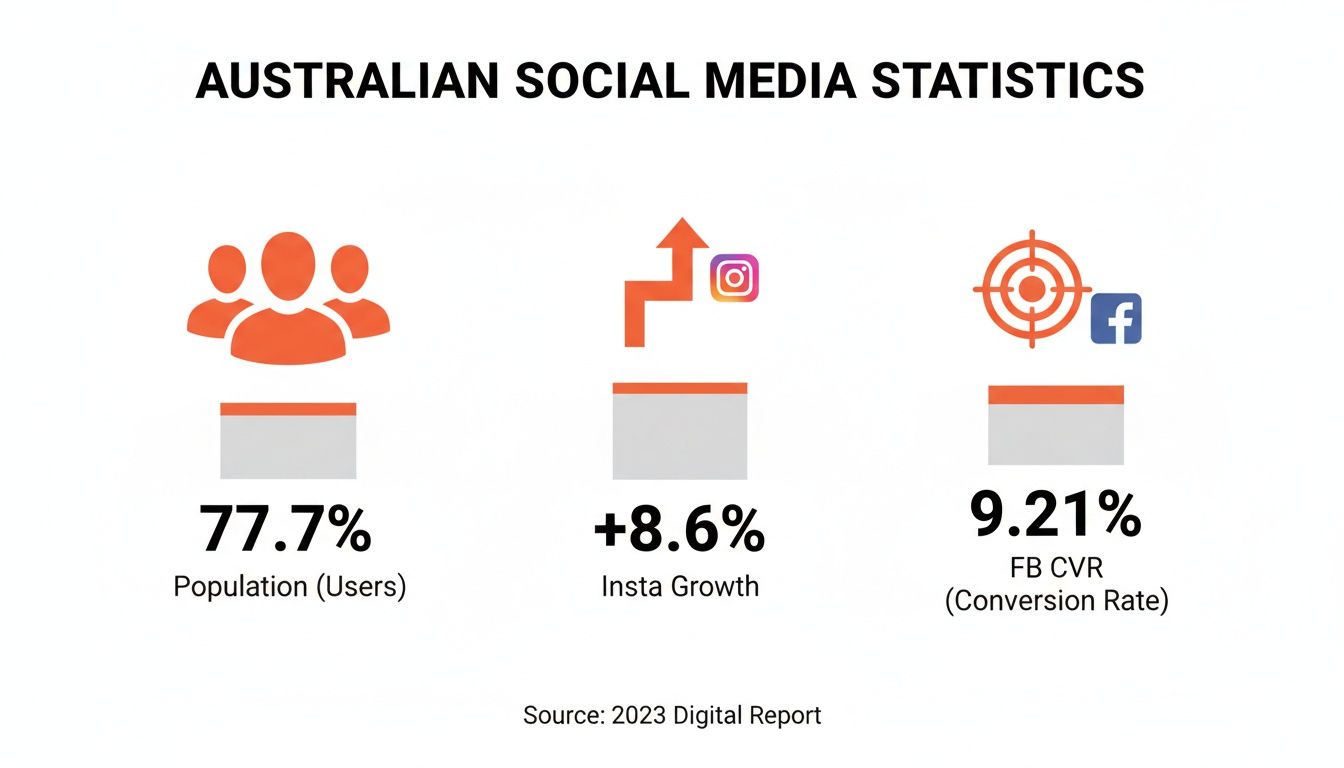
This data shows that Australian consumers aren't just on these platforms; they're actively engaging and converting. It makes channels like Meta a completely viable investment for real business growth.
Australian Digital Marketing Benchmarks by Channel
To make smart investment decisions, you need to know the typical market rates. While your exact numbers will shift based on your industry, competition, and how good your campaigns are, these benchmarks give you a solid financial starting point for planning.
Here’s a look at what you can expect to pay—and get back—from the most popular ad channels in Australia.
| Channel | Typical CPC Range (AUD) | Average CPL (AUD) | Target ROAS Benchmark |
|---|---|---|---|
| Google Ads | $2 – $8+ | $50 – $150 | 4:1 (400%) |
| Meta Ads (FB/IG) | $1 – $4 | $25 – $75 | 3:1 (300%) |
| LinkedIn Ads | $8 – $15+ | $100 – $300+ | 2:1 (200%) |
So, what do all these acronyms actually mean for your bottom line? Let's break it down.
- Cost Per Click (CPC): This is simply the price you pay every time someone clicks on your ad. Google's higher CPC makes sense when you remember the intent is sky-high—people are actively searching for what you sell. LinkedIn’s premium price is because you can target a specific B2B professional like no other platform.
- Cost Per Lead (CPL): This is what it costs you to get one potential customer to show interest, like filling out a form or calling you. A lower CPL isn’t always the winner. A higher CPL from LinkedIn might look expensive, but it could represent a CEO or a key B2B decision-maker worth ten times a cheaper lead.
- Return On Ad Spend (ROAS): This is the metric that truly matters. It’s the ultimate measure of whether your ads are making money. A 4:1 ROAS means for every $1 you spend, you get $4 back in revenue. This is the number that justifies your budget and tells you when it’s time to scale.
The goal isn't just to spend money; it's to generate a predictable and profitable return. A well-managed campaign should consistently hit or exceed these ROAS benchmarks, turning your ad spend into a reliable growth engine.
Getting a handle on these foundational metrics is the first step to mastering your marketing financials. For a deeper look into the specific KPIs you should be tracking, check out our complete guide to digital marketing performance metrics.
By tracking the right numbers, you can stop guessing and start making confident decisions, optimising your campaigns for pure profitability and proving the real value of your marketing efforts to anyone who asks.
Navigating Australian Digital Marketing Regulations
Running a business online in Australia means you’re playing in a well-regulated space. It might sound like a headache, but it’s better to think of these rules as a playbook for building customer trust and protecting your brand.
Getting this wrong isn’t really an option. Ignoring your obligations can lead to hefty fines and, just as importantly, some serious damage to your reputation.
To run digital marketing campaigns in Australia, you need to get your head around three core pillars of compliance. These aren't just legal hurdles to jump; they're the foundations of ethical marketing that customers now expect as standard.
The Three Pillars of Australian Marketing Compliance
Your compliance journey really starts with understanding these key pieces of legislation. Each one covers a different part of how you can talk to, and handle information about, your customers.
-
The Privacy Act 1988: This is all about how you collect, use, and store personal customer data. Think of things like names, email addresses, and purchase history as something you are borrowing. The Act says you have to be upfront about why you're collecting it and, critically, you must keep it secure.
-
The Spam Act 2003: This one sets the rules of engagement for sending commercial electronic messages, which covers both emails and SMS. The main principle here is consent. You must have clear permission to contact someone, you have to identify your business, and you must provide a simple, obvious way for them to unsubscribe.
-
ACCC Guidelines (Australian Consumer Law): The Australian Competition and Consumer Commission (ACCC) is the watchdog making sure all advertising is truthful and not misleading. This covers everything from the claims you make about your product to ensuring paid influencer posts are clearly disclosed as ads.
Think of these regulations as the terms and conditions for earning customer trust. When you respect a customer's data, their inbox, and their intelligence, you move beyond just a transaction. You start building a real, loyal relationship.
Common Pitfalls and How to Avoid Them
Knowing the rules is one thing, but applying them in the real world is where businesses often trip up. Let’s look at a couple of common scenarios where it's easy to get it wrong.
Scenario 1: The Mishandled Email List
An online clothing store runs a competition where people enter their email to win a voucher. The store then dumps all those emails into its weekly marketing newsletter list without asking. This is a classic breach of the Spam Act.
- How to Fix It: The competition entry form needs a separate, unticked checkbox. It should say something clear like, "Yes, I'd like to receive marketing emails and special offers from [Your Brand]." Consent must be actively given, not just assumed.
Scenario 2: The Unverified Product Claim
A supplement company runs a Facebook ad claiming their product "is proven to boost energy levels by 50%." The problem? They have zero scientific evidence to back up that specific number. This is a clear-cut violation of ACCC guidelines against false or misleading advertising.
- How to Fix It: Any claims you make must be accurate and verifiable. A better approach would be to say something like, "formulated to support energy levels," or to cite a specific, credible study if one actually exists.
Staying compliant isn't about holding your marketing back; it's about making it better. By operating transparently and ethically, you not only steer clear of penalties but also build a much stronger, more trustworthy brand that people will want to stick with for the long haul.
Choosing Your Path: DIY vs. Hiring an Agency
One of the biggest forks in the road you'll face is whether to run your digital marketing in-house or hire a specialist agency. This isn't just about cost; it's a strategic decision about where you invest your time, money, and energy to drive growth.
I like to think of it like healthcare. For a common cold, you're fine with your local GP. But for complex heart surgery, you want a specialist surgeon who has years of dedicated experience and a room full of precision tools. The exact same logic applies to your digital marketing here in Australia.
Deciding which path is right for you boils down to your business stage, your resources, and how fast you want to scale. There’s no single correct answer for everyone, but there is a right answer for your business, right now.
When to Go DIY with Digital Marketing
The DIY route can be incredibly empowering, especially for startups and small businesses. It keeps your costs down and gives you direct, hands-on control over your brand’s voice and direction. But this path demands a serious investment of your most precious resource: time.
A successful DIY approach is a lot more than just boosting a few posts here and there. You have to commit to genuinely learning and mastering several key areas:
- Deep Platform Knowledge: You’ll need to get your head around the mechanics of platforms like Google Ads and Meta Ads, from bidding strategies to audience targeting and campaign setup.
- Analytical Skills: Success comes from constantly digging into the data, understanding metrics like CPC and ROAS, and making informed decisions to fine-tune your campaigns.
- Creative and Copywriting Skills: You're the one on the hook for writing compelling ad copy, designing visuals that stop the scroll, and building landing pages that actually convert visitors.
- Time Commitment: Effective marketing isn't a "set and forget" activity. It demands constant monitoring, testing, and tweaking to stay ahead of your competitors.
Going it alone is often the best fit for businesses with a very tight budget, a straightforward product or service, and a founder or team member who is genuinely keen to learn the craft of digital marketing.
When to Hire a Digital Marketing Agency
Hiring an agency is like bringing that specialist surgeon onto your team. You're not just paying someone to push buttons and run ads; you're investing in expertise, efficiency, and immediate access to advanced tools and proven strategies that would take you years to develop from scratch.
An agency's true value isn't just in the tasks they perform, but in the strategic oversight they provide. They’ve seen what works (and what doesn't) across dozens of businesses and can apply those learnings to accelerate your growth from day one.
Partnering with an agency becomes the smarter move when:
- You Value Your Time Over Cost: If your time is better spent running the business, managing your team, or developing products, then outsourcing your marketing is a no-brainer.
- You Need to Scale Quickly: Agencies already have the systems, processes, and experience to scale campaigns far faster and more predictably than a single person learning the ropes.
- You're in a Competitive Market: In a crowded industry, you need an expert edge. An agency brings advanced strategies and a deep understanding of the competitive landscape to the table.
- You Want Access to Expertise: A good agency gives you a whole team of specialists—in SEO, PPC, social media, and analytics. That's a level of brainpower that’s practically impossible for a small business to hire in-house.
Making the right choice between DIY and hiring an agency is all about an honest assessment of your resources, skills, and ambitions. Choosing the path that lines up with your business goals is the first critical step in turning your marketing from an expense into a powerful engine for growth.
Frequently Asked Questions
When it comes to digital marketing in Australia, we hear the same practical questions from business owners time and time again. Let's cut through the noise and get straight to the answers you need to get started, find your focus, and actually measure what's working.
How Much Should a Small Business Budget for Digital Marketing?
A realistic starting point for most small businesses in Australia is somewhere between $2,000 to $5,000 per month. This budget should cover both your actual ad spend and any agency management fees, giving you enough firepower to properly test one or two high-impact channels like Google Ads or Meta Ads.
But here’s the thing: the initial number isn't what matters most. It’s the strategy behind it. It's far smarter to begin with a scalable budget, obsessively track your Return On Ad Spend (ROAS), and then confidently reinvest your profits back into the campaigns that are proven winners.
For example, a local plumber might put their starting budget into Local SEO and targeted Google Search ads to catch people who need help right now. An e-commerce startup, on the other hand, would probably get better bang for their buck by focusing on Google Shopping and Instagram ads. Think of your budget not as a fixed cost, but as a calculated experiment that you scale once you have the data to back it up.
Which Digital Marketing Channel Is Best for B2B Leads?
For generating high-quality Business-to-Business (B2B) leads in Australia, nothing beats the one-two punch of LinkedIn Ads and Google Search Ads. These channels work in tandem, covering different, crucial stages of the client-hunting journey.
LinkedIn is in a league of its own for targeting specific job titles, industries, and company sizes. It’s the go-to platform for getting your message directly in front of key decision-makers, building brand authority, and executing precise account-based marketing campaigns.
At the same time, Google Ads lets you capture high-intent prospects who are actively searching for a solution like yours at this very moment. A truly effective B2B strategy uses Google to mop up this immediate, bottom-of-funnel demand, while leveraging LinkedIn for the longer-term game of top-of-funnel brand building and targeted outreach.
While paid channels deliver instant traffic, don't sleep on SEO. Over the long haul, a solid SEO strategy built around creating genuinely valuable industry content is the single most powerful way to build a sustainable, low-cost pipeline of inbound B2B leads.
How Long Does It Take to See Results from Digital Marketing?
The timeline for seeing tangible results really depends on the channel you're using. It's critical to set the right expectations for each.
-
Pay-Per-Click (PPC) Advertising: With channels like Google Ads or Meta Ads (Facebook & Instagram), you can start seeing traffic, engagement, and even leads within days of launching your first campaign. But turning that initial activity into consistent profitability and a strong ROAS usually takes 1-3 months of hands-on management and refinement.
-
Search Engine Optimisation (SEO): SEO is a different beast entirely. Think of it as a long-term investment in a valuable digital asset. You should start seeing early positive signs—like better keyword rankings and a small lift in organic traffic—within 4-6 months. The big, compounding results that really move the needle for your business typically start kicking in from the 6-12 month mark and grow from there.
A well-rounded strategy often uses the immediate feedback from PPC to generate revenue and gather market data, while simultaneously investing in SEO to build a dominant, long-term organic presence that drives down your customer acquisition costs over time. This dual approach gives you both the short-term wins you need and the sustainable growth you want.
Ready to stop guessing and start getting real results from your advertising spend? The team at Click Click Bang Bang specialises in precision-driven PPC and AI-first SEO to help Australian businesses scale. We offer transparent, flexible plans with a 30-day risk-free trial. Learn more and book your free strategy session with us today.
Read NeXt
Or Read Our Latest
- Manual vs Automated Bidding for PPC Success
- Conversion Tracking Setup: A Complete AU Guide
- Instagram Advertising Australia: Complete 2026 Guide
- Pay Per Click: A Beginner’s Guide for Australian Marketers
- Display Advertising on Google: The Complete Australian Guide
- Stakeholder Communication Plan How to Build One That Works
Click. CLick. Subscribe.
Get our best PPC insights, industry updates, and power moves delivered straight to your inbox. No fluff, just high-caliber strategies that actually work.
Don’t Leave Just Yet
Try Us For 30-Days,
Risk Free!!
We guarantee that you’ll love our work within the first 30 days, if not you’ll get your money back.
What have you got to lose?