

Boost Your Store with ecommerce seo marketing: A Practical Guide
Last Updated
Ecommerce SEO marketing is really just the art of getting your online store seen in search results on places like Google. It’s a blend of technical tune-ups, smart content strategy, and building up your store’s authority online. The whole point is to pull in shoppers who are already looking for what you sell, which ultimately drives more organic traffic and, of course, more sales.
Building a Rock-Solid Technical SEO Foundation
Before a single customer can find your products, search engines need to be able to find and understand your store. The technical side of your website is the bedrock of any successful ecommerce SEO marketing strategy. It’s all about creating a clean, fast, and easily crawlable site that sets you up for success down the line.
Think of your website's architecture like the floor plan of a physical shop. If the layout is a mess, shoppers—and search engine crawlers—will get lost and leave. A logical structure guides them smoothly from your homepage to categories and right down to the specific product they’re after. Getting this clarity is fundamental.
Designing a Logical Site Architecture
A well-organised site doesn’t just happen. It takes careful planning to make sure both people and search engines can find what they need without hitting dead ends. The goal is simple: make every important page discoverable within just a few clicks from the homepage.
- Homepage: This sits at the top, linking out to all your major product categories.
- Category Pages: These are the aisles of your store, grouping related items (e.g., "Men's Running Shoes"). From here, you link down to subcategories or individual products.
- Product Pages: The final stop where the magic happens and a sale is made.
This clean, scalable structure is your best defence against "orphan pages" (pages with no internal links pointing to them) and helps spread link authority effectively across your entire site.
This infographic breaks down the core process, showing how a solid technical SEO plan moves from architecture to content and finally to implementing schema.
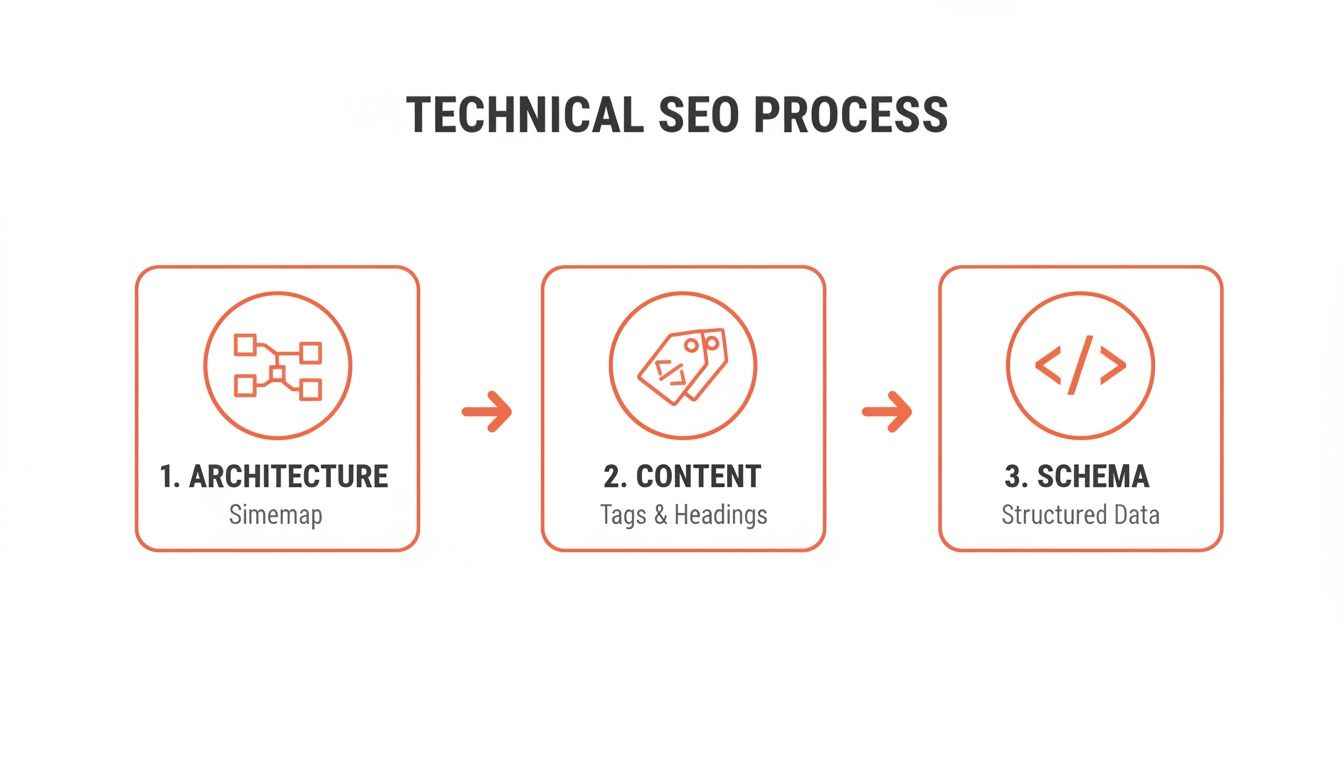
As you can see, a strong technical base starts with a clean structure before you even think about layering on content and more advanced markup.
Managing Duplicate Content with Canonical Tags
Ecommerce stores are notorious for duplicate content problems. Think about it: product variations like size, colour, or material often create unique URLs with nearly identical content, which really confuses search engines. A single t-shirt available in five colours could easily spawn five different URLs, splitting your SEO value five ways.
This is where the canonical tag (rel="canonical") becomes your best mate. By adding this little tag to your variant pages, you're telling Google which URL is the "master" version you want it to index. This simple fix consolidates all your ranking signals into one powerful page and helps you avoid any penalties for duplicate content.
Pro Tip: Don't forget to use canonical tags on pages generated by filtered navigation, like when a user sorts by price or brand. This keeps your search results tidy and focuses Google’s crawling efforts on your main category pages.
To really nail ecommerce SEO, you first need a clear grasp of What is Search Engine Optimization. This foundation helps you understand why these technical details are so critical for getting seen.
Earning Rich Snippets with Structured Data
Structured data, also known as Schema markup, is a bit of code you add to your site to help search engines understand your content in much greater detail. For an ecommerce site, this is a massive advantage.
By implementing product schema, you can spoon-feed Google important details like:
- Price
- Availability (In Stock / Out of Stock)
- Review Ratings
- Brand Name
This information can then show up directly in the search results as "rich snippets"—those eye-catching listings with star ratings and pricing info. We’ve seen time and again how these snippets dramatically improve click-through rates, making your products stand out from the sea of plain blue links. A solid technical base makes all your other marketing efforts that much more effective. For a deeper dive, check out our comprehensive guide on Search Engine Optimisation.
Turning Product Pages into Conversion Engines
Your product and category pages are the digital sales floor of your ecommerce business. Get these right, and you're golden. While a solid technical foundation gets search engines to your door, it’s the optimisation of these crucial pages that convinces browsers to become buyers.
This is where your ecommerce seo marketing efforts pay off, translating directly into revenue.
The goal is simple: create pages that don't just list features but tell a story and solve a customer's problem. Whether someone is searching for "women's running shoes" or something super specific like "lightweight trail running shoe size 8," each page must be finely tuned to capture their intent and guide them smoothly toward checkout.

Crafting Compelling Product Descriptions
So many online stores drop the ball by using generic, manufacturer-supplied product descriptions. This is a massive missed opportunity for both SEO and sales. Why? Because it leads to duplicate content across countless retail sites, which kills your page's authority in Google's eyes.
Writing unique, benefit-focused descriptions is your secret weapon. Don't just list the specs; explain how those features actually help the customer. A "water-resistant Gore-Tex lining" becomes "keep your feet dry and comfortable on rainy morning runs." See the difference?
Key Takeaway: Always write for the human first and the search engine second. A description that connects with a customer's needs will naturally be more effective and almost always includes the long-tail keywords they're searching for anyway.
For a deeper dive into getting your product pages ranking and converting, check out this guide on Mastering Ecommerce Product Page SEO in Australia.
Optimising Images for Search and Sales
In ecommerce, high-quality product images are non-negotiable. Customers can't touch or feel your products, so your photos need to do all the heavy lifting. Show the product from every angle, show it in use, and don't forget detailed close-ups.
From an SEO perspective, every single image is a chance to rank. Make sure you're optimising them properly:
- Use Descriptive Filenames: Ditch
IMG_8452.jpgand go for something likewomens-nike-pegasus-trail-running-shoe.jpg. It’s a small thing that makes a big difference. - Write Detailed Alt Text: This helps search engines understand what an image is about and is vital for accessibility. A great example would be, "A woman's black Nike Pegasus trail running shoe shown on a rocky path."
- Compress Your Images: Large images are page speed killers, and slow pages kill conversions. Compress them without sacrificing quality.
Nailing these steps can get your products discovered through Google Images, which is a surprisingly significant source of traffic for many ecommerce stores.
Leveraging Social Proof and User-Generated Content
Nothing builds trust faster than authentic customer feedback. Integrating customer reviews and user-generated content (UGC) directly onto your product pages is an absolute powerhouse move for both SEO and conversions.
Reviews provide a constant stream of fresh, relevant content that search engines love. Better yet, they're packed with the natural language and long-tail keywords your actual customers use, helping you rank for a much wider range of search queries.
Displaying star ratings prominently can also help you earn rich snippets in the search results, which makes your listing stand out and boosts click-through rates.
This approach transforms your product pages from static brochures into dynamic, trustworthy resources that give visitors the confidence to click 'Add to Cart'. You can find even more conversion-boosting ideas in our comprehensive landing page optimisation checklist.
Winning the Mobile-First Ecommerce Game
Let's be blunt: the modern customer journey almost always starts on a smartphone. Ignoring this isn't just a missed opportunity; it's a direct path to obscurity in the cut-throat world of ecommerce seo marketing. Mastering a mobile-first approach means accepting that a flawless experience on a tiny screen is the new standard for success.
This goes way beyond just making your site look okay on a phone. We're talking about a responsive design that's truly flawless, page speed that's practically instant, and every single interaction feeling intuitive for someone on the go. Shoppers' patience is wafer-thin, and a slow or clunky mobile site will send them running straight to your competitors.

The data backs this up in a big way. Mobile commerce is absolutely dominant in Australia, with 95% of Aussies now shopping via their smartphones. This accounted for 77% of all eCommerce site visits and 68% of orders in a recent quarter. It's a massive shift that demands your marketing strategy becomes laser-focused on mobile optimisation—especially since Google's mobile-first indexing is now the law of the land for getting seen. You can dive deeper into these numbers with these Australian ecommerce trends on redsearch.com.au.
Nailing Page Speed and Core Web Vitals
For anyone shopping on their phone, speed isn't a feature—it's a basic expectation. A page that takes longer than three seconds to load might as well be a broken page. Google sees it the same way, which is why Core Web Vitals have become such a heavy-hitting ranking factor.
These aren't just technical jargon; they measure the actual user experience of your site:
- Largest Contentful Paint (LCP): How fast does the main, visible content load? You need to be aiming for under 2.5 seconds.
- First Input Delay (FID): How quickly does your page respond when a user clicks a button or taps a link? Get this under 100 milliseconds.
- Cumulative Layout Shift (CLS): How much does your page content jump around unexpectedly while it’s loading? A low score means a stable, non-frustrating experience.
To get these scores in the green, zero in on compressing images, using a Content Delivery Network (CDN) to serve files faster, and cutting down on any heavy scripts that slow down the page rendering.
Designing a Thumb-Friendly User Experience
Once your site is fast, you have to make it usable. A design built for a desktop mouse doesn't just magically work for a thumb on a small screen. You have to rethink every element from a mobile user's perspective.
Your goal is to create a totally frictionless journey, from the moment they discover a product to the final purchase confirmation.
This really boils down to:
- Large, Tappable Buttons: Make sure your call-to-action buttons and menu links are big enough to tap easily without hitting something else by mistake.
- Simplified Navigation: Use a clean, obvious "hamburger" menu and keep your main navigation stripped down to the absolute essentials.
- Streamlined Forms: Slash the number of fields in your checkout process. Seriously. Offer guest checkout and one-tap payment options like Apple Pay or Google Pay to kill off tedious typing.
A Quick Tip: Do this right now: go through your own checkout process on your phone. If you find yourself getting annoyed, or having to pinch and zoom all over the place, your customers are feeling that exact same pain—and probably abandoning their carts because of it.
Mobile SEO Optimisation Checklist
To stay on track, it helps to have a clear checklist. Here’s a prioritised list of actions to ensure your ecommerce site is fully optimised for mobile users and Google's mobile-first index.
| Optimisation Area | Key Action | Why It Matters |
|---|---|---|
| Responsive Design | Ensure your site fluidly adapts to all screen sizes, from small phones to large tablets. | This provides a consistent and user-friendly experience, which is a foundational ranking signal for mobile-first indexing. |
| Page Speed | Target an LCP under 2.5 seconds. Compress images and use next-gen formats like WebP. | Slow-loading pages have high bounce rates. Speed is a critical factor for both user satisfaction and Core Web Vitals. |
| Thumb-Friendly UI | Use large buttons, ample spacing between tappable elements, and legible font sizes. | Prevents "fat-finger" errors and user frustration, leading to smoother navigation and higher conversion rates. |
| Simplified Navigation | Implement a clear, intuitive "hamburger" menu and keep the primary navigation minimal. | Mobile users need to find what they're looking for quickly. A cluttered menu leads to abandonment. |
| Streamlined Checkout | Reduce form fields, offer guest checkout, and integrate mobile payment options. | Every extra step in the checkout process is a potential point of cart abandonment. A frictionless process is key to sales. |
| Voice Search Optimisation | Incorporate natural, conversational language and question-based keywords in your content. | Mobile users frequently use voice search for queries. Aligning your content with how people speak captures this traffic. |
| Local SEO | Keep your Google Business Profile updated with accurate address, hours, and contact info. | Many mobile searches have local intent (e.g., "shoe stores near me"). This makes your physical stores visible. |
Working through this list will put you miles ahead of competitors who are still treating mobile as an afterthought.
Capturing Conversational Voice Search Queries
The explosion of smart speakers and voice assistants has completely changed how people search. Mobile users are now more likely to speak their queries than type them, which results in longer, more conversational phrases. Your ecommerce seo marketing strategy needs to be smart enough to capture this intent.
Instead of just targeting a keyword like "waterproof jackets," you need to be optimising for real-world queries like, "find a local store with waterproof jackets" or "order coffee beans online for next-day delivery."
Here's how you can start adapting:
- Use Question-Based Keywords: Build questions and answers directly into your product descriptions, blog content, and FAQ pages. Think "What," "How," and "Where."
- Double Down on Local SEO: If you have physical stores, make sure your Google Business Profile is perfectly optimised with your address, hours, and phone number.
- Write Like a Human: Structure your content in a natural, conversational tone that mirrors how people actually talk. This helps search engines match your pages to voice queries much more effectively.
Building Authority with Content and Backlinks
Having fantastic product pages and a technically flawless website is a great start, but it's not enough to make you a trusted authority in Google's eyes. In a crowded market, you have to actively prove your expertise and earn trust. This is where a smart content strategy and high-quality backlinks can elevate your ecommerce seo marketing from good to great.
Content marketing for an online store isn't about pumping out random blog posts and hoping for the best. It’s about creating genuinely valuable resources that meet your customers at every single stage of their buying journey. The goal is to become the most helpful expert in your niche, answering questions they didn't even know they had.
Developing a Customer-Centric Content Plan
A powerful content plan anticipates the exact questions your ideal customers are typing into search engines. You're essentially building a web of helpful information that guides them, step-by-step, towards your products.
Start by mapping out the customer journey:
- Awareness Stage: The customer has a problem but isn’t sure about the solution. They might search for something like, "how to choose the right running shoe for flat feet." This is where you need educational blog posts or in-depth guides.
- Consideration Stage: Now they know the type of product they need and are comparing their options. A search might look like, "best trail running shoes vs road running shoes." Detailed comparison articles and buying guides are perfect here.
- Decision Stage: They're ready to pull the trigger and are looking for a specific product or deal. Their search could be "Nike Pegasus Trail 4 review." This is the time for expert product reviews, case studies, and user-generated content.
By creating content that’s laser-focused on each stage, you build trust and stay on their radar from their first Google search right through to the checkout.
Key Insight: The most successful content strategies don't just sell products; they solve problems. When you become the go-to resource for information in your niche, the sales will naturally follow.
This approach proves you're more than just a seller; you're an expert partner committed to helping them make the best possible choice.
Earning High-Quality Backlinks That Actually Move the Needle
Backlinks—links from other websites pointing to yours—are still one of Google's most powerful signals for authority. Think of each backlink as a vote of confidence from another site. But not all votes are created equal. A single link from a well-respected industry blog is worth a hundred times more than links from low-quality, irrelevant directories.
The real goal is to earn these backlinks naturally by creating content assets that other people genuinely want to share and reference.
Here are a few practical, white-hat tactics that I’ve seen work time and time again:
- Collaborate with Industry Bloggers: Reach out to respected bloggers and influencers in your space. Don't just ask for a link; offer them a product to review honestly. A genuine, detailed review provides a powerful backlink and, just as importantly, puts your product in front of a highly targeted and engaged audience.
- Create Link-Worthy Resources: Develop content that's so incredibly useful people can't help but link to it. This could be the definitive "how-to" guide on a topic, an original research report with fresh data, or a slick infographic that simplifies a complex subject in your industry.
- Get Featured in Gift Guides: Be proactive. Contact publications and blogs that produce "Best Of" lists and holiday gift guides relevant to your products. Getting featured in a popular guide can drive a ton of referral traffic and land you a high-authority backlink in the process.
This isn't about spammy link-building schemes; it's about building real relationships and creating undeniable value. By pairing a strategic content plan with a focused link-earning effort, you establish the kind of authority that fuels sustainable organic growth for years to come.
Using Data and AI to Sharpen Your SEO Edge
The future of ecommerce SEO isn’t just about keywords and backlinks anymore. It’s smarter, more personal, and powered by intelligent insights. Moving beyond the standard playbook means taking your most valuable asset—customer data—and giving it a serious boost with Artificial Intelligence.
This isn't about letting technology replace your marketing brain; it's about making it sharper. When you can properly analyse user behaviour and hand off the grunt work to AI, you start making data-driven decisions that give you a real competitive advantage in a ridiculously crowded market.
Harnessing First-Party Data for Personalisation
First-party data is the gold you collect directly from your audience. Think purchase history, on-site behaviour, email sign-ups—all the good stuff. This is your secret weapon for creating customer journeys that actually feel relevant. Once you understand what your customers have bought, what they've browsed, and what they’ve left in their cart, you can personalise every single interaction.
Instead of hitting everyone with a generic "New Arrivals" banner, you can show a specific user new products from a category they constantly browse. It’s this level of customisation that turns a passive scrolling session into an engaging, personal shopping experience, which is exactly what builds loyalty and drives up conversion rates.
And the demand for this is crystal clear. With 95% of Australian consumers willing to share their data for incentives and 58% using loyalty programs more often, data-driven personalisation is no longer a "nice-to-have." It’s essential. This is especially true when you consider that 61% of Gen Z and 62% of Millennials are now demanding personalised sales. That makes your first-party data a critical asset for effective ecommerce SEO. You can dig into more of these consumer trends in this detailed industry report.
Integrating AI into Your SEO Workflow
Artificial Intelligence isn't some far-off concept anymore; it's a practical toolkit for any modern SEO. AI-powered tools can handle the heavy lifting on all those repetitive tasks, freeing you up to focus on big-picture strategy and creative execution. For any ecommerce team, that kind of efficiency is a game-changer.
Think about these practical applications:
- Automated Keyword Research: AI can crunch huge datasets to uncover long-tail keywords and content gaps you’d probably miss, often spotting emerging trends before they get hyper-competitive.
- Content Generation and Optimisation: Use AI to spit out first drafts of product descriptions, meta descriptions, or even blog post outlines. Of course, a human touch is crucial for brand voice and quality, but this speeds up the content pipeline dramatically.
- Competitor Analysis at Scale: AI tools can monitor your competitors’ SEO strategies in real-time, keeping tabs on their keyword rankings, backlink profiles, and content updates. This gives you actionable intel without the manual slog.
My Two Cents: I’ve found AI is most powerful when you treat it like an assistant, not a replacement. Use it to generate 10 variations of a product description, then you pick the best one and polish it with your brand's unique flavour. It’s that blend of machine speed and human creativity where the real magic happens.
Predictive Analytics for Proactive Marketing
Going beyond simple personalisation, data analytics lets you start predicting what your customers will do next. By analysing patterns in your data, you can anticipate which customers are likely to churn, who might be ready for an upsell, and what products are about to start trending.
This kind of predictive insight allows you to be proactive instead of constantly reacting.
Imagine automatically sending a special offer to a customer segment that is statistically likely to buy something in the next week. Or using predictive analytics to sort out your inventory, making sure you’ve got enough stock of a product that’s about to see a surge in demand. This is the core of smart ecommerce seo marketing.
To pull these strategies off, you need a crystal-clear view of your performance metrics. Tracking the right data is the bedrock of making informed decisions. To get a better handle on this, check out these practical marketing KPI dashboard examples that can help you visualise your success and spot new opportunities for growth. When you marry rich data with AI-driven tools, you build a marketing engine that’s not just effective, but resilient and responsive too.
Common Ecommerce SEO Marketing Questions
Even with a killer strategy, plenty of questions pop up when you're deep in the trenches of ecommerce SEO. It's totally normal to wonder about timelines, what numbers actually matter, and where to put your marketing dollars. Let's get straight to it and answer some of the most common questions we hear from store owners.
How Long Does It Take for Ecommerce SEO to Show Results?
This is the big one, and the honest answer is that ecommerce SEO marketing is a marathon, not a sprint. You’re building a long-term, sustainable asset for your business, not chasing a quick sugar hit.
Generally, you can expect to see some early signs of life within 3 to 6 months of consistent, focused work. This looks like a bit of upward movement in your keyword rankings and maybe a small bump in organic traffic. It’s the first signal that Google is noticing your efforts.
But the real, revenue-driving results—the kind that actually fatten your bottom line—typically take 6 to 12 months to properly kick in. Of course, that timeline depends on a few key things:
- Industry Competitiveness: If you're selling artisanal dog hats in a niche market, you'll see results faster than someone trying to rank for "women's running shoes".
- Your Site's Current Health: A site with a clean bill of technical health will get moving much quicker than one bogged down with legacy issues.
- Strategy Execution: The quality and consistency of your content, on-page tweaks, and link-building efforts are the engine driving your progress.
Think of it like pushing a boulder. The first few months are tough, just getting it to budge. But once it starts rolling, the momentum builds, and that's when you see that hard work compound into serious growth.
What Are the Most Important Metrics to Track?
Watching your keyword rankings climb is satisfying, for sure, but it doesn't tell you the whole story. To really gauge the success of your ecommerce SEO, you need to laser-focus on the metrics that are directly tied to business outcomes. Vanity metrics don't pay the bills.
The only metrics that truly matter are the ones connecting your SEO activities to actual revenue. If you can't measure the financial impact, you're just flying blind.
Here are the key performance indicators (KPIs) that should be front and centre on your dashboard:
- Organic Revenue: This is the undisputed champion. It's the dollars and cents flowing into your business directly from your SEO investment.
- Organic Conversion Rate: Are the people finding you through search actually buying? This metric tells you all about the quality of the traffic you're attracting.
- Organic Traffic: How many people are finding your store through non-paid search? This is your top-of-funnel indicator of growth and brand visibility.
- Keyword Rankings (for commercial terms): Keep a close eye on your positions for high-intent keywords that signal a readiness to buy, not just broad, informational terms.
- Average Order Value (AOV) from Organic Traffic: This helps you understand the spending power of the customers SEO is bringing to your door.
Tracking these five together gives you a full, 360-degree view of your ecommerce SEO performance and its true return on investment.
Should I Focus on SEO or PPC for My Store?
This isn't an "either/or" dilemma; it's a "both/and" strategy. For any serious ecommerce store, the most powerful approach is to run SEO and Pay-Per-Click (PPC) advertising in tandem. They work together to create an incredible synergy.
SEO is your long game. It's how you build sustainable, organic traffic and authority that grows into a valuable, compounding asset over time. It’s the very foundation of your online presence.
PPC, on the other hand, gives you immediate visibility and traffic. It's perfect for launching new products, pushing seasonal promotions, or quickly testing the waters with new keywords before you commit to a long-term SEO play for them.
The best part is, they actively feed each other. Insights from your PPC campaigns—like which ad copy converts best or what keywords drive sales—can be gold for your SEO strategy. At the same time, a strong organic presence can boost your ad Quality Score, which often leads to lower ad costs. Don't choose one; use both for maximum growth.
Ready to create a powerful synergy between your SEO and PPC campaigns? The team at Click Click Bang Bang specialises in data-driven strategies that get real results. Explore our services at https://clickclickbangbang.com.au and see how we can help you grow.
Read NeXt
Or Read Our Latest
- Manual vs Automated Bidding for PPC Success
- Conversion Tracking Setup: A Complete AU Guide
- Instagram Advertising Australia: Complete 2026 Guide
- Pay Per Click: A Beginner’s Guide for Australian Marketers
- Display Advertising on Google: The Complete Australian Guide
- Stakeholder Communication Plan How to Build One That Works
Click. CLick. Subscribe.
Get our best PPC insights, industry updates, and power moves delivered straight to your inbox. No fluff, just high-caliber strategies that actually work.
Don’t Leave Just Yet
Try Us For 30-Days,
Risk Free!!
We guarantee that you’ll love our work within the first 30 days, if not you’ll get your money back.
What have you got to lose?