

seo on page seo off page: On-Page vs Off-Page SEO Guide
Last Updated
To really get your head around on page seo off page, it helps to think of your website as a brand-new theatre production.
- On-page SEO is everything you control that happens on the stage. The script, the actors, the set design, the lighting – it’s all the stuff you can directly perfect to create an amazing show.
- Off-page SEO is the buzz your show generates all over town. It’s the rave reviews from critics, the word-of-mouth recommendations, and the posters you see plastered everywhere that convince people your show is the one to see.
Understanding the Two Halves of Search Engine Success

This isn’t just a handy analogy; it perfectly mirrors how search engines like Google decide which websites get the spotlight. A flawless performance on stage (on-page SEO) is absolutely essential. But if there’s no audience buzz and no critical acclaim (off-page SEO), you’re playing to an empty theatre.
These two sides of SEO aren't separate strategies you can pick and choose from. They’re two parts of the same whole, working in sync. You could have the most technically sound, beautifully written website in all of Australia, but if no one else on the internet is referencing it, search engines will see it as irrelevant.
On-page SEO proves your relevance to a search query. Off-page SEO proves your credibility and authority. You need both to win.
To quickly break down the core differences and how they work together, here’s a simple comparison.
On-Page vs Off-Page SEO At a Glance
| Aspect | On-Page SEO | Off-Page SEO |
|---|---|---|
| Core Focus | Optimising elements on your website to be clear and useful for search engines and users. | Building your website's authority and reputation across the internet. |
| Control Level | 100% direct control over all factors. | Indirect control; you can influence but not dictate these signals. |
| Primary Tactics | Content quality, keyword optimisation, technical health (site speed, mobile-friendliness), user experience. | Backlink building, brand mentions, online reviews, social media presence. |
| Ultimate Goal | To make your website the most relevant and high-quality answer for a user's query. | To prove to search engines that your website is trustworthy, authoritative, and popular. |
This table shows how each discipline has its own role, but you can see how they’re designed to support each other. A great on-page experience makes earning off-page signals much easier.
On-Page SEO: The Performance on Your Stage
On-page SEO covers every single action you take directly on your website to improve its rankings. It’s all about making your site as clear, helpful, and accessible as possible for both search engine bots and, more importantly, your human visitors. This is your foundation.
The key elements of on-page SEO include:
- High-Quality Content: This is your script. It means creating genuinely valuable articles, guides, and pages that answer your audience's questions better than anyone else.
- Keyword Optimisation: Think of this as your dialogue. It involves strategically weaving relevant keywords and phrases into your titles, headings, and text so Google understands what each page is about.
- Technical Health: This is your stage and set design. A fast-loading, mobile-friendly site with a secure (HTTPS) connection and a logical structure is non-negotiable.
- User Experience (UX): This is the overall production quality. Is your site easy to navigate? Is it enjoyable to use? A great UX keeps people on your site longer, which is a massive signal to Google.
If you nail these components, you’ve got a fantastic show ready for an audience.
Off-Page SEO: Building Your Reputation Around Town
In contrast, off-page SEO is everything you do away from your website to build its authority and trustworthiness. This is how you demonstrate to search engines that your site is a respected and important voice in your industry.
"Social media is like a job: you only get paid clients if you keep posting. Ads are like a loan: you borrow attention, and pay interest on it daily. SEO is like investing: the returns are slower at first, but compound over time."
This idea perfectly captures the long-game nature of building authority. Off-page signals are essentially third-party endorsements telling Google that other credible sources vouch for your content.
The primary tactics for off-page SEO are:
- Backlinks: This is the big one. Earning links from other reputable websites is like getting a five-star review from a major critic. It’s a powerful vote of confidence.
- Brand Mentions: Getting your brand name talked about on other sites, in forums, or on social media, even without a link, shows that you’re part of the conversation.
- Online Reviews: Encouraging positive reviews on platforms like your Google Business Profile and other industry sites builds social proof and trust.
- Social Media Marketing: Having a strong social presence doesn't directly impact rankings, but it amplifies your content, increases visibility, and can lead to more links and mentions.
When you master both seo on page seo off page, you create a powerful feedback loop. Excellent on-page SEO makes your site worthy of earning those off-page signals, and those signals, in turn, boost your authority, driving even more traffic and success.
Mastering Your On-Page SEO Blueprint
Alright, enough with the theory. Let's get our hands dirty and start building the blueprint for your on-page success. A solid on-page strategy isn't just about ticking boxes for Google; it’s about creating a website that search engines can actually understand and, more importantly, that your audience loves using. Think of it as the foundation of your entire SEO house.
To get started, it’s worth taking a moment to properly understand What is On-Page SEO. Getting this right from the beginning means every decision you make—from site structure to content—is deliberate and impactful.
This is where the magic happens, blending technical precision with creative flair. You’re aiming to craft content that genuinely solves problems while making sure your site’s technical health is absolutely flawless.
Keyword Research and Content Strategy
First things first: you need to speak your customer's language. Keyword research isn't about mindlessly stuffing phrases onto a page. It's about uncovering the exact problems your audience is desperately trying to solve.
For Aussie businesses, this means getting granular with local search intent. A search for "footy boots" in Melbourne means something completely different than it does in Miami. Using the right tools to unearth these nuanced, long-tail keywords gives you a direct line into your customers' heads.
Once you’ve got your keywords, it’s all about creating content that delivers serious value. This usually falls into a few key buckets:
- In-depth Guides: Think comprehensive, go-to resources that become the definitive answer on a topic.
- How-To Articles: Practical, step-by-step instructions that solve a very specific problem for your audience.
- Product or Service Pages: Crystal-clear, persuasive pages that detail what you offer, optimised for keywords that signal someone is ready to buy. For online stores, this is the bread and butter of their e-commerce SEO services.
The common thread here? Value. Your content needs to be the absolute best, most helpful answer a person can find for what they’re searching for.
Optimising Your On-Page Elements
With amazing content ready to go, the next step is to make sure search engines can see and appreciate its value. This means fine-tuning a few critical on-page elements.
Title Tags and Meta Descriptions
These are your website’s digital billboard on the search results page. Your title tag is the clickable headline, and the meta description is that short snippet of text underneath.
A great title tag should grab attention, include your main keyword, and spark curiosity. The meta description then has to deliver on that promise, giving the searcher a compelling reason to click your link over the nine others staring back at them.
Your title tag and meta description are your first—and sometimes only—chance to make an impression. They are a promise to the searcher about the value they will find on your page.
Heading Tags (H1, H2, H3)
Headings give your content structure, making it easy to read for both humans and search engines. Your main title is always the H1, and you should only ever have one per page. Subheadings (H2s, H3s, etc.) break the text up into logical, scannable chunks.
This isn’t just about making things look pretty. A clean heading structure helps Google understand the hierarchy and key topics of your content, a crucial piece of the on page seo off page puzzle.
The Technical Foundation of On-Page SEO
Even the most brilliant content will fall flat if it’s sitting on a shaky technical foundation. Technical SEO is a non-negotiable part of on-page optimisation, ensuring your site is fast, secure, and a breeze for search engine crawlers to navigate.
A few key technical elements to nail include:
- Page Speed: People are impatient. Users expect pages to load in under three seconds. Slow sites lead to high bounce rates, which screams "bad user experience" to Google.
- Mobile-Friendliness: With most searches now happening on mobile, a responsive design that looks and works perfectly on any screen is absolutely essential.
- Clean URL Structure: Your URLs should be simple, descriptive, and ideally contain your primary keyword. This helps both users and search engines understand what the page is about with just a quick glance.
The Australian internet advertising market recently soared by 11.6% to hit $4.2 billion in a single quarter, with search revenue alone accounting for $1.896 billion. Organic search is a massive driver of this, bringing in 53% of all website traffic for SMBs. On top of that, data shows that consistent blogging—a core on-page tactic—can boost traffic by a staggering 55%, showing the direct commercial impact of a strong on-page game.
Get these on-page elements right, and you’ll build a powerful foundation that makes your site a trusted destination for both users and search engines. It’s the essential first step to building a dominant SEO presence.
Building Authority Beyond Your Website
So you've fine-tuned your on-page elements, turning your website into a perfectly set stage. That’s a huge first step. But even the best performance needs an audience, and that’s where off-page SEO comes into play. This is all about building your website's reputation and authority across the entire internet. It’s how you show search engines that your content isn't just well-structured—it's also trusted, respected, and genuinely part of the conversation in your industry.
Think of it as digital word-of-mouth. While on-page SEO is about polishing everything on your own turf, off-page SEO is how other sites and users perceive that quality. It's the collection of endorsements, references, and chatter that signals to Google you’re a credible source.
This is a critical part of the seo on page seo off page dynamic. Without these external trust signals, even the most perfectly optimised website can struggle to rank for competitive terms. It’s time to take your message beyond your domain and build a reputation search engines can't ignore.
The Cornerstone of Off-Page SEO: Backlinks
For years, the most powerful signal in off-page SEO has been the backlink. And it still is. A backlink is simply a link from one website to another. In Google's eyes, every backlink from a reputable site acts as a vote of confidence, a powerful endorsement that says, "Hey, this content is valuable and trustworthy."
But here’s the catch: not all backlinks are created equal. The quality of the linking site is everything. A single link from a highly respected, relevant industry publication in Australia is worth more than hundreds of links from low-quality, spammy directories.
Here’s what separates a golden link from a worthless one:
- Relevance: The link comes from a website that is topically related to yours. If you're a Sydney-based plumber, a link from a national home improvement blog is pure gold. A link from a pet grooming website? Not so much.
- Authority: The linking site has a strong reputation and high authority itself. Think of it as getting a glowing recommendation from an industry expert versus a complete stranger.
- Trustworthiness: The link is from a legitimate, well-regarded site, not some shady, manipulative link farm. Google is incredibly good at spotting and devaluing links from bad neighbourhoods on the web.
Earning these high-quality links is the central goal of most off-page SEO campaigns.
Proven Strategies for Earning Quality Links
Here's a hard truth: you don't just ask for high-quality links; you earn them by providing immense value. This is where your on-page and off-page efforts truly connect. Amazing content is the foundation for any successful link-building campaign.
Here are some ethical and effective strategies to build your backlink profile:
- Create Link-Worthy Content Assets: This is about creating content so damn good that other people in your industry can't help but link to it. Think original research, an in-depth statistical report, a free online tool, or a comprehensive guide that becomes the definitive resource on a topic.
- Strategic Guest Blogging: This involves writing and publishing an article on another website in your niche. In return, you get a link back to your own site, usually in the author bio or content. The key is to focus on contributing genuine value to the host site's audience, not just chasing a link.
- Digital PR Campaigns: This is basically traditional public relations, but with an SEO twist. It involves creating newsworthy stories, studies, or creative campaigns and pitching them to journalists, bloggers, and publications to earn media coverage and powerful backlinks.
By focusing on creating genuinely helpful content and building real relationships, you naturally attract the kinds of backlinks that build lasting authority. Pushy, spammy tactics are a short-term game with long-term consequences.
Beyond Backlinks: Other Key Off-Page Signals
While backlinks are the star player, they aren't the only factor in the off-page SEO game. Several other signals contribute to your site's overall authority and trustworthiness in the Australian market.
- Brand Mentions: Even when another site mentions your brand name without linking to you (an unlinked mention), search engines like Google can still recognise this as a positive signal. It shows your brand is part of the online conversation.
- Online Reviews: Positive reviews on trusted platforms like Google Business Profile, Yelp, or industry-specific review sites are a strong indicator of trust. They provide social proof for both potential customers and search engines.
- Social Media Presence: While social media shares don't directly count as backlinks, an active and engaging social presence amplifies your content. It increases visibility and can indirectly lead to more people discovering and linking to your site.
By combining a strong backlink strategy with these other trust signals, you create a powerful off-page SEO profile that solidifies your website's authority. This tells search engines you’re not just relevant; you’re a leader in your field.
Winning the Local Search Game in Australia
For most Aussie businesses, the fight for customers isn't won on a global stage—it’s won on the local map. This is where the whole idea of on-page vs off-page SEO stops being theoretical and becomes a seriously powerful, practical tool for growth. It’s the perfect arena to see how optimising your website (on-page) and building your reputation online (off-page) have to work together to get nearby customers through your door.
Imagine someone in Melbourne searching for "best coffee near me" or a homeowner looking for an "electrician in Parramatta". Getting into that all-important "map pack" at the top of the results takes more than just a slick website. You need a unified strategy that tells Google you’re relevant, well-regarded, and physically present in that specific area.
This isn't just a big city game. Whether you're a plumber in Ballarat or a café in Cairns, nailing local SEO is how you connect with the people most likely to become paying customers. It demands a focused game plan that perfectly merges your digital presence with your physical location.
Your On-Page Local Playbook
First things first: you need to make your website scream "local expert". This means creating specific, targeted content that speaks directly to your local audience. It's about positioning your site as the most helpful answer for anyone searching for your services in the area.
Here’s what you need to nail on your own site:
- Create Dedicated Location Pages: If you serve multiple suburbs or towns, each one deserves its own page. A "Plumbing Services in Chatswood" page is far more powerful than a generic service page because it allows you to target local keywords and provide content for that specific community.
- Optimise for 'Near Me' Searches: Weave your location—suburbs, postcodes, even local landmarks—naturally into your page titles, headings, and body copy. This builds strong geographic signals that Google can't ignore.
- Embed a Google Map: It’s a simple move, but adding an interactive Google Map to your contact page directly reinforces your physical address for both users and search engines.
- Showcase Local Testimonials: Nothing builds trust like social proof. Displaying reviews from local customers (and mentioning their suburb) not only boosts credibility but also adds more locally-relevant text to your pages.
The data absolutely backs this up. An analysis of 36 Australian businesses found that companies with multiple locations drive an average of 557% more traffic than their single-location counterparts. This huge leap comes from having broader on-page content (like those location pages) combined with strong off-page signals.
Your Off-Page Local Authority
While your website sets the stage, it's your off-page presence that builds the trust and authority Google needs to rank you locally. This is where you prove you’re a legitimate, active, and respected part of the local community.
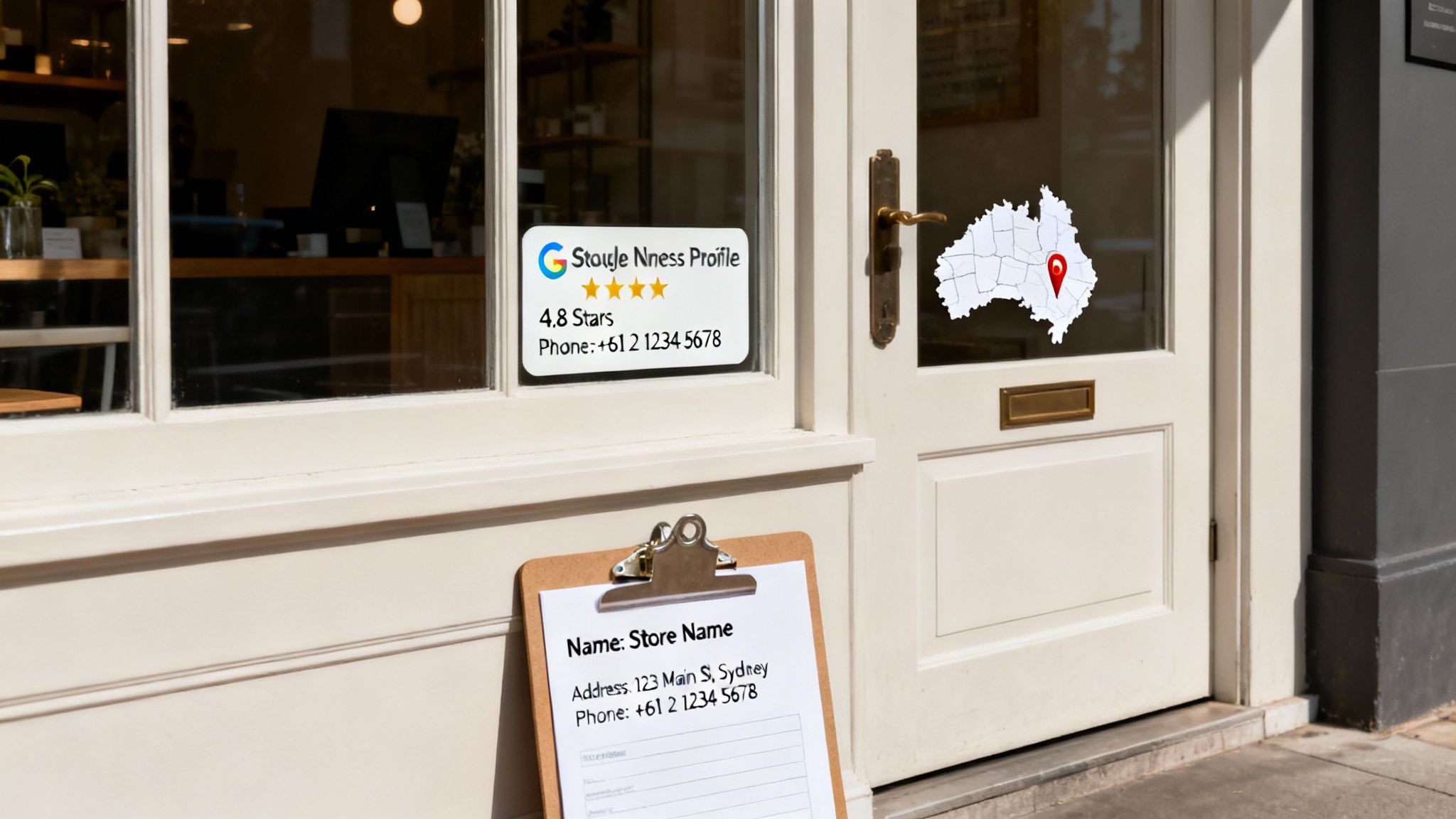
Your Google Business Profile is not just a listing; it's your digital storefront. It is often the first interaction a potential customer has with your brand and is the single most important tool in your local off-page SEO arsenal.
Perfecting these off-page signals is non-negotiable:
- Master Your Google Business Profile (GBP): Your GBP is the heart of local SEO. Fill out every single section with accurate info, high-quality photos, your full list of services, and the right business categories.
- Ensure NAP Consistency: Your Name, Address, and Phone number (NAP) must be identical everywhere online, from Yelp to TrueLocal. Even small inconsistencies can confuse search engines and damage your credibility.
- Actively Chase Customer Reviews: A steady stream of positive reviews on your GBP is a massive ranking factor. Make sure you respond to every review—good and bad—to show you’re engaged and value customer feedback. For any Aussie business owner, mastering these local signals is a fundamental part of a smart SEO for small businesses strategy.
- Build Local Citations and Links: Get your business listed in reputable local and industry-specific online directories. Even better, sponsoring a local sports team or community event can be a brilliant way to earn a valuable link from a trusted local organisation’s website.
Local SEO Implementation Checklist
To pull all this together, here’s a prioritised checklist that combines the most impactful on-page and off-page actions to get your local SEO firing on all cylinders.
| Priority | On-Page Action | Off-Page Action |
|---|---|---|
| High | Fully optimise your website's homepage and contact page with your primary location. | Claim and completely optimise your Google Business Profile (GBP). |
| High | Create dedicated, optimised service/location pages for key suburbs you serve. | Launch a review generation campaign to get a steady flow of new reviews on GBP. |
| Medium | Embed a Google Map and showcase local customer testimonials on your site. | Audit your existing citations and fix all NAP (Name, Address, Phone) inconsistencies. |
| Medium | Ensure your site is mobile-friendly and loads quickly for users on the go. | Build new citations in high-quality Australian and industry-specific directories. |
| Ongoing | Regularly publish blog posts or case studies featuring local projects or news. | Actively pursue backlinks from other local businesses, suppliers, or community groups. |
By meticulously aligning your on-page content with your off-page reputation, you send clear, consistent, and powerful signals to search engines. This integrated approach is the key to dominating local search results and turning online searchers into loyal, local customers.
How AI is Changing the SEO Game
The rise of AI in search isn't some far-off theory; it's happening right now, actively rewriting the rules for Australian businesses. We’re seeing tools like Google's AI Overviews change how people find information by giving them instant, summarised answers right on the results page.
This completely flips the classic on‑page vs off‑page SEO dynamic. For years, the goal was simple: get the click. Now, success also means becoming the trusted source AI models choose to pull from, and that demands a much smarter approach.
The new reality is fewer clicks are making it to the traditional organic listings. Here in Australia, the quick uptake of AI in search is throwing a new spanner in the works.
The world of on-page and off-page SEO is shifting under the weight of AI-powered search. Google’s AI Overviews are showing up more and more, causing the click-through rate (CTR) for the #1 organic spot to drop from a healthy 28% to just 19% — that’s a 32% hit.
This data screams one thing: it's time to adapt. On-page tactics like optimising for featured snippets and creating sharp, high-quality content are no longer optional. At the same time, off-page strategies have to find their footing in a world where "zero-click searches" — where users get their answer without clicking anywhere — are the new normal.
On-Page SEO in an AI World
To stay in the game, your on-page SEO needs to be structured so AI can easily read, understand, and pull from it. This isn't about writing for robots. It's about making your expertise exceptionally clear and digestible. The end goal? Become the go-to source for AI-generated answers.
Here are a few on-page moves you can make right now:
- Structure Content in a Q&A Format: Organise your content with clear questions as headings (your H2s and H3s), followed by direct, to-the-point answers. This format is a perfect match for how AI models scan for information to build their summaries.
- Go All-In on Featured Snippets: Snippets are prime real estate and often the main source for AI Overviews. Focus on providing clear, factual, and well-structured answers using lists, tables, and short paragraphs that Google can easily lift and feature.
- Prioritise Facts and Clarity: AI systems are being trained to favour trustworthy information. Make sure your content is well-researched, factually airtight, and cuts through the jargon. Citing your sources is a great way to double down on credibility.
Off-Page Authority in the Age of AI
With AI acting as a primary source of information, your off-page authority is more critical than ever. Search engines need to see undeniable proof that you're a respected voice in your field. A strong backlink profile and consistent brand mentions across the web are powerful signals of trust.
Think of it this way: AI doesn't just look at one page. It assesses your entire digital footprint to decide who it can trust. Building a solid off-page presence is how you prove you’re a genuine thought leader, not just another website shouting into the void. Your reputation across the web is your ticket to getting featured in AI-powered results.
To really get your head around this shift, understanding What Is Answer Engine Optimization (AEO) is a must. It moves the goalposts from just ranking to being the definitive answer. This is how you future-proof your entire SEO strategy, making sure your on-page content and off-page authority are working together to win in this new era.
Your Integrated On-Page and Off-Page Action Plan
Knowing the difference between on-page and off-page SEO is one thing. Actually turning that knowledge into a plan that gets results? That’s where the real work begins. To succeed, you need a unified strategy where every move you make supports the bigger picture.
The secret is prioritisation. You can't tackle everything at once, so focus on the actions that will deliver the biggest impact with the resources you have. A brand-new website, for instance, should be laser-focused on getting its on-page fundamentals right first. An established site, on the other hand, might prioritise an aggressive off-page campaign to build authority.
Measuring What Matters Most
To guide your strategy, you absolutely have to track the right Key Performance Indicators (KPIs). The data tells you what's working and what isn't, letting you double down on successful tactics and pivot when needed.
For your on-page efforts, keep a close eye on these:
- Organic Traffic: The total number of visitors coming to your site from search engines. Are you getting more visitors over time?
- Keyword Rankings: Where do you stand for your target keywords, especially the ones with high commercial intent?
- Bounce Rate: What percentage of visitors leave after viewing just one page? A high bounce rate can be a red flag for poor content or a clunky user experience.
On the off-page side, your focus shifts to authority and reputation:
- Referring Domains: The number of unique websites linking back to you. Remember, quality over quantity is the name of the game here.
- Domain Authority (DA): This is a predictive score from 0-100 that estimates how well your site will rank. It’s a great benchmark for your off-page progress.
- Brand Search Volume: How many people are searching directly for your brand name? This is a powerful signal of growing authority and brand recognition.
By monitoring these metrics, you get a clear, honest picture of your performance. Of course, the ultimate goal is to connect these SEO metrics to real business outcomes. That’s why understanding how to set up effective website conversion tracking is essential for linking all this effort back to leads and sales.
The diagram below shows how AI is becoming a central influence on both on-page and off-page SEO strategies.
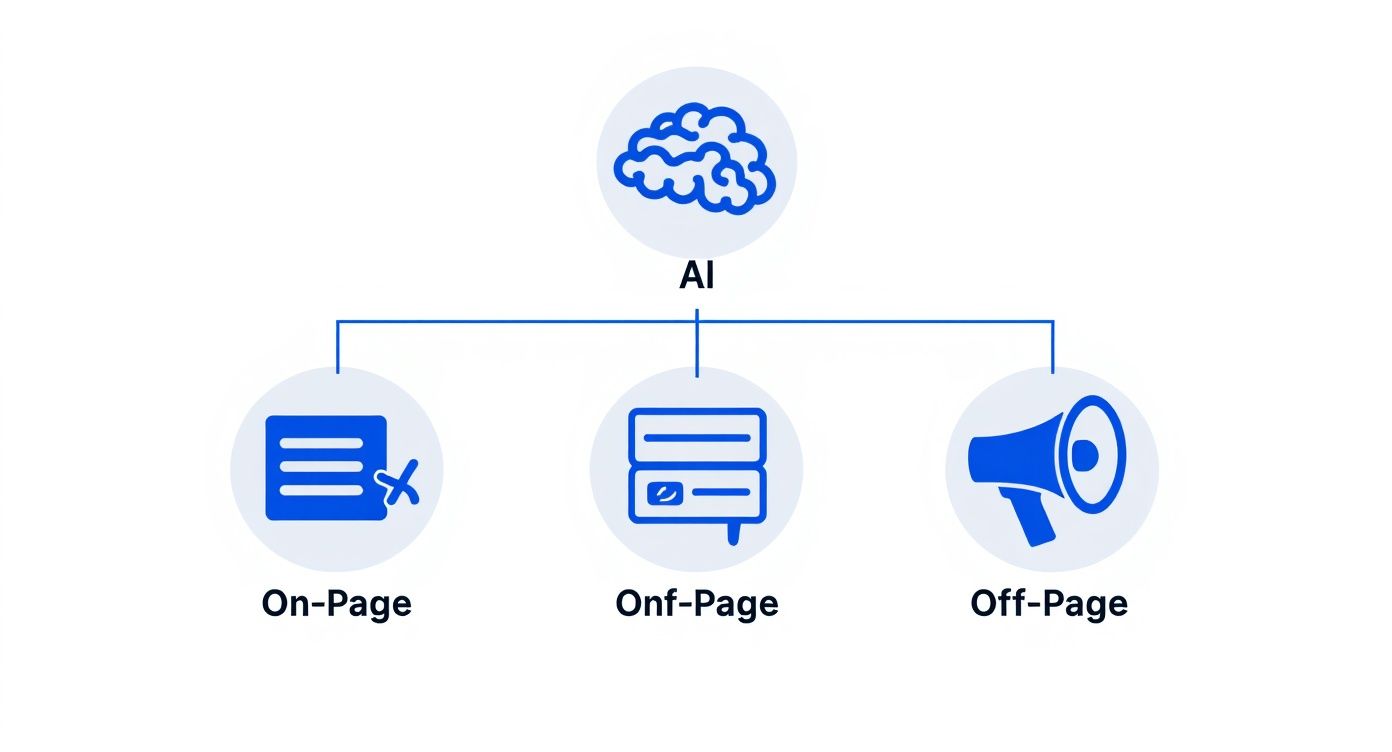
This isn’t about AI being a separate, shiny tool. It's a foundational layer that’s changing how we approach everything from optimising content on our site to building authority out on the web.
Your Quick-Start SEO Audit Checklist
Use this checklist to give your current strategy a quick health check and spot immediate opportunities for improvement.
Your SEO strategy should never be a "set and forget" document. Treat it like a living, breathing plan that you constantly refine based on data, performance, and the ever-changing search environment. A proactive, integrated approach is your best defence against algorithm updates and savvy competitors.
On-Page Actions:
- Content Audit: Does your content actually answer the user's question or solve their problem for your target keywords? Be honest.
- Technical Health Check: Is your site fast, mobile-friendly, and secure (using HTTPS)? These are non-negotiable table stakes.
- Keyword Optimisation Review: Are your title tags, meta descriptions, and headings optimised without sounding like a robot stuffed them with keywords?
Off-Page Actions:
- Backlink Profile Analysis: Are you earning links from authoritative, relevant websites, or is your profile full of spammy junk?
- Google Business Profile Check: Is your profile complete, accurate, and actively managed with recent, genuine reviews?
- Brand Mention Monitoring: What are people saying about your brand online? Is the sentiment positive, negative, or neutral?
By methodically working through these points, you start building a data-driven, integrated plan. This ensures your on-page foundation is solid enough to support your off-page authority-building efforts, creating a powerful cycle of growth that search engines love.
Frequently Asked Questions
Which Is More Important: On-Page or Off-Page SEO?
That's a bit like asking which wing is more important on an aeroplane. You can't fly without both.
Think of it this way: your on-page SEO is the foundation. It tells search engines what you're about and proves your relevance. Your off-page SEO is your reputation. It shows you’re a trustworthy authority in your field.
A site with flawless on-page SEO but zero off-page signals is like a brilliant stage show playing to an empty theatre with no reviews. On the flip side, having amazing off-page authority pointing to a slow, confusing, or poorly built website is just as pointless. For real success, they have to work together.
How Long Does It Take to See SEO Results?
SEO is a long game, not an overnight win. While you might see some positive movement from technical on-page fixes within a few weeks, you're typically looking at three to six months for significant, measurable results.
Building real off-page authority through quality backlinks and brand mentions is a marathon, not a sprint. It takes consistent effort over time. It’s a lot like getting in shape—you don’t see a six-pack after one trip to the gym. The key is consistency, and the good news is that the results compound over time.
Should I Do SEO Myself or Hire an Agency?
Going the DIY route can work for small businesses, especially if you have the time to learn the ropes and implement the basics consistently. Many business owners start this way.
However, once your business starts to grow, or if you're trying to compete in a crowded market, bringing in an expert agency is almost always the smarter move. An agency brings specialised tools, deep experience across different industries, and the dedicated focus needed to drive growth and stay ahead of tricky algorithm updates.
Ready to stop guessing and start growing? Click Click Bang Bang builds precision-driven SEO and PPC campaigns that deliver real results. Explore our services and start your risk-free trial at https://clickclickbangbang.com.au.
Read NeXt
Or Read Our Latest
- Manual vs Automated Bidding for PPC Success
- Conversion Tracking Setup: A Complete AU Guide
- Instagram Advertising Australia: Complete 2026 Guide
- Pay Per Click: A Beginner’s Guide for Australian Marketers
- Display Advertising on Google: The Complete Australian Guide
- Stakeholder Communication Plan How to Build One That Works
Click. CLick. Subscribe.
Get our best PPC insights, industry updates, and power moves delivered straight to your inbox. No fluff, just high-caliber strategies that actually work.
Don’t Leave Just Yet
Try Us For 30-Days,
Risk Free!!
We guarantee that you’ll love our work within the first 30 days, if not you’ll get your money back.
What have you got to lose?