

Empower Content with search engine optimization copywriting for Higher Rankings
Last Updated

SEO copywriting is the craft of writing content that clicks with two very different audiences at the same time: real people and search engine algorithms. It’s about creating compelling, valuable copy that also happens to weave in the keywords people are actually searching for.
Get it right, and you'll drive higher rankings, pull in the right kind of traffic, and turn those visitors into customers.
Why SEO Copywriting Is Your Strongest Growth Lever
Let's cut straight to it. Mastering SEO copywriting isn't just another marketing task—it's a core business strategy. When pretty much every online journey kicks off with a search, your ability to write for both humans and algorithms is non-negotiable. It’s the engine that powers visibility, builds trust, and ultimately, drives sales.
Think of it as the bridge connecting what your audience is looking for with the solutions you offer. This isn't about clumsily stuffing keywords into robotic text. It's about getting inside your customer's head, understanding their intent, and crafting a story that answers their questions, solves their problems, and gently guides them toward making a decision.
The Financial Impact of High-Ranking Copy
The investment in skilled SEO copywriting is blowing up for one simple reason: it delivers a tangible return. For any business, from an e-commerce startup to an established B2B firm, this isn’t an expense; it’s an asset. Great copy is your most dedicated salesperson, working 24/7 to attract qualified leads.
Just look at the spending trends here in Australia. Businesses are on track to spend a massive $1.5 billion on SEO services, a solid 12% jump from previous years. That surge tells you everything you need to know about how critical this has become.
With Google owning 93.95% of the Australian search market, writing copy that ranks isn't just a good idea—it's essential for survival. The top organic result scoops up an average of 29.5% of all clicks, but the number two spot plummets to just 12.8%. For businesses in a competitive space, that gap is enormous. Turning those clicks into conversions is where persuasive, intent-focused copy makes all the difference. You can find more stats on the Australian SEO market over at Red Search.
"Your copy is the voice that greets a potential customer when they land on your page. If that voice is clear, helpful, and trustworthy, you've already won half the battle."
Beyond Traffic: A Focus on Conversion
Getting the ranking is a huge win, but it's not the final goal. The real prize in SEO copywriting is conversion. It's about turning a curious searcher into a paying customer. That takes more than just technical optimisation—it demands empathy, persuasion, and a genuine understanding of the customer journey.
High-quality SEO copy nails several key jobs at once:
- Builds Authority: It positions your brand as a credible, go-to source, fostering trust with your audience from the first sentence.
- Engages Readers: It keeps people on your page longer, which sends strong positive signals back to search engines about user experience.
- Drives Action: It uses clear, compelling calls-to-action (CTAs) that prompt users to take that next logical step, whether it’s making a purchase, filling out a form, or signing up for a newsletter.
Ultimately, this is the foundation for sustainable growth. It's how you build a powerful online presence that doesn't just attract eyeballs but creates a loyal customer base that keeps coming back.
Map Keywords To Your Customer's Journey
Great SEO copywriting doesn't start with a blank page and a clever headline. It starts with a plan. A blueprint, really. This blueprint connects the exact words people are typing into Google with what they need at that specific moment. This is where keyword research and intent mapping become your secret weapons.
Forget chasing high-volume, generic keywords just for the traffic. The real goal is to get inside your audience's head. What are their questions? Their frustrations? What desire is so strong it sends them to the search bar? You have to realise that not all keywords are created equal—each one signals a different stage in someone's journey to making a decision.
When you get this right, your content stops being a static block of text and transforms into an active guide. It meets your audience exactly where they are, answers their immediate question, and then anticipates the next one. This is how you build trust, click by click.
The process boils down to three core stages: attracting a potential customer, building their trust, and finally, giving them a clear path to convert.
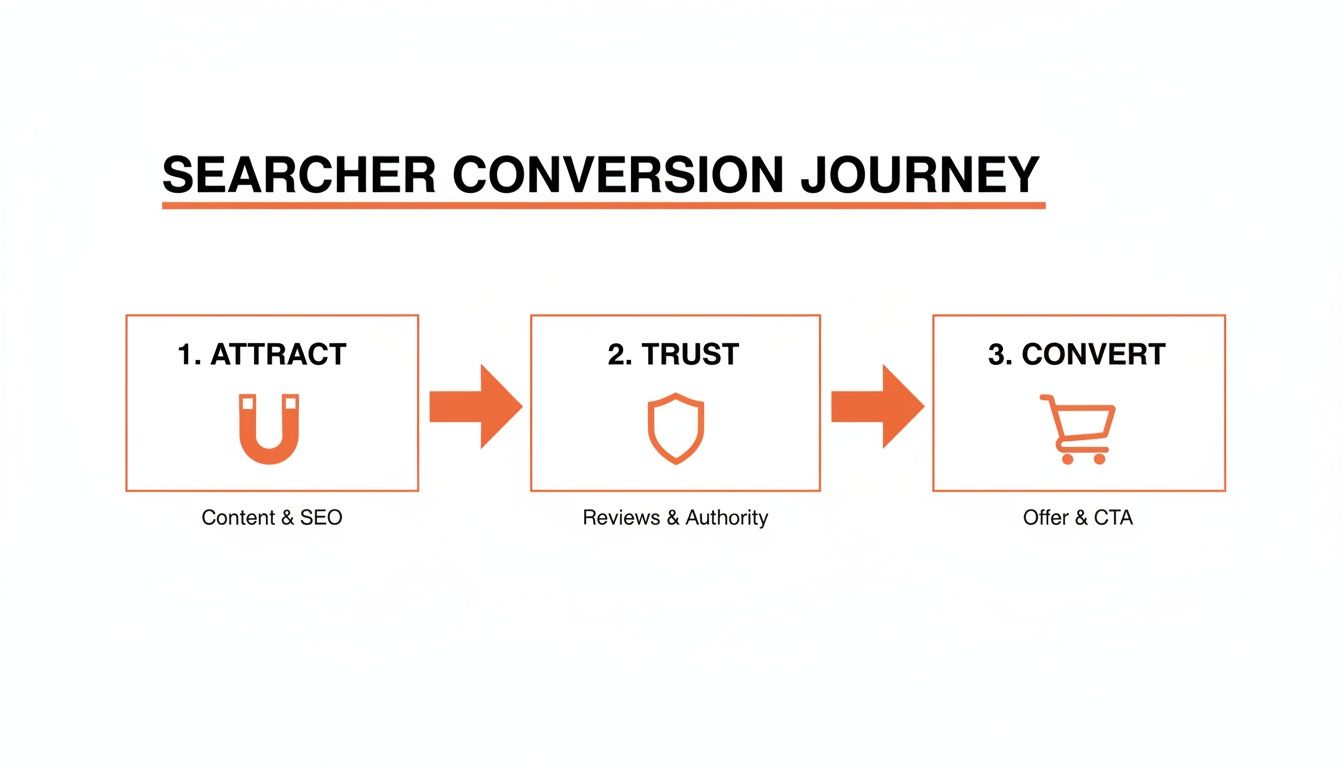
As you can see, SEO is the magnet that pulls people in. From there, authority signals like reviews and expert content build confidence, paving the way for them to take that final, desired action.
The Three Tiers Of Search Intent
To really nail your copy, you have to categorise your keywords by the why behind the search. This simple organisational step ensures the content you create is a perfect match for what the searcher actually wants to find.
There are three main types of intent to think about:
- Informational Intent: The searcher is in learning mode. They want answers, information, or solutions to a problem but aren't ready to buy anything just yet. Keywords often start with phrases like "how to," "what is," or "best ways to," or they're just straight-up questions.
- Commercial Intent: Here, the searcher shifts from learning to comparing. They're weighing up different products, services, or brands to see which is the best fit. These keywords will often include terms like "review," "comparison," "vs," or specific product and brand names.
- Transactional Intent: The decision is made. The user is ready to act—whether that's making a purchase, signing up for a trial, or requesting a quote. These are your money keywords, containing words like "buy," "price," "discount," "near me," or "for sale."
Matching your content to the intent is everything. You wouldn't shove a "Buy Now" button on a blog post answering a simple "how-to" question. That kind of disconnect is jarring and sends users bouncing right back to the search results.
An Intent Mapping Example In The Wild
So, how does this look in practice? Let's say you're an Aussie e-commerce store selling high-performance running shoes.
Someone starts by searching for "how to choose running shoes". That’s pure informational intent. The perfect response is a detailed blog guide explaining pronation, arch types, and cushioning levels. You're being the helpful expert, not a pushy salesperson.
A week later, they might search for "Asics vs Brooks running shoes review". Now we're in commercial intent territory. A dedicated comparison page with a spec table, a list of pros and cons, and real user reviews would be the ideal content to serve them.
Finally, they search for "buy Asics Gel-Kayano 30 men's size 11". This is a transactional search, plain and simple. This keyword needs to lead them directly to that specific product page where they can add it to their cart in one click.
By mapping keywords this way, you create a seamless experience that aligns with the natural https://clickclickbangbang.com.au/process-of-consumer-decision-making/. You're not just optimising for random keywords; you're optimising for the entire customer journey.
The Power of Matching Intent to Content Formats
Once you understand the intent behind a keyword, you can choose the most effective content format to satisfy that search. This table breaks down how different intent types align with specific content formats and business goals.
Aligning Keyword Intent with Content Strategy
| User Intent Type | Keyword Examples | Effective Content Format | Business Goal |
|---|---|---|---|
| Informational | "what is seo", "how to fix a leaky tap", "best winter jacket styles" | Blog Posts, How-To Guides, Infographics, Ebooks, Webinars | Build brand awareness, generate top-of-funnel traffic, capture email subscribers, establish authority. |
| Commercial | "semrush vs ahrefs", "iphone 15 pro review", "best accounting software for smbs" | Comparison Pages, In-Depth Reviews, Product Listicles, Case Studies | Guide mid-funnel users, build product preference, showcase unique selling points, drive consideration. |
| Transactional | "buy nike air force 1", "web design services near me", "outrank.so pricing" | Product Pages, Service Pages, Pricing Pages, Free Trial Landing Pages | Drive immediate sales, generate qualified leads, facilitate direct conversions, capture bottom-of-funnel users. |
Using this framework helps ensure that every piece of content you create has a clear purpose and a direct line to a business objective. It's about being strategic, not just prolific.
Building Your Keyword Blueprint
To make sure your keywords are perfectly aligned with your target audience, you first need to know who they are. This means getting serious about creating effective buyer personas. Once you have that crystal-clear picture of your ideal customer, you can start building your keyword map.
This blueprint should pair specific keywords and their intent with the right pages on your website. For a B2B software company, an informational keyword like "what is project management software" would map to a blog post. Meanwhile, a transactional term like "best project management software for small business" would point to a curated features page or a comparison list.
This approach guarantees that every piece of content serves a distinct purpose, attracting the right people at exactly the right time in their journey.
Writing Compelling Copy That Actually Converts
Okay, you've done the hard yards with your keyword research and mapped out your intent. Now comes the fun part: actually writing the copy.
This is where the art of persuasion meets the science of search engine optimisation copywriting. It’s about building pages that don't just get seen by Google, but actually connect with the people who land on them. We're not just trying to rank; we're trying to inspire action.
A perfectly crafted page never feels "optimised." It feels helpful, authoritative, and convincing. It seamlessly guides someone from their initial search query right to the solution you’re offering.

Structuring Content For Skimmers And Search Engines
Let’s be real for a second. People don’t read webpages; they scan them. Your content structure needs to embrace this behaviour while also giving search engines clear signposts about its hierarchy and what’s important. Headings are your best friend here.
- H1 (Your Main Title): This is your one and only headline for the page. It must contain your primary keyword and make the page's core topic immediately obvious.
- H2s (Main Sections): Think of these as the main chapters of your content. They break down the big topic into logical chunks and are perfect spots for your primary or secondary keywords.
- H3s (Sub-points): Use these to drill down into the details within your H2 sections. They make the content even easier to skim and digest.
This nested structure gives your readers a visual map to follow and provides a logical outline for search engine crawlers, helping them understand what your page is about and how all the information fits together.
Weaving Keywords Into Your Copy Naturally
The bad old days of cramming keywords into every sentence are long gone. Thank goodness.
Today, smart keyword integration is all about creating a rich, topically relevant context. Your main keyword should appear in a few key places, but forcing it in over and over will wreck your readability and probably hurt your rankings.
Think of it this way: your primary keyword is the main theme, and your related LSI keywords are the supporting details that prove you know what you’re talking about.
Here are the non-negotiable spots for your primary keyword:
- Page Title (Title Tag): The single most important place for it. This is what people see in the browser tab and, more importantly, in the search results.
- Meta Description: While not a direct ranking factor, a great meta description with the keyword practically begs people to click on your result over your competitor's.
- URL: Keep it short, clean, and include the keyword. Something like
your-site.com.au/seo-copywriting-guidesends a strong signal to Google. - First 100 Words: Mention your keyword early in the intro to confirm the page's topic for both users and search engines.
- Image Alt Text: This is an accessibility and SEO win. Describe your images accurately, and if the keyword fits naturally (e.g., "copywriter outlining SEO content structure"), include it.
By focusing on topical relevance rather than just keyword density, you end up creating content that covers a subject comprehensively. And that’s precisely what modern search engines are built to reward.
Beyond The Words: On-Page SEO Elements
Great search engine optimisation copywriting is about more than just the words in the main body. A few other on-page elements are crucial for building authority and making your page stand out in a ridiculously crowded search landscape.
Strategic Internal Linking
Internal links are simply links from one page on your website to another. They are absolute gold for SEO. Why? Because they help search engines understand the relationships between your pages and establish a clear site hierarchy.
For instance, while writing about SEO copywriting, linking out to a detailed guide on how to create a landing page gives users a path to learn more and tells Google you've got deep, related expertise on the topic.
Schema Markup Implementation
Think of Schema markup as a secret language you speak to search engines. It’s microdata added to your site’s HTML that helps Google understand your content on a deeper level.
This can unlock "rich snippets" in search results—things like star ratings, event details, or those handy FAQ dropdowns. These eye-catching features can massively boost your click-through rate.
The Shifting Budget For Modern SEO Copywriting
The ground is shifting under our feet. As search engines get smarter, budgets are moving away from old-school tactics.
Traditional methods now account for just 45% of SEO copywriting budgets, a sharp drop from 75%. A massive 25% is now being funnelled into AI and LLM optimisation, with another 20% dedicated to building rock-solid content authority.
This pivot is a direct response to AI overviews slashing top result clicks by 34.5%. It's also because 60% of searches now end without a click, even with Google holding a 91.09% market share. In this environment, human-crafted, intent-driven copy is proving its immense value—one study showed it outperforms AI-generated content by a whopping 854%. You can dig into more of these Australian search usage trends on searchscope.com.au.
The data all points to one critical truth: to win today, your copy must answer the user's true intent with genuine expertise and authenticity.
How to Win at Local Search with Targeted Copywriting
For any business with a physical address, from a Fitzroy cafe to a Parramatta electrician, local SEO is where the real action happens. You're not trying to rank for broad, nationwide terms; you're trying to be the very first result when a potential customer just around the corner searches for what you do.
This is where your copywriting gets hyperlocal—and incredibly powerful.
Effective local copy is about much more than just slotting your city's name into a page title. It’s about speaking the language of your community and proving your local presence so convincingly that Google has no choice but to show you to nearby searchers.
Weave Your Location Into Your Core Message
First up, you need to seamlessly integrate location-based keywords across your website. This is a fundamental signal to both users and search engines that you are a local authority. Think beyond just your homepage—your service pages are prime real estate for this.
For instance, a plumber in Melbourne shouldn’t just have a page titled "Blocked Drain Repairs." A far better approach would be "Blocked Drain Repairs in Richmond" or "Emergency Plumber for Melbourne's Eastern Suburbs."
This forces you to think like your local customers. What specific suburbs, landmarks, or neighbourhoods are they likely to drop into their search?
- Service Pages: Tailor each service page with local modifiers. Instead of a generic "Roofing Services," frame your copy around "Metal Roofing Installation for Geelong Homes."
- 'About Us' Page: This is your chance to tell a local story. Mention how long you've served the community, talk about your involvement in local events, or highlight your connection to the neighbourhood.
- Contact Page: Go beyond a simple address. Embed a Google Map and write clear, landmark-based directions. Think like a local: "You'll find us just opposite Central Park, right next to the post office."
The Power of Dedicated Service Area Pages
If your business serves multiple suburbs or a wider region, creating dedicated landing pages for each key location is a total game-changer. These pages let you get hyper-specific with your copy, perfectly matching the search intent of customers in that area.
Imagine a landscaper based in Penrith. They could create separate, highly targeted pages for:
- "Garden Design in the Blue Mountains"
- "Lawn Maintenance Services in Glenmore Park"
- "Commercial Landscaping for Penrith Businesses"
Each page can then be optimised with suburb-specific keywords, testimonials from clients in that area, and even photos of projects you've completed right there. It transforms your website from a generic brochure into a powerful magnet for qualified local leads.
Local SEO copywriting is a game-changer for Australian SMBs, driving 28% of total search traffic and converting at three times the rate of standard organic results. With 'near me' searches exploding by 500% and 76% of mobile location queries leading to store visits within 24 hours, copy tailored to Aussie locales—from Sydney's hustle to Queensland's regions—is pure gold. Discover more insights about local search trends in Australia on netstripes.com.
Nail Your Google Business Profile Copy
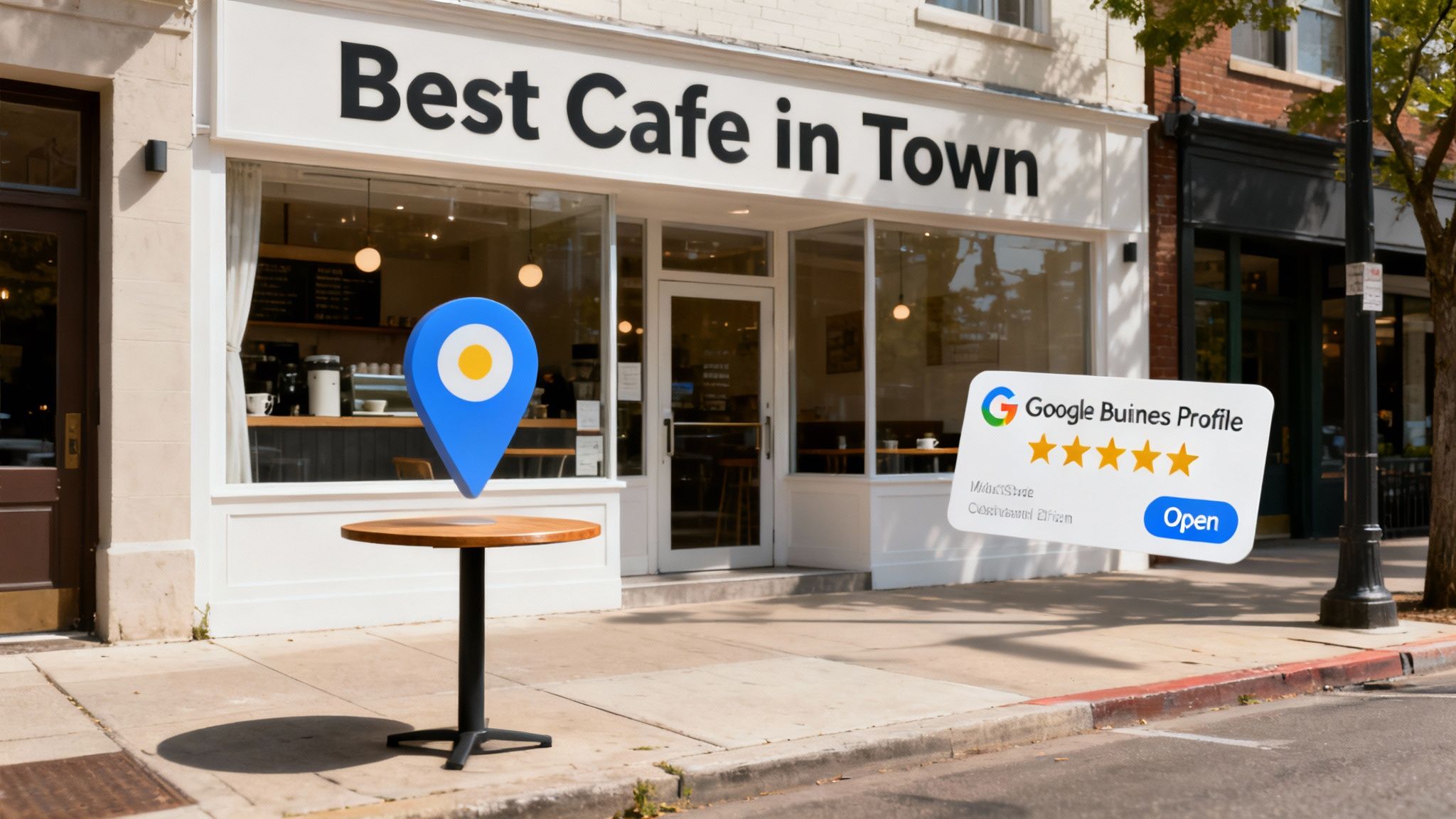
For many local customers, your Google Business Profile (GBP) is the first interaction they'll have with your brand. The copy here needs to be concise, compelling, and absolutely packed with local relevance. It's not just a listing; it's a dynamic marketing tool.
Get proactive in the Q&A section by answering common local questions before they're even asked. Create regular Google Posts to announce specials or highlight a recent project, always mentioning local suburbs and landmarks where it makes sense. The copy in these posts directly influences your visibility in the local map pack.
When you combine sharp on-page local copywriting with a fully optimised GBP, you create an undeniable local presence. You’re not just telling Google you’re a local business; you’re proving it with relevant, helpful content that turns those 'near me' searches into your next loyal customers.
Using AI as Your Creative Co-Pilot
Let's be clear: artificial intelligence is here, and it's shaking up the world of search engine optimization copywriting. It's not some magic button you press for perfect content, but when you know how to use it, AI is an incredibly powerful sidekick. It can supercharge your workflow, smash through writer's block, and help you refine your ideas in minutes.
The trick is to think of AI as your co-pilot, not the pilot in charge. It absolutely shines at speed and data processing—think brainstorming dozens of blog titles or structuring a complex article outline in seconds. This frees you up to handle the irreplaceable human parts of writing: injecting personality, sharing real-world stories, and connecting with your reader on a genuine level.

Smart Ways to Integrate AI
So, how do you actually put this into practice? AI is a massive help during the foundational stages of content creation, taking care of the tedious stuff and giving you a solid launchpad.
Here are a few ways I regularly use AI in my own process:
- Topic Ideation: Feed an AI tool your main keyword and ask for a list of related blog topics, common questions people ask, or even some unique angles to explore. It's like having a brainstorming partner who never runs out of ideas.
- Outline Generation: Once you've landed on a topic, ask the AI to map out a logical structure with H2 and H3 headings. This gives you a solid skeleton to build upon, saving you a ton of time.
- Drafting and Rewriting: Use AI to generate a rough first draft just to get past that intimidating blank page. I also love pasting in my own clunky paragraphs and asking it to sharpen the clarity or tweak the tone.
The Risks of Over-Reliance
The temptation to just let AI do all the work is real, but it's a slippery slope. Relying too heavily on it churns out generic, soulless content that just doesn't connect with people. Worse, it can even hurt your rankings.
Google’s quality guidelines are laser-focused on content that shows real experience and authority—two things AI simply can't fake.
The biggest risk with AI-generated copy is its lack of a unique point of view. It can summarise what’s already out there, but it can’t share a personal story or an original insight that builds real trust with your audience.
On top of that, the line between traditional SEO and AI-driven search results is getting blurrier by the day. If you want to get your head around how AI is changing search results, including those AI-powered summaries at the top of the page, it's worth understanding Generative Engine Optimization. This shift makes authentic, human-led content more valuable than ever.
The best approach is a balanced one. Use AI to speed up research and structure, but always make sure the final piece is heavily edited, fact-checked, and injected with your unique brand voice. To see how this integrated strategy works in detail, check out our guide on using AI for SEO to boost your efforts without sacrificing quality.
How to Measure and Refine Your Copywriting Success
You’ve poured your heart and soul into the copy. But here’s the thing: effective search engine optimisation copywriting isn’t a “set and forget” deal. It’s a living, breathing process of testing, learning, and refining what works.
You can write the most brilliant, persuasive copy on the planet, but if you aren't measuring its impact, you're just flying blind.
This is where data becomes your most trusted creative partner. By tracking the right metrics, you turn guesswork into a reliable system for growth, making sure every single word you write is pulling its weight and contributing to your business goals.
Setting Up Your Measurement Toolkit
Your two non-negotiables here are Google Search Console (GSC) and Google Analytics 4 (GA4). Think of them as two sides of the same coin: GSC tells you how your content is performing in the search results, while GA4 shows you what people do once they actually land on your site.
It's easy to get lost in a sea of data, so the trick is to focus on a few key performance indicators (KPIs) that genuinely matter. We're looking for the sweet spot between search visibility and user engagement.
Here are the core metrics I always keep an eye on:
- Organic Traffic: The total number of visitors coming from search engines. Is your copy attracting more people over time? This is your top-line health check.
- Keyword Rankings: Jump into GSC and track your position for your target keywords. Are you climbing the ranks for the terms that matter most to your bottom line?
- Click-Through Rate (CTR): This GSC metric is gold. It shows the percentage of people who saw your page in the search results and actually clicked it. A low CTR is a huge red flag that your title tag and meta description need a serious rewrite.
- Conversion Rate: This is the ultimate test, tracked in GA4. Are visitors taking the action you want them to? Whether it's making a purchase, filling out a form, or signing up for a newsletter, this metric tells you if your copy is truly working.
A data-driven approach is what separates good copy from great copy. Numbers don't lie—they tell you exactly what your audience responds to, allowing you to double down on what works and fix what doesn't.
Simple A/B Testing for Big Wins
You don't need fancy, expensive software to start optimising. A/B testing, or split testing, is just a simple way of comparing two versions of something to see which one performs better. It’s an incredibly powerful way to sharpen your headlines and calls-to-action (CTAs).
Let’s say you’re trying to sell some hiking boots. You could test two different headlines on your product page:
- Version A: "Durable All-Weather Hiking Boots"
- Version B: "Conquer Any Trail with Our Waterproof Hiking Boots"
The process is straightforward. Run Version A for a couple of weeks and measure the conversion rate. Then, switch to Version B for the next two weeks and do the same. Whichever version drives more sales is your clear winner.
This simple, iterative process of testing, measuring, and refining is the absolute key to continuously improving your copy and getting better results over time.
Got Questions About SEO Copywriting? We've Got Answers
Diving into SEO copywriting can feel like learning a new language. A lot of questions pop up along the way. To clear things up, here are some of the most common queries we hear, along with straightforward, practical answers to get you on the right track.
How Long Does It Really Take to See SEO Copywriting Results?
Ah, the million-dollar question. The honest answer is: it depends. SEO isn't an overnight fix; it's a long game that hinges on your industry's competitiveness and your website's current authority.
For keywords with lower competition, you might start seeing some positive movement in search rankings within three to six months. But if you're trying to muscle your way into a crowded, highly competitive niche, cracking the top spots could easily take a year or more.
Consistency is your secret weapon here. Think of it like building a reputation in real life—it doesn't happen overnight. Publishing high-quality, optimised content on a regular basis creates momentum. Google starts to see you as a reliable source. Of course, your site's existing authority and technical health play a massive role in how quickly your new copy gets noticed.
What's the "Right" Keyword Density to Aim For?
Let's clear this up right now: the idea of a perfect "keyword density" is a relic of old-school SEO. It's an outdated myth. Today's search engines are far too sophisticated to be fooled by simply hitting a certain keyword percentage.
Instead of obsessing over a number, your focus should be on topical relevance and natural language.
Write for your human audience first, always. If your copy sounds clunky or robotic because you're shoehorning in keywords, you've already lost the battle. Search engines are smart enough to pick up on this and will always favour content that provides a better user experience.
Your main keyword should naturally find its way into a few key spots—think page title, H1 heading, and somewhere in your introduction. Beyond that, just use it and its variations where it genuinely makes sense for the reader.
Can I Just Use AI to Write All My SEO Content?
Hitting the "generate" button on an AI tool and calling it a day is a very risky play. While AI is brilliant for brainstorming, creating outlines, and even knocking out a rough first draft, it has one major weakness: authenticity.
AI-generated content often lacks the real-world experience, unique point of view, and authoritative voice that Google's E-E-A-T (Experience, Expertise, Authoritativeness, Trustworthiness) guidelines are all about. Lean on it too heavily, and you'll end up with generic, soulless content that doesn't connect with anyone and will likely struggle to perform in the long run.
The smart approach is a hybrid one:
- Use AI as your assistant. Let it do the heavy lifting with research and structure.
- Bring in a human writer to refine, fact-check, and inject your brand's personality and genuine expertise into the final piece.
This way, you get the speed of AI combined with the irreplaceable nuance of human creativity. It's the best of both worlds.
At Click Click Bang Bang, we pair data-driven SEO with compelling, human-led copywriting to deliver real business growth. Find out how our AI-first SEO services can take your content strategy to the next level.
Read NeXt
Or Read Our Latest
- Manual vs Automated Bidding for PPC Success
- Conversion Tracking Setup: A Complete AU Guide
- Instagram Advertising Australia: Complete 2026 Guide
- Pay Per Click: A Beginner’s Guide for Australian Marketers
- Display Advertising on Google: The Complete Australian Guide
- Stakeholder Communication Plan How to Build One That Works
Click. CLick. Subscribe.
Get our best PPC insights, industry updates, and power moves delivered straight to your inbox. No fluff, just high-caliber strategies that actually work.
Don’t Leave Just Yet
Try Us For 30-Days,
Risk Free!!
We guarantee that you’ll love our work within the first 30 days, if not you’ll get your money back.
What have you got to lose?