

Competition Analysis SEO: A Complete Playbook for 2026
Last Updated

You’ve probably already done the obvious work. You know your core products, you know the competitors your sales team talks about, and you’ve got a rough list of keywords sitting in a spreadsheet somewhere. Yet rankings still stall, paid search costs don’t ease, and the brands taking clicks in Google aren’t always the same ones taking deals from you offline.
That’s where competition analysis seo usually goes wrong. Many teams audit static rivals, collect too many metrics, and stop before the findings affect budget, content, or bidding. The useful version is narrower and more commercial. It identifies who owns your search demand, where their advantage is real, where it’s fragile, and how to use those insights across both SEO and PPC.
For Australian businesses, this matters because organic search drives 53% of all website traffic for AU businesses, while paid channels account for 15%, according to APAC and Australia SEO competition analysis data. If you’re treating competitor analysis as a side task, you’re underinvesting in the channel that carries the most traffic.
How to Identify Your True SERP Competitors
A marketing manager pulls a competitor list from sales, checks a few rankings, and starts benchmarking the usual names. Three weeks later, the analysis is polished and mostly useless because the sites taking organic clicks are review pages, marketplaces, and publishers that never showed up in the original list.
That mistake is expensive. If the wrong domains shape your benchmark, your SEO plan targets the wrong content types, and your PPC team misses the auctions and messaging patterns that are already influencing conversion paths.
Your business competitors and your SERP competitors only partly overlap. A company can lose deals to one brand offline and lose search demand to an entirely different set of domains online.
For an Australian e-commerce retailer, another store in the same category may be the obvious commercial rival. For informational and comparison queries, the primary blocker is often a marketplace, a publisher, a review site, or a specialist blog with stronger topical coverage.

Separate business rivals from search rivals
Start with queries that sit close to revenue. Broad category terms can wait. First identify the searches that influence pipeline, sales calls, quote requests, and product page visits.
Use three buckets:
-
Transactional terms
Product and service queries with clear buying intent. -
Commercial investigation terms
Searches for comparisons, reviews, pricing, alternatives, and best-of queries. -
Decision-support terms
Queries searched just before conversion, often with location, compatibility, urgency, use case, or brand modifiers.
Run those searches manually in an incognito browser. Check both mobile and desktop if mobile traffic matters to the account. Log the domains that appear repeatedly, then note the page type ranking for each term. Product page, category page, guide, comparison page, directory listing, video, forum thread. That page-level detail matters later when you decide whether to build, improve, or support a page with paid search.
Ignore one-off appearances. Repeated visibility across valuable queries is the signal.
Use a three-tier competitor model
After the same domains show up across your keyword set, classify them by the threat they represent.
| Tier | Who belongs here | Why they matter |
|---|---|---|
| Primary | Direct business rivals ranking in your target SERPs | They compete for both clicks and revenue |
| Secondary | Publishers, marketplaces, directories, affiliates, review sites | They shape category demand and absorb research traffic |
| Tertiary | Larger brands with broader authority and content coverage | They set performance benchmarks for trust, links, and content structure |
This model keeps the work tied to decisions. A marketplace ranking on comparison terms may not be your closest sales competitor, but it can still suppress organic entry points that would otherwise lower your paid acquisition cost. A publisher dominating informational queries can also reveal which topics deserve SEO investment and which are cheaper to cover with PPC until authority catches up.
A simple rule helps here. If a domain appears across your high-intent keyword set more often than the brand your sales team mentions, it deserves more attention in your search analysis.
Build a shortlist you can actually use
A long competitor list feels thorough and usually slows execution. In practice, five to eight domains is enough for a working set if they cover the main SERP patterns in your market.
That shortlist usually includes:
- A direct commercial rival with similar offers and similar customers
- A content-led competitor winning with guides, comparisons, or buying advice
- A category authority with strong trust signals and link equity
- A fast-moving challenger gaining visibility faster than its size suggests
- A SERP disruptor such as a marketplace, directory, or review platform that changes click behaviour
Document each domain against the keywords where it ranks, the page templates it uses, the intent it serves, and whether it is likely to affect SEO only or both SEO and paid search. If you need a practical scoring framework, these competitor analysis parameters for SEO and PPC give you a clean way to prioritise what to track.
AI can speed up this stage if you use it carefully. It is useful for clustering competitor pages by intent, spotting repeated content formats, and flagging low-effort gaps such as missing comparison pages, weak title angles, or unsupported commercial terms. It is less useful when asked to decide who your competitors are without SERP evidence. Start with real rankings, then use AI to compress the review time.
If your shortlist is accurate, the rest of the process gets faster. You audit fewer domains, find clearer gaps, and create SEO changes that can also improve PPC targeting, ad copy themes, and landing page priorities. For teams comparing platforms before that next step, SEO tool insights for professionals can help clarify how different toolsets support competitor discovery.
Choosing Your SEO Competition Analysis Tools
Tool selection doesn’t need to be ideological. It needs to match the kind of decisions you want to make.
A bloated stack creates more exports, more dashboards, and more false confidence. A lean stack gives you enough visibility to spot keyword gaps, content weaknesses, backlink opportunities, and PPC crossover points without slowing execution.
Choose by job, not by logo
Teams often need tools from three categories:
-
All-in-one platforms
Best when you want one place for rankings, backlink data, keyword research, and competitor discovery. Semrush and Ahrefs usually sit here. -
Specialist tools
Best when a specific job matters more than breadth. SpyFu is useful when paid search visibility matters in the same workflow. Screaming Frog helps when technical benchmarking is part of your competition analysis seo process. -
Free platform data
Google Search Console, Google Ads, PageSpeed Insights, and manual SERP reviews are still valuable. They don’t replace commercial tools, but they keep the analysis tied to your own performance.
Competitor Analysis Tool Comparison
| Tool | Best For | Key Feature | Pricing Model |
|---|---|---|---|
| Semrush | Broad competitor research across SEO and PPC | Keyword gap and domain comparison | Subscription suite |
| Ahrefs | Backlink profiling and content-led competitor discovery | Link intersect and top pages data | Subscription suite |
| SpyFu | PPC crossover analysis | Competitor keyword and ad visibility insights | Subscription platform |
| Screaming Frog | Technical benchmarking | Crawl-based technical audit data | Licence plus free limited version |
| Google Search Console | Your own search performance | Queries, pages, impressions, clicks | Free |
| Google Ads Auction Insights | Paid search overlap | Impression share and competitor overlap in ads | Included in Google Ads |
The right choice depends on what you’re trying to decide.
If you’re selecting targets for new content, all-in-one tools are usually enough. If you’re trying to combine organic gaps with paid demand, pair an all-in-one platform with paid search visibility data. If technical debt is holding rankings back, a crawler becomes essential.
Build a sensible stack
A practical stack for most businesses looks like this:
-
For lean teams
Google Search Console, Google Ads data, manual SERP reviews, and one paid platform -
For in-house teams with content and paid media
One all-in-one SEO tool, one crawler, Google native data, and a workflow for page-level comparisons -
For agencies or mature in-house teams
Multiple datasets can help, but only if someone is translating them into actions and not just reporting movements
If you’re comparing platforms, this breakdown of SEO tool insights for professionals is useful because it focuses on the trade-offs in feature depth and workflow fit rather than pretending every tool solves the same problem.
Buying the biggest platform doesn’t fix weak analysis. The real lift comes from choosing a stack that helps you make faster decisions about pages, bids, and content priorities.
One note on service options. Some businesses don’t need another platform at all. They need interpretation. In those cases, using an agency workflow alongside your internal tools can make sense. Click Click Bang Bang, for example, includes competitor analysis within broader SEO and PPC planning, which is useful when the output needs to feed both channels rather than sit in a separate SEO report.
Running Audits to Uncover Competitor Weaknesses
A good audit doesn’t try to prove that competitors are better. It tries to identify where their advantage is thin.
That distinction matters. If a competitor ranks because they have deeper content, stronger links, and cleaner technical execution, you’re looking at a strategic gap. If they rank with a weak page, a shallow template, or a patchy backlink profile, you may have found a near-term opportunity.
The four audits below do different jobs. Run them together and you get a decision-making system, not a spreadsheet graveyard.
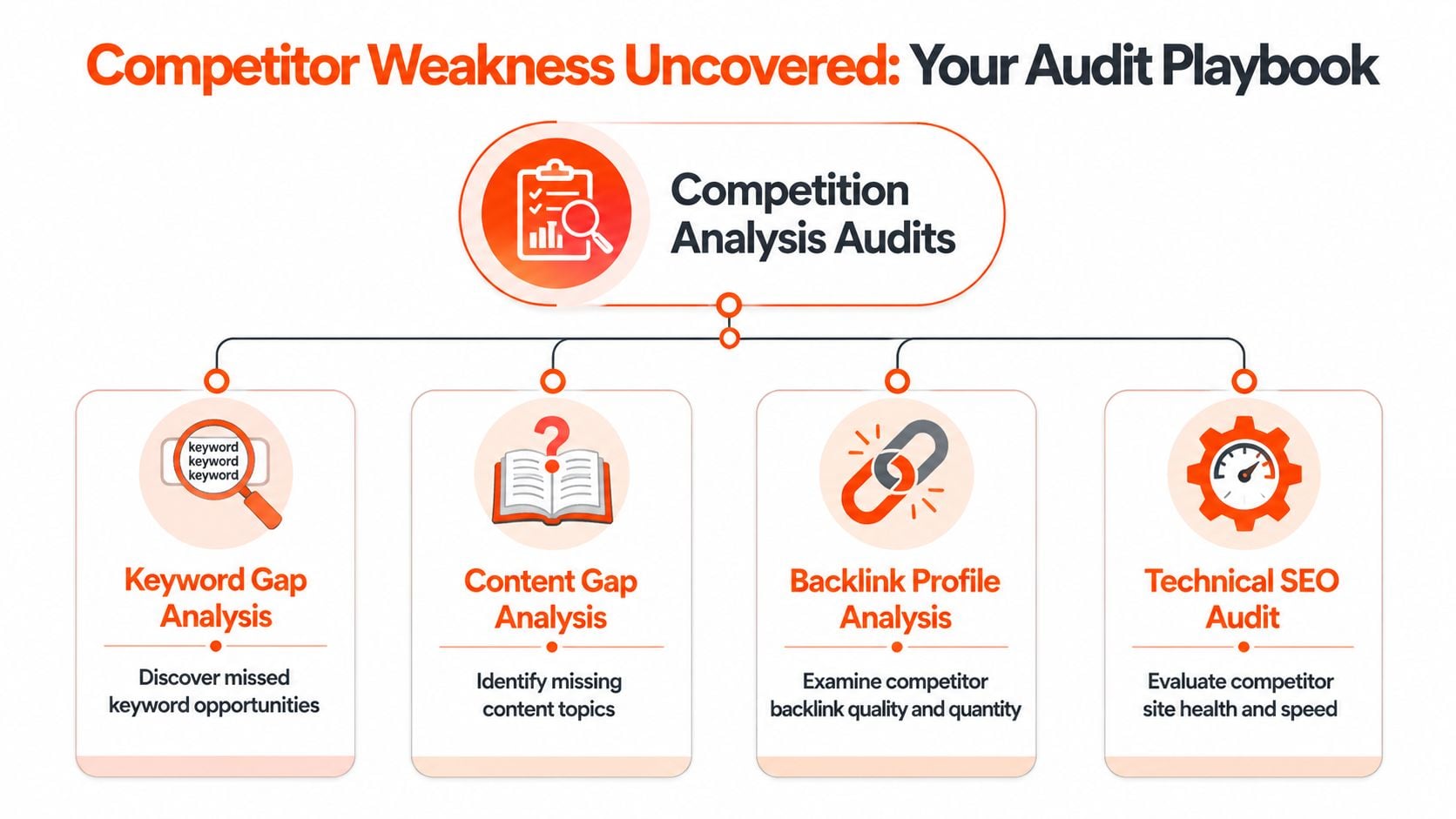
Audit one, keyword gap analysis
Here, many groups begin, and many also finish too early.
A useful keyword gap analysis doesn’t just list phrases competitors rank for. It separates keywords into actions:
- Missing pages where competitors rank and you have no relevant URL
- Weak pages where you have a page but it doesn’t match search intent
- Underperforming pages where you rank, but the wrong page or wrong format is holding you back
For Australian SEO, this should stay close to revenue. Look for commercial and transactional terms first, then supporting queries that influence conversion.
A practical review includes:
- Keyword intent matched against the ranking page type
- SERP consistency to see which domains appear repeatedly
- Page ownership on your site, so one keyword doesn’t map to three competing URLs
- Commercial value based on what the query can lead to
The reason this matters is simple. During the 2022 Core Update, 28% of Australian businesses experienced significant ranking drops, and sites that performed gap analyses recovered 35% more traffic within 6 months by targeting competitors’ backlink sources and technical factors such as page speed, according to AU SEO statistics and core update analysis. Competitor analysis works best when it identifies the pages you can realistically improve, not just the terms you wish you ranked for.
Audit two, content and on-page comparison
Rankings usually leave clues on the page.
Once you’ve identified the target keywords, compare the top-ranking pages side by side. Don’t reduce this to word count. Length matters less than usefulness, structure, and trust signals.
Review the following on each competitor page:
| Area | What to inspect | What weak execution looks like |
|---|---|---|
| Search intent fit | Product page, category page, guide, comparison, local page | Wrong format for the query |
| Content depth | Topic coverage, supporting details, FAQs, examples | Surface-level answers and obvious filler |
| On-page structure | Title, headings, internal links, entity coverage | Repetition, weak hierarchy, missing subtopics |
| Trust signals | Author details, sourcing, reviews, business credibility | Thin or generic trust indicators |
| Conversion path | CTA placement, relevance, friction | Ranking page with no clear next step |
In practice, weak competitors often make one of two mistakes. They either publish thin pages targeting valuable terms, or they publish in-depth content that doesn’t convert because it never moves the visitor toward the next action.
Don’t ask whether a page is “good”. Ask why Google is tolerating it, and whether a better page from your site could replace it.
For local and service-led businesses, manually compare page templates as well. A strong page can still lose if your competitor has cleaner heading logic, better internal linking, or stronger entity relevance.
If you’re doing this properly, page-by-page review belongs alongside your broader website audit process for SEO performance, because competitor weaknesses only matter if your own pages can support the opportunity.
Audit three, backlink gap analysis
Backlink analysis should answer one question. Where are competitors getting authority that you are not?
It should also answer a second question that’s often ignored. How hard would it be to close that gap?
Start by comparing referring domains for your target pages, not only for the whole domain. Then group the competitor links by source type:
- Editorial links from publications or industry commentary
- Commercial listings such as directories or marketplaces
- Partnership links from suppliers, associations, or events
- Resource links earned by tools, guides, or original assets
This reveals whether the ranking gap is structural or beatable. If a competitor depends heavily on links you can also pursue, the gap may be more accessible than the domain-level metrics suggest. If their authority comes from years of editorial coverage, you’ll need a broader plan.
Use backlink data to build three lists:
-
Replicable opportunities
Sites linking to multiple competitors where your inclusion is plausible. -
Content-dependent opportunities
Links you could earn only if you create a more link-worthy page or asset. -
Low-value distractions
Links that look impressive in a report but won’t materially change rankings.
The biggest mistake here is chasing every referring domain equally. A competitor may have a larger profile overall, but only a portion of it drives real page-level strength.
Audit four, technical SEO benchmark
Technical comparison is where hidden ranking friction shows up.
You’re not trying to produce a full engineering brief on every rival. You’re trying to benchmark the technical factors that affect crawlability, mobile usability, rendering, and page experience.
Check these areas first:
- Mobile performance and template speed
- Indexation patterns across categories, faceted pages, and thin content
- Internal linking depth to key revenue pages
- Schema implementation where rich results matter
- Page architecture and how efficiently important pages are reached
A manual plus tool-based review is enough to spot patterns. If a competitor’s category pages load faster, use clearer hierarchy, and keep stronger internal links, they often create a ranking edge without publishing better content.
One reason this matters in Australia is history. The earlier core update data shows that recovery often came from addressing the same technical and authority gaps competitors had already solved. That’s why technical benchmarking belongs inside competition analysis seo, not in a separate silo.
What to record and what to ignore
The audit only becomes useful when the data can be prioritised.
Track:
- Page-level keyword opportunities
- Competitor page types by query intent
- Missing or weak content clusters
- Replicable link sources
- Technical constraints that directly affect ranking pages
Ignore:
- Vanity metrics that don’t connect to page-level movement
- Sitewide scores with no clear action behind them
- Massive exports that no one will review
- Every keyword in the niche, especially if the query has little commercial relevance
A clean audit should leave you with a short list of vulnerable competitor pages, a map of where their authority comes from, and a view of where your site is failing to support the opportunity.
Turning Raw Data into an Actionable SEO Strategy
Most audit decks collapse at this point. They contain valid observations but no operating model for what gets done first.
What works is an impact versus effort filter applied at page level. You’re not prioritising ideas in the abstract. You’re prioritising actions tied to specific keywords, URLs, and revenue paths.

Score opportunities by effort level
In Australian B2B search, a useful angle is assessing competitor effort levels, especially on lead-gen queries. That matters more after a late 2025 Google AU core update penalised thin backlink profiles, making low-effort ranking pages easier to identify as strategic targets, as outlined in this discussion of SEO competitor analysis and effort-based opportunities.
That leads to a simple framework.
| Opportunity type | Impact | Effort | Priority |
|---|---|---|---|
| Competitor ranks with thin page and weak links | High | Low to medium | Immediate |
| Competitor ranks with strong page but weak conversion path | Medium to high | Medium | Fast follow |
| Competitor owns topic cluster with strong content and strong links | High | High | Strategic project |
| Competitor ranks for low-value informational term | Low | Low | Optional |
Marketers often waste time chasing the loudest keyword instead of the weakest competitor position.
If a rival ranks with a page you wouldn’t approve for your own site, that page deserves investigation before you greenlight another giant content build.
Build a ninety-day plan, not a wish list
A workable three-month plan for an AU B2B brand usually combines quick wins with heavier projects.
Month one is for fixes and upgrades:
- Refresh weak existing pages that already have some relevance
- Improve internal linking toward priority commercial pages
- Rewrite metadata and headings where intent mismatch is obvious
- Tighten forms and CTAs on pages that already attract relevant traffic
Month two is for targeted expansion:
- Publish missing pages for commercial gaps competitors currently own
- Create support content that answers pre-conversion questions
- Start link outreach to domains already linking to multiple competitors
Month three is for authority-building:
- Consolidate overlapping content
- Launch stronger pillar assets where the opportunity justifies the effort
- Review assisted conversions so SEO isn’t judged only on last click
This short video gives a useful framing for turning analysis into execution:
Use scenario planning, not raw totals
Say your audit finds a batch of competing keywords and a long backlink prospect list. Don’t spread resources evenly. Group them by business value and execution difficulty.
For example, a B2B company selling lead generation services might sort opportunities like this:
-
High-intent commercial terms
Assign to existing or new service pages first. -
Comparison and alternative queries
Build conversion-focused comparison content second. -
Informational support topics
Use to strengthen topical relevance and nurture earlier-stage traffic. -
Backlink targets with clear relevance
Prioritise domains tied to your industry, buyers, or category trust.
The point isn’t to complete every item. The point is to sequence work so rankings, qualified traffic, and conversion quality improve together.
The difference between a good audit and a good strategy is restraint. You don’t need to “close every gap”. You need to attack the gaps where competitors are overranking relative to the effort they’ve put in.
Leveraging SEO Insights to Fuel Your PPC Campaigns
A familiar scenario plays out in growth meetings. SEO reports that competitors are winning valuable queries organically. PPC reports rising CPCs on those same themes. Both teams are looking at the same SERP, but they are acting on different datasets, so budget gets split, landing pages drift, and useful signals arrive late.
Use SEO competitor analysis to tighten PPC decisions. Organic gaps can tell you which keywords deserve paid coverage now, which messages already match search intent, and which competitor pages are weaker than their rankings suggest.
Turn organic gaps into paid tests
A keyword gap is not automatically an SEO content brief. In many accounts, it should start as a paid search test.
That is especially useful when the term has commercial intent, the CPC is still manageable, and your team needs conversion evidence before investing in a new page or content cluster. PPC gives you that evidence fast. You can see whether the query drives pipeline, revenue, or poor-fit leads before assigning writers, designers, and dev time to organic execution.
This approach also protects budget. If a competitor ranks for a term that looks attractive in a tool but produces weak lead quality in paid search, you have avoided a slow, expensive SEO project.
Use SEO findings to improve paid landing pages
Competitive SEO analysis does more than surface keywords. It shows which page formats Google keeps rewarding across a query set, and that has direct value for PPC landing page decisions.
Review competitor ranking URLs and paid destinations for a few things that change conversion rate:
- How clearly the offer is stated above the fold
- Whether the page answers comparison and pricing questions
- How much friction sits in the form or checkout path
- What proof appears early, such as case studies, reviews, or certifications
- Whether the page depth matches the buying cycle
I see this often in B2B and high-consideration e-commerce. A competitor can hold organic visibility and still send paid traffic to a thin page with weak proof, vague differentiation, and too much form friction. That creates an opening. Better intent match usually beats marginal CPC advantages.
Use AI to find low-effort, high-impact opportunities
AI is useful here when it reduces analysis time and helps the team spot patterns worth testing. The goal is not more output. The goal is faster prioritisation.
Use AI-assisted workflows to:
- Cluster competitor keyword gaps by intent and funnel stage
- Flag thin or outdated competitor pages that rank mainly on domain strength
- Extract repeated offers, objections, and trust signals from competitor ads and titles
- Compare SERP winners against your landing pages to find missing conversion elements
- Surface niche wording or regional modifiers broad match campaigns often miss
That last point matters. Small phrasing differences can separate expensive clicks from qualified conversions, especially in local service categories and B2B niches.
I would avoid hard ROI claims here unless the source is clear. Search Engine Land's guide to SEO competitor analysis outlines how teams use AI to speed up research and identify patterns, but the key value lies in what happens next. Test those patterns in paid search, keep the winners, and feed that learning back into SEO.
For B2B teams that need a tighter process around competitor monitoring and message tracking, this B2B competitor analysis guide adds useful context beyond channel-level reporting.
For businesses running integrated search programmes, this SEO and SEM strategy approach is a practical operating model. Organic research informs paid targeting. Paid conversion data sharpens SEO priorities. The channels stop duplicating discovery work.
Build one feedback loop
A simple operating loop works well:
- Find competitor keyword and page gaps in SEO research
- Test the highest-intent gaps in PPC with controlled budgets
- Measure conversion rate, lead quality, and sales outcomes, not just CTR
- Use winning paid copy and landing page elements in SEO page updates
- Reduce paid dependence where organic pages start capturing qualified demand
The trade-off is speed versus durability. PPC gives fast validation but costs money every click. SEO takes longer but compounds once the page earns visibility. Used together, they help you avoid the worst pattern in search marketing, spending paid budget on terms your site should eventually own while publishing SEO content for themes that never convert.
Creating a System for Continuous Competitive Monitoring
One-off competitor analysis expires fast.
Competitors launch new pages, rewrite templates, acquire links, and change bids. Google shifts layouts, intent handling, and feature visibility. If your process only runs during an annual planning cycle, you’ll always be reacting late.
Monitor movements that change decisions
You don’t need to track everything. You need to track events that affect action.
Set alerts or recurring reviews for:
- Ranking movement on your commercial keywords
- New competitor pages entering priority SERPs
- Meaningful backlink gains to competing URLs
- Major content rewrites on high-performing competitor pages
- Paid search overlap on your most valuable terms
A monthly review is usually enough for tactical changes. A quarterly review is better for deeper resets around content clusters, authority gaps, and channel allocation.
Report patterns, not dashboards
Stakeholders rarely need another export. They need a short view of what changed and what the team should do next.
A useful monthly report includes:
- What competitor entered or gained visibility
- Which page or keyword group is now under pressure
- What opportunity has opened up
- What action is recommended this month
For B2B teams, this kind of process benefits from competitive intelligence discipline rather than only SEO tooling. This B2B competitor analysis guide is a helpful reference because it frames monitoring as an ongoing decision system, not just periodic data collection.
Good monitoring doesn’t answer every question. It answers the next important one before your competitor turns it into a stronger lead source.
The advantage is operational. When competitive monitoring is built into search planning, your team stops treating rankings, bids, and landing pages as separate conversations. You get earlier warnings, cleaner priorities, and fewer reactive rebuilds.
If your team needs a clearer view of who’s taking your search demand, Click Click Bang Bang helps businesses connect competitor analysis with practical SEO and PPC execution. That includes keyword research, SERP competitor mapping, channel integration, and transparent reporting built around actions, not just data exports.
Read NeXt
Or Read Our Latest
- Manual vs Automated Bidding for PPC Success
- Conversion Tracking Setup: A Complete AU Guide
- Instagram Advertising Australia: Complete 2026 Guide
- Pay Per Click: A Beginner’s Guide for Australian Marketers
- Display Advertising on Google: The Complete Australian Guide
- Stakeholder Communication Plan How to Build One That Works
Click. CLick. Subscribe.
Get our best PPC insights, industry updates, and power moves delivered straight to your inbox. No fluff, just high-caliber strategies that actually work.
Don’t Leave Just Yet
Try Us For 30-Days,
Risk Free!!
We guarantee that you’ll love our work within the first 30 days, if not you’ll get your money back.
What have you got to lose?