

What is Lead Gen? Your 2026 Australian Guide
Last Updated

Strip away all the jargon, and lead generation is simply the process of sparking interest in your business and turning that curiosity into a real sales opportunity. It’s about finding people who might want what you sell and giving them a reason to start a conversation.
What Is Lead Generation and How Does It Work

Think of it this way: your business is a shop at a busy market. Lead generation isn't about yelling at everyone who walks past. It’s about being the friendly person at the front who spots someone slowing down, eyeing your products with a flicker of interest.
You then strike up a chat, find out what they need, and maybe offer them a free guide or a sample in exchange for their contact details. Just like that, a stranger becomes a lead—someone who has shown genuine interest and given you the nod to get in touch.
At its core, lead generation is a systematic way to build relationships. It’s the very first, crucial step in guiding someone from being vaguely aware of your brand to becoming a paying customer. Without it, you’re just crossing your fingers and hoping people stumble upon you, which is a terrible strategy for growth.
Why Not All Leads Are Created Equal
It’s a massive mistake to treat every lead the same. A person who downloaded a free checklist is in a very different headspace from someone who just requested a pricing quote. Understanding this difference is what separates a clunky sales process from a high-performing one.
Categorising leads helps your marketing and sales teams focus their energy where it will have the most impact. This is especially true for B2B companies, where understanding the nuances of buyer intent is everything. Getting this right means adopting proven tactics, which you can explore further in these B2B lead generation best practices.
A lead is a potential customer who has shown interest in your product or service by providing their contact information. They are not just anonymous visitors; they are individuals who have raised their hand, signalling they want to hear more.
To help you get a handle on the terminology, here’s a quick breakdown of the common lead types you’ll encounter.
Quick Guide to Lead Generation Terms
| Lead Type | What It Means | Example |
|---|---|---|
| IQL (Information Qualified Lead) | Someone at the very top of the funnel, just looking for information. | A person who reads one of your blog posts. |
| MQL (Marketing Qualified Lead) | A lead who has engaged with your marketing but isn’t ready for a sales call. | Someone who downloads an eBook or signs up for a webinar. |
| SQL (Sales Qualified Lead) | A lead vetted by sales as having strong purchase intent and ready for a direct conversation. | A contact who requests a personalised demo or a quote. |
| PQL (Product Qualified Lead) | A user who has tried your product (e.g., via a free trial) and shown signs they are ready to buy. | A trial user who has invited three team members and used a key feature multiple times. |
This table gives you a simple framework for thinking about where your prospects sit in their journey.
The MQL vs. SQL Showdown
While there are a few types of leads, the two you’ll hear about most are Marketing Qualified Leads (MQLs) and Sales Qualified Leads (SQLs). They represent two critical, distinct stages in the funnel.
-
Marketing Qualified Leads (MQLs): Think of these as the "warm" leads. They’ve interacted with your marketing—maybe they downloaded a whitepaper, subscribed to your newsletter, or kept coming back to your pricing page. They're curious, but they aren’t ready for a hard sell just yet. They need a bit more nurturing.
-
Sales Qualified Leads (SQLs): These are the "hot" leads. They've been vetted and are deemed ready for a one-on-one chat with your sales team. Their actions signal clear buying intent, like requesting a demo, filling out a "contact sales" form, or asking for a specific quote. They've moved from "just browsing" to "I'm ready to talk business."
Why Every Australian Business Needs a Lead Strategy
In the hyper-competitive Australian market, just waiting for customers to show up is a recipe for stagnation. If you're serious about growing your business in a sustainable, predictable way, a proactive lead generation strategy isn't a "nice-to-have" anymore—it's completely non-negotiable.
Shifting from a reactive to an active mindset changes everything. You stop hoping for sales and start building a reliable pipeline of opportunities. This gives you direct control over your growth, turning your business from a boat adrift at sea into one with a clear destination and a powerful engine to get there.
The upsides go way beyond just getting "more customers." A proper lead strategy delivers higher-quality engagement, which leads to better conversations and, ultimately, much better conversion rates. It ensures your marketing budget isn't just making noise but is a focused investment with a return you can actually measure.
Move From Guesswork to Growth
A data-driven lead generation plan lets you stop guessing and start making smart decisions. You get real clarity on which channels and messages actually connect with your ideal customers. This means you can confidently put your budget behind the marketing activities that deliver tangible, quantifiable results.
Imagine knowing exactly where your most valuable customers are coming from. A solid strategy gives you this insight, letting you double down on what works and cut what doesn't. This focus sharpens your entire marketing operation, making sure every dollar is put to its best use.
A well-executed lead generation strategy doesn't just fill your funnel; it fills your funnel with the right people—prospects who are genuinely interested and far more likely to become loyal customers.
This targeted approach is especially vital in Australia's digital-first environment. For local e-commerce stores and B2B firms alike, channels like SEO and PPC have become mission-critical. In fact, Australian market data shows that SEO leads have an impressive close rate of 14.6%, and the channel is the top source for high-scoring leads at 35%. Content marketing is another giant, responsible for 51.5% of all lead acquisition. To see how these numbers stack up, you can explore more lead generation statistics and trends.
The Tangible Benefits of a Lead Strategy
Putting a formal lead strategy in place delivers powerful advantages that hit your bottom line directly. It’s all about creating a system that consistently fuels your business forward.
Here are the key benefits:
- Predictable Revenue: By creating a steady stream of qualified leads, you can forecast your sales with far greater accuracy and manage cash flow. This kind of stability is the bedrock of a healthy, long-term business.
- Improved ROI: When you focus your efforts on proven channels and qualified prospects, you waste less on ad spend and get a much higher return on every marketing dollar you invest.
- Enhanced Customer Quality: A targeted strategy naturally attracts people who are a better fit for what you sell. This leads to higher customer satisfaction, better retention rates, and more positive reviews.
- Scalable Growth: Once you've got a lead generation system that works, you can scale it. Whether you want to expand into a new market or launch a new product, you have a repeatable framework for attracting customers.
Ultimately, a lead strategy is your roadmap to growth. It gives you the power to build meaningful connections, drive conversions, and create a resilient business that can thrive in any market. Without one, you’re simply leaving your future to chance.
Mapping Your Customer's Journey Through the Funnel
Great lead generation isn’t about shouting into the void and hoping someone hears you. It’s about meeting potential customers exactly where they are on their path to a purchase. We often picture this path as a funnel—a simple but powerful model for understanding a prospect's mindset so you can deliver the right message at the right time.
A smart strategy doesn't just collect contact details; it guides people from initial curiosity all the way to a confident buying decision. This means you can't use a one-size-fits-all approach. You need to tailor your tactics to match where someone is in their journey, which typically breaks down into three core stages: Top of Funnel (TOFU), Middle of Funnel (MOFU), and Bottom of Funnel (BOFU).
Top of the Funnel (TOFU): Igniting Awareness
The top of the funnel is the widest part, designed to capture the attention of a broad audience. People at this stage aren’t looking for your specific product. They’re just starting to realise they have a problem and are looking for answers, education, or general solutions.
Your goal here isn't to sell. It’s to help. You want to be the go-to resource that provides valuable, no-strings-attached information. This is how you build initial trust and establish your brand as a helpful authority.
Content for this stage is all about broad appeal and solving common pain points. Think of things like:
- Blog Posts: Articles that answer common questions, like "How do I get more website traffic?" or "Signs you need new accounting software."
- Social Media Updates: Engaging and shareable content that sparks curiosity and starts a conversation.
- Informative Infographics: Visually appealing data that simplifies complex topics and is easy to share.
The key is to attract people into your brand's orbit by offering genuine value first.
Middle of the Funnel (MOFU): Building Consideration
Once someone moves into the middle of the funnel, they’ve gone from "I have a problem" to "I'm researching potential solutions." They know who you are because they’ve already engaged with your helpful TOFU content. Now, they're digging deeper to evaluate their options.
This is your chance to nurture that initial interest and position your business as the best possible solution. The goal is to build a stronger relationship and, crucially, capture their contact information. This is the moment an anonymous visitor officially becomes a lead.
The following infographic shows this strategic shift from waiting for customers to actively guiding them toward a purchase.
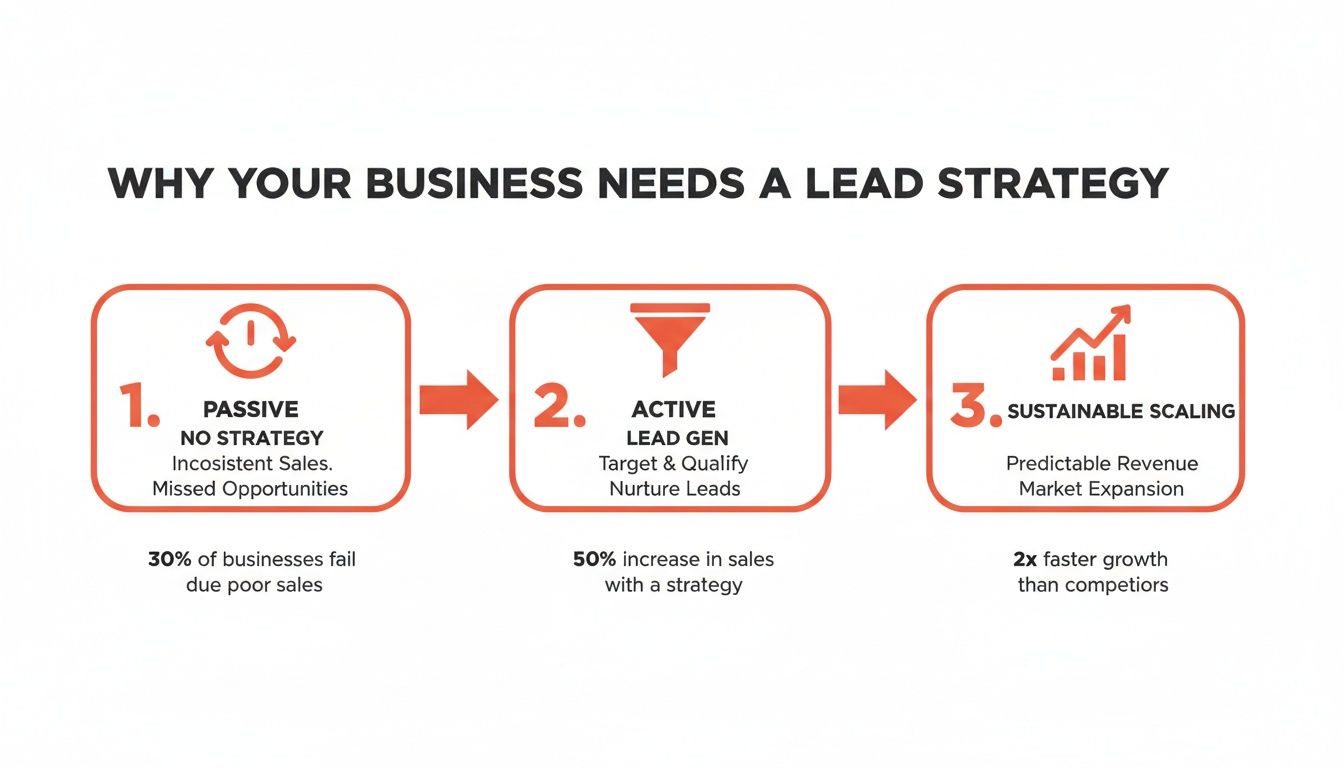
This active guidance is what turns random interest into predictable growth.
A lead in the MOFU stage is actively comparing solutions. Your job is to provide the detailed, high-value content that helps them make an informed choice, with your brand positioned as the clear favourite.
To do this, you need to offer something more substantial in exchange for an email address. This is where lead magnets come into play:
- In-depth Guides or eBooks: Comprehensive resources that dive deep into a specific topic they’re researching.
- Webinars or Workshops: Live or recorded sessions that offer expert insights and practical demonstrations.
- Case Studies: Real-world examples showing exactly how you've helped similar customers solve their problems.
This exchange is critical. It gives you permission to continue the conversation directly.
Bottom of the Funnel (BOFU): Driving the Decision
Down at the bottom of the funnel, your leads are on the verge of making a decision. They’ve done their research and are now looking for that final piece of evidence that convinces them to buy from you. Your goal here is simple: convert the lead into a customer.
Content at this stage needs to be highly specific and product-focused. It must overcome any final hesitations and make it incredibly easy for them to take the next step. If you want to dig deeper into this final conversion stage, our guide on what is a sales funnel explains how it all connects.
The most effective BOFU offers are those that directly prove your value and build confidence:
- Free Trials or Demos: Let prospects experience your product or service firsthand. There's no better proof than seeing it work.
- Consultations or Quotes: Offer a personalised assessment of their needs and a clear, tailored path forward.
- Customer Testimonials and Reviews: Provide social proof from happy clients who have already achieved the results your lead is looking for.
By aligning your content and offers with each stage of the funnel, you create a seamless, logical journey that naturally guides strangers into becoming loyal customers.
Choosing Your Best Lead Generation Channels
Alright, you’ve got a handle on the customer journey. The next big question is a simple one: where are you actually going to find these people?
Picking your lead generation channels is like a tradie choosing tools for a job. Trying to use a hammer when you need a screwdriver will just leave you with a mess and a lot of frustration. Where you decide to spend your time, budget, and creative energy will make or break your results.
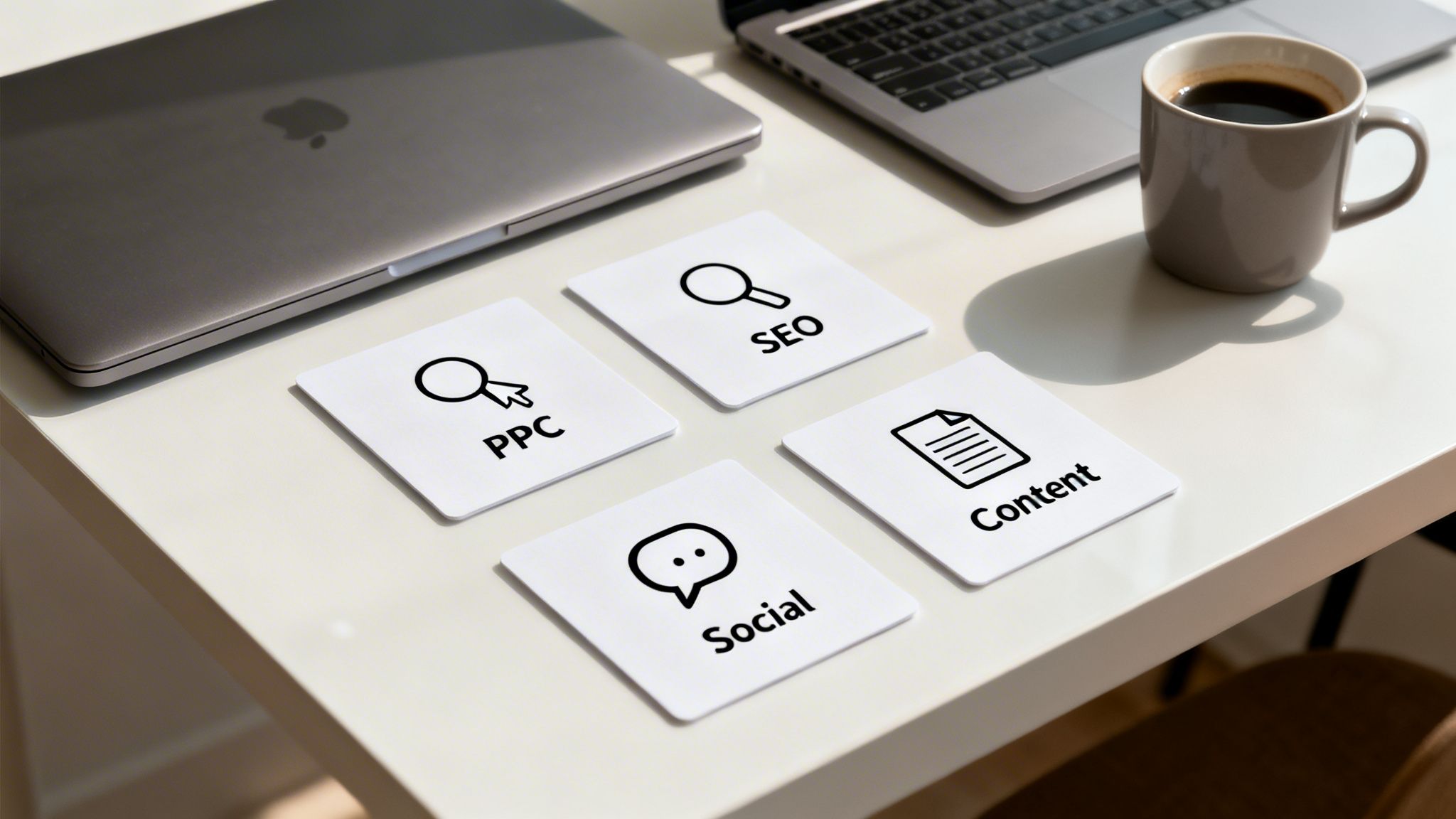
The four pillars of modern digital lead generation are Pay-Per-Click (PPC) advertising, Search Engine Optimisation (SEO), social media, and content marketing. The most successful businesses almost always use a combination of them. Let's break down how each one works so you can start thinking about the right mix for your goals.
Pay-Per-Click (PPC) Advertising
Think of PPC as the sprinter in the lead generation race. It's built for speed and precision, letting you jump right in front of motivated buyers on Google or in their social media feeds.
If you need leads in a hurry, want to test a new offer, or need to reach a super-specific audience, PPC is your go-to. The huge advantage is immediate visibility—you can launch a campaign in the morning and have leads rolling in by the afternoon. You can get a better sense of how paid and organic search work together in our deep dive on what is SEM.
The catch? That speed comes at a price. Your ads are only visible as long as your credit card is running, making it a constant operating expense.
Search Engine Optimisation (SEO)
If PPC is the sprinter, SEO is the marathon runner. It's the long-game strategy of optimising your website to show up in Google's organic search results without paying for every click.
SEO is all about building a sustainable source of high-quality leads over time. When someone searches for a solution and your website pops up as the top answer, it builds instant authority and trust. The payoff can be massive; a single top-ranking page can drive free, relevant traffic for years.
The downside is the time it takes. You'll need to commit several months to see significant results, but you're building a valuable business asset that pays dividends long after you've done the work.
In lead generation, PPC is like renting your audience's attention. SEO is like owning the land they build their community on. Both are useful, but only one creates a lasting asset.
For Aussie businesses, the numbers tell a compelling story. Email marketing is a B2B powerhouse, with 88% of businesses using it as their main channel, followed closely by social media at 78%. This makes sense when you consider 80% of Australian B2B leads come from LinkedIn.
At the same time, 59% of local marketers believe SEO has the biggest impact on generating leads. This strategy works hand-in-glove with content marketing—companies that publish 15 blog posts a month have been shown to average 1,200 new leads. You can find more insights in this B2B lead generation report.
Social Media and Content Marketing
Social media is your brand’s community hub. It’s less about the hard sell and more about building a presence, engaging with your audience, and nurturing relationships. It’s a fantastic channel for top-of-funnel awareness and funnelling people toward your website.
Content marketing is the fuel that powers everything else.
- Your blog posts are what you optimise for SEO.
- Your in-depth guides are what you offer in your PPC campaigns.
- Your engaging videos are what you share on social media.
It's the core pillar that delivers real value and pulls people into your world. And if you're using email, mastering the fundamentals is non-negotiable—knowing how to stop email from going to spam in Gmail is crucial to actually reaching your prospects.
Ultimately, choosing just one channel is rarely the best move. The real magic happens when you build a system where each channel supports the others, creating a powerful, multi-pronged lead generation machine.
How to Supercharge Your Strategy With AI and Experts
Once you have a solid lead generation system in place, the next logical step is to crank up the performance. Simply running campaigns and hoping for the best won’t cut it. To get a real competitive edge, you need to make them smarter, faster, and more efficient.
This is where two powerful accelerators come into play: artificial intelligence and expert agency partnerships. These aren't an either/or choice. In fact, they work best together—AI provides the raw technological muscle for automation and insight, while an agency brings the strategic brainpower to steer it all in the right direction.
Putting AI to Work for Smarter Leads
Artificial intelligence has moved well beyond industry buzzwords; it's now a practical toolkit that's completely changing the game for lead generation. AI algorithms can chew through massive datasets in real-time, spotting patterns and making predictions a human team could never hope to manage on their own.
This isn't just about doing things faster. It’s about making every single part of your lead generation process more intelligent.
- Predictive Analytics: AI can analyse your past performance and market signals to figure out which leads are most likely to convert. This lets your sales team stop wasting time and focus their energy where it counts—on the hottest prospects.
- Automated Ad Bidding: Instead of manually setting bids, AI-driven tools can adjust them on the fly. This ensures you’re always getting the best possible ad placement for the lowest cost, which is a game-changer for your return on ad spend.
- Personalisation at Scale: AI-powered systems can customise website content, emails, and even product recommendations for each user. This creates a deeply personal journey that ramps up engagement and drives more conversions.
Ultimately, this level of optimisation helps you generate the right leads with far greater efficiency. To see how this applies in the real world of advertising, take a look at our detailed guide on artificial intelligence in modern advertising.
Partnering With a Specialised Agency
While AI gives you the high-tech firepower, a specialised agency like Click Click Bang Bang provides the seasoned pilots to fly the jet. We bring the strategic experience, knowing the machine inside and out and having navigated enough turbulence to know how to avoid it.
A good agency does much more than just run your campaigns. They bring a proven methodology, deep platform expertise, and a data-obsessed approach that helps you sidestep the costly mistakes most businesses make when going it alone. This is particularly true in Australia's fiercely competitive B2B market.
For instance, Australian market data reveals that businesses with effective lead nurturing programs see 451% more qualified leads. That's a massive number, especially when you consider that a staggering 80% of new leads never convert without proper follow-up. It's no surprise, then, that 68% of sales leaders prefer outsourcing their lead generation, pointing to a much better ROI than hiring in-house. You can dig into more of these local lead generation trends to see why.
A great agency doesn’t just execute your plan; they challenge it, refine it, and hold it accountable to real business outcomes. They transform your marketing spend from an expense into a predictable investment in growth.
When you look at the two options side-by-side, the value of a partnership becomes crystal clear.
| Aspect | DIY Approach | Agency Partnership |
|---|---|---|
| Expertise | Requires a huge amount of time for learning, testing, and making mistakes. | Get instant access to a team of specialists with deep platform knowledge. |
| Time Investment | A major time-suck for business owners or internal teams who have other jobs to do. | Frees up your internal resources to focus on running the actual business. |
| Tools & Tech | Your access to professional tools is often limited by tight budget constraints. | Agencies come equipped with a full suite of premium analytics and optimisation tools. |
| Strategy | Relies on trial and error, which can be a slow and expensive way to learn. | Built on a proven methodology that's been refined across hundreds of campaigns. |
The choice between a DIY approach and an agency partnership often comes down to where your business is right now. If you're just starting out and have more time than money, trying to manage it yourself can be a viable way to learn the ropes.
But if you're ready to scale and need predictable, consistent results, investing in an expert partnership is one of the fastest ways to get there.
Even the most carefully crafted lead generation strategy can fall flat if you stumble into a few common, easily avoidable traps. Launching campaigns without knowing these pitfalls is a recipe for wasted budget and stalled growth.
Let’s walk through the most frequent mistakes we see businesses make. More importantly, we’ll give you clear, actionable ways to steer clear of them. This isn't just about what not to do; it’s about understanding why these errors are so damaging and how to build a better lead-gen engine from the ground up.
Chasing Quantity Over Quality
The most tempting mistake is obsessing over the sheer volume of leads. It feels great to watch the contact list grow, but if they aren't the right people, you're just creating a mountain of busywork for your sales team. This leads directly to wasted time, frustrated staff, and a dismal conversion rate.
Think of it this way: would you rather have 100 people just browsing in your shop with no plans to buy, or five people who walk in with their wallets out, ready to go?
The solution is to get laser-focused on your Ideal Customer Profile (ICP).
- Refine Your Targeting: Use the data from your best current customers to build a crystal-clear picture of who you should be talking to.
- Implement Lead Scoring: Set up a system that automatically ranks leads based on their demographics and behaviour, so your sales team only spends time on the hottest prospects.
- Qualify with Content: Use your lead magnets and forms to ask smart qualifying questions. This helps you weed out the tyre-kickers before they ever enter your funnel.
Neglecting the Follow-Up
Getting the lead is only step one. One of the most common and costly errors is having no solid lead nurturing process in place. A new lead is like a spark—if you don't fan the flame, it fizzles out almost immediately.
Remember, most new leads aren't ready to buy the second they download your eBook. They need consistent, valuable engagement to guide them along their journey. Without a follow-up plan, you're essentially abandoning them after the first date.
A lead that isn't nurtured is a wasted opportunity and a squandered marketing dollar. The fortune is truly in the follow-up, where you build the trust that eventually leads to a sale.
To fix this, you need to build an automated nurturing sequence. As soon as a lead is captured, they should enter a workflow that delivers value over time. For example, send a series of emails offering related content, case studies, or an invitation to a webinar. This keeps your brand top-of-mind and builds the relationship you need for a conversion.
Creating Poor Landing Page Experiences
You can have the most brilliant ad or blog post in the world, but if it sends traffic to a confusing, slow, or badly designed landing page, you’ve just thrown your money away. Your landing page is the moment of truth—it’s where the conversion actually happens.
Common landing page blunders include:
- Confusing Messaging: The headline on the page doesn't match the promise made in the ad.
- Too Many Distractions: Navigation menus, multiple calls-to-action, and social media links all pull the user away from the one thing you want them to do.
- Complicated Forms: Asking for too much information too soon creates friction and absolutely murders conversion rates.
The fix here is simple: focus on clarity and a single goal. Every single element on your landing page, from the headline to the button text, must be aligned with one specific action. Strip away anything that doesn't serve that purpose and make it incredibly easy for the user to say "yes."
Your Lead Generation Questions Answered
Getting a lead generation strategy off the ground always kicks up a few questions. To help you get moving with confidence, we’re tackling some of the most common ones we hear from business owners and marketers, with straight-up, actionable answers.
How Long Does It Take to See Results?
This is the big one, and the honest answer is: it depends entirely on the channels you choose. Some methods are built for speed, while others are a long-term play for sustainable growth.
-
For Fast Results (Days to Weeks): Paid channels like Pay-Per-Click (PPC) advertising are your go-to for speed. You can launch a campaign on Google or social media and, if everything is dialled in, see your first leads roll in within hours or days. This makes PPC perfect for testing a new offer, pushing a specific promotion, or when you just need to fill the sales pipeline now.
-
For Long-Term Growth (Months to Years): Search Engine Optimisation (SEO) is a marathon, not a sprint. It generally takes several months (often 3-6) to build real momentum and see a noticeable jump in organic traffic and leads. The payoff, however, is huge. The results compound over time, creating a valuable asset that keeps generating high-quality, "free" leads long after the initial work is done.
What Is a Good Cost Per Lead (CPL)?
There’s no magic number for a "good" Cost Per Lead (CPL) in Australia. It can swing wildly depending on your industry, channel, and who you’re targeting. For example, a lead for a local cleaning service might come in around $20, while a highly qualified lead for enterprise software could easily run into the hundreds.
The real goal isn't just to get the lowest CPL possible. The true objective is to secure the highest quality lead that delivers the best return on investment (ROI). A cheap, unqualified lead who never converts is far more expensive than a pricier lead who becomes a loyal, high-value customer.
Instead of chasing some universal benchmark, your energy is better spent tracking your own CPL for each channel and measuring it against the lifetime value of your customers. That’s the metric that matters.
Should I DIY Lead Gen or Hire an Agency?
Deciding whether to manage lead generation in-house or bring in an agency really comes down to your three key resources: time, expertise, and budget.
-
DIY Lead Gen: Going it alone gives you maximum control over your costs and is a fantastic way to learn the ropes. But be prepared for a serious time commitment and a steep learning curve. It’s a solid option if you’re working with a small budget but have plenty of hours to dedicate to research, execution, and analysis.
-
Hiring an Agency: Partnering with experts like Click Click Bang Bang gives you immediate access to strategic guidance, deep platform knowledge, and much faster results. An agency is the right move for businesses ready to scale, as they bring a proven methodology to the table. This helps you avoid costly rookie mistakes and accelerates your growth, all while freeing you up to focus on what you do best—running your business.
Ready to stop guessing and start growing? The team at Click Click Bang Bang builds precision-driven PPC and SEO strategies that deliver predictable results. Book a free strategy session today.
Read NeXt
Or Read Our Latest
- What Is Brand Positioning and Why It Drives Growth
- Push vs Pull Marketing: A 2026 Decision Guide
- Ad Relevance Score Explained: How It Impacts PPC Performance
- Best ROI Digital Marketing: 10 Channels Ranked for 2026
- Localization Strategy: How to Win in Any Market
- Phone Call Tracking: Methods, Metrics, and Best Practices
Click. CLick. Subscribe.
Get our best PPC insights, industry updates, and power moves delivered straight to your inbox. No fluff, just high-caliber strategies that actually work.
Don’t Leave Just Yet
Try Us For 30-Days,
Risk Free!!
We guarantee that you’ll love our work within the first 30 days, if not you’ll get your money back.
What have you got to lose?