

Specialist Search Engine Optimisation for AU Businesses
Last Updated

You're probably in one of two situations right now. Either your business has been “doing SEO” for months and the reports look busy, but revenue hasn't moved in a way that justifies the effort. Or you're comparing providers and noticing that many of them still sell the same package: keywords, blog posts, meta tags, backlinks, monthly report.
That model isn't enough anymore.
Search has become more technical, more localised, more intent-driven, and more accountable to commercial outcomes. A marketing manager doesn't need another agency that celebrates ranking improvements on low-value terms. You need someone who can diagnose why qualified traffic isn't converting, why key pages aren't being discovered properly, why category structures are leaking authority, or why organic and paid search are being planned in isolation.
That's where specialist search engine optimisation becomes useful. Not as a nicer label for general SEO, but as a different operating model. The work starts with business goals, then maps search visibility to revenue pathways. It treats the site as both a marketing asset and a technical system.
Beyond Rankings Why Your Business Needs More Than Generic SEO
The old SEO pitch was simple. Publish more content, add target keywords, build links, wait for rankings. That approach still shows up in proposals, but it breaks down fast when a business needs organic search to support pipeline, online sales, or store-level demand.
A generic SEO process usually produces activity. It doesn't always produce impact.
The reason is straightforward. Most commercial websites don't lose performance because they forgot to add keywords to page titles. They lose because the wrong pages are being prioritised, search intent is being interpreted too broadly, analytics can't tie organic sessions to meaningful outcomes, or technical barriers stop important content from being crawled and understood properly.
Practical rule: If your SEO report can't explain impact on leads, sales, margin, or qualified traffic quality, it's reporting activity, not performance.
Google's own guidance supports the broader role of SEO. The highest-value specialist work is often not content production, but audit-led prioritisation of site structure, analytics, and conversion paths. SEO roles increasingly combine SEO with analytics, strategy, and even PPC, which reframes the discipline as a multi-skill growth function rather than a keyword-ranking service, as outlined in Google's guidance on whether you need SEO.
What changes when SEO becomes a specialist function
A specialist doesn't start with “how many blogs per month”. They start with questions like these:
- Commercial priority: Which products, services, or lead types matter most?
- Search intent fit: Are your landing pages aligned to what Australian buyers want at each stage?
- Technical friction: Is Google discovering, rendering, and indexing the pages you want to rank?
- Conversion path: Does organic traffic arrive on pages built to convert, or pages built to exist?
That's also why budget conversations need more context than a flat retainer comparison. If you're weighing options, this breakdown of how much search engine optimisation costs is useful because cost only makes sense once scope, complexity, and business model are clear.
Generic SEO tries to increase visibility. Specialist SEO tries to increase profitable visibility.
Defining Specialist Search Engine Optimisation
A useful way to understand the difference is to think about a GP and a cardiologist.
A GP can identify common symptoms, manage routine issues, and offer broad advice. A cardiologist handles complex heart conditions, interprets deeper signals, and builds treatment around a specific risk profile. Both are competent. Only one is built for the hard cases.
Specialist search engine optimisation works the same way.
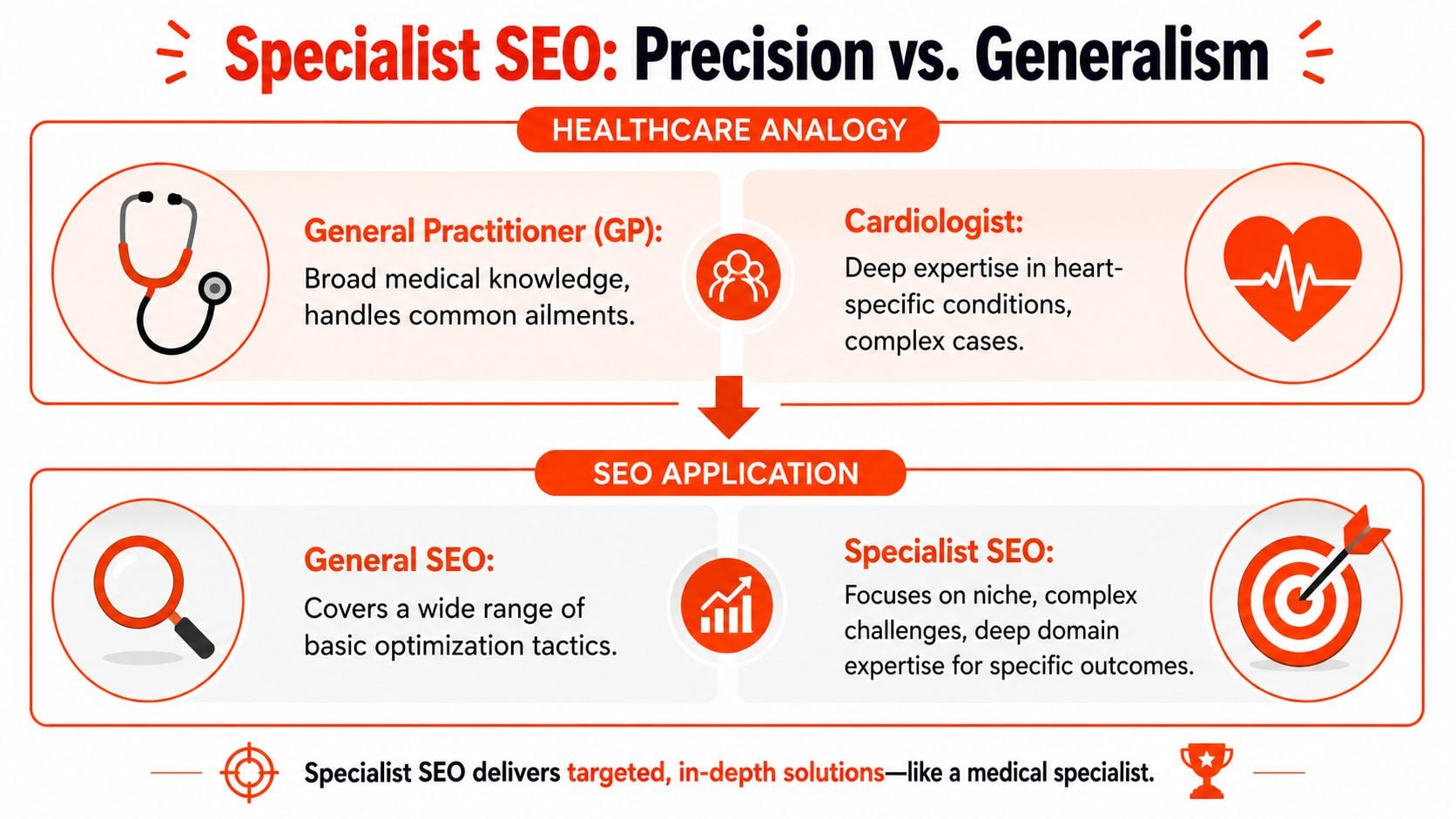
A generalist SEO can handle broad hygiene work. They'll improve titles, publish service pages, and run standard audits. A specialist goes deeper. They isolate why non-branded traffic is underperforming, where internal linking is suppressing key pages, how JavaScript affects rendering, and which search journeys deserve bespoke landing page logic.
That level of depth matters more in Australia because search behaviour is unusually concentrated. In Australia, Google accounts for about 95% of all general search queries, which makes specialist SEO heavily dependent on Google's ranking systems, indexing behaviour, and SERP features rather than a broad multi-engine strategy, according to Ahrefs' reporting on search market concentration.
The main forms of specialisation
Not every specialist works on the same problems. The label only matters if it maps to a clear type of expertise.
- Technical SEO: Focuses on crawlability, indexation, rendering, site architecture, canonical signals, structured data, and performance.
- E-commerce SEO: Works on category logic, faceted navigation, product discovery, merchant intent, stock-driven page management, and conversion-aware page templates.
- B2B SEO: Aligns content to long buying cycles, solution-aware searches, comparison intent, and lead qualification.
- Local SEO: Builds visibility around service areas, suburb and state intent, and location-sensitive search patterns.
Where AI fits and where it fails
AI hasn't replaced specialist SEO. It has raised the cost of being generic.
A weak operator uses AI to flood a site with interchangeable content. A strong operator uses it to speed up clustering, SERP analysis, entity mapping, content gap review, and draft development, then applies judgement before anything goes live. If your team wants a grounded starting point for research workflows, it's worth learning how to learn keywords with Keywordme before anyone turns a prompt into a content calendar.
Specialist SEO doesn't mean more tactics. It means tighter diagnosis, sharper prioritisation, and a clearer path from search demand to commercial return.
Generalist vs Specialist An AI-First SEO Comparison
The quickest way to spot the difference is to compare how each approach handles the same job. Both may use similar tools. They don't use them with the same intent.
A generalist often runs a checklist. An AI-first specialist runs a diagnosis.
Generalist SEO vs Specialist SEO
| Aspect | Generalist SEO | AI-First Specialist SEO |
|---|---|---|
| Keyword strategy | Targets broad phrases with visible volume | Prioritises intent, margin, conversion potential, and SERP fit |
| Site audit | Runs automated scans and exports issue lists | Interprets technical issues in business context and sequences fixes by impact |
| Content production | Publishes large volumes of generic pages, often AI-assisted without editorial control | Uses AI for research and drafting, then shapes content around expertise, differentiation, and conversion goals |
| Reporting | Focuses on rankings, traffic charts, and completed tasks | Connects organic work to leads, sales quality, funnel movement, and assisted conversion paths |
| Local search | Adds location terms to pages | Builds location relevance into page architecture, intent mapping, and supporting signals |
| Collaboration | Works inside a marketing silo | Coordinates with dev, content, UX, analytics, and paid media teams |
| AI usage | Uses tools as a shortcut for output | Uses tools as force multipliers for analysis, workflow speed, and scenario testing |
What AI-first should actually mean
There's a lot of loose language around AI in SEO. In practice, an AI-first workflow should improve quality control and speed, not lower the standard of thinking.
Useful AI support usually includes:
- SERP interpretation: Summarising competing result types and common intent patterns
- Content planning: Grouping related topics and identifying overlap before pages cannibalise each other
- Technical review support: Helping teams sort issue sets and identify repeat patterns across templates
- Workflow acceleration: Producing first drafts, outline variants, and tagging suggestions for faster editing
For teams evaluating tools, this roundup on how to optimize your SEO with AI tools is a practical reference because it separates productivity help from hype.
The problem isn't AI itself. The problem is treating automation as strategy.
The decision test for managers
If you're reviewing your current provider, ask one blunt question: when performance drops, do they explain why in a way that changes business decisions?
If the answer is no, you're likely paying for maintenance, not growth work. That's also why many businesses now combine specialist SEO with broader search planning. A more current view of that overlap is in this guide to AI SEO, where the value comes from using AI to sharpen judgement, not replace it.
Core Services and Tangible Deliverables
Specialist SEO earns its place by producing work your team can implement, measure, and tie back to commercial goals. If the output stops at blog topics and title tags, you are buying activity, not a search growth function.

In practice, the difference shows up in the deliverables. A specialist produces decision documents, implementation priorities, and technical guidance that product, content, development, and paid media teams can all use. That matters in Australian businesses where one search budget often has to support national visibility, local intent, and tighter acquisition targets at the same time.
What the work looks like in practice
A strong engagement usually includes deliverables such as:
- Indexation blueprint: A mapped view of which pages should be indexed, which should stay out of search, and how Google should reach priority content
- Internal linking architecture plan: Recommendations that direct authority toward revenue-driving service, category, or product pages
- Structured data implementation brief: Schema guidance that improves how search engines interpret pages and supports richer search results
- Content intent map: A page-by-page framework that aligns query intent with funnel stage and business objective
- Template-level technical guidance: Recommendations for service pages, collection pages, product templates, and resource hubs so SEO improvements scale across the site
For many businesses, the most useful starting point is a formal audit. A structured website audit gives your team a prioritised action plan, assigned issue groups, and a clearer view of what affects revenue first.
Core Web Vitals affect acquisition
Performance work sits inside specialist SEO because slow pages reduce both visibility and conversion efficiency.
Google uses Core Web Vitals to assess page experience. The current targets are LCP at 2.5 seconds or less, INP at 200 milliseconds or less, and CLS at 0.1 or less. Improvements to image handling, code delivery, mobile rendering, and script control can strengthen technical performance, as outlined in Semrush's technical SEO guidance.
This shows up quickly on Australian mobile traffic. Heavy templates, oversized media files, third-party scripts, and long server response times often hit users outside metro networks first. A page can rank, attract the click, and still fail commercially if it feels slow or unstable once someone lands on it.
Here's a useful explainer on the broader mechanics behind technical improvement:
Content support that goes beyond publishing
Specialist content work focuses on page purpose, commercial fit, and distribution value. The goal is to build assets that rank for the right searches and move visitors toward an enquiry, purchase, or booked call.
That often includes:
- Commercial landing pages: Built around service intent, solution comparisons, and conversion paths
- Authority assets: Category guides, comparison pages, and resource hubs that support trust and assist internal linking
- Video search support: If your team publishes video, it helps to streamline video content with transcripts so content can be reused as crawlable on-page text and supporting articles
- Measurement layers: Event tracking, landing page diagnostics, and Search Console review tied back to business outcomes
Click Click Bang Bang can sit in that middle ground between SEO, PPC, and analytics when businesses need search managed as one acquisition channel rather than a standalone content task.
Measuring the Business Impact of Specialist SEO
A ranking report can look healthy while the business stays flat.
That's the core reporting problem with generic SEO. It over-rewards visibility signals and under-reports commercial value. A marketing manager doesn't need to know only that traffic rose. They need to know whether organic search is bringing better buyers, supporting lower acquisition costs, and contributing to revenue in a way the finance team can recognise.
What to measure instead
The right KPI set depends on the business model.
For e-commerce, the useful questions are tied to transaction quality:
- Revenue from non-branded organic traffic
- Conversion rate on category and product landing pages
- Organic entry pages that assist higher-value purchases
- Commercial page visibility for high-intent searches
For B2B and lead generation, the focus shifts:
- Qualified enquiries from organic search
- Demo or consultation requests from solution pages
- Lead quality by landing page type
- Organic contribution to pipeline, not just form fills
For local businesses, specialist SEO can become even more commercially visible. In Australia, 58% of companies do not optimise for local search, which leaves room for businesses that do the work well. That underinvestment creates a meaningful opening for visibility, foot traffic, and sales, based on Lumar's SEO statistics summary.
The reporting standard to expect
A specialist report should answer three things clearly:
- What changed
- Why it changed
- What the business should do next
That means less time spent celebrating isolated rankings and more time showing how search demand, landing page performance, and conversion behaviour interact. If organic traffic rises on irrelevant queries, that's not success. If fewer visits produce stronger enquiries, that may be.
“Good SEO reporting should help you make a budget decision, a content decision, or a product-page decision. If it can't do that, it's incomplete.”
The ultimate measure of SEO maturity isn't whether a provider can increase impressions. It's whether they can defend the work in the language of revenue, lead quality, and opportunity cost.
How to Hire a Specialist SEO Partner in Australia
Most SEO sales processes sound convincing because they use familiar language. Audit. Optimise. Content. Authority. Growth.
The difference appears when you ask how they think.
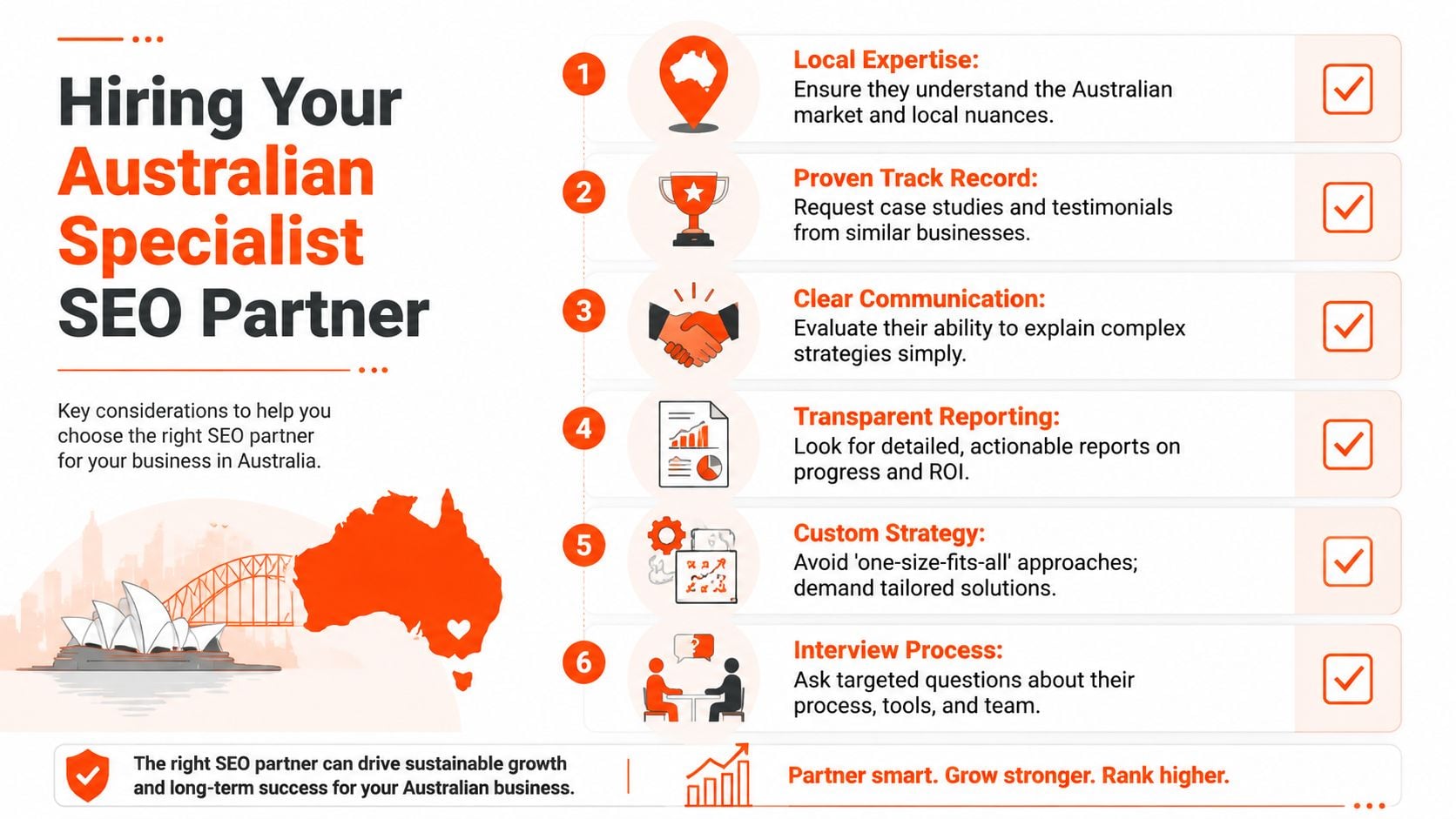
A specialist partner should be able to explain diagnosis, prioritisation, implementation trade-offs, and measurement without hiding behind jargon. If they can't translate technical work into business language, they'll struggle when your internal team needs to choose between dev time, paid budget, and content investment.
Questions that expose the difference
Use questions that force specific answers.
-
How do you decide what to fix first?
Look for prioritisation based on revenue pages, indexation risks, and conversion pathways. Be cautious if the answer is just “we fix all critical errors first”. -
How do you approach indexation?
A specialist should treat discovery and index control as an engineering problem. Google's guidance points to sitemaps, internal links, canonicalisation, and managed visibility controls as core levers, and those signals matter even more when Australian relevance changes by geography and intent, as discussed in this Google search guidance video. -
What does AI do in your workflow?
You want a practical answer. Research support, SERP analysis, drafting, QA, clustering. Not “AI writes all our content”. -
How do you report business impact?
If they default to rankings and traffic, keep digging. Ask how they connect SEO work to qualified leads, sales, or store enquiries.
Signs you're dealing with a generalist in specialist clothing
Sometimes the warning signs are obvious:
- Template-led proposals: The same deliverables appear regardless of whether the site is e-commerce, B2B, or local services.
- Content-first diagnosis: They jump to blogs before understanding architecture, search intent gaps, or indexation issues.
- Tool dependency: They rely on crawler exports but can't explain what the findings mean in context.
- Weak collaboration model: They don't mention dev teams, analytics setup, UX, or paid search coordination.
What a strong partner relationship looks like
The best SEO partner doesn't just “do SEO”. They help the business make better search decisions.
That means they should be able to:
- challenge low-value page plans,
- identify where paid and organic can support each other,
- explain technical debt in commercial terms,
- and adapt the strategy when product priorities shift.
In Australia, that local context matters. Search behaviour, service areas, and state-level relevance can reshape what a page needs to rank and convert. A true specialist should already think that way before you ask.
Your Next Steps Toward Strategic SEO
If your current SEO effort feels busy but commercially vague, that's usually a sign the work is too generic.
Specialist search engine optimisation is different because it treats search as part of growth infrastructure. It connects technical health, content intent, local relevance, analytics, and conversion design. That's why it tends to produce better decisions, not just more deliverables.
A practical next move looks like this:
-
Review your current SEO through a commercial lens
Check whether your reporting links work to revenue, qualified leads, or local demand. If it doesn't, your measurement framework needs work. -
Audit the actual depth of your provider
Ask the hiring questions above. See whether they think in terms of diagnosis and prioritisation, or only in terms of output. -
Identify your highest-value search opportunity
Don't start with the whole site. Start with the category, service line, location cluster, or lead pathway where better organic performance would matter most.
Businesses rarely need more SEO noise. They need sharper search decisions, cleaner implementation, and reporting that stands up in a budget meeting.
If you want a clearer view of what specialist SEO would look like for your business, Click Click Bang Bang can help assess your current search setup, identify technical and commercial gaps, and map a more accountable organic strategy.
Read NeXt
Or Read Our Latest
- Data Privacy Compliance: 2026 Guide for Marketers
- Your 2026 Remarketing Campaign Strategy Blueprint
- Customer Lifetime Value: Calculate & Increase It in 2026
- Contextual Targeting Advertising: A Guide for 2026
- Best Seo Agency Australia Guide 2026
- Cross Domain Tracking: A Practical Guide for GA4 in 2026
Click. CLick. Subscribe.
Get our best PPC insights, industry updates, and power moves delivered straight to your inbox. No fluff, just high-caliber strategies that actually work.
Don’t Leave Just Yet
Try Us For 30-Days,
Risk Free!!
We guarantee that you’ll love our work within the first 30 days, if not you’ll get your money back.
What have you got to lose?