

Digital Marketing for Realtors: Win More Clients
Last Updated

For a real estate agent today, digital marketing isn't just another item on the to-do list; it's the engine room of a successful business. It’s how you use platforms like Google, social media, and email to find motivated vendors and buyers, build your reputation, and create a reliable pipeline of high-quality leads.
Why Your Digital Presence Is Your New Shopfront
Let's be blunt: if you're an Australian real estate agent who isn't taking digital marketing seriously, you're on the fast track to becoming invisible. The era of relying purely on a high-street office and letterbox drops has well and truly passed. Your digital presence is now your most important shopfront, and it’s open 24/7 to a local, national, and even global audience.
Think about where today's property vendors and buyers actually spend their time. They're scrolling through Instagram, searching Google for "real estate agent near me," and researching property values on their lunch break. These online spaces are the new battlegrounds where listings are won and lost long before a potential client ever thinks about walking into a physical office.
Digital vs Traditional Marketing Reach for Realtors
To put it in perspective, let's compare the reach and efficiency of modern digital channels against the traditional methods that once dominated the industry.
| Marketing Channel | Typical Reach | Lead Quality | Cost Efficiency |
|---|---|---|---|
| Google & Local SEO | Suburb to city-wide | High (active searchers) | Very High |
| Social Media Ads | Hyper-targeted demographics | Varies (passive audience) | High |
| Email & CRM | Existing database | High (warm audience) | Excellent |
| Letterbox Drops | Limited to postcode | Low (unqualified) | Low |
| Newspaper/Print Ads | Declining readership | Low (broad audience) | Very Low |
The contrast is stark. While traditional methods involve a lot of hope and guesswork, digital channels allow you to target with precision, measure everything, and get a much better return on your investment.
The Unmissable Shift to Digital-First
This isn't just a fleeting trend; it’s a fundamental change in how people buy and sell property. The data for the Australian market is crystal clear. An incredible 96% of home buyers now start their property search online, and organic search alone drives 57% of all agent website traffic.
Recent industry reports show that in 2026, Australian agents who invested in Google Ads saw a staggering 300% increase in digital traffic compared to those relying on traditional methods. The evidence overwhelmingly proves the definitive move away from print and towards digital.
This simple diagram shows how your "digital shopfront" connects directly to the two arenas that matter most: search engines and social media.
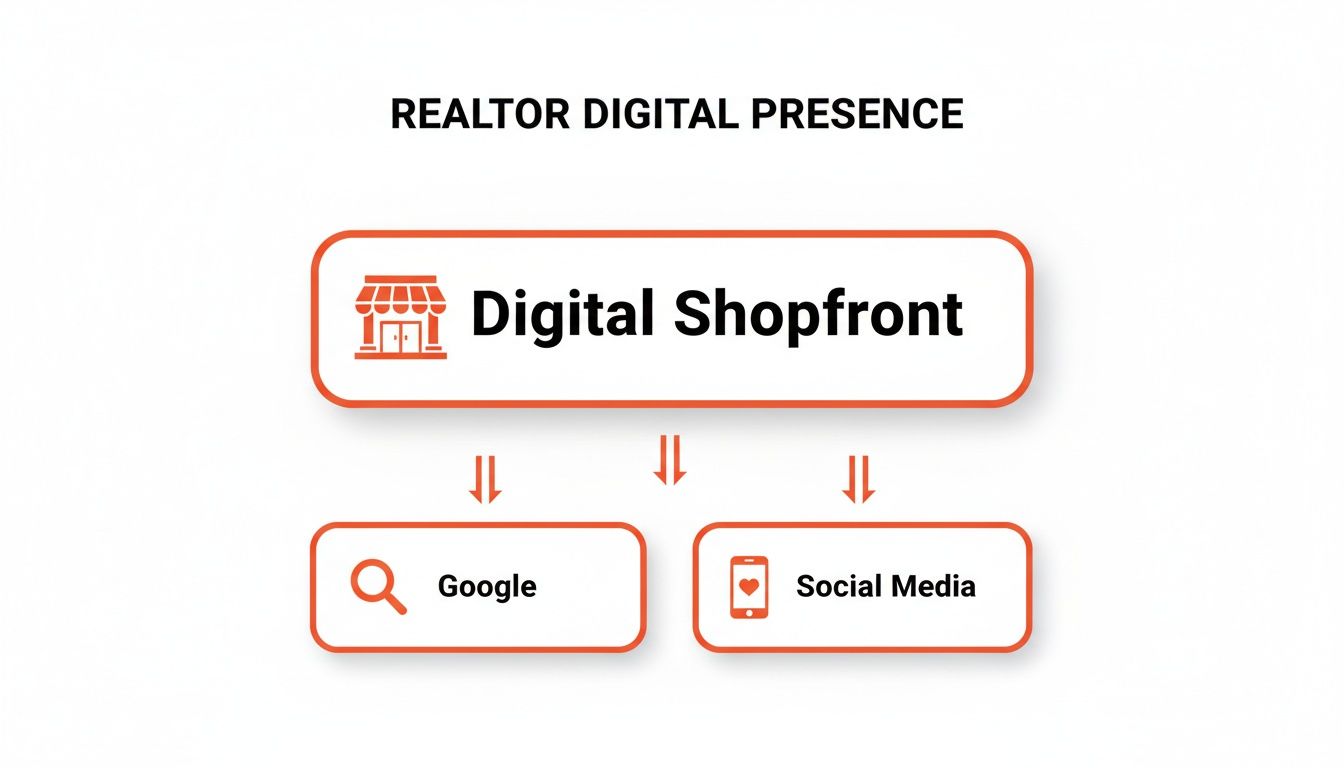
This structure makes it obvious: your success hinges on being highly visible and credible on both Google and the key social platforms where your clients are already active.
Building Your Foundation for Success
Mastering digital marketing isn’t about trying to be everywhere at once. It’s about strategically building your online authority and visibility to directly fuel your sales pipeline. A strong digital presence achieves several key goals:
- Builds Authority and Trust: A professional website, active social media profiles, and a stream of positive online reviews quickly establish you as a credible expert in your local market.
- Generates Qualified Leads: Digital advertising allows you to target specific postcodes, demographics, and even behaviours, attracting people who are actively looking to transact.
- Nurtures Long-Term Relationships: Email marketing and a solid CRM keep you top-of-mind with past clients and future prospects, generating that all-important repeat and referral business.
Your online brand is what people say about you when you're not in the room. In real estate, a strong digital brand ensures they're saying you're the go-to agent in the suburb.
Ultimately, your digital marketing efforts and your professional brand are two sides of the same coin. A robust online strategy doesn't just generate leads; it cements your reputation as a market leader. For a deeper dive, check out our guide on creating a powerful real estate brand that commands attention.
Win Your Suburb with Local SEO
If your digital presence is your new shopfront, then Local Search Engine Optimisation (SEO) is the giant, flashing neon sign that screams, "Your Local Expert is Right Here." It's hands down your most powerful free marketing tool for becoming the go-to, most recommended agent in your digital neighbourhood. While paid ads can get you seen today, Local SEO builds a long-term asset that keeps generating free, high-intent leads for years to come.
Think of it this way: when a potential vendor types "real estate agent in Richmond" into Google, they have a clear intention to transact. They’re not just browsing. Local SEO is the art and science of making sure your name, face, and five-star reviews pop up at the very top of those search results, positioning you as the obvious choice.
Your Google Business Profile Is Your Lead Magnet
Your Google Business Profile (GBP) is the absolute cornerstone of your local SEO strategy. It's that info box that appears in Google Search and on Google Maps, showcasing your business name, address, phone number, and—most importantly—your reviews. A neglected profile is like a dusty, vacant office; a fully optimised one is a vibrant hub that attracts and converts clients around the clock.
Turning your GBP from a basic listing into a lead-generating machine is surprisingly straightforward. Everything you need is right there in the Google Business Profile dashboard, where you can manage every aspect of your public-facing listing.
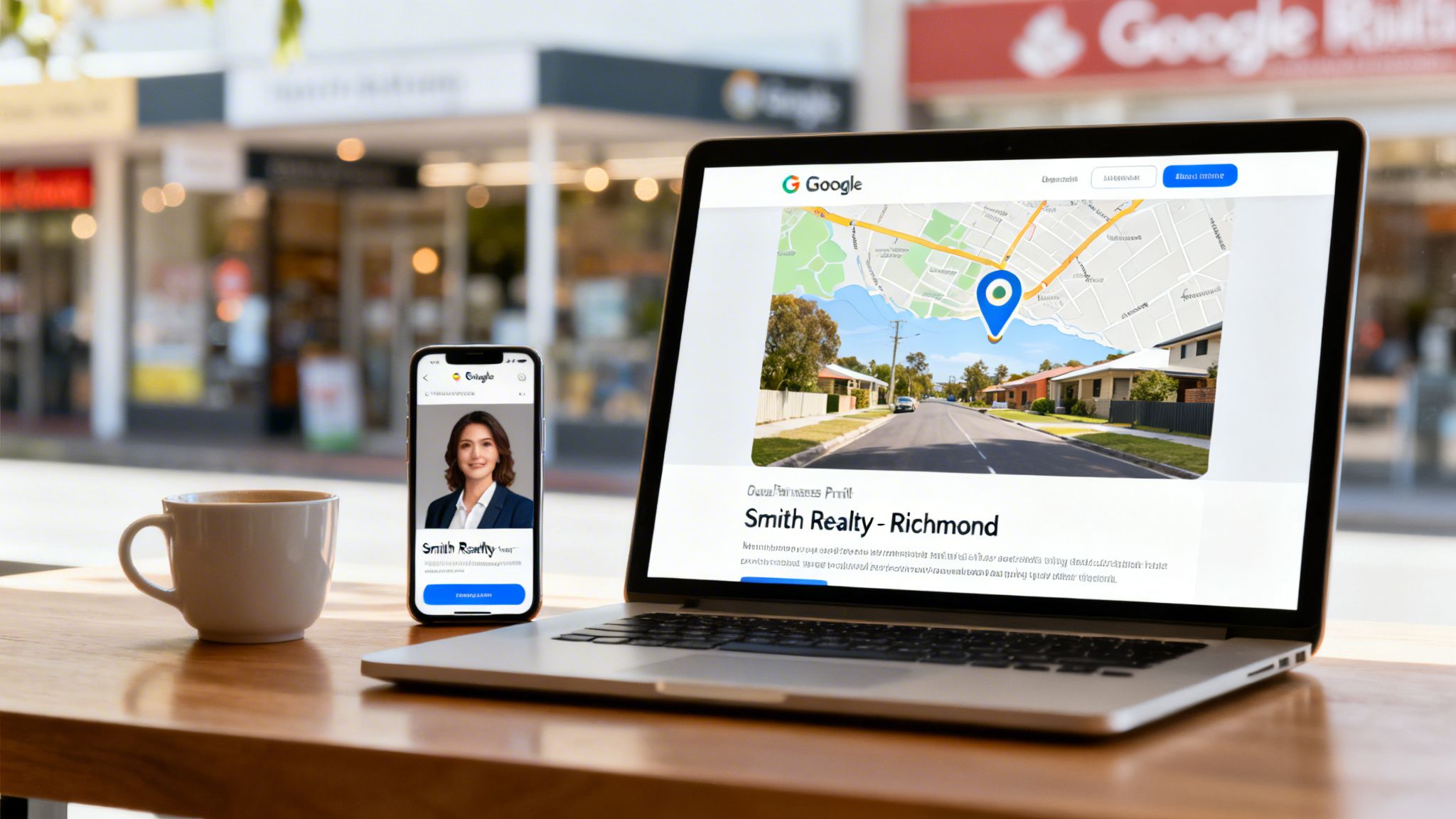
This is your control centre. It’s where you’ll update your details, respond to reviews, and post updates that keep your profile fresh and relevant in Google's eyes.
Your first move is to claim and verify your profile. Then, meticulously fill out every single section. Don't skip a thing. The more complete your profile, the more Google will trust you and promote your listing to local searchers. To really dominate local search and own your suburb, a comprehensive realtor search engine optimisation playbook is an indispensable guide.
Here's a quick checklist for building an all-star profile:
- Choose the Right Categories: Your primary category must be "Real Estate Agent". Then, add secondary categories like "Real Estate Agency" or "Property Appraiser" if they fit your business.
- Showcase Your Services: Use the 'Services' feature to list everything you do. Think "Buyer's Agent Services," "Residential Property Appraisals," and "Home Staging Consultations." Be specific.
- Upload High-Quality Photos: Don't be shy here. Aim for at least 20 professional photos. Include polished headshots, team photos, snaps of your office, and plenty of pictures of "Sold" signs in front of local properties. Photos build trust instantly.
Build Trust with a Stream of Five-Star Reviews
In real estate, social proof is everything. A staggering 90% of people read online reviews before making a decision, and your GBP reviews are often the very first thing a potential client will see. A steady flow of positive reviews is arguably the single most influential factor in both your local search ranking and your ability to convert leads.
Make it your mission to get 10 new five-star reviews in the next 90 days. It's the most impactful activity you can do for your local visibility without spending a cent.
Don't just sit back and hope for reviews to trickle in. You need to build a simple, repeatable system to actively request them. After every successful closing, send a personalised email to your happy client with a direct link to your GBP review page. Make it as easy as possible for them to share their positive experience while the good feelings are still fresh.
Create Content That Ranks for Local Searches
While your GBP is crucial, your website plays a massive role too. To win, you need to create content that directly answers the questions potential clients in your area are typing into Google. Put yourself in their shoes: what are people in your target suburbs actually searching for?
For example, creating a dedicated page on your website titled "Your Expert Real Estate Agent in Paddington" is a huge signal to Google. But this page needs to be more than just a sales pitch. It should be a genuinely valuable resource. Pack it with local market insights, suburb-specific statistics, recent sales, and glowing testimonials from past Paddington clients.
This approach doesn't just help you rank for those all-important keywords; it powerfully establishes your deep local expertise and authority. This strategy is a core part of any successful digital marketing plan, and learning more about how to get the most from local SEO for your business will give you a serious advantage over the competition.
Generate Leads on Demand with PPC Ads
While Local SEO is busy building your long-term authority, Pay-Per-Click (PPC) advertising is how you turn on the lead tap, right now. Think of SEO as owning your business premises and building its value over time. PPC, on the other hand, is like renting a massive, perfectly placed billboard on the busiest digital highway in your city.
It lets you get your message in front of motivated buyers and sellers the very moment they show interest. This speed and precision make PPC a non-negotiable part of any modern agent's digital toolkit. It’s all about generating results today, not just months down the track.
You get to put your services directly in the path of someone Googling "homes for sale in Richmond" or a potential vendor searching for a "property appraisal in the eastern suburbs." This immediacy is what makes paid advertising such a powerful accelerator for your business.
Google Ads vs Meta Ads Explained
While both Google Ads and Meta (which owns Facebook and Instagram) run on a PPC model, they capture completely different types of client intent. Getting this difference right is the key to spending your budget wisely.
Google Ads is basically the Yellow Pages for the modern era. You target keywords, which means you’re reaching people who are actively searching for a solution. They have a problem ("I need to sell my house") and they're looking for an expert to solve it, now.
Meta Ads, however, are more like a glossy magazine ad. You’re not targeting what people search for, but who they are. You can target users based on demographics, interests (like following high-end interior design pages), and even online behaviours that suggest they might be getting ready to move.
Think of it like this: Google Ads finds people who are looking for you. Meta Ads helps you find people who don't know they need you yet, but are the perfect fit.
A balanced approach often uses both. Google Ads captures the high-intent leads who are ready to act immediately, while Meta Ads builds your brand and generates leads from a wider, more passive audience.
Launching a Facebook Lead Ad Campaign
One of the most potent tools in an agent's PPC arsenal is the Facebook (Meta) Lead Ad. These ads are genius because they make lead capture completely seamless. They use an instant, pre-filled form that users can complete without ever leaving the app, which dramatically cuts down on friction and boosts conversion rates.
Here’s a practical checklist for getting a successful Facebook Lead Ad campaign off the ground:
- Define Your Objective: In Ads Manager, choose the "Leads" objective. This tells Meta your primary goal is to gather contact information.
- Set Your Targeting: Target users by location (e.g., a 15km radius around your core suburb), age, and interests. You can even target users who have shown interest in the major property portals.
- Craft Compelling Copy: Your ad copy has to stop the scroll. Start with a hook that speaks directly to a pain point or desire, like "Thinking of Selling in Paddington? Find Out Your Home's New Value Instantly."
- Use Strong Visuals: A high-quality video or a striking image of a beautiful property you recently sold works wonders. Video, in particular, tends to perform exceptionally well for property marketing.
- Configure Your Instant Form: Keep it simple. Only ask for the absolute essentials: Name, Email, and Phone Number. Every extra field you add will lower your conversion rate.
- Write a Clear Call-to-Action (CTA): Use a direct CTA button like "Get Quote" or "Learn More" to make it obvious what you want them to do next.
This type of campaign is a direct line to potential vendors and buyers, delivering their details straight to your inbox or CRM for immediate follow-up.
Understanding Your PPC Budget and ROI
Investing in PPC can feel a bit daunting at first, but it’s one of the most measurable and scalable channels out there. The key is simply to understand your numbers.
In the Australian real estate market, PPC is a standout performer. Data shows that PPC ads for real estate agents achieve a 4.50% conversion rate, smashing the all-industry average of 2.70%. This alone makes it a vital part of your digital marketing for realtors toolkit.
What's more, Google Search PPC ads have an average click-through rate of 6.19%, with the median cost to get a lead typically falling between $30 and $50. When you consider that paid ads drive 75.4% of call conversions and a huge number of deals close over the phone, the value is undeniable.
You can discover more key statistics and insights about real estate marketing to inform your strategy. By carefully tracking your Cost Per Lead (CPL), you can invest with confidence, knowing exactly what it costs to fill your pipeline and lock in your next listing.
Build Connection and Trust Through Video

Static photos show a property's dimensions, but it's video that truly tells its story. Video is what captures the morning light spilling into the kitchen, the sound of birds in the backyard, and the seamless flow from one room to the next. In real estate, video is your best tool for selling not just a house, but a lifestyle—and for building a genuine connection with both buyers and sellers.
More importantly, video allows potential clients to see you. They get a feel for your personality, your expertise, and your passion for what you do. It’s the difference between being just another name on a 'For Sale' sign and becoming a trusted advisor they feel they already know. That connection is the bedrock of a successful real estate business, turning passive online scrollers into active, engaged leads.
Your Smartphone Is Your Film Studio
The thought of creating video content can be intimidating, often bringing to mind expensive cameras and production crews. But the reality is much simpler. You already have a powerful film studio sitting right in your pocket: your smartphone. Modern phones shoot in high-definition, and with a few simple techniques, you can produce professional-looking videos that captivate your audience.
You don't need a Hollywood budget. Just focus on good lighting (natural light is always best), clear audio (a small clip-on microphone is a fantastic, cheap investment), and a steady hand. A simple tripod or gimbal will do wonders here. In fact, the authenticity of a well-shot smartphone video often resonates more strongly with viewers than an overly polished, corporate-style production.
High-Impact Video Ideas That Win Clients
Forget those boring, silent walkthroughs set to generic elevator music. To truly make an impact, your video strategy needs variety and value.
Here are some powerful video ideas that will build your brand and bring in leads:
- Agent-Led Neighbourhood Tours: Don't just sell a house; sell the community. Film a quick tour of the local park, point out the best local coffee shop, and talk about the school catchment zones. This immediately positions you as the undisputed local expert.
- Quick Tips for Sellers: Use short-form video on platforms like Instagram Reels or TikTok to share bite-sized advice. A 30-second video on "Three Easy Ways to Boost Your Curb Appeal" or "The Biggest Mistake Sellers Make at Open Homes" provides real value and is highly shareable.
- Authentic Client Testimonials: A happy client sharing their story on camera is infinitely more powerful than a written quote. Ask them to talk about their experience working with you—their initial anxieties and the successful outcome. This social proof is pure gold.
- 'A Day in the Life' Content: Show the person behind the agent. Film short clips of your day, from preparing for a showing to negotiating a deal or celebrating a successful sale. This humanises your brand and forges a strong personal connection.
Amplify Your Reach with Video Ads
Creating great video content is step one; getting it in front of the right people is step two. Video is an absolute powerhouse in paid advertising campaigns on platforms like Facebook, Instagram, and YouTube. A well-crafted video ad can stop a user mid-scroll and grab their attention in a way that static images just can't.
In Australia, the impact is undeniable. Realtors using video marketing in their digital campaigns see 403% more inquiries on listings with videos compared to those without.
This isn't just a minor uplift; it's a game-changing advantage. In fact, 73% of Australian homeowners say they prefer to list with an agent who uses video, and a staggering 85% of sellers now expect it as part of any modern marketing plan.
When you start incorporating elements like high-quality drone footage and virtual tours, you can even boost a property's perceived value by 20-25%. You can discover more statistics real estate agents need to know to really sharpen your strategy. And when you’re ready to plan your campaigns, exploring the specifics of a YouTube advertising agency approach can show you exactly how to target local buyers and sellers on the world's second-largest search engine.
Turn Leads Into Listings with Smart Nurturing
Getting a lead from your digital marketing is a great feeling, but that's where the real work begins. Top agents know the difference between a full pipeline and an empty one isn't just generating leads—it's what you do with them next. This is where smart lead nurturing comes in.
Think of a new lead like a potential buyer walking into your open home. They've raised their hand to show interest, but they're a long way from signing on the dotted line. Your job is to be their trusted guide, answer their questions, and prove you’re the expert they need. If you drop the ball on follow-up, you're essentially handing that warm lead straight to your competition.
Your CRM Is Your Digital Memory
To nurture leads properly, you need a system. A Customer Relationship Management (CRM) platform is non-negotiable here. It's your digital brain, flawlessly tracking every client, every conversation, and every important detail so you don't have to. It's the difference between organised professionalism and chaotic, last-minute scrambling.
A good real estate CRM lets you see, at a glance:
- When you last spoke to a prospect.
- What you talked about (e.g., they need a 3-bedroom near a good school).
- Which of your emails they've actually opened.
- Where they are in their journey (just browsing vs. ready for an appraisal).
This data is pure gold. It allows you to have relevant, personal conversations instead of sending generic messages that get instantly deleted.
Ditch Generic Blasts for Smart Segmentation
The single biggest mistake agents make with their database is sending the exact same email to everyone. A first-home buyer has completely different questions than a downsizer who's been in their family home for 30 years. Hitting both with the same "market update" is a guaranteed way to be ignored or, even worse, get an unsubscribe.
This is where list segmentation comes into play. It’s simply the practice of dividing your database into smaller, targeted groups based on what they actually care about.
By segmenting your audience, you transform your communication from a megaphone shouting at a crowd into a quiet, one-on-one conversation with a valued client. It's about relevance, not volume.
For instance, you could create segments for:
- Potential Sellers: Send them local market trends, tips on preparing a home for sale, and case studies of your recent wins in their suburb.
- First-Home Buyers: Give them guides on securing finance, explain the steps in the buying process, and send new listings that fit their budget.
- Property Investors: Share intel on rental yields, suburbs with high capital growth potential, and advice on property management.
One of the most effective ways to nurture seller leads is by providing actionable advice. You can learn practical strategies on how to improve curb appeal to share with your clients and immediately showcase your expertise.
Your Automated Nurture Sequence for New Leads
The moment a new lead lands in your system from a Facebook ad or your website is your golden hour. You have to act fast while their interest is at its absolute peak. An automated email nurture sequence is your best friend here, working 24/7 to build trust and position you as the go-to expert from day one.
Here’s a simple but incredibly effective 5-email sequence you can set up to run automatically for every new lead:
- Email 1 (Instant): Welcome & Value. Thank them for reaching out and immediately deliver something valuable. This could be a free suburb report, a guide to selling, or a checklist for buyers.
- Email 2 (Day 2): Introduce Yourself. Share a short, personal story about why you love real estate and what you do for your clients. Add a link to a video intro or your best client testimonials.
- Email 3 (Day 5): Educate and Inform. Send a helpful blog post or video that tackles a common pain point for their segment (e.g., "5 Costly Mistakes to Avoid When Selling Your Home").
- Email 4 (Day 10): Soft Call-to-Action. Offer a no-obligation chat or a free, confidential property appraisal. Frame it as a helpful service, not a hard sell.
- Email 5 (Day 15): The Check-In. A simple, plain-text email just asking if they have any questions. This feels personal and often gets a fantastic response rate.
This automated sequence ensures no lead ever goes cold. It keeps your name consistently in their inbox, building trust and making you the only agent they’ll think to call when they’re finally ready to make a move.
Right, you’ve launched your campaigns. The ads are live, the emails are sending, and traffic is hitting your site. Job done? Not even close.
Successful digital marketing isn't a 'set and forget' exercise. Launching your campaigns is just firing the starting gun. The real race is won by constantly checking your data, figuring out what it’s telling you, and using those insights to make smarter, more profitable decisions.
It's time to stop guessing and start knowing. By tracking the right numbers, you can confidently pour more fuel on the campaigns that are delivering and kill the ones that are just burning cash. This is how you turn your marketing budget from an expense into a strategic investment in your agency's growth.
Demystifying Key Performance Indicators
When you first open your Google or Facebook Ads dashboard, you're hit with a wall of numbers. It’s easy to feel overwhelmed. The trick is to cut through the noise and focus on a few Key Performance Indicators (KPIs) that give you a direct pulse on the health of your real estate business.
For any agent, there are two metrics that trump almost all others:
- Cost Per Lead (CPL): This is simply the total you spent on a campaign divided by the number of leads it brought in. For example, if you spend $500 on a Facebook Lead Ad campaign and it generates 10 vendor appraisal requests, your CPL is a neat $50.
- Return on Ad Spend (ROAS): This shows you the gross revenue you've earned for every single dollar you spent on ads. If a $1,000 spend on Google Ads results in a new listing that nets you $20,000 in commission, your ROAS is an impressive 20x.
Just tracking these two numbers gives you a brutally honest picture of your profitability. A low CPL and a high ROAS mean your marketing machine is firing on all cylinders.
Your goal isn't just to be busy with marketing; it's to be profitable. Understanding your CPL and ROAS is the only way to tell the difference and steer your business towards real, sustainable growth.
Reading the Reports That Matter
You don't need a data science degree to make sense of your analytics reports. You just need to know where to look and what questions to ask. Both Google Analytics and the Meta Ads Manager serve up detailed reports that tell a story about who you’re reaching and how they’re responding.
Get into the habit of asking simple, direct questions of your data:
- Which ad image or video is getting all the clicks?
- Which headline is actually getting people to fill out the form?
- Are my best leads coming from people on their phones or on a desktop?
- Which suburb I'm targeting is giving me the cheapest Cost Per Lead?
The answers are your road map for optimisation. If video ads are blowing static images out of the water, it’s a clear signal to make more videos. If one headline is a clear winner, start using it across your other campaigns. This simple cycle of testing, measuring, and refining is how you systematically drive your costs down and your results up over time.
A Framework for Continuous Optimisation
To put this all into practice, you need a simple, repeatable process. At the end of each month, set aside time to review the core KPIs for each marketing channel you’re using.
The table below gives you a cheat sheet on what to focus on. These are the handful of metrics that truly signal whether your efforts are paying off.
Key Performance Indicators (KPIs) for Realtor Digital Marketing
| Channel | Primary KPI | What It Measures | Good Benchmark (AU Real Estate) |
|---|---|---|---|
| Local SEO (GBP) | Phone Calls & Website Clicks | Direct user engagement and intent from local search | Consistent month-on-month growth |
| Google Ads | Cost Per Lead (CPL) | The cost to acquire one new lead (e.g., appraisal request) | $30 – $80 per lead |
| Facebook/Instagram Ads | Cost Per Lead (CPL) | The cost for a form submission, message, or phone number | $25 – $70 per lead |
| Email Marketing | Open & Click-Through Rate | How engaged your database is with your content | 20%+ Open Rate, 2-3% CTR |
By keeping a regular eye on these numbers, you’ll quickly spot trends. Is your Google Ads CPL slowly creeping up? It’s time to test new ad copy or keywords. Are your email open rates taking a dive? That’s your cue to write more compelling subject lines.
This is the essence of data-driven real estate marketing: turning a spreadsheet of numbers into a series of actionable steps that build your pipeline, your brand, and your bottom line.
Your Top Digital Marketing Questions, Answered
I get it. Stepping into digital marketing can feel like you’re trying to drink from a firehose. There's so much noise and conflicting advice out there.
Let's cut through all that. Here are straight, no-nonsense answers to the questions I hear most often from Australian agents who are ready to get serious about their online presence.
How Much Should I Really Be Budgeting for This?
For a solo agent or a smaller agency just starting out in Australia, a realistic budget sits somewhere between $500 and $2,000 per month. This is enough to run effective, locally targeted ad campaigns on platforms like Google and Facebook, and it also covers your essential software, like a CRM.
But here’s the most important part: this isn't about just spending money. It’s about smart investment. From day one, you absolutely must track your Cost Per Lead (CPL) and your Return on Ad Spend (ROAS). Once you can see a clear, positive return, you’ll have the confidence—and the data—to start scaling up your budget and really put your foot on the accelerator.
Should I Focus on SEO or Paid Ads First?
This is a classic question, but it frames the problem the wrong way. You don’t have to choose. The best approach is a two-speed strategy that gives you leads now and builds a valuable asset for the future.
Think of it like this: Use PPC (Google & Meta Ads) for an immediate flow of leads—it's like turning on a tap. At the same time, put consistent effort into your Local SEO and Google Business Profile. SEO is the long game that builds a sustainable, free source of leads over time.
A smart agent uses paid ads to get the phone ringing today while building an SEO foundation that will deliver leads for years to come. One gives you instant results, the other builds the long-term, saleable value of your business.
What's the Single Most Important Thing I Can Do Today?
Go and completely nail your Google Business Profile (GBP). No question, it is the single most powerful free marketing tool you have at your disposal.
Here’s your mission, starting now:
- Fill out every single section of your profile. Don't skip anything.
- Upload at least 20 high-quality photos of you, your team, and your recent sales.
- Get into the habit of creating a new, informative Post each week.
- Make it your absolute priority to get 10+ new five-star reviews within the next 90 days.
This one activity will give you the biggest possible boost in local visibility and lead generation, all without spending a cent on advertising.
Do I Need a Big, Complicated Website to Get Started?
Absolutely not. In the beginning, a complex website can be more of a distraction than a help.
Start with a simple, professional website that looks great on a mobile phone. It just needs to do three things well: communicate who you are, show which suburbs you service, and make it incredibly easy for potential clients to contact you.
Make sure it features your current listings, highlights your best client testimonials, and has a clear call-to-action on every page. Your website is your digital home base, but remember—your Google Business Profile and social media are where most new clients are going to find you first.
Ready to stop guessing and start getting real results from your marketing? The team at Click Click Bang Bang specialises in precision-driven SEO and PPC campaigns that deliver measurable ROI for real estate professionals. Let's build a lead-generation machine for your business. Learn more at https://clickclickbangbang.com.au.
Read NeXt
Or Read Our Latest
- What Is Brand Positioning and Why It Drives Growth
- Push vs Pull Marketing: A 2026 Decision Guide
- Ad Relevance Score Explained: How It Impacts PPC Performance
- Best ROI Digital Marketing: 10 Channels Ranked for 2026
- Localization Strategy: How to Win in Any Market
- Phone Call Tracking: Methods, Metrics, and Best Practices
Click. CLick. Subscribe.
Get our best PPC insights, industry updates, and power moves delivered straight to your inbox. No fluff, just high-caliber strategies that actually work.
Don’t Leave Just Yet
Try Us For 30-Days,
Risk Free!!
We guarantee that you’ll love our work within the first 30 days, if not you’ll get your money back.
What have you got to lose?