

Company Lead Generation: A Proven Playbook for Growth
Last Updated

Company lead generation is about so much more than just casting a wide net and hoping for the best. It’s the engine that attracts and converts prospects who are actively interested in what you sell. But for that engine to run smoothly, you need a solid foundation. This means getting three things right from the get-go: a razor-sharp Ideal Customer Profile (ICP), bulletproof conversion tracking, and a well-oiled CRM to nurture every single opportunity.
Getting this "plumbing" right at the start is what separates the campaigns that scale from the ones that burn cash. It stops the guesswork and prevents costly failures down the line.
Building Your Foundation for Scalable Lead Generation
Before you even think about spending a dollar on ads, you need to lay the groundwork. This is the stuff that most people skip, and it's why so many campaigns fail. It’s about building the essential infrastructure for your entire growth engine, creating a system that doesn’t just capture leads, but understands them from the very first click.
When this foundation is in place, every decision—from the ad copy you write to the way your sales team follows up—is backed by data, not gut feelings. Without it, you’re flying blind. You’ll end up wasting your budget on audiences that never convert and missing golden opportunities to connect with your best customers.
Define Your Ideal Customer Profile with Precision
Your Ideal Customer Profile (ICP) isn't just a rough sketch of who you sell to. It's a crystal-clear, laser-focused definition of the exact companies that get the most value from your offer and, in return, provide the most value to your business. This goes way beyond basic demographics like industry or company size.
A truly powerful ICP digs deeper into:
- Firmographics: The non-negotiables like company size, industry, location, and annual revenue.
- Technographics: The tech stack they’re currently using (or not using). For a B2B SaaS company, this might mean targeting businesses that use a specific CRM but are missing an advanced analytics tool.
- Behavioural Triggers: Recent company activities that signal a need for what you offer. Think a new funding round, key executive hires, or even expanding into a new market.
- Pain Points: The specific, tangible problems your product actually solves. Not vague benefits, but real-world business pain.
This level of detail is how you focus your resources where they’ll have the biggest impact. Here in Australia’s B2B market, this move towards "signal-led" targeting is becoming a game-changer. We've seen agencies report that using this kind of intelligence to pinpoint buying signals delivers 67% higher conversion rates and 41% shorter sales cycles compared to old-school outbound tactics.
This is especially critical when you realise that business databases decay by about 22.5% every year, making those static contact lists you bought increasingly useless.

Establish Bulletproof Conversion Tracking
It's an old saying, but it's true: if you can't measure it, you can't improve it. Setting up rock-solid conversion tracking isn’t just a nice-to-have; it’s completely non-negotiable for any serious lead generation campaign. Your tracking system must be able to attribute every single lead back to its source, whether it was an organic search, a Google Ad, or a LinkedIn campaign.
Your core tracking stack should include, at a minimum:
- Google Analytics 4 (GA4): You need to configure events for all the key actions a prospect might take—form submissions, phone number clicks, PDF downloads, you name it. GA4’s event-based model is built for tracking this kind of nuanced user journey.
- Platform-Specific Pixels: This means installing the Meta Pixel, the LinkedIn Insight Tag, and any other tracking codes for the platforms you’re using. These are essential for building remarketing audiences and letting the ad platforms optimise delivery.
The ultimate goal here is to create a single source of truth for your marketing performance. When your GA4 data, your ad platforms, and your CRM are all singing from the same hymn sheet, you can make confident decisions about where to put your next dollar.
This is what having a clear, unified view of your data looks like. It lets you see, at a glance, whether your organic search efforts are bringing in more engaged users than your paid social campaigns, which directly informs how you should allocate your budget moving forward.
If you need to get this first part absolutely right, check out our deep-dive guide on how to define your target customer with actionable precision.
Right, let's talk about where to spend your marketing dollars. Spreading your budget thinly across a dozen platforms is a surefire way to get mediocre results everywhere. Proper lead generation demands focus. You need to zero in on the channels where your ideal customers are already looking for solutions.
It’s all about making smart, strategic choices based on your business model, sales cycle, and audience. Think of your channels less like a scattergun and more like a set of specialised tools.
For most Australian businesses I work with, the core toolkit boils down to a few powerhouses: AI-driven SEO for long-term organic growth, targeted PPC for capturing immediate demand, and precision-targeted social media ads to get in front of specific audiences.
Aligning Channels with Your Business Goals
The right channel mix is completely dependent on who you are and who you’re trying to reach. A B2B software company chasing enterprise clients will find huge value in technical SEO and LinkedIn Ads. On the other hand, a local electrician is going to see far better returns from Google Search Ads and geo-targeted Meta campaigns.
Your decision should be guided by a few critical questions:
- Who is my audience? Where do they hang out online when they're in a professional or problem-solving mindset?
- What is their intent? Are they actively googling for a solution right now (high intent), or are they just starting their research (lower intent)?
- How fast do I need leads? Are you building a long-term pipeline, or do you need the phone to ring today?
High-intent prospects, for instance, almost always start at Google. That makes Search Ads and SEO your go-to weapons. If you need to build awareness or target people by their job title, that’s where social media advertising really shines.
A classic mistake is chasing vanity metrics on a popular platform without stopping to think if it's actually relevant. The goal isn’t just to be seen; it’s to be seen by the right people at the right time.
Why Social Platforms Are Lead Gen Machines in Australia
Social media isn't just for brand-building anymore; it's a direct-response engine. The user numbers here in Australia are massive. Facebook alone has 17 million monthly active users, with YouTube not far behind at 15.5M. Instagram sits at 5M and LinkedIn at 4.2M.
For B2B especially, LinkedIn is an absolute goldmine. A staggering 89% of marketers use it for lead generation, and 62% report that it generates leads effectively. This is fertile ground for highly targeted advertising.
These numbers are exactly why most robust strategies include a social component. As you map out your approach, exploring various proven lead generation techniques can give you a much clearer picture of what’s possible.
Choosing Your Channels: A Quick Guide
To help you decide where to focus your energy and budget, here’s a quick breakdown of the most common and effective lead generation channels. Think about how each one aligns with your specific business model and goals.
Lead Generation Channel Selection Matrix
| Channel | Primary Goal | Best For (Business Model) | Typical Sales Cycle | Key Metric |
|---|---|---|---|---|
| AI-Powered SEO | Build a long-term asset; attract high-intent organic traffic. | SaaS, professional services, B2B, content-heavy businesses. | Medium to Long | Organic Leads, Keyword Rankings |
| Google Ads (Search) | Capture immediate, high-intent demand from active searchers. | Local services, e-commerce, B2B, urgent-need products. | Short to Medium | Cost Per Lead, Conversion Rate |
| LinkedIn Ads | Precisely target professionals by job title, industry, and company. | B2B, high-ticket services, enterprise software, recruitment. | Long | Lead Form Submissions, CPL |
| Meta Ads (FB/IG) | Engage broad audiences with visual ads and demographic targeting. | B2C, e-commerce, local businesses, events, app installs. | Short | CPL, ROAS (Return On Ad Spend) |
This matrix gives you a solid starting point for a discussion about your channel mix. You don't have to be on every platform, but you do need to be on the right ones.
The real power, though, comes from integrating these channels. For example, you can use a Meta ad to drive top-of-funnel brand awareness, then retarget anyone who visited your website with a more direct offer on Google or LinkedIn. This creates a cohesive journey that guides prospects from a vague interest to a concrete lead. If you're in the B2B space, our guide on effective LinkedIn ad management is a great next step.
Executing Campaigns With Precision and AI
With your groundwork laid and channels picked, it's time to go live. This is where the rubber meets the road—where all that strategic planning turns into real-world action. A successful launch isn't just a matter of flipping a switch; it's a calculated process designed to bring in high-quality leads, day in and day out. This is the engine room of your lead generation efforts.
We're shifting from theory into tactical playbooks now, covering both the long game and the quick wins. I'll walk you through how to use an AI-first SEO approach to build a long-term asset that pulls in organic traffic, and how to get paid campaigns firing on Google, LinkedIn, and Meta for an immediate impact.
Launching Your AI-First SEO Strategy
Let's get one thing straight: modern SEO has nothing to do with trying to trick Google's algorithm. It's about answering your audience’s questions so thoroughly that you become the undeniable authority on the topic. When powered by AI tools, this approach lets you zero in on user intent and build out powerful content clusters that search engines love.
First off, you need to rethink your keyword research. Forget the old-school obsession with a few high-volume keywords and start thinking about the entire spectrum of questions your ideal customers are asking. AI tools are brilliant for this—they can unearth the specific queries people use at every stage of their buying journey.
For instance, an electrician in Melbourne shouldn't just target "electrician Melbourne." They should be answering questions like "how much to rewire a house in Victoria?" or "signs of faulty wiring in an old home."
This research naturally leads you to create topic clusters. The idea is to build a central "pillar page" covering a broad topic (like a "Complete Guide to Electrical Safety for Homeowners"). You then link out from this pillar page to several "cluster pages" that dive deep into related sub-topics, such as "Surge Protector Installation" or "Smoke Alarm Compliance."
This structure does more than just organise your content. It sends a powerful signal to search engines that you have serious expertise on a subject. It's a proven way to build topical authority, which is absolutely essential for ranking for those competitive, high-value commercial keywords.
PPC Launch Checklist for Immediate Leads
Paid campaigns give you something SEO can’t offer right away: speed and laser-focused targeting. But whether you’re on Google, LinkedIn, or Meta, you need a disciplined launch process to make sure you're not just burning through your budget. Let's break down what that looks like on different platforms.
Structuring a Google Search Campaign
Let's stick with our electrician in Melbourne. A common mistake is to lump dozens of random keywords into a single ad group. Don't do that. A tight, logical structure is the key to good performance.
- Campaigns by Service: Start by creating separate campaigns for your main service categories, like "Emergency Electrical," "Residential Services," and "Commercial Services." This gives you individual budget control for each area.
- Ad Groups by Intent: Inside the "Residential" campaign, break it down further into specific ad groups. Think "Switchboard Upgrades," "LED Lighting Installation," and "Home Rewiring."
- Keyword Matching: Use a mix of phrase match and exact match keywords to control who sees your ads. For your "Switchboard Upgrades" ad group, you’d use keywords like
"[switchboard upgrade cost]"and"get a quote for new switchboard". - Negative Keywords: This is where you save a lot of money. Be proactive and add negative keywords like "free," "DIY," "training," and "jobs" to prevent your ads from showing up in irrelevant searches.
This highly structured approach ensures your ad copy is always hyper-relevant to the search query. That relevance directly boosts your Quality Score, which in turn lowers your cost per click.
Building a B2B Campaign on LinkedIn
Now, let's pivot to a B2B example. Imagine a tech consultancy that wants to generate leads with a new downloadable whitepaper, "AI for Small Businesses." For this, LinkedIn is the go-to platform.
Your campaign setup here is all about precise audience targeting. Don't just target a broad industry and hope for the best. Instead, build a specific audience using a combination of filters:
- Geography: Australia
- Company Size: 11-50 employees, 51-200 employees
- Job Titles: "CEO," "Managing Director," "Founder," "IT Manager"
- Exclusions: Make sure to exclude your own company, existing clients, and any direct competitors.
Your ad creative needs to be direct and scream value. A clear headline like "Free Guide: Implement AI in Your Business This Quarter" works well. The ad copy should then touch on a key pain point and position the whitepaper as the clear solution.
By using a LinkedIn Lead Gen Form, you make it incredibly easy for people to convert, as it pre-fills their details from their profile. This kind of simple, low-friction experience is a cornerstone of effective company lead generation on professional networks.
Mastering Lead Qualification and Nurturing
Getting a steady stream of new leads feels great, but it's just the start. The real money is made when you turn those leads into actual, paying customers. This is where a smart lead management process separates the high-growth businesses from those just spinning their wheels.
Without a solid system, your sales team ends up wasting precious time on prospects who aren't ready to talk, while hot leads who are genuinely interested slip right through the cracks. The goal is to build a rock-solid bridge from marketing to sales, making sure every lead gets the attention it deserves.
Implementing a Smart Lead Scoring Model
Think of lead scoring as your automated triage system. It works by assigning points to leads based on who they are (demographics) and, more importantly, what they do (behaviours). This lets your sales team immediately spot the hottest prospects and focus their energy where it will have the most impact.
Here’s how it works in practice: a lead who perfectly matches your Ideal Customer Profile gets a batch of points right away. But when that same person visits your pricing page, downloads a case study, and opens three of your emails, their score shoots up. They're practically waving a flag that says, "I'm ready to buy."
A simple scoring model might look something like this:
- Job Title: Director or C-Suite (+20 points)
- Company Size: Falls within your ideal target range (+15 points)
- Visited Pricing Page: (+10 points)
- Downloaded an Ebook: (+5 points)
- Unsubscribed from Emails: (-25 points)
You then set a threshold—say, 50 points. Once a lead crosses that line, they’re automatically flagged as “sales-ready” and passed over for a conversation.
Defining the MQL to SQL Handoff
You absolutely need a clear, agreed-upon definition for when a lead moves from marketing to sales. This single point of alignment prevents friction between teams and creates a seamless journey for the customer.
- A Marketing Qualified Lead (MQL) is a prospect who’s shown interest and fits your basic criteria. They’ve engaged with your content, but they’re not necessarily ready for a sales call just yet.
- A Sales Qualified Lead (SQL) is an MQL who has been vetted—usually by hitting that lead score threshold or taking a high-intent action like requesting a demo—and is deemed ready for direct sales engagement.
The handoff has to be crystal clear. When marketing sends over an SQL, the sales team needs all the context at their fingertips: what pages the lead visited, what content they downloaded, and their current lead score. This is what turns a cold call into a warm, relevant conversation.
Once you’ve generated a lead, the next step is knowing how to qualify sales leads so you can focus on the ones most likely to close. This ensures your sales team's time is spent on conversations that actually drive revenue.
Building Automated Nurturing Sequences
Let's be real: not every lead is ready to buy the second they fill out a form. In fact, most aren't. This is where automated email nurturing comes in, working quietly in the background to build trust and guide prospects along their path to purchase.
The goal isn't to bombard them with sales pitches. It’s to educate them, add value, and keep your brand top-of-mind so when they are ready, you’re the first one they think of. If you want to see how this fits into the bigger picture, you can explore what is a sales funnel in more detail.
You should have different sequences ready to go, triggered by how a lead first entered your system.
Example Nurturing Sequence (After an Ebook Download)
- Email 1 (Immediate): Deliver the ebook they asked for, and maybe point them to a related blog post.
- Email 2 (Day 3): Share a customer success story or a case study that’s relevant to the ebook’s topic.
- Email 3 (Day 7): Invite them to a short webinar that digs deeper into the problems discussed in the ebook.
- Email 4 (Day 12): Offer a soft call-to-action, like a "no-obligation strategy call."
This kind of automated system ensures no lead gets left behind. It works 24/7 to warm up your prospects. By the time they finally raise their hand, they're already educated, engaged, and much closer to becoming a customer. This organised approach is fundamental to scaling your results.
Your 30 and 90-Day Implementation Roadmap
A brilliant strategy is worthless without execution. This roadmap is our playbook for getting your lead generation engine humming, moving from initial setup to a scalable system in just one quarter.
The plan is simple: the first month is all about a rapid, foundational launch. The next sixty days are dedicated to smart optimisation and strategic scaling based on real-world data.
The First 30 Days: Foundational Setup and Launch
Your goal in the first month is to move fast and get the core system live. This isn't the time for endless debate; it's about building the essential framework and collecting that first crucial batch of data.
Focus on getting the technical backbone right and launching a couple of high-potential campaigns. This is where you start learning what actually works.
Here are your key actions for the first 30 days:
- Finalise Your Ideal Customer Profile (ICP): Get total sign-off from both marketing and sales. This document is your source of truth for all targeting and messaging from here on out.
- Install All Tracking Mechanisms: This is non-negotiable. Correctly install and test Google Analytics 4, the Meta Pixel, and the LinkedIn Insight Tag. Double-check that conversion events (like form submissions) are firing perfectly.
- Launch Two Core Campaigns: Don't try to be everywhere at once. Start with one campaign on Google Search targeting high-intent, bottom-of-funnel keywords. At the same time, launch another on LinkedIn targeting your precise ICP with a valuable content offer.
Think of this 30-day period as your shakedown cruise. The goal isn't perfection. It's getting a functional system into the water so you can see how it performs and start gathering real performance data immediately.
The 90-Day Plan: Optimisation and Scaling
With that initial data flowing in, the next sixty days are all about refinement. You'll shift from launching to learning, using hard metrics to make your campaigns smarter, more efficient, and more profitable.
This phase is all about iterative improvement. Small, consistent tweaks based on data compound over time, leading to major gains in both lead volume and quality.
Analyse Initial Campaign Data
First, dive into your analytics to find the early winners and losers.
- Which keywords on Google are driving the most qualified leads, not just clicks?
- On LinkedIn, which job titles or company sizes are actually engaging with your ads?
- What is your initial Cost Per Lead (CPL) on each platform? Is one wildly different from the other?
A/B Test Ad Copy and Landing Pages
Now, use those initial findings to run some controlled tests.
- Test two different headlines in your Google Ads. Does a benefit-driven headline outperform a question?
- Create a variation of your landing page with a shorter form or a completely different call-to-action. See how it impacts your conversion rate.
Refine Your Lead Scoring Model
As leads come in and move through your sales process, you gain invaluable insight. Use this to fine-tune your lead scoring based on actual outcomes, not just theory.
For instance, if you notice leads from a specific industry consistently close at a higher rate, increase the points you award for that industry. This makes your "sales-ready" trigger far more accurate.
This visualisation shows the simple, effective flow from initial contact to a sales-ready opportunity.
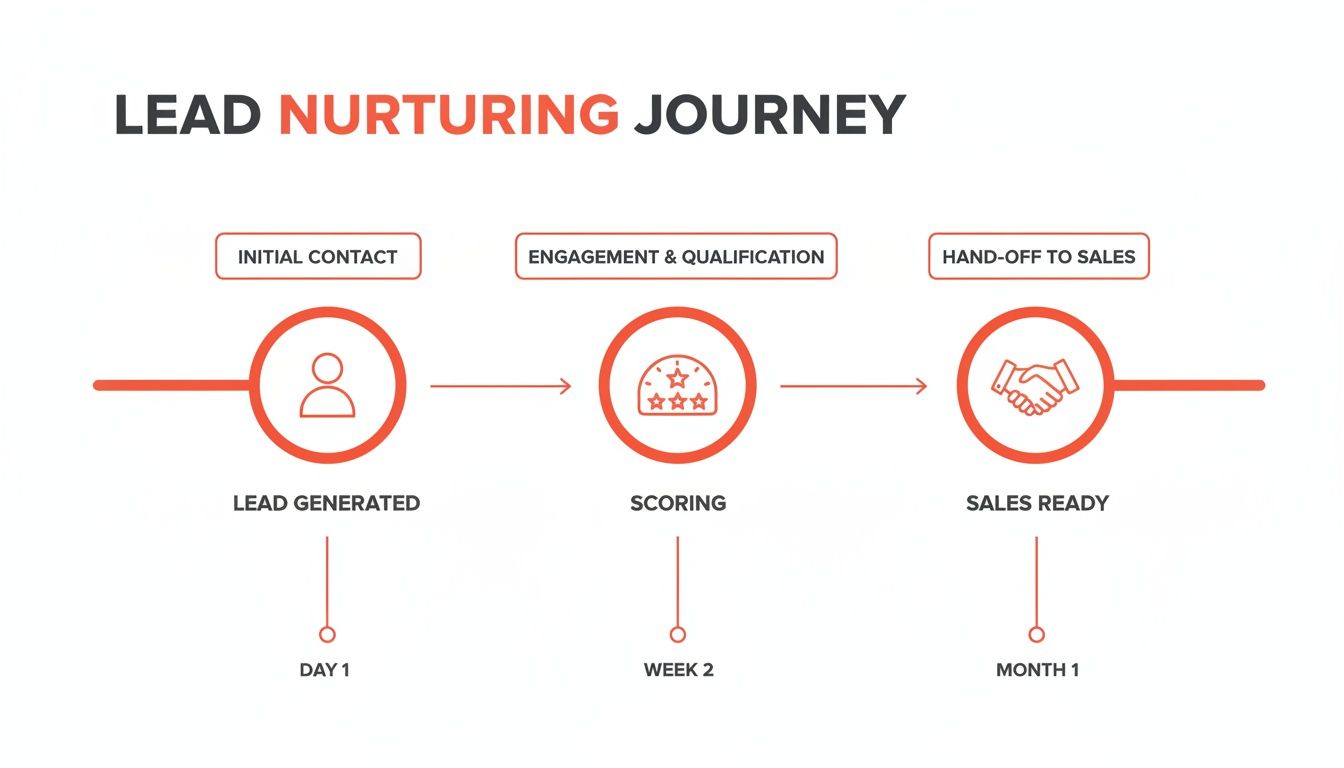
The key takeaway is that lead nurturing is a process of deliberate escalation. You use scoring to pinpoint the exact moment a lead is ready for sales engagement. This roadmap gives you the structure to build, and then perfect, that very process.
Frequently Asked Questions About Lead Generation
Even with the best-laid plans, a few key questions always pop up when we're building a lead generation system for a client. Getting clear on budgets, timelines, and which channels to use is essential. Let's tackle some of the most common queries we hear, so you can move forward with confidence.
Getting these fundamentals right is often the difference between a campaign that takes off and one that fizzles out.
How Much Should a Company Budget for Lead Generation?
There's no single magic number, but a common rule of thumb for B2B companies is to put 5-10% of revenue towards marketing, and lead generation is a huge part of that. A much better way to approach it, though, is to work backward from your business goals.
First, you have to know your numbers. Figure out your Customer Lifetime Value (LTV) and what you’re willing to spend to acquire a customer (your target Cost Per Acquisition, or CPA). For example, if a new customer is worth $10,000 and you’re aiming for a 10:1 return, your target CPA is $1,000.
From there, you can work out what you can afford to pay for each lead. If your lead-to-customer conversion rate is 5% (meaning one in every 20 leads becomes a paying customer), you can afford to pay up to $50 per lead ($1,000 CPA ÷ 20 leads). A starting budget of $3,000–$5,000 per month is usually enough to get meaningful data from core channels like Google and LinkedIn.
The key takeaway is to let your goals and unit economics drive your budget, not the other way around. Grounding your spend in real numbers ensures your lead generation machine is built for profitability from day one.
What Is the Difference Between SEO and PPC for Lead Generation?
Too many people see SEO and PPC as an either/or decision. In reality, they play two very different—but complementary—roles in a powerful lead generation strategy.
-
PPC (Pay-Per-Click) is all about immediate results. You pay to put your ads right in front of a highly targeted audience on platforms like Google or social media. This makes it perfect for generating leads right now, testing new offers, and capturing demand from people actively searching for a solution.
-
SEO (Search Engine Optimisation) is a long-term investment. It's about consistently creating valuable content and building your website's authority to earn free, organic traffic from search engines. You're building a sustainable asset that brings in high-quality leads at a progressively lower cost over time.
A truly effective strategy uses both. PPC gets you quick wins and crucial data on what keywords and messaging actually convert. You then feed those insights directly into your long-term SEO content plan, creating a powerful feedback loop where each channel makes the other stronger.
How Long Does It Take to See Results?
The timeline for seeing results depends entirely on the channel you're using. It's critical to have realistic expectations for each platform to avoid pulling the plug just before things start working.
| Channel | Time to Initial Results | Time to Optimised Performance |
|---|---|---|
| PPC (Google, Meta, LinkedIn) | Within 24-48 hours of launch | 30-90 days |
| SEO (Organic Search) | 3-6 months for initial traffic gains | 6-12+ months for steady lead flow |
With PPC, you’ll see traffic and maybe even a few leads within hours of your campaigns going live. But don't mistake that initial activity for optimised performance. It will take a good 30-90 days to gather enough data to properly refine your targeting, creative, and bids to hit a stable and efficient Cost Per Lead.
For SEO, patience is the name of the game. You might see some encouraging signs like keyword ranking improvements in the first 3-6 months. However, getting a consistent and significant flow of high-quality organic leads often takes 6-12 months of dedicated effort. The key is to track leading indicators along the way—like rankings for key terms and organic traffic growth—to make sure you're on the right track.
Ready to stop guessing and start building a predictable lead generation engine? At Click Click Bang Bang, we specialise in creating precision-driven SEO and PPC campaigns that deliver real results. Let our team build a data-focused strategy to scale your growth. Book a no-obligation strategy call with us today.
Read NeXt
Or Read Our Latest
- Manual vs Automated Bidding for PPC Success
- Conversion Tracking Setup: A Complete AU Guide
- Instagram Advertising Australia: Complete 2026 Guide
- Pay Per Click: A Beginner’s Guide for Australian Marketers
- Display Advertising on Google: The Complete Australian Guide
- Stakeholder Communication Plan How to Build One That Works
Click. CLick. Subscribe.
Get our best PPC insights, industry updates, and power moves delivered straight to your inbox. No fluff, just high-caliber strategies that actually work.
Don’t Leave Just Yet
Try Us For 30-Days,
Risk Free!!
We guarantee that you’ll love our work within the first 30 days, if not you’ll get your money back.
What have you got to lose?