

E-Commerce SEO Services That Drive Real Growth
Last Updated
E-commerce SEO services are a specific flavour of SEO built from the ground up to get an online store’s products seen in search results, ultimately driving more organic traffic and, most importantly, sales. It’s not the same as generic SEO. It zeroes in on optimising product pages, category pages, and the entire shopping journey to turn casual searchers into paying customers.
Think of it as the digital equivalent of choosing the perfect spot for a physical retail store. You want to be right in the middle of the busiest shopping centre, not hidden away in a back alley.
What E-Commerce SEO Services Actually Do
Imagine you've just launched a brilliant online store. Your products are top-notch, your branding is slick, but you've essentially opened for business down a deserted laneway with no signs pointing the way. You could have the best stuff in the world, but if no one can find you, it doesn't matter.
This is the reality for thousands of online stores just floating invisibly in the massive digital marketplace. E-commerce SEO services are the specialists who move your store onto the main street, put up the flashy signs, and make it impossible for your ideal customers to miss.
These services do far more than just chase keyword rankings. They build a foundation for sustainable, long-term growth that isn’t entirely dependent on the ever-rising costs of paid advertising.
Moving Beyond Basic SEO
A general SEO strategy might be perfect for helping a local plumber get more phone calls. But an e-commerce business is a different beast entirely, often with hundreds or even thousands of individual product pages, complex filtering systems, and a direct, measurable link between traffic and revenue. Specialised e-commerce SEO tackles these unique challenges head-on.
- Deep Product Optimisation: This involves making sure every single product page is perfectly tuned to answer customer questions and meet search engine requirements. It’s about more than just a product name and a price.
- Strategic Site Architecture: This is all about building a logical and scalable website structure that allows both customers and search engine crawlers to navigate effortlessly. Think of it as creating clear, easy-to-follow aisles in your physical store so people can find exactly what they’re looking for.
- A Conversion-Focused Mindset: At the end of the day, the goal isn't just clicks; it's sales. While the primary job is to bring in organic traffic, the best e-commerce SEO services often overlap with or include elements of e-commerce conversion rate optimization services to ensure that the visitors who arrive are more likely to become customers.
The core purpose of professional e-commerce SEO is to solve the single biggest problem for online stores—being invisible. It’s about creating a seamless, trustworthy, and highly visible shopping experience that search engines like Google feel confident recommending to their users.
Ultimately, these services are designed to build an organic growth engine for your business. Instead of paying for every single click through ads, you're investing in a powerful online presence that attracts qualified shoppers around the clock, 24/7. This builds brand authority, customer trust, and a far more predictable revenue stream.
The Blueprint for a Winning E-Commerce SEO Strategy
A solid e-commerce SEO service isn’t about flipping a single switch; it's a coordinated campaign built on four distinct pillars. Think of it like building a successful retail store. You need a solid foundation (Technical SEO), well-organised aisles (On-Page SEO), a great reputation in the community (Off-Page SEO), and clear signage to attract locals (Local SEO).
Each part is essential. When they work together, they create a powerful, cohesive strategy that drives real, sustainable growth.
This flowchart breaks down how these pillars all feed into the ultimate goals of any e-commerce SEO strategy: growth, powered by better visibility, trust, and user experience.
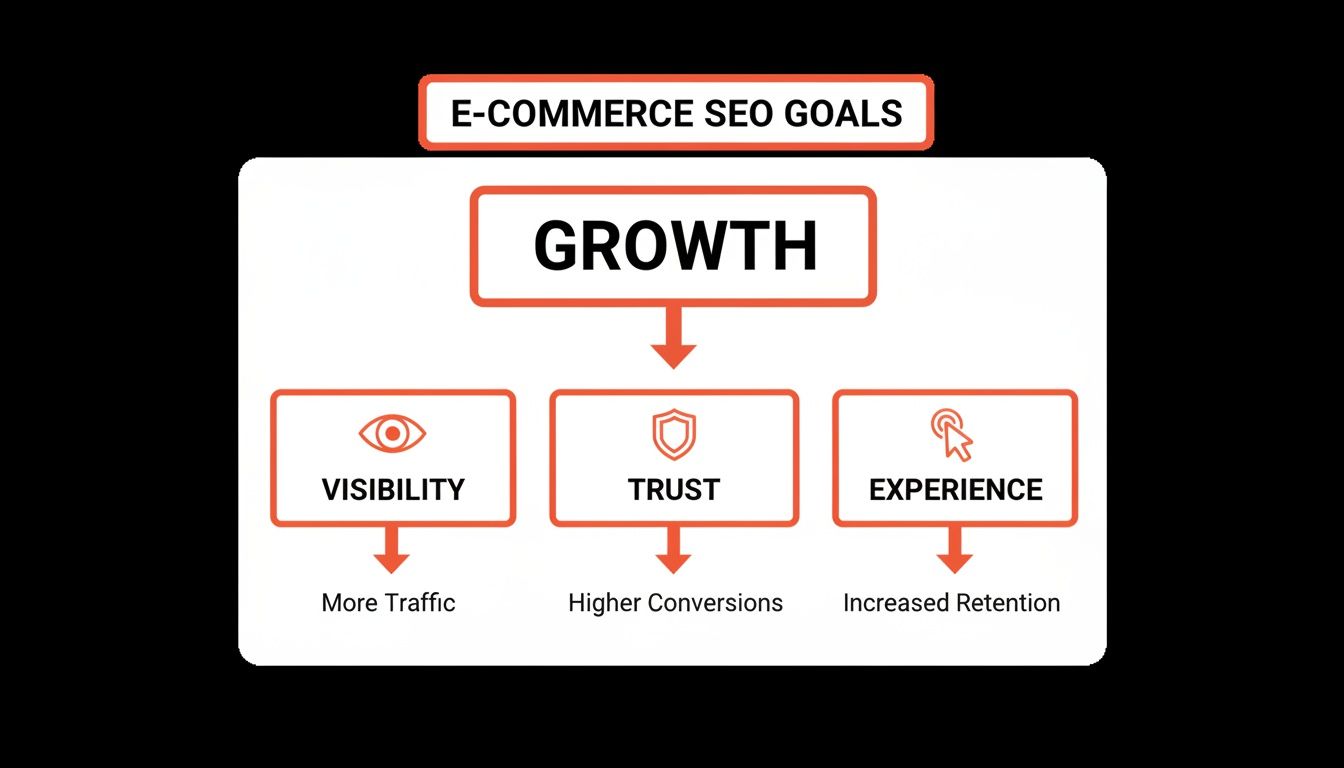
As you can see, every single SEO activity—from technical fixes to building links—is designed to support these core business objectives. Let's break down what that looks like in practice.
Technical SEO: The Unshakeable Foundation
Technical SEO is the plumbing, wiring, and structural integrity of your online store. It’s all the behind-the-scenes work that makes sure search engines can find, crawl, and understand your website without hitting any roadblocks. Get this wrong, and every other effort you make will be less effective. Simple as that.
Imagine building a beautiful physical store but with confusing hallways and doors that don't open. That's what a poor technical setup feels like to Google.
A typical service will cover:
- Site Speed Optimisation: Making sure your pages load almost instantly. Slow sites frustrate users and kill your rankings, so this involves compressing images and cleaning up code.
- Mobile-Friendliness: Ensuring a flawless shopping experience on smartphones and tablets, which is where the majority of online shopping now happens.
- Crawlability and Indexability: This is all about making it dead simple for search engine bots to access and catalogue all your important pages. A deep dive into these elements is non-negotiable, which is why a thorough technical SEO audit is always the first step.
On-Page SEO: Crafting Perfect Shopping Pages
On-page SEO focuses on optimising all the elements your customers (and search engines) actually see on your category and product pages. This is where you organise your digital aisles and create compelling product displays that answer customer questions and drive them to purchase.
The goal here is to make each page the single best, most helpful answer on the internet for a specific search. This means writing unique, keyword-rich product descriptions, using high-quality images with descriptive alt text, and structuring your content with clear, logical headings. For a deeper look, check out these 10 ecommerce SEO best practices.
Off-Page SEO: Building Your Store’s Reputation
Off-page SEO covers all the actions taken outside of your website to build its authority and reputation across the web. If on-page SEO is how you arrange your store, off-page SEO is the word-of-mouth, positive reviews, and media mentions that tell everyone it's the best place to shop.
The core of off-page SEO is link building—earning high-quality backlinks from other reputable websites. Each of these links acts as a vote of confidence, telling search engines that your store is a trustworthy and valuable resource.
This isn't about getting as many links as possible. It's about earning legitimate, editorially given links from relevant and authoritative sources in your industry. Quality over quantity, every time.
Local SEO: Connecting with Your Community
For e-commerce stores that also have physical locations or serve specific geographic areas, local SEO isn't just nice to have—it's essential. It's the digital equivalent of putting up a huge, bright sign for customers in your neighbourhood, making sure you show up in local map packs and "near me" searches.
This is especially true in the bustling Australian e-commerce scene. An incredible 46% of all Google searches in Australia have local intent, with people looking for things like 'best running shoes near me in Sydney'. Getting this right is a game-changer.
This involves optimising your Google Business Profile, actively managing customer reviews, and ensuring your business name, address, and phone number are consistent across all local directories.
These four pillars—Technical, On-Page, Off-Page, and Local—don't work in isolation. A technically sound site makes your on-page efforts more effective, which in turn helps you earn the off-page authority needed for a powerful, growth-driving SEO engine.
How to Measure SEO Success for Your Online Store
So, how do you know if your e-commerce SEO service is actually working? The biggest mistake store owners make is getting fixated on vanity metrics. Sure, high keyword rankings look great in a report, but if they aren't putting money in your till, they’re just digital window shoppers.
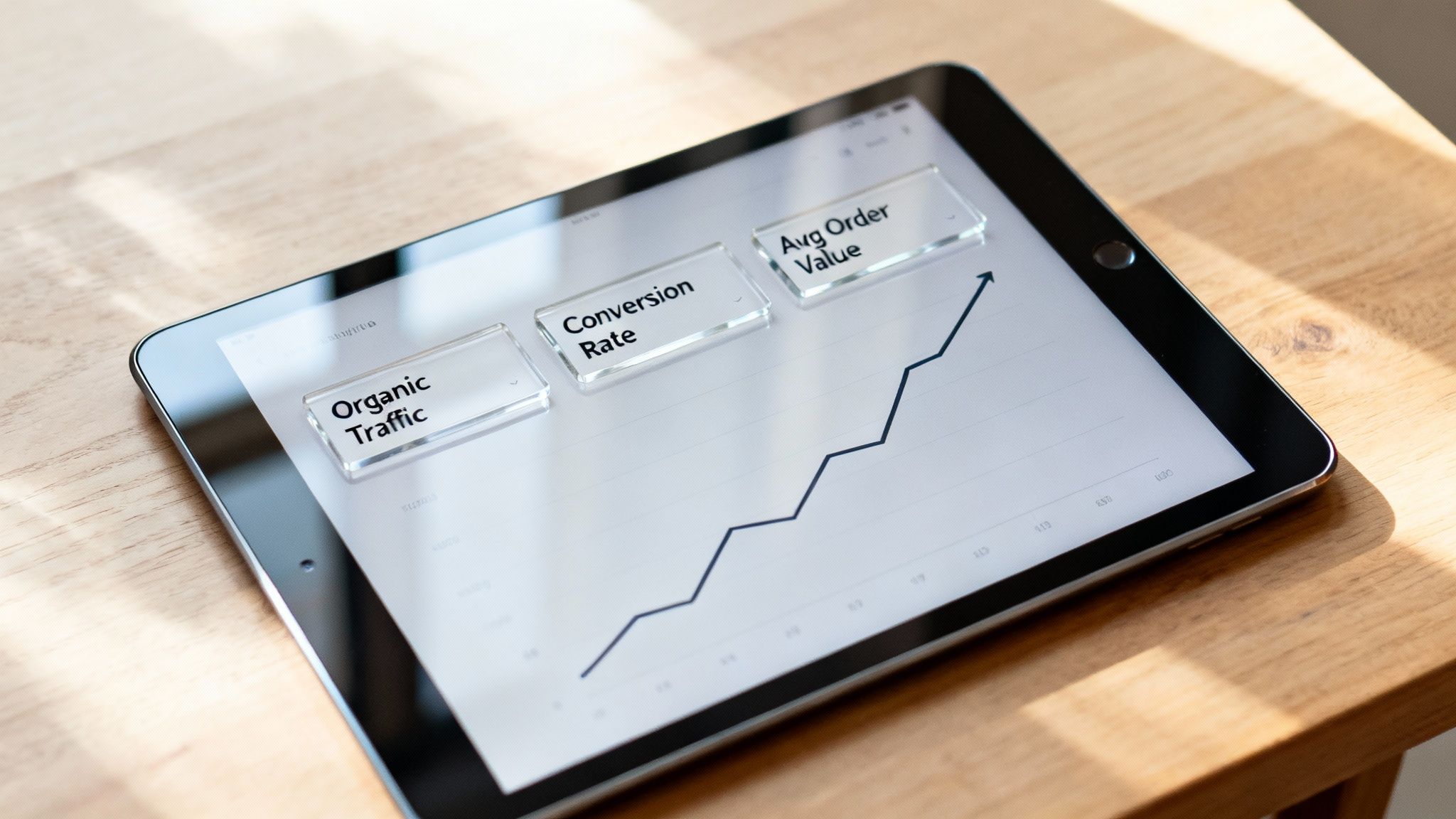
Think of your online store like a physical shop. You wouldn’t just count the people walking past your front window. You'd obsess over how many come inside (traffic), what percentage actually buys something (conversion rate), and how much they spend on average (average order value). Measuring SEO success is exactly the same—it all comes back to the bottom line.
Moving Beyond Rankings to Revenue
It’s time to shift your focus. Stop asking, "Are we on page one?" and start asking, "How much revenue did page one generate?" A good e-commerce SEO service will provide reporting that ties every action directly back to your sales figures.
There's a reason the Australian SEO market is set to hit $1.75 billion: organic search is the lifeblood for online stores, driving a massive 53% of all traffic. But here’s the kicker: with average conversion rates hovering around a measly 1.78%, just getting more traffic isn't enough. You need the right traffic.
That's what precision SEO delivers. It’s about attracting visitors who are not just browsing, but are ready to pull out their wallets. This is the only way to turn traffic into profit.
An SEO strategy without clear, revenue-focused KPIs is like a ship without a rudder. You might be moving, but you have no idea if you're heading toward your destination or sailing further away from it.
Core KPIs That Truly Matter
To get a real handle on performance, you need to track a handful of metrics that tell the whole story, from search to sale. These KPIs give you the insights you need to have much smarter conversations with your SEO provider about what’s working and what isn’t.
Here are the essential numbers every online store owner should have their eyes on:
- Organic Traffic Growth: This is your digital foot traffic. A steady, consistent rise in visitors from search engines is the first sign your SEO is gaining traction. Always look at month-over-month and year-over-year growth to smooth out any seasonal bumps.
- Organic Conversion Rate: This is the big one. It tells you exactly what percentage of your organic visitors are completing a purchase. A healthy conversion rate means your SEO is attracting qualified buyers who are ready to act, not just tyre-kickers.
- Average Order Value (AOV) from Organic Traffic: This measures how much the average customer finding you through search spends per transaction. Optimising for keywords with strong commercial intent often gives this number a healthy boost.
Of course, monitoring these metrics requires a solid foundation. You can't track what you can't see, which is why getting your website conversion tracking set up properly is the absolute first step.
Calculating Your SEO Return on Investment
Once you're consistently tracking these core KPIs, figuring out your return on investment becomes refreshingly simple. No complex formulas needed—just compare the revenue generated from organic traffic against the cost of your SEO services.
Let's say your monthly organic revenue climbs by $15,000, and you're paying your agency $5,000 a month. That’s a clear, positive return.
This kind of tangible data transforms SEO from a marketing "expense" into what it truly is: a powerful, revenue-generating investment that proves its value time and time again.
What to Expect When You Hire an SEO Agency
Hiring an agency to handle your e-commerce SEO services can feel like a huge leap of faith. You're handing over the keys to a critical part of your business to an outside partner. A professional, transparent process shouldn't feel mysterious at all; it should feel like a well-organised collaboration with a clear roadmap from day one.
This section is here to demystify that entire experience. Think of it as your step-by-step guide to the partnership, showing you what a high-quality engagement looks like from the very first chat right through to getting the campaign off the ground.
The Initial Discovery and Onboarding Phase
Your journey will kick off with a discovery call. This is so much more than a sales pitch. It’s a strategic session where the agency’s goal is to properly get under the hood of your business. They'll ask about your revenue targets, your most profitable products, who you're trying to reach, and what you’ve already tried in the past.
Once you're ready to move forward, the formal onboarding process begins. This is where all the foundational work gets done to make sure the campaign is built on solid ground.
- Goal Alignment: We’ll work together to turn your big-picture business objectives into specific, measurable SEO key performance indicators (KPIs).
- Access and Integration: The agency will need access to key platforms like Google Analytics, Google Search Console, and your e-commerce backend (like Shopify or BigCommerce).
- Kick-off Meeting: This gets all the key players in a room (virtual or otherwise) to lock in the project scope, how you’ll communicate, and the reporting schedule. It’s all about making sure everyone is on the same page from the get-go.
A great agency won't just ask what keywords you want to rank for. They'll ask what business results you want to achieve, and then build an SEO strategy to get you there. This shift from keywords to outcomes is the hallmark of a true growth partner.
The Deep Dive Audit and Analysis
Once onboarding is sorted, the real detective work starts. Before a single change is made to your site, a good agency needs to understand its current state and what the competition is up to. This whole phase is about gathering intelligence.
This comprehensive analysis usually breaks down into three core parts:
- Technical SEO Audit: This is a thorough health check of your website. It’s designed to uncover issues like slow page speed, broken links, problems with getting indexed by Google, or poor mobile usability that could be holding you back.
- Competitor Analysis: The team will pinpoint your main organic search competitors and pull apart their strategies. They’ll look at what keywords they’re ranking for, the quality of their content, and their backlink profile to find gaps and opportunities for you to get a competitive edge.
- Keyword and Content Gap Analysis: This is all about finding the "money" keywords your customers are actually using but that you aren't ranking for yet. It also highlights content gaps on your site, revealing opportunities to create valuable blog posts, buying guides, or category page content that will pull in qualified traffic.
Strategy Presentation and Campaign Launch
With all the data gathered and analysed, the final step before launch is the strategy presentation. The agency will walk you through a clear, data-backed plan of action. This isn't just a to-do list; it's a strategic document that explains the "why" behind every single proposed action.
You should expect to see a prioritised roadmap for the first 90 days, outlining the key initiatives that will deliver the most impact, fast. This typically includes technical fixes, on-page optimisation for key product and category pages, and the initial plan for building authority off-page.
Once you give the strategy the green light, the campaign officially launches. The technical fixes get underway, content creation kicks off, and the first reports are set up. This is where you move from planning to active, ongoing execution, with every step designed to push your online store towards greater visibility and, ultimately, more organic revenue.
Choosing the Right SEO Partner and Understanding Costs

Picking a partner for your e-commerce SEO services is one of the most critical decisions you'll make for your store. Get it right, and you’ve found a genuine growth partner who aligns their entire strategy with your revenue goals. Get it wrong, and you could waste a serious amount of money or, even worse, end up with harmful practices that set your website back for years.
Making the right choice comes down to two things: understanding how agencies price their work and having a solid game plan for vetting them. You need to know how to separate the real experts from the pretenders.
Decoding E-Commerce SEO Pricing Models
SEO pricing isn't a simple, off-the-shelf product. It’s structured to match the scope of work and the intensity of the effort needed to get results. Most reputable agencies stick to one of three main models, each with its own pros and cons for an online store.
- Monthly Retainer: This is the industry standard for a reason. You pay a fixed fee each month for a continuous, ongoing SEO campaign. It’s the perfect fit for long-term growth because it gives the agency the runway to consistently implement, monitor, and tweak your strategy. Retainers can range from a few thousand to over $10,000 per month, depending on your store's size and how tough your market is.
- Project-Based Fees: This model is for specific, one-off tasks with a clear finish line. Think of things like a deep-dive technical SEO audit, a website migration project, or a targeted link-building push. It gives you cost certainty but doesn't provide the ongoing management needed to climb—and stay—at the top of the search results.
- Performance-Based SEO: This one sounds great on paper—you only pay for results! But it can be a trap. It often pushes agencies to chase vanity metrics, like ranking for obscure keywords, instead of focusing on what actually moves the needle: your organic revenue. True performance-based deals are rare and should be treated with a healthy dose of scepticism.
For almost any e-commerce business, a monthly retainer delivers the best value. SEO is a marathon, not a sprint, and this model provides the consistent, dedicated effort required to build and maintain momentum in the search results.
Critical Questions to Ask Any Potential Agency
Before you even think about signing a contract, you need to do your homework. A transparent, confident agency will welcome tough questions. An agency that gets defensive or gives you vague, fluffy answers is a massive red flag.
Here’s a checklist of must-ask questions to guide your conversations:
- Can you show me case studies from online stores similar to mine? This proves they have relevant experience and aren't just learning the ropes on your dime.
- How do you actually measure and report on success? You want to hear answers that go way beyond rankings. They should be talking about business-critical KPIs like organic traffic, conversion rates, and, most importantly, revenue.
- What does your communication and reporting cadence look like? There should be a clear schedule for updates, and you should always have access to a real person who can answer your questions.
- Who, specifically, will be working on my account? Get to know the team doing the day-to-day work, not just the senior salesperson who closed the deal.
- What’s your approach to link building? Their answer should be all about quality, relevance, and ethical outreach—not a hollow promise of hitting a certain number of links.
These questions help you cut through the sales pitch. They reveal an agency's real process, their level of transparency, and how they think strategically. If you want to dig even deeper, we've put together a complete guide to finding the right e-commerce SEO service for your business.
E-Commerce SEO Agency Red Flag Checklist
Knowing what to look for is only half the battle; knowing what to run away from is just as important. Certain promises and behaviours are hallmarks of low-quality or even dangerous SEO providers. Be ready to walk away if you spot any of these.
Here’s a quick checklist to help you spot the warning signs.
| Red Flag (What to Avoid) | Why It's a Problem | What to Look For Instead (Green Flag) |
|---|---|---|
| Guaranteed #1 Rankings | No one can guarantee specific rankings on Google. This is a classic, deceptive sales tactic that ignores search algorithms and what your competitors are doing. | A focus on driving measurable business outcomes (traffic, leads, sales) through a proven and transparent process. |
| A "Secret Sauce" or Lack of Transparency | Good SEO isn’t black magic. A quality agency should be completely open about their strategies and willing to explain their process in plain English. | A detailed, data-backed strategy that outlines specific actions and the "why" behind them. |
| Focus on Quantity Over Quality (e.g., "50 backlinks per month") | This approach often leads to low-quality, spammy links that can get your site penalised by Google. Quality and relevance are what actually matter. | A link-building strategy based on earning high-authority, relevant links through great content and genuine outreach. |
| No Access to Your Own Analytics | You should always have full ownership of and access to your Google Analytics and Google Search Console accounts. Hiding data is a massive red flag. | An agency that insists on setting up reporting within your accounts, ensuring you always own your data. |
Choosing the right partner comes down to finding a team that is transparent, data-driven, and genuinely invested in seeing your store succeed. By understanding the costs and knowing which questions to ask, you can confidently pick an agency that will become a true engine for your growth.
Alright, let's get all this theory into practice.
Thinking about e-commerce SEO isn't just another marketing task to add to your list; it's a foundational, long-term investment in your brand's digital real estate. It’s about building an asset that works for you 24/7, freeing you from being completely chained to the paid ad machine.
Here’s a way to look at it: paid advertising is like renting your traffic. The second you stop paying the rent, your visitors vanish. Investing in your store's SEO, on the other hand, is like buying the property. You're building equity over time, creating a powerful, self-sustaining source of growth that you actually own.
Your Immediate Next Steps
You don't need to sign a big agency contract to start moving the needle. You can get started right now, today, by taking a few tangible steps. This quick review will give you a much clearer picture of where you stand and highlight your biggest opportunities.
This isn't about trying to become an SEO pro overnight. It’s about knowing your own digital storefront well enough to ask the right questions and be a smart partner for a professional e-commerce SEO service when you’re ready to really scale things up.
The goal right now is just to get a baseline. Once you know where you are today, you can properly measure the incredible growth that a focused SEO strategy is going to deliver tomorrow.
A Quick-Start Checklist
Here’s a simple, actionable checklist to get you going. Work through these three foundational steps to get an instant pulse-check on your store’s SEO health.
- Do a Basic Site Health Check: Use a free tool like Google's PageSpeed Insights to test your homepage and one of your main product pages. Is your site fast? Does it work well on mobile? Jot down any obvious red flags.
- Pinpoint Your "Money" Keywords: Grab a pen and paper (or open a doc) and list the top 5 to 10 search terms you think your ideal customer would type into Google to find your best-selling products. Don't get bogged down in research; just go with your gut.
- Peek at Your Analytics: Log into Google Analytics. Can you easily see how much traffic and, more importantly, how much revenue came from organic search last month? If that data is a pain to find or isn't set up at all, that’s your first major sign of an opportunity.
Finishing this quick audit gives you a powerful starting point. It takes SEO from an abstract idea and turns it into concrete data about your business.
When you're ready to unlock your store's true potential, this initial homework will make your first conversation with an SEO expert incredibly productive. It sets the stage for hitting the ground running and accelerating your growth from day one.
Got Questions About E-commerce SEO Services?
Even when you’ve got a good handle on what e-commerce SEO involves, it’s completely normal to have a few final questions before you pull the trigger. We get it. This is a big investment for your business.
So, let's clear up some of the most common questions we hear from online store owners. This should help set the right expectations and give you the confidence to make the best call for your store.
How Long Until I See Real Results From E-commerce SEO?
This is the big one, isn't it? While you might spot some early positive signs from quick technical fixes within a few weeks, meaningful, tangible results from e-commerce SEO—we're talking a significant, lasting jump in organic traffic and sales—typically start showing up in about four to six months.
Think of it like getting a massive ship up to speed. The first few months are all about getting the engines running and pointing it in the right direction (that’s the audit, keyword research, and on-page optimisation). You’ll feel the ship start to move within three months, but the real momentum—where you're cruising at top speed—becomes obvious after the six-month mark as your store builds authority and your rankings solidify.
SEO is a long-term growth engine, not a quick-fix turbo button. The patience you put in at the start is rewarded with sustainable, compounding returns that paid ads just can't match. True organic momentum is built, not bought.
Should I Do SEO Myself or Hire an Agency?
You can absolutely tackle some basic SEO tasks yourself. Things like writing unique product descriptions or optimising image alt text are great places to start. But a full-blown e-commerce SEO strategy gets technically complex, fast. We're talking about wrestling with site architecture, fine-tuning page speed, and implementing schema markup—stuff that really needs specialised expertise and some serious tools.
Hiring an agency brings a few game-changing advantages to the table:
- Dedicated Expertise: You get a team of specialists who live and breathe this stuff every single day. Their job is to stay on top of algorithm changes so you don't have to.
- Advanced Tools: Agencies invest tens of thousands in powerful software for audits, research, and tracking. These are tools that are often just too expensive for a single business to justify.
- Proven Processes: A good agency isn't guessing. They have a refined, battle-tested process for getting results, saving you from the headache and cost of trial and error.
For any online store looking to seriously grow, partnering with an agency is almost always more efficient and delivers a much better ROI than trying to become an SEO master in-house.
How Does SEO Work With My Paid Ad Campaigns?
Great question. SEO and pay-per-click (PPC) ads aren’t rivals; they're teammates working together to help you dominate the search results page. A strong organic presence builds trust and brand credibility, which can actually make your ads perform better by increasing click-through rates and bringing down your customer acquisition costs.
Better yet, the data you get from your paid campaigns is pure gold for your SEO strategy. For instance, if you know which ad keywords are converting like crazy, you have a data-backed roadmap telling you exactly what to focus on for your on-page SEO.
When you manage to rank organically for a search term and run an ad for it, you effectively own a huge chunk of valuable real estate on the results page. This massively increases your brand's visibility and boosts the odds of someone clicking on your link instead of a competitor's. It's a powerful one-two punch.
Ready to turn these insights into a powerful growth strategy for your store? The expert team at Click Click Bang Bang specialises in data-driven e-commerce SEO that delivers measurable results. We build customised strategies that align directly with your revenue goals, ensuring every action we take pushes your business forward. Learn how we can help you dominate the search results and drive more organic sales by visiting us at https://clickclickbangbang.com.au.
Read NeXt
Or Read Our Latest
- Manual vs Automated Bidding for PPC Success
- Conversion Tracking Setup: A Complete AU Guide
- Instagram Advertising Australia: Complete 2026 Guide
- Pay Per Click: A Beginner’s Guide for Australian Marketers
- Display Advertising on Google: The Complete Australian Guide
- Stakeholder Communication Plan How to Build One That Works
Click. CLick. Subscribe.
Get our best PPC insights, industry updates, and power moves delivered straight to your inbox. No fluff, just high-caliber strategies that actually work.
Don’t Leave Just Yet
Try Us For 30-Days,
Risk Free!!
We guarantee that you’ll love our work within the first 30 days, if not you’ll get your money back.
What have you got to lose?