

How to Choose the Right Ecommerce SEO Company for Lasting Growth
Last Updated

An ecommerce SEO company is a digital marketing agency that specialises in getting online stores to rank higher in search engines. The whole point is to drive organic traffic from people who are actually looking to buy, turning clicks into sales by fine-tuning product pages, site structure, and all the technical bits and pieces unique to retail websites.
Why Specialist Ecommerce SEO Matters for Your Online Store
Choosing an SEO partner isn’t just about ticking a box. It’s about finding a growth partner who gets the unique challenges of online retail. Unlike general SEO, ecommerce means juggling potentially thousands of product pages, wrestling with complex site structures, and guiding a buyer journey that’s all about conversion.
A generic approach just doesn't work here.

I’ve seen this play out time and time again. Imagine a fashion retailer with a gorgeous website and amazing products, but sales are completely flat. A generalist agency might start a blog and chase broad keywords, completely missing the real problem: a technical mess like poorly managed faceted navigation that’s creating thousands of duplicate, low-value pages and killing the site’s authority. Their best products end up buried where no one can find them.
An ecommerce SEO company would spot an issue like that straight away because they live and breathe the complexities of online stores. Their expertise goes way beyond keywords, digging into the critical areas that have a direct impact on your revenue.
The Specialised Skillset You Need
So, what really sets a specialist apart from a generalist? It’s their deep, hands-on experience with the unique hurdles and opportunities in ecommerce.
Here’s what that looks like in practice:
- Product Schema Mastery: They know how to implement structured data that unlocks rich snippets in search results—things like star ratings, price, and stock availability. This can dramatically boost your click-through rates.
- Faceted Navigation Management: They know exactly how to handle product filters (for size, colour, brand, etc.) without creating a crawl budget nightmare for search engines. This is a classic ecommerce trap.
- Site Speed for Conversions: They understand that even a one-second delay in page load time can slash conversions by 7%. Optimising images, code, and server response times is second nature to them.
- Large-Scale Site Architecture: They have a strategic approach to organising thousands of product and category pages, ensuring internal links are logical and authority flows to your most important pages.
To really see the big picture, it’s helpful to understand how these SEO tactics fit into broader powerful ecommerce growth strategies. SEO isn't an isolated activity; it's the foundation for sustainable, long-term growth.
The core difference comes down to the goal. General SEO often chases visibility and traffic. Ecommerce SEO is laser-focused on profitable, organic revenue. Every single action, from rewriting a product title to fixing a canonical tag, is tied directly to the bottom line.
To help clarify why you need a specialist, here’s a quick breakdown of how their approach differs from a general SEO agency.
General SEO vs Ecommerce SEO Key Differences
| SEO Focus Area | General SEO Approach | Ecommerce SEO Specialisation |
|---|---|---|
| Primary Goal | Increase overall organic traffic and brand awareness. | Drive qualified, high-intent traffic to product pages to increase sales. |
| Keywords | Targets broad, informational keywords (e.g., "how to fix a leaky tap"). | Targets commercial and transactional keywords (e.g., "buy chrome kitchen tap"). |
| On-Page SEO | Optimises blog posts, landing pages, and service pages. | Focuses on product and category page optimisation, including titles, descriptions, and images. |
| Technical SEO | Manages standard technical issues like sitemaps and robots.txt. | Manages complex issues like faceted navigation, canonicalisation for product variants, and large-scale internal linking. |
| Content | Creates blog posts, articles, and guides to attract a wide audience. | Creates buying guides, product comparisons, and category-level content designed to aid purchase decisions. |
| Structured Data | Implements basic schema for articles, local business, or organisation. | Implements advanced product, review, and offer schema to generate rich snippets in search results. |
As you can see, while the foundations are similar, the execution and priorities are worlds apart. An ecommerce site has a very different job to do than a local plumber's website, and its SEO strategy needs to reflect that.
Navigating the Crowded Australian Market
Australia's ecommerce scene is absolutely booming. In 2024, a staggering 17.08 million Australians were shopping online every month—a massive 45% jump from 2020.
But here’s the reality check: the average ecommerce conversion rate sits at a sobering 1.78%, the lowest it's been in a year. This tells a critical story: getting traffic isn't the problem. The real challenge is getting the right traffic that’s ready to buy.
This is exactly where a specialist ecommerce SEO company proves its worth. They focus on turning those clicks into actual customers.
Getting Under the Hood: Evaluating an Agency's Technical and Strategic Expertise
A polished sales pitch and a few glossy case studies are nice, but they don't tell you what really drives SEO success. That comes down to deep technical and strategic expertise. This is where a top-tier ecommerce SEO company pulls away from the pack.
Anyone can talk a big game about keywords and rankings. A true specialist, however, can dissect your site’s code and architecture to find the deep-seated issues actually costing you revenue. It’s not just about knowing what to fix; it's about understanding how those fixes ripple across the entire customer journey, especially for an online store with thousands of products.
To vet an agency for this level of expertise, you have to look beyond the surface and ask the kind of questions that reveal their strategic depth.
The Foundation: A Thorough Technical Audit
The starting point for any serious ecommerce SEO campaign is a comprehensive technical audit. And no, I don't mean a quick scan with an automated tool that spits out a generic PDF. A real audit is a deep dive into the nuts and bolts of your website, specifically tailored to the unique complexities of an online store.
This process is even more critical when you're managing a massive inventory. A genuine expert will dig into:
- Crawlability and Indexability: Can search engines actually find and make sense of all your important product and category pages? They'll hunt for crawl traps, check if your crawl budget is being wasted on low-value pages (like endless filtered URLs), and scrutinise your
robots.txtdirectives for costly mistakes. - Canonicals and Duplication: They'll analyse exactly how your site handles product variants—like different sizes or colours—to make sure you aren't creating huge duplicate content problems that dilute your authority. This is a classic pitfall on platforms like Shopify and Magento.
- Site Architecture: They’ll map out the logic of your internal linking and URL structures. The goal is to ensure "link equity" flows correctly from your homepage down to your most profitable category and product pages, not just randomly around the site.
A proper audit should feel like a doctor’s diagnostic report—detailed, insightful, and the foundation for a precise treatment plan. To get a better sense of what this involves, you can learn more about the crucial elements of a comprehensive technical SEO audit and why it's the bedrock of any successful campaign.
Speed and Mobile-First Optimisation
In ecommerce, speed isn't just a feature; it's a fundamental requirement. Every millisecond counts. Slower page load times lead directly to higher bounce rates and abandoned carts, a problem that's magnified for mobile shoppers who now dominate online retail.
A proficient ecommerce SEO company won't just tell you your site is slow. They will pinpoint the exact causes, whether it’s uncompressed images, bloated JavaScript, or sluggish server response times. They should be able to talk you through specific strategies like lazy loading images, minifying code, and leveraging browser caching to shave precious time off your load speed.
A one-second delay in mobile load times can slash conversion rates by up to 20%. This isn't some minor technical detail; it's a direct lever on your store's profitability. Ask potential agencies to show you "before and after" examples of site speed improvements they’ve delivered for other clients.
Advanced Schema for Maximum Visibility
One of the most powerful tools in an ecommerce SEO's arsenal is structured data, better known as schema markup. This is code you add to your website that helps search engines understand your content more deeply and, in return, display it more prominently in search results.
For an online store, this is a total game-changer. Correct schema implementation is what creates those eye-catching rich snippets in Google, like:
- Product Schema: Displays price, availability, and brand right there in the search results.
- Review Schema: Shows off your star ratings, which can dramatically boost click-through rates. One study found that star ratings in search results can increase clicks by as much as 35%.
- FAQ Schema: Lets you answer common product questions directly on the search results page, establishing your authority and saving customers a click.
A true specialist ecommerce SEO company won't just slap on some basic product schema and call it a day. They'll have a deliberate strategy for using multiple schema types to dominate the search engine results page (SERP) for your most important keywords.
They should be able to clearly explain how they'll use it to make your listings pop against the competition, turning a boring blue link into a powerful sales tool. When you're evaluating an agency, ask them to show you examples of rich snippets they have secured for their clients. Their ability to deliver these tangible results is a dead giveaway of their technical and strategic chops.
Your Vetting Checklist: Questions to Ask Before Signing
You wouldn't hire a key team member without a serious interview process, and the same thinking applies when choosing an ecommerce SEO company. The questions you ask now will reveal far more than any slick proposal ever could.
This isn't just about ticking boxes. It’s about digging into their strategic mind, seeing how they solve problems, and gauging their hands-on experience with the unique pressures of an online store. Forget generic queries like "What's your process?" You need to hit them with real-world scenarios that force them to think on their feet. Their answers will tell you if they're a true partner or just another agency going through the motions.
Gauging Strategic and Technical Depth
Let’s start with the big-picture stuff. A great ecommerce SEO partner thinks in terms of revenue and growth, not just keyword rankings. Their answers should show a deep understanding of the commercial realities of running an online store.
Here are the questions that cut to the chase:
- "How do you approach keyword research for category and product pages differently?" A sharp answer will zero in on user intent. Category pages should target broader, discovery-focused terms (like "women's running shoes"), while product pages need to nail those highly specific, ready-to-buy long-tail keywords (e.g., "Brooks Ghost 15 women's size 8"). They should also mention competitor analysis and using actual customer language to find gold.
- "Talk us through your experience with our ecommerce platform (e.g., Shopify, Magento, BigCommerce)." Vague answers are a major red flag. A strong response will include platform-specific challenges and how they solve them, like managing Shopify's tricky URL structure for variants or optimising Magento's notorious performance issues. They should have concrete examples ready to go.
- "How do you measure SEO success beyond just traffic and rankings?" The best agencies won't hesitate. They’ll immediately talk about business-level KPIs. Look for answers that include metrics like organic revenue, conversion rate from organic traffic, average order value from search, and better visibility for high-value, non-branded keywords.
Pro Tip: Throw them a curveball with a hypothetical crisis. Try this: "Our top-selling product category just dropped from page one to page three. What is your immediate 48-hour action plan?" A top-tier company will outline a clear diagnostic process: check for technical issues (indexing, penalties), analyse SERP changes, review what competitors are doing, and dive into analytics for user behaviour shifts before they even think about recommending a solution.
This flowchart maps out the core technical pillars any agency worth its salt must have mastered.
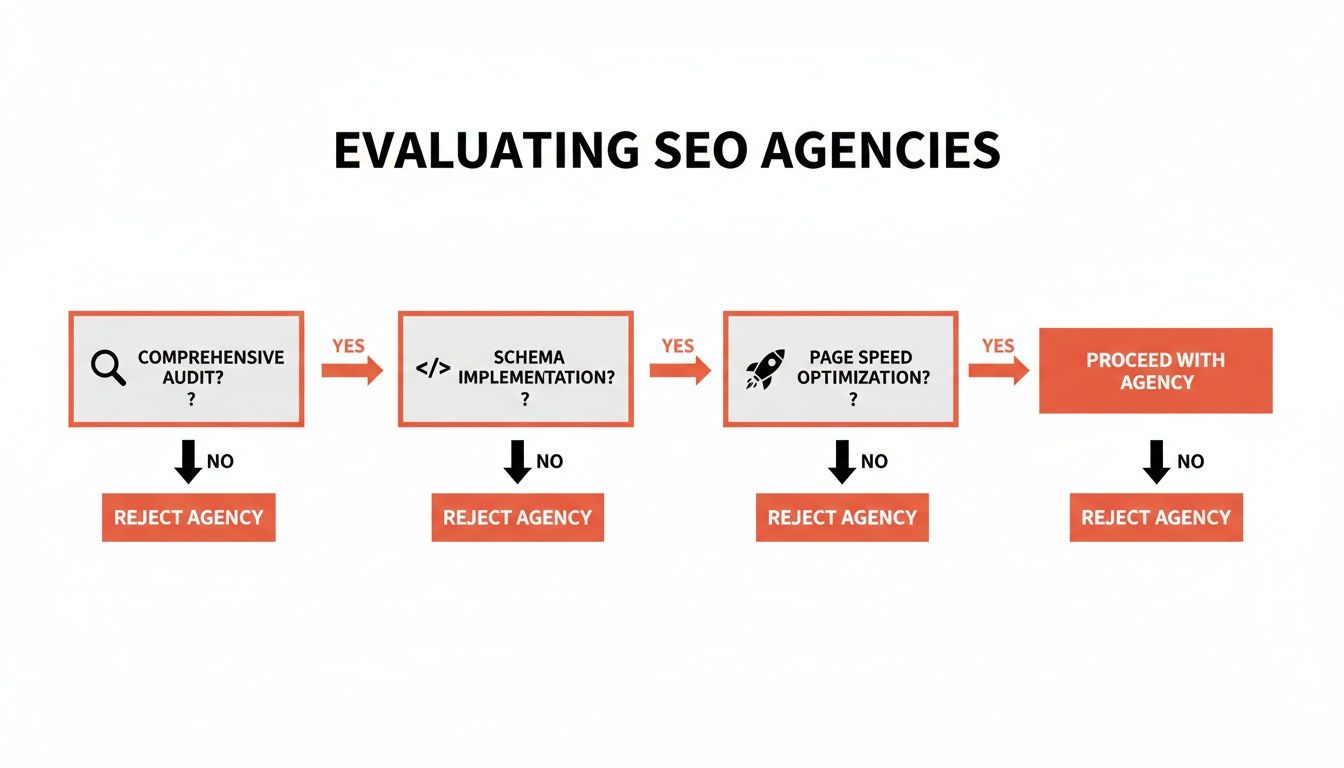
As it shows, a comprehensive audit, solid schema implementation, and an obsession with site speed are the non-negotiable foundations for getting results.
Understanding Communication and Reporting
A brilliant strategy is useless without clear communication and transparent reporting. You need to know exactly what they’re doing, why they’re doing it, and what results it's actually producing. Misaligned expectations here can poison a partnership right from the start.
Drill down into their process with these questions:
- "What does your monthly report look like? Can you walk me through a sample?" A good report tells a story, connecting SEO activities (e.g., "optimised 15 product descriptions") to real-world outcomes (e.g., "which led to a 10% lift in organic clicks to those products"). It should be far more than a simple data dump.
- "Who will be my main point of contact, and what's their level of experience?" You need to be sure you aren't handed off to a junior account manager the second the contract is signed. Ask about the experience of the actual strategist who will be working on your account and how often you'll get to speak with them directly.
- "How do you handle project management and communication between our teams?" Look for a structured system. Do they use a project management tool like Asana or Trello? Will there be weekly check-in calls or monthly strategy sessions? A clear process is what stops important tasks and details from falling through the cracks.
Finding a team that balances technical skills with clear communication can feel like a hunt, but it's the key to a successful partnership. Many businesses find that working with an integrated search marketing agency that sees the full picture—including how SEO and PPC influence each other—delivers the most powerful and cohesive results.
To help you keep track of your evaluations, use a simple scorecard. It forces you to compare agencies on the same criteria, removing gut feelings and focusing on what matters.
Agency Evaluation Scorecard
| Evaluation Criteria | Agency A Score (1-5) | Agency B Score (1-5) | Notes |
|---|---|---|---|
| Ecommerce Platform Expertise | Did they have specific examples for my platform? | ||
| Technical SEO Depth | How did they answer the crisis scenario? | ||
| Strategic Approach (Revenue-focused) | Did they talk about business metrics or just rankings? | ||
| Reporting & Communication Clarity | Was their sample report insightful or just data? | ||
| Team Experience & Structure | Who would I actually be working with day-to-day? | ||
| Transparency & Honesty | Did they avoid red flags and guarantees? | ||
| Total Score |
After you've spoken with a few contenders, this scorecard will make your decision much clearer by highlighting the genuine strengths and weaknesses of each one.
Red Flags to Watch For
Just as important as knowing what a good answer sounds like is recognising a bad one. Certain responses should set off immediate alarm bells, signalling a lack of transparency, expertise, or a reliance on outdated and risky tactics.
Be wary of any ecommerce SEO company that gives you these answers:
- Guarantees of #1 Rankings: This is the oldest, rustiest trick in the book and a massive red flag. No one can guarantee specific rankings on Google. A reputable agency will talk about a transparent process and goals tied to traffic and revenue growth.
- A "Secret Sauce" or Vague Methodology: If they can't clearly explain their strategy in a way you can understand, they are either hiding something or don't really get it themselves. Transparency is completely non-negotiable.
- An Overemphasis on Link Building: While backlinks still have a place, a strategy that almost exclusively focuses on churning out hundreds of low-quality links is stuck in the past and downright dangerous. A modern approach should be balanced, with a heavy focus on technical SEO, content, and user experience first.
Decoding Pricing Models and Contract Terms
Figuring out the money side of hiring an SEO agency can feel a bit like wading through mud. Between different pricing structures and contracts loaded with jargon, it’s critical you know exactly what you’re signing up for before you put pen to paper.
You’ll generally run into three main models: monthly retainers, project-based fees, and occasionally, performance-based deals. Each has its own rhythm and suits different business needs and stages of growth. Let’s break them down.
Understanding Common Pricing Structures
The monthly retainer is the industry standard. You pay a fixed fee every month for an agreed scope of work, which usually covers ongoing technical monitoring, content creation, and strategy tweaks. Because SEO is a marathon, not a sprint, this model works best for businesses committed to long-term, sustainable growth.
Project-based pricing is for specific, one-off jobs. Think of it for things like a massive technical audit, a complex site migration, or a complete overhaul of your category pages. It’s the perfect fit when you have a well-defined problem to solve but aren't ready to commit to an ongoing retainer.
Finally, there are performance-based models. These link the agency's payment to specific outcomes, like a measurable increase in organic revenue. They sound great in theory, but they're less common and often come with complicated terms and potentially higher costs to compensate the agency for taking on all the risk.
The reality is that no two ecommerce businesses are the same, so pricing shouldn't be either. A one-size-fits-all price list is a red flag. A reputable ecommerce SEO company will want to understand your business, goals, and competitive landscape before quoting a price.
Getting a feel for how different agencies structure their fees can be helpful. Looking at some example pricing models for agency services can give you a clearer picture of what to expect from retainers and project-based work.
What Should You Expect to Invest?
Your investment will vary wildly depending on your store’s size, how competitive your niche is, and the scope of work you need. Trying to find the cheapest option is almost always a recipe for disaster. It often leads to flimsy strategies or, even worse, dodgy tactics that could get your site penalised by Google.
To get a clearer idea of what a realistic budget looks like here in Australia, have a look at our detailed guide on how much you should expect to pay for SEO services. It’ll help you benchmark the quotes you receive and spot any that seem too good (or too expensive) to be true.
There's no doubt that Australian businesses are pouring money into this channel. The digital advertising market hit $4.2 billion in the March 2025 quarter, with search-specific revenue climbing 10% to $1.896 billion. With the total SEO market tipped to reach $1.75 billion by the end of 2025, businesses are clearly voting with their wallets. It shows that a smart SEO investment is viewed as essential for growth.
Critical Contract Clauses to Scrutinise
The contract is your safety net. Don’t just skim it—read every single line. A vague or one-sided contract can cause major headaches down the road.
Pay close attention to these key areas:
- Scope of Work and Deliverables: The contract must clearly list what the agency will do each month. Vague fluff like "SEO optimisation" is a massive red flag. It should detail specific actions, like "conduct monthly technical site monitoring," "create two 1,500-word buying guides," or "build five high-authority backlinks."
- Ownership of Work: You need to retain full ownership of everything produced. That includes content, reports, and any technical changes made to your website. This is non-negotiable. It ensures that if you decide to part ways, you don't lose all the progress you've paid for.
- Cancellation Policy: Avoid getting trapped in long, unbreakable lock-in periods. A standard notice period of 30 days is fair for everyone. A good agency will be confident enough in their results that they won't need to lock you into a restrictive contract.
- Reporting and Communication: The contract should outline the frequency and format of reports (e.g., "a monthly performance report delivered via email by the 5th of each month") and your agreed-upon communication schedule.
A poorly written clause might just say, "Agency will provide monthly SEO services." A strong, protective clause will be specific: "Agency will deliver a monthly report detailing all on-page, off-page, and technical SEO activities performed, along with a performance summary of organic traffic, conversions, and keyword visibility." The difference is in the detail, and that detail is what protects your investment.
Setting Realistic Timelines for SEO Success
Let's talk about one of the biggest points of friction between a business and its SEO agency: timelines. Effective ecommerce SEO is a long-term investment, not an overnight fix, and a mismatch in expectations is a recipe for a bad partnership. Understanding the natural rhythm of a campaign is key.
The journey starts the moment you sign the dotted line, kicking off a structured onboarding process. A good ecommerce SEO company doesn't just start "doing SEO" on day one. Instead, they spend the first few weeks getting under the hood of your business.

This initial phase is all about deep discovery and technical setup. It's where your new partners dig into your analytics, run a comprehensive technical audit, and get crystal clear on your business goals. This isn't just admin; it's the strategic foundation for everything that comes next.
The First 90 Days: Foundational Fixes and Early Traction
The first three months are all about heavy lifting. This is where the agency rolls up its sleeves and implements the high-priority fixes uncovered during the audit. It’s the essential groundwork that sets the stage for future growth.
During this period, you should expect to see:
- Technical Cleanup: Implementation of critical fixes for things like crawlability, indexation problems, and site architecture issues. This is the behind-the-scenes work that search engines notice first.
- On-Page Optimisation: Reworking titles, meta descriptions, and on-page content for your most important category and product pages.
- Initial Keyword Movement: You might start to see some positive movement for long-tail keywords or terms where you were already on the edge of ranking well. Think of these as the first green shoots.
It's important to remember this phase is about building momentum, not hitting home runs. The goal is to get your site technically sound so it can actually compete.
Months 4 to 6: Building Authority and Measurable Growth
As you head into the second quarter, the focus shifts from fixing the foundation to actively building authority and expanding your digital footprint. This is where content and link-building strategies usually kick in, and you should start seeing more tangible results in your analytics.
You’ll begin to notice measurable increases in key performance indicators (KPIs). At this point, your monthly reports should tell a story that goes far beyond just keyword rankings.
A valuable monthly report focuses on the KPIs that directly impact your bottom line. Look for data on organic revenue, conversion rates from search traffic, and improved visibility for high-intent transactional keywords. These are the numbers that show SEO is actually working for your business.
This is also where mobile performance becomes absolutely critical. In Australia, mobile is king, with 97.4% of internet users on mobile devices. A strong mobile experience is non-negotiable, especially since 78% of mobile local searches lead to a store visit within 24 hours.
On top of that, the Australian market leads the world in AI search adoption. With 65% of searches now ending without a click thanks to AI-powered summaries, securing featured snippets is more valuable than ever. You can discover more insights about the AI SEO curve and its impact on ecommerce.
Months 7 to 12+: Sustainable Revenue and Compounding Returns
From the six-month mark onwards, a well-executed SEO campaign starts delivering significant, revenue-driving impact. All the initial technical work, combined with ongoing authority-building, creates a compounding effect. Your site earns more trust from search engines, leading to more stable, prominent rankings for competitive, high-volume keywords.
By now, your conversations with your ecommerce SEO company should feel highly strategic. You’ll be talking about targeting new product categories, expanding into new markets, and refining the user experience to squeeze more conversions out of your growing organic traffic.
This is the point where SEO stops being a marketing expense and becomes a predictable, scalable revenue channel that fuels your business's long-term growth. True success isn't measured in months, but in the sustained year-over-year increase in organic sales.
Still Have Questions? Let's Clear Them Up
As you get closer to choosing an ecommerce SEO partner, a few final, make-or-break questions usually pop up. It's totally normal. Getting clear, honest answers is the last step before you can sign on the dotted line with confidence.
Here are the most common queries we get from business owners, answered directly and based on what we've seen work (and what hasn't) over the years. Think of this as your final gut check.
How Long Until We See Real Results?
It’s the million-dollar question, and for good reason. While you’ll likely see some early positive signs within the first 3-4 months—things like better site indexing or fixing critical crawl errors—the results that actually move the needle for an ecommerce store take longer.
When we talk about "meaningful results," we're not just talking about a keyword jumping from page three to page one. We're talking about a measurable lift in organic revenue for your most important product categories. Getting there typically takes anywhere from 6 to 12 months.
Why so long? A few things are at play:
- Deep Technical Fixes: Major architectural changes aren't a quick patch. It takes time to implement them properly, and then you have to wait for search engines to recrawl and re-evaluate your entire site.
- Building Authority: Earning high-quality backlinks and establishing your brand as a trusted name in your niche is a gradual process. You can't rush real authority.
- Algorithmic Trust: Search engines reward consistency. It takes months of sustained, quality work to build the kind of trust that secures stable, high rankings for competitive ecommerce keywords.
Be very wary of any SEO company promising game-changing results in under six months. True, sustainable growth is a marathon, not a sprint. Those "quick wins" often rely on risky tactics that can get you penalised down the road.
What's a Reasonable Budget for Ecommerce SEO?
This varies a lot depending on the size of your store, how cut-throat your industry is, and what your growth ambitions are. But there are some solid benchmarks to guide you.
For a small to medium-sized Australian ecommerce business, a realistic monthly retainer with a capable agency will usually land somewhere between $2,500 and $7,000. If you're a larger, more established brand or you're fighting for space in a crowded niche like fashion or electronics, expect to invest more to make a genuine impact.
Here's a good rule of thumb: rock-bottom prices are a massive red flag. An agency charging less than $1,500 a month is almost certainly cutting corners somewhere. They might be using ineffective automated tools, outsourcing to inexperienced teams, or simply not putting in the hours.
Quality strategic thinking and execution require experienced professionals, and that has a cost. View your SEO budget as an investment in a primary revenue channel, not just another marketing expense.
Should an Agency Ever Guarantee Number One Rankings?
Absolutely not. Full stop. This is one of the oldest and clearest signs of a dodgy agency. Any ecommerce SEO company that guarantees a #1 ranking is selling you a fantasy they can't possibly deliver.
Search engine algorithms are ridiculously complex, they're updated constantly, and—most importantly—they are completely outside of anyone's direct control. A reputable partner knows this and will be upfront about it.
Instead of guaranteeing rankings, a trustworthy agency will guarantee their commitment to a transparent, proven process. They'll focus on the goals they can control and measure, such as:
- Delivering specific, agreed-upon technical improvements on schedule.
- Producing a certain amount of high-quality, strategic content.
- Hitting tangible business outcomes like increased organic traffic and sales.
Their guarantee is in the quality of their work and the transparency of their reporting, not in promising an outcome they have no control over.
Is It Better to Combine SEO and PPC with One Agency?
While it’s not strictly necessary, there are some serious advantages to having one integrated agency manage both your SEO and PPC efforts. When these two powerful channels are managed under one roof, they stop competing with each other and start collaborating, creating a powerful synergistic effect.
For example, insights from your PPC campaigns—like which keywords have the highest conversion rates—can directly inform your SEO strategy. This helps you prioritise the terms that are already proven to drive sales.
A unified approach also ensures your brand message is consistent across all search touchpoints and helps maximise your overall online visibility. This integrated strategy often leads to a lower overall customer acquisition cost, as data from one channel is used to make the other more efficient and effective.
Ready to partner with an agency that gives clear answers and gets real results? Click Click Bang Bang specialises in creating data-driven SEO and PPC strategies that drive sustainable growth for ecommerce businesses. Explore our services and see how we can help you scale.
Read NeXt
Or Read Our Latest
- Manual vs Automated Bidding for PPC Success
- Conversion Tracking Setup: A Complete AU Guide
- Instagram Advertising Australia: Complete 2026 Guide
- Pay Per Click: A Beginner’s Guide for Australian Marketers
- Display Advertising on Google: The Complete Australian Guide
- Stakeholder Communication Plan How to Build One That Works
Click. CLick. Subscribe.
Get our best PPC insights, industry updates, and power moves delivered straight to your inbox. No fluff, just high-caliber strategies that actually work.
Don’t Leave Just Yet
Try Us For 30-Days,
Risk Free!!
We guarantee that you’ll love our work within the first 30 days, if not you’ll get your money back.
What have you got to lose?