

Unlocking Growth With Search Engine Optimisation Services
Last Updated

Search engine optimisation services are a collection of expert strategies designed to boost your website’s visibility in search results on platforms like Google. This isn't about short-term tricks or gaming the system; it's a long-term process that helps the right customers find you organically—without you having to pay for every single click.
What Are Search Engine Optimisation Services Really?

Think of your website as a physical shop. Without SEO, it’s like having a brilliant store tucked away on a quiet backstreet with no signage. It doesn't matter how amazing your products are if no one can find you.
Professional search engine optimisation services are your digital location scout, construction crew, and marketing team rolled into one. They work to put your shop on the busiest digital high street, build it on a solid foundation, and create a glowing reputation that attracts a steady stream of your ideal customers.
Building Your Digital Foundation
At its heart, SEO is all about making your website easy for search engines to understand and, more importantly, to trust. It’s not a one-off task but an ongoing strategy that relies on three core pillars working together to drive real growth:
- Technical Soundness: This is about ensuring your website’s "behind-the-scenes" structure is clean, fast, and easy for search engine crawlers to access. Think of it as making sure your shop’s doors are unlocked and the aisles are clear for customers to walk through.
- Compelling Content: This involves creating genuinely valuable and relevant information that directly answers your customers' questions. It's the equivalent of stocking your shelves with high-quality products and having friendly, knowledgeable staff on hand to help.
- Authoritative Reputation: You build this by earning trust and credibility from other reputable websites online. In the real world, this is like getting fantastic five-star reviews and powerful word-of-mouth recommendations that bring new people to your door.
Investing in SEO isn't just about buying rankings; it’s about investing in a sustainable system that connects your business with customers who are actively looking for what you offer.
This strategic investment is becoming non-negotiable for Australian businesses. With Google dominating between 91–94% of the search market, being visible there is everything. In fact, projected SEO spending in Australia is on track to hit AU$1.5 billion in 2025, because businesses know that the top three organic results capture up to 60% of all clicks.
Investing in a strong SEO foundation ensures you're not just competing, but actively winning the customers who matter most. You can discover more local SEO statistics for Australia to see the full picture.
What's Actually Involved in Modern SEO Services?
To understand what you’re really investing in, it helps to pop the bonnet and look at the engine. A solid SEO strategy isn’t just one thing; it’s a bunch of specialised efforts all working together. Think of it like building a house: you need a rock-solid foundation, well-built walls, a clear street address, and a great reputation in the neighbourhood.
Each of these pieces plays a distinct but connected role in getting your website seen and attracting the right kind of customers. Let's break down these four fundamental pillars.
Technical SEO: The Digital Foundation
Technical SEO is the absolute bedrock of your online presence. It’s all about optimising the "behind-the-scenes" bits of your website to make sure search engines can find, crawl, and index your content without hitting any roadblocks.
Imagine your website is a library. Technical SEO is like making sure the doors are unlocked, the lights are on, and there’s a clear catalogue system so the librarian (Google) can find every single book on your shelves. If the librarian can't get in or make sense of the layout, your amazing content will never be discovered.
Key activities often include:
- Improving Site Speed: Making sure your pages load in a snap. Slow sites frustrate users and get penalised by search engines. A tiny one-second delay in page load time can cause a 7% drop in conversions.
- Mobile-Friendliness: With most searches now happening on phones, your site absolutely must work seamlessly on any screen size.
- XML Sitemap Creation: Submitting a "map" of your website to Google. This helps its crawlers understand your site structure and find all your important pages.
- Fixing Crawl Errors: Hunting down and fixing broken links or other gremlins that stop search engines from accessing your content properly.
On-Page SEO: The Content and Structure
Once your technical foundation is solid, the next job is on-page SEO. This is all about optimising the actual content and HTML code on your individual pages to make them more relevant and crystal clear to both search engines and humans.
It's about speaking the same language as your potential customers. This involves some serious keyword research to figure out the exact words and phrases people are typing into Google when looking for what you offer, then weaving them naturally into your site.
On-page SEO is where you align what your business says with what your customer is looking for. It's about crafting clear, valuable, and easy-to-read content that directly answers their questions.
For example, a plumber in Sydney wouldn't just use the word "plumber." They'd get specific, optimising pages for terms like "emergency plumber Sydney CBD," "blocked drain repairs Eastern Suburbs," or "hot water system installation," because that’s what their customers are actually searching for.
Content Strategy: The Fuel for Your Engine
Content is the absolute heart of modern SEO. A smart content strategy establishes your business as a helpful expert and a trusted authority in your field—which is exactly what search engines like Google are designed to reward.
And we're not just talking about blog posts here. It involves creating a whole suite of valuable resources—like in-depth guides, videos, case studies, and tools—that solve your audience's problems at every step of their journey. Pumping out high-quality content consistently tells search engines that your website is a relevant, active, and valuable resource.
This builds trust and keeps potential customers coming back, turning your website from a simple digital brochure into an indispensable hub of information.
Off-Page SEO: Building Your Online Reputation
Finally, we have off-page SEO. This covers all the actions taken outside of your own website to build its authority and reputation. The biggest piece of this puzzle is link building—the art of getting high-quality backlinks from other reputable websites.
Think of a backlink as a vote of confidence or a referral from another site. When a trusted website links to yours, it signals to search engines that your content is credible and worthwhile. The best SEO services will always include effective SEO link building strategies, as these are fundamental to boosting your domain authority and search rankings.
Other off-page activities include things like:
- Local SEO: Optimising your Google Business Profile and local directory listings.
- Digital PR: Earning mentions and features in online publications.
- Guest Blogging: Writing content for other relevant industry blogs to gain exposure and a backlink.
We've covered the main pillars of a strong SEO campaign. To bring it all together, here's a quick summary of how each component directly contributes to your business goals.
Table: Key SEO Services and Their Business Impact
| SEO Service Component | Core Activities | Primary Business Goal |
|---|---|---|
| Technical SEO | Site speed optimisation, mobile-friendliness, sitemap creation, fixing crawl errors | Improve user experience and ensure search engines can fully access and index the website. |
| On-Page SEO | Keyword research, optimising title tags, meta descriptions, headers, and internal linking | Increase relevance for target search queries and improve click-through rates from search. |
| Content Strategy | Creating blog posts, guides, videos, and case studies that address audience needs | Establish authority, build trust, and attract qualified traffic at all stages of the funnel. |
| Off-Page SEO | Link building from reputable sites, local SEO (Google Business Profile), digital PR, and guest blogging | Build the website's authority and credibility, leading to higher search engine rankings. |
When you put them all together, these four components create a powerful, self-reinforcing system. A technically sound site lets great content be discovered, which in turn earns authoritative backlinks, ultimately driving a steady stream of qualified organic traffic right to your business.
Navigating the New Era of AI-Driven SEO
The way we all find information is being fundamentally rewired, and Artificial Intelligence is pulling the strings. Search engines like Google are no longer just clunky keyword-matching machines. They’re becoming sophisticated 'answer engines' that understand topics, context, and what you really mean when you type something in.
This seismic shift means a lot of old-school SEO tactics are heading for the scrap heap. In this new world, winning isn't about cramming keywords onto a page anymore. It’s about becoming a genuinely authoritative, trustworthy source of information—the kind of expert an AI assistant would confidently quote back to a user.
Why Your Expertise Is the New Keyword
Think of an AI search engine as a super-smart research assistant. Its main job is to find the most accurate, helpful, and reliable answer to a question, and fast. It's actively looking for websites that ooze E-E-A-T (Experience, Expertise, Authoritativeness, and Trustworthiness).
To stand out in this environment, your content has to prove its worth. That means moving beyond thin, surface-level articles and creating in-depth resources that truly showcase your real-world experience. Professional search engine optimisation services are now laser-focused on weaving this deep expertise into your site's very fabric.
The goal is simple: make your website the definitive, go-to resource in your niche. When an AI is hunting for the best information to serve up, your content should be the obvious choice.
The infographic below shows how the core parts of SEO all work together to build this kind of authority.
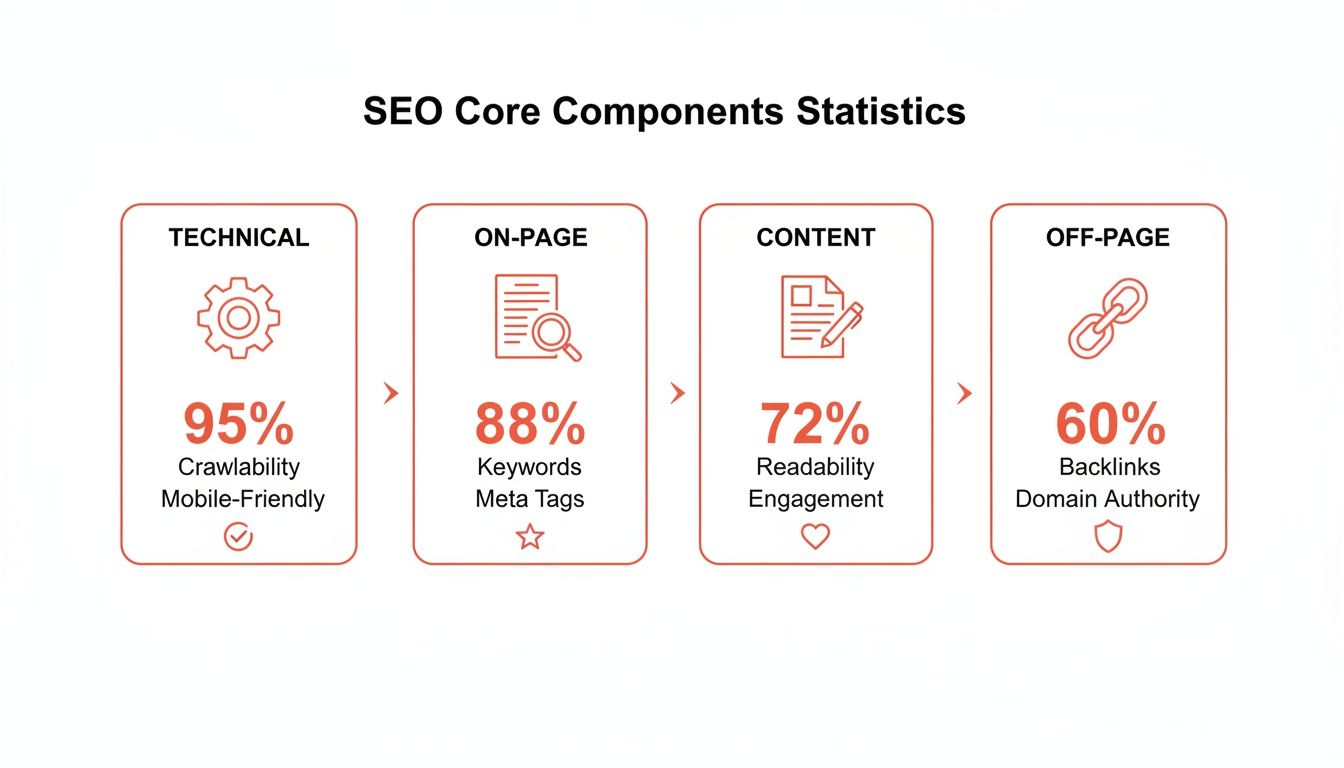
As you can see, a solid technical foundation is non-negotiable—it’s what allows your expert content to even be seen. At the same time, off-page signals act as a vote of confidence, validating your authority to search engines.
Adapting to an AI-First Australian Market
This isn't some far-off future concept; it's happening right now, particularly here in Australia. AI-driven search and "zero-click" behaviour are reshaping the Aussie search market, making modern SEO more critical than ever.
In fact, Australia is now leading the world in AI search adoption with 1.42 AI queries per person. At the same time, research shows that a staggering 60–65% of searches end without anyone clicking through to a website because AI summaries provide the answer right on the results page.
This has had a massive impact on budgets. Traditional SEO tactics now make up just 45% of search marketing spend, a huge drop from 75% in 2023, as businesses scramble to pivot towards AI optimisation and authority-driven content.
It all means that just ranking isn't good enough anymore. Your content needs to be so good that it gets featured in these AI-generated answers.
What Does AI-Driven SEO Look Like in Practice?
An AI-first strategy isn't about learning a few new technical tricks. It's a complete shift in how you think about content and optimisation, moving the focus squarely onto demonstrating genuine value.
Here are the key pillars of an effective AI-driven SEO strategy:
- Building Topical Clusters: Instead of chasing individual keywords, you create comprehensive "clusters" of content around a core topic. This is how you prove you have deep expertise on a subject, not just a passing knowledge.
- Focusing on User Intent: Every single piece of content should be meticulously crafted to answer the real, underlying question a user has, not just to match the words they typed into the search bar.
- Leveraging Structured Data: Think of this as spoon-feeding Google. By implementing schema markup, you help AI systems understand the context of your content, which seriously increases your chances of appearing in rich results and AI-generated summaries. Our detailed guide on AI for SEO dives deeper into these strategies.
- Prioritising Quality and Depth: Vague, generic content is dead. To stand out, your articles must be detailed, accurate, and backed by evidence, case studies, or original data.
To get a handle on this new AI-driven era, exploring the best AI SEO software tools can give you a significant leg up, improving both your efficiency and results. By embracing these principles, you're not just positioning your website to survive the changes in search—you're setting it up to thrive by becoming an indispensable resource for both people and the AI systems that guide them.
Understanding SEO Pricing Models and What You Get
One of the first, and biggest, questions that always comes up is a simple one: what does this stuff actually cost? Unlike buying a product off the shelf, SEO pricing isn't one-size-fits-all. The cost really just reflects the scope, intensity, and time needed to hit your specific business goals.
Getting your head around the common pricing models is the first step. It'll help you make sense of proposals and find an agency that fits both your budget and your ambition. Let's break down the three main structures you'll run into here in Australia.
Monthly Retainer Model
The most popular way to engage an SEO agency is the monthly retainer. In this model, you pay a fixed fee each month for a continuous, agreed-upon scope of work. Think of it like having a specialised digital marketing team on speed dial, constantly working to improve and protect your online presence.
This model is a perfect fit for businesses that are serious about long-term growth. SEO isn't a "set and forget" job; it demands constant attention, quick adaptation to Google's algorithm changes, and a steady drumbeat of content creation and link building. A retainer ensures that momentum never drops off.
So, what's usually packed into a monthly retainer?
- Ongoing Audits and Monitoring: Regular technical health checks to keep your site fast and error-free.
- Content Creation: A set number of blog posts, articles, or landing pages rolling out each month.
- Link Building Campaigns: Consistent outreach to earn high-quality backlinks that build your site's authority.
- Regular Reporting and Strategy Calls: Crystal-clear performance reports and catch-ups to discuss progress and plan the next moves.
This kind of consistent partnership allows an agency to get under the hood of your business and market, fine-tuning the strategy over time for much better results.
Project-Based Pricing
Another common setup is project-based pricing. This one is tailor-made for businesses with a specific, one-off SEO job in mind. Instead of an ongoing commitment, you pay a flat fee for a defined project with a clear start and finish line.
You might hire an agency for a project like:
- A massive, one-time technical SEO audit and fix-up.
- A keyword research and content strategy package to arm your in-house team.
- A full local SEO setup to get your Google Business Profile and local listings humming.
Project-based work is brilliant for tackling a specific pain point or for laying a rock-solid foundation before you commit to a longer-term strategy. It gives you cost certainty and a very clear list of what you'll get for your money.
The only real catch is that SEO success needs sustained effort. Once the project wraps up, the work stops. Without ongoing maintenance, those initial wins can slowly fade away. It’s a powerful way to kickstart your efforts, but it’s rarely a complete, long-term solution by itself.
Hourly Consulting Rates
Finally, some SEO pros and agencies offer their expertise at an hourly rate. This model gives you maximum flexibility and is often used for highly specific tasks, training sessions, or strategic advice.
You might bring in an hourly consultant to:
- Train your internal marketing team on SEO best practices.
- Get a second opinion on a strategy pitched by another agency.
- Troubleshoot a sudden, mystifying technical issue or a sharp drop in rankings.
While it’s super flexible, trying to run a full SEO campaign on hourly rates alone can get unpredictable and expensive pretty fast. It doesn't have the strategic oversight and consistent execution of a retainer, but it’s an invaluable option for getting targeted expert help right when you need it most.
For a more detailed look at what these services might set you back, check out our comprehensive guide on how much you should expect to pay for search engine optimisation. No matter the model, a good proposal will always clearly connect the price to the tangible work and value being delivered for your business.
How to Choose the Right SEO Agency in Australia
Picking a partner to handle your SEO is easily one of the biggest marketing decisions you’ll make. Get it right, and you’ve got a powerful engine for growth. Get it wrong, and you’ll burn through your budget and could even damage your website’s reputation with Google.
Making the smart choice isn't about finding the cheapest quote. It’s about finding a team that genuinely gets your business goals, works transparently, and has their finger on the pulse of where search is heading. To do that, you need to walk into those conversations armed with the right questions.
Key Questions to Ask Potential SEO Partners
Before you even think about signing a contract, you need to dig deeper than the slick sales pitch. A good agency will welcome sharp questions and give you straight, honest answers.
Here are a few essential questions that will help you vet potential agencies and really understand their approach:
- How do you measure success beyond rankings? Sure, seeing your site climb the rankings is nice, but rankings alone don’t pay the bills. A sharp agency will be laser-focused on the metrics that actually matter to your business: growth in organic traffic from your target audience, qualified leads hitting your inbox, and a measurable lift in organic conversion rates.
- What’s your game plan for AI-driven search? This one question quickly separates the forward-thinkers from those stuck in the past. You want to hear them talking about building topical authority, focusing on E-E-A-T (Experience, Expertise, Authoritativeness, and Trustworthiness), and using structured data to help AI systems make sense of your content.
- Can you show me a case study from a business like mine? While every agency needs to respect client confidentiality, a reputable one should have no problem sharing examples of their work. They should be able to walk you through the initial challenge, the strategy they rolled out, and most importantly, the tangible business results they delivered.
- What does your communication and reporting look like? Find out how often you’ll get reports and what’s actually in them. The best partners provide transparent reporting that clearly connects their day-to-day work to your main KPIs and are always available for regular strategy calls.
A great SEO partner acts like an extension of your own team. They should be just as invested in your business outcomes as you are, focusing on metrics that truly drive growth, not just vanity numbers that look good on a report.
Red Flags to Watch Out For
Knowing what to look for is only half the battle; knowing what to run away from is just as critical. The SEO world, unfortunately, has its share of operators who rely on outdated, risky tactics or make promises they can't possibly keep.
Spotting these red flags early will save you a world of headaches later on. If you're looking for a local team, a specialised search marketing agency in Australia should be able to articulate their strategy clearly without resorting to any of this nonsense.
To make it simple, here’s a quick rundown of the green flags versus the red flags.
SEO Agency Evaluation Checklist
It can be tough to sort the good from the bad. This checklist breaks down the key differences between a promising partner and one that might cause you problems.
| What to Look For (Green Flags) | What to Avoid (Red Flags) |
|---|---|
| A focus on business goals like leads and revenue. | Guarantees of #1 rankings on Google. |
| A transparent and customised strategy. | A "secret sauce" or proprietary methods they can't explain. |
| Clear, regular reporting tied to your KPIs. | Vague or non-existent reporting. |
| Case studies with measurable business results. | A heavy focus on low-quality, high-volume link building. |
| An open discussion about the realities of SEO timelines. | Promises of "overnight results" or instant traffic. |
At the end of the day, choosing the right agency boils down to trust and alignment. You’re not just hiring a supplier; you’re looking for a strategic partner who understands your business, communicates clearly, and has a proven, future-focused process for delivering results that last. Taking the time to ask these tough questions upfront is the best investment you can make in your business’s online success.
Measuring SEO Success With Business-Focused Metrics
So, how do you actually know if your investment in search engine optimisation services is working? Watching your website climb the rankings is a great feeling, but rankings alone don't pay the bills. Real success is measured by the impact on your bottom line.
It’s time to look past the vanity metrics and zero in on the Key Performance Indicators (KPIs) that directly map to business growth. These are the numbers that show your SEO is delivering a real, tangible return.
Moving Beyond Rankings to Real Results
A modern SEO strategy isn't just about getting any traffic; it’s judged on its ability to attract the right kind of visitor—someone actively looking for what you offer. This is where business-focused metrics come in, giving you a clear picture of how healthy and effective your campaign truly is.
Here are the core KPIs that actually matter:
- Organic Traffic Growth: Are more people finding you through search engines month after month? A steady climb here shows your visibility is expanding to the right audience.
- Organic Conversion Rate: Of all those new visitors, what percentage are taking the action you want them to? This could be filling out a form, making a purchase, or signing up for a newsletter. This is the ultimate test of traffic quality.
- Lead Quality: Are the leads coming from organic search a good fit? High-quality leads mean your SEO is attracting prospects who are genuinely interested and ready to talk business.
- Customer Acquisition Cost (CAC): Over time, a solid SEO strategy should bring down your average cost to acquire a new customer, making it one of the most cost-effective marketing channels you have.
Tracking these metrics changes the conversation from "Where are we ranking?" to "How much revenue did our organic traffic generate last quarter?" That shift in focus is absolutely crucial for understanding the true value of your SEO investment.
The Powerful Synergy of SEO and PPC
If you want the clearest possible view of your marketing ROI, you need to look at how SEO and Pay-Per-Click (PPC) advertising work together. Think of them as a one-two punch for your marketing. They aren't competing against each other; they're complementary forces that make each other stronger.
PPC delivers immediate traffic and, just as importantly, a mountain of valuable data. You can quickly test keywords, ad copy, and landing pages to see what clicks with your audience.
This data is pure gold for your SEO strategy. It gives you incredible insight into which keywords have the highest commercial intent, allowing your search engine optimisation services provider to focus their long-term efforts where they'll make the biggest impact.
A Sustainable Engine for Growth
While PPC gives you speed and precision, SEO builds a sustainable, long-term asset for your business. Every piece of content you create and every backlink you earn is like adding another brick to your digital foundation, making your online presence stronger and more resilient over time.
This integrated approach creates a powerful feedback loop:
- PPC provides immediate data: You quickly discover high-converting keywords and learn about user behaviour.
- SEO uses this data to build authority: Your team creates targeted content and builds authority around proven, profitable terms.
- A strong organic presence reduces PPC reliance: As your organic rankings improve, you can be more strategic with your ad spend, which ultimately lowers your overall customer acquisition cost.
By combining the short-term wins of PPC with the long-term asset-building of SEO, you create a robust and truly measurable marketing engine. This integrated approach is how you move beyond simple metrics to maximise your real marketing return on investment.
Still Have Questions? Let's Clear a Few Things Up
Diving into the world of search engine optimisation can feel like learning a new language, and it's natural to have questions. Here are some of the most common ones we hear from business owners before they take the leap.
How Long Until I See Real SEO Results?
Patience is probably the hardest part of SEO. Unlike paid ads that give you an instant (but temporary) boost, organic results are something you build over time. You’ll likely start to see some positive signs—think small bumps in rankings and a bit more traffic—within the first 3 to 6 months.
But for the kind of results that really move the needle for your business, you’re usually looking at a 6 to 12 month timeframe. This all depends on things like how competitive your industry is, the current health of your website, and how aggressively you pursue the campaign. The best analogy? It’s like planting a tree. You have to nurture it consistently for a while before you can enjoy the fruit.
Is SEO a One-Time Thing or an Ongoing Commitment?
You can certainly hire an agency for a one-off project to sort out some technical gremlins or get your basic foundation in place. But if you want real, lasting success, SEO has to be an ongoing effort. Think about it: Google's algorithms are always changing, your competitors are constantly trying to one-up you, and new opportunities pop up every day.
SEO is a marathon, not a sprint. Treating it as a core, ongoing part of your marketing means you’re always adapting, growing your online presence, and capturing new customers long after the initial work is done.
This is why an ongoing retainer model works best. It gives your strategy the sustained momentum it needs to not only build authority but also protect it from the competition.
What's the Difference Between SEO and PPC?
This is a big one, and it's crucial to understand. Both are incredibly powerful marketing tools, but they do very different jobs.
- SEO (Search Engine Optimisation): This is all about earning your spot in the search results organically—no paying per click. You’re building a long-term, sustainable asset that brings in traffic day after day without you having to pay for every single visit.
- PPC (Pay-Per-Click): This is where you pay for ads to appear right at the top of the search results page. It's fantastic for getting immediate traffic and gathering data quickly, but the moment you stop paying, the traffic stops.
Honestly, the smartest strategies use both. PPC gets you quick wins and valuable insights you can feed into your SEO, while SEO builds that cost-effective, long-term growth engine for the future.
Ready to stop wondering and start ranking? Click Click Bang Bang specialises in creating data-driven, AI-first SEO strategies that deliver measurable business growth. Get your free, no-obligation proposal today!
Read NeXt
Or Read Our Latest
- Data Privacy Compliance: 2026 Guide for Marketers
- Your 2026 Remarketing Campaign Strategy Blueprint
- Customer Lifetime Value: Calculate & Increase It in 2026
- Contextual Targeting Advertising: A Guide for 2026
- Best Seo Agency Australia Guide 2026
- Cross Domain Tracking: A Practical Guide for GA4 in 2026
Click. CLick. Subscribe.
Get our best PPC insights, industry updates, and power moves delivered straight to your inbox. No fluff, just high-caliber strategies that actually work.
Don’t Leave Just Yet
Try Us For 30-Days,
Risk Free!!
We guarantee that you’ll love our work within the first 30 days, if not you’ll get your money back.
What have you got to lose?