

Recover from Google Penalty: Expert Tips to Boost Rankings
Last Updated

That sudden, sharp drop in your website's traffic is a gut-wrenching feeling. When you're trying to recover from a Google penalty, the very first move is a clear diagnosis. You need to figure out if you're dealing with a direct manual action or a broader algorithmic devaluation. This initial investigation is the most critical part of building a recovery plan that actually works.
How To Tell if You Have a Google Penalty
Before you can even think about fixing the problem, you need to know exactly what you're up against. Is it a direct slap on the wrist from a human reviewer at Google, or did your site simply fail to measure up to a recent algorithm update? Jumping to conclusions here is a classic mistake. It can send you down a rabbit hole, wasting precious time and money on fixes for a problem you don't even have.
Your investigation should always start in one place: Google Search Console. It's the only direct line of communication between your website and Google, and it's where you'll find the smoking gun for a manual action.
Check for Manual Actions First
A manual action is exactly what it sounds like—a human reviewer at Google has looked at your site and decided that some of your pages violate Google's webmaster quality guidelines. This is the most straightforward penalty to diagnose because Google literally tells you it happened.
To check, just head over to the "Security & Manual Actions" report in your Google Search Console account. If you see a comforting "No issues detected" message, you can breathe a sigh of relief and rule out a manual penalty.
But if a penalty has been applied, you’ll see a specific description of the issue.
Common manual actions include:
- Unnatural links to your site: This is a clear red flag for manipulative link-building.
- Thin content with little or no added value: A sign of low-quality, auto-generated, or scraped pages.
- Pure spam: This is the most severe penalty, usually reserved for sites using aggressive, black-hat spam techniques.
- Hidden text and/or keyword stuffing: An old-school tactic that's a big no-no for user experience.
The process flow below shows the core steps for diagnosing a potential penalty. It's a simple model, but it works.
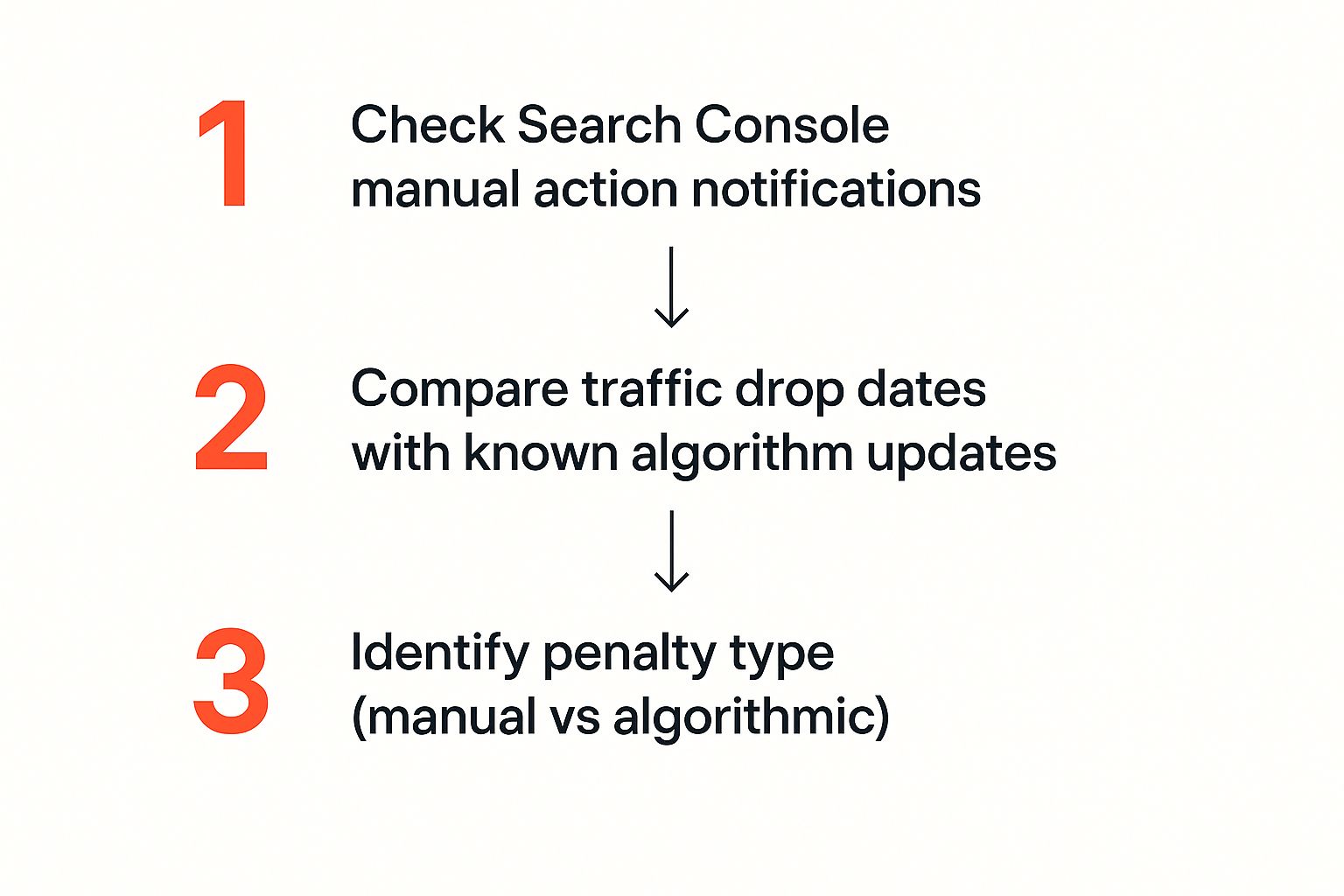
Starting with the most concrete evidence (manual actions) before trying to interpret algorithmic shifts will save you a world of pain.
To help you quickly tell the two apart, here's a simple comparison.
Manual Action vs Algorithmic Penalty Key Differences
This table breaks down the core differences to help you quickly identify what type of Google penalty might be affecting your website.
| Characteristic | Manual Action | Algorithmic Penalty |
|---|---|---|
| Notification | Yes, via Google Search Console | No direct notification |
| Source | Human reviewer at Google | Automated algorithm update |
| Diagnosis | Straightforward, GSC provides details | Requires investigation and analysis |
| Recovery Path | Fix the issue and file a reconsideration request | Improve site quality and wait for the next algorithm refresh |
| Cause | Specific violation of quality guidelines | Site quality doesn't meet new algorithmic standards |
Understanding these distinctions is the first step toward getting your site back on track.
Investigate Algorithmic Devaluations
If your Manual Actions report is squeaky clean, then your traffic drop is most likely due to an algorithmic penalty. This happens when a major Google update re-evaluates your site's quality signals and finds them lacking. There's no notification for this; the evidence is buried in your analytics data.
The trick is to compare the date of your traffic drop with a timeline of known Google search algorithm updates. If the dates line up, you can start digging into what that specific update targeted. For example, a core update might focus on content quality and E-E-A-T (Experience, Expertise, Authoritativeness, Trustworthiness), while a spam update goes after manipulative SEO tactics.
The key difference is communication. A manual action comes with a notification and a clear problem to solve. An algorithmic hit forces you to become a detective, piecing together clues from update documentation and your own site's weaknesses to find the cause.
These penalties aren't rare. In fact, Google's former head of webspam once confirmed that around 400,000 manual actions are issued globally every month. For Australian businesses in competitive spaces like e-commerce or health, the risk is very real. Some specialists have reported that an unaddressed manual action can slash traffic by over 50%, leading to devastating revenue losses of 30-70%.
Performing a Deep Dive Backlink Audit

If a manual action is the official diagnosis, unnatural links are almost always the smoking gun. But even with an algorithmic hit, a toxic backlink profile can act like an anchor, dragging your site down. To recover from a Google penalty, you need to put on your detective hat and become a forensic investigator for every single link pointing to your domain.
This isn't a quick export-and-glance job. We're talking about a deep, methodical audit to build a complete picture of your site's history and the authority signals it's sending. This process is the absolute foundation of your recovery, so precision is everything.
Assembling Your Link Data
First up, you need to gather a comprehensive list of all your backlinks. A common mistake is relying on a single tool. Each platform has its own crawlers and will inevitably miss links that others find. To create a true master list, you have to pull data from multiple sources.
Start by exporting your link data from these essential platforms:
- Google Search Console: This is your most direct source, showing you the links Google definitely knows about. It's free and non-negotiable for any serious audit.
- Ahrefs: Known for its colossal link index and powerful filtering, Ahrefs often uncovers links that GSC might not show you.
- Semrush: Another industry heavyweight, Semrush provides excellent backlink analytics and can reveal a different set of links again.
Once you have these exports, chuck them all into a single spreadsheet and get rid of the duplicate entries. This consolidated list is your starting point for the real analysis.
Categorising Every Single Link
Now for the meticulous part: evaluating each and every link. In your spreadsheet, create a new column labelled "Status" and get ready to sort every link into one of three buckets: Keep, Investigate, or Remove/Disavow.
I can't stress this enough: this manual review is non-negotiable. No tool can perfectly judge the context and intent behind a link, so you absolutely need to put human eyes on your profile.
Here’s a practical framework to guide your analysis.
| Link Category | Action to Take | Real-World Examples |
|---|---|---|
| Keep | Mark as "Keep" and move on. | A genuine guest post on a reputable industry blog. An unsolicited mention in a news article. A link from a partner's website. |
| Investigate | Mark as "Investigate" for a closer look. | Directory links—some are legitimate, many are spam. Links from sites with low domain authority but decent content. Forum links that could be either helpful or pure spam. |
| Remove/Disavow | Mark for cleanup. This is your hit list. | Obvious paid links with exact-match anchor text. Links from foreign-language spam sites. Comments on unrelated blogs with your keyword as the name. |
This methodical sorting process is how you turn a chaotic mess of URLs into an actionable plan.
Identifying Toxic Link Red Flags
As you sift through your backlinks, certain patterns will scream "toxic." These are the links that most likely triggered your penalty in the first place. Your goal is to get really good at spotting them quickly.
A successful backlink audit isn't just about finding bad links; it's about proving to Google that you understand why they were bad. This understanding is crucial for both the cleanup and your future link-building strategy.
Keep an eye out for these undeniable red flags that signal a harmful backlink:
- Irrelevant Source: A link from a Russian casino site to your Aussie plumbing business is a massive red flag. Context is king.
- Over-Optimised Anchor Text: If 100% of your links use the anchor text "best plumber in Sydney," it looks incredibly unnatural and manipulative.
- Low-Quality Directories: We've all seen them. Links from mass-produced, low-value web directories that exist only for SEO are pure poison.
- Sitewide Links: A link from the footer or sidebar of another website that appears on every single page is often a dead giveaway for a paid link scheme.
- Private Blog Networks (PBNs): These are networks of websites built solely to create links and manipulate search rankings. Links from these are extremely risky and a classic penalty-magnet.
- Spammy Comments or Forums: Dropping your link in the comment section of unrelated blogs or forums is a classic spam tactic from a decade ago that can still haunt you today.
By the end of this deep dive, you should have a definitive, clear-cut list of every link that needs to be dealt with. This list is the critical deliverable that will drive the next stage of your recovery: the link cleanup and disavow process. You're now ready to surgically remove the junk that's holding your site back.
Executing the Link Cleanup and Disavow Process

Alright, you’ve got your hit list of toxic backlinks. Now it’s time to roll up your sleeves and get to work. This is the part where you actively show Google you’re taking ownership of your site’s history and fixing the mess. The whole process really boils down to two main jobs: manual removal outreach and submitting a disavow file.
Tackling both is the only way to effectively recover from a Google penalty. While the disavow tool is powerful, Google really values seeing a good-faith effort to get bad links removed manually first. This is especially true if you’re appealing a manual action.
Starting with Manual Removal Outreach
First things first, you need to contact the webmasters of the sites hosting your toxic links and politely ask them to take the link down. Let's be real here: the success rate can be pretty low. A lot of these low-quality sites are completely unmanaged, and some might even try to demand a fee for removal (a massive red flag – never pay them).
So why bother? Because it’s a crucial step that shows Google you’ve done your due diligence.
When you reach out, keep your email:
- Polite and Professional: You’re asking for a favour, after all. A friendly, respectful tone goes a long way.
- Clear and Specific: Tell them exactly where the link to your site is. Always provide the full URL of the linking page.
- Brief and to the Point: Webmasters are busy people. Get straight to your request without a long-winded backstory.
Here’s a simple, effective template you can adapt:
Subject: Link Removal Request from [Your Website Name]
Hi [Webmaster Name, or "Admin"],
I hope you're well.
I'm getting in touch on behalf of [Your Website Name]. We're currently cleaning up our backlink profile and removing some old links. We would be very grateful if you could remove the link to our site from this page:
[URL of the page with the link]
The link points to: [Your URL]
Thank you for your time and help with this.
Kind regards,
[Your Name]
Make sure you keep a detailed spreadsheet of every single email you send, the date it was sent, and any responses you get back. This documentation is absolute gold if you end up needing to submit a reconsideration request later.
Mastering the Google Disavow Tool
Once you’ve given outreach a reasonable amount of time—a couple of weeks is usually enough—it’s time to deal with the stubborn links that remain. This is where you bring out Google’s Disavow tool. This tool lets you tell Google to completely ignore specific links or even entire domains when it’s assessing your site.
Think of it like telling Google, "Hey, I don't endorse these links, so please don't hold them against me." It’s a powerful signal, but it has to be used with surgical precision. Disavowing good links can seriously harm your rankings, so only include links you are 100% certain are toxic.
The process involves creating a simple text file (.txt) that lists the URLs or domains you want to get rid of. The formatting is incredibly strict and is a common point of failure for people new to this.
- To disavow a specific page, just list the full URL:
http://spammy-example-site.com/spammy-page.html - To disavow an entire domain (which I highly recommend for truly toxic sites), use this format:
domain:spammy-example-site.com
Honestly, it’s almost always better to disavow at the domain level. If a site has given you one bad link, it’s a safe bet the entire domain is low-quality and could spit out more toxic links in the future.
Your final disavow file should look something like this:
Contacted webmaster at spammy-site.com on 01/08/2024, no response.
domain:spammy-site.com
This is a low-quality directory we want to disavow.
domain:bad-directory-example.net
http://another-spam-site.com/some-article.html
Once your file is prepped and double-checked, you submit it through the Google Search Console disavow links tool. This process can be tricky, and getting it right is crucial for your recovery.
For those navigating this for the first time, exploring expert SEO services can provide the guidance needed to avoid common pitfalls and ensure the cleanup is executed perfectly. Completing this step is a huge milestone on your journey to recover from a Google penalty and start rebuilding your site’s authority.
Overhauling Your Content and On-Page SEO

While a toxic backlink profile is often the smoking gun for a penalty, it’s a huge mistake to stop your investigation there. Some of the most brutal algorithmic hits, particularly from Google's big Core Updates, are actually rooted in your site’s own content.
If your website is bloated with thin, low-value, or duplicate pages, you're sending a constant stream of poor quality signals. These signals can drag down the visibility of your entire domain, not just the offending pages.
To truly recover from a Google penalty, you have to turn the focus inward. It's about rebuilding your site’s authority from the content up, making it a resource that Google genuinely wants to show its users.
Conducting a Strategic Content Audit
A content audit isn't just a spellcheck. It's a systematic review of every single indexable page on your website. The goal is simple: evaluate each piece of content against hard performance metrics and quality standards to decide its fate. You're assessing whether each page actually serves a purpose for both your users and your business.
First up, get all your URLs into a spreadsheet. You can pull this data from tools like Screaming Frog or simply export your sitemap. Then, you need to layer on the data. Pull key metrics from Google Analytics and Google Search Console for the last 6-12 months, including:
- Organic traffic and sessions
- Bounce rate or engagement rate
- Time on page
- Conversions or goal completions
- Total number of ranking keywords
With this data in hand, the real work begins. Every URL on your site needs to be assigned one of four distinct actions.
| Action | When to Use It | Example Scenario |
|---|---|---|
| Improve | The page has potential but is underperforming. | A blog post ranks on page two for its target keyword but has a high bounce rate. It needs more depth, visuals, and clearer formatting. |
| Consolidate | You have multiple pages competing for the same keywords. | You have three separate, short blog posts about "PPC tips for beginners." Combining them into one definitive guide will create a stronger, more authoritative asset. |
| Prune | The page is irrelevant, low-quality, and has no traffic or links. | An old event page from five years ago that gets zero visitors and has no backlinks. Deleting it and setting up a redirect is the best move. |
| Keep | The page performs well and meets user needs. | A high-traffic landing page that consistently generates leads and ranks well for its primary keywords. |
This methodical process transforms your website from a cluttered digital attic into a lean, high-performing asset.
Aligning with E-E-A-T and On-Page Fundamentals
As you start improving your content, you need to view it through the lens of Google's E-E-A-T guidelines—Experience, Expertise, Authoritativeness, and Trustworthiness. This isn’t just a box-ticking exercise; it’s the very standard by which Google judges content quality.
This intense focus on quality isn't new. Here in Australia, the evolution of Google’s penalties—driven by massive updates like Panda (2011) and Penguin (2012)—fundamentally changed how businesses approached SEO risk. After the Penguin update, for instance, Australian digital marketing experts saw a surge in penalty cases of around 35% among mid-sized businesses. Recovery demanded a sharp focus on both backlink quality and on-site content enhancement.
This is your chance to fix the foundational on-page SEO elements that may have been neglected. Go back to basics and ensure every important page has an optimised, compelling title tag and meta description that encourages clicks.
Finally, you need to reinforce your site's structure with a smart internal linking strategy. As you improve your key pages, make sure you link to them from other relevant posts on your site. This helps distribute link equity, shows Google the relationships between your content, and gives your users a much better experience.
For a deeper dive into building a strong foundation, check out our comprehensive guide to search engine optimisation. Taking this kind of holistic approach is absolutely essential for a lasting recovery.
Right, you've done the hard yards. The audit, the cleanup, the disavow file… it’s been an intense process. Now you're at the final hurdle for getting a manual action lifted: the reconsideration request.
This isn't just about filling out a form. Think of it as your one shot to make a case directly to a human reviewer at Google. Your mission is to prove you get it. You understand what went wrong, you've genuinely fixed it, and you’re committed to playing by the rules from now on.
Getting this right is absolutely critical. A weak, defensive, or vague request can torpedo months of painstaking work, landing you a rejection that sends you straight back to the drawing board. This is your professional apology letter, backed by cold, hard evidence.
Get Your Head in the Game First
Before you type a single word, you need the right mindset. This is not the time to make excuses, get defensive, or point fingers at the dodgy SEO agency you hired five years ago. Google's reviewers are looking for one thing above all else: accountability. They need to see you take their Webmaster Guidelines seriously.
Your tone should be:
- Honest and Transparent: Own up to the violation. Don’t try to downplay it or act like you didn't know.
- Humble and Respectful: Remember, you're asking for a favour—for a penalty to be removed. A polite, professional tone is non-negotiable.
- Detailed and Thorough: Vague claims like "we cleaned up our bad links" are a one-way ticket to rejection. Get specific.
The biggest mistake I see, time and time again, is a defensive tone. The second you start justifying past actions or making excuses, you've lost. Own it, detail the fix, and commit to a better future. That's the formula.
The Anatomy of a Winning Request
A successful reconsideration request really boils down to three key parts. You need to lay out each one clearly, logically, and with proof to back it up. The reviewer has zero context on your cleanup journey; it's your job to tell them the full story.
1. Explain the Problem Clearly
Kick things off by showing you understand exactly why you copped the manual action. Reference the specific violation from your Google Search Console account, whether it's "unnatural links to your site," "thin content with little or no added value," or something else.
Briefly explain what your own audit uncovered that led to the penalty.
For instance, you might write something like: "Our internal audit revealed that a previous marketing campaign involved building a significant number of low-quality links from article directories using exact-match anchor text. We now understand this is a clear violation of Google’s guidelines on link schemes."
2. Document Your Cleanup Efforts Exhaustively
This section is the heart and soul of your request. It's where you provide a step-by-step account of everything you did to clean up the mess. The more detail, the better.
-
For Link Penalties: Describe your manual outreach campaign. Mention the number of webmasters you contacted and the outcome. Crucially, state that for all the links you couldn't get removed, you have submitted a comprehensive disavow file. You can even provide a link to a public Google Sheet that documents every single outreach attempt—date, URL, contact method, response. This shows immense effort.
-
For Content Penalties: Explain your content audit process. Mention how many pages you improved, consolidated, or removed. Give a few specific examples of low-quality pages you culled and, just as importantly, some high-quality pages you significantly overhauled or published.
3. Demonstrate Your Commitment to the Future
Finally, you need to reassure the reviewer this won't happen again. Briefly outline the new processes, policies, or internal training you've put in place to ensure you stick to Google's guidelines moving forward.
This isn't about a quick fix; it's about showing you've fundamentally changed your approach to SEO and are dedicated to maintaining a high-quality site for the long haul. This last piece is what seals the deal and gets you back on the path to recovery.
Monitoring Your Recovery and Building a Resilient Future
Hitting ‘submit’ on your reconsideration request or pushing your content fixes live isn't the end of the road. In fact, it's just the beginning of the next, crucial phase: watching your recovery take shape and shifting your entire SEO mindset from reactive cleanup to proactive resilience. To truly recover from a Google penalty, you need to learn how to read the signs of progress and build a strategy so solid it can weather any future algorithm storms.
Patience is an absolute must here. Recovery isn't a flick-of-the-switch affair. It’s a gradual climb, and you need to watch the right metrics to know you’re on the right track. Forget obsessively checking your main keyword ranking every hour. Instead, your attention should be glued to the leading indicators in your Google Search Console Performance report.
Key Metrics to Watch
Your first signs of life will almost certainly pop up in Google Search Console long before they translate into meaningful traffic gains in Analytics. Keep a very close eye on these two metrics in particular.
-
Impressions: This is often the very first metric to bounce back. An uptick in impressions means Google is starting to test your site again, showing it in search results more often. It’s a fantastic early signal that the penalty is lifting and trust is being restored.
-
Average Keyword Positions: Look for broad improvements across a wide range of keywords, not just your big-money terms. Seeing non-branded, long-tail keywords slowly creep up from position 50 to 30, then 30 to 20, is a crystal-clear sign that the algorithmic suppression is easing off.
Once these leading indicators start trending upwards, you can expect clicks and, eventually, a noticeable rise in organic traffic to follow. This journey takes time, and setting realistic expectations is vital to avoid getting frustrated.
A critical mistake is expecting a sudden V-shaped recovery. Most recoveries look more like a slow, steady incline over several weeks or even months. Celebrate the small wins, like a sustained increase in impressions, as they are the building blocks of a full comeback.
Establishing a Realistic Recovery Timeline
So, how long does it actually take? The honest answer is: it depends entirely on how severe the penalty was and how thorough your cleanup job has been. A minor manual action for something like structured data spam might be lifted within weeks of a successful reconsideration request. A severe, site-wide penalty from a core update, on the other hand, could take many months.
Here in Australia, the recovery process is a familiar pain point for local businesses that see their rankings evaporate overnight. Specialist agencies report that businesses can face immediate traffic drops of 60–80% when a penalty hits. Based on extensive experience with deep-dive audits and fixes, a typical recovery timeframe of 3–6 months after the intervention is achievable. It's a tough road, but it shows a comeback is definitely possible with a sustained, compliant approach.
Shifting from Recovery to Resilience
The ultimate goal here is to never go through this stressful process again. Use this penalty as a wake-up call to build a fundamentally stronger, more resilient SEO foundation. This means leaving behind any questionable tactics for good and committing to a future-proof strategy.
Your new focus should be on three core pillars:
- Clean Link Building: Prioritise earning high-quality, relevant backlinks through great content and genuine outreach. No shortcuts.
- Regular Monitoring: Set up monthly backlink audits to catch and disavow any negative SEO attacks or problematic links before they snowball into a real issue.
- User-First Content: Double down on creating genuinely helpful content that serves your audience and demonstrates strong E-E-A-T signals.
For a broader perspective on sustained SEO health and preventing future issues, check out this comprehensive guide to Google penalty recovery. The principles of penalty prevention are deeply connected with the best practices in SEO for small businesses, focusing on creating long-term value over short-term gains. By making this strategic shift, you transform your site from a penalty risk into an authoritative resource that Google is proud to rank.
Read NeXt
Or Read Our Latest
- How to Set Up Google Ads in Australia: Complete 2026 Guide
- Google Merchant Center Setup: The Complete 2026 Guide
- Business Manager Setup Facebook: The Complete 2026 Guide
- Google Ads Account Setup: Expert Guide for 2026
- Search Ads Optimisation: A Practical Guide for 2026
- Manual vs Automated Bidding for PPC Success
Click. CLick. Subscribe.
Get our best PPC insights, industry updates, and power moves delivered straight to your inbox. No fluff, just high-caliber strategies that actually work.
Don’t Leave Just Yet
Try Us For 30-Days,
Risk Free!!
We guarantee that you’ll love our work within the first 30 days, if not you’ll get your money back.
What have you got to lose?