

How to Choose an Instagram Ad Agency: A 2026 Guide
Last Updated

You’re probably in one of two spots right now. Either you’ve run Instagram ads before and the results felt foggy, expensive, or impossible to trust, or you’re about to hire an instagram ad agency and you don’t want to learn the hard way that polished decks aren’t the same as commercial outcomes.
That caution is justified. Australia is a strong Instagram market, but it’s also a crowded one. Ad reach in Australia has grown to an estimated 10.5 million users aged 18+ as of 2025, with 12.2% year-on-year growth, and Instagram ad revenue locally is estimated at AU$2.8 billion in 2025, according to Sked Social’s Instagram statistics roundup. More opportunity usually means more competition, more recycled creative, and more agencies leaning on generic Meta talking points.
The harder problem in 2026 isn’t just buying reach. It’s finding a partner that understands Australian benchmarks, can explain what “good” looks like for your category, and knows how to avoid the slow decline that comes from AI-generated sameness. If every ad looks polished but interchangeable, fatigue shows up fast and performance drifts.
A good agency should make Instagram feel measurable. A weak one makes it feel mysterious.
Laying the Groundwork Before You Search
If your brief is “we want more sales”, most agencies can nod along and sell you a retainer. That doesn’t mean they can build a campaign that matches how your business generates revenue.
Start with the business outcome, not the platform tactic. An e-commerce brand usually needs profitable purchases and repeatable revenue. A B2B firm often needs qualified leads, booked calls, or a healthy pipeline from the right accounts. A local service business may need enquiry volume, but only if those enquiries convert into jobs worth taking.

Turn business goals into Instagram KPIs
Here’s the practical way to do it.
-
Pick one primary commercial objective
Don’t ask an agency to maximise traffic, leads, purchases, reach, and followers at the same time. Choose the one outcome that matters most over the next quarter. -
Choose platform metrics that support that objective
For Australian businesses, benchmark success rates for Instagram campaigns often include CTR of 0.8% to 1.5%, overall conversion rates of 1% to 2%, and Story ad completion rates of 82%, based on these Instagram advertising benchmarks. Those figures don’t guarantee success, but they give you a realistic frame for evaluating agency promises. -
Define what counts as a conversion
For e-commerce, that’s usually a purchase. For B2B, it might be a form fill, booked demo, or qualified consultation. If you skip this step, reporting gets padded with vanity metrics. -
Set acceptable ranges, not fantasy targets
A serious agency will talk in scenarios and assumptions. It won’t promise instant scale before it understands your offer, margin, audience, and landing page quality.
Practical rule: If an agency can’t connect CTR, conversion rate, and revenue back to your business model, they’re selling media buying, not strategy.
Build your own baseline before the first call
You don’t need a complicated forecasting model. You do need a few answers written down before you speak to anyone:
- Your offer: What exactly are you selling, and why does someone buy now?
- Your margin: Can the business support paid acquisition?
- Your audience: Who buys first, and who only browses?
- Your funnel: Does traffic land on a product page, lead form, quiz, or booking page?
- Your constraints: Approval times, stock limits, seasonality, internal design support.
If your customer definition is still fuzzy, it’s worth tightening that before agency outreach. A simple framework for defining your target customer will save you money because weak targeting usually starts with weak internal clarity, not weak ad settings.
For a broader sense of where Instagram sits in the current mix, this piece on unlocking Instagram's potential in 2026 is useful background reading. It’s a good reminder that the platform can still work well, but only when the channel strategy matches the buying journey.
Know what “AU-specific” really means
An agency that understands Australia shouldn’t just say “we work with local brands”. It should speak fluently about local buying behaviour, creative style, timing, and benchmark expectations.
That matters because plenty of advice online is imported from the US market and doesn’t translate cleanly. A decent instagram ad agency should be able to tell you whether your niche behaves more like impulse e-commerce, considered purchase, or lead generation, and then shape the campaign around that reality.
Evaluating an Agency's Strategic Capabilities
A polished proposal tells you very little. The true test is what happens after week two, when early click-through rates soften, frequency climbs, and the agency has to explain what it will change for an Australian audience that has already seen versions of the same AI-generated ad ten times before.
I look at three areas first. Strategy, creative, and measurement. If one is weak, you usually get one of two outcomes. Spend rises without a clear path to profit, or reporting looks busy while the business owner still cannot tell what is working.
What good strategy sounds like
A capable agency should be able to explain account structure in plain English. That means who sees which message, why that segment matters, what the first test is, and what happens if results come in below target.
The strongest teams usually start with audience logic before they talk about content volume. That matters on Instagram because Meta's automation can improve delivery inside a good setup, but it does not fix poor segmentation, a blunt offer, or weak positioning for the Australian market.
Ask how they separate prospecting from remarketing and how they decide which customer signals deserve more budget. A clear answer should cover:
- Warm audience groups such as site visitors, video viewers, Instagram engagers, and past purchasers
- Lookalike use cases based on stronger signals like high-value customers or qualified leads
- Prospecting structure built around buyer intent, category relevance, and business objective
- Exclusions that stop existing customers seeing the same acquisition ad repeatedly
- Testing rules for sample size, budget allocation, and when a losing angle gets cut
Good agencies also talk about audience decay. In Australia, many brands are working with smaller addressable audiences than their US counterparts, so fatigue arrives faster and sloppy retargeting gets expensive quickly.
Ask which variable is being tested, what threshold triggers a decision, and how they change budget after a winner is found.
If the answer is vague, expect vague performance.
What good creative strategy looks like in 2026
Creative quality now has less to do with production polish and more to do with whether the agency can keep ads from blending into the feed.
AI tools have made it easier for agencies to produce acceptable ads at speed. That is not the same as producing ads people remember. The practical problem for advertisers is ad fatigue. Feeds are crowded with similar hooks, similar edits, similar UGC scripts, and similar claims. An agency that cannot explain how it refreshes concepts will struggle to hold results once the first wave of interest burns out.
For Australian brands, that challenge is sharper because local tone matters. US-style direct response copy can feel overcooked here. So can creative that relies on hype instead of proof. A good instagram ad agency should talk about:
- Hook variation across pain point, outcome, objection, and offer-led angles
- Local relevance in language, timing, references, and buying behaviour
- Proof assets such as reviews, founder footage, demonstrations, before-and-after examples, or on-screen objection handling
- Rotation discipline so the team replaces tired concepts instead of making endless minor edits
- Creative learning loops where winning messages feed landing pages, email, and future ad iterations
This is also where trade-offs matter. High creative volume can help testing, but too much low-quality output creates noise and burns budget. A smaller set of sharper concepts usually beats a pile of near-identical AI variants.
Tracking and measurement separate operators from presenters
Reporting should help you make decisions, not just fill a slide deck.
Post-ATT, a competent agency needs to be comfortable working with imperfect attribution while still building a measurement system you can trust. That usually includes Meta Pixel, Conversions API, GA4, and some method of checking platform results against CRM or back-end sales data.
You also want clarity on success metrics. If the agency talks about return without defining the target, ask how it calculates profitability and what level of return on ad spend actually makes sense for your business. A useful answer should factor in margin, repeat purchase rate, lead quality, and sales cycle length. ROAS on its own can mislead, especially for lead gen accounts and lower-margin ecommerce.
For owners who want a plain-English refresher on the broader paid media side, Wand Websites' guide to PPC is a helpful primer. It will not replace channel strategy, but it does improve the quality of the questions you ask in agency meetings.
One practical point. Some agencies rely almost entirely on native Meta reporting. Others add GA4, CRM inputs, and live dashboards so clients can compare ad platform numbers against business outcomes. Click Click Bang Bang is one example of an agency model that includes live reporting portals, analytics integration, and Meta campaign management as part of its PPC setup. That kind of infrastructure is useful because it gives clients direct visibility instead of leaving them dependent on a monthly summary.
How to Validate ROI with Case Studies and Proof
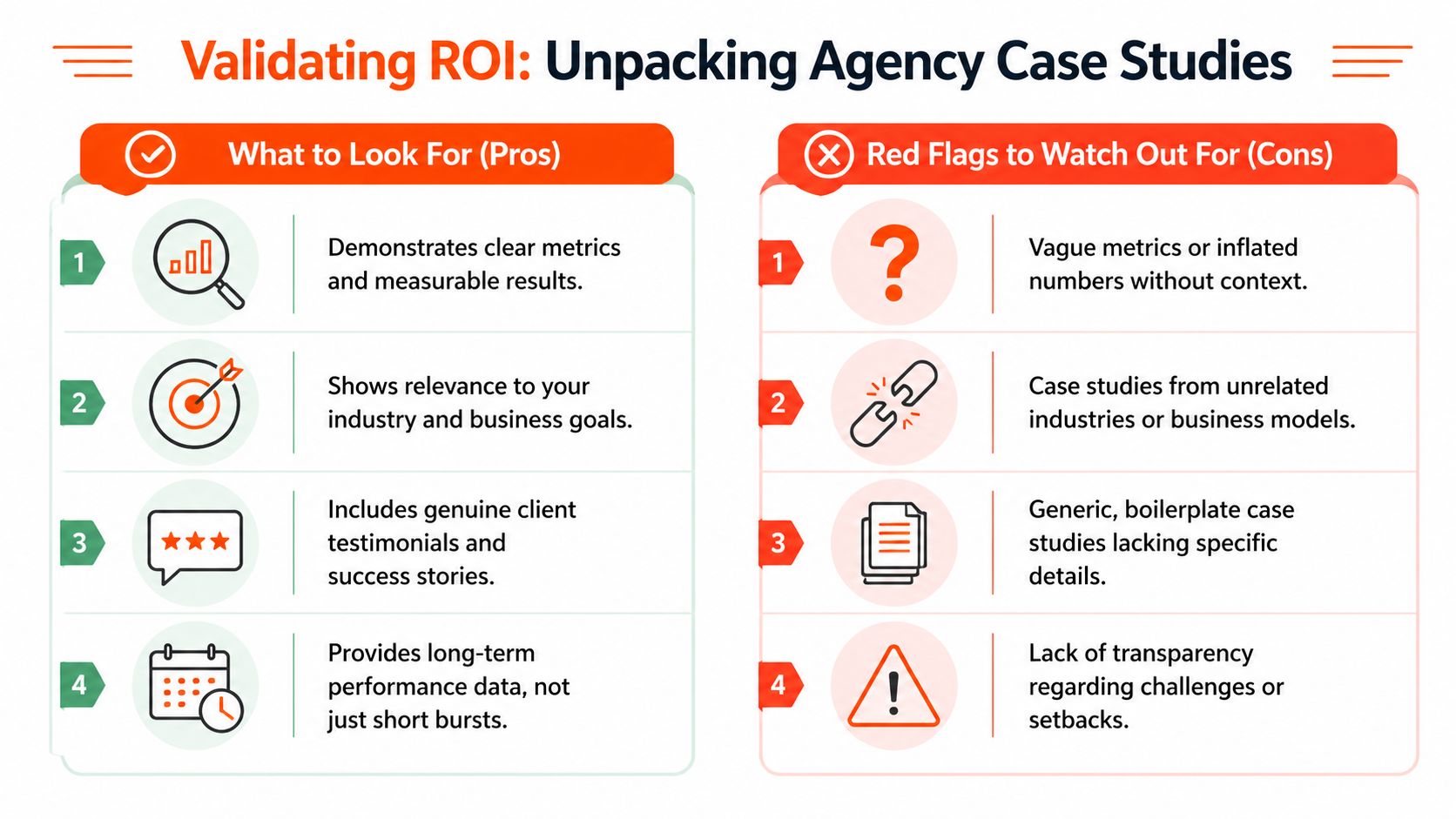
Case studies are useful. They’re also easy to dress up.
The mistake most businesses make is accepting “great results” without checking whether those results are relevant, durable, or expensive to achieve. An agency’s best-looking account may have had unusual seasonality, an exceptional offer, years of existing brand demand, or a creative founder who supplied half the winning inputs.
What proof actually matters
Instagram remains commercially relevant. 29% of B2B and B2C firms rank it as their number one platform for returns, tied with Facebook, and influencer activity on the platform can generate $4.12 in media value for every dollar spent, according to these Instagram ROI and influencer benchmarks.
But that doesn’t mean every agency can turn those platform dynamics into profit for your business.
Ask to see evidence that connects:
- Spend to outcome
- Creative approach to audience type
- Timeframe to result
- Business objective to final metric
If a case study only shows reach, impressions, or engagement, it may be a branding story disguised as a performance story.
The questions that expose thin proof
Use these in calls and proposal reviews.
-
What was the client’s starting point?
A turnaround account and a mature account are not the same challenge. -
How was success measured?
If the answer shifts between leads, clicks, traffic, and revenue, the agency may be selecting whichever metric looks best. -
What changed during the engagement?
Strong operators can explain whether the lift came from creative, audience changes, offer changes, landing page work, or tracking fixes. -
How long did the result last?
Short bursts happen. Repeatable performance is harder. -
What didn’t work first?
If every case study sounds frictionless, it’s probably been over-sanitised.
Reality check: The most trustworthy case studies include setbacks, dead ends, and the specific adjustments that improved performance.
You should also ask whether the agency can define return in terms your finance team would respect. If they can’t talk clearly about contribution to pipeline, margin, or customer acquisition logic, then the proof is only half-built.
For readers who want a tighter handle on the core profitability metric itself, this explainer on what ROAS means in practice is a useful reference before you compare proposals.
Relevance beats spectacle
A modest case study from a similar Australian business is more valuable than a huge result from an unrelated market. I’d rather see a sober breakdown from a retailer with your average order profile than a flashy global brand result that your business could never replicate.
The right question isn’t “what’s the biggest number this agency has produced?” It’s “have they solved a problem close enough to mine that their process is likely to transfer?”
Understanding Agency Pricing Models and Contracts
Pricing tells you how an agency thinks. Contracts tell you how it behaves when the relationship gets uncomfortable.
That’s why I wouldn’t evaluate fees in isolation. The cheapest management model can become expensive fast if reporting is thin, creative scope is vague, or you don’t control your own ad account.

The common pricing models compared
| Pricing model | Usually works well for | Main upside | Main trade-off |
|---|---|---|---|
| Percentage of ad spend | Brands with established budgets and ongoing scale plans | Fee grows with account complexity | Can reward higher spend more than better efficiency |
| Flat monthly retainer | Businesses that want predictable costs | Easy to budget and compare | Scope can become blurry if deliverables aren’t explicit |
| Performance-based fee | Lead gen businesses with strong tracking and clear sales definitions | Aligns fees to outcome in theory | Can create disputes if lead quality or attribution is contested |
| Hybrid model | Businesses needing both strategic work and outcome focus | Balances service scope with incentives | More moving parts, so contract language needs to be tighter |
There’s nothing wrong with any of these. The problem starts when the pricing model and your business model don’t fit.
A newer retailer with unstable creative supply may struggle under a spend-based arrangement if the agency keeps pushing budget before the account fundamentals are ready. A service business with a long sales cycle may run into friction with performance fees if nobody has defined what a qualified lead is.
What to pin down before signing
Most businesses often encounter painful setbacks.
-
Account ownership
Your Meta assets, pixel, audiences, and historical data should remain yours. -
Exit terms
You should know the notice period, offboarding process, and what happens to creative, reporting, and campaign history. -
Scope boundaries
Clarify whether landing pages, creative production, testing volume, reporting calls, and analytics setup are included. -
Approval workflow
Slow approvals kill campaign momentum. The contract should reflect who signs off and how quickly.
For a broader look at how agencies structure these arrangements, PostOnce agency pricing insights offer a sensible comparison of the main fee models.
If you’re trying to pressure-test whether quoted management fees line up with media reality, a practical benchmark is to compare them against your likely platform costs. This guide to social media advertising costs is a good reference point before you agree to a management structure.
Don’t ignore the service mechanics
A contract should also tell you how the work will run. Not in vague language, but in operating terms.
That includes campaign launch timing, reporting cadence, who joins strategy calls, and what happens if performance stalls. You want the commercial relationship to stay calm when results fluctuate. Clear terms help with that.
A short explainer on the commercial side is worth watching before you negotiate:
The Essential Interview and Red Flag Checklist
A sales call can sound polished right up until you ask how the agency handles a difficult account. That is the point of the interview. You are not trying to hear a nice process. You are trying to find out whether the team can produce Australian results when CPMs rise, creative burns out fast, and Meta reporting does not match what your finance team sees.
A good agency should be able to explain its decisions in plain language. If it cannot explain how it tests, diagnoses, and changes direction, you are buying presentation skills, not account management.
One question I recommend asking early is how they structure testing in the first six to eight weeks. A serious team will separate audience tests from offer tests and creative tests. They should also talk about sample quality, not just speed. In Instagram campaigns, rushed conclusions usually lead to false winners, wasted spend, and fatigue setting in before you have found a message worth scaling.
Questions worth asking in the first meeting
Ask questions that expose judgement under pressure, especially in the Australian market where audience size is smaller and fatigue arrives faster than many offshore teams expect.
-
Walk me through your testing plan for a new account in our category.
Listen for prioritisation. They should explain what gets tested first, what stays constant, and how they avoid mixing too many variables at once. -
How do you handle ad fatigue when creative starts to flatten?
A capable agency should talk about replacing angles, proof, format, and hooks. Minor edits alone rarely fix fatigue, especially now that AI-generated creative patterns are easy to spot and easy to ignore. -
What does your reporting include beyond Meta platform data?
The right answer includes Shopify, GA4, CRM data, or another source tied to actual revenue. Ads Manager alone is not enough if you care about margin and lead quality. -
Who does the actual work on the account?
Senior oversight matters. So does knowing whether optimisation is handled by the strategist you met or passed to a junior after the contract is signed. -
What would make you tell us not to increase spend yet?
Good agencies have clear reasons to hold budget. Weak conversion rates, unstable tracking, poor creative depth, or low stock are all valid answers. -
How would you adapt campaigns for an Australian audience rather than recycling overseas winners?
This matters more than many businesses realise. Local seasonality, pricing tolerance, shipping expectations, and creative tone all affect conversion.
If an agency has no language for constraints, it has probably not spent much time fixing underperforming accounts.
Agency Interview Questions and Red Flag Checklist
| Area of Inquiry | Key Question to Ask | Potential Red Flag |
|---|---|---|
| Strategy | How do you set the first testing priorities for a new client? | They jump straight into launching ads without discussing offer strength, funnel issues, or audience quality |
| Creative | How do you decide when creative is fatigued and what replaces it? | They rely on colour swaps, resized assets, or AI variations instead of developing new concepts and proof |
| Tracking | How do you validate Meta data against broader business reporting? | They only show Ads Manager screenshots and cannot explain discrepancies |
| Communication | What does reporting look like in the first month? | They promise transparency but cannot show the format, metrics, or meeting cadence |
| Team structure | Who will manage day-to-day optimisation? | The senior person sells the engagement, then disappears |
| Commercial fit | When would you advise us not to scale budget? | They imply higher spend fixes every problem |
| Ownership | Who owns the ad account, audiences, and data? | The agency keeps assets inside its own master account or controls access |
| Problem-solving | Tell me about a campaign that underperformed and what you changed | They describe a result, but not the diagnosis, trade-offs, or actions taken |
Red flags that should end the conversation
Some warning signs are subtle. Others should stop the process on the spot.
-
Guaranteed outcomes
No credible instagram ad agency can promise commercial results before reviewing the account structure, offer economics, conversion path, and tracking quality. -
Benchmark claims with no Australian grounding
If the agency talks in broad US or global averages and cannot explain how AU audience scale changes testing and creative turnover, be careful. -
No clear view on AI-driven creative fatigue
Plenty of agencies now produce ads faster. Fewer produce ads people still notice after weeks of exposure. You want a team with a plan for new concepts, customer proof, creator inputs, and message rotation, not a content mill. -
Restricted access to assets
You should have direct access to your ad account, pixel, audiences, and reporting stack from day one. -
Answers that stay high level
Vague confidence is expensive. If they cannot show how they diagnose poor performance, they will struggle when your account hits a rough patch.
Hiring advice: Choose the team that answers hard questions with specifics, trade-offs, and examples from accounts that did not go smoothly. That is usually where real competence shows up.
Onboarding and Building a Strong Partnership
A healthy agency relationship usually feels organised from week one. Not flashy. Organised.
The first month should reduce uncertainty, not increase it. That matters because many Australian businesses still don’t have a firm sense of what realistic return should look like. 68% of Australian e-commerce retailers report confusion over realistic ROAS, which is why onboarding should include clear performance projections and transparent reporting from the start.

What a good first month usually includes
In a well-run onboarding, the kickoff call doesn’t stay at the brand-story level. It gets operational quickly. The agency should confirm your commercial objective, review existing assets, map the funnel, and identify where tracking confidence is weak.
After that, there’s usually a working session around access, measurement, audiences, creative inputs, and approval workflow. If the agency runs a live dashboard or portal, you should know how to read it and what numbers matter.
A practical onboarding sequence often looks like this:
-
Kickoff and discovery
Business goals, offer, customer profile, previous campaign history, and internal constraints. -
Technical setup
Meta Business Manager access, conversion tracking, analytics alignment, event checks, and naming conventions. -
Creative and offer planning
Hooks, proof assets, landing pages, objections, and messaging angles for first tests. -
Launch window and review rhythm
Clear timing for campaign go-live, then scheduled reporting and optimisation reviews.
What transparency looks like in practice
Transparency isn’t just “we’ll send reports”. It’s the ability to see what’s happening without needing to decode agency jargon.
You should expect:
- Clear definitions of your core metrics
- Shared visibility into spend and results
- Regular communication about what changed and why
- Honest commentary when something underperforms
The strongest agencies make early expectations boringly clear. They’ll tell you what can be learned quickly, what takes more time, and which constraints sit outside media buying. That tone is far more useful than exaggerated confidence.
A smooth onboarding usually predicts a smoother account. Agencies that are chaotic in setup rarely become disciplined later.
The partnership standard to aim for
The best client-agency relationships are collaborative without becoming messy. You don’t want to micromanage every ad, but you also don’t want to be locked out of strategy and left with unexplained invoices.
Aim for a partner that brings a point of view, documents decisions, and tells you when the issue is bigger than the ads. Sometimes the bottleneck is weak creative. Sometimes it’s the landing page. Sometimes it’s the offer. A trustworthy agency says that plainly.
If you want a PPC partner that handles Instagram as part of a broader Meta and search strategy, Click Click Bang Bang offers structured onboarding, transparent reporting, no long-term lock-in, and a 30-day risk-free trial. That setup suits businesses that want clear visibility into performance from the start, especially if you’re comparing agencies and want a cleaner way to judge fit before committing long term.
Read NeXt
Or Read Our Latest
- How to Calculate Sample Size for A/B Tests and Campaigns
- How to Fix Google Merchant Center Errors Step by Step
- What Is Pagination and Why It Matters for AU Sites
- What Is Value Proposition? PPC & SEO Guide
- How to Choose a Google Ads Agency Australia
- Influencer Collaboration Playbook for E-Commerce & B2B
Click. CLick. Subscribe.
Get our best PPC insights, industry updates, and power moves delivered straight to your inbox. No fluff, just high-caliber strategies that actually work.
Don’t Leave Just Yet
Try Us For 30-Days,
Risk Free!!
We guarantee that you’ll love our work within the first 30 days, if not you’ll get your money back.
What have you got to lose?