

A Strategy for SEO: The 2026 AI-First Playbook
Last Updated

You’re probably in one of three situations right now. Your site has content but rankings are flat. Your paid campaigns are carrying too much of the load. Or your SEO work has turned into a list of disconnected tasks that never quite become a coherent growth system.
That’s where most businesses get stuck with a strategy for seo. They publish blog posts without intent mapping, chase technical fixes without commercial priority, or buy links that look impressive in a spreadsheet and weak in search. None of that compounds.
The workable model now is AI-assisted, human-directed SEO. AI speeds up research, clustering, auditing, internal linking analysis, and competitive review. People still make the calls that matter: what to prioritise, what not to publish, where to focus budget, and how to align search visibility with revenue. If you run e-commerce, B2B lead gen, or a local SMB, that distinction matters because each model wins with a different mix of pages, keywords, and reporting.
Foundations of a Winning SEO Strategy
A good strategy for seo starts with diagnosis, not content production. Before writing a single brief, check three things: technical health, content relevance, and backlink authority. If one is weak, the whole system underperforms.
In Australia, organic search drives 53% of website traffic, and extensive Thought Leadership and SEO campaigns can deliver 748% average ROI, which is why the foundation matters so much (Lumar). Organic isn’t the side channel. For many businesses, it’s the main acquisition layer.

If you need a simple primer before getting tactical, this overview on how to drive growth with SEO is useful because it frames SEO as a business system, not a publishing habit.
Audit the site before you plan the campaign
Most underperforming campaigns fail because teams skip the audit and go straight to production. That creates motion, not progress.
The first pillar is technical. Run Screaming Frog, Google Search Console, GA4, PageSpeed Insights, and your crawler of choice. Check crawl waste, indexation mismatches, redirect chains, canonicals, duplicate pages, broken links, thin templates, mobile rendering, and structured data coverage. For e-commerce, also inspect faceted navigation, parameter handling, and orphaned product or collection pages.
The second pillar is content. Don’t ask whether you have “enough” content. Ask whether each page serves a clear intent and a commercial role. I look for cannibalisation, weak differentiation, stale pages that still earn impressions, pages ranking for the wrong terms, and obvious gaps where competitors own a topic cluster and you don’t.
The third pillar is authority. Backlink audits aren’t just about counting referring domains. Review relevance, editorial quality, anchor concentration, link velocity patterns, and whether links point to pages that can convert. A beautiful backlink profile aimed at dead-end blog posts won’t move pipeline.
Practical rule: If a page is technically sound, mapped to the right intent, and supported by credible links, it has a real chance. If one of those is missing, rankings usually stall before revenue starts.
What the first audit should produce
A proper audit should end with decisions, not a giant spreadsheet. I want four outputs:
- Revenue pages identified: Category pages, service pages, product pages, solution pages, location pages, and high-intent guides.
- Opportunity clusters defined: Themes where authority can be built through supporting content and internal links.
- Priority fixes ranked: What gets fixed now, what waits, and what isn’t worth touching yet.
- Measurement model agreed: Rankings matter, but only when tied to leads, sales, or assisted conversions.
A useful benchmark is whether your SEO plan can be explained without jargon to a founder, marketing manager, or sales lead. If it can’t, it’s probably too abstract.
Goal setting by business model
The audit framework stays consistent, but the goals change by business type.
| Business model | Primary SEO focus | What to measure first |
|---|---|---|
| E-commerce | Category visibility, product discoverability, collection page structure | Revenue by landing page, assisted conversions, non-brand transaction intent |
| B2B | Solution pages, use-case content, comparison pages, authority assets | Qualified leads, demo intent, sales-assisted organic journeys |
| SMB | Local service pages, Google Business Profile support content, trust pages | Enquiries, calls, booked consults, location-based visibility |
For e-commerce, broad blog traffic often distracts from what matters. Collection pages and commercial guides usually deserve the early budget.
For B2B, generic educational content rarely closes the gap on its own. Decision-stage assets such as comparisons, implementation pages, and industry-specific landing pages do more work than another introductory blog post.
For SMBs, simplicity wins. A clean service architecture, strong local signals, and a disciplined content cadence usually beat sprawling content libraries.
One practical starting point is reviewing how your current pages support your broader search engine optimisation services. If the site structure and conversion flow don’t support the offer, rankings alone won’t save the campaign.
Mapping Keywords to Customer Intent
Keyword lists are where weak strategies go to hide. A list can look productive while mixing buyers, researchers, existing customers, and people who were never going to convert.
Precise targeting matters because the upside of ranking at the top is significant. The #1 Google result captures 27.6% click-through rate, which is more than 10 times the click-through rate of the #10 result (Reboot). That value only materialises when the keyword matches what the searcher wants.
The four intent types that matter
Informational intent sits at the top of the journey. The searcher wants to learn, define, compare broadly, or solve an early-stage problem. Queries often look like “how to reduce cart abandonment” or “what is programmatic SEO”. These terms can build authority, but they don’t always convert directly.
Navigational intent is more specific. The searcher already knows the brand, product, or platform and wants to get somewhere. Think “Ahrefs login” or a search for your company name plus “pricing” or “reviews”. These pages protect branded demand and often support conversion rather than create it.
Commercial intent signals evaluation. The user is considering options and narrowing the field. Searches like “best CRM for manufacturers” or “Shopify SEO agency Australia” sit here. These pages need comparisons, proof, and strong information scent.
Transactional intent is the closest to revenue. The user wants to buy, book, enquire, or start now. Product names, service-plus-location terms, and bottom-funnel category pages live here.
Don’t group these together in one brief. An informational article and a transactional landing page can share a topic, but they shouldn’t share the same job.
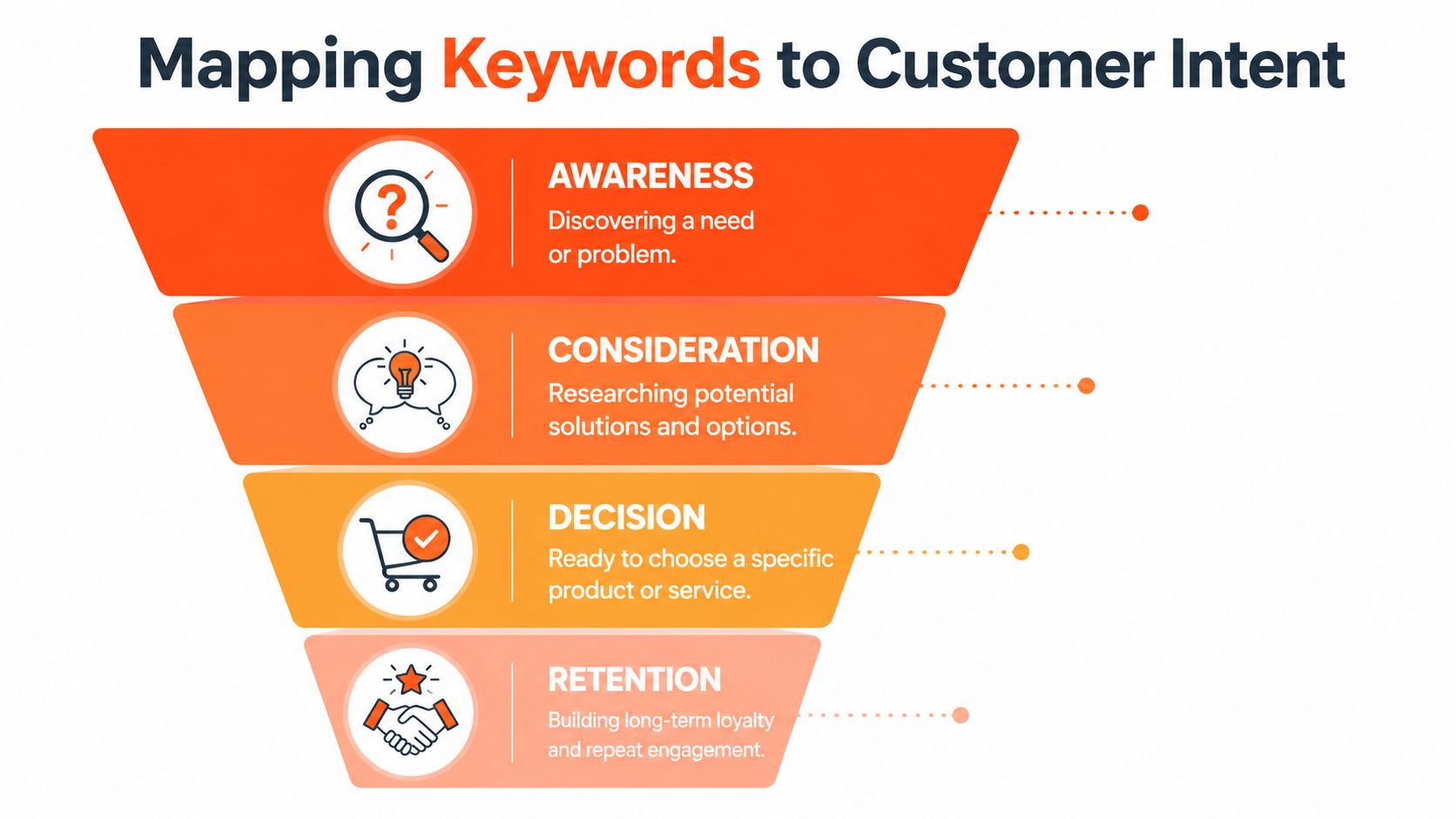
How to map intent to the customer journey
Keywords are often organised by volume. Better teams, however, organise them by journey stage and page type.
Use this working model:
- Awareness: Educational blogs, glossaries, explainers, problem-framing pages
- Consideration: Comparison pages, alternatives pages, “best for” content, use-case guides
- Decision: Service pages, category pages, product pages, demos, pricing, consultations
- Retention: Help content, onboarding content, support hubs, expansion pages
The mistake I see most in B2B is sending early-stage traffic to pages that ask for a demo too soon. The equivalent e-commerce mistake is pushing transactional keywords into blog content when a category page should own the term.
A practical mapping example
Here’s what intent mapping looks like in practice.
| Intent type | Example query style | Best page type | Conversion expectation |
|---|---|---|---|
| Informational | “how to improve product page SEO” | Blog or guide | Assisted conversion later |
| Navigational | “brand name seo services” | Branded page | High if brand demand exists |
| Commercial | “best seo agency for ecommerce” | Comparison or service explainer | Mid to high |
| Transactional | “seo agency melbourne quote” | Service or contact-led landing page | Highest immediate intent |
For local businesses and service brands, customer research sharpens this process fast. This guide on defining your target customer is useful because intent mapping gets much easier when you know the buyer’s pain points, objections, and buying language.
What AI changes in intent mapping
AI doesn’t replace intent strategy. It accelerates the messy parts. Use it to cluster thousands of keyword variations, detect modifiers that signal urgency, separate mixed-intent SERPs, and surface adjacent topics you might otherwise miss.
What still needs a human eye is the final sort. Some keywords look transactional but aren’t. Some look informational but sit inside a high-conversion path because they answer the last objection before purchase. That judgement call is where good strategy still beats automation.
Building a Durable Technical SEO Engine
A common scenario looks like this. The site has good pages, decent offers, and steady publishing, but revenue stalls because Google is crawling the wrong URLs, key templates load too slowly on mobile, and product or service pages never get the internal prominence they need. Technical SEO decides whether the rest of the strategy gets traction.
The pressure is higher now because AI-generated search features can reduce click-throughs before a user reaches your site. Google’s AI Overviews can cause a 34.5% CTR drop for affected pages, and 88% of organisations delay technical fixes, which leaves recoverable visibility on the table (SEOProfy). In practice, that means technical work needs an operating rhythm, not a backlog that sits untouched for a quarter.

Core Web Vitals need revenue-based prioritisation
Page speed work should start where slow templates suppress conversion or waste crawl activity.
For e-commerce, that usually means category pages, product pages, and cart-entry paths. For B2B, focus on service pages, solution pages, comparison pages, and high-traffic resources that feed qualified leads. For SMBs, mobile service and location pages usually carry the highest near-term return.
The fixes are rarely glamorous, but they are measurable:
- Heavy assets: Compress oversized hero images, replace unnecessary motion, defer non-essential scripts, and trim design elements that add weight without helping conversion.
- Third-party drag: Audit tags, chat widgets, A/B testing tools, heatmaps, and review apps. If a script does not support measurement, sales, or support, it should justify its cost.
- Template inefficiency: One bloated CMS template can weaken hundreds or thousands of URLs at once, which is why template-level fixes usually beat page-by-page cleanup.
- Rendering problems: JavaScript-dependent elements can delay indexing and create weaker page experiences on lower-end mobile devices.
Perfection is not the target. Pages need to load fast enough, remain stable enough, and stay usable enough to support both rankings and conversion.
Indexability determines whether your pages can earn traffic
If Google cannot crawl, render, and classify your important pages reliably, content production turns into cost with limited return. I see this often on large e-commerce catalogues with faceted navigation, multi-location SMB sites with duplicated service copy, and B2B sites where repeated CMS edits leave conflicting directives behind.
Start with four checks:
-
Crawl consistency
Confirm that high-value URLs return the right status codes, appear in XML sitemaps where appropriate, and are not blocked by robots directives, noindex tags, or inconsistent internal linking. -
Canonical logic
Faceted pages, duplicate product variants, tracking parameters, and campaign URLs can split authority or flood the index with low-value duplicates. -
Internal prominence
Important pages should be reachable through clear navigation and contextual links. If a revenue page is buried three layers deep or only accessible through site search, it sends a weak importance signal. -
Content uniqueness at template scale
A live URL is not always an indexable asset. Thin copy, near-duplicate headings, copied manufacturer descriptions, and boilerplate location content reduce the chance that a page earns stable visibility.
This is one of the clearest places where AI helps. Use it to scan title tags and headings for duplication, classify index bloat patterns, surface orphaned URLs from crawl exports, and prioritise fixes by page type instead of reviewing thousands of URLs manually. For teams building around AI search visibility as well as classic rankings, LLMrefs AI search strategies are useful for understanding how structured pages and entity clarity affect discovery beyond standard blue-link results.
Architecture and structured data shape how search engines interpret the site
Architecture is not just a UX concern. It determines how authority flows, how clearly topics relate to each other, and how easily a user can move from research to purchase or enquiry.
For e-commerce, that usually means a clean path from category to subcategory to product, with filters configured so they help shoppers without creating index bloat. For B2B, it means connecting service pages, industry pages, use cases, case studies, and supporting resources so the commercial path is obvious. For SMBs, simple relationships usually win. Service, suburb, and proof pages should reinforce each other without creating dozens of weak near-duplicates.
Schema adds another layer of clarity. Use product, service, FAQ, article, organisation, and local business markup where it matches the page. It will not fix weak positioning or poor copy, but it helps search engines interpret entities and page purpose more reliably. The same principle applies to on-page language. Clean structure and explicit wording improve machine understanding, which is one reason strong technical execution pairs well with disciplined SEO copywriting services.
Technical SEO works best as a system. Audit the site with crawlers and log data, use AI to cluster issue patterns and estimate impact, then push fixes by template and business value. That approach is faster than chasing isolated errors, and it produces clearer ROI across e-commerce revenue pages, B2B pipeline pages, and SMB lead-generation pages.
Developing an AI-First Content Strategy
Most content calendars are still built the old way. A keyword gets picked, a draft gets assigned, and everyone hopes the page will find a role later. That approach is too slow and too inconsistent for a modern strategy for seo.
The workable model is AI-assisted, human-refined content production. AI handles pattern recognition, clustering, SERP review, content gap analysis, internal link suggestions, and first-pass briefs. Humans handle differentiation, expertise, brand judgement, legal and factual checks, and conversion logic.

One reason this matters is simple. Businesses that maintain a blog generate 67% more leads than those that don’t, as noted in the earlier Lumar-cited data. The catch is that volume alone isn’t enough. More content only helps when the topics, structure, and internal linking support business intent.
Topic clusters only work when authority is earned
A topic cluster isn’t a fancy content map. It’s a way of proving depth around a commercial theme.
If you sell SEO for e-commerce, your cluster might include category page optimisation, product schema, collection page strategy, internal linking, and merchandising content. If you sell B2B lead generation, your cluster might centre on solution pages, industry-specific landing pages, comparison content, and pipeline-focused attribution.
E-E-A-T sharpens that system. A cluster earns authority when the content shows real experience, expert judgement, clear ownership, and trust signals. That means named authors where appropriate, original examples, current information, and content that reflects how the work is performed.
AI is useful here because it can spot gaps between your cluster and a competitor’s cluster far faster than manual review. It can also detect where you’ve overproduced informational content and underbuilt commercial support pages.
Where AI actually speeds things up
The strongest use case for AI in SEO content isn’t writing entire articles with one prompt. It’s reducing low-value manual labour.
Use AI to help with:
- Keyword clustering: Group search terms by intent, modifier, SERP overlap, and likely page type.
- Brief creation: Pull common subtopics, related entities, questions, and competitor patterns into a draft brief.
- Internal linking analysis: Identify orphan pages, weak anchors, and missed contextual links across a cluster.
- Content gap review: Compare your topical coverage against competing domains and flag missing assets.
- Refresh workflows: Summarise what changed in the SERP and what an ageing page now needs.
Where people still matter is the final output. AI can assemble. It can’t reliably prioritise nuanced objections from your sales team, decide whether a page should push conversion or education, or inject the kind of lived expertise that makes content trustworthy.
For teams adapting to AI-shaped search, these LLMrefs AI search strategies are a useful companion resource because they focus on visibility beyond classic blue-link rankings.
Human refinement is where conversion happens
A polished SEO article isn’t just ranked content. It’s content that moves the reader. That usually comes from editorial judgement and commercial context.
Writers need more than a target phrase. They need the buyer stage, the page’s job, the conversion action, the objections to answer, and the internal pages this asset should support. That’s why content operations improve when SEO and copywriting are treated together rather than as separate tasks. A good reference point is this overview of SEO and copywriting, which reflects the reality that rankings and persuasion have to sit on the same page.
Editorial standard: If AI helps create the first draft, a subject-matter expert or strategist still needs to tighten claims, sharpen positioning, remove generic phrasing, and make sure the page says something worth citing.
One practical note. There’s still a content gap in the market around AI-first execution. Mainstream guides explain evergreen SEO tactics, but they rarely show how AI should automate research, briefing, and competitive analysis in a way that shortens execution time without lowering quality. That’s exactly where disciplined teams can pull ahead.
Acquiring Authority with Modern Link Building
Link building still works. Bad link building still fails, sometimes slowly enough that teams confuse movement for progress.
The quality-first argument isn’t theoretical. 89% of SEO experts favour content outreach for acquiring backlinks, and the #1 result in Google averages 3.8 times more backlinks than results in positions 2 to 10, according to the Lumar-cited data noted earlier. The takeaway isn’t “get links at any cost”. It’s that authority still matters, and editorially earned links remain one of the clearest signals.
What doesn’t work well anymore
Buying random links, stuffing guest posts onto irrelevant sites, and chasing low-quality directories can still create a graph that looks busy. It usually doesn’t create durable ranking strength.
These tactics fail for practical reasons:
- Poor relevance: A link from an unrelated site sends a weak contextual signal.
- Weak trust: Pages built only to publish outbound links rarely help long term.
- No brand effect: If nobody would cite the placement outside SEO, it’s probably not doing much for authority either.
I’ve seen sites with hundreds of links and almost no ranking resilience because the links weren’t attached to strong pages, relevant topics, or a credible brand narrative.
What earns links that keep helping
Modern link acquisition works best when it starts with an asset worth referencing. That might be a strong guide, original perspective, a useful tool, a data-led page, a local resource, or a clear thought-leadership piece.
A practical mix usually includes:
-
Digital PR
Create something newsworthy or comment on a topic with real expertise. This suits B2B and larger brands especially well. -
Unlinked brand mention reclamation
If people already reference your brand without linking, reclaiming those mentions is often more efficient than cold outreach. -
Broken link building
Find dead resources in your topic area and offer a better replacement where it’s relevant. -
Relationship-based outreach
Partner content, expert contributions, podcasts, associations, and industry communities often produce stronger links than mass email blasts.
If you want a broader tactical menu, NameSnag's link building guide is a practical resource because it lays out multiple ethical approaches rather than pretending one tactic fits every site.
One relevant editorial link to a page with real commercial value can outperform a pile of easy links pointed at content nobody revisits.
Matching link strategy to business type
E-commerce sites often do well with product-led resources, gift guides, category explainers, and manufacturer or partner relationships. B2B firms usually benefit from expert commentary, original opinion pieces, comparison assets, and ecosystem partnerships. SMBs tend to get better returns from local citations, community relevance, service-area mentions, and local PR than from chasing national publications too early.
The trade-off is speed versus durability. Cheap links feel faster. Earned links take more work. But earned links keep helping because they tend to sit on real pages, inside real editorial context, attached to a believable brand.
Measuring SEO Success and Integrating with PPC
A familiar scenario plays out in search programs. Organic traffic rises, the report looks healthy, and revenue stays flat because growth came from low-intent pages while high-value pages stalled.
Measurement needs to follow business outcomes, not activity.
The KPI set should match the model. E-commerce teams should track revenue by landing page, assisted conversions, and return on ad spend trends across paid and organic. B2B teams should track qualified leads, cost per lead, pipeline influence, and sales acceptance of organic leads. SMBs usually need a tighter view: calls, form fills, booked jobs, and lead quality by location or service line.
An AI-first SEO program improves the speed and accuracy of this work. AI can classify queries by intent, group landing pages by funnel stage, flag ranking gains on pages with no conversion lift, and surface PPC terms that deserve SEO investment. That shortens the gap between reporting and action.
Build a Dashboard People Use
A useful dashboard stays small. It should answer four questions clearly:
| Question | Useful metric | Why it matters |
|---|---|---|
| Are we getting found? | Impressions, ranking distribution, click-through trends | Shows visibility movement |
| Are the right pages growing? | Landing page sessions by page type | Separates commercial pages from vanity traffic |
| Is traffic turning into business? | Leads, sales, assisted conversions | Connects SEO to outcomes |
| Are paid and organic informing each other? | Query overlap, conversion terms, page performance | Improves channel efficiency |
Keep branded and non-branded performance separate. Segment by page type and intent. Review changes at the query level before changing strategy. A site can gain traffic while the pages that drive margin, demos, or booked jobs do nothing.
The reporting view should also reflect the company’s sales motion. E-commerce teams often need category, product, and promo page reporting. B2B teams usually need content grouped by buying stage, not just by URL. SMBs need service-area clarity because one city can produce strong lead quality while another burns budget.
SEO and PPC work better as one search system
Paid search gives fast signal. SEO builds durable coverage around what proves its value.
That matters because PPC often reveals intent faster than organic alone. Teams can see which queries close, which offers attract weak leads, which locations underperform, and which landing pages create friction after the click. SEO can then prioritize pages, clusters, and internal linking around terms with proven commercial value instead of relying on volume estimates.
The loop should run both ways. Organic performance often surfaces rising themes, informational paths that assist conversion, and long-tail demand that paid teams can test with controlled budgets. For an AI-first agency, this is one of the clearest operating advantages. AI can cluster search terms across both channels, identify query overlap, detect wasted spend where organic already wins, and recommend where paid coverage should fill gaps while SEO matures.
A shared reporting setup helps teams work from the same facts. GA4, Search Console, Google Ads, Looker Studio, and agency reporting platforms can pull SEO and PPC data into one view so teams can compare intent, landing page value, and conversion quality without splitting analysis across disconnected tools.
A strong strategy for seo treats search as one acquisition system with different time horizons.
If you want a search strategy that connects technical SEO, AI-assisted content, link acquisition, and PPC data into one measurable growth model, Click Click Bang Bang can help you build it around the outcomes that matter to your business.
Read NeXt
Or Read Our Latest
- How to Calculate Sample Size for A/B Tests and Campaigns
- How to Fix Google Merchant Center Errors Step by Step
- What Is Pagination and Why It Matters for AU Sites
- What Is Value Proposition? PPC & SEO Guide
- How to Choose a Google Ads Agency Australia
- Influencer Collaboration Playbook for E-Commerce & B2B
Click. CLick. Subscribe.
Get our best PPC insights, industry updates, and power moves delivered straight to your inbox. No fluff, just high-caliber strategies that actually work.
Don’t Leave Just Yet
Try Us For 30-Days,
Risk Free!!
We guarantee that you’ll love our work within the first 30 days, if not you’ll get your money back.
What have you got to lose?