

Lead Gen SEO (lead gen seo): 2026 Playbook to Turn Traffic Into Qualified Leads
Last Updated

When people talk about SEO for lead generation, they're not just talking about getting more eyeballs on your website. That's the old way of thinking. True lead gen SEO is a completely different game. It’s about methodically attracting high-intent visitors—the ones actively looking for your solutions—and converting them into qualified leads.
Done right, it turns your organic search traffic into a predictable, reliable pipeline for your business.
The New Rules of Lead Generation SEO

Forget the old playbook of just chasing higher traffic numbers. Modern SEO for lead generation is all about attracting qualified prospects who are actually ready to talk, not just random visitors who bounce. Recent Google algorithm shifts have only hammered this point home, rewarding valuable, user-focused content and penalising thin, keyword-stuffed pages.
A successful strategy today is built on quality over quantity. It’s less about one-off tactics and more about creating a system that turns a simple search into a real business opportunity.
The Core of a Modern Lead Gen Strategy
An effective lead gen SEO program really comes down to mastering three interconnected parts. Get these right, and you'll have a machine that consistently generates high-quality leads.
-
Mapping User Intent: This is about getting inside your audience's head. You need to deeply understand what they’re really looking for at each stage of their journey and align your content with their specific questions, pain points, and goals.
-
Creating High-Value Content: Your content is the engine. It must solve problems, answer questions, and build trust with your audience. This is what attracts prospects in the first place and proves you know what you’re talking about.
-
Optimising for Conversion: Every single element on your page—from the headline to the call-to-action—needs to gently guide the user toward becoming a lead. It’s about making that next step obvious, easy, and compelling.
The goal isn't just to rank anymore. It’s to rank for the right searches and deliver an experience that naturally encourages people to take the next step. Think of it as building a digital salesperson that works for you 24/7.
To stay competitive, you also have to keep an eye on how new technology is changing the game. For a closer look at this, exploring how businesses are leveraging AI for lead generation offers some fantastic insights into where things are heading.
By weaving these elements together, you build a seamless funnel that moves prospects from awareness to action, fuelling sustainable growth for your business.
Mapping Your Customer Journey and Keyword Strategy
Effective lead generation SEO isn't about throwing everything at the wall to see what sticks. It's about precision. It all starts with getting inside your customer's head to understand exactly who you're trying to attract and what path they take from having a problem to choosing a solution.
Before you even touch a keyword research tool, you need to build out your buyer personas. These aren't just vague descriptions; they're detailed profiles of your ideal customers, built from real data and market research. Give them a name, a job title, goals, and most importantly, the specific pain points you can solve. If you're starting from scratch, our guide on how to define your target customer is a great place to begin.
Once you know who you're talking to, you can map their journey.
Aligning Keywords with the Buyer's Journey
The buyer's journey is the perfect framework for organising your keyword strategy. It’s typically broken down into three stages, and each one has a totally different user intent and, therefore, a different type of keyword.
Stage 1: Awareness (Top of Funnel)
At this point, your prospect knows they have a problem, but they might not have the right words for it yet. They’re looking for information, education, and answers. Your job is to show up as the helpful expert, not a salesperson.
- Intent: Purely informational. They’re using broad, problem-focused search terms.
- Keyword Examples: "why is my sales pipeline empty," "how to improve lead quality," "signs of a bad marketing strategy."
- Your Goal: Attract them with educational content like blog posts, comprehensive guides, and articles that address their pain points without a hard sell.
Stage 2: Consideration (Middle of Funnel)
Now, your prospect has put a name to their problem and is actively researching solutions. They're weighing up different approaches, methods, and types of providers to see what fits best.
- Intent: Commercial investigation. They’re using keywords that compare options and solutions.
- Keyword Examples: "lead generation services vs in-house," "best CRM for small business Australia," "HubSpot alternatives."
- Your Goal: Nurture that interest with more in-depth content. Think detailed case studies, comparison guides, and webinars that prove your expertise and showcase how your solution works.
Stage 3: Decision (Bottom of Funnel)
Finally, the prospect has settled on a solution and is now looking for the right company to partner with. Their searches become highly specific and signal a clear intention to buy.
- Intent: Transactional. These are the "money" keywords, showing someone is ready to convert.
- Keyword Examples: "SEO agency for B2B quote," "local SEO services Sydney," "hire PPC expert Melbourne."
- Your Goal: Make it easy for them to choose you. This is where you capture the lead with perfectly optimised service pages, clear pricing, and compelling calls-to-action.
The real magic of lead gen SEO happens when you create content for every stage. You build trust at the top, prove your value in the middle, and make it a no-brainer for them to choose you at the bottom.
Finding and Prioritising Your Keywords
With your journey map complete, your keyword research becomes far more targeted and effective. Use your preferred SEO tool to brainstorm seed keywords based on your persona’s problems, then expand on those ideas for each stage of the funnel.
And don't just think about single words. The Australian digital environment is being heavily shaped by mobile and voice search. A staggering 57% of Australians now use voice search. Couple that with the fact that over 57% of local searches happen on mobile devices, and you can see why long-tail, conversational keywords are more critical than ever.
When you consider that 60% of mobile users will click-to-call a business directly from the search results, optimising for queries like "emergency plumber near me open now" becomes a direct line to a paying customer. To stay ahead, you can find more of the latest trends in these local SEO statistics from Rankmax.
A keyword map is a practical way to keep all this organised. A simple spreadsheet is all you need.
| Target Page URL | Primary Keyword | Funnel Stage | User Intent | Secondary Keywords |
|---|---|---|---|---|
| /blog/improve-sales-pipeline | how to improve sales pipeline | Awareness | Informational | sales pipeline problems, fixing lead flow |
| /services/seo-agency | b2b seo agency | Decision | Transactional | seo company for tech, get seo quote |
| /case-studies/client-x | [brand] case study | Consideration | Commercial | [brand] results, [brand] testimonials |
By mapping keywords to specific pages and user intent, you’re not just chasing rankings—you’re building a cohesive strategy. This ensures every piece of content you create has a clear purpose in your lead generation engine, guiding prospects smoothly from their first search all the way to becoming a valued customer.
Creating High-Conversion Content and Lead Magnets
Once you’ve mapped your keywords to the customer journey, the real work begins: creating the actual content that pulls prospects in, keeps them engaged, and ultimately converts them into leads. Lead generation SEO isn’t just about ranking; it's about building assets that serve a very specific purpose at each stage of the funnel, guiding people from casual interest to genuine sales-readiness.
Forget just targeting keywords. Your focus should be on solving the real-world problems your audience is searching for. This is how you build authority and earn their trust long before they’re even thinking about buying.
Aligning Content Types to the Funnel
The kind of content someone wants depends entirely on where they are in their buying process. Someone at the top of the funnel needs education and awareness, not a hard sales pitch. In contrast, someone at the bottom needs clear confirmation and a frictionless path to take action.
-
Top of Funnel (Awareness): Your goal here is to attract a broad audience by addressing their initial problems and questions. Think comprehensive "how-to" guides, data-backed blog posts, and insightful articles that provide immediate value. A marketing agency, for example, might write a post like "10 Reasons Your Sales Pipeline is Empty" for this stage.
-
Middle of Funnel (Consideration): Now it’s time to nurture the interest you’ve captured. Prospects here are actively comparing solutions. This is the perfect spot for insightful case studies showing real results, webinars that demonstrate your expertise, or detailed comparison guides. A great MoFu piece could be a webinar titled, "Choosing the Right Lead Gen Channel: SEO vs. PPC."
-
Bottom of Funnel (Decision): This is where you turn interest into a lead. The content needs to be direct, compelling, and built for conversion. This means optimising your service pages with sharp value propositions, creating detailed product or service comparison pages, and making it incredibly easy to get in touch. We're talking pages like "Get a Custom SEO Quote" or "Book a Free Strategy Call."
This visual shows how mapping your persona and their journey ties directly into your keyword and content strategy.
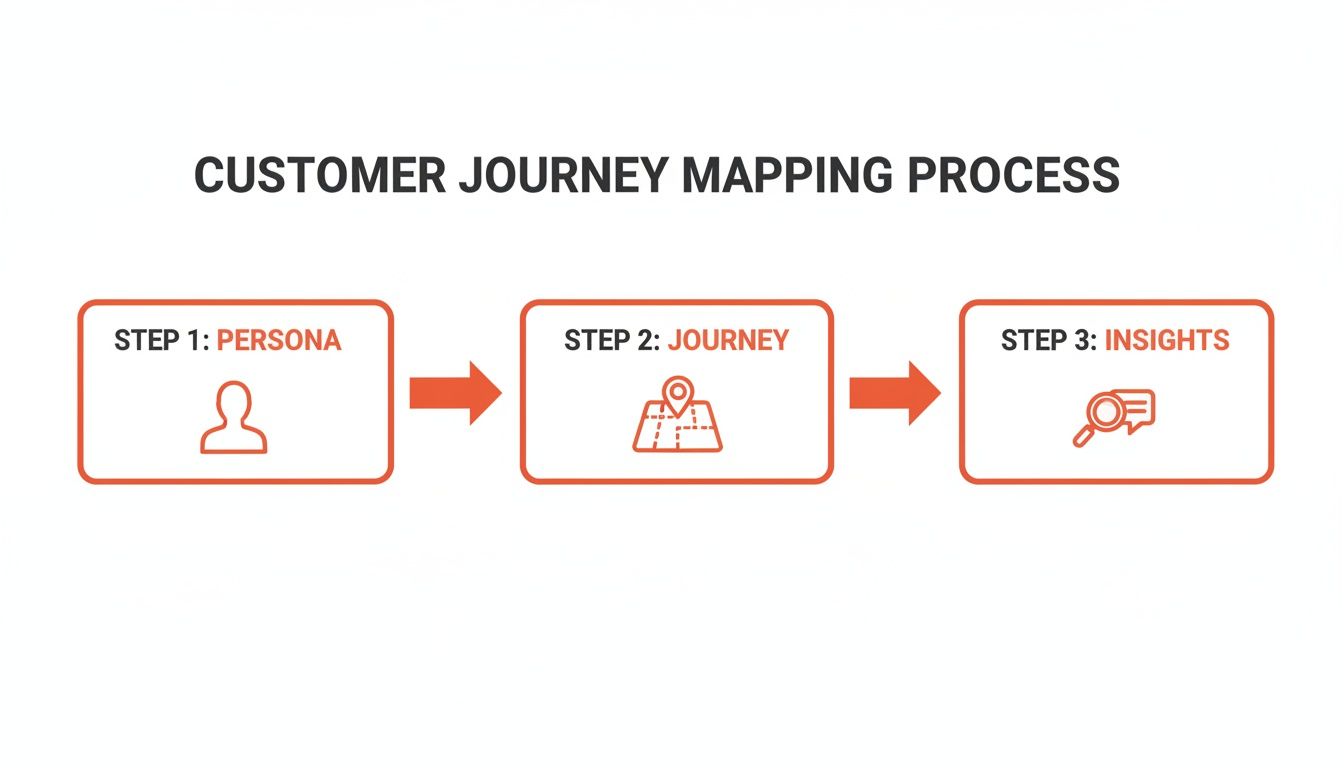
As you can see, a solid plan starts with understanding the persona, mapping their journey, and only then selecting the right content and keywords for each stage.
To help you visualise this, the table below breaks down how different content types and lead magnets align with each funnel stage.
Content and Lead Magnet Funnel Alignment
| Funnel Stage | User Intent | Content Type Example | Lead Magnet Example |
|---|---|---|---|
| Top of Funnel | "I have a problem and need to understand it." | Blog Post: "Why Is My Website Not Generating Leads?" | Checklist: "The 10-Point Website Health Checklist" |
| Middle of Funnel | "I need to compare different solutions for my problem." | Case Study: "How We Increased a Client's Leads by 200%" | Template: "Free Lead Gen Funnel Planning Template" |
| Bottom of Funnel | "I'm ready to choose a solution or provider." | Service Page: "Our SEO for Lead Generation Services" | Offer: "Book a Free 30-Minute Strategy Session" |
This framework ensures you have a logical progression, offering the right value at the right time to move prospects smoothly towards becoming a lead.
Developing Irresistible Lead Magnets
A lead magnet is the critical bridge between your content and a conversion. It's a valuable piece of gated content you offer in exchange for a prospect's email address or other contact details. To actually work, it needs to offer a quick, tangible win that’s directly related to the content they’re already consuming.
Let’s be honest, generic offers like "subscribe to our newsletter" are dead. Your lead magnet has to be specific and highly desirable.
Here are a few powerful lead magnet ideas that deliver real value:
- Checklists: "The 15-Point Pre-Launch SEO Checklist"
- Templates: "Free Content Calendar Template for Google Sheets"
- Exclusive Reports: "The 2026 State of B2B Lead Generation"
- Cheat Sheets: "A One-Page Google Analytics 4 Event Cheatsheet"
The best lead magnets solve a small, specific piece of the larger problem your main content addresses. If your blog post is about "how to build a better landing page," your lead magnet could be a "High-Conversion Landing Page Template." This creates a seamless and logical next step for the user, making the conversion feel natural.
Strategic Placement of Calls-to-Action
Your Calls-to-Action (CTAs) are the signposts that tell your visitors what to do next. Without clear CTAs, even the best content and lead magnets will fail to generate leads. The key is to place them strategically where they make sense, without being pushy or disruptive.
Here are a few common spots to place your CTAs for maximum impact:
- In-line Text: Hyperlinked text within a paragraph is perfect for linking to related content or a lead magnet in a natural, contextual way.
- End of Post: A prominent banner or button at the end of an article is a classic for a reason. It captures the reader’s attention right after they’ve finished consuming your content.
- Slide-in Box: A small box that appears as users scroll down the page can offer a lead magnet without completely interrupting the reading experience.
- Header/Footer Bar: A persistent bar at the top or bottom of the screen is great for promoting a high-value, site-wide offer, like a webinar or a free trial.
Ultimately, your goal is to make the conversion path feel like a natural extension of the user's journey. For instance, after reading an in-depth blog post, a visitor might be primed and ready for a more detailed resource. If you're building out pages specifically for conversion, our guide on how to create a landing page provides an excellent framework to follow.
By combining valuable content, irresistible lead magnets, and smart CTAs, you create a powerful system for turning passive readers into active, qualified leads.
Technical SEO and On-Page Optimisation for Leads
You can have the best content and the smartest keyword strategy in the world, but they won't generate a single lead if search engines can't find, crawl, and make sense of your website. This is where technical and on-page SEO come in. These are the behind-the-scenes optimisations that get your lead generation content seen by the right people and ensure they have a great experience when they arrive.
Think of it like this: your content is the star performer, but technical SEO builds the stage, rigs the lights, and opens the doors to the audience. Without it, your show plays to an empty house. For SEO lead generation to really work, both elements need to be perfectly in sync.
On-Page Essentials for Higher Conversions
On-page SEO is all about optimising the individual elements on your actual pages. These signals are what help Google figure out what your content is about and whether it’s relevant to a search. More importantly, they’re your first chance to win a lead right there in the search results.
-
Optimised Title Tags and Meta Descriptions: Your title tag is the very first thing a potential lead sees in Google’s search results. It needs to be compelling. Include your main keyword, for sure, but also add a clear benefit that makes someone want to click. A meta description won't directly boost your rankings, but a persuasive one acts like ad copy, convincing a searcher to choose your link over a competitor's.
-
Logical Heading Structure: Use headings (H1, H2, H3) to give your content a clear, logical structure. You should only ever have one H1—that's your main page title. Then, use H2s and H3s to break down the content into bite-sized, scannable sections. This not only makes the page easier for people to read but also gives search engines critical context about what’s important.
-
Strategic Internal Linking: Think of internal links as pathways guiding both users and search engine crawlers through your site. A well-placed link from a high-traffic blog post to a relevant, bottom-of-funnel service page does two things: it passes SEO authority to the more valuable page and, crucially, it moves interested prospects closer to the point of conversion.
The Technical Foundation for a Strong User Experience
Technical SEO is about making sure your website is structurally sound. These elements are non-negotiable because they have a massive impact on how both users and search engines see your site's quality and usability. A slow, clunky website will send potential leads running for the "back" button before they even see what you have to offer.
The need for a solid technical and on-page foundation has never been more apparent, especially in Australia. SEO for lead generation in Australia reached a turning point with the 2025 Google Core Update, which heavily penalised sites with thin, repetitive content. This was a clear signal that prioritising content depth and site credibility is essential for surviving algorithm updates and keeping your lead flow steady. You can read more about the impact of recent Google updates on ROI.com.au.
A strong foundation helps you avoid these kinds of penalties. Here are the must-haves:
-
Mobile-First Design: The majority of searches now happen on a smartphone, so your site absolutely has to look and work flawlessly on mobile. Google now primarily uses the mobile version of your site for indexing and ranking, making a responsive, mobile-first design essential for even being visible.
-
Lightning-Fast Site Speed: Page speed is a confirmed ranking factor, and for good reason. A site that loads in under two seconds is the goal; any longer and you risk users bouncing straight back to the search results. Key actions here include compressing your images, using a content delivery network (CDN), and getting your developers to optimise the site’s code.
-
Schema Markup Implementation: Schema is a type of code you add to your site to give search engines a deeper understanding of your content. This can earn you "rich snippets" in the search results, like star ratings, pricing, or FAQ dropdowns. For lead generation, FAQ and How-to schema are especially powerful. They make your listing stand out, take up more space on the results page, and capture more clicks from qualified prospects.
One of the biggest mistakes I see is businesses treating technical and on-page SEO as a one-and-done checklist. It’s an ongoing process. Every time you add new content or Google tweaks its algorithms, you need to be auditing and refining these elements to protect and grow your lead flow.
Tapping Into Local SEO to Win High-Intent Leads
If your business serves a specific geographic area, some of your most valuable leads are right in your own backyard. This is where local search engine optimisation isn't just a tactic; it's an absolute powerhouse for lead generation. It puts you in front of customers the very moment they’re searching for your services nearby.
Unlike broader SEO strategies, local SEO hones in on visibility within a defined service area, creating a direct line to immediate sales opportunities. Think about it. A search for "emergency plumber Sydney" isn't someone casually browsing—it’s a cry for help from a customer who is ready to hire, right now.
Your Google Business Profile Is Your Digital Front Door
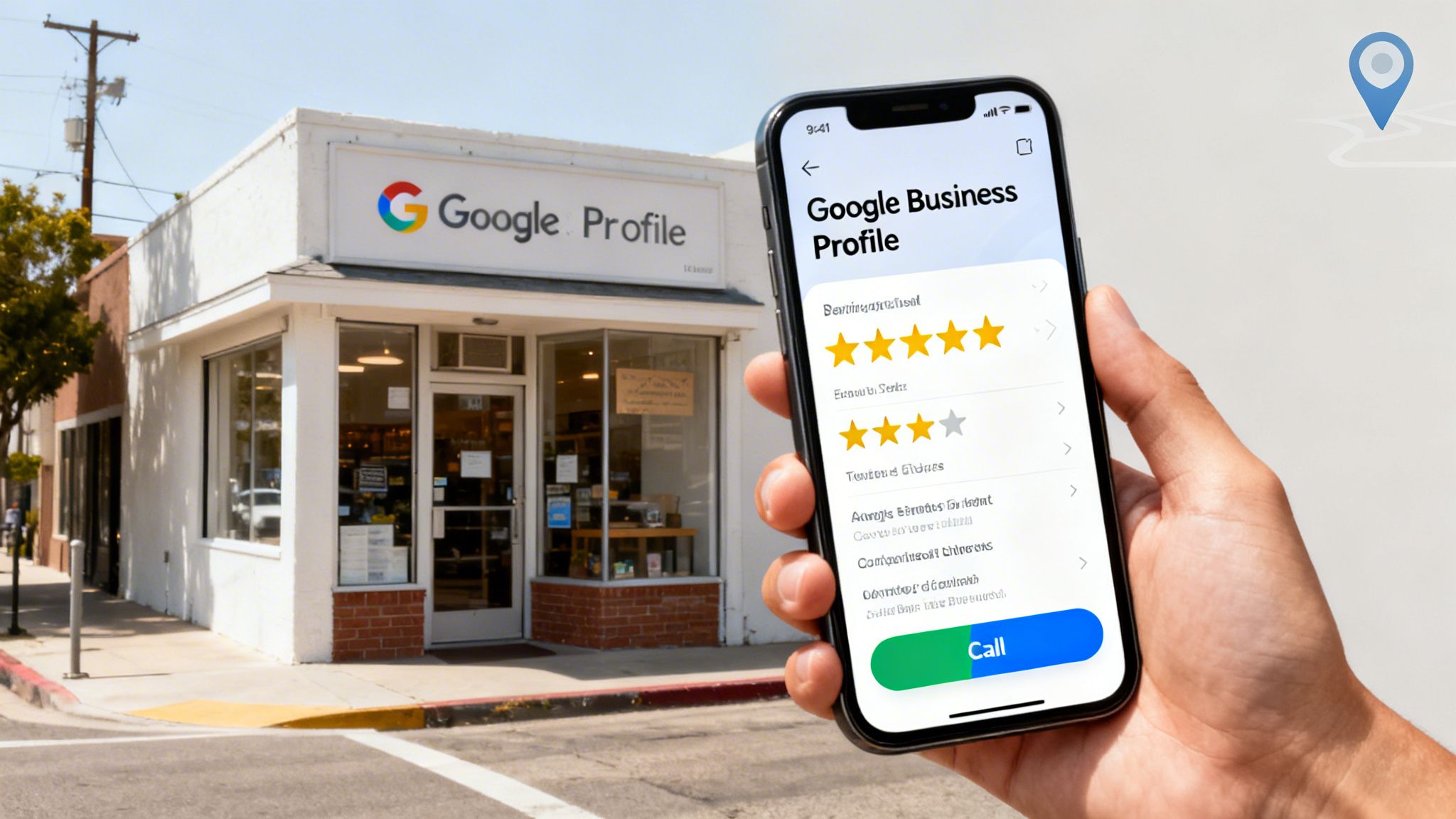
Your Google Business Profile (GBP) is the cornerstone of your entire local SEO strategy. For many potential leads, it’s the very first interaction they’ll have with your business, serving as a digital storefront directly within Google Search and Maps. Just having a profile isn't enough; you need to actively manage and optimise it to truly stand out.
A fully fleshed-out profile gives both Google and your customers confidence in your business. Here’s what to get right:
-
Nail Your Categories: Choose the most specific primary category you can (e.g., "Plumber" instead of the generic "Home Services"). Then, add every relevant secondary category to cast a wider net and capture related searches.
-
Craft a Compelling Description: Don't waste the character count. Tell your story, clearly stating what you do, who you serve, and what makes you different. This is the perfect place to naturally weave in your core local keywords.
-
Get Proactive with Q&As: Don’t wait for customers to ask questions. Seed the Q&A section yourself with the most common queries you get. This lets you control the narrative and provide helpful, keyword-rich answers from the get-go.
Build Local Trust Signals That Google Loves
Beyond your GBP, Google is on the lookout for consistent signals about your business from all corners of the web. This is where local citations and customer reviews come into play, building a web of trust around your brand that reinforces your local authority.
In the Australian market, local SEO is a massive channel for lead generation. A staggering 46% of all Google searches in Australia now have local intent. Nailing a top spot in these local searches can capture 24.4% of all clicks, and even more importantly, 28% of those searches result in a purchase. This data underscores how critical a meticulous strategy is, especially considering the average local SEO campaign takes around 4.76 months to become ROI-positive. You can dig into more of these valuable local statistics on this in-depth post from Safari Digital.
To tap into this powerful channel, you need to focus on two key areas:
-
Consistent NAP: Your Name, Address, and Phone number (NAP) must be identical everywhere it appears online. From your website to major directories like Yellow Pages and niche industry sites, any inconsistency can confuse search engines and erode the trust you’re trying to build.
-
Encourage Customer Reviews: Positive reviews are not just powerful social proof; they're a known ranking factor. Make it a habit to actively request reviews from happy customers. This builds credibility and helps your GBP listing pop in a crowded search result.
A common mistake we see is businesses creating dozens of near-identical "service-in-suburb" pages. The December 2025 Google Core Update heavily penalised this thin content tactic. Instead, focus on creating unique, high-value location pages that offer genuinely useful, suburb-specific information, case studies, or testimonials. Quality will always win over quantity.
Measuring Success and Scaling Your Lead Generation Engine
An SEO lead gen program that just runs on autopilot is a program destined to fail. It's not a "set and forget" channel; it’s a living, breathing engine that needs constant monitoring and fine-tuning.
If you aren't measuring what you're doing, you’re essentially flying blind. You have no real way of knowing which efforts are paying off, which are falling flat, and where your next big opportunity might be hiding. This is where we move beyond vanity metrics like keyword rankings and start zeroing in on the numbers that actually grow the business.
Key Performance Indicators for Lead Gen SEO
To get a clear picture of how your SEO is performing, you need to track a specific set of Key Performance Indicators (KPIs). These metrics are your feedback loop, giving you the data you need to make smart, informed decisions.
Your core focus should be on these four metrics:
-
Conversion Rate: This is the gold standard. It’s the percentage of your organic search visitors who take a desired action—like filling out a contact form or downloading a guide. It tells you how well your content is actually resonating with the right people.
-
Cost Per Lead (CPL): While organic traffic is often called "free," we know it’s not. Your investment in content, tools, and time has a real cost. To figure out your CPL, divide your total SEO-related expenses by the number of leads generated. This tells you the true cost of acquiring a lead through SEO.
-
Lead Quality Score: Let's be honest, not all leads are created equal. You need to work with your sales team to define what a "qualified lead" looks like for your business. Then, you can track how many of these high-quality prospects your SEO efforts are bringing in.
-
Goal Completions (by channel): Dive into Google Analytics and track how many leads are directly coming from the organic search channel. This helps you isolate the impact of your SEO work from other marketing channels.
Monitoring these KPIs helps you ask better questions. Is that high-traffic blog post actually a dud because its conversion rate is near zero? Is a page with modest traffic secretly your best performer because it’s bringing in your highest-quality leads? For a deeper dive, our guide on website conversion tracking will walk you through setting up the right measurement systems.
Don’t get lost in "analysis paralysis." Start with these core metrics. You can always add more complex layers as your program matures, but these four will always be the bedrock for measuring your lead gen success.
Analysing Data and Scaling What Works
Once you have accurate tracking in place, your data will start to tell a story. Google Analytics 4 (GA4) and Google Search Console are your go-to tools here. You're looking for patterns. Which content pieces are driving the most form submissions? Which service pages are converting visitors into leads most effectively?
When you spot your top performers, it's time to double down. That usually means a few things:
- Expand on Winning Topics: If your in-depth guide to "B2B SaaS marketing" is a lead-generation machine, don't stop there. Create a series of posts that dive deeper into related sub-topics. You've found a goldmine, so keep digging.
- Optimise High-Potential Pages: Find those pages that get a lot of traffic but have a disappointing conversion rate. This is a huge opportunity. A/B test different headlines, calls-to-action (CTAs), or even offer a new lead magnet to see if you can lift performance.
- Build Links to Converting Pages: Funnel your link-building efforts towards the pages that are already proven lead generators. Boosting their authority will only increase their visibility and bring in even more of the right kind of traffic.
Scaling also means getting smarter about how you handle the leads coming in. A critical piece of this is learning how to effectively qualify sales leads, which ensures your sales team isn’t wasting time on prospects who aren’t a good fit.
By continuously analysing your data, refining your approach, and scaling what works, you’ll transform your SEO from a simple marketing tactic into a predictable, sustainable lead generation engine for your business.
Frequently Asked Questions About Lead Gen SEO
When you're diving into SEO for lead generation, a few questions always pop up. We get it. Here are some straight answers to the most common queries we hear from clients, designed to give you clarity and help you move forward.
How Long Does Lead Gen SEO Take to Work?
Everyone wants to know the timeline. While you might see some small wins from on-page tweaks within one to three months, a proper lead gen SEO strategy needs time to build momentum.
Realistically, you should expect to wait four to six months before you see significant, sustainable results. This isn't a switch you can flip overnight; it's a long-term investment in building a valuable business asset.
Your specific timeline will hinge on a few key variables:
- Industry Competition: Are you up against a handful of local competitors or a dozen established national players?
- Website Authority: Is your domain brand new, or does it already have some history and authority with Google?
- Consistency: Are you consistently publishing quality content and building links, or is it a stop-start effort?
For local businesses, Australian data shows it takes an average of 4.76 months to see a positive return on investment from SEO. The takeaway is to treat it like building a house, not ordering a pizza.
What Is the Difference Between SEO for Traffic and SEO for Leads?
The core difference is the goal. SEO for traffic is a volume game. The aim is to attract the largest possible audience, often by targeting broad, high-volume keywords. It's all about getting more eyeballs on the site, regardless of whether those visitors are ready to buy.
Lead gen SEO is far more surgical. It focuses on attracting a qualified audience—the right people, not just more people. This means targeting keywords with clear commercial or transactional intent, where the searcher is actively looking for a solution you provide.
This approach requires content tailored to every stage of your sales funnel, with each page optimised for a specific conversion point. It's a fundamental shift from chasing quantity to capturing quality.
Can I Do Lead Gen SEO Myself or Do I Need an Agency?
You can absolutely get the ball rolling on your own. For small businesses on a tight budget, tackling the fundamentals like basic on-page optimisation, keyword research for blog posts, and creating your first few pieces of content is a great starting point.
However, once you start aiming for serious growth and want to compete for high-value keywords, the complexity ramps up fast. This is where an agency brings specialised expertise that's tough to replicate in-house.
An agency accelerates your results in a few critical areas:
- Technical SEO: Navigating the tricky stuff like site speed, schema markup, and constant algorithm updates.
- Competitive Analysis: Using advanced tools to uncover strategic gaps your competitors have missed.
- Strategic Link Building: Earning the high-authority backlinks you need to rank, and doing it at scale.
Ultimately, hiring an agency isn't just about outsourcing tasks. It’s about letting experts build and manage a powerful lead generation engine while you focus on what you do best—running your business.
Ready to stop chasing traffic and start capturing qualified leads? The team at Click Click Bang Bang builds precision-driven SEO and PPC campaigns that deliver real business growth. Find out how we can help by visiting us at https://clickclickbangbang.com.au.
Read NeXt
Or Read Our Latest
- Manual vs Automated Bidding for PPC Success
- Conversion Tracking Setup: A Complete AU Guide
- Instagram Advertising Australia: Complete 2026 Guide
- Pay Per Click: A Beginner’s Guide for Australian Marketers
- Display Advertising on Google: The Complete Australian Guide
- Stakeholder Communication Plan How to Build One That Works
Click. CLick. Subscribe.
Get our best PPC insights, industry updates, and power moves delivered straight to your inbox. No fluff, just high-caliber strategies that actually work.
Don’t Leave Just Yet
Try Us For 30-Days,
Risk Free!!
We guarantee that you’ll love our work within the first 30 days, if not you’ll get your money back.
What have you got to lose?