

A Modern Guide to Lead Generation Digital Marketing
Last Updated
At its heart, lead generation in digital marketing is all about sparking interest from potential customers and pulling them into your sales pipeline. It's a deliberate strategy that uses online channels to turn complete strangers into genuine prospects who are actually interested in what you have to offer.
What Is Modern Lead Generation
Let's get one thing straight: this isn't about just hoarding a list of email addresses anymore. Modern lead generation is far more sophisticated. Think of it as your business's digital matchmaker, connecting you with people who are already out there looking for the exact solutions you provide—often long before they're even thinking about making a purchase.
This process goes way beyond simple contact collection. It’s about carefully designing a journey that guides a curious visitor from their first moment of awareness all the way to becoming a loyal, paying customer. It's about building real trust and proving your value every step of the way.
The Core Process of Attracting Customers
To really get your head around modern lead generation, it helps to understand the full system for how to generate business leads and drive sales. The whole thing can be broken down into four key stages that work together to create a predictable flow of potential customers for your business.
- Attract: This is the top of your funnel, where the goal is to draw in your ideal audience with genuinely helpful content. This is where strategies like search engine optimisation (SEO), blogging, and social media marketing shine, answering the questions your prospects are asking.
- Capture: Once you’ve got their attention, the next job is to capture their information. This usually means offering something valuable—a free guide, a webinar seat, or a special discount—in exchange for their contact details. This is the moment anonymous traffic becomes an identifiable lead.
- Nurture: Most leads aren't ready to buy straight away. The nurturing phase is where you build a relationship through targeted communication, like a smart email marketing sequence. You stay top-of-mind and gently guide them closer to making a decision.
- Convert: This is the final step where a warmed-up lead becomes a customer. A compelling offer, a sales call, or a targeted promotion provides that last little nudge they need to make the purchase.
This diagram shows how these four stages—Attract, Capture, Nurture, and Convert—fit together in the modern lead generation process.
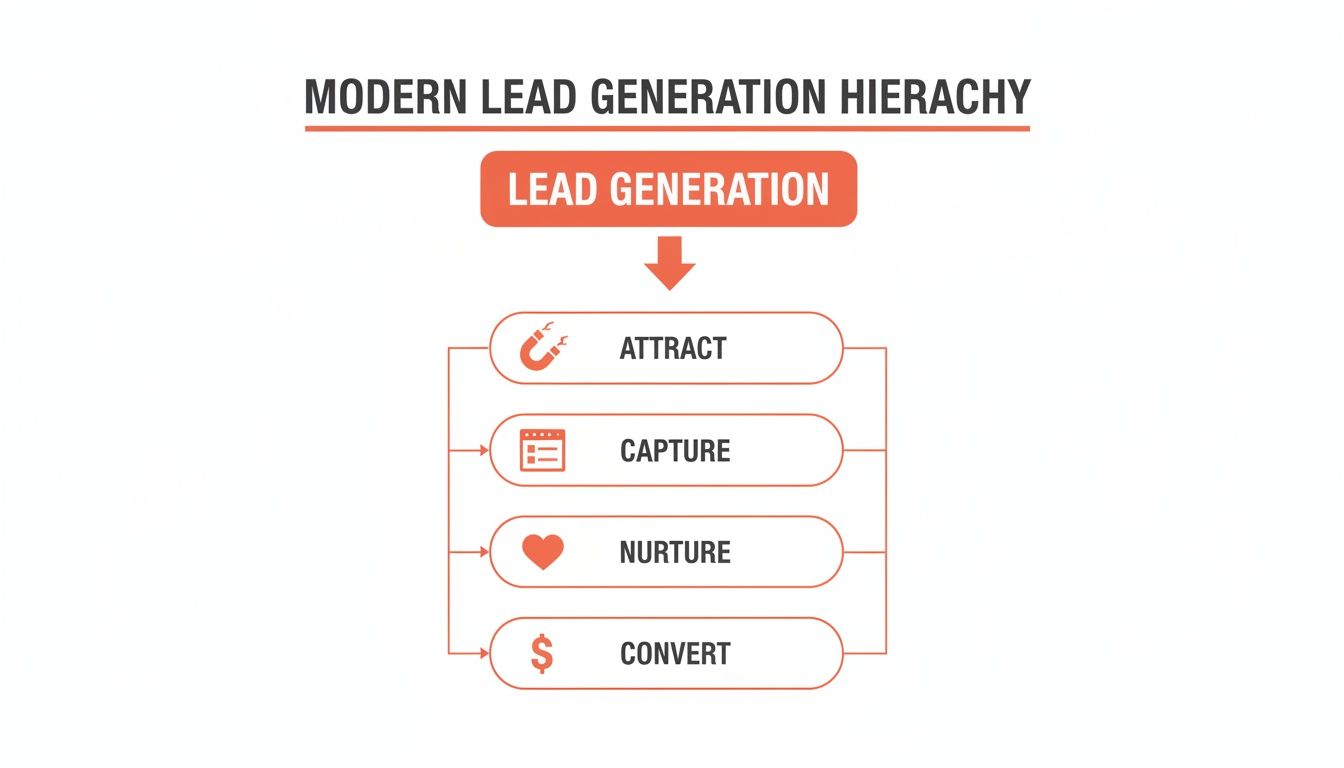
As you can see, each step is a critical part of the journey, with one stage flowing logically into the next to build momentum. Getting this process right is non-negotiable for any business looking for sustainable growth. It creates a structured framework that you can learn more about through specialised lead generation services.
Building a Lead Magnet with AI-First SEO
Forget thinking of your website as a digital brochure. It's time to transform it into a powerful, 24/7 lead generation engine. That’s the real promise of an AI-first SEO strategy. The goal is to build a library of high-value solutions that your ideal customers are already looking for, positioning your brand as the definitive answer to their most urgent problems.

This goes way beyond just stuffing keywords onto a page. It’s about using intelligent analysis to get to the heart of searcher intent—the real why behind every Google query. Once you know what a potential customer truly wants to achieve, you can create content that doesn't just rank well but genuinely helps them.
Understanding the AI-First SEO Mindset
Traditional SEO often feels like a guessing game, a constant battle to please a mysterious algorithm. An AI-first mindset flips that script entirely. It's about creating content so genuinely valuable and relevant that search engines want to show it to their users.
Think of it like being a great host. You're not just throwing random ingredients together and hoping your guest likes it; you're preparing the perfect dish for someone you know intimately.
This shift involves baking "lead magnets" right into your content strategy. A lead magnet is any valuable resource you offer in exchange for a prospect's contact details.
Some of the most effective lead magnets include:
- In-depth Guides and Ebooks: Comprehensive resources that solve a major pain point for your audience.
- Exclusive Case Studies: Real-world examples proving how you achieved incredible results for a client.
- Webinar Recordings: Expert-led sessions that offer deep insights into a specific topic.
- Templates or Checklists: Practical tools that make a complex process dead simple for the user.
By creating content that addresses user needs at every stage of their journey, you build a compounding asset. Your website becomes a trusted authority that consistently attracts high-quality organic traffic, cutting your long-term reliance on paid ads. This is a fundamental concept in modern AI for SEO and the secret to sustainable growth.
Creating Content That Converts
Attracting visitors is only half the battle; the real goal is to convert them into leads. Every single piece of content, from a blog post to a detailed whitepaper, should be designed with a clear call-to-action (CTA) that nudges the user towards the next step. A blog post might lead to a downloadable checklist, while a case study could prompt someone to book a consultation.
This methodical approach has completely changed the game for lead generation efficiency in Australia. Content marketing now generates 3x as many leads as traditional marketing methods, and it does so at a 62% lower cost. The Australian content marketing industry is projected to hit $564.8 billion by 2025, and for every dollar spent on SEO, the return can be over $22.
The most effective lead generation in digital marketing isn’t about shouting the loudest. It’s about being the most helpful voice in the room, consistently providing value until the prospect is ready to buy.
A Practical Playbook for Your Content
To put this into action, start by mapping out your customer's journey. What questions are they asking at the awareness stage versus the consideration stage? Your content needs to answer these questions progressively.
- Identify Core Topics: What are the central problems your business solves? These will become your content pillars.
- Research Search Intent: Use AI-powered tools to uncover the specific questions, phrases, and long-tail keywords your audience is typing into search engines.
- Build Your Lead Magnet: Create a high-value asset, like an ebook titled "The Ultimate Guide to E-commerce Conversion Optimisation."
- Create Supporting Content: Write blog posts like "5 Common Cart Abandonment Mistakes" and "How to Write Product Descriptions That Sell," making sure each one links back to your main ebook.
This structure does two things: it establishes your expertise and creates a natural pathway for visitors to become leads. By consistently publishing useful, intent-driven content, you build a reliable lead generation machine that works for you around the clock.
Accelerating Results with Paid Advertising
While an AI-first SEO strategy builds your long-term foundation for organic growth, paid advertising is the turbo-boost you need for immediate, targeted, and scalable results.
Think of SEO as planting an orchard that will bear fruit for years to come. It’s a powerful asset. Paid advertising, on the other hand, is like going straight to the market and buying exactly the fruit you need, right now. It gives you speed, control, and precision that organic efforts simply can’t match from day one.
This powerful approach to lead generation in digital marketing lets you place your message directly in front of high-intent prospects at the exact moment they’re looking for a solution. With professional campaign management, your ad spend becomes a predictable and highly profitable lead machine, working hand-in-hand with your organic strategy.
Capturing High-Intent Searchers with Google Ads
Google Ads is the undisputed king of capturing active demand. When someone types "emergency plumber near me" or "best accounting software for small business" into Google, they aren't just browsing—they have an immediate, urgent problem that needs solving.
Your ad showing up at the top of the results is like being the first person to offer a helping hand. You’re meeting prospects who are actively looking to buy, which means you’re generating sales-qualified leads (SQLs) from users who have already raised their hand. You pay for the click, but that click often represents a potential customer already deep into the sales funnel.
Precision Targeting with Meta Ads
While Google captures existing demand, Meta Ads (Facebook and Instagram) are brilliant at creating it. Meta’s true power lies in its incredibly detailed audience targeting. You can build audiences based on demographics, interests, online behaviours, and life events, letting you reach people who perfectly fit your ideal customer profile—even if they’ve never heard of you.
This makes Meta an exceptional channel for top-of-funnel lead generation. You can introduce your brand to new audiences with compelling content, run lead ad campaigns to capture contact details directly within the platform, and build awareness that feeds your entire marketing ecosystem. It’s less about immediate purchase intent and more about sparking interest in a highly relevant group of people.
Paid advertising gives you granular control over who sees your message, when they see it, and what action you want them to take next. It’s the ultimate tool for testing offers, scaling winners, and generating predictable lead flow on demand.
To make it clearer how these channels stack up, here’s a quick comparison of the most effective paid advertising options for lead generation.
Comparing Key Paid Advertising Channels for Lead Generation
| Channel | Primary Use Case | Best For Audience | Key Strength |
|---|---|---|---|
| Google Ads | Capturing active search demand | High-intent users actively searching for solutions | Connects with sales-qualified leads at the moment of need |
| Meta Ads | Creating demand and building audiences | Users targeted by demographics, interests, and behaviours | Unmatched audience precision for top-of-funnel awareness |
| LinkedIn Ads | B2B lead generation and professional networking | Professionals targeted by industry, job title, and company size | High-quality B2B lead generation in a professional context |
| Remarketing | Re-engaging past website visitors | "Warm" audiences already familiar with your brand | High ROI by keeping your brand top-of-mind for interested prospects |
Each channel has a specific job to do, and the real magic happens when you use them together to guide customers through their buying journey.
The Power of the Follow-Up: Remarketing
Ever looked at a product online, only to see ads for it pop up everywhere you go for the next week? That’s remarketing, and it's one of the most effective tactics in your paid advertising arsenal. It allows you to re-engage users who have already visited your website but didn’t convert.
Think of it as a friendly, helpful follow-up. Someone showed interest by visiting your site, but maybe they got distracted or weren't quite ready to commit. Remarketing gently reminds them of your solution, keeping your brand top-of-mind as they move closer to a decision. This strategy consistently delivers a high return on investment because you're marketing to a "warm" audience that already knows who you are.
Mastering B2B Lead Generation on LinkedIn
When it comes to the B2B world, other platforms are just playing in the sandbox. LinkedIn is the undisputed heavyweight champion. It's where the world's professionals gather, making it the most potent channel you can possibly have for a targeted lead generation digital marketing strategy.
You have to stop thinking of it as just a place to dust off your resume. LinkedIn is a living, breathing ecosystem where deals get done, partnerships are forged, and high-value decision-makers are actively hunting for solutions. It’s less like shouting into the void of a typical social media feed and more like having an all-access pass to the biggest and most relevant business networking event on the planet.
The real magic of LinkedIn, though, is its business-centric data. It lets you slice and dice your audience to find your ideal clients with a level of precision no other platform can touch.
Precision Targeting for High-Value Leads
Imagine being able to get your message directly in front of the exact person who can green-light a major deal for your company. With LinkedIn, that's not a fantasy—it's a daily reality. You can zero in on prospects using incredibly specific professional criteria that other platforms simply dream of offering.
This level of detail is a complete game-changer for B2B marketers. The platform's knack for finding the right people is exactly why it dominates the Australian B2B scene. In fact, LinkedIn commands an incredible 80% of all B2B leads that come from social media platforms in the region. Its visitor-to-lead conversion rate clocks in at 2.74%—miles ahead of other networks—and 40% of B2B marketers name it their single most effective channel for sourcing high-quality leads. You can check out more of these B2B marketing statistics from Lead Agency.
Some of the key targeting levers you can pull include:
- Job Title: Reach CEOs, Marketing Directors, or Heads of Procurement directly.
- Industry: Focus your budget on specific sectors like software, manufacturing, or healthcare.
- Company Size: Target enterprise-level businesses with over 1,000 employees or get nimble with startups.
- Seniority Level: Connect with VPs, managers, or the C-suite.
This granular control means every dollar of your budget is spent reaching only the most relevant people, which dramatically increases the quality of the leads that come your way.
Combining Organic and Paid Strategies
A winning LinkedIn strategy is a bit like a pincer movement; it balances two core components that work together. You need to build your organic presence while simultaneously accelerating your results with paid advertising. One establishes authority, the other generates a consistent pipeline of sales-ready leads.
First up, your organic presence is the foundation everything is built on. This starts with a fully optimised company page and strong personal profiles for your key team members. Think of these profiles as resource hubs that clearly spell out your value and expertise. By regularly sharing genuinely valuable content—industry insights, case studies, helpful articles—you position your brand as a trusted authority, not just another vendor.
The most successful B2B marketers on LinkedIn don't just sell; they educate. They build relationships by consistently providing value, making them the first and only call when a prospect is finally ready to buy.
Once that organic foundation is solid, you can pour fuel on the fire with paid strategies. This is where you can truly scale your lead generation digital marketing and turn a trickle of leads into a flood. If you're looking to get started, our expert LinkedIn Ads management can help guide your campaigns to success.
Actionable Paid LinkedIn Tactics
To turn LinkedIn into a proper lead generation machine, you need to focus on the ad formats that are purpose-built for B2B success.
- Sponsored Content: This is where you promote your best-performing organic posts to a much wider, highly targeted audience. It’s the perfect way to share valuable blog posts, whitepapers, or case studies that build brand awareness and drive traffic to your lead magnets.
- Lead Gen Forms: This is arguably the most powerful tool in LinkedIn's entire arsenal. These forms cleverly pre-fill with a user's profile data, making it ridiculously easy for them to send you their details without ever leaving the platform. That tiny bit of reduced friction often leads to significantly higher conversion rates.
- Sponsored Messaging (InMail): This tactic lets you slide personalised messages directly into the inboxes of your target prospects. When used thoughtfully—not like spam—with a compelling offer, it can be a hugely effective way to kick off one-on-one conversations with high-value decision-makers.
By combining an authoritative organic presence with these precision-targeted paid campaigns, you create a powerful, self-reinforcing system for connecting with, engaging, and ultimately converting your ideal B2B customers.
Turning Leads into Customers with Smart Nurturing
Getting a lead is a huge win, but it’s really just the beginning of the story. A new contact in your system is an expression of interest, not a commitment to buy. The most crucial next step in any lead generation digital marketing strategy is turning that initial spark into genuine action through smart, strategic nurturing.

Think of it like this: you wouldn't ask someone to marry you on the first date. You can't expect a new lead to buy from you immediately, either. Lead nurturing is the process of building that relationship over time, delivering the right information at the right moment to build trust and guide them toward a purchase.
Designing Automated Email Sequences
Email marketing is still the absolute powerhouse of lead nurturing. It’s your direct line to a prospect, allowing you to deliver value straight to their inbox. The key is to move beyond one-off email blasts and design automated sequences that intelligently guide leads through your sales funnel.
An effective sequence doesn't just sell—it educates and helps. For instance, if someone downloads your guide to e-commerce SEO, a well-designed nurture sequence might look like this:
- Email 1 (Instant): Delivers the guide and offers a warm welcome.
- Email 2 (2 Days Later): Shares a related blog post, like "3 Common SEO Mistakes E-commerce Stores Make."
- Email 3 (5 Days Later): Offers a case study showing how you helped a similar business boost their traffic.
- Email 4 (8 Days Later): Introduces a soft call-to-action, like an invitation to a free webinar or a 15-minute strategy call.
This approach builds your credibility and keeps your brand top-of-mind. When they're finally ready to act, you'll be the first one they think of.
The Power of Segmentation and Personalisation
Not all leads are created equal, and treating them the same is a recipe for low engagement. This is where segmentation and personalisation come into play. Segmentation is all about grouping your leads based on specific criteria, like their industry, job title, or the specific content they downloaded from your site.
Once you’ve segmented your list, you can personalise your messaging to make it hyper-relevant. Instead of sending a generic newsletter, you can send targeted content that speaks directly to their pain points. This tailored approach dramatically boosts engagement because the content feels like it was created just for them.
The goal of lead nurturing is to transform a simple contact list into a powerful revenue engine. It’s about building a genuine dialogue with prospects, proving your value long before you ask for the sale.
This focus on relevance is why email marketing consistently delivers such a strong return on investment. It's been shown to generate an average return of £42 for every £1 spent, making it one of the highest-ROI channels out there. What’s more, companies with mature lead nurturing practices generate 50% more sales-ready leads at a 33% lower cost. You can discover more insights about these digital marketing stats.
AI's Role in Modern Email Marketing
Modern AI is completely changing the game for email marketing, taking personalisation to a whole new level. Today, 53% of email marketers are already using generative AI to sharpen their campaigns.
Here’s how AI tools can help:
- Optimise Subject Lines: By analysing huge datasets, AI can predict which subject lines will get the best open rates for specific audience segments.
- Personalise Content at Scale: AI can dynamically insert relevant content, product recommendations, or calls-to-action into emails based on an individual user's past behaviour.
- Determine the Best Send Times: AI algorithms can figure out when each individual lead is most likely to check their email and schedule delivery for that optimal window.
By integrating these intelligent tools, you can automate and refine your nurturing process, ensuring every single communication is as effective as it can possibly be.
Measuring What Matters for Real Growth
Effective lead generation digital marketing isn’t about guesswork or gut feelings; it’s a science built on hard data. If you really want to scale your efforts, you have to measure, analyse, and constantly optimise your campaigns. Flying blind is the fastest way to burn through your budget without knowing what’s actually working.
Think of your key performance indicators (KPIs) as the dashboard for your marketing engine. They give you the critical, real-time feedback you need to steer your strategy, make sharp turns, and accelerate towards your goals. It’s time to look past vanity metrics like social media likes and zero in on the numbers that translate directly into business growth.
Identifying Your Core KPIs
While there are dozens of metrics you could track, a handful truly matter when it comes to the health of your lead generation. Focusing on these core KPIs will give you a clear, actionable picture of your performance.
These are the non-negotiables:
- Cost Per Lead (CPL): This is the bottom-line cost to acquire a single new lead. You calculate it by dividing your total campaign spend by the number of leads generated. A low CPL is a sign of an efficient campaign.
- Conversion Rate: This metric tells you the percentage of visitors who take a desired action, like filling out a form. A high conversion rate means your landing pages and offers are compelling.
- Customer Lifetime Value (CLV): CLV predicts the total revenue your business can expect from a single customer over their entire relationship with you. Knowing this helps you figure out how much you can afford to spend on acquiring a lead and still be profitable.
Tracking these numbers gives you a powerful framework for making decisions. For instance, a channel with a high CPL might still be a winner if it produces leads with a significantly higher CLV.
The ultimate goal of measurement is not just to report on what happened, but to gain the insight needed to make smarter decisions tomorrow. It's about turning data into actionable intelligence that drives real growth.
Below is a quick-reference table breaking down the most important KPIs.
Essential Lead Generation KPIs and What They Tell You
| KPI (Key Performance Indicator) | How to Calculate It | What It Measures |
|---|---|---|
| Cost Per Lead (CPL) | Total Marketing Spend / Total New Leads | The efficiency and cost-effectiveness of your lead acquisition efforts. |
| Conversion Rate (CR) | (Total Conversions / Total Visitors) * 100 | The effectiveness of your landing pages, ads, and offers at compelling action. |
| Lead-to-Customer Rate | (Total New Customers / Total New Leads) * 100 | The quality of your leads and the effectiveness of your sales process. |
| Customer Lifetime Value (CLV) | (Average Purchase Value x Average Purchase Frequency) x Average Customer Lifespan | The total predicted revenue from a single customer account, informing acquisition spend. |
| Return on Ad Spend (ROAS) | Total Revenue from Ads / Total Ad Spend | The direct revenue generated for every dollar spent on advertising. |
| Click-Through Rate (CTR) | (Total Clicks / Total Impressions) * 100 | How relevant and engaging your ad copy and creative are to your target audience. |
Having these numbers at your fingertips is what separates hopeful marketing from predictable, scalable growth. They're the pulse of your lead generation machine.
The Cycle of Continuous Optimisation
Data is only useful if you act on it. The best digital marketers operate in a continuous cycle of testing, learning, and refining their approach. This process, often called conversion rate optimisation (CRO), is where you turn good campaigns into great ones.
One of the most powerful tools in your optimisation toolkit is A/B testing. This involves creating two versions of an asset—like a landing page headline or an email subject line—and showing each to a different segment of your audience. By measuring which one performs better, you can make data-backed decisions that incrementally improve your results over time. For example, you might test a red call-to-action button against a green one to see which gets more clicks. These small, steady wins really add up.
Understanding how to measure social media ROI is also crucial for validating your strategies across different platforms. It ensures every part of your marketing mix is held accountable for its contribution to your goals, allowing you to allocate budget to the channels delivering the best returns.
By embracing a data-driven culture, you move from hoping for results to engineering them. Every campaign becomes a learning opportunity, and every insight helps you build a more powerful and predictable lead generation machine.
A Few Common Lead Gen Questions
Diving into the world of lead generation digital marketing always kicks up a few questions, especially when you're just getting started or trying to figure out how to scale. Here are the straight-up answers to the queries we hear most often.
How Long Does It Take to See Results?
This is the million-dollar question, isn't it? The honest answer is: it depends entirely on the channel you’re using.
- Paid Advertising (Google, Meta, LinkedIn): This is your fast lane. You can genuinely start seeing leads trickle in within days—sometimes even hours—of launching a campaign. These channels deliver speed and immediate feedback, but they need a consistent budget to keep the engine running.
- AI-First SEO and Content Marketing: Think of this as a long-term investment. It can easily take 3-6 months to start gaining real traction and see a steady flow of organic leads. But the payoff is huge—the results are sustainable and you end up building a compounding asset that works for you 24/7.
The smartest approach is usually a blend of both. Use paid ads for those quick wins and to gather data, all while you build a powerful organic foundation for the future.
How Much Should I Budget for Lead Generation?
Your budget should never be a random number plucked from thin air. It needs to be tied directly to your business goals and what a new customer is actually worth to you. A great starting point is to figure out your Customer Lifetime Value (CLV) and then work backwards to a target Cost Per Lead (CPL).
For instance, if a new customer is worth $5,000 to your business and you know your sales team converts 1 in 10 leads, you can afford to spend up to $500 per lead and still break even. Start with a budget you're comfortable testing, measure your CPL and return on ad spend (ROAS) like a hawk, and then pour fuel on whatever’s working.
Stop thinking of it as a "cost." It's an investment. The right lead generation strategy doesn't cost you money—it makes you money by creating a predictable pipeline of profitable new customers.
What Is the Difference Between a Lead and a Prospect?
People often use these terms interchangeably, but in the sales and marketing world, they represent two very different stages of the buying journey.
- A Lead is someone at the very top of the funnel. They've shown a flicker of interest by giving you their contact info, maybe for an ebook download or a newsletter signup. They’ve raised their hand, but that’s about it.
- A Prospect is a lead who’s been properly vetted and qualified (often called a Sales Qualified Lead, or SQL). They’re a good fit for what you sell and they've shown stronger buying intent, like requesting a demo or asking for a price quote. They're ready for a real sales conversation.
The whole point of lead nurturing is to smoothly guide those initial leads into becoming qualified prospects.
Should I Focus on Inbound or Outbound Marketing?
Why choose? The most powerful lead generation digital marketing strategies don't pick a side—they blend both for maximum impact.
- Inbound Marketing (SEO, Content): This is all about pulling customers in. You provide value, answer their questions, and become a trusted authority. It’s fantastic for building your brand and generating high-quality, long-term leads who already trust you.
- Outbound Marketing (Paid Ads, Cold Outreach): This involves pushing your message out to a specific, targeted audience. It’s perfect for generating immediate results and reaching niche market segments with precision and speed.
When you combine these two, you create a holistic machine that both captures existing demand and creates new demand at the same time.
Ready to stop guessing and start growing? Click Click Bang Bang specialises in building precision-driven PPC and AI-first SEO campaigns that deliver measurable results. Explore our services and start your risk-free trial today.
Read NeXt
Or Read Our Latest
- Manual vs Automated Bidding for PPC Success
- Conversion Tracking Setup: A Complete AU Guide
- Instagram Advertising Australia: Complete 2026 Guide
- Pay Per Click: A Beginner’s Guide for Australian Marketers
- Display Advertising on Google: The Complete Australian Guide
- Stakeholder Communication Plan How to Build One That Works
Click. CLick. Subscribe.
Get our best PPC insights, industry updates, and power moves delivered straight to your inbox. No fluff, just high-caliber strategies that actually work.
Don’t Leave Just Yet
Try Us For 30-Days,
Risk Free!!
We guarantee that you’ll love our work within the first 30 days, if not you’ll get your money back.
What have you got to lose?