

Lead generation in digital marketing: Turn visitors into customers fast
Last Updated

Lead generation in digital marketing is all about sparking interest and capturing it to build a healthy sales pipeline. It’s the art of using online channels—search engines, social media, content, you name it—to collect contact details from people who’ve actually shown they’re interested in what you offer. This is the first crucial step in turning a stranger into a customer.
Building Your Lead Generation Foundation
Before a single dollar is spent on ads, the success of your whole operation hinges on a solid foundation. Too many businesses jump straight into building campaigns, then wonder why their expensive ads aren't converting. The problem almost always comes back to a failure to really understand their audience and create an offer that genuinely clicks.
This is where the real work begins. Rushing this stage is like building a house on sand; it’s just not going to hold up. You have to get past the generic assumptions and step into your ideal customer's shoes. What keeps them up at night? What are their biggest professional headaches or personal goals? Answering these questions isn't optional.
Define Your Ideal Customer Persona
A customer persona is so much more than a lazy demographic profile listing age and location. It's a detailed story about your perfect buyer, pieced together from data, real customer interviews, and a bit of educated guesswork. A strong persona becomes the north star for every decision you make, from ad copy to blog topics.
When you're building yours, think about:
- Pain Points: What specific, nagging problems are they trying to fix that your product or service can solve?
- Motivations: What's driving them? Are they chasing efficiency, growth, security, or something else entirely?
- Watering Holes: Where do they hang out online? Are they scrolling LinkedIn, asking questions in specific Reddit forums, or reading industry blogs?
- Objections: What are all the reasons they might have for saying "no" to you?
Craft an Irresistible Lead Magnet
A lead magnet is the value you offer in exchange for someone's contact details. Its one job is to be so useful and compelling that your ideal customer wants to hand over their email address to get it. Let's be honest, the generic "Sign up for our newsletter" offer died a long time ago.
Your lead magnet has to solve a specific problem for your specific persona.
A well-crafted lead magnet acts as a bridge, connecting a prospect's immediate problem with your ultimate solution. It’s the first tangible proof that you understand their world and can deliver real value.
Some of the most effective lead magnets I've seen include:
- Checklists: "The 10-Point Website Launch Checklist for Small Businesses."
- Webinars: "How to Double Your E-commerce Sales During Peak Season."
- Case Studies: "How a Local Cafe Increased Foot Traffic by 40% with Meta Ads."
- Free Tools: A simple ROI calculator or a project timeline template.
This simple visualisation breaks down the core process into three essential steps creating your lead generation foundation.
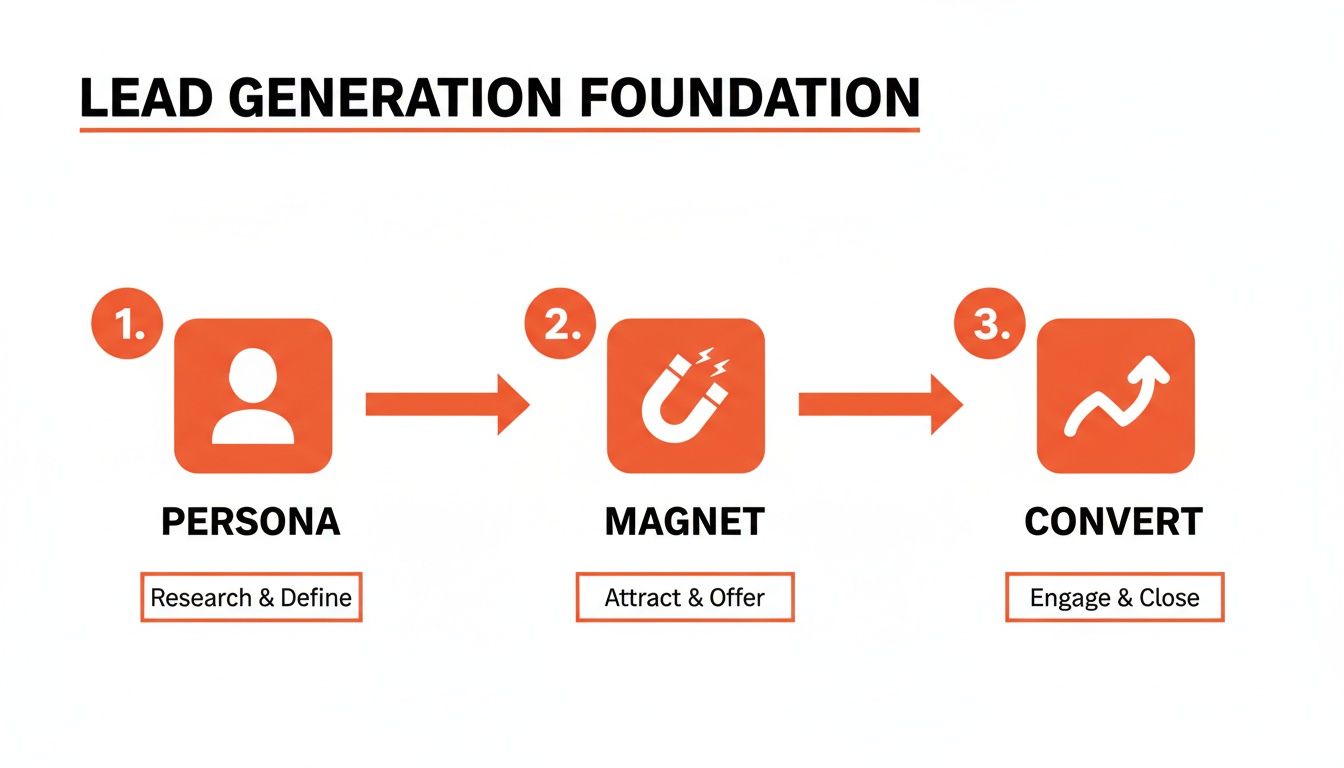
The flow is simple but powerful: understanding your Persona lets you create a compelling Magnet, which is what ultimately drives high-quality Conversions.
This foundational thinking is becoming even more critical as Australian businesses ramp up their online spending. Projections show a massive $1.5 billion will be funnelled into SEO services alone in 2025—that's a 12% jump from 2024. For small businesses, this is huge, as active blogging can pull in 55% more website visitors, feeding directly into this lead generation machine.
In the end, how well you know your audience and the quality of your lead magnet will make or break every other step. To actually convert the traffic you generate, understanding these crucial landing page optimization best practices is non-negotiable for turning those clicks into customers. You can learn more about this by checking out our guide on how to create a landing page that converts.
Winning with Paid Ads on Google and Meta
While your organic strategies are busy building long-term momentum, paid advertising on platforms like Google and Meta is your fast track to immediate traffic and data. It's how you get in front of your ideal audience today, making it an absolute cornerstone of any serious lead generation playbook.
Let's get one thing straight: success here isn't about having the deepest pockets. It’s about precision, smart targeting, and a solid grasp of how each platform works.

The biggest difference between the two giants comes down to user intent.
With Google, you’re capturing existing demand. People are actively searching for solutions to their problems. Your job is to show up with the answer. On Meta (that’s Facebook and Instagram), you’re generating new demand. You interrupt their scrolling with compelling ads based on their interests and behaviours, making them aware of a solution they didn't even know they needed.
Both are incredibly powerful, but they require different approaches.
Setting Up Your Campaign for Success
That very first button you click inside an ad platform can make or break your entire campaign. Seriously. Every platform will ask for your campaign objective, and your choice here is a direct instruction to the algorithm, telling it exactly what success looks like. For lead generation, you need to be specific.
On Meta, this usually means choosing the "Leads" objective. This unlocks access to Instant Forms (what they used to call Lead Forms), which are brilliant for frictionless lead capture. Users can submit their details—often pre-filled by the platform—without ever leaving the app. This simple trick minimises drop-off and can slash your Cost Per Lead (CPL).
Over on Google Ads, a "Leads" objective is also your starting point. This tells the algorithm to focus on driving specific actions like form submissions on your website, phone calls, or live chats. Google’s machine learning then gets to work finding users who are most likely to take those actions, ensuring your budget is optimised for conversions, not just pointless clicks.
Crafting Ads That Actually Convert
Your ad creative and copy are your frontline soldiers. In a sea of digital noise, generic, boring content is a death sentence. Your mission is to stop the scroll on Meta and earn the click on Google with messaging that speaks directly to the persona you’ve already defined.
For Meta Ads:
- Video First, Always. Short, punchy videos consistently knock static images out of the park. Think user-generated content, quick-fire tutorials, or a dynamic showcase of what you’re offering.
- Write Like a Real Person. Your ad copy needs to sound conversational, not like a corporate memo. Hook them with a pain point they recognise, then position your lead magnet as the obvious, simple solution.
- Have a Clear Call-to-Action (CTA). Don’t be vague. "Learn More" is weak. Use strong, direct CTAs like "Download Your Free Guide" or "Get Your Custom Quote" so people know exactly what to do next.
For Google Search Ads:
- Mirror the Search Intent. Your headline and description absolutely must reflect what the user searched for. If they typed in "emergency plumber Sydney," your ad better mention something very close to that. It’s a basic trust signal.
- Shout About Your Benefits. Use the description lines to highlight what makes you the best choice. Focus on outcomes and benefits like "24/7 Service," "No Call-Out Fee," or "Free Consultation."
- Use Ad Extensions. Don't skip these. Sitelinks, call extensions, and lead form extensions give you more real estate on the search results page and provide extra ways to capture a lead right then and there.
A classic mistake is getting bogged down in features instead of focusing on outcomes. Nobody wants to buy a drill; they want a hole in the wall. Your ad copy needs to sell the hole, not the drill.
Optimising Your Landing Page for Conversion
Alright, you’ve paid for the click. That's only half the battle. If your landing page drops the ball and delivers a clunky experience, you're just lighting money on fire. The landing page has one job, and one job only: get the visitor to take that final action.
A high-converting landing page has a few non-negotiable elements:
- Message Match: The headline on your landing page must echo the promise you made in your ad. Any disconnect will create confusion and cause people to bounce.
- Minimal Distractions: Get rid of everything that doesn't lead to a conversion. That means no navigation menu, no sidebar, and no unnecessary links that could tempt them away from the form.
- A Simple Form: Only ask for the information you absolutely need to qualify the lead. Every extra field you add is another reason for someone to give up. Name and email might be all you need to get started.
- Social Proof: This is huge for building instant trust. Sprinkle in some testimonials, case studies, or logos of well-known clients you've worked with.
By tightly aligning your campaign objective, your ad creative, and your landing page experience, you create a powerful, efficient system for generating leads. This cohesive approach ensures the traffic you’re paying for has the absolute best chance of turning into a valuable lead for your business.
Driving High-Value B2B Leads with LinkedIn
When you're chasing B2B leads, Google and Meta are the workhorses. No doubt about it. But if you're serious about B2B, LinkedIn is in a league of its own. It's not just another social platform; it's the digital equivalent of the industry’s biggest conference, where decision-makers connect, research, and ultimately, do business. Ignoring it is a massive missed opportunity.

But just having a slick company page won't cut it. Real success on LinkedIn comes from mastering its incredibly detailed targeting capabilities. You can get so much more specific than broad demographics and pinpoint the exact people you need to talk to.
Precision Targeting for High-Value Prospects
The true magic of LinkedIn Ads lies in its targeting options. You can build audiences using criteria that other platforms can only dream of, which is what allows you to speak directly to the people who hold the purse strings.
Just think about what's possible:
- Job Title Targeting: Want to get your message straight to "Chief Financial Officers" or "Heads of Procurement"? You can do that, bypassing gatekeepers entirely.
- Company Size & Industry: Need to hit up tech startups with 50-200 employees? Easy. Targeting established manufacturing firms in a specific state? You can build that exact audience.
- Member Skills & Groups: You can even target users based on the skills they’ve listed on their profile or the professional groups they belong to. These are powerful signals of interest and relevance.
This isn't about casting a wide net and hoping for the best. It's about using a high-powered sniper rifle. For anyone trying to figure out how to generate leads for B2B, LinkedIn is the perfect training ground to master that specialised skill.
LinkedIn transforms B2B marketing from a guessing game into a calculated strategy. The platform's data allows you to find your exact ideal customer, ensuring your budget is spent talking to people who matter, not just anyone.
This approach is especially powerful in the local market. In Australia, LinkedIn is responsible for a staggering 80% of B2B leads generated through social media, and its conversion rate leaves other platforms in the dust. Even more telling, 40% of B2B marketers name LinkedIn as their number one source for high-quality leads. It's simply indispensable.
Leveraging High-Value Content and Ad Formats
Once you've zeroed in on your audience, you need to offer them something genuinely valuable. Pushy sales pitches get ignored on LinkedIn. This is a space to demonstrate your expertise and build real authority.
High-value content is your currency here. Focus on creating assets like:
- In-depth whitepapers that solve a major industry headache.
- Detailed case studies that show off the tangible results you've delivered for clients.
- Exclusive webinars featuring well-respected industry experts.
These assets become the bait on your lead generation hook. From there, you just need to use LinkedIn’s ad formats to get them in front of the right people.
Effective LinkedIn Ad Formats
Sponsored Content is your bread and butter for promoting these assets. It appears natively in your target audience’s news feed, making it perfect for driving traffic to a landing page where they can download your content or sign up for a webinar.
For an even smoother user experience, LinkedIn Lead Gen Forms are an absolute game-changer. These forms pre-fill with a user's profile information, slashing the friction involved in signing up. Someone can submit their details and get your content in just a couple of clicks, all without ever leaving the LinkedIn app. This one feature can give your conversion rates a serious boost.
Finally, for that hyper-targeted, high-touch approach, there’s Sponsored InMail. This lets you send personalised messages directly into the inboxes of your key prospects. It’s best used selectively for high-value targets, delivering a tailored message that speaks directly to their specific needs.
If you’re ready to get serious, working with a specialist LinkedIn advertising agency can help you navigate these advanced features and squeeze every drop of value out of your spend. By combining laser-focused targeting with valuable content and the right ad formats, you can build a reliable pipeline of qualified B2B leads that fuels real, sustainable business growth.
Building a Long-Term Lead Engine with SEO
Paid ads are brilliant for turning on the taps and getting immediate traffic. But for sustainable, long-term success in lead generation in digital marketing, nothing beats a powerful search engine optimisation (SEO) and content strategy. This is your blueprint for creating a consistent, compounding flow of inbound leads—without having to constantly feed the ad spend machine.
This isn't just about ticking boxes to please an algorithm. It's about building genuine trust and authority. When a potential customer stumbles upon your helpful article right when they need it most, you're not just another brand; you're the solution. This approach transforms your website from a simple digital brochure into an automated lead generation engine that works for you 24/7.

Uncovering What Your Audience Is Actually Searching For
The entire foundation of a winning SEO strategy rests on one thing: search intent. You have to get inside your audience's head and figure out the exact phrases and questions they're typing into Google when they're grappling with a problem you can solve. We call this keyword research.
Don't just guess what your customers are looking for. Use proper tools to dig into the real data.
- Informational Keywords: These are your "how to" or "what is" queries, like "how to improve warehouse efficiency" or "what is the best CRM for a small business". The searcher here is in research mode.
- Commercial Keywords: Terms like "Xero vs MYOB comparison" or "best project management software" signal that someone is getting much closer to making a decision. They're comparing options.
- Transactional Keywords: These are the money-makers. Phrases with high purchase intent, such as "emergency plumber near me" or "buy accounting software online," mean someone is ready to act now.
A smart SEO strategy targets keywords across this entire journey. It lets you capture attention early, nurture prospects with genuinely useful content, and become the obvious choice when they're finally ready to pull out their wallet. Even a simple content refresh can make a massive difference; some studies show that updating existing content can boost its organic traffic by over 100%.
Creating Content That Genuinely Helps
Once you know what your audience is searching for, your job is to create the absolute best answer to their query. This is where so many businesses fall flat. They churn out thin, self-promotional blog posts that offer little real value. To stand out, your content must be genuinely helpful, insightful, and comprehensive.
This is your moment to build authority and establish trust. If someone is searching for a solution and your article provides a detailed, actionable guide, you’ve immediately proven your credibility.
Your content's primary job isn't to sell; it's to solve. When you consistently solve your audience's problems, you earn their trust. The sale becomes a natural byproduct of that relationship.
And don't just limit yourself to blog posts. A robust content strategy should include various formats that can double as powerful lead magnets.
Effective Content Formats for SEO Lead Generation
- In-Depth Guides: Comprehensive, long-form articles that cover a topic from every possible angle.
- Case Studies: Real-world examples showcasing how you’ve helped clients achieve specific, tangible results.
- Free Tools: Simple calculators, templates, or checklists that provide immediate, practical value.
- Original Research: Industry reports or surveys that offer unique data and insights nobody else has.
Every piece of content you create is another digital asset, another potential doorway for a customer to find you. It's an investment that pays dividends for years.
Turning Traffic Into Tangible Leads
Ranking on the first page of Google is a fantastic achievement, but it doesn't pay the bills. The final, critical piece of this puzzle is converting that hard-earned organic traffic into actual leads. This means strategically placing calls-to-action (CTAs) within your content that feel like a natural next step.
Your CTAs shouldn't feel like an aggressive sales pitch. Instead, think of them as a content upgrade—a relevant, valuable resource that complements the information the reader just consumed.
For example, inside a blog post titled "10 Ways to Improve E-commerce Checkout Conversion," you could offer a free, downloadable checklist that summarises the key points. It's a highly relevant offer that makes perfect sense in the context of the article.
Consider these tactical placements for your CTAs:
- In-line Text CTAs: A simple, hyperlinked sentence within a paragraph that points to your lead magnet.
- End-of-Post Banners: A visually distinct banner at the conclusion of your article offering a related resource.
- Pop-ups or Slide-ins: These can be very effective when used tastefully—triggered by user behaviour like exit intent or scroll depth.
By pairing high-quality, intent-focused content with compelling, relevant offers, you build a sustainable engine for lead generation in digital marketing. It's a long game, for sure, but it’s one that creates a powerful, owned asset that generates qualified, inbound leads with an incredible ROI.
How to Actually Measure Your Lead Generation Success
Launching your campaigns and watching the traffic roll in is a buzz, but it’s just the opening act. Real, sustainable growth comes from knowing precisely what’s working, what isn’t, and why. Flying blind is a surefire way to burn through your budget with nothing to show for it.
This is where so many businesses stumble. They get bogged down in vanity metrics like clicks and impressions, losing sight of the data that actually moves the needle. Success isn't about being busy; it's about being effective.
Setting Up Reliable Conversion Tracking
Before you can measure a single thing, you need a rock-solid tracking foundation. Without it, you're just guessing. This means getting the technical bits right from day one to make sure every lead is accurately credited to its source.
Your setup absolutely must include:
- Google Analytics 4 (GA4): This is your command centre for understanding user behaviour. You’ll want to set up specific conversion events for every single lead action, from form submissions and phone number clicks to live chat initiations.
- Platform Pixels: Install the tracking pixels for Meta, LinkedIn, and any other ad platforms you're on. These pixels don't just track conversions; they feed crucial data back to the platform's algorithm, helping it find more people like your best customers.
Getting this right allows you to build a complete picture of the customer journey, from the first ad they saw to the moment they became a lead. It’s the difference between knowing "we got 50 leads last month" and knowing "our LinkedIn webinar campaign generated 15 high-quality leads at a cost of $75 each."
Focusing on the KPIs That Truly Matter
Once your tracking is solid, it's time to cut through the noise. You need to focus on the key performance indicators (KPIs) that tell the real story of your lead generation efforts.
Your dashboard might be overflowing with data, but only a handful of metrics truly reflect the health of your lead pipeline. The goal is to measure outcomes, not just activity. Obsess over the numbers that connect directly to your bottom line.
Here are the non-negotiables:
- Cost Per Lead (CPL): This is the most straightforward, honest metric you have. Simply divide your total ad spend by the number of leads generated. It tells you exactly how much it costs to acquire a new prospect. No fluff.
- Conversion Rate: What percentage of people who hit your landing page actually follow through and fill out the form? A low conversion rate is a massive red flag, often pointing to a disconnect between your ad and your landing page, or a clunky, frustrating user experience.
- Lead Quality Score: Let's be honest, not all leads are created equal. You need to work with your sales team to define what makes a lead "qualified." This could be based on company size, job title, or specific pain points they mention in a form. Tracking this helps you optimise for value, not just volume.
For a deeper dive, our guide on essential digital marketing performance metrics can help you build out a more robust reporting framework.
To keep things organised, it's helpful to map out which KPIs matter most for each channel you're using.
Essential KPIs for Lead Generation Channels
Here’s a breakdown of the most important metrics to track for each major lead generation channel to measure success effectively.
| Channel | Primary KPI | Secondary KPI | Business Goal |
|---|---|---|---|
| Google Ads | Cost Per Lead (CPL) | Conversion Rate | Acquire high-intent leads cost-effectively |
| Meta Ads | Cost Per Lead (CPL) | Click-Through Rate (CTR) | Generate leads from targeted audiences |
| LinkedIn Ads | Cost Per Lead (CPL) | Lead Quality Score | Attract qualified B2B prospects |
| SEO/Content | Organic Leads | Keyword Rankings | Drive consistent, long-term lead flow |
This table provides a simple framework, but remember to tailor it to what matters most for your specific business goals.
The Power of Continuous A/B Testing
Data is completely useless if you don't act on it. The final, critical piece of the puzzle is using your insights to constantly improve. A/B testing, or split testing, is a systematic way to do this. You simply create two versions of an ad or landing page (A and B) and let the data tell you which one performs better.
You can test almost anything, but you'll get the best results by starting with the elements that have the biggest potential impact.
A/B Testing Ideas for Your Campaigns:
- Headlines: Test a benefit-driven headline ("Save 20% on Your First Order") against one that agitates a pain point ("Tired of Wasting Time on Admin?").
- Call-to-Action (CTA): Compare different button texts. Does "Get Your Free Quote" outperform "Request a Consultation"? The answer might surprise you.
- Ad Creative: Pit a slick video ad against a high-quality static image. Or test a graphic featuring a customer testimonial against one focused purely on the product.
- Landing Page Forms: Try a super short form (email only) versus a longer one that asks for more qualifying information. See how it impacts not just the conversion rate, but also your lead quality.
By constantly testing and iterating based on real data, you move from a "best guess" approach to a calculated process of optimisation. This data-backed discipline is what turns good campaigns into great ones, ensuring your lead generation engine becomes more efficient and profitable over time.
Your Common Lead Generation Questions Answered
When you're getting started with lead generation in digital marketing, it's natural to have a few big questions swirling around. I've heard them all over the years, and a handful of them come up time and time again, no matter the industry.
Let's cut through the noise and tackle the most common ones. These aren't textbook answers; they're straight-up, practical insights from years of running campaigns in the real world.
How Long Until I See Real Results?
This is always the first question, and the honest answer is: it really depends on your channel. The timeline for seeing a return on your effort varies massively between paid ads and organic strategies. Getting your head around this is the key to setting realistic expectations.
-
Paid Advertising (Google, Meta, LinkedIn): This is your express lane. With a well-tuned campaign, you can see leads rolling in within days, sometimes even hours, of going live. The trade-off? The second you turn off the tap, the leads dry up. Paid ads are all about speed and immediate feedback.
-
Organic SEO and Content: Think of this as a long-term investment. You’ll likely need 3-6 months to see the first signs of life and a good 6-12 months to build real, consistent momentum. The payoff is immense, though. You're building a sustainable asset that pulls in leads for years to come, long after you've stopped paying for direct ad spend.
What’s a Realistic Cost Per Lead For My Industry?
Cost Per Lead (CPL) is a metric everyone obsesses over, but it’s not a one-size-fits-all number. It can swing wildly from one industry to the next. A lead for a local lawn mowing service might only cost you $20, while a highly qualified lead for enterprise-level B2B software could easily run into the hundreds.
Instead of chasing some mythical "industry average" CPL, get laser-focused on your own data. The real goal is to establish your own baseline CPL in the first month, then work methodically to bring it down through continuous optimisation.
Start with small, controlled test campaigns. This will give you a true CPL for your specific offer and audience, which is infinitely more valuable than any benchmark report. Your guiding star should always be what’s profitable for your business.
How Do I Balance My Budget Between Paid Ads and Organic Content?
Figuring out the right split between paid and organic is a classic strategic balancing act. For most businesses, especially when you're just starting to scale, a hybrid approach is the smartest way to go.
Here's how I like to think about it:
- Use paid ads for immediate data and cash flow. This funds your growth right now and gives you rapid-fire insights into what messages and offers actually get people to convert.
- Reinvest a slice of those profits into your long-term organic engine. Take what you learn from your paid campaigns—the keywords that work, the ad copy that hits home—and pour it into your SEO and content strategy.
This creates a powerful, self-sustaining loop. Paid ads act as the initial fuel and provide market intelligence, while your organic efforts build a compounding asset that steadily reduces your dependency on ad spend over time.
When you're starting out, your budget might look something like 70% paid and 30% organic. The long-term goal, however, is to gradually shift that balance as your organic presence gains strength and starts doing the heavy lifting.
Navigating the complexities of lead generation requires expertise and constant optimisation. At Click Click Bang Bang, we specialise in creating data-driven SEO and PPC strategies that deliver measurable results. If you’re ready to build a powerful lead engine for your business, explore our services at https://clickclickbangbang.com.au.
Read NeXt
Or Read Our Latest
- Manual vs Automated Bidding for PPC Success
- Conversion Tracking Setup: A Complete AU Guide
- Instagram Advertising Australia: Complete 2026 Guide
- Pay Per Click: A Beginner’s Guide for Australian Marketers
- Display Advertising on Google: The Complete Australian Guide
- Stakeholder Communication Plan How to Build One That Works
Click. CLick. Subscribe.
Get our best PPC insights, industry updates, and power moves delivered straight to your inbox. No fluff, just high-caliber strategies that actually work.
Don’t Leave Just Yet
Try Us For 30-Days,
Risk Free!!
We guarantee that you’ll love our work within the first 30 days, if not you’ll get your money back.
What have you got to lose?