

Boost Your Growth with search engine optimization seo services
Last Updated

Search Engine Optimization (SEO) Services are professional services designed to get your website seen in search engines like Google.
Think of it this way: your website might be a brilliant storefront, but it’s tucked away on a quiet side street where no one can find it. SEO is the expert team of marketers and city planners who pick up your store and move it to the busiest digital high street in the world—Google's first page.
At its core, SEO connects your business with customers who are actively searching for the exact solutions you offer, right when they need them most.
What Are Search Engine Optimisation SEO Services?
Professional SEO services aren't just about a few technical tweaks here and there; they're about forming a strategic partnership focused on driving real, sustainable business growth through organic search. It’s a comprehensive strategy that dives deep into your business, your market, and your competitors to build a roadmap for boosting your online visibility and authority.
The whole idea is to align your website's content, structure, and reputation with what search engines are programmed to value. When that alignment happens, and a potential customer types in a relevant query, your site shows up as a top solution. It's a long-term investment that builds a powerful, durable asset for your business: a consistent stream of high-intent organic traffic.
The Foundation of Digital Visibility
A solid SEO strategy is built on several key pillars that all work together. An experienced agency won’t just focus on one; they’ll integrate these elements into a cohesive campaign that delivers results.
The key pillars include:
- Technical Health: This is the non-negotiable first step. It’s about ensuring your website's foundation is solid, fast, and easy for search engines to crawl and understand.
- On-Page Relevance: This involves optimising the content and structure of your individual pages to clearly signal what they're about, making them highly relevant for specific keywords.
- Content Value: It’s about creating high-quality, genuinely helpful content that answers your audience's questions and solves their problems. This is how you establish your business as an expert.
- Off-Page Authority: This pillar focuses on building your website's reputation across the web. High-quality backlinks and mentions from other trusted sites prove to search engines that you're a credible, trustworthy source.
Why SEO Matters in a Competitive Market
Ignoring SEO today means you're actively leaving money on the table for your competitors to pick up. In Australia's booming digital advertising market, the competition is fierce. The internet ad market hit an incredible USD 4.2 billion in the March 2025 quarter alone, with search revenue climbing 10% to USD 1.896 billion.
That data tells a clear story: businesses are investing heavily in search to capture customer attention. You can discover more insights about Australia's digital ad spend and see just how much your competitors are leveraging search to grow.
When you partner with an agency for expert search engine optimisation services, you're not just buying a task list. You're investing in a strategic advantage that builds a predictable, scalable channel for acquiring new customers—one that keeps paying dividends long after a paid ad campaign has ended. It’s about positioning your business for durable, long-term success.
The Four Pillars of a Winning SEO Strategy
A winning SEO strategy isn't a single silver bullet. It's a coordinated effort built on four distinct, yet totally interconnected, pillars. Getting your head around these is the key to figuring out which search engine optimisation services are right for your business.
Think of your website as a high-end retail store. Each pillar plays a critical role in making it a success.
This visual shows how professional SEO services act as the bridge between your website and your future customers, all built on these four foundations.
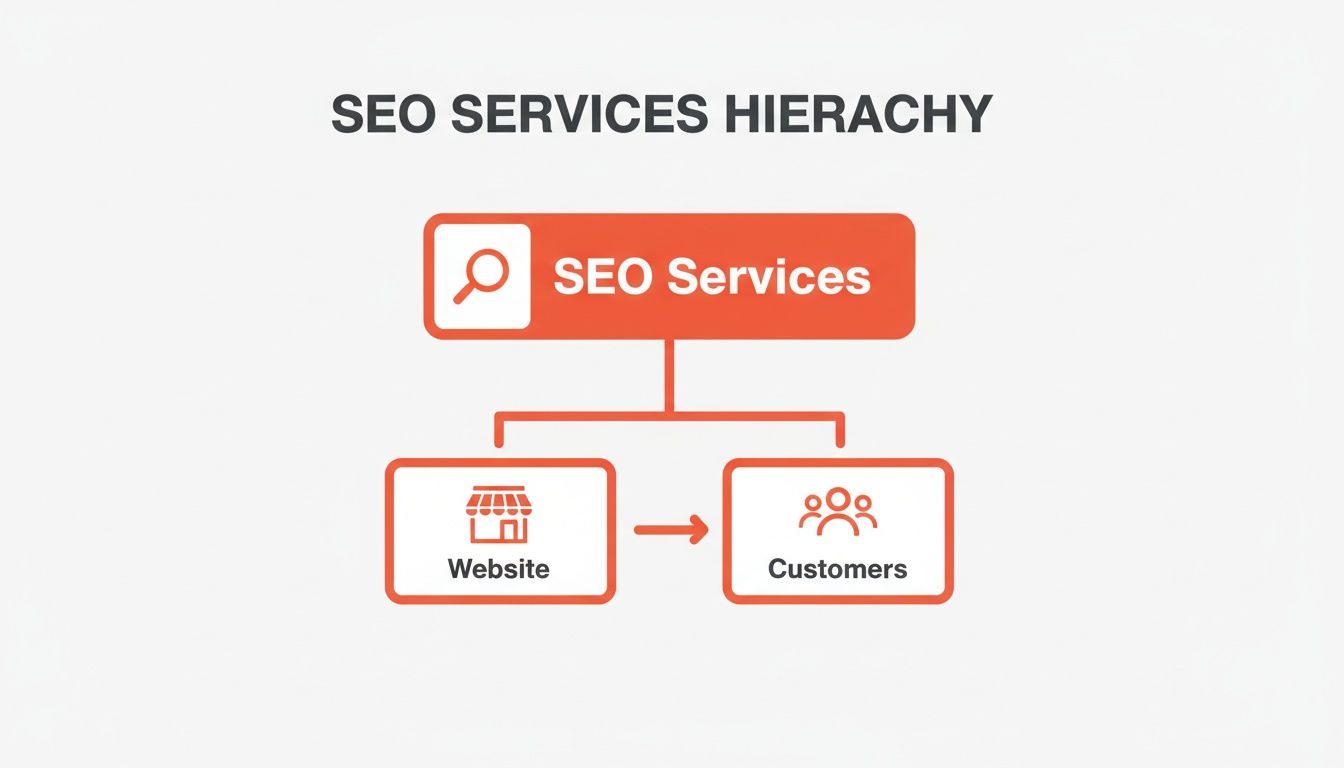
Simply put, a well-executed SEO strategy connects your digital storefront directly to a stream of high-intent customers who are ready to buy.
Pillar 1: Technical SEO
Technical SEO is the very foundation of your store—the concrete slab, the internal wiring, the plumbing. It’s all the behind-the-scenes work that makes your website fast, secure, and dead simple for search engine crawlers to understand.
If the foundation is cracked or the wiring is faulty, nothing else you do will matter.
Your agency should be delivering things like:
- Site Speed Audits: Pinpointing and fixing what’s slowing your site down. Slow pages frustrate users and tank your rankings.
- Mobile-Friendliness Optimisation: Making sure your site works flawlessly on any device, which is a massive ranking factor for Google.
- Crawlability and Indexing Fixes: Sorting out any errors that stop search engines from finding and listing your pages, like submitting a clean XML sitemap.
- Schema Markup Implementation: Adding structured data that helps search engines understand the context of your content, which can earn you those eye-catching rich snippets in search results.
Pillar 2: On-Page SEO
Next up is On-Page SEO. This is your in-store merchandising and signage. It’s the art of optimising individual web pages so they clearly communicate their purpose to both people and search engines.
It’s about making sure that when a customer walks in looking for something specific, clear signs point them exactly where they need to go.
A solid On-Page SEO plan makes your website intuitive and hyper-relevant. It’s about more than just stuffing in keywords; it’s about crafting a user experience that directly answers what someone is searching for, which builds trust and drives conversions.
Key deliverables for On-Page SEO involve:
- Keyword Research and Mapping: Finding the exact terms your audience uses and assigning them to the most relevant pages on your website.
- Title Tag and Meta Description Optimisation: Writing compelling, clickable headlines and summaries that stand out on the search results page.
- Content Optimisation: Ensuring your page content is high-quality, relevant, and structured properly with headings (H1, H2) for easy reading.
- Internal Linking Strategy: Building a logical web of links that guides users and search engine crawlers through your site, spreading authority along the way.
For a deeper look, check out our detailed guide on the crucial differences between On-Page and Off-Page SEO.
Pillar 3: High-Quality Content
Content is the actual product on your shelves. You can have a perfectly built store with brilliant signage, but if your products are cheap or irrelevant, customers will walk out empty-handed and disappointed.
High-quality, genuinely valuable content is what solves your customer's problems and establishes your brand as an authority they can trust.
Professional content services should deliver:
- Content Strategy Development: A game plan for what content to create, based on audience needs, keyword research, and your business goals.
- Blog Post and Article Creation: Writing genuinely helpful articles that attract organic traffic by answering your customers' biggest questions.
- Landing Page Copywriting: Crafting persuasive copy for your service or product pages that’s designed to drive action and conversions.
Pillar 4: Off-Page SEO
Finally, Off-Page SEO is your brand's reputation around town. It covers all the activities that happen off your website that signal to search engines that your brand is trustworthy, authoritative, and credible.
Think of it as word-of-mouth recommendations, five-star reviews, and features in reputable industry publications. The main way this is achieved is through strategic link building—a backlink from a respected site is like a powerful endorsement, telling Google your content is worth paying attention to.
Common deliverables for Off-Page SEO include:
- Backlink Profile Analysis: Auditing your existing backlinks to find and get rid of any toxic links that might be hurting you.
- Competitor Backlink Research: Analysing where your competitors are getting their best links from to uncover new opportunities for you.
- Strategic Link-Building Campaigns: Actively earning high-quality backlinks from relevant, authoritative websites through smart outreach and content promotion.
Each of these pillars is essential. You can't just pick one or two. A winning strategy expertly weaves them all together, creating a powerful engine for sustainable, long-term growth.
To give you a clearer picture of what to expect from a professional engagement, here’s a quick summary of the core components and their deliverables.
Key Deliverables in Professional SEO Services
| SEO Component | Primary Goal | Common Deliverables |
|---|---|---|
| Technical SEO | Ensure the website is fast, secure, and crawlable for search engines. | Site speed audits, mobile optimisation, schema markup, XML sitemap submission, crawl error resolution. |
| On-Page SEO | Optimise individual pages to rank higher and earn more relevant traffic. | Keyword research & mapping, title/meta tag optimisation, content optimisation, internal linking strategy. |
| Content | Attract, engage, and convert the target audience by providing valuable information. | Content strategy, blog post creation, landing page copywriting, case studies, white papers. |
| Off-Page SEO | Build the website's authority and credibility through external signals. | Backlink analysis, competitor research, strategic link building, guest posting, digital PR outreach. |
Understanding these deliverables will help you have more productive conversations with potential agencies and ensure you're investing in a comprehensive strategy that covers all the bases.
Understanding SEO Pricing Models and What to Expect
Once you’ve got a handle on the core parts of search engine optimisation services, the next question on any business owner’s mind is usually about the cost. But a better question is, "How is that cost structured, and what should I get in return?" Thinking about the different pricing models helps you see SEO not as a simple expense, but as a strategic investment in predictable, long-term growth.
The way an agency charges often says a lot about its approach to partnership and results. Some models are built for ongoing, adaptive strategies that grow with you, while others are designed for specific, one-off goals. There's no single "best" model; the right fit depends entirely on your business goals, where you are now, and where you want to be.
Let's break down the three most common engagement models you'll come across.
Monthly Retainer: The Standard for Ongoing Growth
The most common model in the SEO world is the monthly retainer. It’s simple: you pay a fixed fee each month for a continuous, agreed-upon scope of work. Think of it like having an expert outsourced marketing team that’s solely focused on your organic growth.
This model is perfect for businesses committed to long-term success. SEO isn’t a set-and-forget task. It demands constant attention—monitoring performance, adapting to Google's algorithm changes, and consistent effort across content creation, technical upkeep, and link building. A retainer ensures your strategy never goes stale and consistently builds momentum over time.
- Best for: Businesses that need a comprehensive, ongoing SEO strategy to build and hold onto competitive rankings.
- What you get: A consistent partnership covering all pillars of SEO, from technical audits and content creation to link acquisition and monthly performance reporting.
- Typical Investment: Retainers can range widely, often from $1,500 to $10,000+ per month, depending on the scope of work and how competitive your industry is.
Project-Based Fees for Specific Objectives
Sometimes, you don't need the whole shebang. You might just have a very specific, defined problem that needs a targeted solution. This is where project-based pricing comes in.
This model involves a one-time fee for a clearly defined project with a specific start and end date. It's perfect for knocking over isolated issues or getting your foundational SEO right.
For instance, a business might hire an agency for a:
- Comprehensive SEO Audit: A deep dive into your website to uncover every single technical, on-page, and off-page issue that's holding you back.
- Website Migration: Expertly managing the move to a new domain or platform without torpedoing your hard-earned search rankings.
- Penalty Recovery Service: Figuring out what caused a Google penalty and creating a clear plan to fix it.
Project-based work is tactical. It’s designed to solve a particular problem or set your website up for future success, making it a great starting point before you commit to a longer-term retainer.
Hourly Consulting for Strategic Guidance
Finally, some agencies offer hourly consulting. This is a great fit for businesses that already have an in-house marketing team but need some high-level strategic guidance or specialised expertise on a tricky challenge. You're essentially paying for an expert's time and advice, not for them to do the implementation.
This approach is flexible and can be a cost-effective way to solve specific problems, like training your team on a new SEO tool or simply getting a second opinion on your current strategy. It allows you to tap into senior-level expertise without the commitment of a full retainer.
For a more detailed breakdown, you can learn more about how much SEO costs and which factors influence the final price.
Measuring SEO Success With KPIs That Drive Business Growth
Any search engine optimisation seo services partnership worth its salt should be measured by its impact on your bottom line. It's easy to get caught up in the thrill of watching your website climb the rankings, but that's a vanity metric if it doesn't translate into actual business results.
The real conversation shouldn't be, "Are we ranking #1?" but rather, "Is our search visibility generating profitable customers?" True success comes from tracking the entire customer journey—from their first search to the final sale—and seeing how SEO moves the needle at every step.
Moving Beyond Rankings to Business Impact
Obsessing over keyword rankings is like a shop owner counting how many people walk past their store without ever checking how many come inside to buy something. A top ranking is useless if the clicks don't convert.
Instead, a results-driven strategy focuses on metrics that show genuine business impact. This approach gives you a much clearer picture of your return on investment (ROI) and makes sure your SEO agency is aligned with your core financial goals, not just chasing algorithm trends.
Here are the KPIs that actually matter:
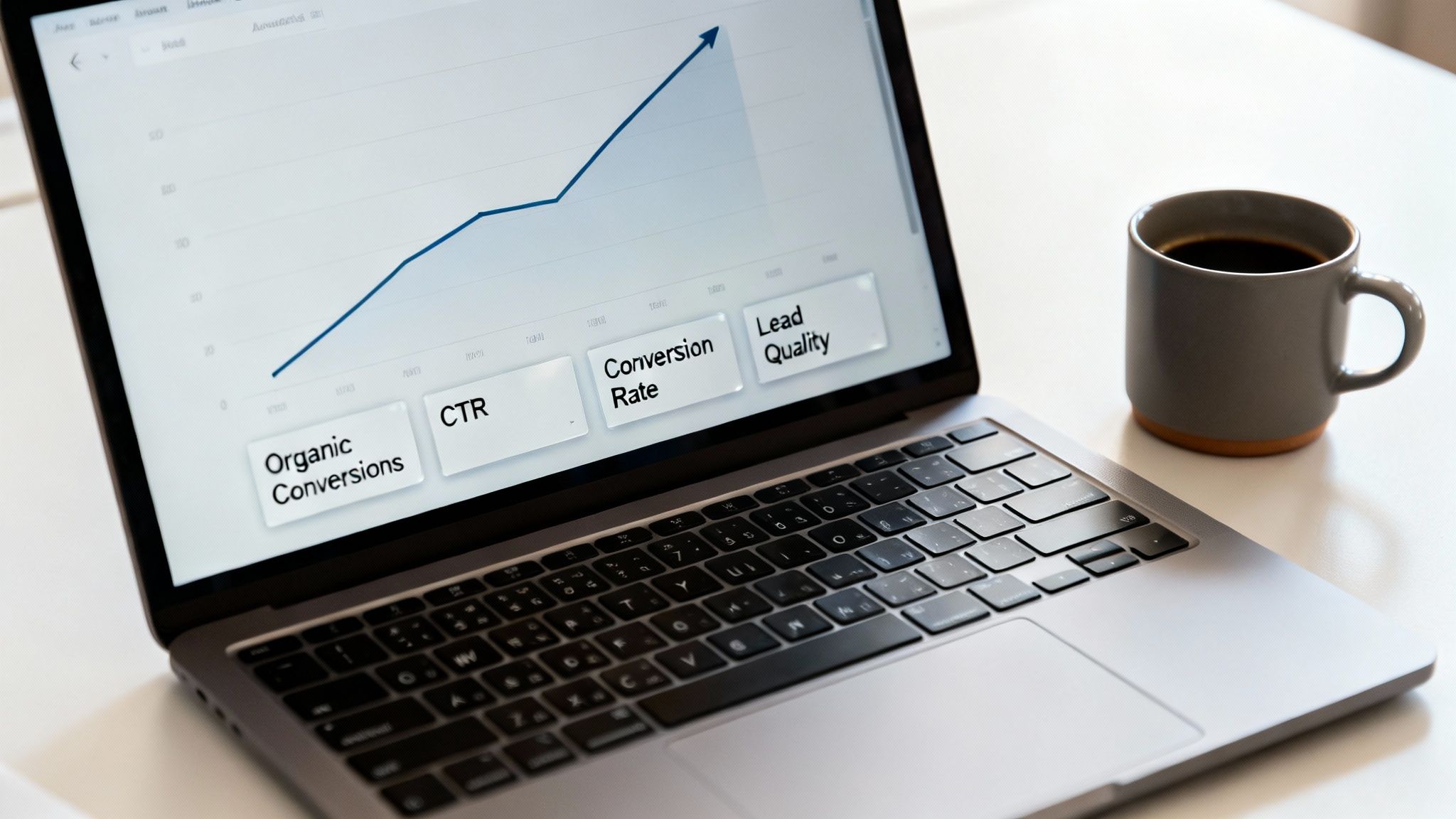
- Organic Conversions: This is the big one. It tracks how many visitors from organic search complete a goal, whether that’s making a purchase, filling out a contact form, or signing up for a newsletter.
- Conversion Rate: This metric tells you the percentage of organic visitors who convert. A rising conversion rate means you're not just getting more traffic, but higher-quality, more relevant visitors.
- Lead Quality: For B2B or service-based businesses, not all leads are created equal. Tracking lead quality from organic search (using lead scoring, for example) helps you know if your SEO is attracting prospects who are likely to become valuable customers.
- Customer Lifetime Value (CLV) from Organic Search: This advanced KPI measures the total revenue a business can expect from a single customer acquired through SEO. It's a powerful way to show the long-term value of your investment.
By concentrating on these bottom-funnel metrics, you move from a cost-based mindset to an investment-based one. You can clearly see how every dollar spent on SEO is contributing to tangible, sustainable business growth.
Understanding User Engagement Metrics
While business outcomes are the top priority, user engagement metrics provide the crucial "why" behind the numbers. They offer insights into how people are interacting with your site and why your main KPIs are moving up or down.
A high Click-Through Rate (CTR), for instance, suggests your page titles and meta descriptions are grabbing attention in the search results. That's the first step in winning over a customer. If you'd like to dive deeper, you can learn how to improve click-through rates to give your organic performance a serious boost.
The Untapped Potential in Local Search
For businesses with a physical location, local SEO KPIs are non-negotiable. You absolutely have to track metrics like phone calls from your Google Business Profile, requests for driving directions, and your rankings in the local map pack.
The opportunity here is massive, considering 46% of all Google searches have local intent.
Despite this, a shocking 56% of local businesses haven't even claimed their Google Business Profile. This leaves a huge opening for savvy businesses that invest in professional local SEO services. Getting your local search presence right can directly lead to more foot traffic and in-store sales.
How AI and PPC Integration Supercharge Your SEO

Effective search engine optimisation (SEO) services don't operate in a vacuum anymore. The strategies that truly move the needle are part of a bigger picture, where different marketing channels feed off each other to create something much more powerful.
When it comes to amplifying SEO, two of the heaviest hitters are Pay-Per-Click (PPC) advertising and Artificial Intelligence (AI). Get these three working together, and you build a growth engine that can dominate search results and pull in customers at every stage of their journey.
Using PPC Data to Fuel SEO Growth
I like to think of PPC as a nimble speedboat and SEO as a massive cargo ship. The cargo ship (SEO) builds incredible, long-term value and can carry a huge load, but it takes a while to get up to speed. The speedboat (PPC), on the other hand, can zip around and gather crucial intelligence almost instantly.
PPC campaigns give you a direct line to what the market is thinking right now. You can test keywords, ad copy, and landing pages and get immediate feedback on what clicks with your audience. This data is pure gold for your SEO strategy.
- Keyword Validation: Find out which keywords don't just bring in traffic, but actually lead to conversions. This takes the guesswork out of your long-term content plan.
- Ad Copy Insights: See which ad headlines get the best click-through rates? That's your cheat sheet for writing magnetic SEO title tags and meta descriptions for your organic listings.
- Landing Page Testing: Use paid traffic to A/B test different page layouts, calls-to-action, and content. The winners can then be rolled out to improve your organic conversion rates.
By using PPC as a rapid testing ground, you can fine-tune your SEO strategy with hard data that would otherwise take months, or even years, to gather organically. This dramatically shortens the learning curve and gets you to a positive ROI much faster.
The Rise of an AI-First SEO Approach
Artificial Intelligence is completely changing the game for professional SEO services. It's moved way beyond just churning out basic content; it's now a core tool for analysis, prediction, and automation that lets human experts do what they do best: think strategically.
An AI-first approach doesn't replace your strategist. It supercharges them.
This isn't just a fleeting trend. It mirrors a massive shift in how people behave online. Here in Australia, AI adoption is absolutely exploding. A staggering 12.7 million Australians used AI tools in April 2025, which is a 109% jump from the year before.
An agency with an AI-first mindset can:
- Perform Predictive Keyword Analysis: Go beyond current search volumes to forecast what topics and keywords are about to trend, giving you a serious head start on the competition.
- Pinpoint Competitor Weaknesses: AI tools can scan thousands of competitor pages to find content gaps, technical weak spots, and backlink opportunities on a scale a human team simply can't match.
- Automate Complex Audits: Run deep technical SEO audits that find and prioritise issues like crawl errors, slow page speeds, and indexation problems in a fraction of the time.
Getting a handle on these technologies is key to gaining a real competitive edge. You can learn more about AI for SEO in our detailed article and see how it can be put to work for your brand.
SEO vs PPC: A Synergistic Approach
It's not a question of choosing one over the other. The real power comes from using them together. SEO builds long-term authority and trust, while PPC delivers immediate visibility and invaluable data. This table breaks down how they complement each other.
| Attribute | SEO (Organic Search) | PPC (Paid Search) | How They Work Together |
|---|---|---|---|
| Speed to Results | Slower, long-term asset building | Immediate visibility | PPC provides quick wins and data while the long-term SEO foundation is built. |
| Cost | "Free" clicks, but requires investment in time, content, and expertise | Pay per click | SEO's organic traffic helps offset PPC costs over time, improving overall ROI. |
| Data & Testing | Slower feedback loop | Real-time data on keywords, ads, and landing pages | PPC data is used to validate and de-risk SEO keyword and content strategies. |
| Sustainability | Once ranked, traffic is consistent and builds over time | Traffic stops when you stop paying | SEO provides a stable baseline of traffic that persists even if PPC budgets are paused. |
| Audience Targeting | Targets based on search intent | Highly granular targeting (demographics, location, behaviour) | PPC insights on converting audiences can inform SEO content personas and topics. |
| SERP Presence | Builds organic authority and trust | Top-of-page placement | Occupying both paid and organic spots ("SERP domination") builds massive brand credibility. |
By combining forces, SEO and PPC create a feedback loop where each channel makes the other stronger, leading to a unified and dominant presence in search results.
Creating a Dominant Search Presence
When you integrate SEO and PPC, you achieve what's known as search engine results page (SERP) domination. Seeing your brand in both the paid ad section and the top organic results builds immense trust and authority. This double-whammy significantly increases the odds that a user will click through to one of your pages.
Now, layer AI into this mix. It makes the entire system smarter. AI can analyse data from both your SEO and PPC campaigns to find hidden opportunities, like shifting budget to the most profitable keywords across both channels or identifying new content topics that will resonate with both paid and organic audiences.
The result is a unified, intelligent search strategy that delivers sustained, compounding growth.
How to Choose the Right SEO Agency for Your Business
Partnering with an SEO agency is a massive decision, one that can genuinely define your growth for years to come. The right partner becomes a true extension of your team, driving tangible results that hit the bottom line. The wrong one, however, can burn through your budget and time, leaving you in a worse spot than when you started.
Making the right choice means looking past a flashy sales pitch. It’s about vetting a potential partner for their strategic thinking, their transparency, and how well their approach aligns with your actual business goals. Before you dive in, it’s worth understanding the pros and cons of in-house vs agency marketing to give you a solid framework for the decision.
Red Flags to Watch Out For
Navigating the agency selection process is as much about knowing what to avoid as it is about knowing what to look for. Some promises sound too good to be true because, frankly, they are. Be wary of any agency that shows these warning signs, as they often signal a lack of depth or an outdated, ineffective approach.
Here are the critical red flags to keep an eye on:
- Guaranteed #1 Rankings: This is the oldest, tiredest trick in the book. No one can guarantee a specific ranking on Google. The algorithm is far too complex and changes constantly. Legitimate experts focus on a sound strategy and measurable growth, not impossible guarantees.
- A "Secret Sauce" Strategy: Transparency should be non-negotiable. If an agency is cagey about their process or won't clearly explain what they plan to do for your business, it’s a major red flag. Walk away.
- Fixation on Vague Metrics: Be cautious if the conversation only revolves around vanity metrics like "impressions" or raw "keyword rankings." These numbers mean nothing unless they’re tied directly to business outcomes like leads, sales, and revenue.
A reputable agency will never promise specific rankings. Instead, they'll promise a transparent, data-driven process designed to improve your overall organic performance and connect it directly to your business's bottom line. Their focus will be on sustainable growth, not quick, unsustainable tricks.
Green Flags That Signal a True Growth Partner
On the flip side, great agencies all share common traits that signal their expertise and commitment to your success. These are the green flags you should be actively looking for. A true growth partner invests time in understanding your unique challenges and opportunities before they even think about proposing a solution.
They don't just talk about SEO; they talk about how SEO fits into your broader business strategy.
Key Indicators of a Quality Agency
- Focus on Your Business Goals: The very first conversation should be about your business—your revenue targets, customer acquisition costs, and long-term ambitions. SEO tactics should always be framed as a way to hit those objectives.
- Transparent and Educational Reporting: They provide clear, easy-to-digest reports that are more than just a data dump. They take the time to explain what the numbers mean, what's working, what isn't, and what the plan is for the next steps.
- A Clear, Documented Process: A good agency can walk you through their entire strategic process, from the initial audit and discovery phase right through to implementation and reporting. You should have a solid understanding of their methodology for technical SEO, content, and link building.
- Verifiable Client Success Stories: They should have a portfolio of case studies and testimonials from happy clients, ideally in an industry similar to yours. They should be able to clearly articulate the specific challenges those clients faced and exactly how their services delivered a solution.
Choosing the right SEO agency is a strategic investment in your future. By keeping an eye out for these green flags and steering clear of the red ones, you can build a partnership that drives meaningful, sustainable results for your business.
Frequently Asked Questions About SEO Services
Look, we get it. Diving into the world of search engine optimisation services can feel like you're learning a new language, and it naturally brings up a few important questions. Getting clear, straight answers is vital before you commit your budget and trust to an agency.
Here are the no-fluff answers to the most common queries we hear from business leaders just like you.
How Long Does SEO Take to Show Results?
SEO is a marathon, not a sprint. It’s about building a long-term asset, not getting a short-term sugar hit.
While you might see some small wins from initial technical fixes within the first three months, you should really be looking at a 6 to 12-month timeframe to see significant, needle-moving gains in traffic and leads. This all depends on how competitive your industry is, the history of your website, and how consistently the strategy is applied. Sustainable growth takes patience.
The most powerful SEO results are built brick-by-brick over time. Think of it as an investment in a durable business asset that keeps generating leads long after a paid ad campaign has been switched off.
What Is the Difference Between SEO and Local SEO?
Think of it this way: standard SEO is casting a wide net, aiming for visibility on a national or even global scale. It's for businesses that can serve anyone, anywhere.
Local SEO, on the other hand, is like using a spotlight. It’s hyper-focused on attracting customers within a specific geographic area—your city, your suburb, even your neighbourhood. It uses a different playbook.
A few key Local SEO tactics include:
- Perfecting your Google Business Profile so you show up in the map pack.
- Building local citations—basically, mentions of your business name, address, and phone number across relevant online directories.
- Targeting keywords that people actually use when looking for local services (e.g., "best electrician in Parramatta").
If you have a physical location or a defined service area, a solid local SEO strategy isn’t just nice to have; it’s absolutely essential for connecting with customers right on your doorstep.
Should I Hire an Agency or Do SEO Myself?
Sure, you can handle some basic SEO tasks yourself, especially if you have a small site and a lot of time on your hands. But the reality is that SEO has become incredibly complex, and the goalposts are always moving. It’s a full-time job.
Working with an agency gives you immediate access to a team of specialists, expensive enterprise-level tools you wouldn't buy on your own, and the peace of mind that someone is constantly watching for algorithm updates. For any business that's serious about growth, an agency provides the strategic depth needed to get a real return on your investment.
Ready to see how a data-driven, AI-first approach can transform your organic search performance? Click Click Bang Bang specialises in creating precision-focused SEO and PPC campaigns that deliver real business results. Explore our services and book a consultation at https://clickclickbangbang.com.au.
Read NeXt
Or Read Our Latest
- Manual vs Automated Bidding for PPC Success
- Conversion Tracking Setup: A Complete AU Guide
- Instagram Advertising Australia: Complete 2026 Guide
- Pay Per Click: A Beginner’s Guide for Australian Marketers
- Display Advertising on Google: The Complete Australian Guide
- Stakeholder Communication Plan How to Build One That Works
Click. CLick. Subscribe.
Get our best PPC insights, industry updates, and power moves delivered straight to your inbox. No fluff, just high-caliber strategies that actually work.
Don’t Leave Just Yet
Try Us For 30-Days,
Risk Free!!
We guarantee that you’ll love our work within the first 30 days, if not you’ll get your money back.
What have you got to lose?