

A Practical Guide to Local Business SEO for Australian Companies
Last Updated
If you want to win at local SEO, you have to get one thing right above all else: your Google Business Profile.
For a small or medium business, your Google Business Profile (or GBP) isn't just a listing; it's your digital storefront. It’s often the very first impression a potential customer has of your business, long before they even think about visiting your website. A well-optimised profile is the difference between being the go-to choice in your area and being completely invisible.
Mastering Your Google Business Profile
Think of your GBP as the central hub where customers find everything they need to decide whether to call you, visit your shop, or buy from you. A complete, active profile builds immediate trust and makes you the most compelling option right there in the local search results.
This is especially true when you look at how Aussies search. A massive 46% of all Google searches have local intent. For small and medium businesses, that’s not just a statistic; it’s your entire market. With Google fielding over 3.5 billion searches a day, that’s about 1.6 billion queries where people are looking for things like 'cafes near me in Sydney' or 'plumbers in Melbourne open now'. Getting your GBP right is non-negotiable.
Choosing Categories That Capture Your Business
The single most important field on your GBP is your primary category. It tells Google exactly what your business is, which is the foundation for showing up in the right searches. You need to be as specific as possible. Don't just pick "Restaurant"; choose "Italian Restaurant" or "Thai Restaurant."
But don't stop there. Secondary categories are your chance to highlight everything else you do. For instance, a local cafe that also hosts small events and sells coffee beans could add categories like:
- Event Venue
- Coffee Shop
- Gift Shop
Adding these helps you cast a wider net, making sure you appear for a much broader range of relevant local searches.
Crafting a Compelling Business Description
You get 750 characters for your business description. Treat it like your elevator pitch. This is your chance to be engaging, informative, and naturally weave in your main keywords and location. Please, don't just list your services. Tell a bit of your story.
A great business description connects with people. Instead of a dry "We offer plumbing services," try something like, "Your trusted local plumbers in Geelong, specialising in emergency repairs and bathroom renovations for over a decade." It’s far more personal and packed with the keywords that matter.
For a deeper dive, you can find more handy Google Business Profile tips that cover these areas in more detail.
This whole process boils down to a few core pillars: getting your foundational info right, adding rich media, and then actively engaging with your audience.
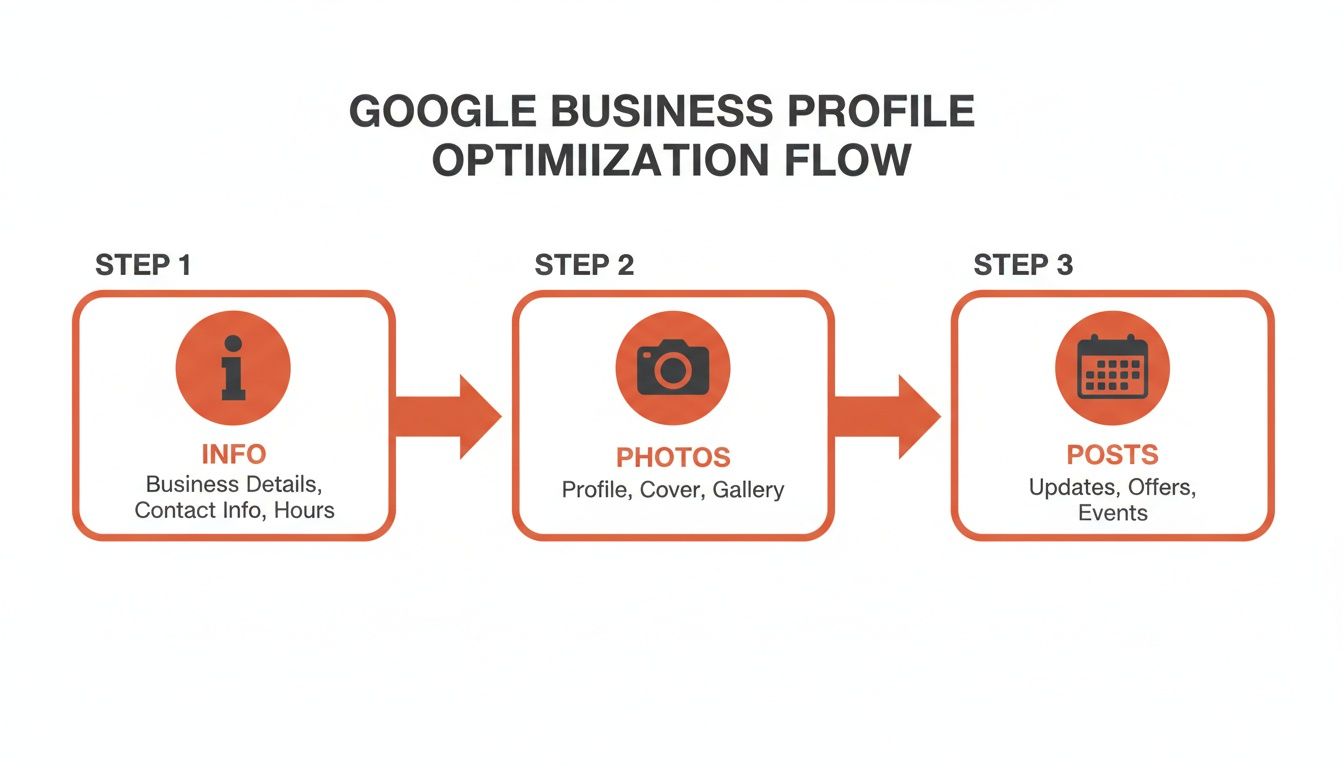
The real takeaway here is that a top-performing profile isn't a "set it and forget it" task. It needs a mix of solid data, dynamic content, and regular interaction.
Leveraging Advanced GBP Features
To really pull ahead of the competition, you need to use the full suite of features Google gives you. These tools are designed to drive engagement and give customers timely information without them ever having to leave the search results page.
Google Posts
This is your mini-billboard. Use Posts to announce special offers, highlight a new product, or promote an upcoming event. A standard post lasts for seven days (unless it's for an event), which creates a bit of urgency and, more importantly, shows Google your profile is active and current.
Q&A Section
Don’t wait for customers to ask questions—get ahead of them. You can (and should) seed the Questions & Answers section with your own FAQs. Post common questions and provide clear, detailed answers yourself. This stops misinformation in its tracks and positions you as a helpful expert from the get-go.
Products and Services
Make it painfully obvious what you sell. Use the Products and Services sections to list out your specific offerings. If you run a retail store, this is where you can showcase individual items with photos and pricing. For a service business, it’s your menu—think "Residential Window Cleaning" or "Commercial Electrical Inspection." It makes what you do crystal clear at a glance.
To help you stay on track, we've put together a simple checklist covering all the critical optimisation points.
Google Business Profile Optimisation Checklist
Use this checklist to run a quick audit of your own GBP or to guide you through a full optimisation process. Ticking off each of these boxes ensures you're giving Google every possible signal that your business is relevant, active, and trustworthy.
| Optimisation Area | Action Item | Why It Matters |
|---|---|---|
| Core Information | Verify NAP (Name, Address, Phone) is 100% consistent with your website. | Consistency is a massive trust signal for Google. Mismatches hurt your ranking. |
| Categories | Select the most specific Primary Category. Add all relevant Secondary Categories. | This is the #1 factor in determining which searches you appear for. Be precise. |
| Business Description | Write a compelling, keyword-rich description (up to 750 characters). | Your chance to sell your story and include local keywords naturally. |
| Photos & Videos | Upload high-quality photos (exterior, interior, team, products). Add a video if possible. | Visuals dramatically increase engagement and help customers choose you. |
| Google Posts | Publish a new Post at least once a week (offers, events, updates). | Keeps your profile fresh and signals to Google that your business is active. |
| Reviews | Actively request reviews from happy customers. Respond to ALL reviews (good and bad). | Reviews are a huge ranking factor. Responding shows you care and builds trust. |
| Q&A Section | Proactively add and answer frequently asked questions. | Positions you as an authority and helps customers overcome buying objections. |
| Products/Services | Add detailed listings of your products or services with descriptions and prices. | Makes your offerings clear directly in the search results, qualifying leads faster. |
| Attributes | Select all relevant attributes (e.g., "wheelchair accessible," "free Wi-Fi"). | Helps you appear in filtered or specific searches (e.g., "cafe with outdoor seating"). |
Running through this checklist periodically is a great habit. It ensures your digital storefront is always in top shape, ready to attract and convert local customers.
Building Trust with Citations and Reviews
With a perfectly tuned Google Business Profile, you've built a strong foundation. Now it's time to expand your digital footprint and build authority across the wider web. This is where citations and online reviews become your most powerful tools for building trust with both search engines and potential customers.
Think of it like this: if your GBP is your digital storefront, citations are the signposts all over town pointing people toward it. They're simply mentions of your business's core information online, scattered across relevant directories and websites.
The Power of NAP Consistency
The cornerstone of any effective citation strategy is NAP consistency. This acronym is crucial, standing for your business Name, Address, and Phone number.
For search engines like Google, seeing the exact same NAP information across dozens of different websites is a massive trust signal. It confirms that your business is legitimate, established, and located where you say it is.
Even a tiny variation, like listing your business as "Smith St." on one directory and "Smith Street" on another, can dilute this signal and confuse the algorithms. Consistency is absolutely key to a successful local business seo campaign.
Your goal is to ensure these core details are identical everywhere they appear. We're talking about places like:
- High-authority national directories: Think Yellow Pages, TrueLocal, and Yelp.
- Industry-specific sites: For a restaurant, this might be Zomato; for a tradie, it could be Hipages.
- Local business associations: Your local Chamber of Commerce or neighbourhood business group websites are goldmines for hyper-relevant citations.
Generating a Steady Stream of Positive Reviews
Reviews are the modern-day word-of-mouth. Plain and simple. They're one of the most significant factors in local search rankings and, more importantly, in a customer's final decision. A steady flow of positive, recent reviews signals to Google that your business is active, popular, and delivering great service.
The key is to make the review process as simple as possible for your happy customers. You don’t need a complicated system. Often, the best approach is a direct, personal ask right after a successful transaction or service.
Pro Tip: Create a direct link to your GBP review form using a free online tool. You can then turn this long URL into a short link (like bit.ly/YourBusinessReview) or a QR code to print on receipts, business cards, or invoices. This removes all friction for the customer.
Don't just collect reviews; engage with them. Responding to every single one—both positive and negative—shows you value customer feedback. Thanking a customer for a positive review reinforces their good experience. Meanwhile, a professional, empathetic response to a negative review can often turn a bad situation around and show prospective customers that you genuinely care.
This effort pays off. An impressive 28% of all local searches in Australia result in a purchase, highlighting the immediate commercial intent of people searching for local services. When someone searches for 'best dentist near me Perth', they are ready to book an appointment, and your reviews are often the final piece of social proof they need. You can find more insights on the power of local search over at birdeye.com.
Your Review Management Playbook
A structured approach to review management will always yield the best results. Here's a simple playbook to follow.
- Simplify the Ask: Make it effortless. Send a follow-up email or SMS with a direct link to your review page. Put a QR code on your front counter. Just make it easy.
- Respond Promptly: Aim to reply to all new reviews within 24-48 hours. This shows you're paying attention and you appreciate the feedback.
- Handle Negativity Gracefully: Always respond publicly to negative feedback. Acknowledge the issue, apologise sincerely, and offer to take the conversation offline to resolve it. Never get into a public argument.
- Showcase Your Best Reviews: Leverage your hard-earned social proof! Use screenshots of positive testimonials on your website's homepage, service pages, and social media channels to attract even more customers.
Optimising Your Website For Local Search
Alright, with your Google Business Profile dialled in and your citations looking sharp, it’s time to turn our attention to your most important digital asset: your website. This is where you seal the deal, turning local interest into actual customers. For your site to pull its weight in local search, it needs to consistently send clear, geographic signals to both Google and your visitors.
This whole process is what we call on-page SEO. It’s about weaving your location into the very fabric of your site's content and code, making it undeniably obvious where you operate and who you serve. Get this right, and when someone in your area searches for what you do, your website will be right there at the top of the list.
Weaving Location Into Your Core Pages
The simplest way to signal local relevance is to sprinkle location-based keywords into your most important pages. Now, this doesn’t mean cramming "plumber in Ballarat" into every other sentence—that’s old-school and ineffective. It's about smart, strategic placement in the spots search engines care about most.
Start with the basics:
- Title Tags: This is one of the heaviest hitters for on-page ranking. A killer format is
Primary Service | Location | Brand Name. So, a bakery’s homepage title might look like:Artisan Sourdough & Pastries | Newcastle | The Flour Mill. - Meta Descriptions: While not a direct ranking factor, a good meta description is your sales pitch in the search results. Mentioning your location here—like "Sydney's trusted family law specialists"—tells local searchers you're the right choice and boosts your click-through rate.
- H1 Headings: Your main page heading (the H1 tag) needs to be crystal clear. Something like
Emergency Electrical Services in Parramattaleaves absolutely no doubt about what the page is for.
This isn't just for Google. It immediately reassures human visitors they’ve landed in the right place, which helps reduce bounce rates and builds trust from the get-go.
The Power Of Dedicated Location And Service Pages
If your business serves a few different suburbs or offers several distinct services, creating dedicated pages for each combination is an absolute game-changer. A single, generic "Services" page just can't compete with landing pages that are laser-focused on a specific need.
Think about a cleaning company that covers both Wollongong and Shellharbour. They should build out separate pages like:
yourbusiness.com.au/commercial-cleaning-wollongongyourbusiness.com.au/residential-cleaning-shellharbour
Each page can then be loaded with unique, hyper-local content. You can feature testimonials from Wollongong clients on one page, and mention specific projects completed in Shellharbour on the other. A great example of this is seen when optimising for local keywords for professional services in specific towns.
This granular approach is how you win the "long-tail" local search game. A user searching for "end-of-lease cleaning Wollongong" is a far hotter lead than someone just typing "cleaners," and a dedicated page is infinitely more likely to rank for that specific, high-intent query.
Demystifying Local Business Schema
Okay, let's peek behind the curtain at a powerful tool called schema markup. In simple terms, it's a snippet of code you add to your website that acts as a translator, speaking directly to Google in a language it perfectly understands. It spells out your business details in a structured way, leaving no room for interpretation.
Specifically, LocalBusiness schema lets you clearly define details like:
- Your official business name
- Your exact street address
- Phone number and email
- Opening hours
- The geographic areas you serve
Adding this code to your site reinforces all the NAP (Name, Address, Phone) information from your Google Business Profile and other citations, creating a rock-solid, consistent signal. It removes all the guesswork for search engines, making it much easier for them to feature you in local search results like maps and knowledge panels.
While it sounds a bit nerdy, many website platforms (like WordPress) and SEO plugins can generate and add this code for you—no developer required. If you want to get your hands dirty with the technical side of things, a good technical SEO auditing guide is a fantastic place to start. It’s a small technical step that gives you a massive edge in a competitive local market.
Creating Content That Gets Local Customers Talking
Content is the absolute engine of any solid digital strategy, and for local SEO, it's no different. But let's be clear: we're not talking about generic, keyword-stuffed articles churned out for the sake of it.
The real key to winning your local market is to create content that genuinely helps your community. It’s about answering the specific questions your neighbours are asking and cementing your reputation as the go-to expert on the block. When you get this right, you don't just attract customers—you start earning valuable backlinks naturally.
Great local content speaks directly to the needs and interests of people in your specific area. It’s less about broad, sweeping topics and more about what matters on a street-by-street level. You've got to think like a local, because that’s exactly who you’re trying to reach.
Brainstorming Hyper-Local Content Ideas
Often, the best content ideas are hiding in plain sight—they come from the questions your customers are already asking you every day. What are their common frustrations? What information would make their lives just a little bit easier? Kicking off a brainstorm session around these real-world queries is a fantastic place to start.
Here are a few proven content formats that work wonders for local businesses:
- Community Guides: Go deep and create the definitive guide to a local event, a specific neighbourhood, or a popular activity. A real estate agent in Sydney could write "The Ultimate Guide to Family Fun in the Sutherland Shire," while a cafe in Adelaide could create a "Dog-Friendly Parks of Adelaide" map and blog post.
- Local Case Studies: Nothing builds trust like showing your work with a recognisable local client. A web designer could publish a detailed story on how they helped a well-known Geelong boutique triple its online sales. This isn't just a testimonial; it's powerful social proof that hits close to home.
- "Best Of" Listicles: These are always a hit. A mechanic could publish a post on "The 5 Best Scenic Drives Near Toowoomba," subtly positioning their workshop as the place to get your car road-trip-ready.
This kind of content just works because it delivers genuine value beyond a sales pitch. It shows you’re actually invested in the community you serve.
Building Links Within Your Community
Think of backlinks as votes of confidence from other websites. They are a massive factor in how search engines decide to rank your site. For a local business, the most potent links you can get are from other local organisations.
This process, known as link building, is a cornerstone of any serious SEO effort. You can get a deeper understanding of how it fits into the bigger picture by exploring our detailed guide on the differences between on-page and off-page SEO.
Treat local link building like digital networking. It’s all about forging real relationships in your community that then translate into online authority.
The goal isn't just to get a link; it's to embed your business into the local digital ecosystem. A link from the local newspaper or a neighbouring business carries far more weight for local rankings than a random link from a blog halfway across the world.
Practical Strategies for Local Link Building
Getting high-quality local links isn’t a passive activity. It requires proactive outreach and getting involved in your community in authentic, meaningful ways.
Here are some actionable strategies to get you started:
- Sponsor a Local Team or Event: Whether it’s the local footy club, a school fete, or a charity fun run, sponsorships almost always come with a thank-you link from the organiser's website. This is an easy win and a brilliant way to show your community support.
- Partner with Neighbouring Businesses: Find a non-competing business in your area and team up for a joint promotion. A florist and a bakery, for instance, could offer a "Mother's Day Gift Package." You can then both write a blog post about the partnership and link to each other’s websites. It's a win-win.
- Host a Local Workshop or Event: Run a free workshop at your place of business and list it on local event websites like Eventbrite or your local council’s "What's On" page. These listings almost always include a link back to your site.
- Connect with Local Bloggers and News Outlets: Do you have a unique story to tell, a special achievement, or an interesting new product? Don't be shy—reach out to local journalists and bloggers. A single feature in a local publication can send a flood of relevant traffic your way and provide a high-authority backlink that gives your local SEO a serious boost.
Tracking Your Local SEO Performance
You can't improve what you don't measure. After putting in all the hard work to get your digital presence humming, the next logical step is to track what’s actually moving the needle. Measuring performance is how you refine your local business seo strategy, ensuring your efforts translate into real-world results like phone calls, store visits, and sales. It's about swapping guesswork for data-driven decisions.
This whole process kicks off with your most powerful local tool: your Google Business Profile. The data it dishes out offers a direct line of sight into how potential customers are engaging with your business, straight from the search results page.
Unlocking Google Business Profile Insights
Your GBP dashboard is an absolute goldmine of performance data. This isn't just abstract website traffic; these are high-intent actions from people in your area actively looking for what you offer.
Here are the key metrics you need to keep a close eye on:
- How customers search for your business: This chart shows if people found you via a "Direct" search (typing your business name), "Discovery" (searching a category, like "cafe near me"), or "Branded" search (searching for a brand you stock). A high number of Discovery searches is a fantastic sign your local SEO is doing its job.
- Customer actions: This is where the money is. It tracks how many people clicked to call, requested directions to your location, or visited your website right from your GBP listing. A steady increase here is the clearest sign of a positive return on your time and effort.
These insights tell a powerful story. For instance, if you see a sudden spike in direction requests right after running a local promotion using Google Posts, you've got a direct link between your activity and real-world customer behaviour.
Monitoring Keyword Rankings and Organic Traffic
While GBP Insights are invaluable, you also need the bigger picture of your website's performance. This is where tools like Google Search Console and Google Analytics come into play. They help you understand how visible you are in organic search and what happens once someone actually clicks through to your site.
In Google Search Console, dive into the "Performance" report. You can filter by queries containing your city or suburb to see precisely which local keywords are driving impressions and clicks. Are you ranking for "emergency plumber Parramatta" or just "plumber"? This data is your roadmap for refining the content on your service and location pages.
Meanwhile, Google Analytics tells you what people do after they land on your site. Setting up goal tracking is non-negotiable here. You need to measure key actions like form submissions, phone number clicks, and newsletter sign-ups. For anyone looking to really nail this, understanding the fundamentals of website conversion tracking is an excellent starting point.
Tracking these metrics together gives you the complete picture. Search Console shows you how you’re getting found, while Analytics tells you how well your website converts that interest into leads.
To make sense of it all, here’s a quick breakdown of the metrics that matter most and where to find them.
Key Metrics for Local SEO Success
| Metric | What It Measures | Tool to Use | Why It's Important |
|---|---|---|---|
| GBP Discovery Searches | How many people find you by searching for a product or service, not your business name. | Google Business Profile Insights | This is a direct measure of your local SEO visibility to new customers. |
| GBP Customer Actions | Clicks for directions, phone calls, and website visits originating from your GBP listing. | Google Business Profile Insights | These are high-intent actions that often lead directly to sales or inquiries. |
| Local Keyword Rankings | Your website's position in search results for geographically specific keywords (e.g., "best pizza in Richmond"). | Google Search Console, Third-party rank trackers | Shows your visibility for the exact terms local customers are using to find you. |
| Organic Traffic from Local Area | The number of visitors coming to your site from organic search who are physically located in your target service area. | Google Analytics (with location filters) | Confirms that your SEO efforts are attracting a relevant, local audience. |
| Goal Completions | The number of times users complete a desired action on your site, like filling out a contact form or clicking to call. | Google Analytics | This connects your traffic to tangible business outcomes and measures conversion rates. |
| Local Pack Visibility | How often your business appears in the "map pack" at the top of local search results. | Third-party rank trackers, manual checks | The Local Pack gets prime real estate and drives a huge portion of local clicks. |
Tracking these specific metrics will give you a clear, actionable view of how your local SEO is performing and where you can make improvements.
The Synergy Between Local SEO and PPC
Finally, it's crucial to understand that local SEO doesn't operate in a vacuum. It works hand-in-hand with paid advertising, especially local pay-per-click (PPC) campaigns. When used together, they create a powerful one-two punch that can help you dominate local search results.
A strong organic presence built through SEO can actually lower your ad costs. When Google sees your website as a highly relevant and authoritative result for a search term, it might reward you with a higher Quality Score for your ads. This often leads to better ad positions at a lower cost per click.
On the flip side, your local PPC campaigns are a treasure trove of keyword data. The immediate feedback from paid ads tells you exactly which search terms are converting into customers. You can then take these proven, high-intent keywords and double down on them in your SEO strategy—optimising your GBP, website content, and blog posts to rank organically for them.
It’s a perfect feedback loop where paid insights fuel long-term organic growth. This integrated approach ensures your local business seo and advertising efforts are always working in concert, maximising your visibility and driving more customers through the door.
Got Questions About Local Business SEO? You're Not Alone.
Diving into local SEO can feel like opening a can of worms. As you start putting these strategies into action, it's natural to have questions pop up about timelines, costs, and whether certain tasks are really worth the effort.
This is the part where we tackle the most common queries we get from Australian business owners just like you. We've put together some straight-shooting answers to help you set realistic expectations and make confident decisions.
How Long Does Local SEO Take to Show Results?
This is the million-dollar question, isn't it? While some quick wins—like a solid Google Business Profile optimisation—can start moving the needle in just a few weeks, a proper local SEO strategy is a long game. Think marathon, not a sprint.
Generally, you can expect to see significant, measurable improvements in your rankings, website traffic, and leads within three to six months. But that's with consistent effort. Factors like how competitive your industry is, your specific location, and how much work you're putting into content and link building all play a huge role. It’s not a set-and-forget fix; it's an ongoing process of building your local authority.
Can I Do Local SEO Myself or Should I Hire an Agency?
Honestly, you can absolutely get started on your own. Many of the foundational local SEO tasks are perfectly manageable for a hands-on business owner. Claiming and optimising your Google Business Profile, managing your business listings (citations), and responding to reviews are all things you can tackle in-house.
The tipping point comes when your business grows, and the more technical side of SEO becomes too complex or time-consuming. Advanced tactics like implementing schema markup, building out a strategic local content plan, or running a consistent link-building campaign require real expertise. An agency brings dedicated resources and powerful tools to the table, which can seriously accelerate your growth and free you up to do what you do best—run your business.
What Is the Difference Between Local SEO and Traditional SEO?
The key difference boils down to one word: geography.
Traditional SEO aims to rank a website for broad keywords on a national or even global scale. Think of a blog about baking recipes—it wants to be found by anyone, anywhere in the world, who's searching for "how to make sourdough."
Local SEO, on the other hand, is all about winning in a specific geographic area. Its main goal is to make your business hyper-visible to potential customers right in your neighbourhood. It relies on a unique set of signals to do this, including:
- Local citations (making sure your Name, Address, and Phone number are consistent everywhere online)
- Location-specific keywords (like 'plumber in Parramatta' or 'cafe near me')
- A fully optimised Google Business Profile
The endgame for local SEO is to dominate the 'Map Pack' and show up in localised organic results for people nearby who are ready to buy.
The searcher's intent is completely different. Traditional SEO targets a wide audience interested in a topic, while local SEO targets a nearby audience actively looking to make a purchase or enquiry.
How Important Are Customer Reviews for My Local Ranking?
Incredibly important. Customer reviews aren't just a nice-to-have; they are a direct and powerful ranking factor, especially for getting into that coveted local map pack.
Google sees a steady stream of positive, recent reviews as a massive signal of trust and relevance. It tells search engines that your business is not only active but also genuinely valued by real people in the community.
And let's not forget the human element. Reviews heavily influence whether a potential customer chooses you over a competitor. The data is clear: the vast majority of people read online reviews before deciding where to spend their money. They're essential for both your search visibility and your conversion rate.
At Click Click Bang Bang, we craft data-driven SEO and PPC strategies that connect local businesses with their communities. If you're ready to turn local searches into loyal customers, let's have a chat. Learn more about our approach.
Read NeXt
Or Read Our Latest
- Manual vs Automated Bidding for PPC Success
- Conversion Tracking Setup: A Complete AU Guide
- Instagram Advertising Australia: Complete 2026 Guide
- Pay Per Click: A Beginner’s Guide for Australian Marketers
- Display Advertising on Google: The Complete Australian Guide
- Stakeholder Communication Plan How to Build One That Works
Click. CLick. Subscribe.
Get our best PPC insights, industry updates, and power moves delivered straight to your inbox. No fluff, just high-caliber strategies that actually work.
Don’t Leave Just Yet
Try Us For 30-Days,
Risk Free!!
We guarantee that you’ll love our work within the first 30 days, if not you’ll get your money back.
What have you got to lose?