

A Practical Guide to Legal Firm SEO
Last Updated

A powerful online presence for your firm doesn’t just happen—it's built on a flawless technical foundation. Getting this right is the first, most critical step. It’s the blueprint for auditing your website, fixing the issues that are quietly hurting your rankings, and setting the stage for every piece of legal firm SEO that follows.
Building Your Technical SEO Foundation
Think of your law firm's website as a high-performance vehicle. You can have the sharpest legal minds and the most compelling marketing message in the world, but if the engine is sputtering, you’re not going to win any races.
Technical SEO is the engine room of your digital presence. It’s all the behind-the-scenes work that ensures search engines can find, crawl, and understand your content efficiently.
Without a solid technical base, even the most brilliant content or aggressive link-building campaigns will fall flat. It’s about creating a seamless user experience that signals trust and authority to both Google and your potential clients.
This simple flow chart breaks down the core pillars of a strong technical foundation for any legal practice.
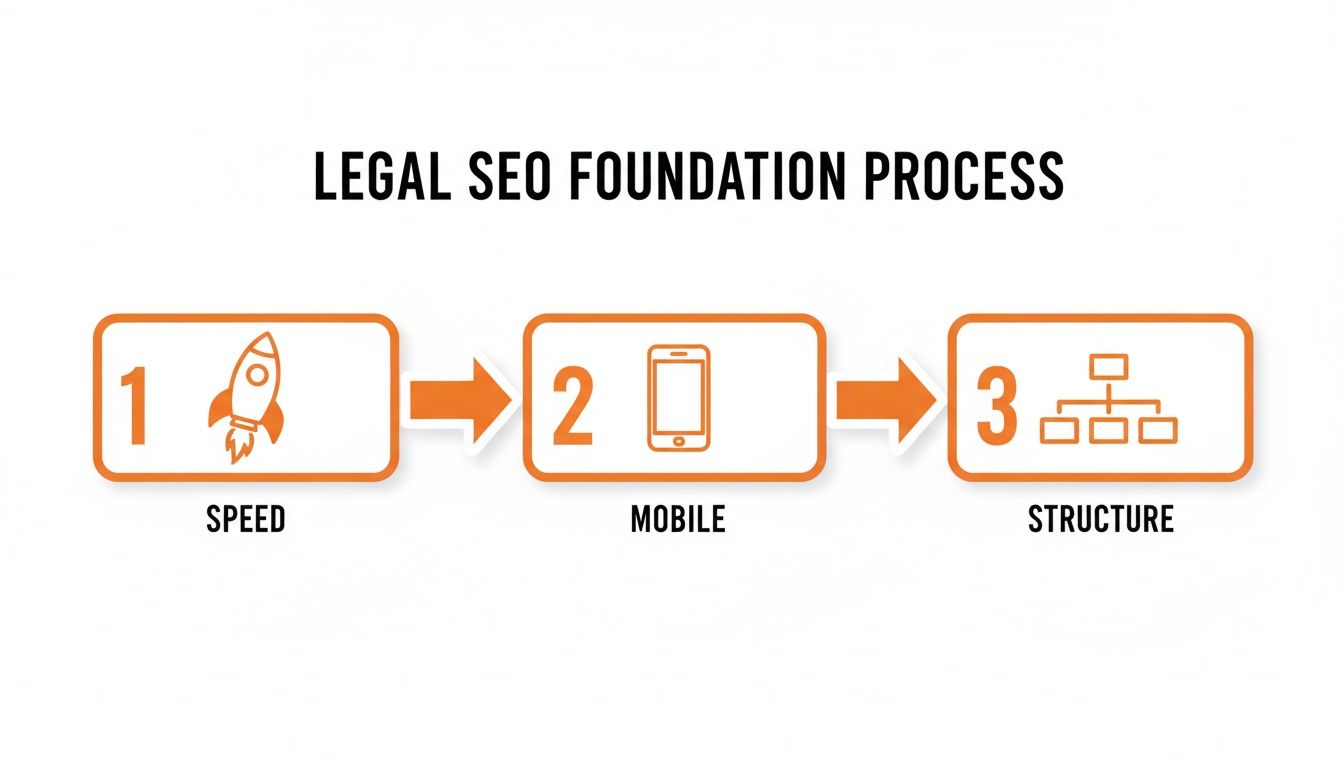
As you can see, mastering speed, mobile-friendliness, and site structure creates a powerful and stable base for growth. Let's dig into how you can get it done.
Conducting a Comprehensive Site Audit
Before you can build a strong foundation, you have to understand its current state. A site audit is like a diagnostic check-up, analysing your website to identify its strengths and, more importantly, its weaknesses. You can't fix problems you don't know exist.
I've seen countless firms invest in new content only to have it disappear into a technical black hole. The audit prevents that.
Key areas to investigate include:
- Crawlability and Indexability: Can search engine bots easily navigate and index all the important pages on your site? Things like broken links or sneaky "noindex" tags can make entire sections of your site invisible to Google.
- Duplicate Content: Do multiple URLs lead to the same or very similar content? This is a surprisingly common issue that dilutes your ranking power and confuses search engines.
- Site Security (HTTPS): A secure website is non-negotiable. Google prioritises secure sites, and clients absolutely expect it. An
http://site screams "outdated and untrustworthy."
Tools like Google Search Console and Ahrefs have robust site audit features that can automatically pinpoint these technical flaws. For a much deeper dive into this process, check out our complete guide to technical SEO auditing.
Optimising for Site Speed and Mobile Experience
In an era of instant gratification, speed is everything. A slow-loading website is a massive turn-off for potential clients and a clear negative ranking signal for Google. Pages that load quickly provide a better user experience and consistently rank higher. Simple as that.
Remember, a one-second delay in page load time can result in a 7% reduction in conversions. For a law firm, that translates directly to lost client enquiries and revenue.
Just as important is the mobile experience. Google now primarily uses the mobile version of a website for indexing and ranking (this is called "mobile-first indexing"). Your firm’s site absolutely must be fully functional and easy to navigate on a smartphone, which is where a huge portion of your potential clients are searching for legal help—often in a moment of distress.
Creating a Logical Site Structure
A clear, logical site structure helps both users and search engines. It acts as a roadmap, guiding visitors to the information they need while helping search engine crawlers understand the hierarchy and relationship between your pages.
A well-organised site often follows a simple, intuitive hierarchy:
- Homepage: The front door to your firm.
- Practice Area Pages: Top-level pages for major services (e.g., Family Law, Criminal Defence).
- Specific Service Pages: More detailed pages nested under the main practice areas (e.g., Divorce, Child Custody, Bail Applications).
- Supporting Content: Blog posts, lawyer bios, and FAQ pages that link back to the relevant service pages.
This organisation doesn't just improve navigation; it also helps spread "link equity" or authority throughout your site. When you build a logical structure, you create a website that’s easy for clients to use and simple for Google to reward with higher rankings.
Winning the Local Search Battlefront
For most law firms, your highest-value clients aren't scattered across the country; they're right in your neighbourhood. That’s why winning in local search is a non-negotiable part of modern legal firm SEO. It’s all about being the first name a potential client sees when they’re in a bind, frantically searching for "family lawyer near me" on their phone.
This isn't just about having a website. It’s about turning your digital presence into a local powerhouse that consistently pulls in high-intent clients who are ready to make a call. The battle for these clients is won or lost in the local search results—specifically, in the Google Maps "Local Pack."
Your Google Business Profile Is Your Digital Front Door
Think of your Google Business Profile (GBP) as your most critical local SEO asset. For many potential clients, it’s the very first interaction they'll have with your firm. A neglected or incomplete profile sends a bad signal, suggesting a lack of attention to detail—not exactly a quality you want associated with a legal practice.
A fully optimised profile, on the other hand, acts like a powerful client-generation machine. It builds immediate trust and gives someone all the information they need to make a decision, right there in the search results.
Here’s what a client sees when they search for legal help in their area, with the GBP-powered "Local Pack" dominating the screen.

This prime digital real estate is precisely why mastering your GBP is so crucial for attracting local enquiries before they even think about clicking through to a website.
To make your profile a true asset, you have to go beyond just listing your firm's name and address.
- Select Precise Categories: Don't just list "Law Firm." Get specific. Use primary categories like "Family Law Attorney" or "Criminal Justice Attorney," and then add secondary categories for all your other practice areas.
- Add High-Quality Photos: Show, don't just tell. Include professional photos of your office (inside and out), your team, and headshots of the solicitors. This humanises your firm and builds instant rapport.
- Utilise Google Posts: Think of Posts as mini-blog updates that appear directly on your profile. You can share firm news, highlight a recent case win (ethically, of course), or link to a new insightful blog article. Posting regularly signals to Google that your profile is active and relevant.
A well-managed Google Business Profile isn't just a directory listing; it's a dynamic marketing channel. It provides critical social proof and makes it incredibly easy for stressed-out clients to contact you in their moment of need.
The Power of Reviews and Local Citations
Positive client reviews are the currency of local trust. They're one of the most powerful signals for both potential clients and Google's ranking algorithm. A steady stream of authentic, positive reviews tells search engines that your firm is a credible and authoritative choice in your area.
The key is developing a simple, repeatable process for requesting reviews. This could be through automated email follow-ups after a case concludes or by giving clients a simple one-sheet with a direct link to leave a review.
Beyond reviews, local citations are crucial. These are simply mentions of your firm's name, address, and phone number (NAP) on other reputable local websites and directories.
Consistency is everything here. Your NAP information must be identical across every single platform—from your own website to legal directories like FindLaw, Avvo, and your local chamber of commerce site. Any inconsistencies create confusion for search engines and can hurt your local rankings. Kicking off any local SEO campaign with a thorough audit of your existing citations is a vital first step.
Engaging Your Community with GBP Features
An advanced local strategy means actively using GBP's interactive features to engage with your community. The Questions & Answers (Q&A) section, for example, is a goldmine for demonstrating expertise.
You can proactively populate this section yourself by asking and answering the common questions your clients have. For instance, a family law firm could ask, "What is the process for filing for divorce in NSW?" and then provide a clear, helpful answer. This not only helps potential clients but also lets you control the narrative and showcase your knowledge.
The importance of a robust local strategy cannot be overstated. By 2026, a striking 50% of Australian legal firms have identified SEO as their top marketing investment priority. Local SEO via Google Business Profiles amplifies this, with fully optimised profiles driving up to 7 times more traffic, and 50-60% of phone calls originating from the Google Maps Pack rather than organic results. You can read more about these law firm marketing statistics from PracticeProof.
For a complete breakdown of building an SEO strategy from the ground up, you might be interested in our dedicated SEO guide for lawyers. This comprehensive approach—combining a perfect GBP with stellar reviews and local engagement—puts your firm directly in front of clients when and where it matters most.
Crafting Content That Converts Prospects into Clients
Let's be blunt: a technically flawless website is useless if it doesn't have the right words on it. Your content is the engine driving your entire SEO strategy. It’s what turns a frantic late-night search into a booked consultation.
Without quality, targeted content, you're invisible. It's the critical bridge connecting someone's urgent legal problem with your firm's expert solution. The goal isn't just to fill pages; it's to build a library of resources that speaks directly to the fears, questions, and needs of your ideal clients.
Good content builds trust and demonstrates authority long before they ever pick up the phone.

Developing Pillar Service Pages
Think of your service pages as the digital storefronts for each practice area. They need to be much more than a simple list of what you do. They must be comprehensive, authoritative resources that answer every conceivable question a potential client has about that specific legal issue.
Put yourself in their shoes. Someone searching for "drink driving lawyer Sydney" isn't just looking for a phone number. They're stressed, scared, and desperate for reassurance and expertise.
Your service pages need to deliver that. They should include:
- A clear explanation of the legal issue: Break down the problem in simple, accessible terms. Ditch the dense legal jargon.
- An overview of the legal process: What happens next? Walk them through the steps involved after they hire you.
- Answers to common questions: Directly address the top 3-5 questions you hear from every new client for that service.
- Clear calls-to-action (CTAs): Make it incredibly easy to take the next step, whether it's calling for a free chat or filling out a contact form.
Answering Questions with Strategic Blog Content
While your service pages are for people ready to hire, your blog is for everyone else. It captures potential clients in the earlier "awareness" and "consideration" stages of their journey.
These are the people who know they have a problem but aren't ready to commit. They're searching for answers, not necessarily a solicitor. A sharp blog strategy positions your firm as a helpful, knowledgeable guide. You're not selling; you're educating. This builds incredible trust, making you the obvious choice when they are ready to act.
For instance, a family law practice could publish posts like:
- "What Are My Rights in a De Facto Separation in Victoria?"
- "How Is Property Divided in a Divorce in Australia?"
- "5 Common Mistakes to Avoid During Child Custody Negotiations"
Each post needs to be a deep dive into a specific topic, offering genuine value and insight. This is also a fantastic way to target long-tail keywords—those longer, more specific search phrases that signal a user is looking for detailed information.
As you build out your content, you might consider how AI can help brainstorm and structure your articles. There are some excellent guides on using ChatGPT for legal content creation that offer practical tips without sacrificing quality.
Mapping Content to the Client Journey
A truly effective content strategy anticipates a client's needs at every single step. By mapping your content to their journey, you make sure you have the right information ready for them at the right time.
This journey typically breaks down into three key phases:
- Awareness: The person realises they have a legal problem but is unsure what to do. They use informational keywords like "what happens if you get a DUI" or "signs of an unfair dismissal." This is where blog posts and guides shine.
- Consideration: They are now actively researching solutions and comparing firms. Searches might look like "best criminal lawyer near me" or "reviews for family law firms." Strong service pages, case studies, and client testimonials are vital here.
- Decision: The prospect is ready to hire. They are searching for your firm by name or looking for contact details. Your optimised Google Business Profile and a clear, easy-to-find "Contact Us" page are absolutely critical at this final stage.
The power of an integrated content strategy is undeniable. It's not about creating one type of content; it's about building a complete ecosystem that nurtures a prospect from their initial query all the way to becoming a client.
This methodical approach delivers real, measurable results. As a prime example, Australian SEO agency Temerity Digital achieved a 300% increase in organic traffic for a client in just 12 months, along with a 4x surge in conversions. This came from a holistic strategy of meticulous keyword research, creating new core service pages, and perfecting their GBP. You can dig into the details in their potent lawyer SEO case study on TemerityDigital.com.au.
By building out content that serves each phase of this journey, you create a powerful conversion funnel that consistently turns online searchers into paying clients for your firm.
Building Unshakeable Authority and Trust
In the legal world, authority isn't just a buzzword—it's everything. It's the foundation of your online presence. Google needs to see your firm not just as another website, but as a genuinely credible and trustworthy source of legal information. Without that trust, even the most brilliantly written content will struggle to see the light of day on page one.
This is where you build your digital reputation. It’s done through two powerful, interconnected strategies: earning high-quality backlinks and getting your technical schema markup right. Get these two sorted, and you're sending clear signals to search engines that your firm is a leader in its field.

Earning High-Quality Backlinks The Right Way
Think of a backlink from another website as a professional referral. When a trusted site links to yours, it’s essentially vouching for you, telling Google your content has value. But be warned: not all links are created equal. The game here is all about quality over quantity.
A few links from spammy, irrelevant sites can do more harm than good, so your strategy needs to centre on earning links from authoritative sources within the legal and local community.
Here are a few practical, ethical ways to do it:
- Legal Directories: Getting listed in respected legal directories is step one. Make sure your profile is complete, accurate, and consistent everywhere it appears.
- Local News and Community Sites: Has your firm sponsored a local charity event or offered a pro bono service recently? These are perfect opportunities to get a mention and a link from a local news outlet or community blog.
- Industry Associations: Links from state bar associations or specialty legal organisations carry serious weight. If you're a member, double-check that your public profile links back to your firm’s website.
- Guest Content: Don't just think about legal publications. Offer to write an insightful article for a related professional blog—maybe for an audience of accountants or real estate agents—providing real value to their readers while earning a link back to your site.
Building a strong backlink profile is a long game. It’s not about finding quick wins. It’s about steadily building relationships and creating content so genuinely useful that other authorities want to reference it.
Demystifying Legal-Specific Schema Markup
Now for the technical side of things. Schema markup is a type of code you add to your website. It doesn't change how your site looks to a human visitor, but behind the scenes, it gives search engines a perfectly organised, structured brief on your firm. It's like handing Google a neatly labelled file on your business instead of a shoebox full of receipts.
This is an incredibly powerful tool for law firm SEO because it helps you stand out from the crowd. By using legal-specific schema, you can tell Google exactly what kind of services you offer, which lawyers work at your firm, and what your specific areas of expertise are. No guesswork required.
Implementing Attorney and LegalService Schema
For law firms, there are two crucial schema types you'll want to focus on: Attorney and LegalService.
The Attorney schema is perfect for individual lawyer bio pages. It lets you specify key details like:
- Name and job title
- Qualifications and bar admissions
- Areas of practice
- A professional headshot
Then you have the LegalService schema, which is designed for your main practice area pages. This helps you define:
- The specific type of legal service (e.g., Family Law, Commercial Litigation)
- The geographic area you serve
- Your firm's name and contact details
Putting this code in place helps search engines understand your firm’s structure and expertise, which can lead to rich snippets appearing in search results. These are the enhanced listings you see with extra details like review ratings or office locations right on the search page. They take up more space, catch the eye, and can seriously boost your click-through rates.
This isn’t just a minor technical tweak; it's a strategic move to communicate your authority directly to the algorithms that control your visibility. When you combine a deliberate backlink strategy with precise schema markup, you build an unshakeable foundation of trust that both potential clients and search engines will reward.
Integrating PPC and SEO for Maximum Impact
Why treat your marketing channels like separate islands when they can work together as a powerful, coordinated force? Too many firms fall into the trap of seeing Pay-Per-Click (PPC) advertising and Search Engine Optimisation (SEO) as an either/or decision.
The reality is, a truly effective legal firm seo strategy combines both, creating a synergy that drives faster, more sustainable growth. PPC delivers immediate visibility and a firehose of valuable data, while SEO builds the kind of long-term organic authority and trust that money can't buy.
When you get them working together, you dominate the entire search engine results page (SERP), capturing clicks from different types of clients and making sure your firm is visible at every stage of their journey.
Using PPC Data to Fuel Your SEO Strategy
One of the smartest things you can do is use the instant feedback from your PPC campaigns to make better SEO decisions. Think of it this way: PPC is a fantastic, real-time testing ground for your long-term organic efforts.
Your PPC campaigns essentially become a live market research tool, telling you exactly where to invest your SEO resources for the biggest payoff.
- Discover High-Converting Keywords: Your Google Ads account will show you precisely which search terms are driving not just clicks, but actual client enquiries and signed cases. This takes the guesswork out of your SEO keyword strategy, letting you zero in on terms with proven conversion potential.
- Test Messaging and Ad Copy: Not sure which headline or value proposition clicks with potential clients? Test a few versions in your PPC ads. The winning ad copy can then be repurposed for your website’s title tags, meta descriptions, and on-page content to boost your organic click-through rates.
By using PPC to validate your keywords and messaging before you invest months into ranking for them, you significantly de-risk your SEO efforts and accelerate your return on investment.
Achieving Total SERP Dominance
Having both a top-ranking organic result and a prominent paid ad on the same search results page is the ultimate power move. This "SERP domination" strategy accomplishes a few critical things.
First, it dramatically increases your firm's visibility and physically pushes competitors further down the page. More importantly, it reinforces credibility. Seeing your firm in multiple positions signals authority and trustworthiness to a potential client. This dual presence lets you maintain visibility for your most critical, high-value keywords while your organic rankings continue to climb.
This combined approach also makes compelling financial sense. To put it in perspective, we can compare the typical investment and return for each channel.
Comparing SEO and PPC Investment for Law Firms
This table illustrates the comparative efficiency and long-term value of investing in SEO versus PPC for a typical small to medium-sized Australian law firm.
| Metric | SEO (Organic Search) | PPC (Paid Search) |
|---|---|---|
| Upfront Cost | Lower initial monthly retainer (e.g., $1,500 – $3,000/month) | Higher upfront ad spend required for visibility (e.g., $3,000 – $10,000+/month) |
| Time to Results | Slower (3-9 months to see significant traction) | Immediate (visibility starts as soon as campaigns are live) |
| Cost Per Click (CPC) | $0 (clicks are "free" once ranked) | Varies, but often high for legal terms ($50 – $200+ per click) |
| Long-Term Asset | Yes. Rankings are a durable digital asset that continues to generate traffic. | No. Traffic stops the moment you stop paying for ads. |
| Credibility & Trust | High. Organic results are often perceived as more trustworthy. | Moderate. Users know it's a paid advertisement. |
| Data & Insights | Provides broad data on user behaviour and search trends over time. | Provides granular, immediate data on keyword performance, ad copy, and conversions. |
| Typical ROI Horizon | Long-term. ROI compounds over time as rankings solidify. | Short-term. Can provide immediate leads and a clear, measurable ROI from day one. |
As you can see, SEO builds a lasting asset while PPC provides the speed and data to get there faster and smarter. The analysis consistently shows that a well-executed SEO campaign delivers an exceptional long-term ROI that often eclipses PPC in pure cost-per-acquisition. For instance, a $2,500 monthly SEO investment that secures top rankings can generate hundreds of high-value leads, far outpacing what the same budget would achieve in the hyper-competitive legal PPC auction.
Ultimately, integrating these two channels isn't about choosing one over the other; it’s about creating a holistic search engine marketing plan that maximises every dollar you spend. By playing to the strengths of each, you build a resilient, multi-faceted strategy that captures immediate leads while building a lasting digital asset for your firm's future.
For a deeper understanding of how these channels work together, you can learn more about the fundamentals of search engine marketing in our complete guide.
Answering Your Questions About Legal Firm SEO
Diving into search engine optimisation can feel like navigating a maze, often leaving law firm partners and marketing managers with more questions than answers. Getting clear, straightforward information is the first step toward making a confident and profitable investment in your firm's digital future.
Let's tackle some of the most common queries we hear about legal firm SEO.
How Much Should a Law Firm Budget for SEO?
This is the big one, and the honest answer is: it varies. A lot. The right budget really depends on how competitive your practice area is and where you're located. A personal injury lawyer in a major metro area is playing a completely different game than a wills and estates solicitor in a smaller regional town.
Generally, law firms can expect to invest anywhere from a few thousand dollars up to $15,000 or more per month for a comprehensive SEO campaign. It’s critical to see this not as a cost, but as an investment in a long-term asset that generates high-value leads. Beyond just marketing, smart firms also look for ways to improve law firm profitability, because a healthy bottom line is what fuels growth initiatives like SEO in the first place.
When Can We Expect to See Results?
Patience is more than a virtue in SEO; it's a requirement. Unlike PPC, which can get you visibility almost instantly, organic search is a long game focused on building sustainable authority. You should realistically expect a runway of at least 3 to 6 months before seeing a meaningful shift in your rankings and lead flow.
The first few months are all about laying the groundwork—technical fixes, on-page optimisations, and getting the foundations right. After that, consistent content creation and authority-building efforts start to compound, leading to more substantial gains around the six-to-nine-month mark.
Think of SEO like planting a tree. The initial effort is all about preparing the soil and planting the seed, with little to show for it above ground. But with consistent nurturing over time, it grows into a strong, resilient asset that provides value for years to come.
This timeline can be shorter or longer depending on factors like your website's age, its existing authority, and just how fierce the competition is. A brand-new website will naturally take longer to gain traction than an established site with a solid history.
Is SEO a One-Time Project or Ongoing?
One of the biggest misconceptions we see is treating SEO as a "set it and forget it" task. Nothing could be further from the truth. SEO is a continuous process. Search engine algorithms are constantly being updated, your competitors are always trying to outrank you, and your own content needs regular attention to stay relevant.
A successful legal firm SEO strategy is an ongoing function, not a one-off project. It involves:
- Monitoring and Reporting: Keeping a close eye on keyword rankings, organic traffic, and conversion rates to know what's working and what isn't.
- Content Development: Consistently publishing new blog posts, practice area pages, and guides to target new keywords and answer the real questions your potential clients are asking.
- Link Building: Continuously earning high-quality backlinks to strengthen your site's authority and credibility in Google's eyes.
- Technical Maintenance: Periodically auditing your site to ensure it remains fast, secure, and free of technical errors that could hold you back.
The only way to achieve and maintain top rankings in the competitive legal space is to treat SEO as the ongoing marketing engine it is.
At Click Click Bang Bang, we demystify SEO and deliver data-driven strategies that generate real results for law firms. If you're ready to turn your website into a powerful client acquisition tool, we invite you to explore our AI-first SEO and PPC services at https://clickclickbangbang.com.au.
Read NeXt
Or Read Our Latest
- Manual vs Automated Bidding for PPC Success
- Conversion Tracking Setup: A Complete AU Guide
- Instagram Advertising Australia: Complete 2026 Guide
- Pay Per Click: A Beginner’s Guide for Australian Marketers
- Display Advertising on Google: The Complete Australian Guide
- Stakeholder Communication Plan How to Build One That Works
Click. CLick. Subscribe.
Get our best PPC insights, industry updates, and power moves delivered straight to your inbox. No fluff, just high-caliber strategies that actually work.
Don’t Leave Just Yet
Try Us For 30-Days,
Risk Free!!
We guarantee that you’ll love our work within the first 30 days, if not you’ll get your money back.
What have you got to lose?