

A Guide to Marketing in Dentistry for Australian Practices
Last Updated

Marketing in dentistry is all about strategically attracting new patients, keeping the ones you have, and building a reputation as the trusted, go-to practice in your local area. It’s a blend of modern digital tactics, like local SEO and paid ads, fused with timeless fundamentals like reputation management and creating a brilliant patient experience. Get this mix right, and you're set up for sustainable growth.
Building Your Practice's Marketing Foundation
Before you even think about launching a campaign, you need to get your marketing foundation right. It’s like the prep work before building a house—skip it, and everything else you build on top is at risk of crumbling.
Effective marketing isn't just about throwing some money at ads and hoping for the best. It's about getting crystal clear on who you want to serve and what makes your practice the obvious choice for them.
This whole process kicks off with defining your ideal patient. Are you aiming to be the friendly, go-to family practice for young parents in the neighbourhood? Or are you focused on high-value cosmetic work like veneers and full-mouth reconstructions? Nailing this down will shape every single piece of your marketing, from the words on your website to the posts you share on social media.
Defining Your Niche and Sizing Up the Competition
Once you know who you’re talking to, it’s time for a quick look at what the competition is up to. Check out the other dental practices in your area. What services are they pushing hard? And more importantly, where are the gaps?
Maybe no one is positioning themselves as the local expert in sleep apnoea dental solutions. Perhaps there’s a real need for anxiety-free sedation dentistry that isn't being met. Spotting these opportunities allows you to carve out a unique space for yourself in a crowded market.
And believe me, it is a crowded market. In 2025, the Australian dental services industry is a massive $14.8 billion market, with over 20,980 businesses all competing for patients. This just highlights how crucial a smart marketing plan is for grabbing your slice of the pie.
The simple, repeatable process for building this foundation is all about defining, analysing, and then building.
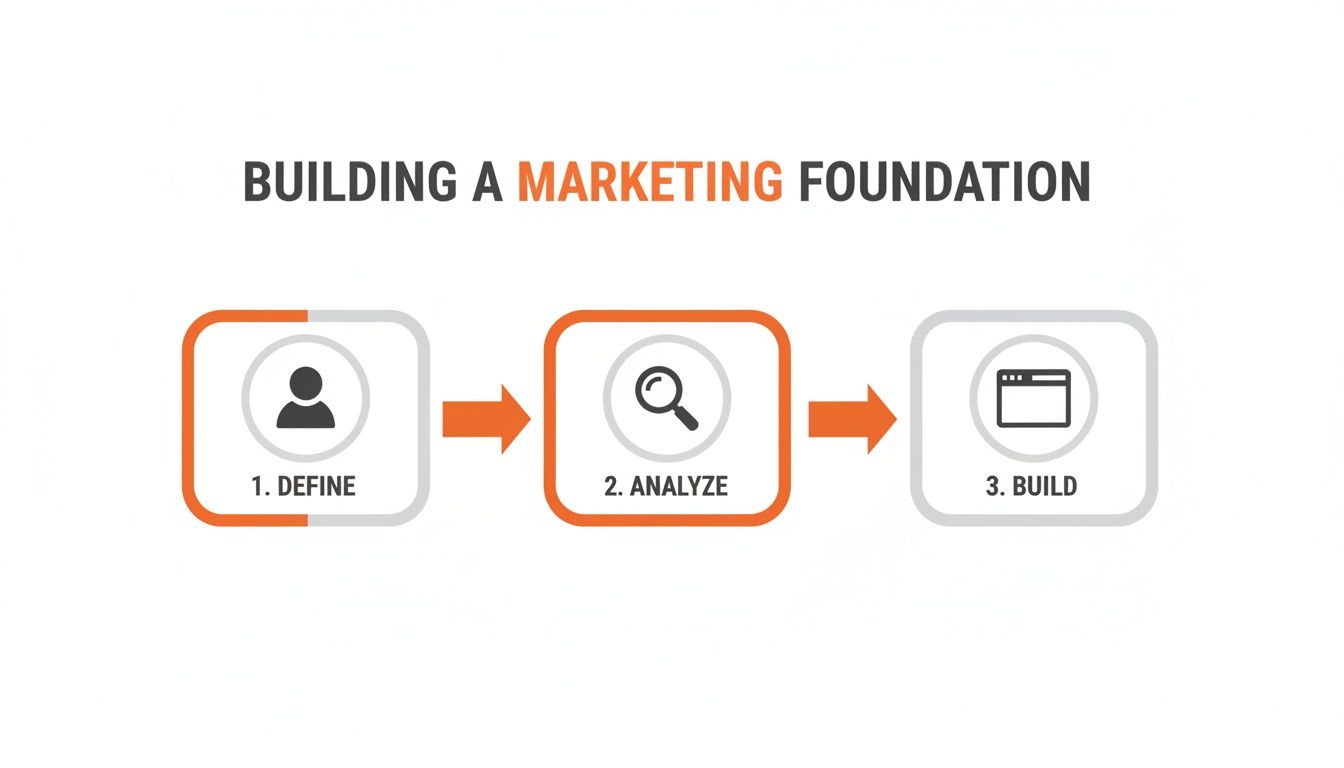
As you can see, a winning strategy always starts with defining your audience and analysing the competitive landscape before you start building out your digital presence.
Assembling Your Digital Toolkit
With your target patient and competitive angle locked in, you can start putting together your essential digital assets. These are the absolute non-negotiables for any modern dental practice.
- A Professional, Mobile-First Website: Think of your website as your digital front door. It has to be a breeze to use on a smartphone, load in a flash, and clearly tell people what you do and why you’re great at it.
- Optimised Social Media Profiles: Platforms like Facebook and Instagram are perfect for showing off your practice’s personality. Share patient success stories, introduce the team, and build genuine trust with your community.
- A Google Business Profile: This is probably your single most important tool for local marketing. It’s what gets you seen in Google Maps searches and brings in patients from just around the corner.
Your marketing foundation isn't just about getting new faces through the door. It's about creating a system that consistently delivers a positive and memorable experience, from that very first click all the way to the final check-up.
Remember, even the best marketing can be undone by a poor in-clinic experience. True success comes when you learn how to improve the overall patient experience, ensuring your marketing investment pays off with loyal patients and glowing word-of-mouth referrals.
Winning New Patients with Local SEO
For almost any dental practice, your next new patient is online right now, probably typing a search into Google for a dentist in your neighbourhood. Winning in the local search results isn’t about some secret, complex technical trick. It’s simply about being the most helpful and visible answer when someone searches “dentist near me.”
This is where local Search Engine Optimisation (SEO) becomes your most powerful tool for attracting new patients.
The whole journey kicks off with your Google Business Profile (GBP). Think of it as your digital front door on the world's biggest search engine. It's shocking how many practices set it up once and then forget about it, leaving a massive opportunity on the table. A fully optimised profile does way more than just display your address; it actively engages potential patients before they even consider clicking through to your website.
Frankly, you need to treat it like your practice's mini-website right there on Google. And just like any part of your marketing, it needs consistent attention to really work for you.
This is your control panel for how patients find you and interact with your practice directly on Google Maps and in Search results. Getting this right is non-negotiable for modern dental marketing.
Supercharge Your Google Business Profile
Going beyond the basics of your name, address, and phone number (NAP) is what separates the top-ranking practices from everyone else. Your goal here is simple: fill out every single section Google gives you. This signals to Google that you're an active, engaged local business worth showing to searchers.
Start by digging into these often-overlooked features:
- Google Posts: Think of these as mini-ads that appear right on your profile. Share practice updates, new patient offers, or link to your latest blog post. They expire after seven days, which is Google’s way of encouraging you to keep your profile fresh.
- Q&A Section: Don't wait for patients to ask questions—get in there first. Proactively ask and answer common questions yourself. Put yourself in a patient's shoes: "Do you offer payment plans?" or "Is there parking at the clinic?" This tackles their concerns head-on and shows you know your stuff.
- Services List: "General Dentistry" is too broad. Break it down into the specific, high-value services people are actually searching for. List things like “Dental Implants,” “Invisalign Treatment,” “Teeth Whitening,” and “Emergency Dental Care.”
A well-maintained GBP is often the first—and sometimes only—impression a potential patient will have of your practice. We've seen that a fully optimised profile can significantly boost patient phone calls and requests for directions, sometimes even doubling them.
This intense focus on local visibility is a core part of effective marketing. If you want to go deeper, exploring a broader guide on SEO for small businesses can give you some great context and more advanced strategies that go well beyond just your GBP.
Optimising Your Website for Local Searches
While your GBP is crucial, its main job is to drive traffic to your website—the one digital asset you truly own. Here, the focus shifts to on-page SEO. That just means making sure your website's content is a perfect match for what local patients are looking for.
Every single high-value service you offer needs its own dedicated page on your website. A generic "Cosmetic Dentistry" page just won’t cut it anymore. You need specific, location-focused pages that answer a searcher's exact query.
For instance, instead of one broad page, you should be creating separate pages for things like:
- Invisalign Specialist in Parramatta
- Porcelain Veneers Cost Sydney
- Emergency Dentist Chatswood
This strategy directly targets high-intent keywords—the kind people use when they're ready to pick up the phone and book. Each page needs to be packed with useful details, answering questions about the procedure itself, the benefits, costs, and what a patient can expect.
Building Local Authority and Trust
Finally, Google looks for signals from other websites to decide how much authority your practice has in the local area. The two most important ingredients here are local citations and backlinks.
Local citations are simply mentions of your practice's name, address, and phone number (NAP) on other reputable sites, like online business directories (think Yellow Pages or TrueLocal). The key here is consistency. Your NAP information must be absolutely identical everywhere it's listed.
Local backlinks are links pointing to your website from other businesses or organisations in your community. Earning these links builds incredible trust with Google. You could sponsor a local kids' footy team and get a link from their site, or partner with a nearby specialist for cross-referrals and share a blog post.
These community-based links are like digital endorsements, telling Google you're a legitimate and respected authority in local dentistry.
Getting Immediate Results With Paid Advertising
While local SEO is a marathon, paid advertising is the sprint. It’s designed to get new patient leads in your appointment book this week. Pay-per-click (PPC) advertising, especially on platforms like Google Ads and Meta (Facebook and Instagram), lets you jump straight to the top of search results and target your ideal patients with surgical precision.
Think of it this way: SEO builds the long-term reputation that brings patients in organically over months and years. Paid ads capture the urgent needs of patients who are ready to make a decision right now. A dual approach is the cornerstone of any effective dental marketing plan.
Capturing High-Intent Patients With Google Ads
When someone has a cracked tooth or suddenly decides they want whiter teeth for an upcoming event, they don’t browse—they search. Google Ads puts your practice directly in front of these motivated individuals at the exact moment they’re looking for a solution.
The secret is to focus on high-intent, location-specific keywords. These are search terms that signal a person is ready to book, not just doing preliminary research.
For example, a campaign targeting "emergency dentist near me" or "teeth whitening cost Brisbane" is far more likely to generate an immediate phone call than one targeting a broad term like "dental health tips."
Don’t just set up a campaign and let it run. The most successful dental practices actively manage their ads by using negative keywords—like 'free' or 'cheap'—to filter out low-quality clicks and protect their budget.
Mastering Google Ads involves more than just picking keywords. Effective Google Ads management for dental practices means using ad extensions to showcase your phone number, location, and five-star reviews directly in the ad itself. This simple strategy boosts visibility and gives a potential patient multiple ways to contact you instantly.
Reaching Your Ideal Patient on Facebook and Instagram
While Google Ads captures active searchers, social media ads on platforms like Facebook and Instagram allow you to create demand. These platforms are incredibly powerful for promoting services that patients may not be actively searching for but are definitely interested in, such as cosmetic dentistry, clear aligners, or new patient specials.
The magic here lies in the ridiculously detailed targeting options. You can show your ads to people based on:
- Demographics: Target specific age groups, such as young professionals for Invisalign or older demographics for dental implants.
- Location: Pinpoint users within just a few kilometres of your practice to ensure they are locals.
- Interests: Reach people who have shown an interest in health, wellness, beauty, or parenting pages.
Imagine running a compelling visual ad for a "$199 New Patient Exam, Scale, and Polish" special. You can set it to only show to women aged 30-55 who live within a 10km radius of your clinic. That level of precision is something traditional advertising could only dream of.
Choosing the Right Advertising Platform for Your Goal
Deciding where to put your ad spend comes down to your objective. Are you trying to fill an empty chair tomorrow, or are you building awareness for a new high-value service like full-arch implants? The platform you choose should match the goal.
Here’s a quick breakdown to help you decide.
Choosing the Right Advertising Platform for Your Goal
| Feature | Google Ads | Facebook & Instagram Ads |
|---|---|---|
| Primary Goal | Capturing existing demand (bottom of the funnel) | Creating new demand (top of the funnel) |
| Best For | Emergency services, implants, immediate needs | Cosmetic services, new patient offers, branding |
| Targeting Style | Keyword-based (what people search for) | Audience-based (who people are) |
| Patient Intent | High – actively seeking a solution right now | Low to medium – passive browsing, discovery |
Ultimately, a blended strategy almost always delivers the best results. A practice that’s running optimised Google Ads campaigns alongside targeted social media promotions will see a significant return on their investment. We've seen practices report 28% more foot traffic from Google Business Profile optimisations alone, while loyalty programs promoted through social ads can drive 15% repeat visits. This integrated approach ensures you’re not just waiting for patients to find you, but actively reaching them wherever they are.
Building Patient Trust with Content and Email
Lasting success in dental marketing is built on trust and education, not just a barrage of paid ads. Sure, Google Ads can fill an empty chair tomorrow, but a smart content and email strategy builds a loyal patient base that sticks with your practice for years and becomes a powerful source of referrals.
This approach isn't about selling dental services; it’s about solving patient problems and easing their anxieties. When you consistently provide value, you build the kind of trust no advertisement can buy, positioning yourself as the go-to authority in your community.
Answering Patient Questions with Helpful Content
Your potential patients are turning to Google every day with questions they’re too nervous or embarrassed to ask in person. By creating helpful blog articles that answer these exact queries, you meet them where they are and start building a relationship before they even pick up the phone.
Just think about the common concerns you hear chairside every single day. Those are your content goldmines. Instead of writing a generic post about "cosmetic dentistry," get specific and tackle the real-world pain points your patients face.
Try building articles around topics like these:
- Is a dental crown really worth the cost in the long run? (This directly addresses financial concerns).
- What can I do to stop my teeth from being so sensitive? (A common problem looking for a solution).
- Veneers vs. Bonding: What’s the actual difference? (This clarifies treatment options in simple terms).
Each article needs to be written in simple, jargon-free language. By tackling these topics, you not only boost patient confidence but also give your website's SEO a massive lift. You'll start ranking for the long-tail keywords that high-intent patients are actively searching for.
Building a library of helpful, patient-focused content is one of the most effective long-term marketing strategies you can invest in. It proves your expertise, shows you genuinely care about patient education, and works 24/7 to attract new patients to your practice.
Nurturing Relationships with Email Marketing
Once a patient is in your system, email marketing becomes your most powerful tool for nurturing that relationship. It's a direct line of communication that keeps your practice top-of-mind, making patients feel valued long after they've left the chair.
The key is to move beyond basic appointment reminders and start using automated email sequences that provide genuine value. A well-structured email strategy can dramatically improve patient retention and drive more repeat business.
You can start by implementing a few simple but highly effective campaigns:
- The New Patient Welcome Series: As soon as a new patient books, trigger a short series of automated emails. The first can confirm their appointment and link to new patient forms. A follow-up can introduce their dentist with a friendly photo and bio. The final email can provide helpful info like parking details or what to expect.
- Post-Appointment Follow-Ups: After a significant procedure like a root canal or crown, send an automated email a day or two later checking in on them. Include some post-op care tips. This small gesture shows you care about their recovery and well-being.
- A Monthly Health Newsletter: Once a month, send out a simple, valuable newsletter. Share a link to your latest blog post, offer a seasonal oral health tip (e.g., "Protecting Your Smile During Footy Season"), and introduce any new technology or team members.
This kind of consistent, helpful communication is what separates a one-off dental visit from a long-term healthcare partnership. It’s a significant competitive advantage, especially in Australia's growing oral care market, which is projected to grow from USD 460.2 million in 2025 to USD 745.1 million by 2034.
Amid this growth, practices using personalised email marketing are retaining 40% more customers. You can read the full research about these market trends to really grasp the opportunity here. It’s clear that staying connected has incredible power.
By combining educational blog content with a thoughtful email nurturing strategy, your practice can build an unshakeable foundation of patient trust that drives sustainable growth for years to come.
Managing Your Online Reputation and Patient Reviews
Let's talk about one of the most powerful, and often overlooked, marketing assets you have: your online reviews. In the world of dentistry, patient reviews are the new word-of-mouth. They build instant trust and provide the social proof that helps a potential patient choose your practice over the one down the road.
Think about it from their perspective. They're looking for a dentist, a healthcare provider they can trust. What's more convincing than seeing a steady stream of recent, positive feedback from other patients just like them? The data backs this up—most people now trust online reviews as much as a personal recommendation from a friend. This isn't just a "nice to have"; actively managing your reputation is a core part of your growth strategy.
Creating a Simple Review Request System
So, how do you get more reviews? The biggest hurdle for most practices is simply asking. It can feel a bit awkward or pushy, but here's the thing: happy patients are almost always willing to share their experience, provided you make it incredibly easy for them. The secret is to build a simple, automated system that does the asking for you.
Timing is everything. The absolute best moment to ask for a review is right after a positive experience, while the patient is still feeling good about their visit. A simple text or email, sent automatically a few hours after their appointment, works wonders.
It doesn't have to be complicated. Something friendly and direct like, "Hi [Patient Name], thanks for visiting us today! We'd be so grateful if you could share your experience on Google," with a direct link to your review page, is perfect. This removes all the friction and dramatically boosts your chances of getting that five-star rating.
Responding to All Patient Feedback
Getting the reviews is only half the job. Responding to them is just as crucial. It shows both your current and future patients that you're engaged, you listen, and you genuinely care about their feedback. This goes for every single review, from the glowing five-star raves to the occasional critical comment.
When you're replying, keep a few things in mind:
- Be Prompt: Try to reply within 24-48 hours. It shows you're on the ball.
- Be Professional: Your tone should always be courteous and helpful, even if the review is negative.
- Be Personal: Address the reviewer by name and, if possible, mention something specific from their feedback.
- Be HIPAA-Compliant: This is critical. Never mention specific treatments, patient information, or any protected health details in a public response.
Responding to every review—good and bad—is one of the most impactful things you can do for your online reputation. It turns a static rating into an active conversation, demonstrating to everyone watching that you are a practice that truly cares about the patient experience.
Handling Negative Reviews Gracefully
Seeing a negative review can feel like a punch to the gut. But instead of seeing it as an attack, reframe it as an opportunity. A thoughtful, professional response can neutralise the situation and often win back a patient's trust. Remember, your goal isn't to win an online argument; it's to show everyone else that you handle issues with class.
A simple script often works best. Your reply should always acknowledge their concern, show empathy, and aim to take the conversation offline immediately.
For example: "Hi [Patient Name], we're very sorry to hear your experience didn't meet your expectations. We take patient feedback very seriously and would appreciate the opportunity to discuss this with you directly. Please call our practice manager, [Name], at [Phone Number]."
This approach validates their feelings without admitting public fault and moves the resolution to a private, more productive channel. To really get your practice standing out online, you should explore proven strategies to boost Google reviews and learn to manage all types of feedback constructively.
Tracking Your Marketing and Planning Your Budget
Let's be blunt: you simply cannot improve what you don't measure.
Pouring money into marketing without tracking its performance is like driving with your eyes closed—sure, you might be moving forward, but you have absolutely no idea where you're going. This is where data-driven decision-making separates the dental practices that are thriving from those that are just getting by.
The real trick is to stop obsessing over vanity metrics like 'likes' or 'website visits' and start focusing on the numbers that actually impact your bottom line. We call these Key Performance Indicators (KPIs), and they tell the real story of your marketing success.
Identifying the Metrics That Matter
For any dental practice, a small handful of KPIs can give you a crystal-clear snapshot of what’s working and what’s not. You don't need some overwhelmingly complex dashboard; you just need to consistently watch the right data points. Without this focus, you're just guessing where your next new patient is coming from.
Start by tracking these absolute essentials:
- New Patient Phone Calls from Marketing: How many calls are your ads and SEO efforts actually generating each month? Tools like Google Analytics can help you see which calls came directly from your website.
- Cost Per Qualified Lead (CPL): This is your total marketing spend for a specific channel (like Google Ads) divided by the number of new patient enquiries it produced. It tells you exactly how much it costs to make the phone ring.
- Appointment Conversion Rate: Of all the qualified leads that came in, what percentage actually booked an appointment? This single metric shines a bright light on the effectiveness of your front desk team.
Don't get lost in a sea of data. Your primary goal is to answer one simple question for every marketing activity you run: "Did this effort bring a new patient into our practice, and at what cost?"
Knowing where your new patients come from is fundamental. Properly setting up your website conversion tracking is the only way to accurately measure which channels—whether it’s SEO, paid ads, or social media—are delivering a genuine return on your investment.
Setting a Realistic Marketing Budget
Once you have your tracking in place, you can finally build a budget that’s tied directly to your practice’s growth goals, not just some random number you plucked out of thin air.
A common benchmark for an established dental practice is to allocate 3-5% of your total revenue to marketing. This is a solid starting point for maintaining steady growth.
However, for a brand new practice or one in a high-growth phase trying to capture more market share, a budget of 6-10% is often more appropriate. This provides the necessary fuel to build momentum and establish a strong, recognisable presence in your local community.
The true power of tracking really kicks in when you use this data to make smarter financial decisions. If you can see that your Google Ads campaign is delivering new implant patients for a CPL of $150, while a social media campaign is bringing in leads at $400 each, you know exactly where to shift your funds for the next month.
This ongoing process of analysing and reallocating your budget ensures that every dollar is working as hard as possible to grow your practice. It turns your marketing spend from a hopeful expense into a predictable, powerful investment.
Common Questions We Hear About Dental Marketing
When you're running a busy practice, it's easy to get bogged down in the day-to-day. But when you finally come up for air and think about marketing, a few key questions almost always pop up. Let's tackle some of the most frequent ones we hear from practice owners and managers just like you.
How Much Should a Dental Practice Actually Spend on Marketing?
There isn’t a single magic number, but there’s a solid rule of thumb. For an established practice, a marketing investment of around 3-5% of your total revenue is a great starting point. This is usually enough to keep the patient schedule full and drive steady, predictable growth year after year.
But what if you're the new practice on the block? Or you’re trying to aggressively expand and grab a bigger piece of the local market? In that case, you'll need to be a bit more assertive. Budgeting 6-10% of revenue is far more realistic for a high-growth phase. This extra fuel allows you to build brand awareness from scratch, compete with the established names, and really make your mark.
The most important thing isn't the percentage itself, though. It’s all about the return. You have to track your results obsessively and shift your budget based on what's actually bringing new patients through the door.
I Need New Patients Now. What's the Fastest Way?
When you’ve got gaps in the appointment book that need filling fast, nothing beats targeted paid advertising. Specifically, Google Ads campaigns focused on high-intent keywords are the most direct route to immediate results. You're getting in front of people who need a dentist right now.
We're talking about search terms like:
- "Emergency dentist near me"
- "Dental implants Sydney"
- "Same-day crown Parramatta"
Campaigns built around these kinds of searches can start making the phone ring and driving online bookings in a matter of days. It’s the perfect way to get an instant injection of new patients while your longer-term strategies, like local SEO and content marketing, are still warming up.
Keep in mind, paid ads work best when they have a strong foundation to stand on. All the ad spend in the world won't help if it leads to a slow, confusing website or a Google profile riddled with bad reviews. Get those right first to maximise every dollar.
Is Social Media Marketing Worth It for Dentists?
Absolutely, but its role is often misunderstood. Social media isn't typically a direct lead-generation machine for dentists. Instead, think of it as your digital town square—it’s where you build trust, community, and stay top-of-mind. It’s where you show off the human side of your practice.
Use platforms like Facebook and Instagram to share glowing patient testimonials, post friendly photos to introduce your team, or run special promotions for cosmetic services like teeth whitening. It's an incredible tool for staying connected with your existing patient base, which is the secret sauce for boosting loyalty and encouraging those priceless word-of-mouth referrals.
Ready to stop guessing and start getting real, measurable results from your marketing? The team at Click Click Bang Bang specialises in data-driven SEO and PPC campaigns that attract high-value patients to your practice. Learn how we can help you grow.
Read NeXt
Or Read Our Latest
- How to Set Up Google Ads in Australia: Complete 2026 Guide
- Google Merchant Center Setup: The Complete 2026 Guide
- Business Manager Setup Facebook: The Complete 2026 Guide
- Google Ads Account Setup: Expert Guide for 2026
- Search Ads Optimisation: A Practical Guide for 2026
- Manual vs Automated Bidding for PPC Success
Click. CLick. Subscribe.
Get our best PPC insights, industry updates, and power moves delivered straight to your inbox. No fluff, just high-caliber strategies that actually work.
Don’t Leave Just Yet
Try Us For 30-Days,
Risk Free!!
We guarantee that you’ll love our work within the first 30 days, if not you’ll get your money back.
What have you got to lose?