

Unlock Growth with Pay Per Click Perth
Last Updated

You’re probably in one of two spots right now. Your business already gets some enquiries, but the flow is patchy and too dependent on referrals. Or you’ve invested in a decent website, maybe done some SEO, maybe posted on social media, and you’re still wondering why competitors show up first when buyers are ready to spend.
That’s where pay per click Perth becomes practical, not theoretical. It’s not about chasing vanity traffic. It’s about putting your business in front of people in WA when they’re actively looking for what you sell, whether that’s emergency plumbing in Joondalup, bookkeeping in Osborne Park, or industrial services near the airport precinct.
What Is PPC and Why Perth Businesses Need It Now
PPC means you pay when someone clicks your ad. The most common example is Google Ads, where your business appears above the organic search results for the terms you choose to target.
The simplest way to think about it is this. SEO helps you earn shelf space over time. PPC lets you rent the best shelf space now.
That matters in Perth because local buyers don’t just compare you with nearby operators anymore. They compare you with interstate brands, directories, aggregators, and competitors who are already buying visibility. If your business relies on being found at the exact moment someone needs you, waiting passively is expensive.
Why PPC suits local intent
A good PPC campaign captures demand that already exists. Someone searches “commercial electrician Perth”, “NDIS provider Rockingham”, or “kitchen renovations near me”. You don’t need to convince that person they have a problem. You need to show up with a relevant offer, a credible message, and a landing page that makes taking action easy.
That’s why PPC often works well for Perth businesses that need leads, calls, bookings, or online sales without waiting months for organic rankings to build.
Across Australia and globally, PPC delivers an average ROI of 200%, and PPC traffic converts 50% better than organic traffic when campaigns are properly optimised, according to Semaphore Search’s PPC guide for Perth businesses.
Practical rule: If people already search for your service, PPC is usually the fastest way to test demand, message fit, and lead quality.
Why local businesses shouldn't treat PPC like a side experiment
The biggest mistake I see is treating paid search as a small add-on with no real plan. A few broad keywords. One generic ad. Traffic sent to the homepage. No call tracking. Then the owner decides PPC “doesn’t work”.
That isn’t PPC failing. That’s loose execution.
A Perth campaign needs local relevance. Suburbs matter. Service areas matter. Opening hours matter. Mobile experience matters. If you’re a law firm, for example, the decision path is often urgent and high intent, which is why niche resources like this law firm marketing guide are useful for understanding how paid ads fit a service business with real lead value.
Here’s the core point. PPC works best when it’s built around buyer intent, not platform features. If someone is already searching, the opportunity is immediate. If you don’t occupy that space, someone else will.
Choosing the Right PPC Platform for Your Perth Business
Not every platform deserves your budget on day one. The right choice depends on how people buy from you.
If you run a service business with urgent demand, Google Search is usually the first place to start. If you sell products with visual appeal, Shopping and Meta can do more of the heavy lifting. If you’re selling specialist services into mining, engineering, or enterprise teams, LinkedIn can be useful, but only when the offer and audience are tightly defined.
PPC Platform Selector for Perth Businesses
| Platform | Best For | Perth Business Example |
|---|---|---|
| Google Ads Search | High-intent leads and enquiries | A plumber targeting same-day callouts in Joondalup |
| Google Shopping | Product-led e-commerce demand | A local retailer selling homewares across WA |
| Meta Ads | Visual products, remarketing, demand generation | A Fremantle fashion boutique promoting new arrivals |
| LinkedIn Ads | B2B lead generation and niche decision-makers | A Perth engineering consultancy targeting operations managers |
Match platform to buying behaviour
A search campaign works when the customer already knows what they want. Someone types the service, product, or problem into Google and expects an immediate solution. That’s a strong fit for tradies, professional services, healthcare, automotive, and local service operators.
Meta is different. People aren’t there with the same level of direct purchase intent. They’re scrolling. That doesn’t make Meta weak. It just means your creative, offer, and audience targeting have to do more work. For Perth retailers, hospitality venues, beauty brands, and event-led businesses, Meta can complement search well.
For Australian e-commerce fashion retailers, a common allocation is 60% to Search, 30% to Shopping, and 10% to Social, with expected CPCs between AUD 0.50 to AUD 2.00, as outlined in Click Click Bang Bang’s PPC for beginners guide. That split makes sense because Search and Shopping capture stronger buying intent, while Social supports discovery and remarketing.
What usually works and what usually doesn't
A few platform choices tend to hold up in practice:
- Google first for direct response: If you need calls, quote requests, or form fills, Google Search usually gives the clearest path to revenue.
- Shopping for product-led stores: If price, image, and product range influence the sale, Shopping often brings stronger commercial traffic than sending cold audiences to a category page.
- Meta for follow-up and offer-driven campaigns: Meta often performs better when it supports demand already created elsewhere.
- LinkedIn for narrow B2B targets: Useful when deal value justifies higher lead costs and the audience can be filtered by role or company type.
A platform isn't “good” or “bad”. It’s either aligned with how your customer buys, or it isn’t.
If you’re unsure where to begin, start with the channel that matches the closest thing to purchase intent. That keeps wasted spend down and gives you cleaner data to build from.
Budgeting and Bidding for the Perth Market
The first question most owners ask is fair. How much should I spend?
The short answer is enough to generate meaningful data, but not so much that you burn cash before the campaign proves itself. Perth businesses don’t need enterprise budgets to start, but they do need realistic expectations about clicks, conversion rates, and the time it takes to optimise.
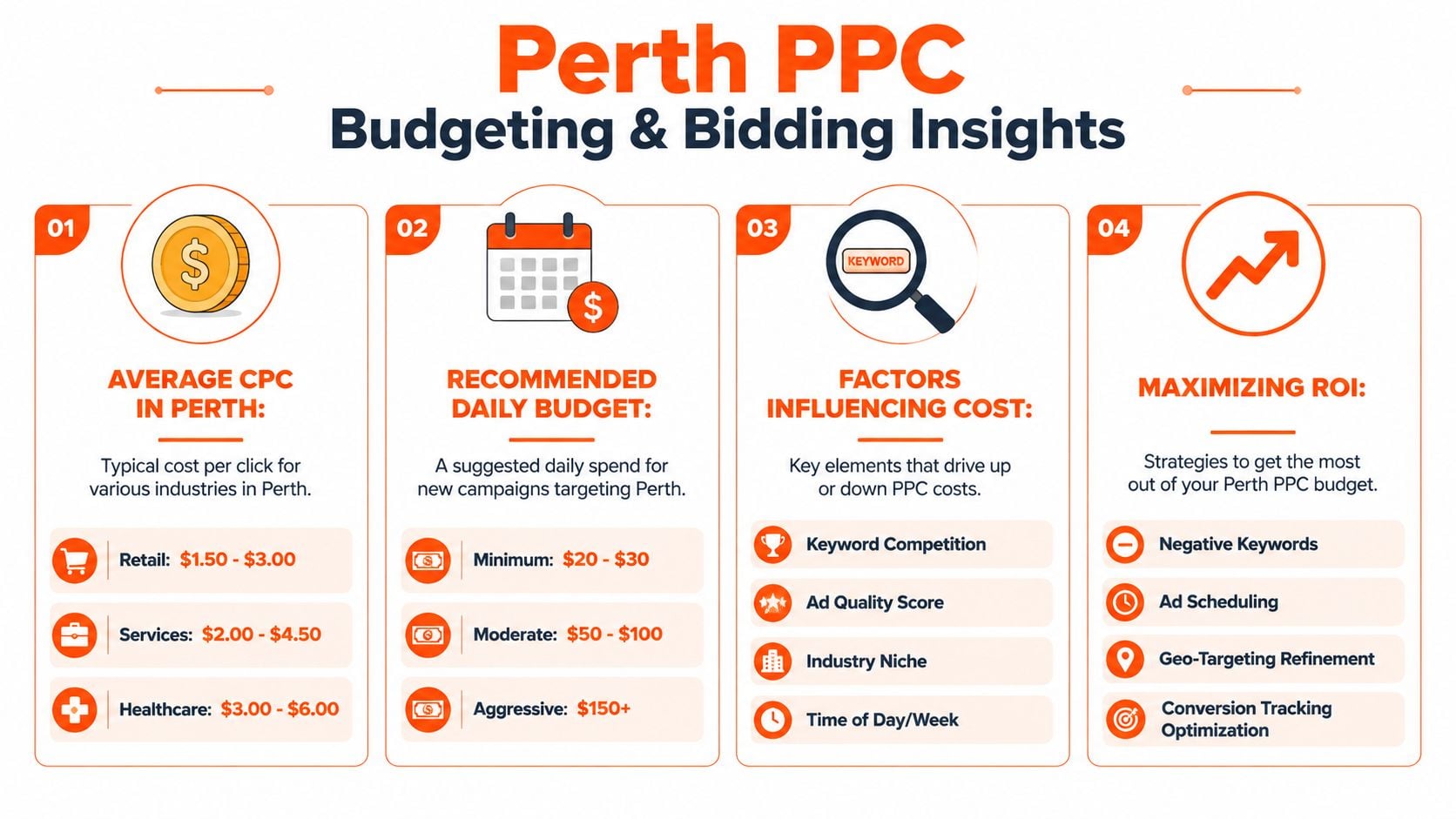
What the numbers mean in practice
Across Google Ads, the average CPC is $5.26 across industries, while sectors like automotive services average $3.90. The average PPC conversion rate is 7.52%, and small to mid-sized companies in Australia typically invest $9,000 to $10,000 monthly for campaigns, according to Shopify’s PPC statistics roundup.
Those figures are benchmarks, not instructions. A focused local service campaign in Perth can start smaller than a full multi-channel national account. The key is to judge your budget against your goals. If you need a steady lead flow across several services and locations, underfunding the campaign usually creates noise rather than insight.
Why the highest bidder doesn't always win
Google Ads is an auction, but it’s not a simple “who pays more gets top spot” system. Quality Score changes the economics.
Think of it this way. Google wants to show ads that searchers are likely to click and find useful. So your bid matters, but so do your keyword relevance, ad copy, expected click-through rate, and landing page experience. That’s why a sharper campaign can outperform a clumsy one with a larger budget.
For a plain-English breakdown of CPC benchmarks and how to think about cost efficiency, this guide on what counts as a good cost per click is worth reading alongside your own numbers.
Budget decisions that usually improve outcomes
- Protect relevance first: Don’t spread budget across too many services or locations at launch.
- Use separate campaigns where intent differs: “Emergency electrician Perth” should not be managed the same way as “electrical maintenance contract”.
- Judge cost against lead quality: A cheaper click that never turns into a sale is not a bargain.
- Watch acquisition cost, not just media cost: Teams trying to lower ad costs often make better decisions when they also focus on optimizing customer acquisition costs, not just reducing bids.
Cheaper traffic isn't the goal. Profitable traffic is.
Mastering Local Targeting in Western Australia
Perth campaigns get stronger when location targeting goes beyond “all of WA” or “Perth metro”. That broad setup sounds safe, but it often wastes spend on people outside your real service area, outside your ideal customer profile, or outside the context where they’re likely to convert.

Start with how your business actually operates
A local café in Claremont doesn’t need clicks from Mandurah. A mobile mechanic may want to target a service radius around Balcatta, Malaga, and Osborne Park. A B2B supplier might care less about suburbs and more about industrial areas, office hubs, or logistics corridors.
That means your targeting should reflect your operating model:
- Storefront businesses often do well with radius targeting around the physical location.
- Service-area businesses usually need suburb, postcode, or municipality-level targeting.
- B2B operators may need campaigns centred on commercial precincts rather than residential audiences.
- WA-wide providers can split metro and regional targeting into separate campaigns to keep messaging cleaner.
Use local language in the ads
A strong Perth campaign often sounds local without trying too hard. Mention the service area when it matters. Reference same-day availability if that’s true. Match the ad to the searcher’s geography and urgency.
Good local targeting isn’t just a settings job. It’s also a messaging job.
For example, someone in Rockingham searching for a local service responds better to an ad that confirms the area served than one that looks like a generic national template. The same goes for regional WA campaigns. If you serve Bunbury, Geraldton, or the South West, build that into the structure rather than hiding everything inside one catch-all ad group.
Useful targeting layers for WA businesses
A few layers tend to help tighten spend:
- Demographic filters: Helpful when your offer clearly suits a specific household profile or buying stage.
- Ad scheduling: Strong for businesses that only convert well during staffed hours.
- Device adjustments: Important when calls matter and most leads come through mobile.
- Audience overlays: Useful for remarketing and for separating cold traffic from warm traffic.
Local targeting works when geography, message, and landing page all agree with each other.
One more practical note. Exclusions matter as much as inclusions. If you know certain suburbs are outside your profitable service area, remove them. If regional clicks rarely turn into revenue, split them off instead of letting them distort your metro campaign.
Setting Up Your Campaign and Tracking Conversions
A campaign can look polished and still be badly built. Clean branding, smart headlines, strong visuals. None of that matters if the account structure is loose and you can’t tell which clicks turn into revenue.
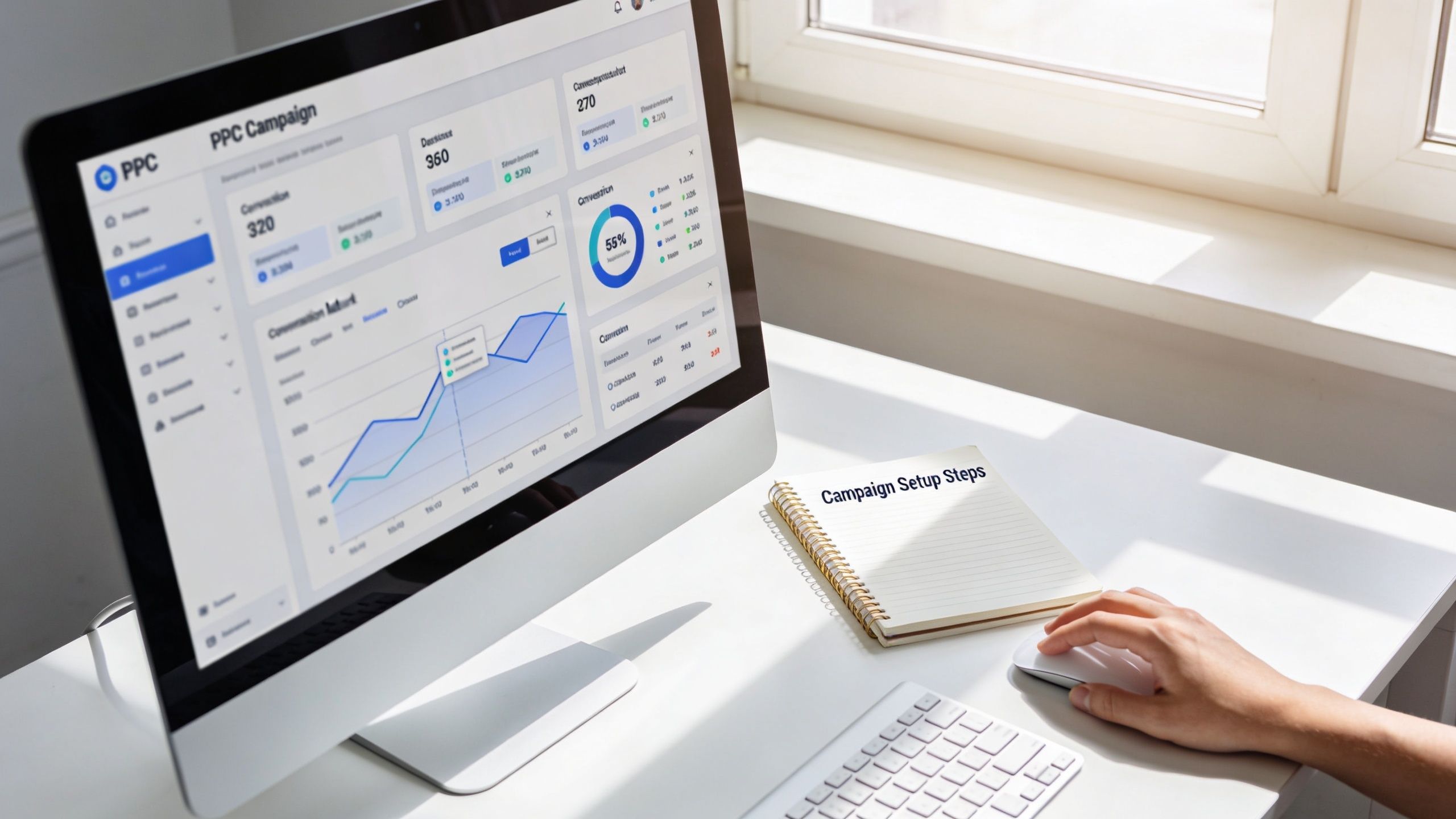
Build the campaign in the right order
Most solid PPC builds follow a straightforward sequence.
Define the conversion before writing the ad
If you’re a service business, the conversion may be a phone call, a form submission, or a booked consultation. For e-commerce, it’s usually a purchase. For B2B, it might be a qualified lead form rather than every basic enquiry.
That definition changes everything. It shapes your keywords, ad copy, landing page, bidding approach, and how you judge performance.
Keep account structure tight
Don’t dump every service into one campaign. Split by service line, intent, or geography where needed. A user searching for a brand-specific product behaves differently from someone researching a category. A person looking for an urgent callout behaves differently from someone comparing providers.
A tighter structure usually improves relevance, and relevance affects cost.
The relationship between CPC, Quality Score, and bid strategy is fundamental. In Perth’s competitive market, a higher Quality Score can reduce CPC. In the example cited by Improvado’s PPC analysis, an ad with an 85+ Quality Score might pay AUD 1.20 CPC for a top position, while a competitor with a 60 score might pay AUD 2.50.
Tracking is not optional
If conversion tracking isn’t installed properly, you’re guessing. That’s the truth.
You need to know which keyword drove the call, which ad group produced the sale, and which landing page generated the qualified lead. Otherwise, optimisation turns into opinion.
For Google Ads setups, this walkthrough on Google Ads conversion tracking covers the mechanics business owners and in-house teams need to get right before scaling spend.
The conversions worth tracking
- Lead forms: Track submitted forms, not just visits to the contact page.
- Phone calls: Especially important for tradies, clinics, legal, and urgent-service businesses.
- Purchases: Include transaction value where possible so bidding can align with revenue.
- Key micro-conversions: Useful when the sales cycle is longer, but don’t confuse these with final outcomes.
A short explainer can help if you’re setting this up for the first time:
Landing pages decide whether clicks become customers
Many campaigns underperform. This often occurs when the ad is relevant, the keyword is solid, the click comes through, and then the user lands on a generic homepage with too many options and not enough clarity.
A good landing page should match the keyword, reflect the ad promise, and make the next action obvious. If the ad offers same-day service in Perth, the page should confirm that quickly. If the campaign is for a specific product category, don’t force visitors to dig through the main navigation.
Track first, then optimise. If you reverse that order, you’ll spend weeks improving the wrong things.
Choosing a Perth PPC Agency vs DIY
Some businesses should start PPC themselves. Others shouldn’t. The right choice depends less on budget and more on time, internal skill, speed of execution, and the cost of mistakes.
If you enjoy data, can learn platform mechanics, and have time each week to review search terms, adjust bids, test ads, and fix tracking issues, DIY can work. It’s often a good way to understand the fundamentals before handing the account to someone else.
If your time is already stretched, your leads are valuable, or your market is competitive, the hidden cost of DIY is usually slower learning and more wasted spend.

When DIY makes sense
DIY usually suits businesses with a narrow offer, one main location, and a manageable number of services. A local operator with one lead goal and a simple funnel can often get decent initial traction by keeping the setup tight and the scope small.
It becomes harder when you add multiple service lines, separate locations, shopping feeds, call tracking, CRM integration, remarketing, or B2B lead qualification. Complexity compounds fast.
Perth PPC agency selection checklist
If you’re considering outside help, ask direct questions.
- Reporting clarity: Will you show actual keyword, conversion, and cost data in a way a business owner can understand?
- Local market familiarity: Have you managed campaigns where suburb targeting, service radiuses, or WA-specific buyer behaviour matter?
- Commercial focus: Do you optimise for leads and sales, or just platform metrics like clicks and impressions?
- Contract structure: Are there lock-in terms, or can you review the relationship based on performance and fit?
- Setup depth: Will the agency handle analytics, tags, tracking, landing page feedback, and account hygiene?
- Access and ownership: Do you keep access to your ad account and conversion data?
One local option business owners may consider is Click Click Bang Bang’s Google PPC company service, which offers PPC management across major ad platforms with reporting and setup support. That’s one model. Others may offer project-based consulting, in-house training, or full management.
The right agency doesn’t just run ads. They help you make better budget decisions.
A good test is simple. Ask how they define success in the first ninety days. If the answer is vague, heavy on jargon, or focused only on traffic, keep looking.
What Results to Expect and How to Scale in 2026
PPC isn’t a magic button, but it is one of the clearest growth levers available to a Perth business when it’s set up properly. Early on, the goal is learning. Which keywords attract the right buyers, which ads get qualified clicks, which landing pages convert, and which locations produce the best commercial outcomes.
From there, scaling gets more deliberate. You increase budget into proven campaigns, expand into adjacent services, test new suburb clusters, add remarketing, or build separate campaigns for higher-value products and customer segments. Growth comes from tightening the system, not from blindly spending more.
This is also where many businesses improve performance by looking past surface metrics. Clicks matter. Conversion rate matters. But the deeper question is whether the campaign produces profitable customer acquisition and sustainable return. If you want a plain-English refresher on how to evaluate that, this guide on optimize advertising returns is useful.
For 2026, the businesses that get the most from pay per click Perth won’t be the ones with the loudest ads. They’ll be the ones with the cleanest tracking, the strongest local relevance, and the discipline to scale only what proves itself.
If you want a practical next step, Click Click Bang Bang can help you map out a PPC campaign for Perth with the essentials in place from the start, including platform selection, conversion tracking, and a structure built around leads or sales rather than guesswork.
Read NeXt
Or Read Our Latest
- User Generated Content Strategies That Actually Convert
- Copyright and Infringement Guide for Business Marketers 2026
- What Is Brand Positioning and Why It Drives Growth
- Push vs Pull Marketing: A 2026 Decision Guide
- Ad Relevance Score Explained: How It Impacts PPC Performance
- Best ROI Digital Marketing: 10 Channels Ranked for 2026
Click. CLick. Subscribe.
Get our best PPC insights, industry updates, and power moves delivered straight to your inbox. No fluff, just high-caliber strategies that actually work.
Don’t Leave Just Yet
Try Us For 30-Days,
Risk Free!!
We guarantee that you’ll love our work within the first 30 days, if not you’ll get your money back.
What have you got to lose?