

Search Engine Optimization Services Cost: 2026 Guide
Last Updated

You’ve probably got three SEO proposals open right now. One is cheap enough to feel safe. One looks expensive but polished. One sits in the middle and still leaves you wondering what you’d receive.
That’s a normal place to be.
SEO is one of the few services where two providers can use almost the same words, then quote fees that are thousands of dollars apart. “Technical SEO.” “Content optimisation.” “Authority building.” “Monthly reporting.” On paper, it can all look similar. In practice, the work, depth, accountability, and business impact can be completely different.
The core question isn’t just the search engine optimization services cost. It’s whether the proposal buys meaningful progress, or just busywork with a ranking chart attached. If you’re comparing providers, it helps to treat SEO like a growth investment with moving parts, not a commodity you can buy off a shelf.
Why SEO Pricing Is So Confusing
A business owner gets one quote for a basic monthly package. Another agency proposes a bigger retainer with strategy sessions, technical fixes, and content. A freelancer offers to “do the same thing” for much less. All three promise better visibility. No wonder the numbers feel arbitrary.
The confusion usually starts because SEO isn’t one task. It’s a bundle of specialist jobs that affect each other. A campaign might include site audits, keyword mapping, content updates, internal linking, local profile work, reporting, analytics setup, and link acquisition. Some providers include most of that. Others include one or two items and leave the rest out.
Same label, different scope
A quote can look affordable because it’s narrow. Another can look expensive because it includes the work that actually moves a site forward. If a provider is planning technical diagnostics, page rewrites, measurement setup, and ongoing content support, the number should be higher. If they’re mostly sending monthly reports and tweaking title tags, it won’t be.
That’s why price shopping alone often leads to a bad decision. Cheap SEO can feel efficient in month one and wasteful by month six.
SEO pricing gets messy when businesses compare package names instead of deliverables.
There’s also the issue of service model. Some firms sell advice. Some sell execution. Some do both. If you’re still narrowing your options, looking through providers that outline Australian SEO services can help you see how differently agencies define scope, especially around local optimisation, audits, and ongoing support.
What buyers actually need
Most first-time buyers don’t need a lecture on algorithms. They need answers to simple commercial questions:
- What work is included: Not just “SEO”, but the actual tasks.
- Who’s doing it: A solo consultant, a specialist team, or outsourced contractors.
- How progress is measured: Rankings alone aren’t enough.
- What happens first: Audit, fixes, content plan, or link work.
- How long you’re locked in: Commitment changes risk.
If you can’t see those answers clearly in a proposal, the price will always feel confusing.
Decoding the Four Common SEO Pricing Models
SEO is usually sold in four ways. The easiest way to understand them is to think like you’re hiring a tradesperson.
If your roof leaks, you might pay someone for a one-off inspection. You might pay hourly for small repairs. Or you might hire a team on an ongoing arrangement because the whole property needs regular work. SEO follows the same logic.
Monthly retainer
A monthly retainer is the most common structure for ongoing SEO. You pay a set amount each month for continuous work. That usually suits businesses that need strategy, implementation, and refinement over time.
This model works when the website needs more than a quick tidy-up. If you’re trying to build non-branded visibility, improve category or service pages, publish better content, fix technical issues, and strengthen authority, monthly work makes sense.
Project-based pricing
A project fee is for a defined outcome. That could be a technical audit, a migration plan, keyword research, or a content architecture overhaul. For Australian businesses, project-based technical work such as migrations or technical audits ranges from $5,000 to $30,000+ AUD, while standalone technical SEO audits typically cost $2,000 to $15,000 AUD, according to Clutch’s SEO pricing data.
This is useful when you know exactly what needs doing, or when you want expert diagnosis before committing to a longer engagement.
Hourly consulting
Hourly consulting fits businesses that already have internal marketing staff, developers, or content writers. You’re paying for direction, review, troubleshooting, or senior advice rather than full delivery. The same Clutch pricing data notes Australian agency hourly rates average $100 to $250 AUD.
That can be efficient if your team can execute well. It can also become expensive if every decision still needs outside interpretation.
Performance-based arrangements
Performance-based SEO sounds attractive because it lowers perceived risk. In theory, you only pay when results happen. In reality, these models often create misaligned incentives.
If an agency gets paid only on rankings, they may chase easy, low-value keywords. If they get paid on traffic, they may prioritise volume over qualified leads. Business owners like certainty, but performance pricing can hide weak strategy behind a simple promise.
Comparison of SEO Pricing Models
| Model | Best For | Pros | Cons |
|---|---|---|---|
| Monthly retainer | Businesses needing steady growth and ongoing execution | Consistent work, strategic continuity, easier prioritisation | Requires patience and trust in the process |
| Project-based | One-off needs like audits, migrations, or roadmap creation | Clear scope, defined budget, strong for diagnosis | Doesn’t usually cover ongoing implementation |
| Hourly consulting | In-house teams needing expert guidance | Flexible, focused, useful for specialist advice | Costs can drift without clear boundaries |
| Performance-based | Buyers focused on low upfront risk | Simple to understand on paper | Can reward the wrong outcomes |
If you’re comparing providers, it helps to look at how experienced search marketing experts describe their delivery model, not just their package names. The payment structure should match the kind of support your business needs.
What Really Determines Your SEO Cost

The fee doesn’t come from a magic SEO rate card. It comes from workload, complexity, and the calibre of people involved.
Two sites in the same industry can need very different levels of effort. One might have a clean structure, usable content, and decent internal links. Another might have indexation issues, thin pages, poor category targeting, and no measurement setup. The second site will cost more because there’s more to fix before growth can even start.
Scope changes everything
A narrow brief costs less because it covers less. If you only want a technical review, that’s one type of engagement. If you want a team to audit the site, map search intent, rewrite key pages, plan new content, and improve authority signals, that’s a larger one.
Buyers often misread proposals. They compare line-item totals without checking whether one provider included real implementation and another mostly listed recommendations.
A proper website audit is often the starting point because it shows whether the problem is technical, structural, content-related, or all three. That’s why businesses often begin with a structured review such as a website audit process before deciding how much ongoing support they need.
Competition and website condition
SEO gets harder when your market is crowded, your site is weak, or both. A local service business targeting a defined suburb set is different from an e-commerce store trying to rank category pages across a national market. The amount of content planning, page refinement, and authority building changes accordingly.
Off-page work creates another cost variable. Some businesses already have a recognised brand and attract mentions naturally. Others need deliberate outreach and asset creation. If you’re trying to understand that side of the work, these proven ways to earn free backlinks are useful because they show the difference between legitimate authority building and low-quality link buying.
Practical rule: If a quote includes link building, ask how the links are earned, what content supports them, and what quality checks are used.
Agency versus freelancer
One of the biggest pricing drivers is the delivery model itself. Analysis of 439 SEO providers found that Australian agencies charge 138% more than freelancers on average, at $3,209 per month versus $1,348 per month, based on Ahrefs’ SEO pricing analysis. That premium exists because agencies can provide a broader team, reporting infrastructure, and integrated analytics.
That doesn’t mean agencies are always the right choice. A strong freelancer can be excellent for focused work. But if you need technical support, content direction, reporting, stakeholder communication, and continuity when one person is away, an agency structure often makes more sense.
The right question isn’t “Why is this agency dearer?” It’s “What delivery capacity am I paying for?”
Typical SEO Cost Ranges in Australia for 2026
If you want a realistic benchmark, Australian SEO costs sit on a broad spectrum because the work ranges from lean local campaigns to multi-layered national programs.
The strongest anchor for small and medium-sized businesses is this. In Australia, SEO services for SMBs typically range from $1,500 to $5,000 AUD per month, with entry-level local services starting at $500 to $1,500 AUD, while advanced plans in competitive niches can exceed $5,000 to $10,000 AUD. The same source notes a 10-20% annual budget increase as competition grows, according to Portland Peak SEO’s 2025 Australia pricing analysis.
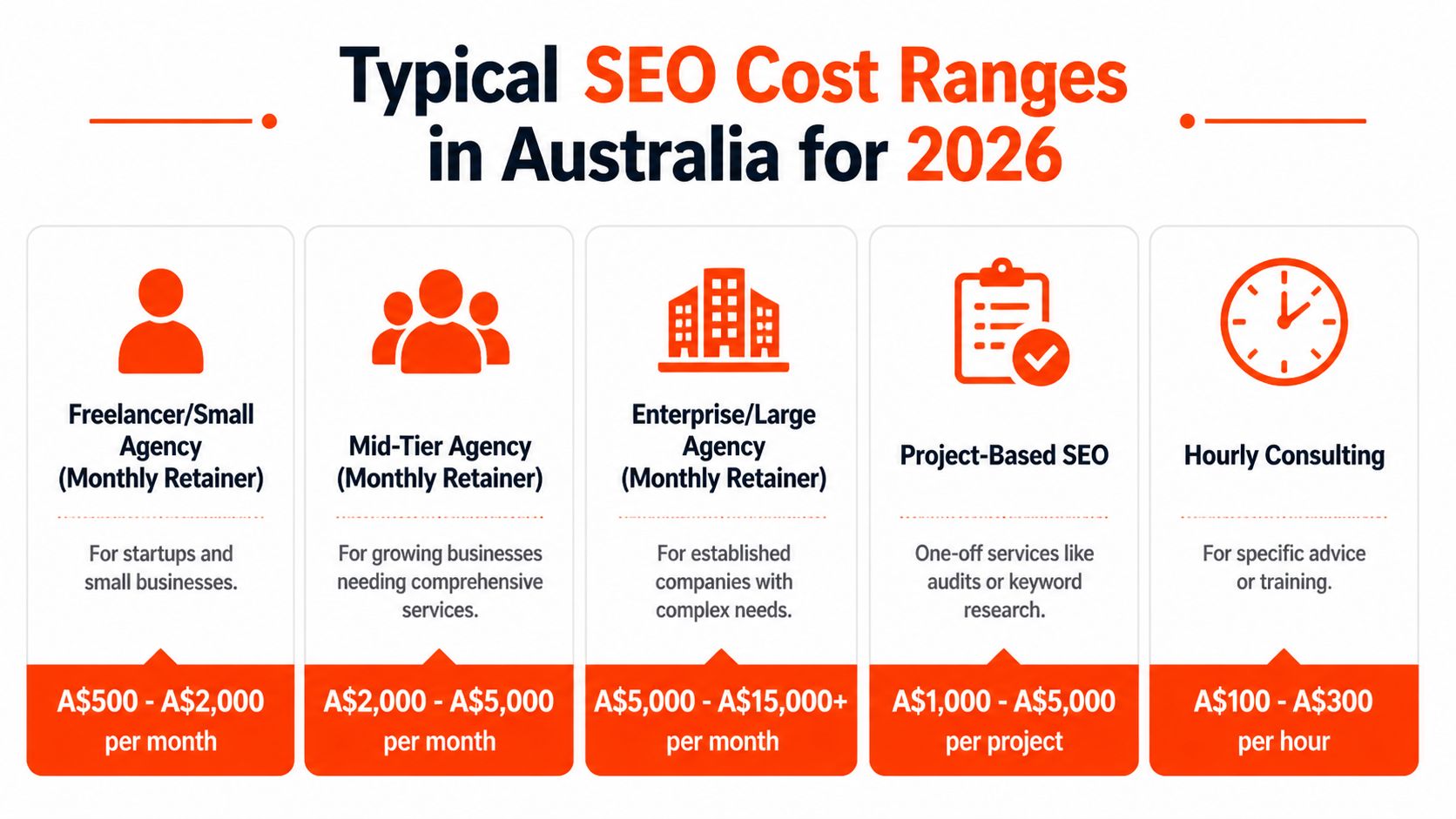
What those ranges usually mean
A lower monthly budget usually fits a startup, single-location operator, or small service business that needs foundational work. That might involve local page improvements, technical basics, Google Business Profile support, and selected content updates.
A mid-range budget often suits growing businesses that need broader execution. At this level, SEO starts to look more like an operating system than a checklist. There’s usually a blend of technical oversight, content planning, on-page refinement, internal linking, and reporting.
Higher-end retainers are common when the site is larger, the market is more competitive, or the business needs specialist support across multiple page types and stakeholder groups.
A practical way to frame the budget
Instead of asking “What does SEO cost?”, ask which of these sounds most like your situation:
- Foundational local visibility: You need to appear for local intent searches, improve core pages, and fix obvious technical problems.
- Growth-stage SEO: You need ongoing content and optimisation work because competitors are already active.
- Complex or competitive campaign: You need technical depth, stronger authority building, and tighter reporting because the outcomes are more critical.
A proposal is in the right range only if the scope matches the business problem.
The 2026 label matters here as a planning lens, not as a promise that every business should spend more. Some businesses still do well with a modest monthly program. Others underinvest for too long, then wonder why SEO never becomes a reliable acquisition channel.
How to Evaluate Proposals and Measure SEO ROI

A good SEO proposal doesn’t just tell you the monthly fee. It tells you what’s going to happen, why it matters, and how the work connects to leads, sales, or revenue.
That sounds obvious, but many proposals still lean on vague deliverables. “Optimisation.” “Visibility improvements.” “Authority strategy.” Those phrases aren’t useless, but they don’t help you judge commercial value.
Australian businesses typically allocate 30.5% of their SEO budget to monthly retainers, and 93% of AU users start their journey on a search engine, according to GoodFirms’ SEO pricing research. That’s why proposal quality matters so much. If search is a major entry point, your spend should connect to business outcomes, not just SEO activity.
What to check before you compare prices
Look for concrete signs that the provider has thought through your situation.
- Clear starting priorities: The proposal should identify what gets tackled first. Technical issues, page intent mismatch, weak service pages, poor tracking, or content gaps.
- Defined deliverables: Not “content support”, but what kind of content, for which pages, and how often.
- Reporting that ties to business performance: Rankings have value, but they’re not enough on their own.
- Access to the people doing the work: Sales teams often sound sharp. You also need to know who runs the account after signing.
- Measurement setup: If conversion tracking, analytics alignment, and attribution are fuzzy, ROI discussions will stay fuzzy too.
If you want a clean way to assess this, compare the SEO proposal against the same framework you’d use for paid media or broader digital marketing performance metrics. The channel changes. Accountability shouldn’t.
A simple ROI lens
SEO ROI doesn’t need a complex spreadsheet at the start. A first-pass model is enough:
- Estimate the value of a qualified lead or sale.
- Identify which pages or keyword themes can plausibly bring in that demand.
- Ask how the agency will improve those pages.
- Check whether the likely business value justifies the ongoing spend.
This helps you avoid a common trap. Businesses often buy SEO because they want more traffic, when they really want more profitable enquiries. Those are not the same thing.
If a proposal can’t explain how the work may influence qualified demand, the price is impossible to judge properly.
For buyers who like comparing service tiers before they commit, tools that let you compare pricing options can be a useful reference point. Not because another platform’s fees define SEO value, but because structured pricing makes it easier to ask better questions about scope, reporting, and support.
A short explainer can also help when you’re reviewing agency language and trying to separate deliverables from jargon:
What a strong proposal usually sounds like
It doesn’t promise certainty. It shows reasoning.
It says, in effect: these pages matter, these issues are limiting performance, this is how we’ll prioritise the work, this is what we’ll measure, and this is what success should look like commercially. One option in the market is Click Click Bang Bang, which offers tiered month-to-month plans, transparent reporting, and a 30-day risk-free trial. That model is relevant for businesses that want a clearer view of scope before entering a longer relationship.
Warning Signs and Red Flags in an SEO Quote
The wrong SEO quote rarely looks obviously wrong. It usually looks attractive.
It’s neat, affordable, and full of confident language. That’s why red flags matter. They help you spot the difference between a structured investment and a low-accountability service.

The promises that should make you pause
Some warning signs are immediate:
- Guaranteed rankings: No one controls search results completely. A reputable provider can commit to process, not a fixed ranking promise.
- Secret sauce language: If the strategy can’t be explained in plain English, that’s a problem.
- No detail on deliverables: If the quote lists outcomes but not the work, you can’t judge value.
- Reporting built around vanity metrics: More impressions or more traffic mean little if enquiries don’t improve.
- Very low pricing with broad promises: That often signals templated work, light-touch execution, or offshore fulfilment with little strategic oversight.
What a credible provider does instead
A credible agency or consultant usually does the opposite. They define scope. They explain trade-offs. They tell you what needs fixing first and what can wait.
They also talk openly about timelines. SEO can produce early wins, but durable gains usually come from cumulative work, especially when technical fixes, content quality, and authority need to improve together.
Cheap SEO often fails quietly. Nothing breaks. Nothing grows either.
Another red flag is contract structure. If the provider wants a long lock-in before they’ve shown how they work, ask why. Strong operators don’t need to hide behind friction. They earn continuity by making progress visible.
The quick sanity check
Before signing, ask these questions:
- What exactly happens in the first month
- Who is responsible for implementation
- How will you report on business impact
- What assumptions is this strategy based on
- What is not included in the fee
If the answers stay vague, walk away.
Choosing Your Path to Sustainable Growth
The right SEO investment is the one that matches your business stage, your internal capability, and the commercial outcome you care about most.
If you need specialist diagnosis, a project may be enough to start. If your team can implement, hourly consulting can work well. If you need momentum across technical work, content, authority, and measurement, a retainer is usually the more realistic path.
The decision framework that holds up
When you compare proposals, keep your lens simple:
- Fit to business goal: Is the provider solving the problem you have?
- Fit to scope: Does the fee reflect real work, or just vague monthly activity?
- Fit to delivery model: Do you need a solo expert or a wider team?
- Fit to risk tolerance: Are you comfortable with lock-ins, or do you want flexibility?
That’s how you move from price confusion to investment clarity.
Why modern buyers favour flexible structures
A lot of the frustration around search engine optimization services cost comes from uncertainty. You commit to a monthly fee, but you don’t know how transparent the reporting will be, how involved the team will be, or whether the plan can adapt as the business changes.
That’s why tiered, month-to-month structures are gaining traction. They give businesses a clearer entry point. They also reduce the false choice between “go all in” and “do nothing”. If the plan includes transparent reporting, live performance visibility, and a short runway to prove fit, the buying decision becomes much more practical.
A risk-free trial model also changes the conversation. Instead of asking a business owner to trust a pitch, it gives them a way to test the working relationship, the communication quality, and the reporting discipline before making a longer commitment.
The smartest SEO decisions usually aren’t driven by the cheapest quote. They come from a sober read of scope, accountability, and likely business value.
If you want a practical second opinion on an SEO proposal, or you’d rather start with a transparent month-to-month structure, Click Click Bang Bang offers tiered plans, clear reporting, and a 30-day risk-free trial so you can assess fit before making a bigger commitment.
Read NeXt
Or Read Our Latest
- User Generated Content Strategies That Actually Convert
- Copyright and Infringement Guide for Business Marketers 2026
- What Is Brand Positioning and Why It Drives Growth
- Push vs Pull Marketing: A 2026 Decision Guide
- Ad Relevance Score Explained: How It Impacts PPC Performance
- Best ROI Digital Marketing: 10 Channels Ranked for 2026
Click. CLick. Subscribe.
Get our best PPC insights, industry updates, and power moves delivered straight to your inbox. No fluff, just high-caliber strategies that actually work.
Don’t Leave Just Yet
Try Us For 30-Days,
Risk Free!!
We guarantee that you’ll love our work within the first 30 days, if not you’ll get your money back.
What have you got to lose?