

How to Hire Search Marketing Experts for Your Business
Last Updated
Think of search marketing experts as your business's navigators on the vast ocean of the internet. Their job is to guide customers who are actively searching for what you sell directly to your digital doorstep. They do this with a smart mix of paid advertising for a quick boost and long-term organic strategies for sustainable growth, making sure your business is seen and your growth is measurable.
What Search Marketing Experts Actually Do

It’s easy to think it's just about getting more traffic, but that’s only half the story. A real search marketing expert acts like an architect, designing the pathways that bring the right kind of traffic to you—people who are already looking for your exact solutions.
This isn't about casting a wide net and hoping for the best. It's a calculated effort built on two powerful, complementary disciplines that are the bedrock of any solid search strategy.
The Two Pillars of Search Marketing
First up is Pay-Per-Click (PPC) advertising. This is the express lane to the top of the search results. Using platforms like Google Ads, experts place your ads in front of people at the very moment they’re searching. For instance, if you sell hiking boots in Melbourne, a PPC pro makes sure your ad shows up when someone types "best hiking boots Melbourne" into Google. This drives traffic now and delivers instant feedback on which messages actually convert.
The second pillar is Search Engine Optimisation (SEO). This is the art and science of earning your way to the top for free, organic visibility. Unlike PPC, SEO is a long-term play. It's about building your website's credibility and relevance so search engines see it as an authority and rank it highly on their own. It’s a marathon, not a sprint, involving technical site health, creating genuinely useful content, and building trust across the web.
The real magic happens when you stop treating PPC and SEO like two separate things. A great strategy uses them together. The insights you get from a PPC campaign—like which keywords lead to sales—can be gold dust for your long-term SEO plan, creating a powerful feedback loop for growth.
An AI-First Approach to Modern SEO
In today's world, a search expert has to think with an AI-first mindset. Search engines now use incredibly advanced AI to figure out what users really want. The old days of just stuffing keywords onto a page are long gone. Modern SEO is about creating content that thoroughly answers a user's question and establishes your brand as a true expert on the topic.
This really boils down to three things:
- User Intent: You have to understand the why behind a search, not just the what.
- Content Quality: It's about producing genuinely valuable, well-researched content that search algorithms recognise as a go-to resource.
- Technical Excellence: Your website needs to be fast, secure, and easy for search engine bots to crawl and understand.
By blending the immediate impact of PPC with the lasting authority of AI-driven SEO, a search marketing expert crafts a complete strategy. This dual approach ensures your business grabs attention today while building a rock-solid competitive advantage for tomorrow, turning search engines into a reliable engine for your growth.
What Modern Search Marketing Experts Actually Do
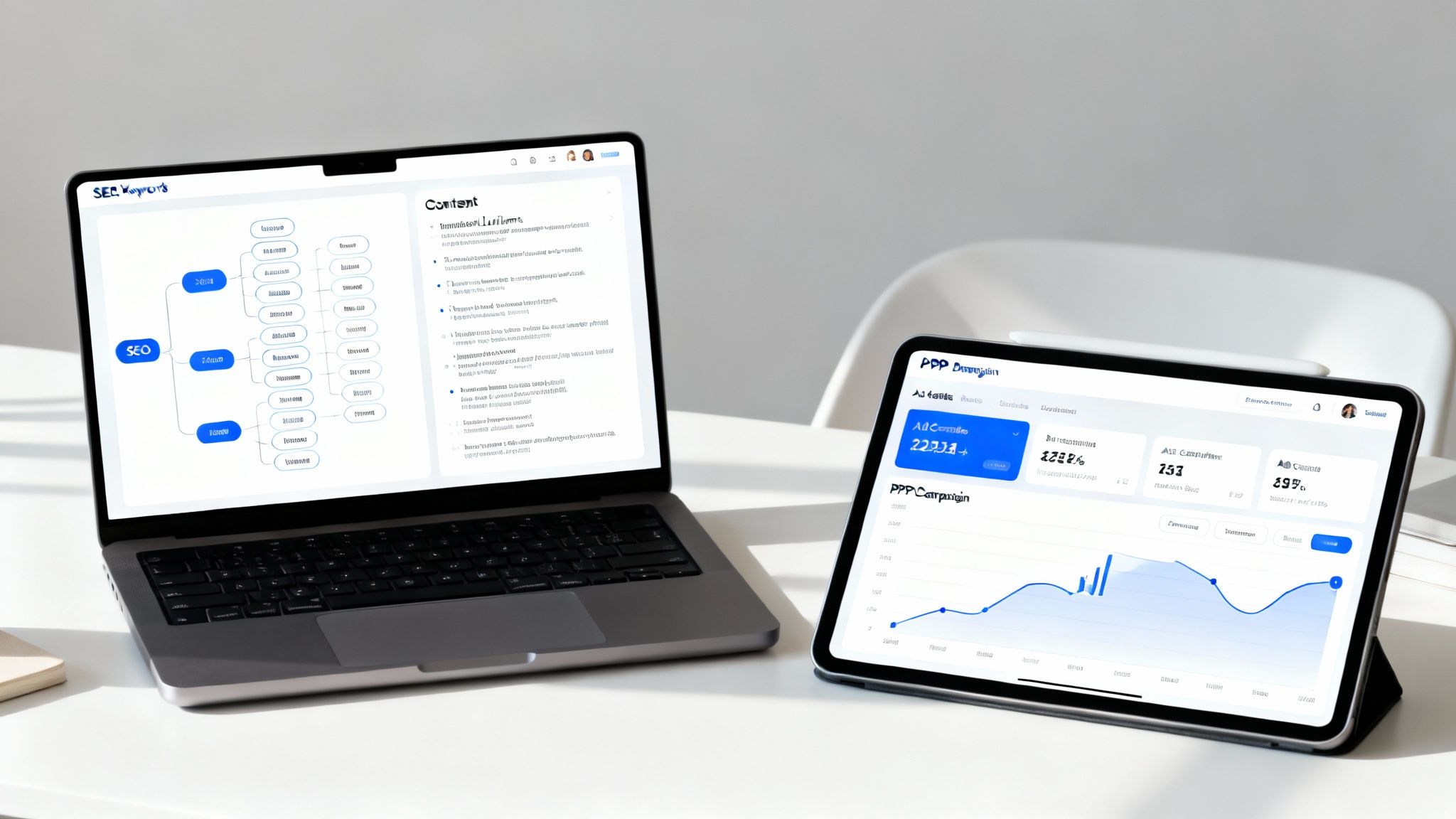
When you partner with genuine search marketing experts, you’re not just buying a to-do list. You're plugging a strategic growth engine into your business, one designed to connect you with customers who are actively looking to buy what you sell. Let's get past the jargon and look at the tangible services a top-tier agency actually delivers.
These services aren't standalone tasks; they're a finely tuned system. Think of it like a high-performance car: the paid ads are the turbocharger, giving you an immediate burst of speed. The SEO is the meticulously engineered engine, built for long-term, reliable power. And the analytics? That's your dashboard, showing you exactly how fast you're going and the most efficient route to your destination.
Strategic PPC Management
Pay-Per-Click (PPC) advertising is the quickest way to get your brand in front of a highly targeted audience. But a modern agency's approach goes way beyond just flipping on some ads on Google or Meta. It’s a relentless, data-driven process focused on squeezing the absolute maximum return from every single dollar you spend.
This isn't just about bidding on keywords. It involves several critical layers:
- Intelligent Campaign Architecture: This is the blueprint. Experts structure your campaigns around your specific business goals, carefully segmenting audiences and keywords to make sure your budget is funnelled into the most profitable corners of the market.
- Ad Creative and Copy That Converts: An expert agency crafts ad copy that doesn't just list features. It speaks directly to a customer's problem and presents your product as the clear, obvious solution, making that click almost irresistible.
- Relentless Optimisation: PPC is never "set and forget." True professionals live in the data, constantly analysing performance, A/B testing ad variations, refining targeting, and tweaking bids to improve your results day in, day out.
The Australian search advertising market shows just how critical this is. Forecasted to hit US$6.60 billion in spending, the sector's unstoppable growth highlights its importance for Aussie businesses. This trend is exactly why a sophisticated PPC strategy, managed by specialists like Click Click Bang Bang, is non-negotiable for anyone serious about capturing market share. You can explore more about Australia's digital marketing statistics and see the numbers for yourself.
An AI-First Approach to SEO
The ground has completely shifted under search engine optimisation. The old tricks of stuffing keywords into pages are long dead. Today, search marketing experts build their strategies around an AI-first approach to SEO, designed to win in a world run by smart, learning algorithms like Google's. It's all about demonstrating genuine authority and providing real, tangible value to users.
An AI-first SEO strategy isn’t about tricking algorithms. It's about becoming the most trusted, comprehensive, and helpful resource in your niche, making it impossible for AI-driven search engines to ignore you.
This modern SEO framework is built on three core pillars:
- Technical Foundations: Making sure your website is lightning-fast, secure, and easy for search engine crawlers to understand. This covers everything from mobile optimisation and site speed to implementing structured data.
- Authority-Building Content: Creating deep, expert-led content that doesn't just skim the surface but thoroughly answers every question a user might have. This is how you establish your site as a go-to source that AI models learn to trust and reference.
- User-Intent Alignment: Moving beyond simple keywords to understand the why behind a search query. This means structuring your content around topics and anticipating what your user will want to know next.
Analytics and Conversion Tracking
Finally, the central nervous system of any successful search marketing campaign: robust analytics and conversion tracking. Without accurate data, every decision is nothing more than a guess. Experts ensure every click, every lead, and every sale is tracked, measured, and attributed correctly.
This is the service that connects marketing activity to real business results. It translates raw data into actionable intelligence, answering the questions that matter, like, "Which campaigns are actually driving sales?" and "What is our true return on ad spend?" This clarity allows for smart, strategic pivots and ensures your investment is always laser-focused on your most important business goals.
Key Skills That Separate an Expert from an Amateur
Not all search marketers are created equal. Far from it. While plenty of people can set up a basic Google Ads campaign or publish a blog post, a true search marketing expert brings a much deeper, more strategic game to the table. Think of it like this: one mechanic can change your oil, but another can completely rebuild your engine for peak performance.
An amateur often gets fixated on surface-level metrics like clicks or traffic volume—things that look good on a report but don’t necessarily pay the bills. An expert, on the other hand, is obsessed with what actually impacts your bottom line: metrics like Return On Ad Spend (ROAS), lead quality, and customer lifetime value. This shift in focus is what separates busy work from genuine business impact.
Deep Analytical Proficiency
Perhaps the most critical skill that splits a professional from a novice is the ability to interpret complex data. Modern marketing platforms spew out a mind-boggling amount of information, but data without interpretation is just noise. An expert doesn’t just read a report; they see the story hidden within the numbers.
They’re the ones who can answer the tough questions, like:
- Why did our conversion rate suddenly drop last Tuesday, even though traffic was up?
- Which specific audience segment is driving our most profitable sales, not just the most clicks?
- How is the performance of our top-of-funnel content influencing bottom-of-funnel conversions three weeks down the track?
This kind of analysis requires a real mastery of tools like Google Analytics 4, SEMrush, and various data visualisation platforms. It’s all about connecting the dots between user behaviour, campaign activity, and real business growth.
Strategic Foresight and Business Acumen
A genuine expert doesn't see a marketing campaign as an isolated task. They see it as a vital cog in your company's growth machine, and they align every single search campaign with your core business objectives. Before they even think about launching a campaign, they start asking questions that go far beyond marketing.
They’ll want to understand your profit margins, your typical sales cycle, and your customer retention rates. This business-first approach allows them to build campaigns that don't just generate leads, but attract the right kind of customers—the ones who are profitable and likely to stick around for the long haul. An amateur chases vanity metrics; an expert chases sustainable profitability.
The true mark of an expert is their ability to translate marketing metrics into a language the C-suite understands. They don't just report on click-through rates; they talk about market share growth, cost of customer acquisition, and overall return on investment.
A key part of this strategic thinking is understanding what the competition is up to. This is where the proficient use of ad spy tools comes in, allowing them to deconstruct competitor strategies and pinpoint untapped opportunities in the market.
Creative Problem Solving and Adaptability
The world of search marketing is constantly shifting. Google rolls out major algorithm updates, new ad formats pop up overnight, and consumer behaviour changes on a dime. When faced with these changes, an amateur might panic or, worse, stick stubbornly to outdated tactics.
An expert, however, sees these shifts as opportunities.
Their creative problem-solving skills mean they can pivot strategies quickly and effectively. When an algorithm update hits, they don’t just react—they have a plan. They analyse the impact, form a hypothesis, and methodically test new approaches. This agility is absolutely crucial for maintaining momentum and turning potential setbacks into a competitive advantage. It’s about playing chess, not checkers, always thinking several moves ahead.
To really bring these differences to life, a direct comparison can be helpful.
Expert vs Novice Search Marketer Skill Comparison
The table below breaks down the fundamental differences in approach and thinking between someone who is just getting by and someone who truly excels in the field.
| Skill Area | Novice Marketer Approach | Expert Marketer Approach |
|---|---|---|
| Data Analysis | Focuses on simple metrics like clicks and impressions. | Analyses deeper metrics like ROAS, CPA, and customer lifetime value to measure true business impact. |
| Strategy | Launches campaigns based on generic "best practices." | Develops customised strategies tied directly to specific business goals, profit margins, and sales cycles. |
| Adaptability | Relies on a fixed set of tactics and struggles when algorithms change. | Continuously tests new approaches and pivots quickly to capitalise on industry shifts and algorithm updates. |
| Tools | Uses basic platform features. | Masters advanced features of analytics, SEO, and ad management tools to gain a competitive edge. |
Ultimately, hiring true search marketing experts means you’re not just getting a campaign manager; you’re investing in a strategic partner. They bring a powerful mix of analytical rigour, business savvy, and creative agility that transforms your campaigns from simple online ads into a powerful, predictable engine for business growth.
Riding the New Wave of AI-Driven Search
The world of search is going through its biggest shake-up in more than a decade, and AI is in the driver's seat. We're now seeing generative search experiences—think AI-powered summaries popping up right at the top of the results page—and they're completely changing how people find information. For any business, this is a massive turning point.
The new reality throws a huge spanner in the works: the classic organic click is dying. When your customers get their answers without ever visiting your website, the old SEO rulebook goes out the window. This is exactly why a modern, AI-first SEO strategy isn't just a nice-to-have anymore; it's essential for survival.
Why Your Old SEO Playbook Is Officially Obsolete
In this new environment, savvy search marketing experts are ditching the old tactics. It's no longer just about ranking for a keyword. The new game is about becoming such a trusted source of information that AI models actually cite your website in their answers.
This calls for a complete strategic pivot. While Google still has an iron grip on Australia's search market, controlling 93.95% of the market share, how people use it has changed dramatically. A jaw-dropping 65% of searches in Australia now end without a click thanks to these AI summaries. This has triggered a major shift in marketing budgets, with old-school SEO tactics dropping from 75% to just 45% of total search marketing spend. The other 55% is now pouring into AI optimisation, authority building, and crucial technical upgrades. You can check out more on these Australian search trends over at SearchScope.
The goal has shifted from just ranking number one to becoming the answer. Your content needs to be so authoritative and well-structured that AI has no choice but to use it as a primary source for its summaries.
How to Thrive with an AI-First SEO Strategy
Forward-thinking agencies are already getting businesses ready to win in this new world. An AI-first approach isn't just theory; it involves practical, high-impact tactics designed to make your brand a go-to source within these generative search results. This is a core skill for any modern search marketing expert.
Here are the key pillars of a winning AI-first strategy:
- Optimising for Conversational Questions: People are asking search engines questions just like they'd ask a friend. Your content has to be built to directly answer these "who," "what," "why," and "how" queries in a super clear and concise way.
- Building Unshakeable Topical Authority: This is all about creating comprehensive content hubs that cover a topic from every conceivable angle. When you become the definitive resource, you're sending a massive signal to AI models that your website is the most reliable place for information in your niche. You can get a head start by exploring our guide on leveraging AI for your SEO strategy.
- Using Structured Data (Schema Markup): Think of this as creating a cheat sheet for search engines. By using schema markup, you can label your content in a way that AI can easily read, helping it pull accurate details like product prices, reviews, and event info directly into the search results.
For search marketing experts wanting to master this new terrain, staying on top of the right tech is non-negotiable. Checking out the best AI search tracker tools can give you the insights needed to fine-tune your strategies and actually measure what's working in this AI-centric world. Embracing these changes isn't just about adapting—it's about grabbing a powerful new opportunity to connect with customers in a far more direct and meaningful way.
How to Hire and Onboard Your Search Marketing Partner
Finding and bringing on the right search marketing partner is one of the most important growth decisions you'll make. This isn't just about handing off a task; it's about embedding a strategic ally into your business. A structured approach to hiring and onboarding takes the guesswork out of the equation and builds the foundation for a transparent, results-focused partnership from day one.
The process actually starts long before you even glance at an agency's website. The first, and most critical, step is an internal one: getting crystal clear on what success really looks like for your business. Without clear goals, you have no yardstick to measure potential partners against.
Defining Your Goals and KPIs
Before you even think about interviewing search marketing experts, you need to turn your big-picture business objectives into specific, measurable Key Performance Indicators (KPIs). A true expert will ask about these on the very first call, so being prepared is non-negotiable.
Start by asking yourself:
- What's our number one business goal? Are we trying to drive e-commerce sales up by 20%? Generate 50 qualified B2B leads a month? Or maybe grab market share in a new region?
- What metrics directly track this goal? For an e-commerce store, this will likely be Return On Ad Spend (ROAS) or Customer Acquisition Cost (CAC). For a B2B company, it’s more likely to be Cost Per Lead (CPL) or the lead-to-customer conversion rate.
- What's our budget and expected timeline? Having a realistic budget and timeframe helps frame the entire conversation and quickly weeds out agencies that aren't the right fit.
Taking this step first ensures you're hiring for business outcomes, not just a list of marketing activities. It fundamentally shifts the conversation from, "So, what will you do for us?" to "How will you help us hit this specific target?".
Vetting Potential Partners and Spotting Red Flags
Once you've nailed down your goals, you can start looking at potential agencies. This is where asking the right questions is crucial for separating the real experts from the pretenders. You need to go beyond surface-level stuff and really dig into their strategic thinking and processes.
Try asking these kinds of questions during your interviews:
- Strategy and Approach: "Based on our goals, what would your initial 90-day strategy look like? How would you balance getting quick wins from PPC with building our long-term SEO growth?"
- Performance and Reporting: "Can you walk us through a sample of your reporting dashboard? How do you communicate campaign performance, and what’s your process when results aren't meeting expectations?"
- Past Success: "Could you share a case study from a client who had similar goals to ours? What were the big challenges you faced and how did you overcome them?"
Just as important is knowing what to watch out for. Certain promises or behaviours are massive red flags that should give you pause.
Be wary of any agency that guarantees a "#1 ranking on Google." True search marketing experts know that rankings are influenced by hundreds of factors, many of which are outside their direct control. An expert promises a clear process and relentless effort, not an unattainable guarantee.
Other red flags include a vague pitch that's light on data, a one-size-fits-all strategy, or a hesitation to provide client references. A confident, capable partner will be completely transparent about their methods and proud to show off their past work. For a deeper look at what to look for, check out our guide on choosing the right search marketing agency.
Understanding the Onboarding Process
After you've picked your partner, the onboarding process kicks off. A professional agency will have a structured timeline for the first 30-90 days to ensure a smooth transition and get campaigns launched quickly.
This infographic gives a glimpse into a key process modern agencies use for AI-First SEO.
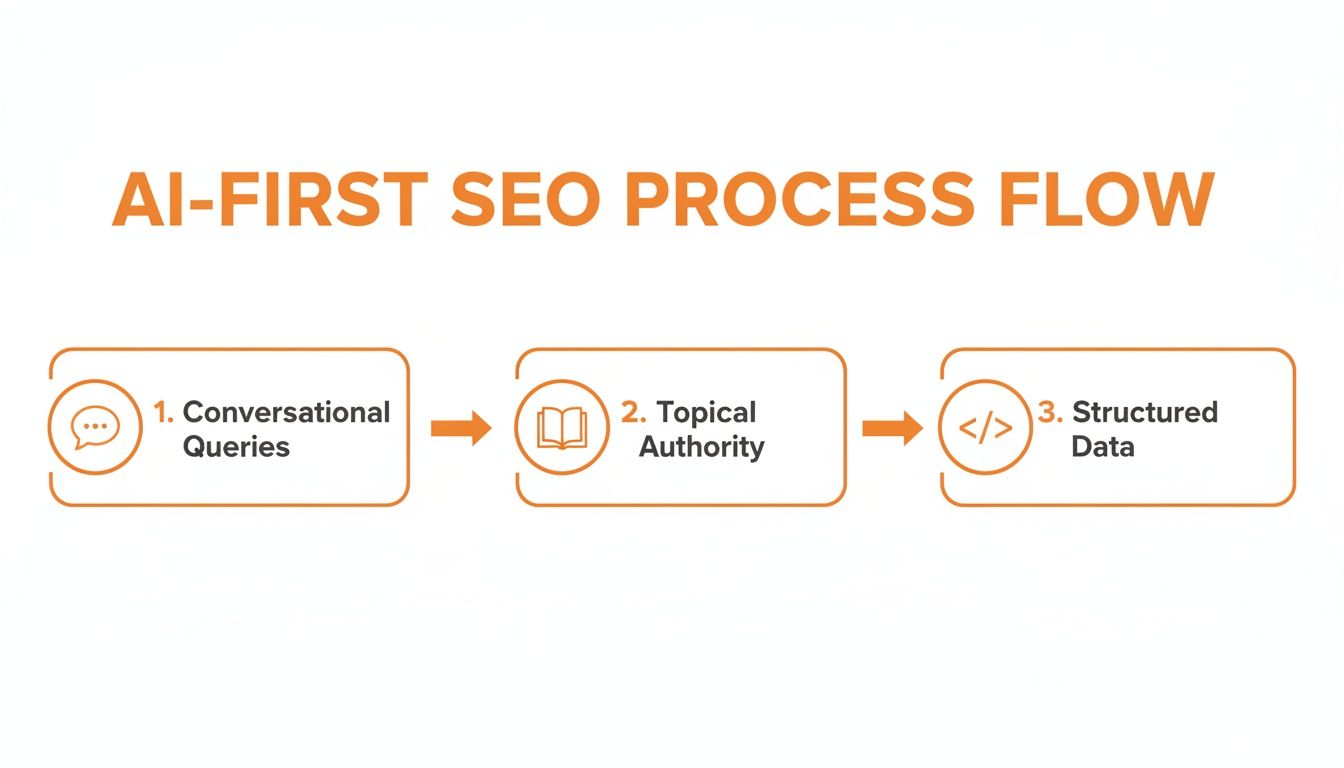
It shows how today's experts are focused on answering conversational questions and building topical authority—essentials for succeeding in an AI-driven search world.
Here’s what a typical onboarding map looks like:
- First 30 Days (Discovery and Setup): This phase is all about deep discovery. You should expect in-depth calls, requests for access to your analytics and ad accounts, and a series of technical audits. A top priority will be setting up or verifying conversion tracking to make sure every piece of data is captured accurately from the get-go.
- Days 30-60 (Campaign Launch and Initial Optimisation): With the foundations firmly in place, your first PPC campaigns will go live. On the SEO front, the team will start rolling out technical fixes and creating foundational content. The focus here is on gathering that initial data and making quick, smart adjustments.
- Days 60-90 (First Performance Review and Scaling): By the end of the first three months, you should have a clear performance review. Your agency will present the initial results, talk through what they’ve learned, and lay out a strategic plan for scaling up the parts of the campaigns that are working best. This review really sets the tone for the ongoing partnership.
Understanding Pricing Models and Measuring True ROI
Bringing on a search marketing expert is a serious investment. The first step to making sure it’s a good one is getting your head around how they charge. It’s the foundation of a transparent and accountable partnership.
While every agency is a bit different, most operate on one of three common models. Each has its pros and cons, and the right one for you really depends on your budget, the scale of your campaigns, and how much flexibility you need. It’s something you need to nail down upfront so the financial side of things lines up perfectly with your growth plans.
Common Engagement Models
Before you sign on the dotted line, you need to understand the mechanics of each pricing structure. Getting this clarity from the get-go means no nasty surprises later and ensures the agency is motivated by your success.
-
Monthly Retainer: This is the most straightforward model—a fixed fee you pay each month for a set scope of work. It’s predictable, which makes budgeting a breeze, and it’s perfect for ongoing work like SEO or managing stable PPC campaigns. The only catch is making sure the work being delivered consistently justifies that fixed cost.
-
Percentage-of-Spend: You’ll see this a lot in the world of PPC management. The agency takes a cut (usually 10-20%) of your total monthly ad spend. This model gives them a real incentive to scale up your budget, which is great if performance is strong. The flip side? You need to keep a close eye to make sure they aren’t just pumping up the spend without a matching increase in your returns.
-
Project-Based Fees: This is a one-off fee for a very specific, defined project—think a technical SEO audit or a strategy for a new website launch. It's brilliant for short-term needs with crystal-clear deliverables but doesn't really work for the constant tweaking and optimisation that search marketing demands over the long haul.
Measuring What Truly Matters
Pricing is one thing, but the real value of a search marketing partnership is in the results. A flashy report packed with vanity metrics like clicks and impressions is completely useless if it doesn't connect to your bottom line. Real experts will immediately shift the conversation to the numbers that actually measure business impact.
The most important chat you can have with a potential partner isn’t about what they do, but how they’ll measure success. An expert will always steer this towards tangible business outcomes like revenue and lead quality, not just marketing activity.
For an e-commerce business, this means getting obsessive over metrics like Return on Ad Spend (ROAS) and Cost Per Acquisition (CPA). These numbers cut through the noise and tell you exactly how much revenue you’re making for every dollar you put into ads. Simple as that.
For B2B companies, the game is different. Cost Per Lead (CPL) is a decent starting point, but the far more critical metric is Lead Quality. A top-tier agency will want to work directly with your sales team to track which leads actually become customers. They’ll then use that intel to optimise campaigns to bring in more of those high-value prospects.
Transparent reporting is the bedrock of this whole process. You should expect access to a live dashboard that clearly shows these key metrics. Regular performance reviews are also non-negotiable; they’re your chance to talk through the results, figure out what’s working, and strategically plan what’s next. This constant feedback loop is what turns a simple vendor relationship into a powerful growth partnership.
If you want to go deeper, you can learn more about the essential digital marketing performance metrics in our comprehensive guide.
Got Questions About Hiring a Search Expert?
Even when you know you need help, a few questions always pop up before you pull the trigger. It's completely normal. Let's tackle the most common ones we hear from businesses just like yours, so you can move forward with confidence.
How Long Until I See Results?
This is a classic tale of two timelines, and it all comes down to the strategy we’re using.
-
Pay-Per-Click (PPC): This is the fast lane. Once we get your campaigns built and launched—which can happen in just a few days—you’ll start seeing traffic, clicks, and potential leads almost immediately. It’s the quickest way to get your brand in front of people who are actively searching.
-
Search Engine Optimisation (SEO): Think of this as a long-term investment in your brand's digital real estate. It generally takes about 3-6 months to see significant, meaningful movement in your organic rankings and traffic. That time is crucial for search engines like Google to recognise, crawl, and reward all the technical improvements and high-quality content we’re building for you.
Should I Choose a Freelancer or an Agency?
The right fit really depends on the level of support and scale you’re aiming for.
A freelancer is a single specialist, which can be a great, cost-effective choice for simpler, more focused campaigns. You get a direct line of communication, but their bandwidth might be limited, and they might not have a deep bench of skills outside their core expertise.
An agency, on the other hand, brings a full team to the table. You're not just hiring one person; you’re getting access to data analysts, copywriters, technical SEO pros, and campaign managers. This model gives you a much broader skill set, robust support for complex, multi-channel campaigns, and the built-in ability to scale up as your business grows.
Is Search Marketing Really Necessary If I Already Have Word-of-Mouth?
Absolutely. Word-of-mouth is fantastic—it’s one of the most powerful marketing channels there is. But it's also a reactive channel. You have to wait for it to happen.
Search marketing flips that on its head. It allows you to proactively find and capture brand-new customers who are out there, right now, looking for the exact solutions you offer but have just never heard of you.
Think of it this way: a strong online presence not only finds new customers but also validates those referrals you get. It builds instant credibility and turns that amazing customer base you have into an even more powerful engine for growth.
Ready to turn search engines into your most reliable source of customers? The team at Click Click Bang Bang specialises in data-driven PPC and AI-first SEO to deliver results you can actually measure. Start your risk-free trial today and see the difference an expert team can make.
Read NeXt
Or Read Our Latest
- How to Set Up Google Ads in Australia: Complete 2026 Guide
- Google Merchant Center Setup: The Complete 2026 Guide
- Business Manager Setup Facebook: The Complete 2026 Guide
- Google Ads Account Setup: Expert Guide for 2026
- Search Ads Optimisation: A Practical Guide for 2026
- Manual vs Automated Bidding for PPC Success
Click. CLick. Subscribe.
Get our best PPC insights, industry updates, and power moves delivered straight to your inbox. No fluff, just high-caliber strategies that actually work.
Don’t Leave Just Yet
Try Us For 30-Days,
Risk Free!!
We guarantee that you’ll love our work within the first 30 days, if not you’ll get your money back.
What have you got to lose?