

SEO for Healthcare: A Complete 2026 Guide
Last Updated

You’re probably dealing with the same tension most hospital and practice marketing teams face right now. Leadership wants more patient acquisition from digital, clinicians want content that’s accurate and defensible, compliance wants risk controlled, and your website team is already overloaded. At the same time, search has changed. Generic health content is crowded, local intent is stronger, and AI systems are changing how patients discover providers.
That’s why seo for healthcare can’t be treated like standard lead generation for retail, SaaS, or hospitality. In Australia, the job is harder and more strategic. You need visibility, but you also need to stay inside the Therapeutic Goods Advertising Code, protect patient trust, and build a search presence that still works as AI-generated answers become more common.
The Foundations Why Healthcare SEO Is a Different Beast
Healthcare websites sit in a category Google treats with unusual caution. If a recipe blog gets something wrong, the consequence is usually minor. If a hospital page gets symptoms, treatment guidance, or practitioner credentials wrong, the stakes are very different. Search engines know that, and they evaluate health content accordingly.
That’s the starting point for seo for healthcare. It isn’t just a traffic exercise. It’s a credibility system.
In Australia, 79% of healthcare providers prioritise website optimisation and SEO as their top tactic to attract new patients, according to CallRail’s healthcare marketing statistics. That says something important. Digital visibility is no longer a side project for healthcare organisations. It’s a frontline growth channel.
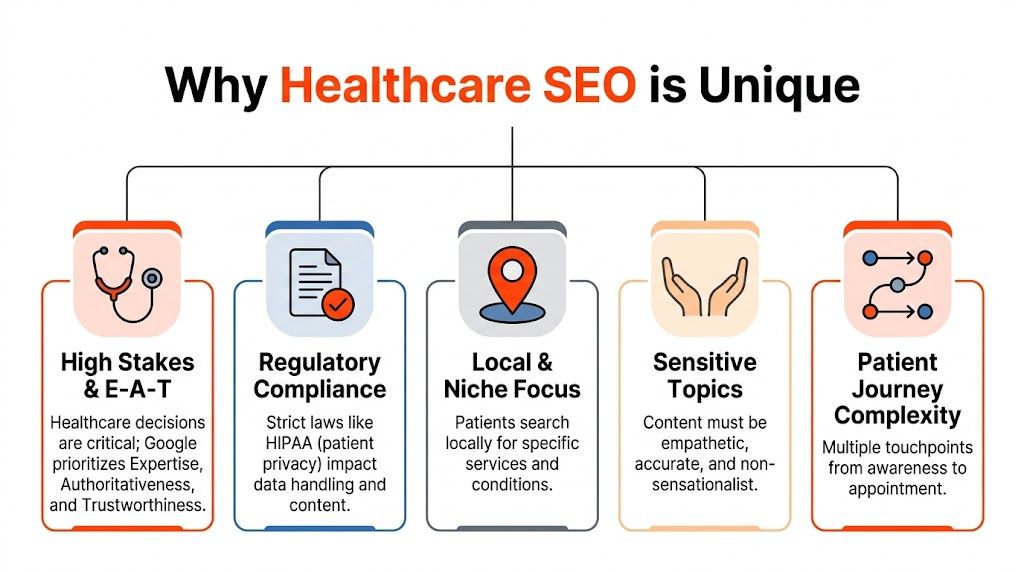
YMYL means your content is judged more strictly
Google uses the idea often referred to as Your Money or Your Life, or YMYL, for pages that can influence a person’s health, safety, finances, or wellbeing. Healthcare pages fall into that category by default.
That means a treatment page, specialist bio, clinic location page, article about symptoms, or post-op recovery guide all carry more scrutiny than a standard commercial page. Thin copy, vague authorship, recycled AI text, and exaggerated claims don’t just weaken rankings. They weaken trust.
A marketing director should read that as an operational requirement, not a theory. If your website publishes medical information, every page has to answer three questions clearly:
- Who wrote or reviewed this
- Why should a patient trust it
- What evidence on the page supports that trust
E-E-A-T is not a checklist
Healthcare teams often reduce Experience, Expertise, Authoritativeness, and Trustworthiness to cosmetic fixes. They add a clinician name, upload a few certificates, and assume the job is done. That approach rarely holds up.
E-E-A-T is better understood as a pattern of proof across the whole site.
| Element | What it looks like on a healthcare site | What usually fails |
|---|---|---|
| Experience | Real treatment context, practical patient guidance, clinician-reviewed explanations | Generic copy with no evidence of real-world care context |
| Expertise | Named medical reviewers, qualifications, specialty alignment | Anonymous articles and outsourced health content |
| Authoritativeness | Strong service pages, practitioner bios, citations to recognised standards where appropriate | Broad blog content with no clear ownership or depth |
| Trustworthiness | Clear contact details, privacy practices, accurate claims, consistent brand signals | Missing policies, hype language, unclear booking paths |
Practical rule: if a patient wouldn’t trust the page enough to choose a provider, Google usually won’t trust it enough to rank strongly either.
What works and what doesn’t
What works in healthcare SEO is usually less glamorous than what gets pitched in sales decks.
What works
- Clinician-led content workflows where medical experts review core pages before publishing
- Detailed practitioner and service pages that prove capability instead of asserting it
- Clear editorial governance for updates, authorship, and compliance checks
- Patient-focused language that explains options without drifting into sensationalism
What doesn’t
- Mass-produced blogs on broad health topics with no local angle or clinical owner
- Keyword stuffing city names into service pages
- Dubious link schemes dressed up as outreach
- AI-generated copy published raw without medical review, compliance review, and tone control
A hospital brand doesn’t need to out-publish global health publishers on every topic. It needs to become the most trusted answer for the services it delivers, in the markets it serves.
Winning the Local Battle with Google Business Profile
For most clinics, specialists, imaging centres, and hospitals with outpatient services, the most important local asset isn’t the homepage. It’s the Google Business Profile. That profile is often the first thing a patient sees before they ever visit your website.
When someone searches for a provider, a specialty, or a service near them, Google Maps and local pack results shape the shortlist. If your profile is incomplete, inconsistent, or unmanaged, your digital front door is effectively half shut.
At this point, local healthcare SEO becomes operational.

Get the basics right before doing anything fancy
A surprising number of healthcare organisations skip the fundamentals and move straight to “content strategy”. That’s backwards. Your Google Business Profile needs clean foundational data first.
Australian healthcare search behaviour is heavily mobile-led. Mobile optimisation influences 70% of patient search behaviours, with page speed under 3 seconds reducing bounce rates by 32%, according to Tebra’s healthcare SEO trends. That matters for your profile because most local discovery happens on a phone, and the handoff from profile to landing page needs to be frictionless.
The essentials are simple:
- Accurate NAP details. Your name, address, and phone number must match your website and key listings.
- Correct primary and secondary categories. Don’t choose broad labels if more specific medical categories fit.
- Current hours and service details. Holiday hours, urgent care hours, and special access notes need active maintenance.
- High-quality photography. Exterior shots, reception, treatment spaces, and clinician portraits all reduce uncertainty for first-time patients.
Use the profile like a live patient acquisition channel
Most organisations set up a profile once and leave it untouched. That leaves a lot of opportunity on the table.
A strong profile should be managed like an active publishing and conversion asset. That includes regular updates, answering common questions, and improving the path from search to booking. A useful reference point is this guide to local SEO for business, especially for thinking about profile management as part of a broader local visibility system.
Here’s where the lift usually comes from:
-
Posts that reflect current patient needs
Publish updates on seasonal clinics, screening reminders, flu vaccination availability, new specialists, or changed hours. Keep them factual and useful. -
Q&A that removes hesitation
Add and manage common questions such as parking, referral requirements, billing approach, accessibility access, and telehealth availability. -
Booking and contact actions
If you offer direct booking, the profile should connect cleanly to that journey. If you don’t, the contact pathway should still be obvious and fast.
A quick visual walkthrough helps if your team is revisiting profile management standards:
Local visibility is won by consistency
The local pack doesn’t reward effort alone. It rewards consistency across systems. If your profile says one thing, your website says another, and directory listings say a third, Google gets mixed signals and patients get frustrated.
The best-performing healthcare profiles usually feel boring in the right way. Accurate, complete, current, and easy to act on.
That also means resisting common mistakes:
- Don’t over-optimise the business name with extra keywords.
- Don’t ignore reviews for weeks at a time.
- Don’t send profile traffic to generic pages when a specific location or specialty page is the better match.
- Don’t treat all locations the same if services, clinicians, or booking rules differ by site.
A hospital marketing director should think of Google Business Profile as local distribution infrastructure. It connects search intent to real patient action. If that infrastructure is weak, even excellent website content will struggle to convert local demand into appointments.
Building Digital Trust Through Technical and On-Page SEO
Technical SEO is where many healthcare sites subtly lose trust. Not because the content is wrong, but because the site makes it hard for search engines to interpret and hard for patients to use. In healthcare, those two problems tend to show up together.
A site that loads slowly, hides key credentials, breaks on mobile, or uses vague page structure sends the wrong signals. It suggests a lack of control. That’s never ideal for a healthcare brand.

Schema gives Google the context your pages assume
Healthcare teams often expect Google to “figure out” what a page means. Sometimes it does. Often it doesn’t. That’s why structured data matters.
In the Australian healthcare sector, implementing MedicalClinic and Physician schema markup in JSON-LD format on provider and location pages can materially improve visibility. Health systems using structured data achieve up to 30% higher click-through rates in location-specific searches, according to DexCare’s guide to healthcare SEO.
That’s not just a technical win. It’s a clarity win.
A few examples make this tangible:
| Page type | Useful schema approach | Why it matters |
|---|---|---|
| Clinic location page | MedicalClinic |
Helps search engines understand location, services, and contact details |
| Practitioner bio | Physician |
Clarifies specialty, credentials, affiliated organisation, and profile identity |
| Condition content | MedicalCondition where appropriate |
Gives more explicit topical context for medically focused educational pages |
If you’re reviewing implementation quality, a proper technical SEO audit should check whether schema is present, valid, and aligned to the actual page content. Markup that exaggerates or mislabels content creates more risk than benefit.
Speed, mobile usability, and security are trust signals
Patients don’t separate technical quality from brand quality. If a page stalls, jumps around on screen, or feels awkward on mobile, they often assume the care experience may be disorganised too.
That’s especially relevant in healthcare because search often happens under pressure. A parent looking for an after-hours GP, a patient comparing specialists between appointments, or someone checking symptoms while commuting doesn’t have patience for a bloated site.
The practical standard is straightforward:
- Mobile-first layouts that prioritise readability, tap targets, and clear action paths
- Fast-loading templates for key entry pages such as locations, services, and practitioner bios
- HTTPS across the site, especially where forms, bookings, or patient enquiries are involved
- Clean internal linking so users can move from information to provider to booking without getting lost
A technically weak healthcare site rarely fails in one dramatic way. It leaks confidence through dozens of small moments.
Compliance has a technical layer too
Healthcare compliance isn’t confined to ad copy and disclaimers. It also touches data handling, consent, privacy controls, and what your forms and third-party tools are doing behind the scenes. That becomes especially important when marketing stacks include chat tools, analytics, call tracking, or embedded booking systems.
For teams reviewing vendor arrangements and data handling obligations, reruptionchat's Compliance-Ressource is a useful operational reference. It isn’t healthcare-specific advice for Australia, but it’s a practical reminder that compliance work often starts in the infrastructure layer, not in the copy deck.
On-page SEO should make expertise visible
Good on-page SEO for healthcare doesn’t look like “optimisation”. It looks like clarity.
That means:
- Titles that describe the page plainly
- Headings that reflect real patient questions
- Service pages that explain eligibility, process, and next steps
- Clinician bios that surface qualifications and scope of practice
- Internal links that connect symptom, treatment, and provider content logically
What fails is equally predictable. Pages stuffed with awkward keywords. Metadata that overpromises. Templates that bury important information below irrelevant brand copy. Large hospital sites are especially prone to this because they accumulate layers of governance, campaign priorities, and legacy CMS decisions.
The fix is usually less about publishing more and more about making existing pages easier to understand, easier to trust, and easier to act on.
Developing a Content Strategy That Connects with Patients
Most healthcare content underperforms for one of two reasons. It’s too generic to compete, or it’s too promotional to trust. In Australia, there’s a third problem as well. It may drift into claims that create compliance risk under the Therapeutic Goods Advertising Code.
That’s why content strategy in healthcare has to do two jobs at once. It must answer patient intent well enough to earn visibility, and it must stay disciplined enough to avoid the kind of language that gets medical advertisers into trouble.
Build around patient decisions, not internal service line language
Patients don’t usually search the way hospitals organise themselves. They search with symptoms, concerns, treatment questions, practical obstacles, and location needs.
A useful content plan usually maps queries across stages such as:
-
Early concern
“why does my knee hurt when climbing stairs” -
Evaluation
“when should I see an orthopaedic specialist” -
Treatment consideration
“non-surgical treatment for knee pain” -
Provider selection
“knee specialist Sydney” -
Practical decision-making
“do I need a referral for orthopaedics”
That structure changes the content you produce. Instead of publishing disconnected blogs, you build topic clusters around real patient journeys. A strong orthopaedics cluster might include symptom content, diagnostic pathways, treatment options, recovery guidance, clinician profiles, and location pages that connect naturally.
Generic health content is usually a poor investment
Many teams still commission broad educational articles because they feel safe. The result is often a library full of “what is” and “top tips” pages that don’t rank, don’t convert, and don’t support service-line growth.
A hospital or specialist group rarely needs another interchangeable article on general wellness. It needs content that bridges from a patient’s question to the organisation’s care pathway.
That usually means prioritising:
| Content type | Strategic value | Common mistake |
|---|---|---|
| Condition pages | Capture diagnostic and treatment research intent | Writing them like encyclopaedia entries |
| Procedure pages | Support high-intent decision-making | Focusing on features, not patient concerns |
| Clinician profiles | Reinforce expertise and fit | Publishing thin bios with no context |
| Location pages | Convert local intent | Duplicating the same copy across suburbs |
| FAQ content | Address friction before enquiry | Treating FAQs as an afterthought |
Editorial rule: every healthcare page should answer a patient question, reduce uncertainty, or help someone take the next step.
TGA compliance changes how you write
Australian healthcare SEO diverges sharply from generic international advice. You can’t borrow US healthcare content patterns, swap in suburb names, and expect the result to be safe or effective.
A critical challenge for Australian practices is complying with TGA advertising regulations for high-intent procedures. HealthEngine data shows practices can lose 52% of potential patients to non-compliant meta descriptions, as outlined in Siteimprove’s healthcare SEO content strategy analysis. That’s a serious commercial issue. If your metadata and page copy are vague because the team is afraid of saying the wrong thing, visibility suffers. If the language becomes too promotional or makes unsupported efficacy claims, compliance risk increases.
That creates a real trade-off. You still need compelling copy, but it has to be precise.
Here’s the practical difference.
Risky approach
- “Best IVF clinic in Sydney”
- “Guaranteed results”
- “No waitlist and superior outcomes”
- “Most advanced treatment with proven success”
Stronger compliant approach
- Describe the service factually
- State what the consultation covers
- Clarify who the service is for
- Explain process, eligibility, referral requirements, and next steps
- Avoid unapproved claims, superiority language, and implied guarantees
The best healthcare content sounds calm
A lot of poor-performing healthcare copy shares the same tone problems. It sounds inflated, salesy, or strangely detached from the patient’s actual situation. That weakens both trust and conversion.
Good healthcare content usually has these characteristics:
-
Plain language first
Explain terms without dumbing them down. Patients shouldn’t need a glossary to understand the page. -
Clinical review built into the workflow
Core service and treatment pages should have named medical oversight. -
Clear boundaries
Distinguish education from diagnosis. Say when someone should seek professional advice or urgent care. -
Specific local relevance
Address referrals, Medicare-related questions where appropriate, access pathways, appointment process, and service availability. -
Strong metadata discipline
Titles and descriptions should be accurate, descriptive, and compliant. This is often where legal risk and click loss collide.
AI can help, but only inside a governed workflow
AI tools are useful for outlining, gap analysis, FAQ extraction, and content inventory work. They are not a substitute for editorial judgement in healthcare. Used badly, they produce smooth-sounding copy that overstates, generalises, or introduces unsupported claims.
Used properly, AI can help a marketing team move faster by:
- clustering patient questions,
- identifying overlapping pages,
- drafting first-pass structures,
- standardising schema prompts for content teams,
- and surfacing metadata variations for review.
The key is governance. AI should produce drafts and analysis. Humans should decide what is publishable.
If a hospital marketing director wants one content principle to enforce across the organisation, it’s this: publish fewer pages, but make each page demonstrably better, safer, and more useful. That’s how authority compounds in healthcare. Not by volume, but by disciplined relevance.
Expanding Authority with Link Building and Reputation Management
Authority in healthcare isn’t built only on your own website. Search engines also look for signals that other sources recognise your organisation as credible, relevant, and trustworthy. That’s where link building and reputation management become part of the same system.
Many teams separate them. They shouldn’t.
The links that matter are the ones you can defend
Healthcare link building has a quality problem because too many agencies still apply old outreach tactics to a high-trust industry. Buying links, swapping irrelevant guest posts, or chasing generic directories may create activity, but it rarely creates durable authority.
The links worth pursuing usually come from real institutional relevance, such as:
- Local health organisations that reference services, partnerships, or events
- Universities and training bodies connected to teaching, research, or specialist expertise
- Professional associations where clinicians hold recognised affiliations
- Reputable media coverage tied to expert commentary, service launches, or public health initiatives
- Community partnerships with councils, charities, or health programs
A useful test is simple. If the link disappeared tomorrow, would the relationship still matter? If the answer is no, it probably wasn’t a strong authority signal to begin with.
Reviews are not separate from SEO
Healthcare marketers often treat reviews as a customer service issue. In practice, reviews influence search performance, click behaviour, and conversion confidence. They’re an SEO asset because they shape local trust before a patient ever reaches the site.
That doesn’t mean chasing review volume at any cost. It means building an organised process for requesting feedback ethically, monitoring new responses, and replying professionally without exposing patient information.
A mature review workflow usually includes:
| Review activity | Why it matters |
|---|---|
| Consistent review requests | Keeps feedback current and reduces recency gaps |
| Response governance | Protects privacy while showing attentiveness |
| Escalation rules | Routes sensitive issues to operations or patient experience teams |
| Service-line monitoring | Identifies patterns around locations, clinicians, or booking friction |
Patients often read reviews to answer a question your website never addressed. They’re looking for reassurance about staff, wait times, communication, and the overall care experience.
Reputation compounds trust signals
A strong authority profile usually looks coherent across channels. Your website shows expertise. Your Google presence shows local relevance. Reviews reflect real patient experience. Third-party mentions confirm standing in the community or profession.
What doesn’t work is trying to patch one weak area with another. A hospital can’t compensate for poor local reviews by buying links. A specialist clinic can’t overcome thin service pages solely by getting listed in more directories. Search signals reinforce each other when they tell the same story.
That’s the core value of off-page healthcare SEO. It turns trust from a claim into a pattern of evidence.
Accelerating Growth with AI-First SEO and Integrated Campaigns
The healthcare teams gaining ground now aren’t treating SEO as an isolated channel. They’re building connected systems where SEO, paid media, analytics, and content operations inform one another. That’s the practical future of growth in this category.
An AI-first workflow matters here, but not in the shallow sense of “use AI to write faster”. In healthcare, the value of AI is speed plus structure plus better decision support. The strategy still has to come from people who understand patient intent, regulatory boundaries, and service-line priorities.

Use PPC data to sharpen SEO decisions
Paid search gives healthcare marketers something organic search often withholds. Fast feedback. You can see which messages attract clicks, which landing pages hold attention, and which queries are more likely to produce enquiries or bookings.
That doesn’t mean paid and organic should mirror each other exactly. It means each should inform the other.
For example:
- a PPC campaign may reveal that patients respond better to “book a skin check” than a more clinical phrasing,
- search term reports may expose practical, high-intent questions your organic content doesn’t answer,
- and paid landing page tests may show which appointment pathways create less friction.
Those learnings should influence content briefs, title tags, internal linking priorities, and page design. An agency or in-house team building mature workflows around AI for SEO will usually combine search data, content opportunity analysis, and technical review rather than running them in separate silos.
AI is strongest in research, workflow, and QA
In healthcare, AI works best when it reduces manual labour around analysis and drafting, not when it makes unsupervised publishing decisions.
Useful AI-assisted tasks include:
- clustering keyword themes by service line,
- identifying cannibalisation across similar pages,
- extracting recurring questions from call logs or reviews,
- suggesting metadata variants for review,
- summarising technical crawl findings,
- and helping content teams structure long pages more clearly.
Where AI tends to fail is exactly where healthcare brands can least afford failure. It can overstate treatment claims, flatten nuance, miss Australian compliance issues, and produce text that sounds polished but generic.
Some teams also use AI output that sounds mechanically “perfect” and then wonder why it feels cold or suspicious to readers. If that’s a recurring issue in your workflow, a tool designed to humanize chatgpt text can help as part of the editing process, but it should sit behind clinical review and compliance review, not replace them.
Measure patient acquisition, not publishing activity
Healthcare SEO reporting often gets stuck on metrics that are easy to export and hard to act on. Rankings, sessions, and impressions matter, but they don’t tell a marketing director whether the programme is helping service-line growth.
The more useful measurement model tracks movement across the patient journey:
| Layer | Better question to ask |
|---|---|
| Visibility | Are priority services appearing for the right intent set? |
| Engagement | Do patients reach the information they need without confusion? |
| Conversion | Are users booking, calling, or submitting enquiries from organic entry pages? |
| Quality | Which pages attract intent that aligns with real patient demand? |
| Efficiency | Where can paid and organic reduce wasted spend together? |
Boardroom translation: traffic is only valuable if it moves patients towards an appointment, referral, or provider selection action.
CRO matters more in healthcare than many teams admit
Conversion rate optimisation often gets framed as button colour testing. In healthcare, it’s usually more fundamental than that. Patients abandon because they can’t work out whether a service is right for them, whether they need a referral, which location to choose, or what happens next.
That means CRO work often includes:
- rewriting confusing service pages,
- simplifying booking journeys,
- surfacing referral and billing information earlier,
- improving mobile page layout,
- and aligning page content to the user’s stage of decision-making.
Integrated teams outperform siloed ones by leveraging distinct contributions. SEO brings intent insight. Paid media brings rapid testing data. Analytics shows path behaviour. Content and UX fix the actual friction.
The future-proof approach is disciplined, not flashy
The strongest healthcare SEO programmes don’t chase every trend. They absorb useful change without abandoning the fundamentals. AI search results, local pack changes, zero-click behaviour, and compliance scrutiny all raise the bar for quality. They don’t remove the need for trusted content, technically sound websites, and clear patient journeys.
For Australian providers, the durable roadmap is clear:
- build authority in the service areas you own,
- make local discovery easy,
- keep technical signals clean,
- write with compliance discipline,
- use AI to improve workflow quality,
- and connect SEO with paid search and conversion optimisation.
That’s how seo for healthcare becomes more than a ranking exercise. It becomes a patient acquisition system that can hold up under scrutiny.
If your team needs a partner that understands AI-first SEO, paid search, technical implementation, and transparent reporting, Click Click Bang Bang is built for that kind of work. They help organisations turn search data into practical growth strategy, with flexible engagement options and a clear focus on measurable outcomes.
Read NeXt
Or Read Our Latest
- How to Calculate Sample Size for A/B Tests and Campaigns
- How to Fix Google Merchant Center Errors Step by Step
- What Is Pagination and Why It Matters for AU Sites
- What Is Value Proposition? PPC & SEO Guide
- How to Choose a Google Ads Agency Australia
- Influencer Collaboration Playbook for E-Commerce & B2B
Click. CLick. Subscribe.
Get our best PPC insights, industry updates, and power moves delivered straight to your inbox. No fluff, just high-caliber strategies that actually work.
Don’t Leave Just Yet
Try Us For 30-Days,
Risk Free!!
We guarantee that you’ll love our work within the first 30 days, if not you’ll get your money back.
What have you got to lose?