

Digital Marketing Strategy for Startups: A 2026 Playbook
Last Updated
Most startup founders hit the same wall. They know digital matters, but every option looks urgent. Google Ads promises speed. SEO promises compounding returns. LinkedIn looks right for B2B. Social feels mandatory because everyone else is posting.
That's where bad strategy starts. Not with a wrong platform, but with trying to do too much before you've proved what drives pipeline, sales, or revenue.
A useful digital marketing strategy for startups in 2026 isn't built around being everywhere. It's built around measurement, prioritisation, and speed of learning. You need a system that tells you what's working inside the first 90 days, what deserves more budget, and what should be cut quickly.
Your Starting Point in a Crowded Digital World
You're probably dealing with some version of this. The product is live, or close to live. Sales targets are real. Investors, co-founders, or the team want traction. Meanwhile, your marketing choices keep expanding.
That pressure is happening inside a market that's become overwhelmingly digital. According to industry projections for digital marketing strategy for startups, worldwide advertising expenditure is forecasted to reach $1.04 trillion in 2026, with 68.7% or $714.48 billion allocated to digital platforms. For Australia, the same source notes that digital ad spend grew to AUD $15.4 billion in 2025, with search and social accounting for 62% of the total.

That doesn't mean you need a bigger channel list. It means you need better choices.
What founders usually get wrong
Early-stage teams often make one of three mistakes:
- They spread too thin by launching SEO, paid social, email, LinkedIn, content, influencer outreach, and partnerships all at once.
- They chase activity instead of evidence and celebrate clicks, followers, or impressions without tying them to conversions.
- They delay tracking setup until after campaigns are already live, which makes early data messy and hard to trust.
Start narrow enough that you can learn fast, but broad enough that you're not betting the company on one assumption.
If you need a quick refresher on the fundamentals before building a more aggressive growth plan, Adwave's guide to effective small business marketing basics is a useful starting point.
The practical starting rule
Your first move isn't “pick a channel”. It's this:
- Define the customer you want first
- Choose the smallest set of channels that can reach them
- Install clean tracking before launch
- Judge every channel by business outcomes, not noise
That's how a startup stops guessing and starts building a real acquisition engine.
Laying the Groundwork for a Winning Strategy
Startups love speed, but speed without direction burns budget. Before you put money into Google Ads, Meta, or LinkedIn, you need three things in place: a clear view of the customer, a sober read on competitors, and KPIs that reflect commercial reality.
According to The Digital Bloom's startup marketing guide, only 17% of organisations clearly define their digital strategies, yet those that do achieve 2.5x higher ROI. The same source notes that Australian startups that track performance with tools like Google Analytics and defined KPIs see a 28% uplift in campaign effectiveness.
Know the customer beyond demographics
“SMBs in Australia” isn't a target market. Neither is “women aged 25 to 44”. Useful targeting starts with buying triggers, objections, urgency, and channel behaviour.
Build your first buyer profile around questions like these:
- What problem triggers the search. A compliance issue, missed revenue, manual admin, poor lead quality, abandoned carts?
- What outcome they care about. Saving time, increasing sales, replacing a clunky supplier, reducing waste in ad spend?
- What stops them from acting. Budget anxiety, internal approval, poor timing, distrust, or lack of urgency?
- Where they evaluate vendors. Google, LinkedIn, peer referrals, review sites, or product comparison pages?
If your team needs help structuring this work, this guide on how to define your target customer is a practical place to begin.
For faster synthesis, AI can help sort interview notes, CRM tags, search themes, and category signals into usable patterns. Tools that synthesize market data can be useful when your inputs are scattered and you need sharper hypotheses quickly.
Audit competitors with intent
Competitive research isn't about copying ad headlines. It's about seeing where the market is overinvested, underexplained, or poorly positioned.
Look at:
| What to inspect | What to look for | Why it matters |
|---|---|---|
| Paid search presence | Brand terms, category terms, offer language | Shows who's buying intent and how crowded core keywords are |
| Landing pages | Weak messaging, slow pages, vague calls to action | Reveals conversion gaps you can beat |
| Organic content | Topic clusters, comparison content, FAQs, gaps | Helps identify SEO whitespace |
| LinkedIn activity | Thought leadership, offer framing, retargeting patterns | Useful for B2B category positioning |
Set KPIs that can survive scrutiny
Founders often say they want “more traffic”. That's not a KPI. Traffic matters only if it contributes to acquisition.
A stronger startup scorecard usually includes:
- Customer Acquisition Cost
- Lead quality by channel
- Conversion rate on core landing pages
- Return on Ad Spend
- Sales-qualified leads or booked demos
- Revenue contribution by campaign
Practical rule: If a metric can't help you decide whether to increase, reduce, or pause spend, it doesn't belong at the centre of your dashboard.
This foundation isn't admin work. It's what stops your startup from confusing motion with progress.
Choosing Your High-Impact Marketing Channels
A startup doesn't win by using more channels than competitors. It wins by choosing the channels that match its buying cycle, margin structure, and speed requirements.
For Australian startups, channel choice is often a trade-off between speed, control, and compounding value. PPC can validate demand quickly. SEO takes longer but builds durable visibility. Meta can support remarketing and demand capture. LinkedIn can be expensive, but for the right B2B offer it can produce much stronger lead quality.
According to Ripple's startup marketing framework, LinkedIn Ads can generate 2.7 times more qualified leads compared to Google Ads for Australian B2B startups. For e-commerce, the same source notes that a structured funnel using Meta retargeting and Google Shopping can achieve an average conversion rate of 5.2%.
What each channel is good for
SEO
SEO is your long-game asset. It works best when buyers research, compare, and revisit before purchase. That's common in B2B, services, health, finance, and considered e-commerce categories.
Use SEO when you need to:
- Build category authority
- Capture non-branded problem-aware searches
- Lower dependence on paid channels over time
- Create content that supports both acquisition and sales enablement
SEO is not the right answer if you need immediate validation next week. It's also weaker when your category has low search demand or your site can't yet support quality content and technical basics.
Google Ads
Google Ads is the fastest way to test commercial intent. If buyers are already searching for the problem you solve, search campaigns can tell you quickly whether your message, offer, and landing page can convert.
It's a strong fit for:
- High-intent lead generation
- Launch periods
- Product-market validation
- Offer testing
- Branded demand capture once awareness grows
The downside is obvious. Poor keyword control, weak landing pages, and loose conversion tracking will burn spend fast.
Meta
Meta usually works best as a support and scale channel, especially for e-commerce and remarketing. It can also help shape demand with creative-led offers, founder-led content, and social proof.
Use it when:
- Your product benefits from visual explanation
- You have enough traffic to retarget
- You need to recover non-converting visitors
- Your funnel can support repeat exposure
Meta is less forgiving when the offer is vague or the audience is too narrow.
For B2B startups selling to decision-makers, LinkedIn is often the right choice even when click costs feel uncomfortable. The question isn't whether the click is expensive. It's whether the lead is relevant.
LinkedIn works best when:
- Deal value is high enough to justify a more expensive acquisition path
- Targeting by job title, industry, or company type matters
- The sale needs education, trust, and repeated exposure
- Your messaging can speak directly to commercial pain points
A simple channel selection table
| Startup type | Best first channel | Best supporting channel | Why |
|---|---|---|---|
| B2B SaaS | Google Ads or LinkedIn | SEO | Search captures intent, LinkedIn improves lead quality, SEO builds category coverage |
| E-commerce | Google Shopping | Meta remarketing | Shopping captures active buyers, Meta brings back non-buyers |
| Professional services | Google Ads | SEO | Strong for urgent, problem-aware searches and long-term authority |
| Niche B2B | Retargeting | Useful when targeting specific roles matters more than broad reach |
Don't choose channels because they're popular. Choose them because they match how your buyer discovers, evaluates, and commits.
The startup rule for channel count
In the first 90 days, most startups should focus on one primary acquisition channel, one supporting channel, and foundational SEO work. That's usually enough to generate signal without creating operational chaos.
If you add too much too early, you won't learn which input caused the result. And if you can't explain the result, you can't scale it safely.
Allocating Your Startup Marketing Budget for Growth
Budget allocation is where strategy becomes real. Every startup says it wants efficiency. Very few build a budget model that produces it.
The mistake is treating budget as a static monthly number. A better approach is to treat budget as a learning system. Part of it should prove demand. Part should improve what's already working. Part should stay flexible enough to test a new audience, offer, or creative angle without disrupting the core engine.
Build a test and invest model
A practical startup budget usually has three layers:
- Core spend on the channel most likely to produce pipeline or sales now
- Support spend on remarketing, branded search, or conversion assistance
- Test spend reserved for experiments that could lead to a better CAC or higher-quality lead source
Discipline is paramount. The test budget is not a playground for random ideas. It should answer a specific question, such as whether a new landing page angle converts better, whether LinkedIn outperforms search for a B2B segment, or whether shopping traffic beats standard search for a product category.
Budget by evidence, not opinion
Founders often allocate spend based on confidence, familiarity, or what another business said worked. That's understandable, but it's weak decision-making.
A stronger model asks:
- Which channel can produce trustworthy signal fastest
- Which channel supports the strongest buying intent
- Which campaigns have clean enough tracking to judge fairly
- Which spend is preserving efficiency versus merely preserving hope
To keep those decisions grounded, you need to understand the economics behind acquisition. If your team needs a sharper handle on that, this resource on how to calculate customer acquisition cost is worth reviewing.
What smart budget behaviour looks like
| Good allocation behaviour | Bad allocation behaviour |
|---|---|
| Increase spend after conversion quality is proven | Increase spend because clicks are cheap |
| Pause campaigns with weak downstream outcomes | Keep weak campaigns running to “gather more data” indefinitely |
| Protect spend on high-intent traffic | Overfund awareness before the offer is validated |
| Use remarketing to improve paid efficiency | Ignore returning visitors and keep paying for first touches only |
A startup budget should buy learning first, then scale. If it does those in reverse order, waste compounds quickly.
Your 90-Day AI-First Digital Marketing Roadmap
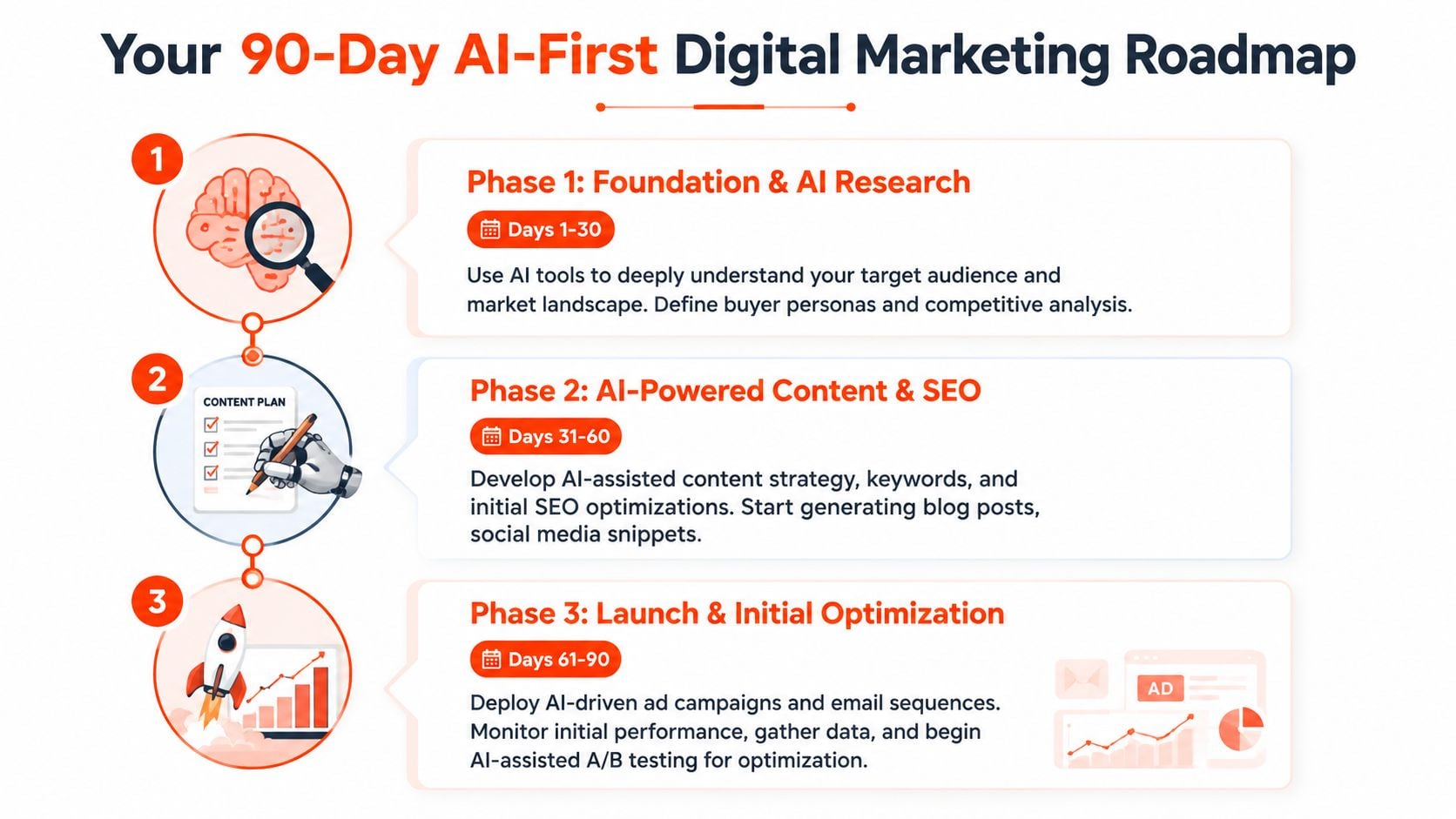
The first 90 days matter because they shape your baseline. You're not just launching campaigns. You're building the operating system your startup will use to make marketing decisions.
According to Ginger IT Solutions' startup strategy guide, Australian startups that follow a structured, data-driven PPC methodology and iterate weekly can boost their ROAS by 35%. The same source says 67% hit a 3x ROAS within 90 days, compared to 22% of those without a clear plan.
Days 1 to 30
The first month is about setup, clarity, and controlled launch. Don't aim for scale yet. Aim for signal.
Lock in measurement first
Before ads run, make sure these basics are in place:
- Analytics setup with Google Analytics 4 and clear conversion events
- UTM conventions so campaign traffic can be segmented properly
- Platform tracking for Google, Meta, or LinkedIn as relevant
- Landing page alignment so every ad group or audience has a logical destination
If your tracking is messy at launch, your first month of data won't be trustworthy enough to guide budget decisions.
Use AI to accelerate research, not replace judgment
AI is most useful here as a research and production assistant. It can cluster search themes, suggest ad variations, surface recurring objections from call notes, and help structure content briefs faster.
Useful AI-first tasks in this phase include:
- Turning customer interviews into pain-point summaries
- Grouping keyword themes by intent
- Drafting first-pass ad copy variations
- Building content outlines around problem-aware search topics
- Summarising competitor messaging patterns
For a closer look at how this can work inside paid acquisition, this overview of artificial intelligence ads is a practical reference.
Launch one core paid campaign
Start with the shortest path to signal. For most startups, that means:
- Google Search for high-intent demand capture
- Google Shopping for e-commerce
- LinkedIn Ads for specific B2B decision-maker targeting
Keep the structure tight. Don't dump every keyword, product, audience, and message into one account build. Segment by intent, product category, or offer type so the data tells a clear story.
Days 31 to 60
The second month is where startups usually make one of two errors. They either scale too quickly off shallow wins, or they hesitate too long because the data feels imperfect.
The better move is controlled optimisation.
Review the funnel, not just the ad account
By this point, you should be looking beyond platform metrics. Click-through rate and cost per click matter, but they're not enough.
Review:
- Search terms against lead quality
- Landing page behaviour against conversion outcomes
- Device performance
- Audience segments
- Assisted conversions from remarketing
If one campaign generates cheap leads but sales rejects them, it isn't a winning campaign. It's just a cheap form fill engine.
The first useful insight often comes from mismatch. Strong clicks paired with weak conversion usually points to landing page friction or message misalignment, not a traffic problem.
Start weekly iteration cycles
Fostering discipline is vital for startups. Pick a weekly review cadence and stick to it.
One week you might test:
- New headlines based on search queries
- Stronger offer framing
- Product-specific landing pages
- Negative keyword expansion
- Different call-to-action wording
The following week, review what changed and decide what stays live.
Build foundational SEO in parallel
While paid campaigns generate immediate data, start laying SEO groundwork:
- Publish solution pages tied to your core offer
- Create content around buyer questions
- Improve metadata, internal linking, and page structure
- Build comparison and alternative pages where appropriate
Paid search tells you what people respond to now. SEO helps you turn that learning into compounding owned visibility.
Days 61 to 90
The third month is about choosing what deserves scale. You should now have enough directional evidence to separate promising channels from expensive distractions.
Double down on the clearest winner
Put more budget behind the campaign or audience combination that shows the best balance of:
- Conversion quality
- Commercial intent
- Sustainable cost
- Operational simplicity
That doesn't always mean the lowest acquisition cost. It often means the cleanest route to revenue.
Expand carefully
Good expansion ideas at this stage include:
- A second audience segment
- A new ad angle based on proven copy
- Retargeting layered onto the main campaign
- Additional product or service pages
- Branded search protection if demand is growing
Bad expansion ideas include launching three new platforms because one campaign had a good fortnight.
Document the playbook
By day 90, capture what you've learned:
- Which messages resonated
- Which search themes converted
- Which objections kept appearing
- Which landing page structure worked best
- Which channels deserve the next round of spend
That document becomes the starting point for quarter two. Without it, teams repeat the same experiments and lose momentum.
Beyond the Launch Scaling with Data and Optimisation
The biggest startup marketing myth is that once campaigns are live, the hard part is done. It isn't. Launch is only the point where your assumptions finally meet the market.

According to BolsterBiz's analysis of startup marketing strategy, 60% of startups abandon their marketing strategies within six months due to unclear attribution. The same source notes that teams using transparent, live reporting and ruthless channel prioritisation are better placed to reduce that failure pattern and scale more reliably.
Attribution problems break good strategy
A lot of startups don't fail because the channel was wrong. They fail because they can't tell what the channel achieved.
Typical attribution issues look like this:
- Branded search gets too much credit because demand was created elsewhere
- Paid social gets dismissed too early because it assisted rather than closed
- SEO is undervalued because the conversion happened on a later visit
- Sales feedback never reaches marketing so poor lead quality hides behind decent platform metrics
That's why weekly reporting matters. You need one view of performance that combines ad platform data, analytics, CRM outcomes, and actual commercial feedback.
Build a run, measure, learn, refine loop
A useful optimisation loop is simple, but it has to be enforced.
- Run campaigns with clear hypotheses
- Measure results against commercial KPIs
- Learn from both winners and false positives
- Refine targeting, messaging, offers, and landing pages
Key takeaway: Startups don't need perfect attribution. They need attribution that's clear enough to guide the next budget decision with confidence.
This short video adds helpful context on the discipline behind performance-led marketing:
What to optimise every week
| Area | What to review |
|---|---|
| Search campaigns | Search terms, negatives, ad relevance, lead quality |
| Landing pages | Conversion friction, message match, form quality |
| Social and retargeting | Audience fatigue, creative response, assisted conversions |
| Sales feedback | Lead quality, objections, close reasons |
The startups that keep improving aren't the ones with the flashiest launch. They're the ones that keep tightening the loop after launch.
If you want help turning this into a live acquisition system, Click Click Bang Bang works with startups on PPC and AI-first SEO built around transparent reporting, fast launch cycles, and flexible plans that don't lock you into long-term commitments.
Read NeXt
Or Read Our Latest
- Manual vs Automated Bidding for PPC Success
- Conversion Tracking Setup: A Complete AU Guide
- Instagram Advertising Australia: Complete 2026 Guide
- Pay Per Click: A Beginner’s Guide for Australian Marketers
- Display Advertising on Google: The Complete Australian Guide
- Stakeholder Communication Plan How to Build One That Works
Click. CLick. Subscribe.
Get our best PPC insights, industry updates, and power moves delivered straight to your inbox. No fluff, just high-caliber strategies that actually work.
Don’t Leave Just Yet
Try Us For 30-Days,
Risk Free!!
We guarantee that you’ll love our work within the first 30 days, if not you’ll get your money back.
What have you got to lose?