

Search Engine Optimisation Service: Boost Growth with AI-Driven SEO
Last Updated

So, what exactly is an SEO service? Think of it as a strategic partnership designed to make your website way more visible in search engine results. The main goal isn't just traffic for traffic's sake; it's about attracting high-quality organic traffic—the kind of visitors who are actively looking for exactly what you sell. This isn't a one-off task but an ongoing process of improving your site's authority and relevance in the eyes of search engines like Google.
What Is a Search Engine Optimisation Service?
Let's get straight to it. A professional search engine optimisation service is like having a dedicated navigation and engineering crew for your business in the digital world. It’s a complete strategy built to make your website the most authoritative and obvious choice for customers searching on Google. Forget just chasing clicks. The real objective is to attract the right people—those who are ready to become leads and customers.
To really get why this is so valuable, it helps to understand what is search engine optimization from the ground up. At its core, it's all about systematically improving your online presence so the right people can find you.
The Race for Digital Visibility
You can think of it like preparing a high-performance race car. A specialised SEO service meticulously fine-tunes your website’s ‘engine’ (that’s the technical SEO), plots the most efficient ‘race lines’ (your content strategy), and builds your ‘reputation’ on the track (that’s link building). The end game? To consistently leave your competitors in the dust and claim those top spots in the search results.
For Australian businesses, this kind of strategic investment is quickly becoming non-negotiable. Projections show that in 2025, spending on SEO services will hit a massive $1.5 billion, a solid 12% jump from 2024. And with Google absolutely dominating 93.95% of the search market here in Australia, if you’re not ranking high, you’re practically invisible.
A professional SEO service doesn’t just get you seen; it gets you seen by the right people at the exact moment they need you. It transforms your website from a passive digital brochure into an active, lead-generating asset for your business.
The impact of this is huge. The number one organic result on Google scoops up an average click-through rate of 29.5%. On top of that, organic search is responsible for driving between 85-90% of all website traffic. That’s an incredible amount of value just waiting to be unlocked by climbing the search rankings.
The Four Pillars of an SEO Service
To get a better handle on how an SEO service actually delivers these kinds of results, it’s useful to break it down into its core parts. We like to think of them as four pillars. Each one supports a different aspect of your site's performance, and when they all work together, they create a seriously powerful engine for business growth.
This table shows how each pillar's activities connect directly to a real-world business outcome.
The Four Pillars of an SEO Service and Their Business Impact
| SEO Pillar | Core Activities | Primary Business Outcome |
|---|---|---|
| Technical SEO | Site speed optimisation, mobile-friendliness, sitemap creation, secure connections (HTTPS). | Improved user experience, better search engine crawling, higher ranking potential. |
| On-Page SEO | Keyword research, content optimisation, meta tag creation, internal linking strategy. | Increased relevance for target search queries, higher click-through rates from search results. |
| Content Strategy | Blog post creation, service page writing, creating helpful resources (guides, FAQs). | Attracting qualified traffic, building brand authority, and engaging potential customers. |
| Link Building | Earning backlinks from reputable websites, digital PR, guest posting. | Enhanced domain authority, improved trust signals for Google, referral traffic. |
As you can see, it's not about just one thing. A solid SEO strategy is a coordinated effort across all these areas, each one building on the others to push your website higher and attract more of the right customers.
Deconstructing Modern SEO Service Components
A powerful search engine optimisation service isn’t a single magic trick. It's a coordinated strategy, with multiple disciplines working together.
Think of it like a high-performance engine. For it to run smoothly and win the race, every component—from the foundational engine block to the fuel injection system—must be perfectly tuned and synchronised. This holistic approach is what drives sustainable, long-term growth.
The diagram below breaks down the core pillars that form the foundation of any successful SEO campaign.
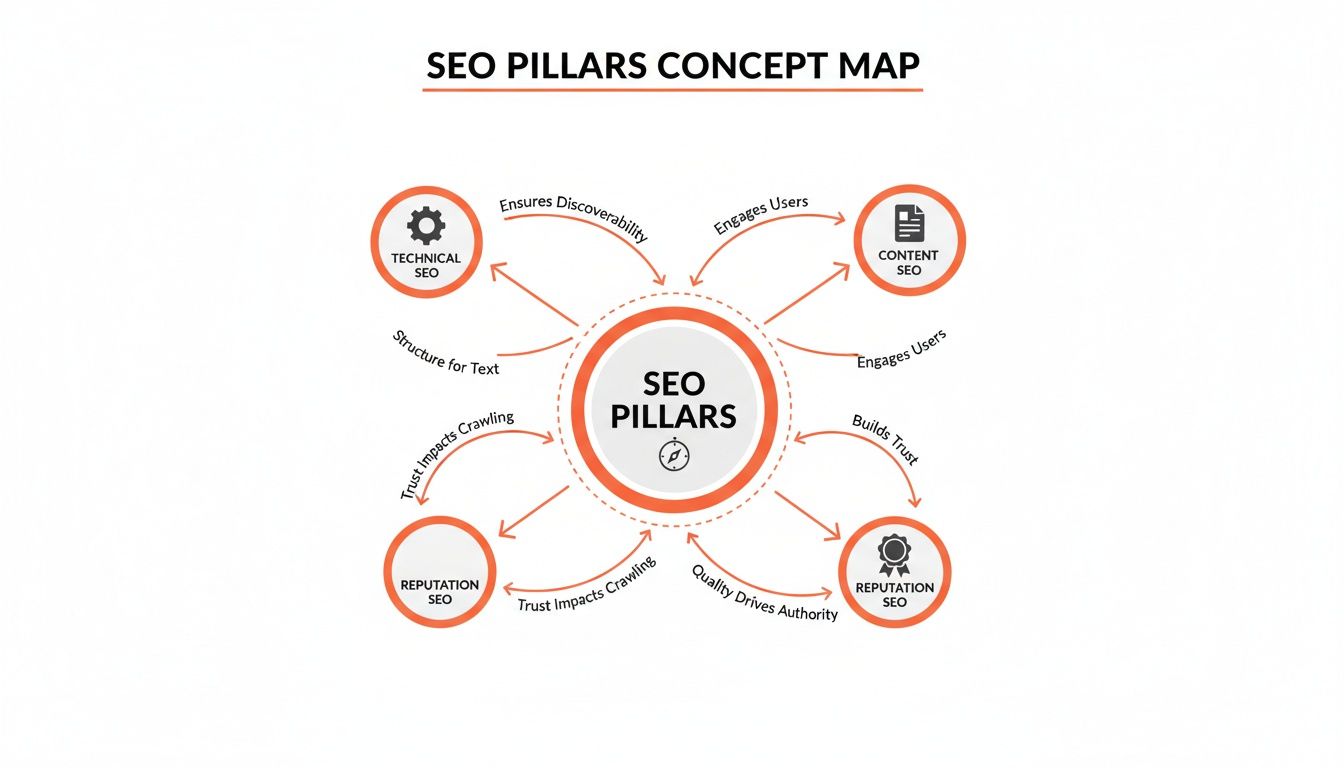
This visual shows how Technical SEO, Content, and Reputation are all interconnected, forming a robust structure that supports your website's visibility and authority in search results.
The Foundation: Technical SEO
Before you can even think about keywords or content, your website needs a rock-solid foundation. This is the domain of Technical SEO, the discipline focused on making sure search engines can easily crawl, understand, and index your site. It’s the behind-the-scenes work that makes a massive difference to performance.
Imagine building a house on shaky ground. No matter how beautiful the interior design is, the structure is fundamentally flawed. Technical SEO ensures your digital house is built on a solid concrete slab.
Key jobs here include:
- Improving Site Speed: Making sure pages load in a flash to keep visitors from bouncing.
- Mobile-Friendliness: Guaranteeing a seamless experience for users on smartphones and tablets.
- Creating a Logical Site Structure: Making it easy for both users and search engine crawlers to find their way around.
- Implementing Secure Connections (HTTPS): Protecting user data and building trust.
A technically sound website is the non-negotiable first step to getting on Google's good side.
The Structure: On-Page SEO
With a strong foundation in place, the next step is to get the individual rooms of your house in order. On-Page SEO is all about optimising the content and HTML source code of each page to make it more relevant and understandable to search engines. It's about signalling exactly what your page is about.
This process ensures your content is perfectly aligned with what your target audience is searching for. It’s the difference between a page that vaguely touches on a topic and one that is clearly the best possible answer for a specific query. We dive deeper into this in our guide comparing the nuances of on-page and off-page SEO.
On-Page SEO is about making your content speak Google's language. It translates your valuable information into a format that search engine algorithms can easily recognise and rank for relevant queries.
The Fuel: Content and Link Building
If technical SEO is the foundation and on-page SEO is the structure, then content and link building are the fuel and highways that bring visitors to your site. High-quality content is the reason people visit in the first place. It answers their questions, solves their problems, and establishes your brand as an authority.
At the same time, Link Building (often called Off-Page SEO) is the process of earning backlinks from other reputable websites. Each of these links acts like a vote of confidence, telling search engines that your content is trustworthy and valuable. A site with lots of high-quality backlinks is seen as an authority, which leads to higher rankings.
The Neighbourhood: Local SEO
For any business with a physical presence or a defined service area, Local SEO is absolutely critical. This specialised discipline focuses on optimising your online presence to attract more customers from relevant local searches. It involves fine-tuning your Google Business Profile, managing local reviews, and creating location-specific content.
The power of this focused approach can't be overstated. Research shows that multi-location Australian businesses generate an astounding 557% more organic traffic on average than single-site operations. The top performers in this space have 35 times more backlinks and eight times more reviews, proving the vital connection between link building, reputation, and local optimisation.
By integrating all these components, a search engine optimisation service creates a comprehensive strategy that addresses every factor search engines use to rank websites, ensuring no opportunity for growth is left on the table.
Why an AI-First SEO Strategy Is Essential
The world of search is changing, and fast. The engine driving that change? Artificial intelligence. An AI-first SEO strategy isn't some far-off concept anymore; it's a must-have for any business that wants to compete right now. This approach fundamentally re-wires how we tackle optimisation for search engines like Google.
AI has officially moved beyond being just a buzzword. For us, it means ditching yesterday's methods and using intelligent tools for things like predictive keyword analysis, creating content that’s genuinely helpful, and automating technical audits that used to take days. It allows for a much sharper, more responsive SEO service.

This shift is especially obvious here in Australia, which is actually leading the world in AI search adoption. The average Aussie is making 1.42 AI queries every single day. As a result, 56% of Australian businesses have already started using AI-driven tools to get their content right. It's a critical move, especially when 65% of searches now end without a click because of AI-generated summaries, and Google's AI Overviews are showing up in 39% of results. To see the full picture, you can dig into the latest data on AI search adoption in Australia.
AI as Your Strategic Co-Pilot
Think of AI less as a replacement for human marketers and more as an incredibly powerful co-pilot. It chews through mountains of data in seconds, spotting patterns and opportunities that would take a human team weeks, if not months, to uncover. It’s this partnership that lets us make smarter, faster, and more data-backed decisions for your campaigns.
For example, AI tools can analyse thousands of competitor pages to pinpoint content gaps, predict which topics are about to trend, and even suggest the best internal linking structure for your site. This frees up human strategists to focus on what we do best: creativity, understanding customer psychology, and building the high-level strategy that wins. You can learn more in our detailed guide on using AI for SEO effectively.
By getting on board with this new reality, your business gets a serious competitive advantage. It's about future-proofing your online presence and making sure you're ready for whatever search engines throw at us next.
An AI-first approach doesn't just make your SEO more efficient; it makes it more intelligent. It transforms your strategy from being reactive to proactive, anticipating user needs and market shifts before they happen.
Traditional vs AI-First SEO
To really get your head around the shift, it helps to see the two approaches side-by-side. The traditional way of doing SEO, while it worked for a long time, is quickly becoming a relic thanks to the machine learning that now powers search engines. An AI-first mindset completely changes the game.
Here's a breakdown of the key differences between a legacy SEO service and a modern, AI-integrated one.
| Aspect | Traditional SEO Approach | AI-First SEO Approach |
|---|---|---|
| Keyword Research | Focuses on historical search volume and static keyword lists. | Uses predictive analysis to identify emerging trends and user intent clusters. |
| Content Creation | Follows a formulaic approach based on keyword density and length. | Creates hyper-relevant, nuanced content that directly answers complex user queries. |
| Technical Audits | Relies on manual checks and periodic crawls, which can be slow. | Employs automated, real-time monitoring to identify and fix issues instantly. |
| Strategy Focus | Primarily reactive, adjusting to algorithm updates after they occur. | Proactive and adaptive, modelling strategies on machine-learning principles. |
Adopting an AI-first methodology is no longer a "nice-to-have" for businesses looking for real growth. It delivers the analytical power and strategic foresight needed to not just keep up, but to lead in an increasingly complex digital world.
Combining SEO and PPC for Maximum Impact
Ever wished for a marketing strategy that delivers both instant wins and long-term, compounding growth? It’s not a pipe dream. It’s what happens when you pair a smart search engine optimisation service with a sharp pay-per-click (PPC) campaign. When these two powerhouses work together, they don’t just coexist—they create a synergy that can completely dominate the search results.
I like to think of it as a coordinated offensive. PPC is your air support. It gets you on the map fast, providing immediate visibility, letting you test messages, and gathering valuable intel on what your competitors are up to.
Meanwhile, SEO is your ground force. It’s the methodical, deliberate campaign of capturing and holding valuable online territory. You’re building a strong, lasting presence that becomes harder and harder for rivals to challenge over time. One supports the other, creating a unified and frankly, formidable, front.
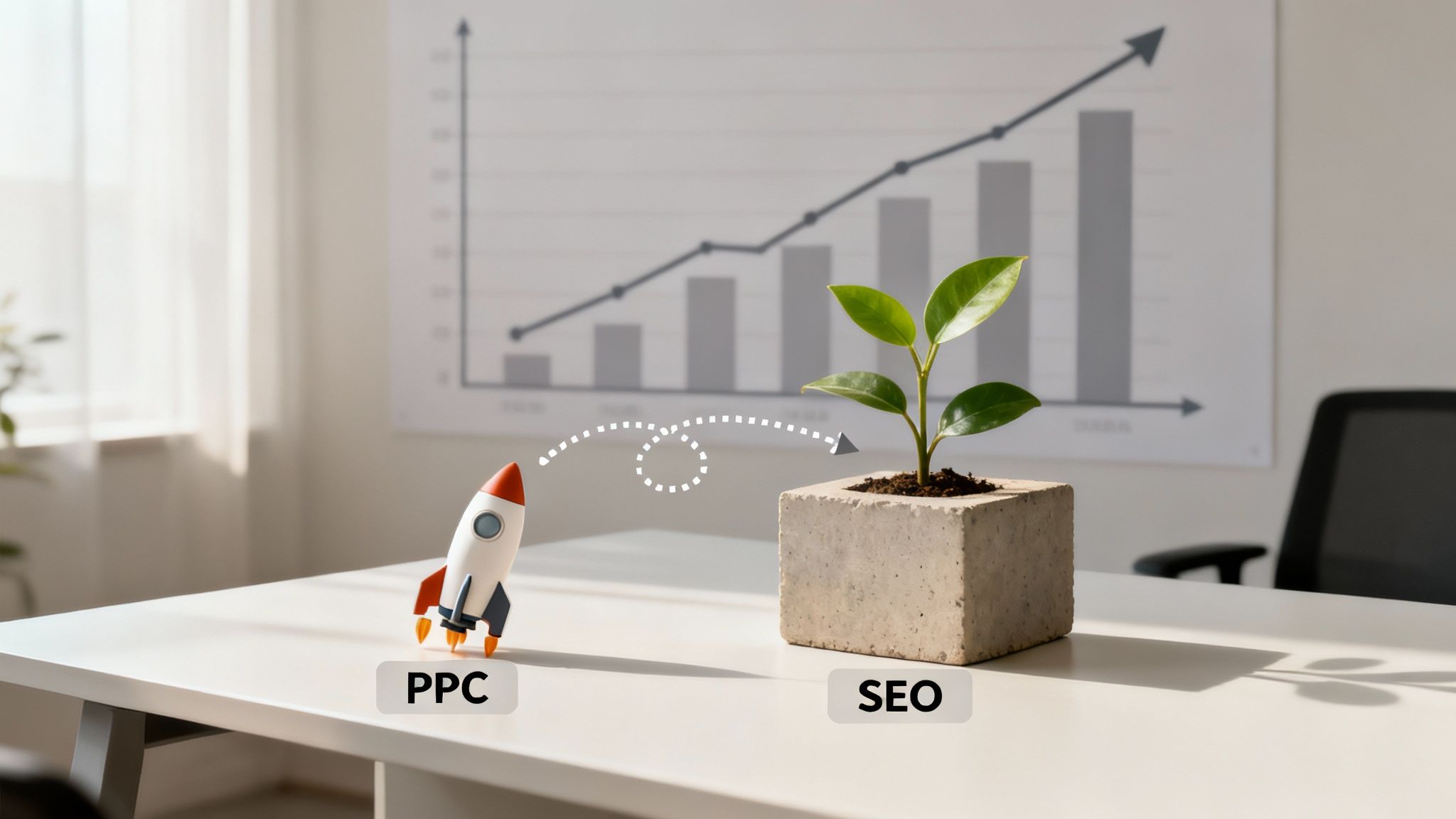
How SEO and PPC Fuel Each Other
The real magic kicks in when you start using insights from one channel to make the other one stronger. This creates a data-driven feedback loop that lets you make smarter decisions, grow faster, and get a much better return on your total marketing spend. To get this right, you first have to understand the fundamental difference between SEM and SEO and see how paid and organic search are two sides of the same coin.
This tag-team approach pays off in a few critical ways:
- Keyword Intelligence Sharing: Your PPC campaigns are a goldmine of keyword data. You can quickly find out which search terms actually convert into leads or sales. This real-world conversion data is then handed over to your SEO strategy, so you can focus your long-term efforts on the keywords you already know make you money.
- Total SERP Domination: Picture this: a potential customer searches for a key term, and your brand shows up twice—once as a paid ad at the very top, and again as a top organic result. This "double coverage" massively boosts your visibility and credibility, pushing competitors further down the page and significantly increasing your total clicks.
- Remarketing to Organic Visitors: SEO is brilliant for attracting high-intent traffic to your site. A coordinated PPC strategy can then retarget those visitors with specific ads, keeping your brand front-and-centre and gently nudging them back to your site to finish a purchase or make an enquiry.
Running SEO and PPC in isolation is like having two separate teams that never speak to each other. Combining them ensures every piece of data and every dollar spent works harder to achieve your business goals.
Smarter Ad Spend and Accelerated Growth
An integrated strategy isn't just about more traffic; it's about being more efficient with your ad budget. As your organic rankings climb thanks to consistent SEO work, you can start to reduce your reliance on paid ads for those same keywords.
Your strong organic presence also gives your brand more authority in Google's eyes, which can lead to a higher Quality Score for your Google Ads. A better Quality Score often translates directly to lower costs-per-click and better ad positions. It's a classic win-win.
Ultimately, combining these two powerful channels creates a holistic search marketing machine. PPC delivers the speed and immediate data, while SEO builds the invaluable, long-term asset of organic authority. This unified approach doesn't just get you more traffic—it gets you smarter, more profitable growth.
How to Choose the Right SEO Partner
Picking an SEO partner is one of the most important marketing decisions you’ll ever make. It’s a genuine partnership that demands trust, total transparency, and a shared vision for growth.
Get it right, and you unlock a powerful, consistent stream of organic leads and sales. Get it wrong? You’re looking at wasted budgets and months of lost opportunity. This isn't just about hiring a supplier; it's about finding a strategic partner who gets your business goals and has the technical chops to turn them into real results on Google.
Verify Their Expertise and Process
A good SEO partner should be an open book. They need to be able to clearly explain their strategy without hiding behind confusing jargon or vague claims about their "secret sauce."
Don't be afraid to ask direct questions. What’s their process for a technical site audit? How do they perform keyword research and map it to your customer's journey? A confident, competent partner will have clear, structured answers ready to go.
Most importantly, you need to dig into their understanding of modern, AI-first SEO. Ask them how they use AI for predictive analysis or to optimise content. How they answer that question will tell you if you’re talking to a forward-thinking agency or one that’s stuck in the past.
Demand Complete Transparency in Reporting
"Trust us, it's working" is not a report. It's a cop-out. When you hire an SEO service, true transparency is non-negotiable. You should expect—and demand—access to clear, easy-to-digest reporting that ties directly back to your business goals.
Look for a partner who gives you:
- A Live Reporting Dashboard: 24/7 access to your key metrics means you never have to guess how your campaign is tracking.
- Regular Strategy Calls: Scheduled catch-ups to talk through the results, what they actually mean for your business, and what’s coming next.
- Clear KPIs: The agency should work with you to define what success looks like—whether that’s more organic leads, higher revenue, or specific keyword rankings.
This level of openness builds trust and makes your partner accountable for their performance. Anything less should be a massive red flag.
Scrutinise Case Studies and Testimonials
Past performance is one of the strongest indicators of future success. Don't just glance at the company logos on their website; properly dive into their case studies. A good case study does more than just show a graph going up and to the right—it tells a story.
It should clearly outline the client's original problem, the strategy the agency built, the challenges they hit along the way, and the specific, measurable results they delivered. Look for examples from businesses similar to yours, whether in size or industry.
A great testimonial speaks to the experience of working with the agency, not just the results. It highlights their communication, strategic thinking, and ability to act as a true partner.
When you chat with their references, ask about the onboarding process, how they handle unexpected problems, and how proactive their communication is. That insight is gold because it tells you what the day-to-day partnership will actually feel like. For a wider look at what to expect, check out our guide on choosing a modern search marketing agency.
Watch Out for Common Red Flags
Finally, knowing what to avoid is just as important as knowing what to look for. Be wary of any agency that makes pie-in-the-sky promises or is fuzzy on the details.
Steer clear of partners who:
- Guarantee #1 Rankings: Nobody can guarantee specific rankings on Google. It's a dead giveaway that they’re overpromising just to get your signature.
- Are Vague About Their Strategy: If they can't explain what they're going to do and why, it usually means they don't have a solid plan.
- Use High-Pressure Sales Tactics: A great partner is confident in the value they provide. They don’t need to rush you into a decision.
Choosing the right SEO partner comes down to finding a team that aligns with your business values, operates with honesty, and has the proven expertise to drive real growth.
What to Expect From Our SEO Process
Kicking off a new partnership can feel like a leap into the dark. That’s why we’ve built our entire process on a foundation of total transparency, designed to get your SEO campaign up and running—and delivering value—as quickly as possible. This roadmap shows you exactly what the journey looks like from day one.
We firmly believe that a winning campaign starts with a deep dive into your business. Our process isn't some cookie-cutter template; it's a structured workflow that aligns our expertise with your unique commercial goals. From that very first conversation, our focus is squarely on building a strategy that drives real business results, not just vanity metrics.
Your Onboarding Journey
Getting started with us is a straightforward, collaborative process. We’ve honed each step to be clear and purposeful, making sure we have everything we need to launch a powerful, data-driven campaign that hits the ground running.
Here’s a look at the initial phases:
- Initial Discovery Call: This is our chance to listen. We’ll get stuck into your business objectives, target audience, and what success truly looks like for you.
- In-Depth Strategy Session: Armed with insights from our call, our strategists map out a preliminary campaign framework. We’ll walk you through keyword opportunities, check out what the competition is doing, and establish the core KPIs that will guide our efforts.
- Technical Setup and Integration: Our team handles all the essential backend work. This means setting up conversion tracking, plugging in analytics, and making sure your website is technically primed for peak performance.
- Campaign Launch: Within seven business days of our strategy session, your initial campaign will go live. From this moment on, you’ll have complete visibility over every single aspect of its performance.
Client-First Features and Communication
We know that trust is built on clear communication and easy access to data. Vague monthly reports that land in your inbox weeks late just don’t cut it. We’re committed to keeping you in the loop and empowered throughout our partnership, so you always know exactly how your investment is performing.
Our philosophy is simple: your results should be as accessible to you as they are to us. A true partnership needs shared data and a constant feedback loop, which is why we provide unrestricted access to your campaign’s performance from the moment we begin.
This commitment to transparency comes to life through two key features. First, you get 24/7 access to a live reporting dashboard. This portal gives you real-time data on keyword rankings, organic traffic, and lead conversions, so you're never left guessing.
Second, we schedule regular strategy calls to discuss progress, interpret the data, and refine our approach together. It’s all about demystifying the work we do and building your confidence in our structured, results-focused approach.
Got Questions About SEO Services? We've Got Answers.
Jumping into the world of search engine optimisation can feel like learning a new language, and it's natural to have questions. Business owners often come to us with similar concerns when they're thinking about investing in their digital presence. Our job is to give you clear, straight answers so you can make a smart, confident decision.
We’ve pulled together the most common queries we hear to clear up the confusion and set the right expectations from day one.
How Long Does It Take to See SEO Results?
This is the big one, and the honest answer is: SEO is a long game. While you can often see some positive flickers in rankings and traffic within 3 to 6 months, the real, business-changing results—we're talking a steady stream of qualified leads and sales—typically start showing up around the 6 to 12-month mark.
Think of it like building a reputation in real life. It doesn't happen overnight. You have to consistently show up and prove your value, and that’s exactly what we’re doing with search engines. The good news is, our live, transparent reporting means you can track every key metric from the get-go, so you’ll always know exactly how your investment is performing.
How Much Should I Invest in an SEO Service?
The right investment for an SEO service in Australia really depends on your industry, how fierce the competition is, and what you're trying to achieve. A reputable agency will always frame the conversation around the return on investment (ROI), not just the monthly fee.
The right investment isn't the cheapest one; it's the one that aligns with the scope of work required to achieve your specific growth targets. A well-funded campaign can capture market share, while an underfunded one may struggle to gain traction.
We design our plans to be flexible, scaling with your success. This ensures your strategy always has the resources it needs to win, without overcommitting before you're ready.
Is SEO Still Worth It With AI and Social Media?
Absolutely. SEO is more critical than ever, but the game has changed. Today, an AI-first SEO strategy isn't just a nice-to-have; it's essential for staying visible in the new world of AI-powered search results.
While social media is fantastic for building a brand and engaging with your community, SEO connects you with people who have a problem right now and are actively searching for a solution. A truly dominant digital strategy doesn't choose between them—it integrates SEO, PPC, and social media to meet customers at every single stage of their journey. That way, no opportunity is ever left on the table.
Ready to see how a modern search engine optimisation service can drive real growth for your business? Click Click Bang Bang creates data-driven, AI-first strategies that deliver measurable results. Book your free strategy session with us today!
Read NeXt
Or Read Our Latest
- Manual vs Automated Bidding for PPC Success
- Conversion Tracking Setup: A Complete AU Guide
- Instagram Advertising Australia: Complete 2026 Guide
- Pay Per Click: A Beginner’s Guide for Australian Marketers
- Display Advertising on Google: The Complete Australian Guide
- Stakeholder Communication Plan How to Build One That Works
Click. CLick. Subscribe.
Get our best PPC insights, industry updates, and power moves delivered straight to your inbox. No fluff, just high-caliber strategies that actually work.
Don’t Leave Just Yet
Try Us For 30-Days,
Risk Free!!
We guarantee that you’ll love our work within the first 30 days, if not you’ll get your money back.
What have you got to lose?