

ROI Digital Marketing Agency: A Practical ROI Playbook
Last Updated
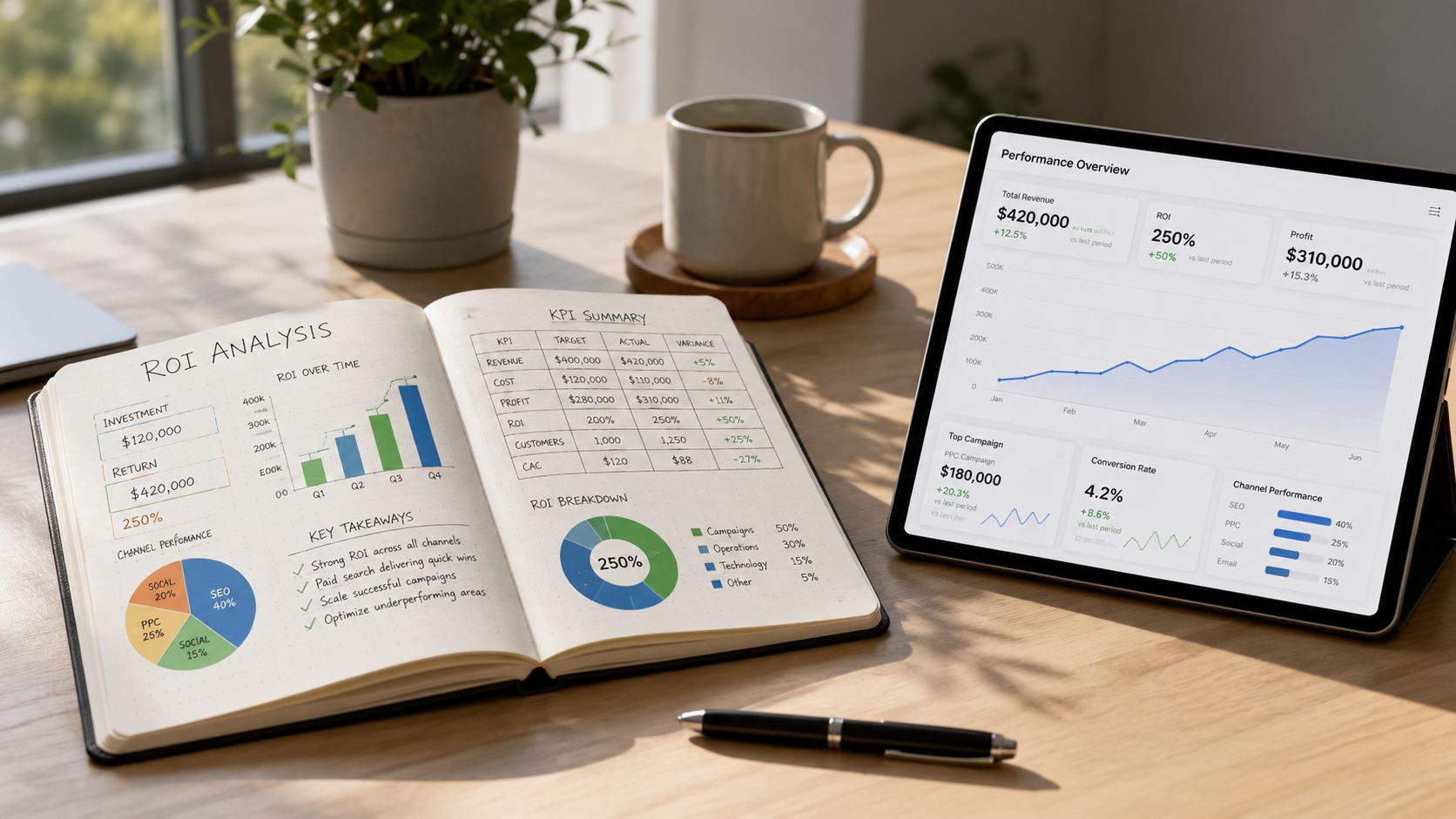
You're probably in one of two situations right now. Either your agency sends reports full of clicks, impressions, and conversions, but you still can't tell whether profit is improving. Or you're hiring a new partner and you want to avoid the usual promise: “We'll scale your campaigns,” followed by vague reporting that takes credit for sales you may have won anyway.
That's the ultimate test of an ROI digital marketing agency. Not whether they can run Google Ads, Meta campaigns, LinkedIn ads, or publish SEO content. Plenty of agencies can do that. The harder question is whether they can prove incremental business growth, separate signal from noise, and show what changed because of their work.
In Australia, that standard matters more than ever. Digital buying behaviour is ingrained, budgets are significant, and attribution is getting messier. If an agency can't connect spend to commercial outcomes with discipline, you're not getting strategy. You're getting activity.
Laying the Groundwork for Accurate ROI Tracking
Most ROI problems don't start in reporting. They start in setup.
A business says it wants accountability, but the tracking is incomplete, the CRM isn't connected, platform data doesn't match finance data, and half the conversions are only visible inside ad platforms. That setup guarantees arguments later. The agency says performance is strong. The client says revenue doesn't reflect it. Both may be looking at different versions of the truth.
Building a reliable measurement stack means treating tracking as infrastructure, not admin.
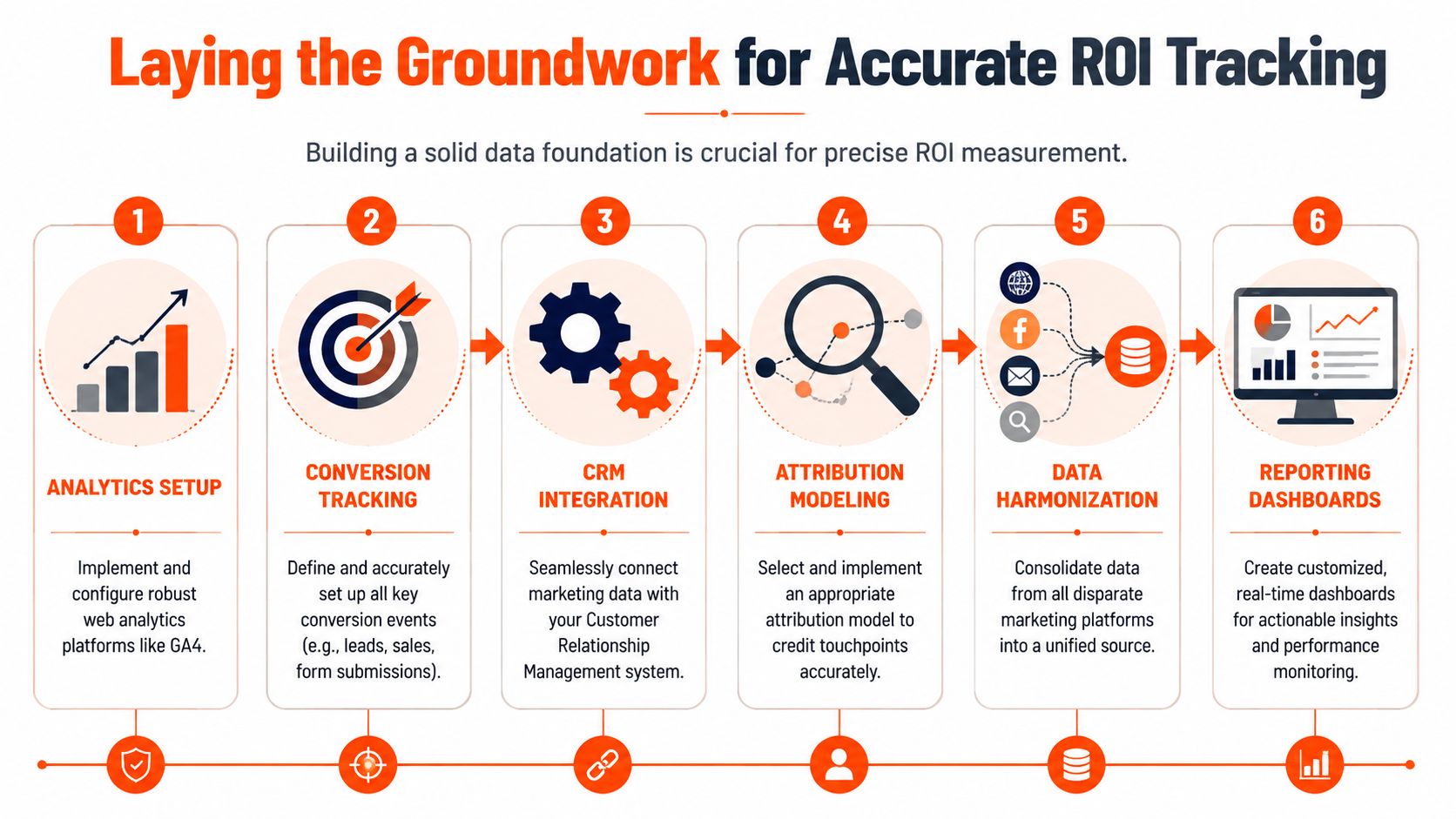
What needs to be in place before you judge ROI
A solid foundation usually includes these six elements:
-
Analytics configured properly
GA4 is useful, but only if events, channels, and business outcomes are mapped correctly. A default install won't tell you which campaigns produce qualified revenue. -
Conversion tracking that reflects real actions
Form submissions, booked calls, purchases, quote requests, and qualified leads shouldn't all be treated as equal. If every conversion is valued the same way, optimisation will drift toward volume instead of value. If you need a practical reference point, this guide to website conversion tracking is the kind of implementation detail businesses should expect from an agency. -
CRM integration
If your ad platforms can't connect leads to downstream outcomes, your ROI model breaks. You need to see what happened after the click, not just after the form fill. -
Attribution logic
You don't need a perfect model. You do need one that's explicit, consistent, and understood by both sides. -
Data harmonisation
Search, paid social, organic, CRM, and sales data need to sit in one view. Otherwise, every channel ends up claiming the same revenue. -
Dashboards built for decisions
A live dashboard should help you act. It shouldn't function as a prettier PDF.
Practical rule: If a report can't tie leads to sales quality, it's a channel report, not an ROI report.
Why server-side tracking and data integration matter
Pixel-based measurement still matters, but browser restrictions, privacy controls, and ad blockers make browser-only tracking increasingly fragile. If you want a clean explainer on the mechanics, the Tagada blog on pixel tracking is a useful starting point.
The bigger shift is this: mature agencies don't rely on pixels alone. They combine browser events with server-side tracking and CRM reconciliation so reported conversions are closer to business reality.
That's not a minor technical preference. Benchmark data from the Australian market indicates that agencies using centralised data lakes that integrate CRM tools with GA4 and Business Manager accounts achieve a 68% higher ROI success rate, with average ROAS improving from 3.2:1 to 5.4:1 after integration, while neglecting this setup can lead to an 18% drop in reported conversion data according to Sanctuary Marketing Group's discussion of attribution and measurement.
The non-negotiable mindset
We treat tracking setup the same way we treat campaign structure. If it's messy at the start, optimisation later gets distorted.
The wrong foundation creates fake confidence. The right foundation gives you control. That's the difference between an agency that reports performance and one that can defend it.
Choosing KPIs That Actually Drive Business Growth
A lot of businesses still judge agency performance by what's easiest to see. Clicks go up. Traffic goes up. Followers go up. The dashboard looks busy, so everyone feels productive.
That's exactly how money gets wasted.
The Australian market isn't short on digital activity. The IAB Australia/PwC Internet Advertising Revenue Report recorded A$16.4 billion in internet advertising revenue for 2023, a 4.8% increase on the prior year, as cited in this summary of digital marketing ROI statistics. In a market this competitive, surface metrics aren't enough. Your KPI set has to reflect how the business makes money.

Stop rewarding vanity
Impressions can be useful diagnostic data. Click-through rate can help assess creative relevance. Engagement can tell you whether an audience is responding.
None of those metrics should sit at the top of the reporting hierarchy.
A stronger KPI framework separates diagnostic metrics from commercial metrics:
| KPI type | What it helps with | What it shouldn't do |
|---|---|---|
| Diagnostic metrics | Spot campaign issues early | Stand in for business success |
| Efficiency metrics | Measure spend against output | Ignore lead quality |
| Commercial metrics | Show revenue impact | Be judged without context |
For e-commerce, we usually care most about revenue quality, margin-aware return, repeat purchase behaviour, and how paid and organic channels contribute together. For B2B, the centre of gravity shifts toward qualified lead rate, sales acceptance, pipeline value, and lead-to-customer outcomes.
Clicks tell you someone visited. KPIs tied to revenue tell you whether that visit mattered.
The KPI conversation your agency should be able to lead
A capable ROI digital marketing agency won't just ask what platform you want to advertise on. They'll ask:
- How does the business recognise a good lead?
- What happens between enquiry and sale?
- Which channels tend to introduce demand, and which ones capture it?
- What commercial threshold makes a campaign worth scaling?
Those questions shape KPI selection more than any platform benchmark.
If you want examples of how agencies and in-house teams visualise this properly, these marketing KPI dashboard examples are a good reference point. The useful dashboards aren't the ones with the most widgets. They're the ones that connect marketing actions to business outcomes.
A short walkthrough can also help if your team needs to align reporting expectations internally:
What good KPI discipline looks like in practice
A healthy account usually has a small set of primary KPIs and a broader layer of supporting diagnostics.
Primary KPIs might include:
- Revenue efficiency
- Qualified lead quality
- Pipeline contribution
- Customer value over time
Supporting metrics might include:
- Search term relevance
- Landing page conversion rate
- Cost by audience segment
- Assisted conversions by channel
When agencies blend those levels correctly, reporting becomes sharper. When they don't, they start defending weak commercial outcomes with busy platform charts.
Calculating Digital Marketing ROI The Right Way
Most ROI calculations fail for one reason. They're too simple for the buying journey they're trying to measure.
The core formula is still useful:
| Metric | Formula | Example |
|---|---|---|
| ROI | (Net Profit / Total Investment) x 100 | Net profit generated from campaigns divided by total campaign investment, then multiplied by 100 |
| Net Profit | Revenue Attributed to Marketing minus Total Investment | Sales value from marketing less media, fees, software, and production costs |
| Predicted Return | Number of Leads x Lead-to-Customer Rate x Average Sale Price | Forecast value based on expected leads, close rate, and average sale |
| ROAS | Revenue / Ad Spend | Revenue generated from ads divided by ad spend |
| Cost per Lead | Total Spend / Total Leads | Media and campaign cost divided by leads generated |
That framework is only the starting point. Real-world ROI has to include more than ad spend. Agency fees, creative work, landing page costs, reporting tools, CRM tooling, and sales follow-up all affect the return picture. If you only calculate against media spend, you're measuring efficiency inside the ad account, not business return.
Where ROI forecasts usually go wrong
The most common forecasting error is using a generic conversion assumption.
Agencies often model predicted return using a broad lead-to-customer rate, but that shortcut causes serious distortion. As noted in O8's guide to digital marketing ROI, agencies often use a generic 20% lead-to-customer conversion rate, while the actual median for B2B LinkedIn campaigns in Australia is 8.4%. That gap is a primary reason some agencies project 5:1 ROI but deliver only 2.5:1, and it can underestimate campaign costs by up to 40%.
That's not a reporting issue. That's a planning issue.
If an agency can't explain the conversion assumptions behind its forecast, don't trust the forecast.
Use your own historical data, not a generic spreadsheet
A reliable ROI model uses your actual sales process.
That means segmenting by channel, offer, sales cycle, and lead quality. A lead from branded search doesn't behave like a lead from cold LinkedIn outreach. An enquiry for a low-friction e-commerce purchase doesn't behave like a high-consideration B2B demo request.
A practical workflow looks like this:
-
Start with closed revenue data
Pull won deals or completed purchases, not just raw leads. -
Map back to source and campaign
Tie outcomes to search, social, SEO, remarketing, email, and direct. -
Apply channel-specific close rates
Don't average everything together if the journeys differ. -
Include full investment
Add fees, tools, and implementation costs. -
Review over the right time horizon
Short sales cycles can be assessed quickly. Longer cycles need a lag-aware model.
If you want a quick sense-check during planning, a tool like this ROI Calculator can help structure the conversation. For ad-channel efficiency specifically, this return on ad spend calculator is useful for comparing outcomes before and after campaign changes.
The long-term view matters
Short-term ROI can look weak even when the investment is commercially smart.
That happens often when campaigns acquire new customers whose value compounds over time, or when SEO builds non-paid demand that converts later through branded search, direct traffic, or sales outreach. If the agency only reports what converted immediately, the business may cut channels that are doing important upstream work.
The right calculation method doesn't inflate performance. It protects decision-making from bad assumptions.
Optimising PPC and SEO for Maximum Return
Once the tracking and KPI framework are in place, optimisation becomes a commercial exercise, not a platform habit.
Too many PPC accounts are managed to chase cheap conversions or high ROAS on paper. Too many SEO programmes are still judged by rankings and traffic alone. Neither approach is strong enough if your actual objective is profit growth.
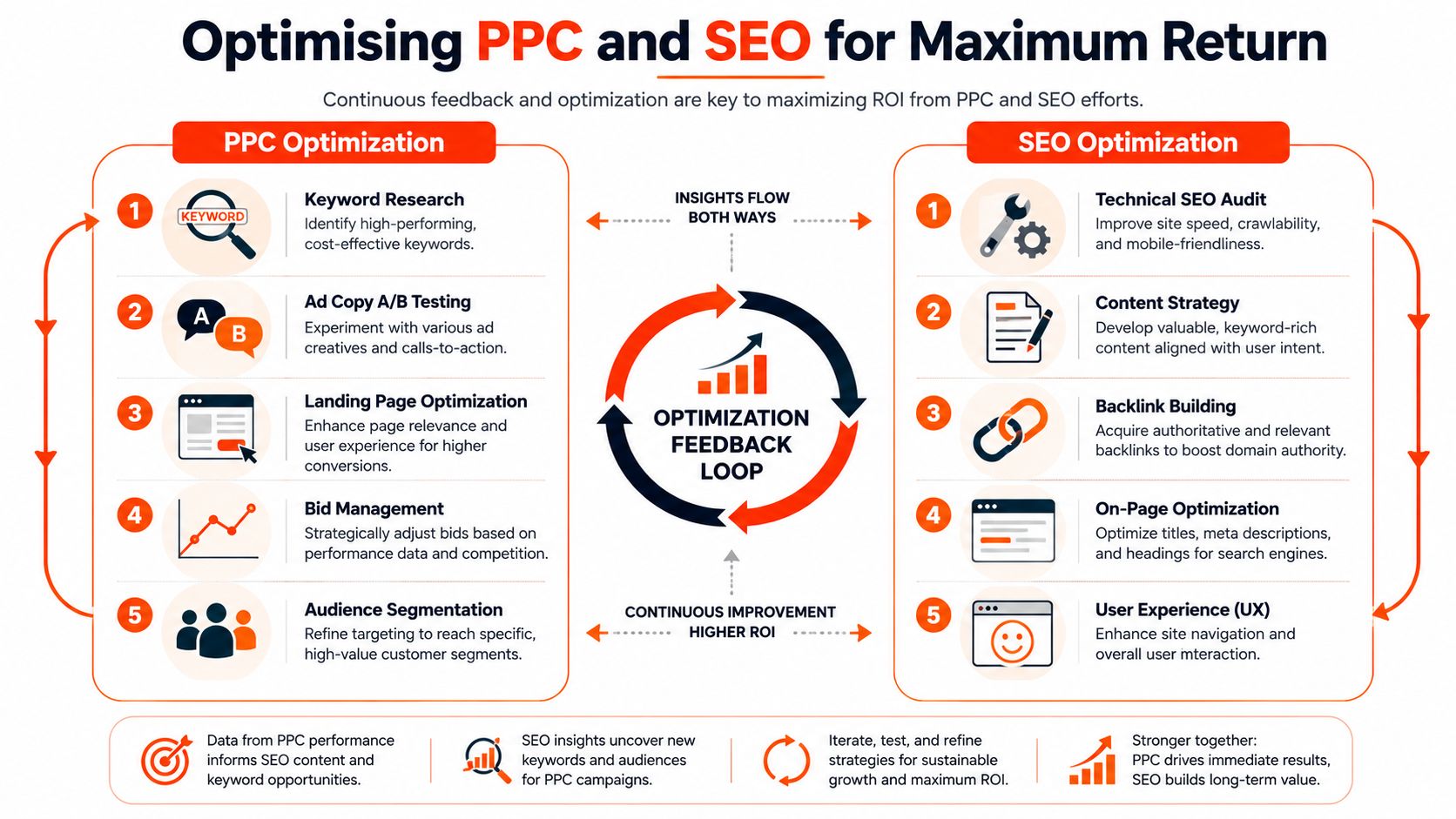
The better approach is to turn PPC and SEO into one feedback system. Paid search reveals what converts now. SEO captures demand earlier and more broadly. CRM data tells you which terms and pages lead to revenue, not just sessions.
PPC should be managed for profit, not platform comfort
A campaign can show acceptable ROAS and still be a bad investment. That usually happens when average order value is low, margins are thin, or the account is leaning too hard on remarketing and branded search.
Useful PPC optimisation questions sound like this:
- Which search terms are producing first-time customers?
- Where are we paying for low-quality leads that sales won't progress?
- Which audiences produce stronger downstream value, even if front-end CPA looks higher?
- Are bid strategies rewarding conversion volume or actual commercial quality?
When agencies answer those questions properly, account management changes. Budget moves away from channels that look efficient but add little incremental value. Landing pages get rebuilt around sales intent, not just ad relevance. Creative testing becomes about message-to-market fit, not random variation.
One practical example in the market is Click Click Bang Bang, which offers PPC management alongside analytics and conversion tracking implementation. That kind of setup matters because campaign changes are only as good as the measurement beneath them.
SEO ROI has changed because click behaviour has changed
Organic search is harder to judge by old metrics alone. AI summaries, richer search features, and more zero-click behaviour have changed how users discover and evaluate options.
As noted earlier in the O8 source, clicks are becoming less reliable, so stronger SEO ROI measurement focuses on qualified lead rate, pipeline value, and assisted conversions rather than traffic alone. That's the right shift for B2B and higher-consideration services in particular, where organic content often shapes the deal before the final conversion happens elsewhere.
Good SEO reporting doesn't just ask, “Did traffic grow?” It asks, “Did organic sessions influence better opportunities?”
Run one optimisation loop, not two separate teams
The strongest returns usually come when PPC and SEO inform each other.
A practical loop looks like this:
- Use paid search query data to identify commercial language that deserves SEO coverage.
- Use SEO landing page engagement to find content themes worth testing in ads.
- Use CRM outcomes to downgrade keywords that bring weak-fit leads, even if they convert cheaply.
- Use assisted conversion patterns to identify pages that support revenue without closing it directly.
That's especially important in an AI-first search environment. If fewer users click the first interaction, channel managers need to value influence, not just final-click capture.
A modern ROI digital marketing agency doesn't optimise channels in isolation. We optimise the buying journey those channels shape together.
Demystifying Reports and Proving Incremental Value
A monthly report shouldn't feel like an argument waiting to happen.
Yet that's where many agency relationships end up. The report says conversions increased. Finance says profit didn't move in line with spend. Sales says lead quality is mixed. The platform takes credit for everything it touched. Nobody is lying, but nobody is answering the core question either: what revenue was incremental?
That question matters because last-click reporting overstates certainty. It also tends to reward the channels closest to the sale, even when those channels are just harvesting demand generated elsewhere.
What a credible report should contain
A useful report does more than summarise activity. It should show:
-
Business outcomes first
Revenue, qualified pipeline, sales quality, and acquisition efficiency should sit above channel metrics. -
A clear attribution position
The agency should say how conversions are being credited and where the model is weak. -
New versus existing customer separation
Remarketing and branded demand often perform well on paper. That doesn't mean they created the demand. -
Commentary on trade-offs
If spend increased to acquire higher-value customers or enter a new market, the report should explain that. -
A decision log
Reporting should show what changed, why it changed, and what happened next.
How to test whether the value is incremental
In Australia, marketers face persistent attribution challenges that make last-click ROI misleading, and ROI is often overstated when agencies rely on platform-reported conversions instead of holdouts, MMM, or blended MER-style reporting, as discussed in the earlier measurement source.
That means a good agency should be comfortable with tougher methods. Not on every account all the time, but wherever scale and complexity justify it.
Here are the questions worth asking:
-
What percentage of reported conversions comes from platform reporting versus CRM-confirmed outcomes?
If the answer is vague, the reporting chain is weak. -
How do you separate demand capture from demand creation?
Branded search and remarketing can be valuable, but they should not absorb all the credit. -
Do you use holdout tests, geo splits, or blended reporting anywhere in your process?
Agencies don't need perfect econometric models to think incrementally. They do need a method. -
How do you report on assisted impact?
Some channels don't close the sale, but they materially improve the odds of one.
A transparent agency won't pretend attribution is perfect. They'll show you where confidence is high, where it isn't, and how they're reducing uncertainty over time.
The report should change the conversation
When reporting is handled well, monthly meetings stop being defensive.
You spend less time debating which platform number is “right” and more time discussing commercial decisions. Should budget shift toward customer acquisition? Is SEO assisting pipeline strongly enough to justify continued investment? Are paid social campaigns introducing net-new demand or just re-engaging existing interest?
That's the standard. A report should help you make better decisions, not just absorb more data.
Key Questions to Ask Your ROI Digital Marketing Agency
A good agency doesn't fear hard questions. If anything, the right questions usually reveal whether you're dealing with campaign operators or commercial thinkers.
In Australia, this matters because online purchasing is normal behaviour, not an edge case. During the 2023 to 24 financial year, 80.5% of Australians aged 15 to 74 used the internet for purchasing goods or services, according to this summary of content marketing and digital buying behaviour statistics. If digital channels sit that close to buying intent, your agency should be able to show how their work captures and converts it.
Ask about measurement before you ask about tactics
Start here:
How do you define success for a business like ours?
If the answer starts and ends with traffic, impressions, or leads, keep digging. A commercial answer should reference revenue quality, sales outcomes, customer acquisition, and the time lag between marketing activity and purchase.
What data do you need from us to measure ROI properly?
A serious agency will usually ask for CRM access, sales-stage definitions, historical performance context, and visibility into what counts as a qualified conversion.
How do you handle attribution where multiple channels influence the sale?
You're looking for clarity, not jargon. They should explain how they treat assisted conversions, branded search, remarketing, and direct traffic rather than pretending one channel owns the whole result.
Ask how they make decisions when the numbers are messy
Some of the best agency work happens in grey areas.
What do you do when platform data and CRM data disagree?
The answer should include reconciliation, investigation, and a preference for business-level truth over platform convenience.
How do you decide whether to scale or cut a campaign?
The right answer usually involves lead quality, marginal return, and downstream performance. Not just front-end cost metrics.
How do you prove your work is incremental rather than just attributed?
Even if they don't run complex experiments on every account, they should have a framework for testing causality and avoiding inflated credit claims.
Ask how they work with your team, not just inside ad platforms
Agency performance isn't only about campaign management.
-
How often do you review sales feedback?
Marketing quality often becomes obvious in sales conversations before it appears in dashboard trends. -
Who owns tracking integrity?
If nobody owns it, it will drift. -
What happens in the first weeks of engagement?
You want a clear onboarding plan, not a vague promise to “get things live”. -
What does transparent reporting look like in your process?
Live dashboards, commentary, and clear commercial interpretation are stronger than static exports.
The best agency relationships feel less like outsourced media buying and more like shared commercial problem-solving.
If an agency can answer those questions plainly, show its assumptions, and explain trade-offs without hiding behind platform metrics, you're in a much better position. That's what a real ROI digital marketing agency looks like in practice.
If you want a partner that focuses on measurable PPC and AI-first SEO outcomes, Click Click Bang Bang offers campaign management, conversion tracking setup, and live reporting designed to connect channel activity with business performance.
Read NeXt
Or Read Our Latest
- Reporting Portal Login: Access Your Client Dashboard Fast
- How to Calculate Sample Size for A/B Tests and Campaigns
- How to Fix Google Merchant Center Errors Step by Step
- What Is Pagination and Why It Matters for AU Sites
- What Is Value Proposition? PPC & SEO Guide
- How to Choose a Google Ads Agency Australia
Click. CLick. Subscribe.
Get our best PPC insights, industry updates, and power moves delivered straight to your inbox. No fluff, just high-caliber strategies that actually work.
Don’t Leave Just Yet
Try Us For 30-Days,
Risk Free!!
We guarantee that you’ll love our work within the first 30 days, if not you’ll get your money back.
What have you got to lose?