

Ecommerce Search Engine Optimization Services That Drive Sales
Last Updated

Ecommerce SEO services are a lot like setting up a killer retail shop. Think of it as picking the perfect high-street location, crafting an irresistible window display, and arranging your aisles so customers can find exactly what they need, effortlessly. It’s a complete strategy designed to make your online store more visible and appealing to both search engines and shoppers who are ready to buy.
The end game? To pull in a steady stream of qualified organic traffic that actually converts into sales, creating a sustainable growth engine for your business.
Why Your Online Store Needs SEO Services
Imagine your online store is a boutique tucked away in a massive, sprawling city. Without a big, bright sign or a spot on the main drag, potential customers will simply walk right past. Ecommerce SEO is the art and science of putting your digital storefront right on the internet's busiest high street—Google's first page.
It’s about more than just slotting in a few keywords. It’s a deep-dive strategy that involves understanding precisely how customers search for products like yours and then fine-tuning every part of your site to meet their needs.
This process ensures that when someone searches for "handmade leather wallets" or "vegan skincare in Sydney," your store pops up as a relevant, trustworthy option. It’s all about building a solid foundation that attracts shoppers who are actively looking to buy what you're selling.
Beyond Keywords: A Holistic Approach
Good ecommerce SEO goes way beyond just stuffing keywords onto a page. It covers a whole range of activities that improve your site's overall health and authority in the eyes of search engines. To really get your head around what’s involved, it’s worth checking out an ultimate guide to ecommerce SEO best practices.
A solid strategy includes:
- Technical Health Checks: Making sure your site is fast, secure, and mobile-friendly so search engines can easily crawl and index your pages. No one likes a slow or broken website, including Google.
- Strategic Content Creation: Writing genuinely helpful product descriptions, category page content, and blog posts that answer customer questions and rank for valuable search terms.
- Authority Building: Earning high-quality backlinks from other reputable websites. Think of these as "votes of confidence" that tell Google your store is the real deal.
To give you a sense of how important this is, Australia's digital economy is projected to hit a $120 billion valuation, with businesses expected to pump $1.5 billion into SEO services alone. This signals a massive shift, especially for ecommerce retailers who already rely on organic search for a whopping 53% of their website traffic—far more than from social media or email.
By focusing on the user experience and building trust with search engines, these services create a powerful, long-term asset for your business—a consistent stream of qualified traffic that doesn't rely on you constantly paying for ads.
Decoding the Core Components of Ecommerce SEO
Ecommerce SEO isn’t just one thing; it’s more like a finely tuned orchestra of different strategies all working in harmony. To really get what high-quality ecommerce search engine optimisation services deliver, you have to look at the individual instruments. Think of them as the four essential pillars holding up your online store’s visibility and sales potential.
Each component plays its own unique role, from making sure your website is technically sound to building its reputation across the web. When you bring them all together, they create a powerful, sustainable engine for organic growth, pulling in customers who are actively looking for the exact products you sell.
Technical SEO: The Engine Room of Your Store
Technical SEO is the foundation that everything else is built on. It’s like the engine, plumbing, and electrical wiring of a physical shop—customers might not see it, but they’ll definitely notice when it’s not working right. This pillar is all about making your website easy for search engines like Google to crawl, understand, and index.
A huge part of this is making sure your site is fast. In fact, nearly 70% of consumers admit that page speed influences their willingness to buy from an online retailer. A slow, clunky site doesn't just frustrate users; it sends a clear signal to Google that your store offers a poor experience. Technical SEO tackles this by optimising images, streamlining code, and improving server response times.
Other critical technical elements include:
- Mobile-First Design: Ensuring your store looks and functions perfectly on smartphones, which is where the majority of online shopping now happens.
- Secure Connection (HTTPS): Using HTTPS encryption is non-negotiable for protecting customer data and is a confirmed Google ranking signal.
- Clean URL Structure: Creating logical, easy-to-read URLs (e.g.,
yourstore.com.au/mens-shirts/cotton-tee) helps both users and search engines make sense of your site's hierarchy.
This visual map helps illustrate how the different pillars of ecommerce SEO—your store's organisation, display, and location—work together.
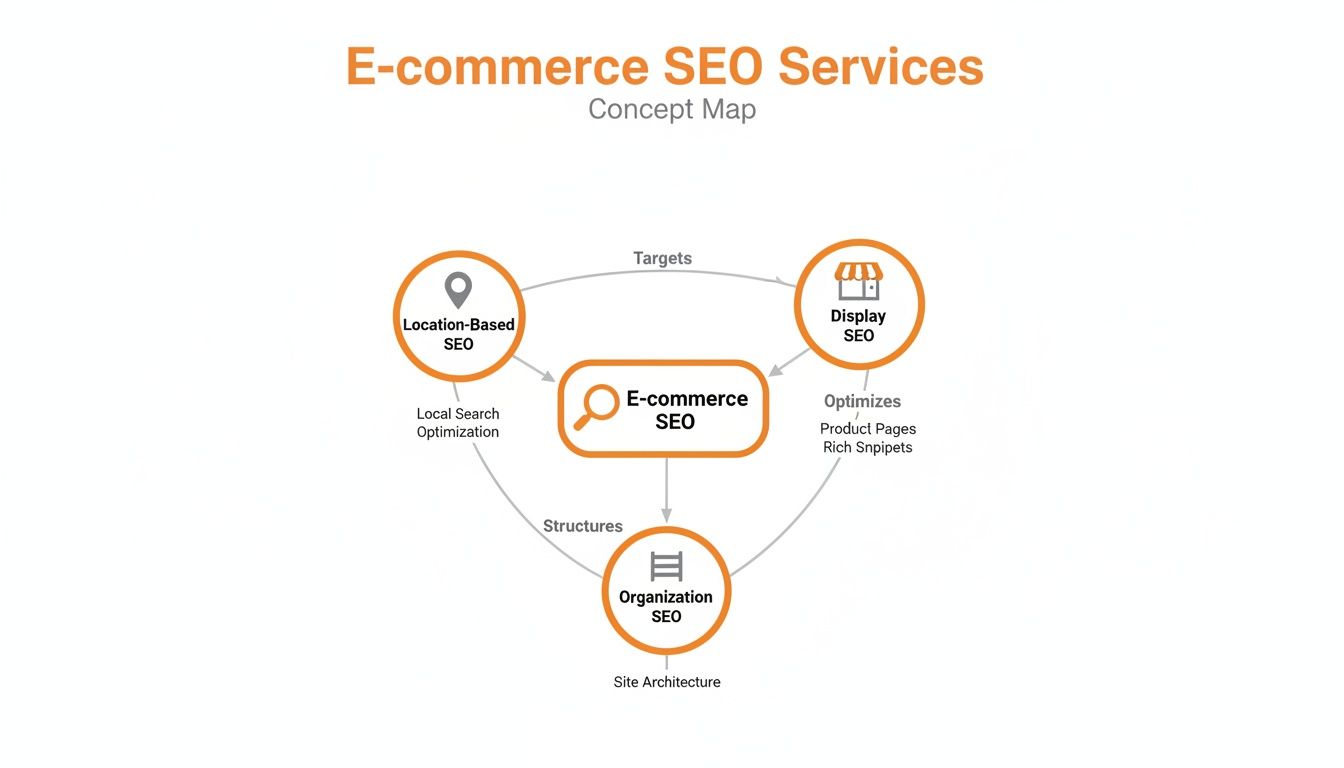
As the diagram shows, a winning strategy balances how your site is structured (organisation), how it appears to customers (display), and where it shows up (location).
On-Page SEO: The Art of the Perfect Product Display
If technical SEO is the engine room, then on-page SEO is your storefront, product displays, and in-store signage. This is where you optimise the content that both customers and search engines actually see. The goal is to make every page—from your product pages and category pages to blog posts—as relevant and compelling as it can possibly be.
This involves getting smart with your keywords. By researching the exact terms your ideal customers are typing into Google, you can weave them naturally into:
- Product Titles and Descriptions: Making them clear, descriptive, and perfectly aligned with what people are searching for.
- Category Page Content: Writing helpful introductions that guide shoppers and signal relevance to search engines.
- Meta Titles and Descriptions: Crafting that little snippet of text that appears in search results to tempt people to click.
On-page SEO is your chance to communicate value directly. It answers the user's query and convinces them that your product is the solution, all while speaking Google's language.
For a deeper look into these foundational elements, you might find our guide on the importance of a thorough technical SEO audit useful.
Off-Page SEO: Building Your Digital Reputation
Off-page SEO is all about building your store’s authority and reputation outside the walls of your own website. Imagine other popular shops and local experts recommending your store to their own customers—that’s the essence of off-page SEO. The most powerful tactic here is backlink building.
A backlink is simply a link from another website to yours. Search engines see high-quality backlinks as "votes of confidence." When a reputable industry blog or news site links to one of your products, it signals to Google that your store is a trustworthy and valuable resource.
Effective off-page strategies for an ecommerce business often include:
- Getting featured in product roundups or gift guides.
- Partnering with influencers who link back to your store.
- Creating genuinely shareable content, like buying guides, that naturally attracts links.
Local SEO: Connecting with Your Community
For ecommerce businesses that also have a physical presence, Local SEO is an absolute must. This component focuses on making your store visible to customers searching for products "near me," bridging the gap between your online and offline operations.
The cornerstone of Local SEO is your Google Business Profile (GBP). This involves making sure your business name, address, and phone number (NAP) are accurate and consistent across the web. It also means actively managing customer reviews, posting updates, and using local keywords to attract nearby shoppers who might want to visit your store in person or use a click-and-collect service. It’s a targeted approach that ensures you capture that valuable local search traffic.
How AI Is Reshaping Ecommerce SEO
The world of search is in the middle of its biggest shake-up in decades, and artificial intelligence is calling the shots. This isn't just another algorithm update; it's a completely different way for customers to find and interact with your products online. For any ecommerce business, getting your head around this new reality isn't just a good idea—it's a matter of survival.
The most obvious change is the arrival of AI-powered search results, like Google's AI Overviews. Instead of just giving you a list of blue links, search engines are now answering questions directly with their own AI-generated summaries. This totally changes the game, often giving a shopper an answer without them ever needing to click through to a website.

This new search behaviour is already making huge waves. In fact, Australia is a global leader in this shift, with a high rate of AI query usage. A mind-boggling 65% of searches now end without a click, all thanks to these AI summaries. This trend is forcing businesses to rethink everything. Many of the 56% of Aussie businesses now using AI content tools are also shifting their budgets—traditional SEO now makes up just 45% of search marketing spend, a massive drop from 75% the previous year.
Adapting Your Strategy for an AI-First World
The challenge for ecommerce stores is pretty clear: if customers get their answers right on the search results page, how do you get them to your site? The old playbook of ranking for basic keywords just isn't cutting it anymore.
The new game is all about user intent and conversational queries. You need to tune your product pages and content to answer complex, detailed questions that an AI is likely to pull information from. Think less about "black running shoes" and more about "what are the best durable black running shoes for trail running in wet conditions?"
This means your content needs to be dripping with genuine:
- Experience: Showcasing real-world use of your products.
- Expertise: Providing detailed specs, comparisons, and technical info.
- Authoritativeness: Building a reputation as the go-to source in your niche.
- Trustworthiness: Featuring real customer reviews and crystal-clear return policies.
Using AI as Your Ally in Ecommerce SEO
While AI throws some curveballs, it also hands you a powerful set of tools to hit them out of the park. Modern ecommerce search engine optimisation services now use AI to get ahead, turning what looks like a threat into a serious advantage. By automating the grunt work, AI frees up human strategists to focus on what they do best: creative thinking and big-picture strategy.
AI isn't here to replace SEO strategists; it's here to supercharge them. It handles the heavy lifting of data analysis, allowing experts to pinpoint growth opportunities with greater speed and precision.
Here are just a few ways AI is being woven into SEO:
- Advanced Keyword Research: AI can sift through thousands of long-tail and conversational search queries, uncovering hidden gems that manual research would take weeks to find.
- Automated Content Creation: AI tools can help churn out unique product descriptions, meta tags, and even blog post outlines at scale, ensuring every single page is optimised. You can dive deeper into our insights on using AI for SEO to see what's possible.
- Deep Technical Analysis: AI-powered crawlers can sniff out complex technical problems, like crawl budget issues or schema errors, way faster than traditional methods ever could.
By getting on board with these tools, your business can adapt to the new search landscape. To see exactly how this works in practice, you can learn how to integrate AI with ecommerce SEO through real-world examples. Taking a proactive approach is the only way to make sure your online store stays visible and competitive in a world increasingly run by AI.
Measuring the Success of Your SEO Investment
So you're investing in ecommerce search engine optimisation services. It can feel a bit like throwing money into a black box, right? Unlike a paid ad where you see clicks and costs straight away, SEO is a long game. It builds value over time.
So, how do you actually know if it’s paying off? The secret is to look past the flashy "vanity metrics" like website visits and dig into the data that really hits your bottom line.
Real success isn’t just about getting more traffic; it’s about getting the right traffic. We're talking about people who are actively searching for what you sell, wallet in hand. By tracking the right key performance indicators (KPIs), you get a crystal-clear picture of your return on investment (ROI) and can make sharp, data-driven decisions for your store's future.
Beyond Traffic Numbers: Core Ecommerce KPIs
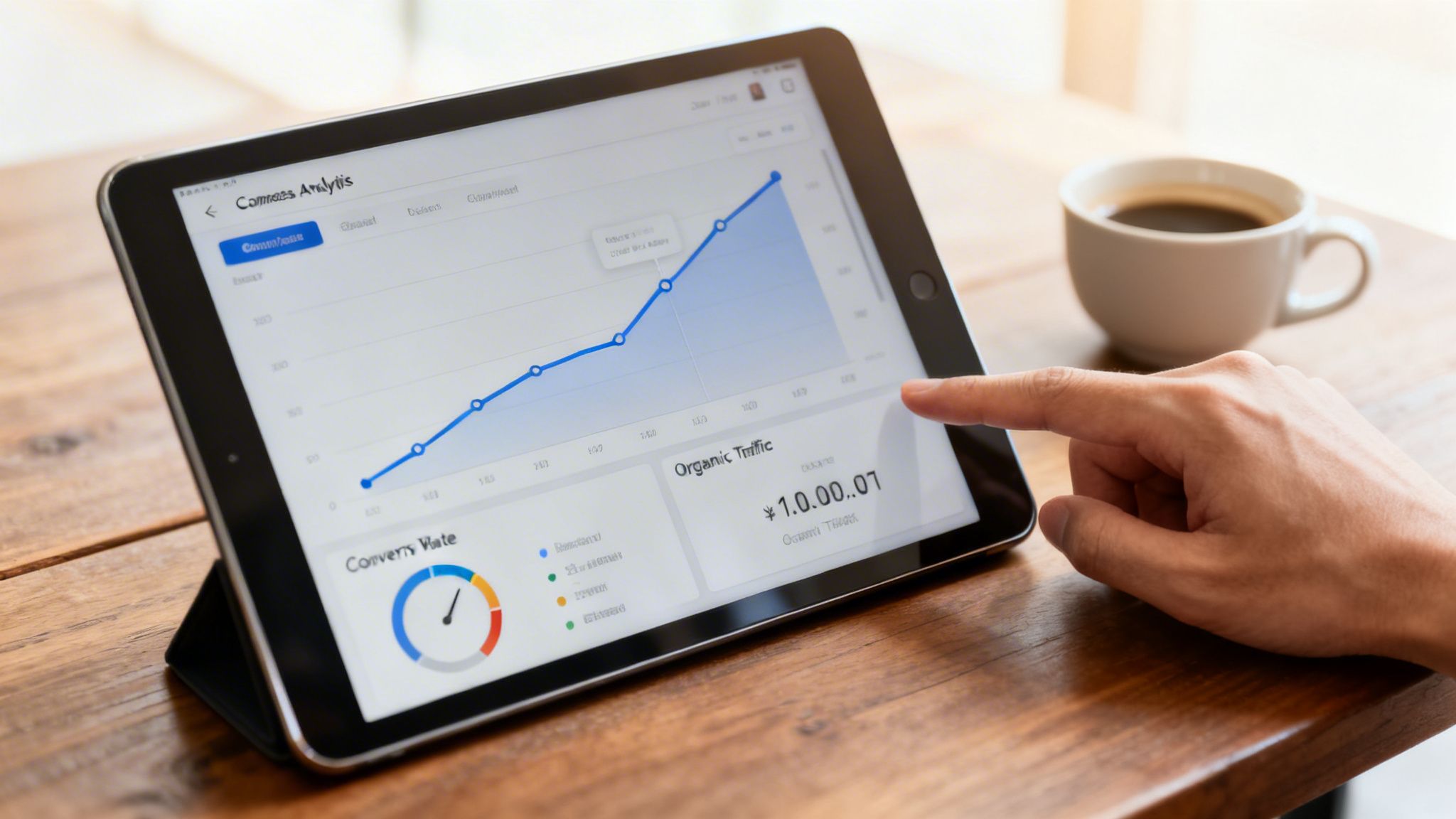
Look, seeing your organic traffic graph shoot up is always a thrill. But it’s only one piece of the puzzle. A professional SEO strategy is designed to move a whole collection of metrics that, together, generate actual revenue. If you're not tracking them, you're flying blind.
Here are the essential KPIs that truly measure the health and success of your ecommerce SEO:
- Organic Conversion Rate: This is the big one. It's the percentage of visitors from organic search who actually buy something. A rising conversion rate means your SEO isn't just bringing in tyre-kickers; it's attracting motivated shoppers.
- Average Order Value (AOV) from Organic Traffic: This tracks how much the average customer who found you via search is spending. When AOV climbs, it's a great sign that your content and site structure are successfully encouraging upsells or cross-sells.
- Keyword Rankings for Commercial Intent Terms: Ranking for broad terms is nice, but ranking for keywords that scream "I want to buy this now" is where the money is. Think terms like "buy men's waterproof hiking boots" or "fast delivery coffee machine."
- Organic Revenue: This is the ultimate proof. It’s the total, hard-dollar revenue generated directly from customers who landed on your site from a non-paid search result. No fluff, just sales.
Tracking these metrics tells the full story. For instance, a small bump in organic traffic might not seem like much. But if that new traffic has a 50% higher conversion rate and a 20% higher AOV, your SEO campaign is an absolute home run.
Your Essential SEO Reporting Toolkit
You don't need a complicated dashboard of expensive software to keep an eye on these core KPIs. Honestly, two free and incredibly powerful tools from Google are all you need to get started and hold your SEO agency accountable.
Transparent reporting is the bedrock of a great client-agency relationship. You should always have direct access to your own data and receive regular, easy-to-understand reports that connect SEO activities to your business goals.
Let's break down the two must-have tools:
- Google Analytics 4 (GA4): This is your business intelligence hub. Inside, you can track organic traffic, conversion rates, AOV, and most importantly, organic revenue. With proper ecommerce tracking set up, you can see exactly how many dollars your SEO efforts are putting in the till.
- Google Search Console: Think of this as your website's health report card, direct from Google. It gives you the raw data on keyword rankings, click-through rates (CTR) from the search results page, and any technical hiccups holding your site back. It’s your window into what queries are driving traffic and where the biggest opportunities are.
Used together, these tools provide a complete, 360-degree view of your SEO performance. Any reputable agency will help you get them set up correctly and will use this data to build reports that clearly show the value of their work. This is how you ensure your investment in ecommerce search engine optimisation services isn't just a cost, but a powerful engine for profitable growth.
Choosing the Right Ecommerce SEO Partner
Picking an agency for your ecommerce search engine optimisation services is one of the most critical decisions you’ll make for your store. This isn’t just hiring another contractor; you’re bringing on a strategic partner who will directly influence your online visibility and, ultimately, your revenue.
The right partner becomes an extension of your team. The wrong one can burn through your budget and, in the worst cases, even damage your site's reputation with search engines.
Making a smart choice boils down to knowing what to look for and, just as importantly, what red flags to avoid. A great agency will be an open book, transparent about their methods and proud of their past successes. They'll zero in on your business goals—not abstract metrics—and establish clear, consistent communication from day one.
And it’s a serious investment. The Australian SEO software market, which is the engine behind these services, is projected to surge from USD 2.1 billion to a whopping USD 5.2 billion by 2030. This boom is fuelled by e-commerce brands moving away from a total reliance on paid ads to build sustainable organic traffic. Done right, this shift can boost site traffic by 55% and revenue per visitor by 62%. To get a better feel for the trends driving this market, you can find in-depth Australian search engine statistics here.
Your Vetting Checklist for SEO Providers
When you’re talking to potential agencies, you need a solid checklist. This isn’t about finding the cheapest quote; it's about finding the best value and the right cultural fit for your brand. A strong partnership is built on proof, process, and crystal-clear communication.
Here are the green flags you should be actively looking for:
- Relevant Case Studies: They should be able to show you real-world examples of e-commerce stores they’ve helped, ideally in a niche similar to yours. Don't be shy—ask for specific results like increases in organic revenue or conversion rates.
- A Clear, Customised Strategy: Steer clear of cookie-cutter proposals. A top-tier provider will audit your site and analyse your competitors before presenting a strategy that’s genuinely tailored to your business needs and goals.
- Transparent Reporting: They should explain exactly which KPIs they'll track and how those numbers connect directly to your business objectives. You should expect regular, easy-to-understand reports and always have access to your own data.
Red Flags That Signal Trouble Ahead
Knowing what to look for is half the battle. Knowing what to run from is the other half. Some agencies dangle tempting promises to lock in clients, but their methods can be ineffective at best and downright harmful at worst. Spotting these red flags will save you time, money, and a world of headaches.
Be wary of anyone who promises guaranteed results. SEO is influenced by hundreds of factors, including competitor actions and Google's own algorithm updates, making guarantees of #1 rankings impossible and a clear sign of a dishonest provider.
Keep a sharp eye out for these warning signs:
- "Secret Sauce" or Vague Methodologies: If an agency can't—or won't—explain their process clearly, it’s a major red flag. They might be using outdated or "black-hat" techniques that could get your site penalised by Google.
- Long-Term, Lock-in Contracts: Confident agencies don’t need to trap you in a 12-month contract from the get-go. Look for providers offering flexible month-to-month agreements or a reasonable trial period to prove their value.
- Focus on Vanity Metrics: If their sales pitch is all about rankings and traffic without connecting them to actual sales and revenue, their priorities aren't aligned with your business growth.
To make this easier, we've put together a quick comparison table to help you weigh your options.
Provider Evaluation Checklist Green Flags vs Red Flags
Use this comparative table to quickly assess potential SEO service providers and identify the right partner for your business.
| Evaluation Area | Green Flag (What to Look For) | Red Flag (What to Avoid) |
|---|---|---|
| Strategy & Proposal | A customised strategy based on an audit of your site and competitors. | A generic, one-size-fits-all proposal that feels templated. |
| Case Studies & Proof | Specific, verifiable results from e-commerce clients, ideally in your niche. | Vague success stories or an unwillingness to share client examples. |
| Communication | A dedicated point of contact and a clear schedule for meetings and reports. | Poor responsiveness or communication that's hard to understand. |
| Transparency | Openness about their methods and a willingness to explain their process. | Talk of a "secret sauce" or guarded, vague answers to your questions. |
| Contracts & Pricing | Flexible terms, like month-to-month or a 3-month trial, with clear pricing. | Insistence on long, unbreakable contracts from the start. |
| Goal Alignment | A clear focus on business outcomes like organic revenue and conversion rates. | An overemphasis on vanity metrics like rankings and raw traffic numbers. |
| Guarantees | Honest assessments about potential outcomes and realistic timelines. | Unrealistic promises, especially "guaranteed #1 rankings." |
Ultimately, your goal is to find a partner who is genuinely invested in your success. When an agency ticks all the right boxes and avoids these red flags, you know you’re on the right track. For a deeper look at what a top-tier service looks like, see how our specialised ecommerce SEO agency approaches client partnerships.
Common Questions About Ecommerce SEO Services
Even with a clear strategy, diving into the world of professional SEO can bring up a few practical questions. Many ecommerce owners find themselves wondering about the tangible details—like costs, timelines, and how all this fits with their existing marketing.
Getting straight answers to these common queries helps build confidence and sets realistic expectations for the journey ahead. Below, we tackle the three most frequently asked questions about ecommerce search engine optimisation services.
How Long Does It Take to See Ecommerce SEO Results?
This is usually the first question on every business owner’s mind. While you might see small improvements from quick technical fixes within weeks, significant and meaningful results from ecommerce SEO—like a noticeable lift in organic traffic and sales—typically take four to six months to really kick in.
SEO isn't an overnight fix; it's a long-term investment that builds momentum and value over time.
Several factors influence this timeline:
- Your website's history: A brand-new site will naturally take longer to gain traction than an established one with some existing authority.
- Industry competition: Breaking into a highly competitive market requires a more aggressive and sustained effort to get noticed.
- The scope of the strategy: A comprehensive campaign tackling technical, on-page, and off-page SEO will always yield more robust, lasting results.
The first few months are all about laying the groundwork—things like technical audits, deep keyword research, and optimising your core pages. You should expect to see positive movement in keyword rankings within the first three months, with more substantial growth in traffic and revenue following as the strategy matures and Google starts to recognise your site's improved authority.
How Much Do Ecommerce SEO Services Cost in Australia?
The cost of professional SEO services in Australia can vary widely, depending on your store’s size, your business goals, and just how competitive your market is. There’s no one-size-fits-all price tag, and you should be wary of any provider offering a suspiciously cheap, fixed-price solution.
Generally, monthly retainers are the most common pricing model for ongoing SEO. These can range from around $1,500 per month for smaller businesses or startups to well over $10,000 per month for large, complex ecommerce enterprises competing on a national scale.
It's crucial to look for providers that offer transparent pricing and flexible agreements without locking you into long-term contracts. The focus should always be on the potential return on investment (ROI), not just the monthly cost. A slightly higher investment with a proven agency will almost always deliver better business outcomes than the cheapest option on the market.
Should I Use SEO or PPC for My Ecommerce Store?
The best answer? You should absolutely use both. SEO and Pay-Per-Click (PPC) advertising aren't competitors; they are two sides of the same coin and work together to create a powerful, holistic marketing engine for your store.
Think of it like this: PPC delivers immediate results. You can launch a campaign and start driving targeted traffic and sales within hours. This provides a quick revenue stream and, just as importantly, generates valuable data on which keywords convert best.
This data can then be used to inform your long-term SEO strategy. SEO, in turn, builds a sustainable asset. It drives "free" organic traffic, establishes your brand as an authority, and gradually reduces your reliance on ad spend over time. An integrated approach ensures you capture customers at every single stage of their buying journey for maximum growth and profitability.
Ready to drive real results with a unified SEO and PPC strategy? Click Click Bang Bang specialises in data-driven campaigns that deliver measurable growth for ecommerce businesses. Explore our services and book a free consultation to see how we can help you scale.
Find out more at https://clickclickbangbang.com.au.
Read NeXt
Or Read Our Latest
- How to Set Up Google Ads in Australia: Complete 2026 Guide
- Google Merchant Center Setup: The Complete 2026 Guide
- Business Manager Setup Facebook: The Complete 2026 Guide
- Google Ads Account Setup: Expert Guide for 2026
- Search Ads Optimisation: A Practical Guide for 2026
- Manual vs Automated Bidding for PPC Success
Click. CLick. Subscribe.
Get our best PPC insights, industry updates, and power moves delivered straight to your inbox. No fluff, just high-caliber strategies that actually work.
Don’t Leave Just Yet
Try Us For 30-Days,
Risk Free!!
We guarantee that you’ll love our work within the first 30 days, if not you’ll get your money back.
What have you got to lose?