

Ecommerce SEO Australia: Boost Your Store’s Local Rankings
Last Updated

Welcome to your practical playbook for ecommerce SEO in Australia. This guide is all about cutting through the noise and giving you actionable strategies that actually work for Aussie online stores. We're here to help you get seen, attract the right kind of traffic, and ultimately, drive more sales.
Building Your Foundation for Australian Ecommerce Success
The Australian ecommerce scene is a unique beast. You've got everything from local slang in search queries to fierce competition in the big cities, but the opportunity is massive. Getting your head around search engine optimisation is the key to thriving here, turning organic search into a reliable, long-term revenue stream.
To really succeed, you need a clear framework that covers all the bases—from the nitty-gritty of technical site health to keyword strategies that understand how Aussies actually search, and content that genuinely connects.
The Booming Digital Marketplace
The shift to online shopping in Australia isn't just a passing trend; it's a massive change in how people buy things. The growth has been incredible, with online spending hitting a record-breaking $69 billion recently. That's nearly double the $28.5 billion spent before the pandemic and represents a solid 12% jump year-on-year, showing this momentum isn't slowing down.
Laying the right groundwork is essential before you even think about advanced tactics. Start by building a robust online presence for small businesses, which covers the critical local SEO considerations you'll need.
This flow chart breaks down the core pillars of a winning ecommerce SEO program, all starting from that solid foundation.
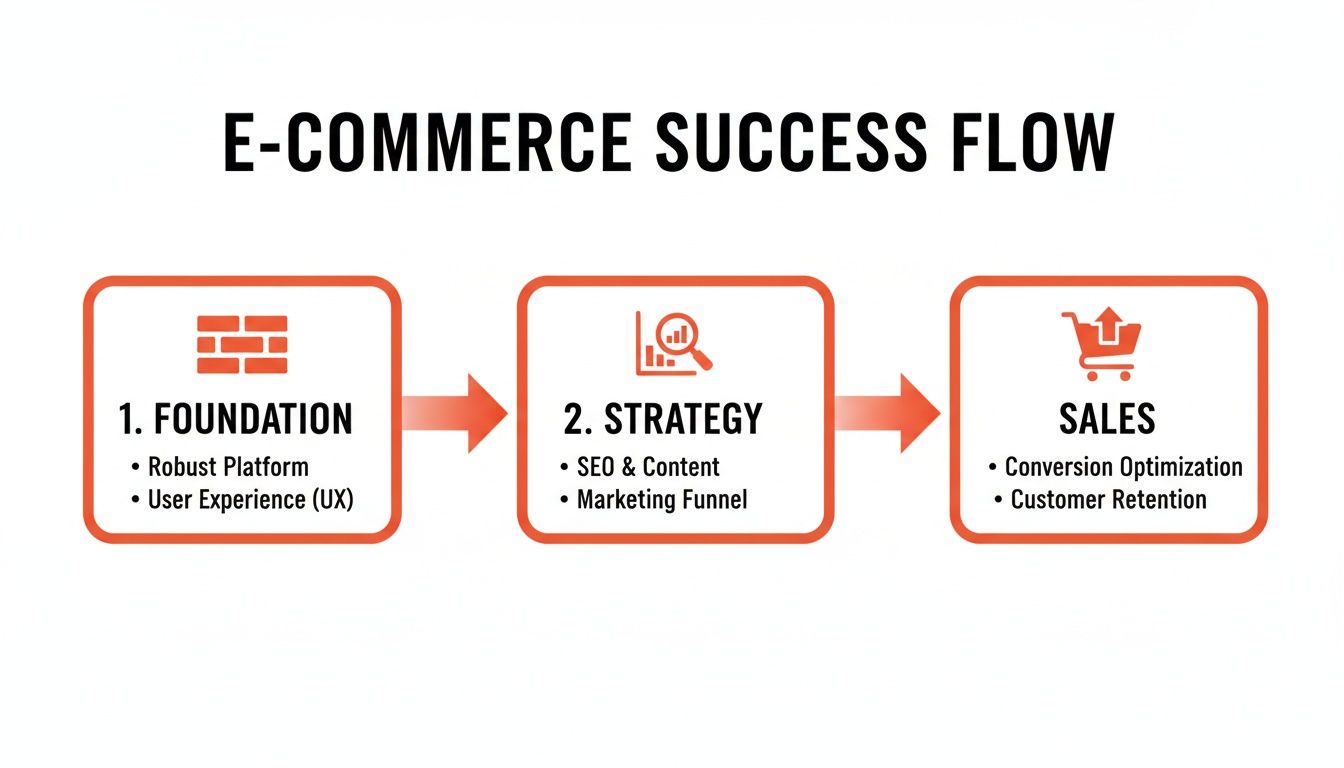
As you can see, a strong technical and strategic base isn't just nice to have—it's a prerequisite for driving real sales.
What This Guide Covers
This playbook is your roadmap, designed to help you navigate the ins and outs of the local market, whether you’re just kicking things off or looking to scale up. We'll walk you through the most critical areas for growth.
- Technical SEO: Making sure your website is perfectly structured for search engines to find and understand.
- Keyword Research: Pinpointing the exact terms real Australian shoppers are typing into Google.
- On-Page Optimisation: Turning your product and category pages into ranking powerhouses that convert.
- Content Strategy: Building your authority and pulling in customers at every stage of their buying journey.
- Measurement: Learning how to track what actually matters so you can prove your return on investment.
Mastering Technical SEO for Your Online Store
If there's one area of SEO you absolutely cannot afford to get wrong, it's the technical stuff. Think of it as the foundation of your house—if it’s cracked and unstable, everything you build on top is at risk of falling apart. This is where we make sure search engines like Google can crawl, understand, and index your online store without any headaches. Get this right, and you're setting yourself up for long-term success in a crowded Aussie market.
A solid technical setup starts with a logical site structure. It’s a win-win: your customers can find what they’re looking for easily, and Google’s crawlers can efficiently discover all your important pages. No one gets lost.
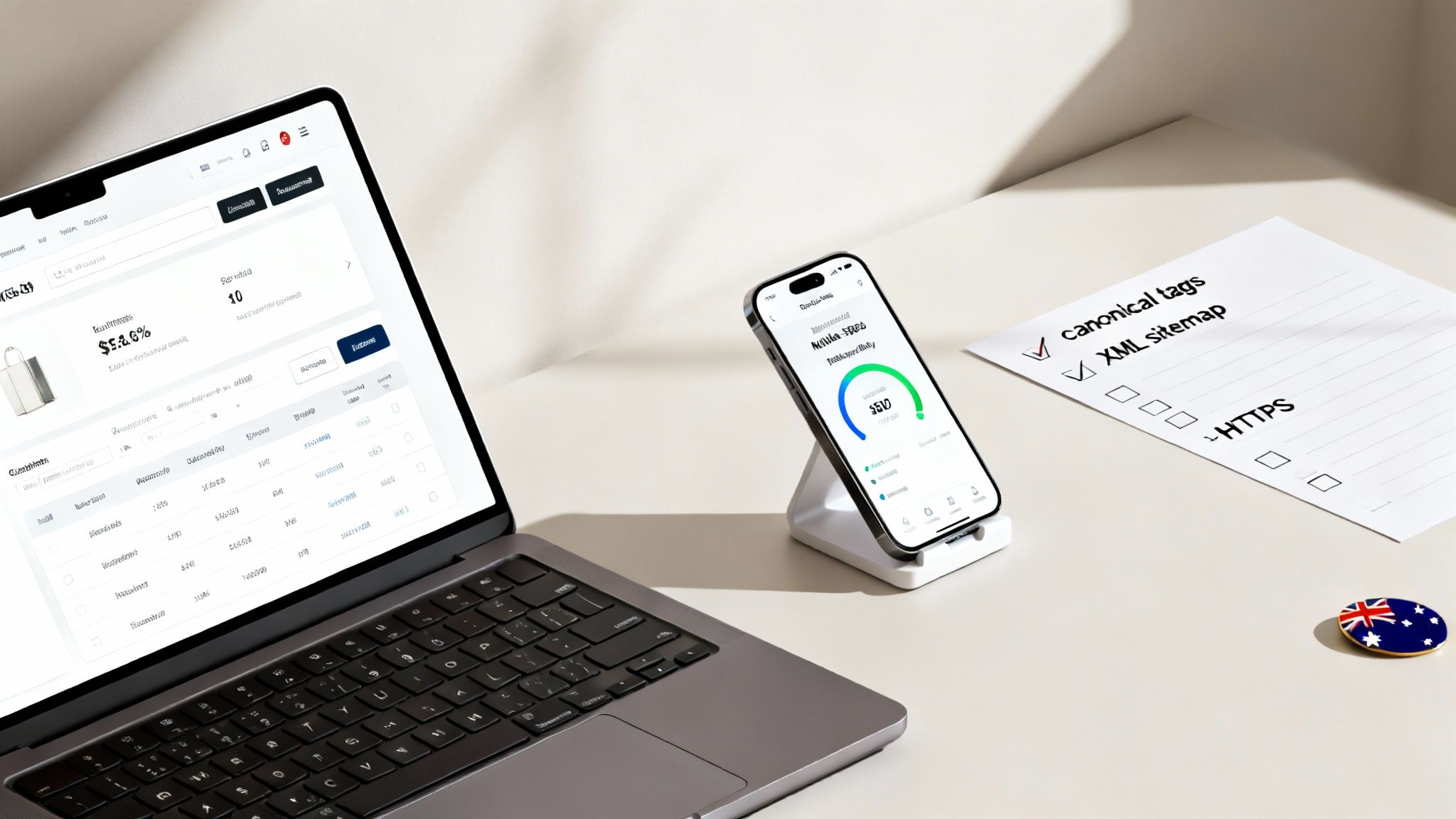
Submitting a clean, well-structured XML sitemap through Google Search Console is like handing Google a map to your entire store. It’s a direct line of communication that ensures none of your product or category pages get left behind in the indexing process.
Structure Your Site for Easy Navigation
Your site architecture is the roadmap for both your customers and for Google. A classic mistake I see all the time is burying key product pages four or five clicks deep from the homepage. This not only frustrates shoppers but also massively dilutes the ranking power passed from your homepage down to your most important money-making pages.
Keep it simple. Aim for a structure where any page is reachable within three clicks.
- Homepage: Links to your main categories.
- Category Pages: Link to sub-categories or directly to product pages.
- Product Pages: The final stop where your customers make a purchase.
This logical flow makes browsing intuitive and helps spread "link equity" (ranking power) throughout your site far more effectively. If you want a deeper dive into finding and fixing these kinds of foundational issues, our guide on conducting a https://clickclickbangbang.com.au/technical-seo-auditing/ provides a step-by-step process.
Conquer Duplicate Content with Canonical Tags
Ecommerce stores are notorious for duplicate content problems. It’s almost unavoidable. When you have product variations for size, colour, or material, you often end up with multiple URLs showing almost identical content, which can confuse Google about which one to actually rank.
Imagine you sell a t-shirt in blue, red, and green. You might have three different URLs:
yourstore.com.au/t-shirts/cool-tee-blueyourstore.com.au/t-shirts/cool-tee-redyourstore.com.au/t-shirts/cool-tee-green
This is where the rel="canonical" tag becomes your best friend. By placing a canonical tag on the blue and green pages that points to the red one (your preferred version), you're essentially telling Google, "Hey, these pages are basically the same, but please treat the red one as the master copy." This consolidates all your ranking signals into a single, more powerful URL.
A clean site is a fast site. Regularly check Google Search Console for crawl errors, broken links (404s), and redirect chains. Fixing these issues ensures a smooth experience for users and keeps search engine crawlers happy.
Prioritise Mobile and Site Speed
In Australia, optimising for mobile isn't just a suggestion—it's everything. Mobile commerce is king. Smartphones generated a whopping AU$56.07 billion in revenue, and in a recent quarter, a staggering 68% of online purchases were made on a phone. Mobile users now account for 77% of all website traffic.
These numbers aren't just stats; they're a clear signal that a mobile-first approach is non-negotiable for any Aussie ecommerce SEO strategy.
This means your store needs to be fast and flawless on a mobile device. Google's Core Web Vitals are the key metrics here, measuring the actual user experience of your site. They focus on:
- Largest Contentful Paint (LCP): How quickly does the main content load?
- First Input Delay (FID): How fast does your page respond when someone clicks something?
- Cumulative Layout Shift (CLS): Is your page visually stable, or does it jump around while loading?
Improving these scores usually comes down to practical fixes like compressing your images, using browser caching, and trimming down any heavy code. And finally, an absolute must-have: make sure your entire site is secured with HTTPS. An SSL certificate builds trust with your customers and satisfies a core Google ranking requirement. Don't even think about skipping it.
Finding Keywords That Australian Shoppers Actually Use
Great keyword research isn't a treasure hunt for the highest search volumes; it's about getting inside your customer's head. You've got to understand the exact words and phrases they use when they're actually looking to buy something from you.
For any solid ecommerce SEO Australia strategy, this means going way beyond generic, high-level terms. We need to dig into the long-tail, high-intent phrases that signal someone is ready to pull out their credit card. This is where you find the real gold.
Uncovering Local Language and Buyer Intent
The Australian market has its own lingo, and getting it wrong means you’re invisible to a massive chunk of your audience. Simple as that.
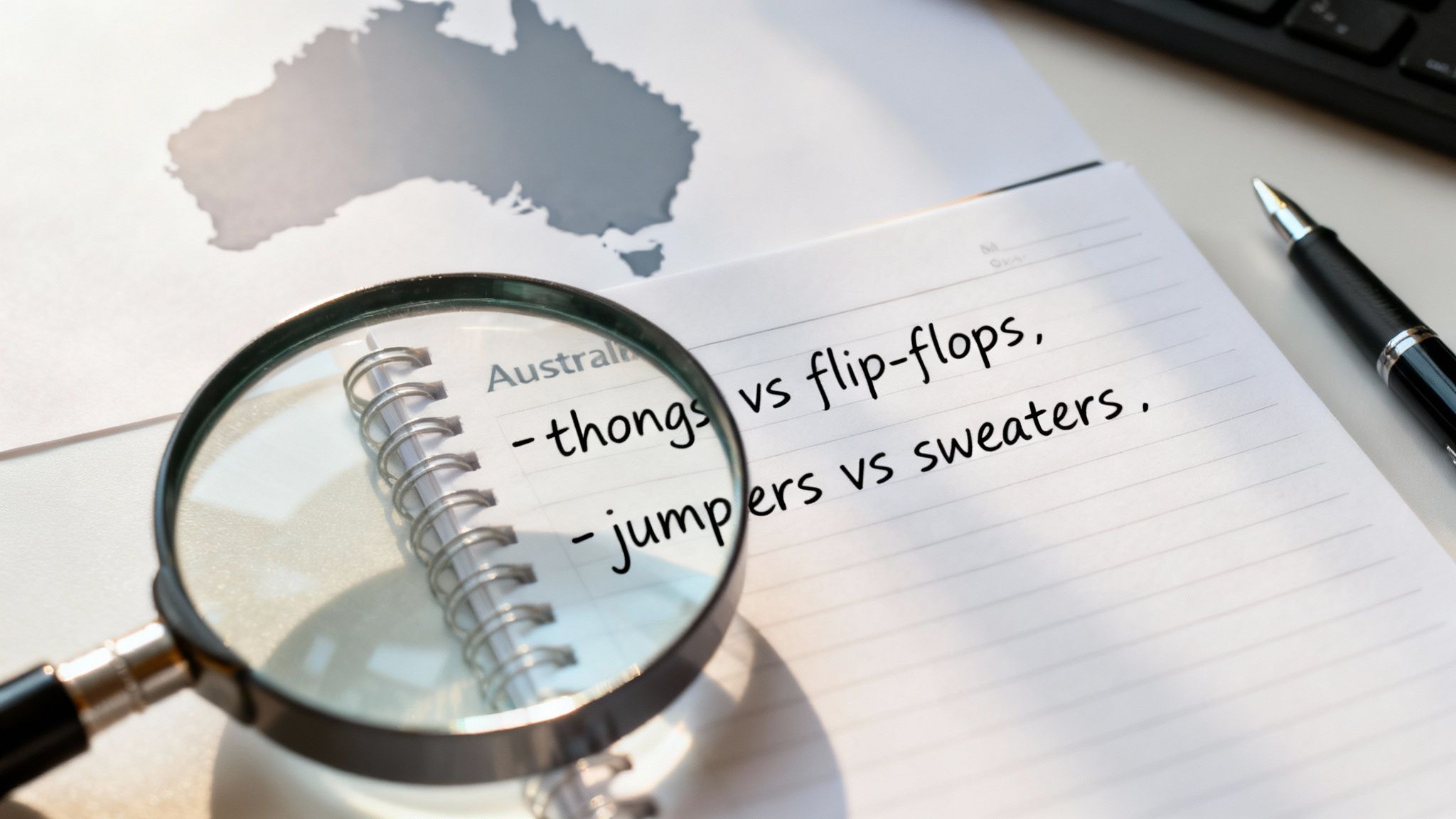
Are your customers searching for 'thongs' or 'flip-flops'? 'Jumpers' or 'sweaters'? 'Eskies' or 'coolers'? These aren't just minor differences; they're clear signals of local search behaviour that can make or break a category page.
A quick trip to Google Trends is perfect for settling these debates. You can compare the search interest between two terms and, crucially, filter the results just for Australia. It’s a dead-simple check that ensures your product and category pages speak the same language as your customers.
Beyond the slang, you have to decode buyer intent. Not all keywords are created equal. Some signal early-stage research, while others scream, "I'm ready to buy now!"
- Informational Intent: Think phrases like "how to choose a mountain bike" or "best hiking boots for Tasmania." These are perfect fodder for blog posts or detailed buying guides.
- Transactional Intent: This is where the money is. Searches like "buy R.M. Williams boots online" or "men's Akubra hat sale" are from people with their wallets out. These belong on your product and category pages.
Focus your most valuable pages—your product and category pages—on keywords with crystal-clear transactional intent. While informational content is vital for attracting new audiences, your "money" pages need to capture people who are actively looking to make a purchase.
A Quick Guide to Keyword Intent
Understanding the why behind a search query is fundamental. Targeting the wrong intent means you're putting the perfect answer in front of the wrong person. Here’s a quick breakdown to help you map your keywords to the right pages on your site.
| Keyword Type | Example (AU Context) | User Intent | Best Page to Target |
|---|---|---|---|
| Navigational | "Bunnings Warehouse" | User wants to go to a specific website. | Homepage |
| Informational | "how to season a cast iron pan" | User is looking for information or answers. | Blog Post or Guide |
| Commercial | "best coffee machines under $500" | User is comparing products before buying. | Category Page or "Best Of" Article |
| Transactional | "buy Blundstone 550 boots online" | User is ready to make a purchase. | Product Page or Category Page |
Mapping keywords this way prevents you from trying to rank a product page for an informational query, which is almost always a losing battle. It brings structure and strategy to your on-page efforts.
Leveraging Keyword Research Tools
While getting the local language right is the foundation, you still need hard data to guide your decisions. This is where paid SEO tools like Ahrefs and SEMrush become absolute game-changers.
These platforms let you see estimated monthly search volumes, gauge how difficult a keyword will be to rank for, and—my personal favourite—spy on your competitors.
Here's a trick I use all the time: enter the domains of your top Australian competitors into a tool like Ahrefs' Site Explorer. Head straight to their "Organic Keywords" report to see every single keyword they rank for. It’s a goldmine.
From there, you can filter this list to find keywords that contain transactional modifiers like "buy," "sale," or "online" to quickly pinpoint their most commercially valuable terms. This reverse-engineering approach shows you what's already working in the Aussie market and helps you find gaps. Maybe a competitor ranks well for a broad category, but you spot a long-tail, product-specific keyword they've totally neglected. That's your opening.
Putting It All Together: A Practical Workflow
Effective keyword research isn’t about randomly plugging words into a tool; it's a systematic process. It’s about building a keyword map that will guide your entire SEO strategy.
- Start with seed keywords. Brainstorm broad terms related to your products. Think "women's dresses" or "leather boots."
- Expand with your tools. Plug these seed keywords into Ahrefs or SEMrush. This will generate thousands of related ideas, questions, and long-tail variations you’d never have thought of.
- Analyse your competitors. As we just covered, see what your Aussie rivals are ranking for. Steal their best ideas and find the keywords they're missing.
- Filter and group everything. Now, sift through your massive list. Group related keywords by topic and, most importantly, by user intent. For example, all keywords about "caring for leather boots" go into one bucket for a blog post, while all keywords for "buy brown leather boots" go into another for a category page.
- Map keywords to specific pages. Finally, assign each keyword group to a specific URL on your site. This crucial step ensures every important page has a clear focus, preventing you from accidentally competing against yourself. This keyword map becomes the blueprint for all your on-page optimisation.
Optimising Pages to Rank Higher and Sell More
Think of your product and category pages as your digital shopfronts. This is where the magic happens, where browsers turn into buyers. Nailing your on-page SEO is a mix of art and science, designed to charm search engines while convincing Aussie shoppers to pull out their wallets. It’s all about creating pages that are not just easy for Google to find, but are also compelling and dead simple to use.
When a potential customer lands on your page, you’ve got seconds—literally—to make your case. The words, the layout, even the photos all need to work together to build trust and nudge them towards that "Add to Cart" button. Let's break down how to craft pages that climb the rankings and actually sell more stuff.
Crafting Titles and Descriptions That Win the Click
Your page title and meta description are your first—and often only—chance to stand out in a crowded Google search. They're your tiny digital billboard, and getting them right can massively boost how many people click through to your site.
Page Titles (H1 & Title Tag)
The title tag (what you see in the browser tab) is a heavyweight ranking factor. Your H1 tag is the main headline on the page itself. They should be closely related, but don't have to be identical.
- Lead with your primary keyword: Get your most important search term as close to the start as possible.
- Keep it short and sweet: Aim for under 60 characters so it doesn’t get awkwardly cut off in the search results.
- Add a hook or your brand: Something like, "Men's Waterproof Hiking Boots – Free Shipping Australia | Aussie Outdoors" works wonders.
Meta Descriptions
This isn't a direct ranking factor, but a killer meta description is what convinces a searcher to click your link instead of the one above or below it.
- Write it like ad copy: Use action-oriented words and highlight a key benefit.
- Include your keyword: Google often bolds the search term in the description, making your result pop.
- Stay under 160 characters: This ensures your full pitch is visible on most devices.
A great meta description answers the user's unspoken question: "Why should I click this one?" Focus on the value—free shipping, a unique feature, or your brand's rock-solid reputation.
Writing Product Descriptions That Actually Convert
Copy-pasting the generic, manufacturer-supplied product description is an SEO sin. It creates duplicate content problems and, frankly, is boring as hell. Your descriptions need to be unique, focused on benefits, and written for your ideal Aussie customer.
Don’t just list features; explain how those features make the customer's life better.
- Feature: "10,000mm waterproof rating."
- Benefit: "Stay bone dry during a surprise Melbourne downpour on your morning commute."
Use short paragraphs, bullet points, and bold text to make the key info scannable. Try to answer common questions right in the description to head off any purchase anxiety. This is a crucial piece of the puzzle, helping both people and search engines understand what makes your product great. If you want to dive deeper into the overall strategy, you can explore the differences between on-page and off-page SEO for a broader view.
Using Images and Alt Text for Visual SEO
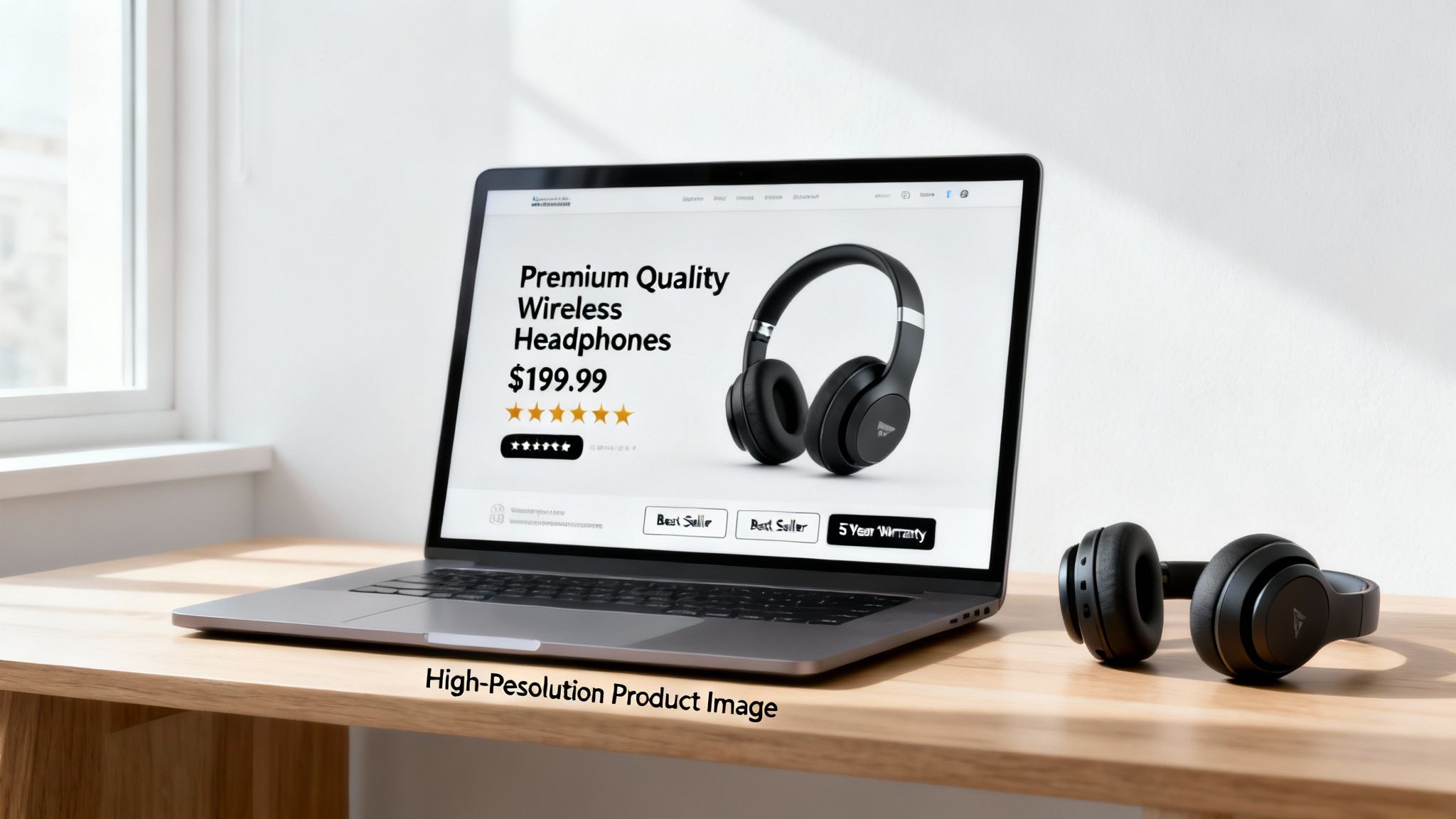
In e-commerce, great photos are non-negotiable. Shoppers can't touch or try on your products, so your images have to do all the heavy lifting. But they also play a surprisingly big role in your SEO.
Search engines can't 'see' images, so they rely on alt text (alternative text) to understand what’s in the picture. This is a golden opportunity to include your target keyword in a natural, descriptive way.
- Bad Alt Text:
image123.jpg - Good Alt Text:
R.M. Williams Comfort Craftsman boots in chestnut brown leather
This simple tweak not only helps your page rank for its main keywords but also makes your products discoverable through Google Images—a seriously underrated source of traffic.
The Power of Structured Data and Customer Reviews
Structured Data (Schema Markup)
Ever seen search results with star ratings, prices, and stock levels displayed right there on the Google page? That’s structured data in action. Adding schema markup to your site is like giving Google a cheat sheet for your product pages.
This special code helps search engines pull out key info and display it as "rich results." These flashy listings grab attention, build instant trust, and can give your click-through rate a massive boost.
Customer Reviews
Genuine customer reviews are pure marketing gold. They provide the social proof that hesitant buyers need to see, and they constantly add fresh, user-generated content to your pages—which Google absolutely loves.
Encourage customers to leave reviews with follow-up emails and make the process as painless as possible. Taking the time to reply to reviews, good or bad, is the cherry on top, showing everyone that you care about your customers.
Building Authority with an Australian Content Strategy
A rock-solid content strategy is the engine that drives sustainable, long-term growth for your ecommerce store in Australia. While perfectly tuned product and category pages are vital for snagging buyers at the checkout, a huge chunk of your audience isn’t ready to pull out their wallet just yet.
This is where a smart content plan comes into play. It’s your chance to build trust and stamp your brand as the go-to authority in your niche. Your blog is the perfect tool for this, letting you attract potential customers much earlier in their journey by answering their questions, solving their problems, and offering real value long before you ask for the sale.
Creating Content That Actually Connects with Aussies
To win over an Australian audience, your content needs to do more than just stuff in keywords. It has to speak to their specific needs, quirks, and interests. This means creating genuinely helpful, practical resources that guide them toward making a smart purchase.
Think bigger than just product announcements. Your goal is to develop "content pillars" that prop up your core product categories.
- In-Depth Buying Guides: Go deep with comprehensive guides like "The Ultimate Guide to Choosing a Wetsuit for Victorian Winters" or "How to Pick the Best BBQ for a Small Sydney Balcony." These articles are magnets for searchers with high commercial intent who are actively weighing up their options.
- How-To Articles and Tutorials: Practical, hands-on content builds immense trust. A hardware store, for instance, could publish a post on "How to Build a Raised Garden Bed," then naturally link out to the timber, screws, and tools they sell. It's helpful, not salesy.
- Honest Product Comparisons: A straight-up comparison like "Weber vs. Ziegler & Brown: Which is Right for You?" can capture customers in the final moments of their research. It positions your store as an unbiased expert, making you the obvious choice to buy from.
Content isn't just about driving traffic; it's about building a relationship. When you consistently provide valuable information, you become a trusted advisor. That makes it a no-brainer for customers to buy from you when the time is right.
The Critical Role of Internal Linking
Creating killer content is only half the job. To squeeze every drop of SEO value out of it, you need to strategically link from these articles back to your key commercial pages. This tactic, known as internal linking, is one of the most powerful yet underused weapons in ecommerce SEO.
Imagine your blog post, "The 5 Best Hiking Tents for Australian Conditions," is ranking well on Google and pulling in steady traffic. By linking from this article directly to the specific product pages for each tent you sell, you pass some of that authority—or "link juice"—from the blog to your money-making pages.
This sends a strong signal to Google that your product pages are important and highly relevant for those topics, helping them rank higher in search results. It creates a powerful, self-fuelling cycle where your content supports your products, and your products validate your content.
Earning Trust with Local Link Building
To truly establish your authority in Google’s eyes, you need other reputable Australian websites to link to you. These backlinks act as votes of confidence, signalling that your store is a credible and trustworthy resource. Chasing links from massive international sites can be a soul-crushing grind, but focusing on the local scene can deliver incredible results.
Here are a few practical strategies to build high-quality local links:
- Collaborate with Aussie Bloggers: Find influential bloggers in your niche—whether it’s fashion, parenting, or outdoor adventure. Offer them a product to review or suggest co-creating a piece of content. A genuine review from a trusted Aussie voice can drive both referral traffic and a powerful backlink.
- Engage with Local Publications: Local news outlets and community websites are always hungry for stories. If you’re launching a unique product, hosting a local event, or have an interesting business story, send out a press release. A feature on a site like Broadsheet or a local newspaper’s online portal can land you a highly authoritative link.
- Sponsor a Local Event or Charity: Sponsoring a local footy team, a community fair, or a charity fun run often comes with a link from their website's sponsors page. It's a fantastic way to build goodwill in the community while earning a relevant local backlink.
This focus on local relevance is vital. The Australian digital advertising market is booming, with search advertising revenue growing 10% year-on-year to hit $1.896 billion in a single recent quarter. This proves that Aussie businesses are investing heavily in search visibility, and earning high-quality, local links is a key way to stand out. You can dig into more details in this breakdown of Australian digital marketing statistics.
Tracking Your SEO and When to Call in an Expert
If you’re not measuring your SEO, you’re just guessing. Simple as that.
Effective ecommerce SEO in Australia isn’t about wishful thinking; it’s about using hard data to make smart, revenue-focused decisions. Without tracking, you have no real way of knowing what’s actually working, what’s a complete waste of time, or how your investment is paying off.
Your two most critical (and free) tools are Google Analytics 4 (GA4) and Google Search Console. Setting these up isn't optional—it's foundational. Search Console is your direct line to Google, revealing the keywords bringing people to your site and flagging any technical hiccups. GA4 then tells you what those visitors do once they land, tracking organic traffic, engagement, and—most importantly—conversions and sales.
By connecting both tools, you get the full story. You can see which search terms are leading to the most valuable customer actions, giving you undeniable proof of your SEO’s return on investment.
Interpreting the Data and Making Decisions
Once you've got data flowing in, the trick is to focus on the metrics that genuinely matter. It’s incredibly easy to get lost in a sea of numbers, so start by building a straightforward report that answers a few core questions:
- Organic Traffic: Is the number of visitors from search engines climbing month-on-month?
- Keyword Rankings: Are you gaining ground for your main commercial keywords?
- Click-Through Rate (CTR): Are your page titles and meta descriptions compelling enough to actually win the click in the search results?
- Organic Conversion Rate: Are visitors from search actually buying your stuff?
For businesses zeroing in on specific Australian cities or states, it's vital to learn how to track local SERPs effectively. This is how you'll understand regional search performance and fine-tune your local SEO game. You can learn more about which key digital marketing performance metrics you should focus on to prove ROI.
Should You DIY or Hire an Agency?
This is a crossroads many Australian businesses eventually reach. Keeping SEO in-house can definitely work, especially if you have someone on the team with the time and a genuine hunger to learn. It keeps costs down at the start and builds valuable knowledge within your company.
But let's be realistic—effective SEO is a complex and massively time-consuming discipline.
It might be time to bring in an expert agency when:
- You lack the time or expertise: If SEO keeps getting pushed to the bottom of the to-do list, it’s time to delegate it to someone who lives and breathes it.
- Your growth has stalled: An agency can bring a fresh set of eyes and advanced strategies to punch through a performance plateau.
- You're in a highly competitive market: Trying to compete in crowded niches like fashion, electronics, or finance often requires the specialised tools, experience, and resources an agency brings to the table.
Partnering with a specialist agency isn’t giving up; it’s a strategic move to fast-track your growth and secure a powerful edge over your competition.
Frequently Asked Questions
Got a few more questions rattling around? Navigating the ins and outs of Aussie ecommerce SEO can definitely feel like a maze. Here are some of the most common questions we get from retailers, answered straight up.
How Long Does It Take to See SEO Results?
Look, SEO is a marathon, not a sprint. Anyone who tells you otherwise is selling you snake oil. In a competitive market like Australia, you can realistically expect to see the first green shoots of progress—think small ranking bumps and a slight uptick in organic traffic—within three to six months of solid, consistent work.
But the real, game-changing results? The kind that actually drives significant revenue? That usually takes a good six to twelve months of sustained effort. The good news is that you're building a powerful, long-term asset for your brand that will keep paying you back for years to come.
What’s the Most Important SEO Factor?
If I had to pick just one thing, it would be a mobile-first user experience. It's non-negotiable. Aussies live on their phones, and a massive chunk of online shopping happens on a mobile device. If your site is slow, clunky, or just a pain to use on a phone, you're dead in the water before you even start.
Think of mobile usability as the foundation of your house. Get that right, and then you can build on it with the other essential pillars: high-quality content that actually answers what local customers are searching for, and a strong profile of backlinks from reputable Aussie sites.
Should I Focus on SEO or PPC?
Why choose? The smartest play is to use both SEO and PPC together. They’re two sides of the same coin and work brilliantly in tandem.
SEO is your long game. It builds your brand's authority and delivers a highly cost-effective stream of organic traffic over time. PPC, on the other hand, gives you that instant, targeted traffic you need for launching a new product, clearing out seasonal stock, or running a big promotion.
Using them together means you’re catching Australian customers at every single stage of their buying journey. It maximises your visibility, builds your brand, and ultimately, drives more sales.
Ready to stop guessing and start growing with a data-driven SEO strategy? Click Click Bang Bang is an AI-first SEO agency that builds precision campaigns to boost your visibility and drive sales. Get in touch with us today to see how we can help.
Read NeXt
Or Read Our Latest
- Manual vs Automated Bidding for PPC Success
- Conversion Tracking Setup: A Complete AU Guide
- Instagram Advertising Australia: Complete 2026 Guide
- Pay Per Click: A Beginner’s Guide for Australian Marketers
- Display Advertising on Google: The Complete Australian Guide
- Stakeholder Communication Plan How to Build One That Works
Click. CLick. Subscribe.
Get our best PPC insights, industry updates, and power moves delivered straight to your inbox. No fluff, just high-caliber strategies that actually work.
Don’t Leave Just Yet
Try Us For 30-Days,
Risk Free!!
We guarantee that you’ll love our work within the first 30 days, if not you’ll get your money back.
What have you got to lose?