

Seo Boost: seo ecommerce services That Grow Your Store
Last Updated

Picture your online store. It’s brilliant, stocked with amazing products, but it’s tucked away in a quiet back alley where no one can find it. Ecommerce SEO services are what move your shop from that forgotten laneway to the busiest high street in town, right where your dream customers are window shopping. It's all about making your digital shopfront impossible to miss, easy to navigate, and irresistible to both search engines and actual shoppers.
What Are Ecommerce SEO Services, Really?
At its heart, an ecommerce SEO service is a specialised discipline designed to get your online store seen on search engines like Google. Think of it as the master plan to pull in more organic traffic—that is, visitors who find you for free because they’re actively searching for the exact products you sell. This isn't like paid advertising, where you're forking out cash for every single click.
Instead, ecommerce SEO builds a lasting asset for your business. The focus is on fine-tuning every part of your site, from the technical nuts and bolts and site structure to the content on your product pages and your overall brand authority. The end game? To rank high for the keywords that matter and turn your website into a magnet for qualified buyers ready to spend.
Why Organic Search is More Important Than Ever
The digital marketplace is getting noisier and more crowded by the day, which makes standing out organically an absolute game-changer. Australia's digital economy is surging, and this growth is forcing a major rethink for online retailers. Organic search isn’t just a driver of website traffic; it’s the leading driver, leaving paid ads and social media in its dust.
With Australia's digital economy tipped to hit $120 billion in 2025, businesses are set to pour $1.5 billion into SEO to grab a piece of the action. And when you consider that a whopping 53% of all website traffic comes from organic search, a solid SEO foundation goes from being a 'nice-to-have' to a non-negotiable for growth. You can dive deeper into the Australian SEO landscape and its importance for retailers to see just how big this opportunity is.
It's simple: if your customers can't find you on Google, you're just handing sales over to your competitors. A dedicated SEO strategy ensures you're not just in the game—you're winning it.
This whole process isn't about pulling one magic lever. A winning strategy weaves together several key pillars to create a powerful, unified push.
Before we unpack each component, here’s a quick overview of what a comprehensive ecommerce SEO strategy looks like.
Key Pillars of Ecommerce SEO at a Glance
This table provides a quick summary of the essential components that form a successful ecommerce SEO strategy, which we'll explore in detail.
| SEO Pillar | What It Achieves | A Real-World Tactic |
|---|---|---|
| Technical Health | Ensures your site is fast, secure, and easily understood by search engines. | Optimising your site's robots.txt file and sitemap to guide Google's crawlers. |
| On-Page Optimisation | Crafts compelling pages that target keywords and answer shopper questions. | Writing unique, benefit-driven product descriptions for your top-selling items. |
| Content Strategy | Attracts shoppers at every stage with valuable, helpful content. | Creating an in-depth "Best Running Shoes for Beginners" buying guide. |
| Authority Building | Builds trust and credibility with search engines through high-quality backlinks. | Getting your new product line featured on a popular industry blog. |
Each of these pillars is crucial. Neglect one, and the whole structure can become wobbly.
By tackling these core areas, SEO ecommerce services take an invisible online store and transform it into a thriving market leader. The result is consistent, profitable growth that doesn't rely on a constant stream of ad spend to keep the lights on.
What Goes Into a Winning Ecommerce SEO Strategy?
A genuinely effective SEO strategy is so much more than a simple to-do list. It’s a living, breathing system where every part works together to power organic growth. Think of it as the architectural blueprint for your online store—every wire, beam, and window is meticulously planned to attract customers and make them want to stay.
This isn't about chasing the latest shiny algorithm update. It's about building a rock-solid foundation that delivers results for the long haul. The real goal is to create a website that both shoppers and search engines fall in love with, turning casual browsers into loyal fans.
Let's pull back the curtain on the core pillars that make up this winning blueprint.
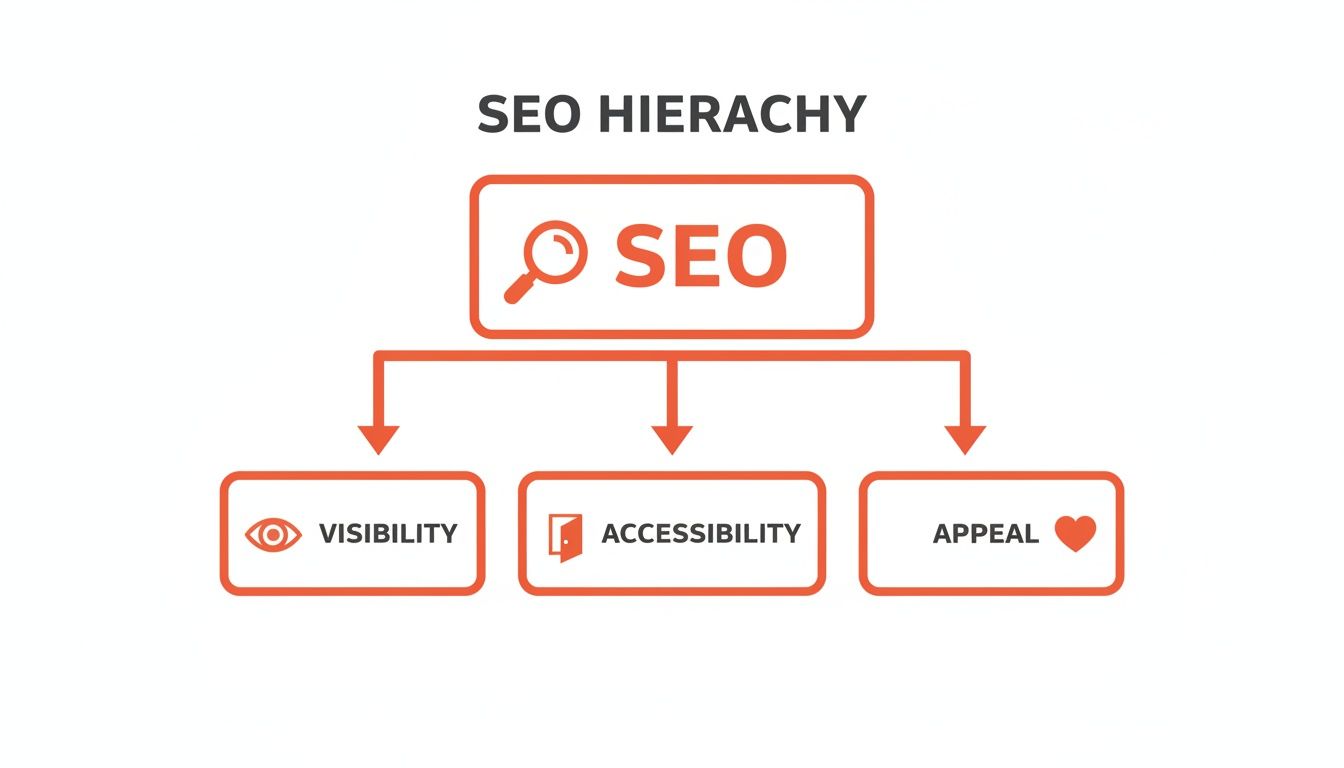
This diagram shows how true SEO success starts with a strong technical base (visibility and accessibility) and builds towards the ultimate goal: making your brand irresistible to shoppers.
Technical SEO Health
Before you even think about keywords or content, your store's technical engine needs to be purring. Technical SEO is like giving a race car a full diagnostic check before a big event. It doesn’t matter how skilled the driver is if the engine is misfiring or the tyres are flat.
Your site’s technical health is what determines how easily search engines can find, crawl, and make sense of your pages. A slow, buggy, or insecure site doesn't just annoy users—7% of whom will abandon a purchase for every one-second delay in page load time—it screams "don't rank me" to Google.
Key technical tune-ups include:
- Site Speed: Making sure pages snap to attention, especially on mobile.
- Mobile-Friendliness: Creating a seamless experience for anyone shopping on their phone or tablet.
- Crawlability and Indexability: Ensuring search engine bots have a clear path to navigate and list your pages in their index.
- Secure Connection (HTTPS): Protecting customer data is non-negotiable and a fundamental ranking signal.
Any credible SEO campaign kicks off with a deep dive into the technicals. You can get a better sense of why this is so critical by exploring what a comprehensive technical SEO audit really entails.
Smart Site Architecture
How your store is laid out has a huge impact on both shoppers and search engines. A logical site architecture is like a well-organised supermarket. You instinctively know where to find the milk, the bread, and the checkout without needing a store map for every item.
A well-planned structure helps shoppers find what they’re looking for in just a few clicks. This simplicity not only prevents them from bouncing but also helps channel "link equity" (think of it as ranking power) from your homepage down to your most important category and product pages.
A great rule of thumb for site architecture is the "three-click rule." A customer should be able to get from your homepage to any product page in three clicks or less. This keeps people engaged and makes your entire catalogue more visible to Google.
Product Page and Category Mastery
This is where the magic really happens—your product and category pages are your digital shop floor. Getting these pages right is about so much more than just slotting keywords into a description. It's about anticipating customer questions, showing off your product’s value, and giving them every reason to hit "Add to Cart."
This involves:
- Unique, Compelling Descriptions: Ditch the generic manufacturer spiel. Write benefit-focused copy that speaks directly to your ideal buyer.
- High-Quality Images and Videos: Use optimised visuals that load fast and showcase your products from every possible angle.
- Clear Calls-to-Action (CTAs): Make it painfully obvious and easy for shoppers to take the next step.
- User-Generated Content: Pull in customer reviews and Q&As to build trust and social proof right where it matters most.
Treat each product page like your best salesperson, ready with all the info a customer needs to make a confident purchase.
A Content Strategy That Actually Sells
Content is the bridge connecting what your customers are searching for with the products you sell. A smart content strategy extends far beyond your product pages, meeting shoppers at every stage of their buying journey with helpful guides, "how-to" blogs, or comparison articles.
For instance, a store selling running shoes could publish a guide on "How to Choose the Best Running Shoes for Shin Splints." This piece attracts people who aren't ready to buy a specific shoe yet but are actively researching their problem. By offering real value, you build authority and naturally guide them toward your products when they're ready to buy.
A modern SEO blueprint also embraces new ways to create content. For example, some brands are using new tech to help write engaging, SEO-friendly product descriptions and articles more efficiently. To get an idea of how this works, you can learn how AI is revolutionizing fashion content creation and see how similar ideas could apply to your own niche.
Advanced Schema Markup
Schema markup is a bit like adding special, behind-the-scenes labels to your products that only search engines can read. For an ecommerce site, this is a game-changer. It gives Google extra context about your page content, allowing it to show much richer, more informative results to searchers.
By adding product schema, you can unlock "rich snippets" in the search results that might include:
- Star ratings pulled from customer reviews.
- Product pricing and any special offers.
- Stock availability (like "In Stock").
These little details make your listings pop on a crowded results page, seriously boosting click-through rates and drawing in more qualified traffic. It's one of the best ways to get a competitive edge before a shopper even lands on your site.
Understanding How Ecommerce SEO Is Priced
Investing in professional ecommerce SEO services can feel a bit like buying a car without seeing the price tag first. You know you need it to get where you want to go, but the actual cost can seem like a mystery. Let's pull back the curtain on this investment so you can make a confident decision that genuinely grows your store.
The price of SEO isn’t just some arbitrary number; it’s a reflection of the expertise, resources, and strategic grunt work required to outrank your competitors. Think of it less like paying for a checklist of tasks and more like investing in a tangible business outcome: sustainable, profitable organic traffic. The conversation should quickly shift from, "How much does it cost?" to, "What return can I expect on my investment?"
Common Ecommerce SEO Pricing Models
When you start looking for an SEO partner, you’ll typically run into three main pricing structures. Each one is built for different business needs, goals, and how hands-on you want to be. To get a better feel for the numbers, it's worth exploring the typical pricing models for SEO services and seeing how they fit different business situations.
-
Monthly Retainer: This is the most common model for ongoing SEO, and for good reason. You pay a fixed fee each month for a continuous, comprehensive strategy that covers everything from technical audits and content creation to link building and performance reporting. It’s perfect for businesses committed to long-term growth and carving out a dominant spot in their market.
-
Project-Based Fees: If you have a specific, one-off goal, this model makes a lot of sense. Maybe you need a complete website migration, a deep technical SEO overhaul to fix core problems, or a targeted content blitz for a new product launch. You pay a set price for a defined scope of work with a clear start and end date.
-
Hourly Consulting: This structure gives you access to an expert on an as-needed basis. It's ideal for in-house teams who've hit a specific roadblock, want a second opinion on their current strategy, or need specialised training. You only pay for the time you use, making it flexible but definitely a less hands-on option.
What Determines the Cost
Several key factors will influence the quotes you receive for an SEO engagement. Understanding these variables helps you see the value behind the numbers and why a one-size-fits-all price just doesn't work.
The cost of SEO is a direct reflection of the competitive landscape. A local boutique competing against a few nearby stores requires a vastly different level of investment than a national retailer going head-to-head with Amazon.
Here are the key cost drivers:
- Your Business Goals: Aiming for a 20% bump in organic revenue is a very different ball game than shooting for a 200% increase. Ambitious goals demand a more aggressive and resource-heavy strategy.
- Website Size and Complexity: A store with 50 products is far simpler to optimise than one with 5,000 SKUs, multiple languages, and a labyrinth of faceted navigation.
- Industry Competition: The level of competition in your niche is a massive factor. Trying to break into a highly saturated market requires a much more significant and sustained effort to gain traction and lock in those top rankings.
Ultimately, the right SEO partnership is one where the pricing model lines up perfectly with your business objectives. For a more detailed breakdown of what goes into the cost, our guide on how much search engine optimisation costs offers deeper insights.
How to Choose the Right Ecommerce SEO Agency

Choosing a partner for your SEO is a big deal. It's less like hiring a contractor and more like picking a co-pilot for a long-haul flight — this decision will shape your store’s visibility, revenue, and brand authority for years to come.
Start by shortlisting at least three agencies that can show you the goods: demonstrable ecommerce case studies, ideally in your niche. You want to see their work on stores of a similar size and complexity to your own.
Dig into the metrics. Look for tangible results like organic revenue growth, significant traffic lifts, and improved conversion rates. If an agency gives you vague promises or guarantees overnight success, that’s a massive red flag. Real SEO is a long game built on consistent work, transparent processes, and clear milestones.
And always, always ask how they react when Google drops another algorithm update. Their answer will tell you everything you need to know about their proactivity and expertise.
Key Vetting Criteria
Before you get lost in sales pitches, create a simple checklist to score each agency against your non-negotiables. Think of it as your vetting scorecard.
Your list should cover the basics of how you'll work together day-to-day. You’ll also want to speak to their current clients to get the real story on their responsiveness and problem-solving skills. A solid agency will happily provide direct contacts for at least two current clients.
Your checklist should include:
- Reporting Cadence: How often will you get updates? Do they provide live dashboards and easy-to-digest summaries?
- Communication Channels: What's the primary way to connect? Email, Slack, regular phone calls?
- Tool Access: Will you get access to analytics, keyword tracking, and crawl data to see what’s happening behind the scenes?
Next, get into the nitty-gritty of their product-level optimisation methods. Do they run A/B tests on calls-to-action or experiment with different image layouts? Ask for specific examples where a few smart tweaks lifted conversion rates by 15% or more.
Also, press them on their site architecture recommendations. A top-tier agency should be able to diagram your current site structure and propose optimised category hubs designed to improve navigation and user experience. These blueprints are critical for reducing bounce rates and funnelling link equity to your most important pages.
Core Deliverables to Expect
A reputable agency won’t just talk a big game; they’ll present a clear roadmap. This should cover everything from the initial technical SEO audit and on-page work to a comprehensive content strategy.
Make sure they’re talking about advanced tactics like schema markup, conversion rate optimisation (CRO), and setting up robust analytics and tracking. If their pricing models feel murky, push for clarity on retainers, project fees, and any performance-based options.
A true partner treats your goals as their goals and maintains an open feedback loop.
You're looking for an agency that aligns its costs with your outcomes and can provide tangible ROI projections. The best ones will connect their work—like keyword ranking improvements and technical fixes—directly to estimated impacts on your revenue.
Once you’ve vetted their process and deliverables, it’s time to evaluate the cultural fit. Good chemistry is crucial. Clarify how often you’ll meet and who will be leading the calls. Does your in-house team get a dedicated account manager? You want a team that solves problems proactively, not one that just reacts when things go wrong.
Finally, compare price to value. Scrutinise contracts for any hidden fees or long, restrictive lock-in clauses.
Final Selection Checklist
With all your research done, lay out your agency scores side-by-side. This makes it much easier to make a balanced, informed decision.
Prioritise the agencies that offer clear KPIs, transparent pricing, and a schedule for regular reviews. And remember, the cheapest option rarely delivers the best long-term ROI in ecommerce SEO. You're investing in growth, not just ticking a box.
Select a partner who is genuinely willing to invest the time to understand your business inside and out. That collaborative mindset is what leads to long-term success and a real competitive advantage.
Check out our guide on selecting an ecommerce SEO agency to see how our AI-driven, tiered plans solve common pain points for businesses like yours.
To get started on the right foot, make sure you agree on a clear path forward:
- Outline a 30-day check-in plan to measure initial impact.
- Set quarterly business reviews (QBRs) to adjust strategy as needed.
- Agree on a living document to track experiments, wins, and learnings.
Choosing the right ecommerce SEO agency is what turns your store’s potential into measurable, sustainable growth. Use this framework to cut through the noise, find a partner you trust, and kick off your first project with confidence. Then, get ready to watch your sales climb.
What Your First 90 Days With an SEO Agency Should Look Like
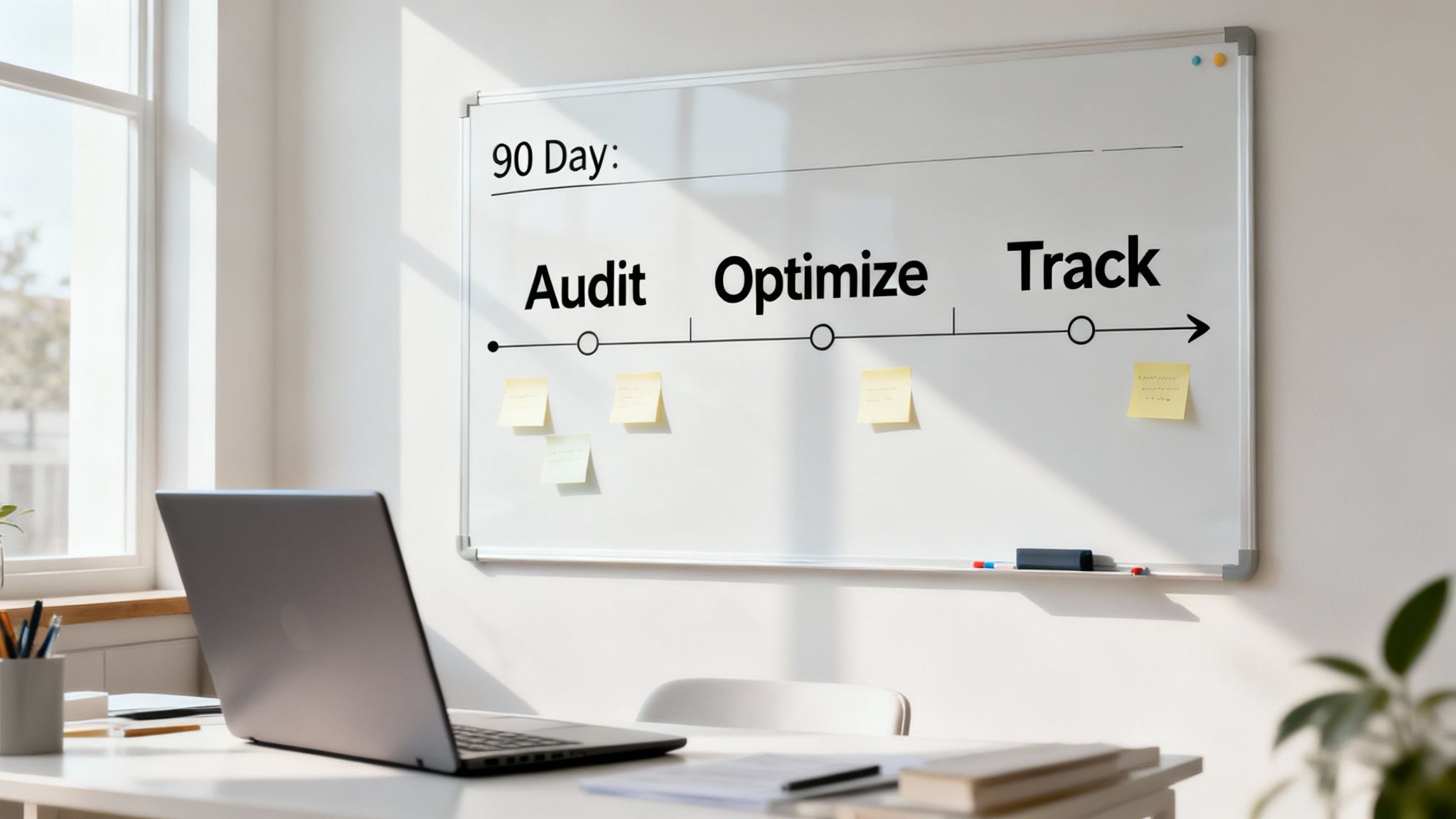
Signing on with a new SEO agency can feel like a bit of a leap of faith. The contract is signed, the invoice is paid… so what actually happens next? A proper, structured onboarding process is non-negotiable. It’s what sets the foundation for the entire campaign, making sure your business goals are baked into the strategy right from the word "go."
Let's be clear: the first 90 days are not about watching your sales figures shoot for the moon. Instead, think of it as laying the concrete slab and framework for a skyscraper. It’s all about meticulous setup, deep analysis, and strategic alignment. This initial work is absolutely vital for long-term stability and growth, paving the way for the results you’re really after.
Month 1: The Deep-Dive and Technical Audit
The first 30 days are all about discovery and diagnostics. Your new agency should become an extension of your team, and that starts with them getting to know your business inside and out. This phase is intensely collaborative.
Expect a detailed kickoff meeting where you'll get into the nitty-gritty of your business objectives, target audience, top competitors, and even your profit margins on key products. This isn't just a formality; it's essential for building a strategy that drives profitable growth, not just vanity metrics like traffic.
At the same time, the agency will be getting under the hood of your website with a comprehensive technical SEO audit. They'll examine things like:
- Crawlability and Indexability: Can search engines actually find and understand your most important pages?
- Site Speed: How fast do your pages load, especially on mobile? Just a one-second delay can drop conversions by a staggering 7%.
- Mobile-Friendliness: Is your store giving shoppers on their phones a seamless, easy experience?
- Site Architecture: Is your store logically structured, making it simple for both users and search engines to navigate?
By the end of this month, you should have a crystal-clear roadmap detailing all technical issues—prioritised by impact—and a shared understanding of your business goals.
Month 2: Strategy Development and Foundational Fixes
With a clear picture of your site’s health and your business objectives, month two is all about hammering out the strategic framework. This is where the audit findings get translated into a real, actionable plan.
The agency will dive deep into keyword research, going beyond the obvious high-volume terms to pinpoint valuable long-tail keywords and transactional phrases that signal high buyer intent. This research is what will guide the optimisation of your most critical category and product pages.
This phase is critical because it connects the technical "what" with the strategic "why." Every optimisation should be tied directly to a business goal, whether it's increasing visibility for a high-margin category or capturing more qualified traffic.
During this time, the agency will also be setting up advanced analytics and conversion tracking. This is the plumbing that ensures every action can be measured, giving you the hard data needed to make informed decisions and demonstrate a clear return on investment down the line.
Month 3: Initial Optimisation and Reporting Setup
In the final month of this initial phase, the strategy finally moves into execution. The agency will start rolling out the highest-priority fixes identified in the audit. This could be anything from improving site speed and fixing broken links to optimising your site's navigation for a better user journey.
They'll also begin on-page optimisation for a select group of high-priority pages. This involves fine-tuning page titles, writing compelling meta descriptions, and improving product copy to better target the keywords identified back in month two.
By the end of the first 90 days, you should have a fully functional analytics dashboard, a clear strategic roadmap for the next six months, and the first wave of foundational optimisations live on your site. This structured approach ensures your SEO ecommerce services partnership is built on a solid foundation for long-term, measurable success.
Your Next Steps to Ecommerce Growth
Knowing the theory behind SEO ecommerce services is a solid start, but turning that knowledge into actual growth is where the fun begins. What you do next hinges entirely on where your business is right now. Whether you're a scrappy startup or an established enterprise, there’s a clear path to turning these insights into action and driving real, sustainable organic revenue.
The trick is to focus on what will move the needle the most today. Don't get overwhelmed trying to boil the ocean. You need to prioritise based on your unique goals, whether that’s getting a flagship product to fly off the shelves or building your brand’s authority across an entire market.
Action Plan for Small and Medium Stores
For smaller ecommerce businesses, the game is all about high-impact, manageable tasks that build a rock-solid foundation. You don't need a massive budget to see meaningful progress. The aim here is to score quick wins that build momentum and prove that SEO is worth the effort.
Here are your immediate priorities:
- Refine Your Top 10 Product Pages: Go way beyond just a basic description. We're talking compelling, benefit-driven copy, high-quality images with descriptive alt text, and actively chasing down those all-important customer reviews.
- Build Out Your Google Business Profile: This is a free and ridiculously powerful tool for local visibility. Make sure every detail is accurate, upload great photos, and get a system in place for collecting customer reviews to build that trust signal.
- Target Long-Tail Keywords: Instead of trying to fight the big guys for broad, super-competitive terms, get specific. Think phrases like "waterproof leather hiking boots for women." These searches almost always have higher buyer intent and are far easier to rank for.
By mastering a few core areas, smaller stores can create a powerful organic engine that drives consistent traffic and sales—no enterprise-level resources required.
Scaling Strategies for Enterprise Teams
For larger enterprises, the challenge isn't starting from scratch; it’s about scaling effectively and weaving SEO into the very fabric of your business operations. Your focus shifts from foundational tasks to sophisticated strategies that can handle thousands of products and capture massive market share.
It's time to level up with these advanced tactics:
- Implement Programmatic SEO: When you have a catalogue with thousands of SKUs, optimising every page by hand is just impossible. Programmatic SEO uses templates and data to automatically generate optimised landing pages for thousands of long-tail search queries, capturing traffic at a scale that would make your competitors weep.
- Integrate SEO with Business Intelligence (BI): This is where things get really smart. Connect your SEO performance data with other business metrics like inventory levels, profit margins, and customer lifetime value. This allows you to point your SEO firepower at the products and categories that actually make you the most money.
- Develop a Content Moat: Invest in building out comprehensive resource hubs, detailed buying guides, and digital tools that cement your brand as the undisputed authority in your niche. This not only attracts incredibly valuable backlinks but also builds a loyal audience that trusts you over anyone else.
Common Questions About Ecommerce SEO Services
Diving into SEO ecommerce services always brings up a few questions. Investing in your store’s organic growth is a big step, and you absolutely should have all the facts straight before you commit. We get it.
Here are some honest, no-fluff answers to the most common questions we hear from ecommerce store owners. These cover everything from timelines and budgets to what makes this corner of SEO so unique. Getting these answers sorted helps set the right expectations from day one.
How Long Until I See Results from Ecommerce SEO?
This is the big one, and the honest answer is it takes time. While you might see a small boost from initial technical fixes within a few weeks, meaningful growth in organic traffic and sales typically takes 4 to 6 months.
Think of it like planting a tree, not flipping a light switch. The early work is all about building strong roots—fixing the technical foundation, researching keywords, and structuring your site. The real, compounding growth comes later as that foundation takes hold. The timeline really depends on your site's current state, how tough your competition is, and the intensity of the strategy. But unlike paid ads, the wins you get from SEO keep delivering value long after the initial work is done, turning into a sustainable asset for your business.
What Makes Ecommerce SEO Different from Regular SEO?
While they both stem from the same core principles, ecommerce SEO is a completely different beast. It's a specialised field that’s laser-focused on one thing: driving product sales at scale. We’re not just trying to get visitors; we’re trying to get buyers to the checkout.
This specialisation brings its own unique set of challenges that you just don't see in standard SEO:
- Massive Scale: Instead of a few service pages, you're managing and optimising hundreds or even thousands of individual product pages, each needing unique attention.
- Tricky Navigation: Dealing with category filters and faceted search is a minefield. Get it wrong, and you can create a monstrous duplicate content problem that tanks your rankings.
- Product Schema: This is non-negotiable for ecommerce. Implementing structured data correctly is what makes your products pop in the search results with shiny star ratings, pricing, and stock availability.
- Conversion Focus: Every single decision—from site architecture to blog content—is engineered to move a user from a Google search to a completed purchase.
Regular SEO might aim for leads or article traffic. Ecommerce SEO is built from the ground up to sell stuff.
Can I Do Ecommerce SEO on My Own?
You can definitely tackle some of the basics yourself, and you should! Writing unique, compelling product descriptions or optimising your product images with good alt text are great starting points that will absolutely help.
But a truly competitive strategy that drives serious growth requires a much deeper, more technical skill set. It demands expertise in solving complex site architecture issues, access to expensive analytics and research tools (think A$1,000s/month), and a massive time commitment for ongoing work like link building and content strategy. For most businesses aiming to scale, partnering with a specialist agency gives you the firepower and resources needed to see a real return on your investment.
Is SEO Better Than Paid Ads for My Online Store?
The best answer? They work brilliantly together, not against each other. It’s not an either/or question.
Paid ads are fantastic for getting immediate traffic and data. They’re perfect for new product launches, flash sales, and quickly testing whether a new market is viable. You turn them on, and the visitors arrive.
SEO, on the other hand, builds a long-term, sustainable asset. It drives highly qualified traffic to your store month after month without a per-click cost, creating compounding returns and building genuine brand authority over time.
A smart digital strategy uses paid ads for those short-term wins and quick feedback loops while building a powerful organic foundation with SEO. This integrated approach ultimately lowers your total customer acquisition cost and makes your business far more resilient.
Ready to stop wondering and start growing? At Click Click Bang Bang, our AI-first, data-driven SEO strategies are designed to deliver measurable results for your ecommerce store. Explore our tiered plans and book your free strategy call today!
Read NeXt
Or Read Our Latest
- Manual vs Automated Bidding for PPC Success
- Conversion Tracking Setup: A Complete AU Guide
- Instagram Advertising Australia: Complete 2026 Guide
- Pay Per Click: A Beginner’s Guide for Australian Marketers
- Display Advertising on Google: The Complete Australian Guide
- Stakeholder Communication Plan How to Build One That Works
Click. CLick. Subscribe.
Get our best PPC insights, industry updates, and power moves delivered straight to your inbox. No fluff, just high-caliber strategies that actually work.
Don’t Leave Just Yet
Try Us For 30-Days,
Risk Free!!
We guarantee that you’ll love our work within the first 30 days, if not you’ll get your money back.
What have you got to lose?