

Best PPC Agency Perth: Your 2026 Selection Guide
Last Updated
You're probably in one of three spots right now.
Your current ads are underperforming and nobody can explain why in plain English. You're about to hire your first agency and don't want to burn budget learning hard lessons. Or you've spoken to a few Perth providers already and every proposal sounds polished, but oddly interchangeable.
That's the problem with choosing a PPC agency in Perth. The surface-level promises are usually the same. Better leads, stronger ROI, transparent reporting. What matters is whether the agency understands how Perth behaves as a market, how local sector concentration changes campaign economics, and how to build an account that measures real business outcomes instead of cheap clicks.
Perth isn't just another Australian city with a Google Ads account attached. B2B demand can be heavily shaped by mining, engineering, logistics, and related services. E-commerce businesses face a different challenge. They need profitable acquisition in a smaller local market while still deciding when to target nationally. A good agency knows the difference. A mediocre one runs the same account structure for everyone.
Finding Your PPC Partner in Perth
A business owner in Perth often starts with the wrong question. They ask, “Who's the best agency?” The better question is, “Who can run my account profitably in this market, with my sales model, and with reporting I can trust?”
That shifts the whole buying process.
If you run an e-commerce store, you need someone who understands product feeds, Shopping structure, remarketing, and what happens when local demand isn't enough on its own. If you run a B2B service business, especially in sectors tied to WA's industrial economy, you need an agency that understands long sales cycles, lead qualification, and why high click volume can still produce poor pipeline value.
Perth businesses need local context, not generic PPC talk
Most agency selection mistakes happen before the first ad goes live. The business hires for presentation quality instead of operational depth. A polished deck doesn't tell you how the agency handles query intent, account segmentation, lead validation, or conversion tracking.
Perth adds another layer. Local demand can be uneven across sectors. Some B2B categories have very strong commercial intent but a smaller audience. Some retail categories need a broader geography to scale. That means the right PPC agency in Perth should talk to you early about market shape, not just campaign types.
A strong agency doesn't start with ad copy. It starts with your commercial model, your margins, and how buyers in your category actually convert.
The other thing to watch is channel bias. Plenty of agencies still default to Google Ads as if every business should live there first. That's not always wrong, but it's often incomplete. In Perth, some B2B advertisers need search plus LinkedIn. Some e-commerce brands need Shopping plus remarketing before broad search expansion. Some service businesses need a tighter local search footprint instead of scattered national reach.
What a serious agency conversation sounds like
You should hear practical questions early.
- Sales quality first: How do you define a qualified lead, not just a conversion?
- Market fit: Are your buyers searching locally, nationally, or both?
- Tracking depth: Where does lead data go after the form submission or phone call?
- Channel realism: Is Google Ads enough, or do you need Shopping, remarketing, Meta, or LinkedIn as well?
If the discussion never gets past “we'll drive more traffic”, keep looking.
For businesses comparing providers, it helps to review what a specialist Google PPC company in Australia should handle operationally. The useful benchmark isn't how confidently they pitch. It's whether they can explain what gets built, measured, and improved from day one.
Understanding the Perth PPC Landscape and Budgets
Perth rewards specificity. That's true in targeting, campaign structure, and agency selection. It's also true in budgeting.
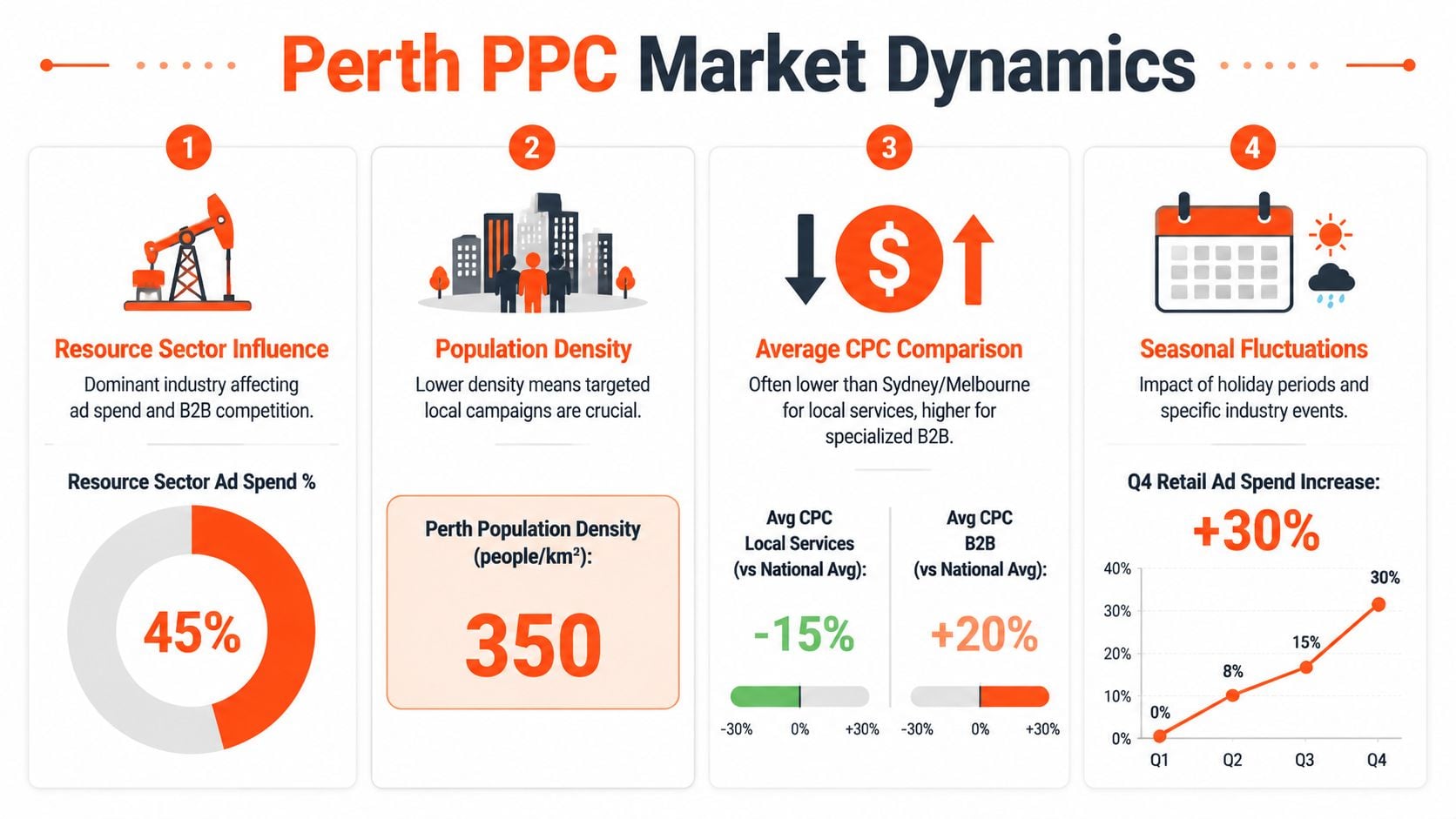
The local market doesn't behave like Sydney or Melbourne in every category. Western Australia's economy is unusually concentrated in mining and mining-related services, which changes keyword economics, lead quality, and channel mix for many B2B advertisers, a gap noted in this Perth PPC agency market analysis. If you sell into engineering, industrial maintenance, recruitment, transport, or technical services, your campaign planning needs to reflect that.
For e-commerce, Perth creates a different tension. Local targeting can work well for some product categories, especially when delivery speed or local relevance matters. But many stores eventually need to test broader reach because Perth alone may not provide enough efficient volume. That makes platform mix more important than many agencies admit.
What agencies in Perth usually charge
There is at least a practical baseline in the local market. In Perth, PPC management pricing often starts around AUD 400 to 500 per month for 1 to 2 search campaigns. More complex accounts can reach AUD 1,500 to 2,000 per month, while e-commerce management typically begins from AUD 600 to 700 per month. Common pricing models include flat monthly retainers, percentage of ad spend, and hybrid pricing, as outlined in this Perth PPC pricing breakdown.
Those numbers matter because they tell you how agencies segment service levels. They also give you a fast way to spot proposals that are either suspiciously cheap or padded with vague deliverables.
For a deeper comparison of fee structures, it's worth reviewing how PPC pricing models typically work before you sign anything.
Which pricing model fits which business
Here's the blunt version. No pricing model is automatically good or bad. It depends on account complexity and how much clarity you want.
| Pricing model | Usually suits | Main trade-off |
|---|---|---|
| Flat retainer | Smaller accounts, stable scopes, businesses that want predictable fees | Can become rigid if campaign scope expands |
| Percentage of ad spend | Growth-stage accounts with rising budgets | The agency earns more as spend grows, which can create the wrong incentive if not managed carefully |
| Hybrid | Businesses wanting some baseline management plus scale flexibility | More moving parts. You need clear definitions of what is included |
Budgeting by business type
A Perth e-commerce business shouldn't budget the same way as a B2B lead generation company.
- E-commerce accounts: Usually need tighter feed management, Shopping setup, remarketing, and landing page alignment. The management fee often starts higher because the account structure is broader from the outset.
- B2B service businesses: May begin with focused search campaigns, but they often need more rigorous lead qualification and CRM feedback to avoid paying for low-value enquiries.
- SMBs with local intent: Can start leaner, but they still need clean geo targeting, conversion tracking, and a clear plan for expansion.
Commercial filter: If an agency can't explain why your proposed budget matches your channel mix, they're guessing.
Key Criteria for Choosing Your Perth PPC Agency
Once budget is on the table, critical screening starts. At this point, many businesses get distracted by the wrong signals. Fancy dashboards, broad claims, or long service menus don't tell you whether the agency can manage your account properly.
What matters is how they think.
Start with relevance, not reputation
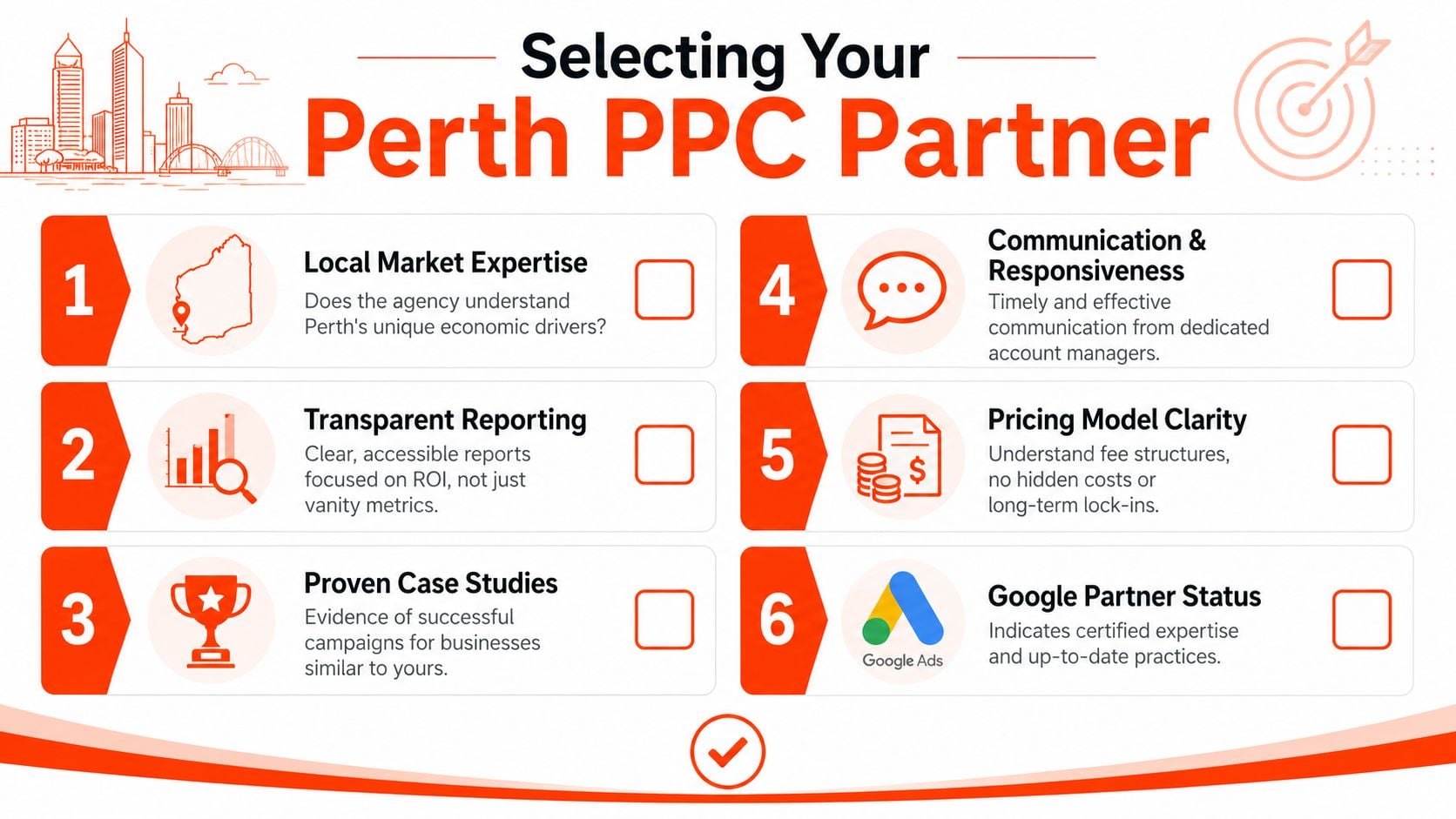
A large agency isn't automatically a better fit. A niche one isn't automatically better either. The question is whether they've handled accounts that resemble yours in sales process, platform mix, and conversion path.
An e-commerce brand should ask about Shopping architecture, product segmentation, feed handling, and remarketing logic. A B2B business should ask about search intent, lead scoring, CRM feedback, and how the agency separates branded and non-branded demand.
If the examples they give you are too broad, the fit probably is too.
Watch for budget fragmentation
One of the most common reasons campaigns underperform is budget fragmentation in reverse, where too much budget gets trapped in a single campaign type. Verified AU market guidance notes that underperformance often happens when over 70% of budget is allocated to one campaign type, while agencies using a segmented structure across Search, Shopping, Display, and remarketing can improve conversion rates by 45% and lower cost-per-lead by 30%. Those figures are part of the verified data provided for this article.
That matters when you're interviewing an agency because you want to hear channel allocation logic, not a one-channel pitch.
A better answer sounds like this:
- Search for intent capture: Use it where buyers are already close to action.
- Shopping for product-led demand: Critical for many e-commerce accounts.
- Display or remarketing for recovery: Useful when buyers don't convert on first visit.
- Additional channels selectively: Consider Meta or LinkedIn when the business model supports them.
The questions worth asking in the meeting
Use the first call to test strategic depth.
Ask this directly: How would you split budget across channels for a Perth business like mine, and what would make you change that split after launch?
If an agency only talks about clicks, impressions, and CTR, they're not talking about your business. They're talking about ad delivery.
Also ask how reporting works, who owns the account assets, how often optimisation happens, and what happens when lead quality drops even if platform metrics look healthy.
Non-negotiables before you sign
- Clear ownership: You should know who manages the account and who writes strategy.
- Transparent reporting: Reports should connect spend to leads or sales, not just activity.
- Platform fit: The agency should be able to explain why it would use Google Ads, Shopping, Meta, or LinkedIn, and why it would not.
- Tracking discipline: They should discuss conversion setup early, not as an afterthought.
- Commercial honesty: A good agency will tell you when PPC isn't the right first move for your category or landing page state.
A good PPC agency in Perth sets itself apart. It provides a decision-making framework, not just a quote.
The Ideal Onboarding Timeline From Day 1 to Live Ads
The onboarding process tells you a lot about how the agency will behave once the contract is signed. If the early stages are messy, slow, or vague, that usually carries into account management.
A solid onboarding process is organised around access, tracking, commercial priorities, and approval flow. Perth agency packages often make that operational structure visible. One local package model includes support for ad spend up to $5,000, full conversion tracking, fortnightly or weekly optimisations, and daily website traffic dashboards, which shows how mature providers tie fees to accountability rather than just media buying, as shown on this Perth PPC advertising package page.
What should happen first
The first stage shouldn't be “we'll launch and see what happens”. It should be diagnosis.
A competent agency will usually begin with a business questionnaire, a strategy discussion, and access collection. That includes Google Ads, GA4, tag management, merchant tools if relevant, and any CRM or lead handling system needed for attribution.
For Shopify brands, this stage often exposes practical setup gaps. If the store's backend apps and operational workflows are still being assembled, resources like installing Helmsly for Shopify can be useful alongside ad onboarding because fulfilment and attribution issues often surface together.
What a good launch sequence looks like
The exact timing can vary, but the milestones should be clear.
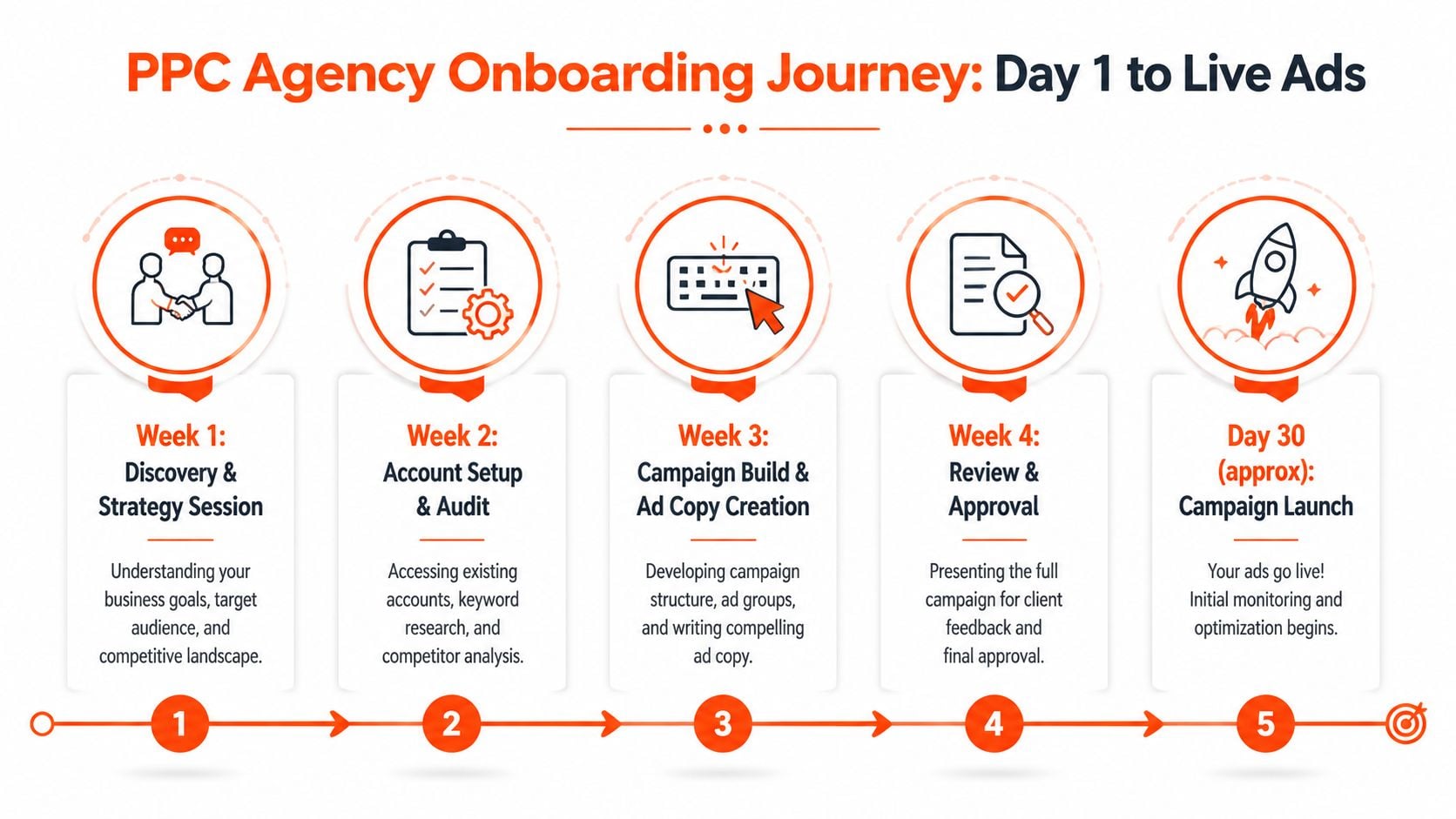
-
Discovery and business review
The agency needs your offers, margins, lead qualification rules, locations, and sales process. Without that, campaign planning is guesswork. -
Tracking and account audit
Here, existing data gets checked. Broken conversions, duplicate tags, weak event setup, and poor campaign naming need fixing before scale. -
Campaign structure build
Search, Shopping, display, remarketing, or LinkedIn should be built around intent and account goals. This is also where geo settings and exclusions matter for Perth businesses. -
Ad copy and asset review
Messaging should match your sales reality, not generic benefits. B2B ads need qualification. E-commerce ads need product clarity and feed quality. -
Approval and launch
You should know exactly what is being launched, what is being held back, and what gets reviewed first after traffic starts.
Warning signs during onboarding
- No conversation about conversion tracking
- No access to dashboards or reporting tools
- No distinction between branded and non-branded search
- No discussion of sales quality or CRM feedback
- No clear approval stage before launch
A rushed launch can feel productive. It usually just means the agency skipped the hard parts that protect your budget.
Setting KPIs and Measuring Real ROI in Perth
Most PPC reporting still overstates performance because it rewards activity instead of commercial outcomes. Impressions look impressive. Click volume is easy to show. CTR can look healthy. None of that tells you whether the campaign is bringing in profitable customers or qualified leads.
That matters even more in Perth, where local demand patterns can make weak traffic look stronger than it is. A niche B2B advertiser might get plenty of low-cost clicks from broad queries that never become real opportunities. An e-commerce retailer might see sales attributed inside the ad platform while backend profitability tells a different story.

The metrics that deserve your attention
For lead generation, the key question is simple. Are the leads sales-ready, and can your team prove it?
For e-commerce, the question changes slightly. Which campaigns are generating orders at a margin that still makes sense after ad spend, product cost, and fulfilment?
That's why a serious PPC agency in Perth should anchor reporting to business metrics such as acquisition efficiency, lead quality, and return on ad spend. If you need context around performance thresholds, this guide on what is a good ROAS is a useful reference point.
Why tracking quality changes the whole account
In the Australian market, agencies using server-side conversion tracking can achieve 2.8x higher ROI compared with agencies relying only on client-side pixels. Verified data for this article also notes that failing to implement this properly can waste 35–45% of ad spend on campaigns that generate clicks without quality leads.
That's not a technical side note. It changes bidding, attribution, and optimisation.
When tracking is weak, the platform learns from incomplete data. It may optimise toward cheap form fills, accidental events, or shallow actions that never become revenue. The campaign can look efficient inside the ad account while the sales team complains that nothing useful is coming through.
A practical KPI stack for Perth advertisers
Different businesses need different KPI stacks. But a useful structure usually looks like this:
- Primary KPI: Sales revenue or qualified leads
- Validation KPI: Lead quality feedback from CRM or sales team
- Efficiency KPI: Cost per acquisition or return on ad spend
- Behaviour KPI: Search term quality, landing page engagement, and assisted conversion patterns
Reality check: If your agency can't connect ad data to downstream lead quality, they're managing platform performance, not business performance.
There's another local issue that many Perth advertisers miss. High impressions and strong CTR can still hide a conversion-lead divergence problem when first-party data loops are missing. Verified guidance in the data set for this article recommends a three-step audit approach: isolate branded versus non-branded search queries in GA4, implement server-side tracking, and validate lead quality through CRM feedback within 14 days.
That framework matters because some campaigns appear healthy on surface metrics while the sales pipeline says otherwise.
A short explainer on tracking discipline is worth watching if you're reviewing agencies and trying to separate dashboard noise from real attribution.
Your First 30 Days What to Expect and Mitigating Risk
The first month with a new agency shouldn't be judged by hype. It should be judged by signal quality.
That means cleaner tracking, tighter search terms, clearer reporting, better budget control, and early evidence that the agency is making sensible decisions with your account. If you expect instant scale in the first few weeks, you'll usually end up rewarding the wrong behaviour. Agencies can force spend quickly. That doesn't mean they're building a profitable account.
What good early progress actually looks like
In the first month, you want proof that the agency can observe, diagnose, and adjust.
A good early pattern often includes:
- Cleaner traffic: Fewer irrelevant queries and tighter matching between ads and intent.
- More reliable reporting: You should be able to see what happened, not wait for vague monthly commentary.
- Useful optimisation decisions: Bid changes, keyword exclusions, landing page notes, audience adjustments, and channel refinements should all have a reason behind them.
- Sales feedback loop: For B2B especially, the agency should care whether the leads were worth following up.
Where risk usually appears
Risk tends to show up in predictable places.
One is misalignment. The business wants qualified pipeline or profitable orders, while the agency optimises for platform-friendly conversions. Another is poor communication. If nobody explains what changed and why, trust drops fast. The third is contract lock-in before competence has been demonstrated.
Early PPC success isn't about dramatic growth. It's about proving the account is being managed with discipline.
Why a trial period matters
A short validation window is valuable. It gives both sides room to test fit without pretending certainty exists on day one.
A sensible trial period lets you judge what matters:
- Communication quality: Are they responsive, direct, and commercially aware?
- Reporting clarity: Can you understand what happened without decoding jargon?
- Strategic judgment: Do their changes match your market and business model?
- Operational reliability: Are they doing what they said they'd do?
If those pieces are strong, longer-term commitment becomes much easier. If they aren't, you'll know early, with less wasted spend and less organisational drag.
Perth businesses don't need another polished sales process. They need a PPC partner who can handle local market nuance, choose the right mix of channels, measure real outcomes, and tell the truth about what's working and what isn't.
If you want a Perth-focused PPC team that works with transparent pricing, practical reporting, and a 30-day risk-free trial, take a look at Click Click Bang Bang. They specialise in Google Ads, Shopping, Meta, and LinkedIn campaigns with clear onboarding, live reporting, and no long-term lock-in.
Read NeXt
Or Read Our Latest
- Reporting Portal Login: Access Your Client Dashboard Fast
- How to Calculate Sample Size for A/B Tests and Campaigns
- How to Fix Google Merchant Center Errors Step by Step
- What Is Pagination and Why It Matters for AU Sites
- What Is Value Proposition? PPC & SEO Guide
- How to Choose a Google Ads Agency Australia
Click. CLick. Subscribe.
Get our best PPC insights, industry updates, and power moves delivered straight to your inbox. No fluff, just high-caliber strategies that actually work.
Don’t Leave Just Yet
Try Us For 30-Days,
Risk Free!!
We guarantee that you’ll love our work within the first 30 days, if not you’ll get your money back.
What have you got to lose?