

Small Business Digital Marketing Services: A 2026 Guide
Last Updated

You’re probably dealing with this already. One person tells you to pour money into Google Ads. Another insists SEO is the only channel worth building. A freelancer says you need TikTok, email automations, landing pages, and a full rebrand before anything will work.
Meanwhile, you’re still running the business.
For most Australian owners, the problem isn’t a lack of marketing options. It’s that there are too many disconnected options, each sold like a silver bullet. That’s how budgets get split across random activities that never turn into a system.
Navigating the Digital Maze as a Small Business Owner
A retail founder in Melbourne, a trades business in Brisbane, and a B2B software firm in Sydney can look completely different on the surface, but the marketing frustration is usually the same. They’ve tried bits and pieces. A few boosted posts. Some Google Ads. Maybe an SEO package that produced a report but not much else. Traffic arrives in patches, leads feel inconsistent, and nobody can clearly explain which channel is pulling its weight.

That confusion matters because small businesses dominate the Australian economy. Small businesses represent 97.2% of all businesses in Australia, yet only 28% actively invest in a full suite of digital marketing channels like PPC and SEO. At the same time, 64% plan to increase their digital ad spend in 2025, according to Australian small business marketing data. The opportunity is obvious, but so is the risk. More spend doesn’t automatically create better results.
Practical rule: If your marketing channels don’t share data, messaging, and goals, you don’t have a strategy. You have separate tasks.
Small business digital marketing services should remove that confusion, not add to it. Good services create a clear line between spend and outcome. They answer basic commercial questions. Which channel brings qualified enquiries? Which campaign brings repeat buyers? Which landing page turns clicks into booked jobs, demo requests, or online orders?
Here’s the shift that helps. Stop thinking about digital marketing as a menu of isolated services. Treat it as a connected growth system. SEO builds discoverability. PPC captures demand now. Content helps buyers trust you. Email turns interest into repeat business. Analytics tells you what to keep, what to cut, and what to fix.
That’s the difference between being busy with marketing and getting useful results from it.
The Core Digital Marketing Services Explained
A small business owner usually does not need more channels. They need each channel to do a specific job, share signals with the others, and feed one buying journey.
That distinction matters. A campaign can look busy and still waste money if SEO, ads, content, email, and tracking are all working from different assumptions. The services below matter because each one solves a different part of the growth problem.
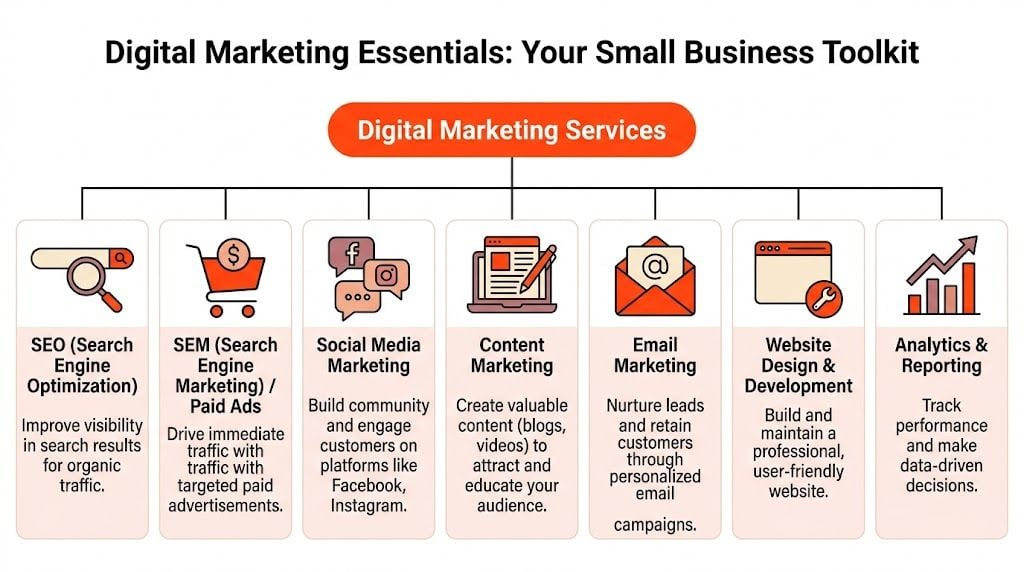
SEO builds long term visibility
Search engine optimisation (SEO) helps your business appear when people search for what you sell. For a local service business, that usually means suburb and service queries. For ecommerce, it means category pages, product pages, and comparison content. For B2B, it often means solution pages, use-case content, and pages built around commercial intent.
SEO takes time, but the payoff can last. A page that ranks for a useful query can keep bringing in qualified traffic without paying for every visit. That makes SEO an asset-building channel.
What drives results is less glamorous than many agencies make it sound. Clean site structure. Search intent matched properly. Pages that answer the buyer’s real question. Internal links that help both users and search engines. Conversion paths that turn visits into enquiries or sales.
Poor SEO usually follows the same pattern. Thin content. Keyword-stuffed service pages. Blog posts written for traffic that never buys. Rankings improve on paper, but revenue does not.
PPC buys speed and sharper feedback
Pay-per-click advertising (PPC) gives you immediate visibility. Google Search Ads are useful when people already know what they need and are actively looking. Shopping campaigns help product-based businesses compete at the point of comparison. Remarketing gives you another chance to convert people who visited and left.
The biggest advantage is feedback speed. PPC shows, fast, which offers attract serious buyers, which keywords waste budget, and which landing pages fail after the click. That makes it one of the best channels for testing demand before you commit months of effort elsewhere.
Small businesses often lose money in PPC for predictable reasons. Broad match terms with weak intent. No negative keyword list. Traffic pushed to the home page. Forms that ask for too much. Missing conversion tracking, so nobody can tell the difference between a click and a sale.
PPC works best when the offer, keyword, ad, and landing page match closely.
If you are comparing providers, this overview of digital marketing services for Australian businesses shows how PPC should sit beside SEO, content, and reporting rather than run as a separate tactic.
To see the channel mix in action, this explainer is useful:
Social ads create demand before a search happens
Search captures existing intent. Social media advertising helps shape it earlier.
Meta is often effective for visual products, local offers, promotions, remarketing, and top-of-funnel audience building. LinkedIn tends to work better for B2B firms that need tighter control over job title, industry, and company profile. The right platform depends on buying behaviour, sales cycle, and offer value.
The trade-off is clear. Social traffic is usually colder than search traffic, so the message has to do more work. Creative matters more. The offer matters more. Follow-up matters more. If someone clicks a social ad and lands on a generic page with no proof, no clear next step, and no reason to act, the spend disappears quickly.
Used properly, social ads do more than generate impressions. They build remarketing pools, test messaging angles, and move buyers closer to a later search or direct enquiry.
Content gives every other channel something useful to say
Content marketing is not just blogging. It includes service pages, product copy, buying guides, FAQs, comparison pages, landing pages, videos, email copy, and ad creative.
Every channel depends on it. SEO needs content that answers intent. PPC needs landing pages that match the promise in the ad. Social needs creative that earns attention. Email needs messages that stay relevant after the first click.
The best content reduces friction. It answers pricing questions, explains differences between options, handles objections, and gives buyers enough confidence to take the next step. In practice, that usually means fewer generic articles and more pages tied directly to real commercial questions.
AI has changed the workflow here, but not the standard. AI can help speed up research, briefs, draft structures, and creative testing. It cannot replace original expertise, customer insight, or editorial judgement. Small businesses get better results when AI supports production and analysis, while humans shape positioning, proof, and accuracy.
Email turns attention into repeat revenue
Email is one of the highest-margin channels for many small businesses because it works on leads and customers you already paid to acquire.
A prospect who did not enquire on the first visit may respond to a short follow-up sequence. A customer who bought once may buy again with the right post-purchase email. A quote request that stalled may come back after a useful case study, testimonial, or reminder.
Good email marketing depends on segmentation. New leads should not get the same message as repeat buyers. Abandoned cart emails should not sound like monthly newsletters. Timing, message, and offer need to match buyer stage.
This is also where integration starts to show its value. Search terms, ad clicks, pages viewed, and prior purchases should shape what gets sent next. If email runs in isolation, it turns into batch-and-blast noise.
CRO fixes the leaks after the click
Conversion rate optimisation (CRO) improves what happens on your website after traffic arrives. It focuses on the page experience. Is the page relevant to the ad or keyword? Is the offer clear? Are trust signals visible? Is the mobile layout easy to use? Can people act without friction?
A lot of hidden waste sits.
I often see businesses increase spend before fixing the page that receives the traffic. That is backwards. More visitors to a weak page usually produce more wasted budget, not more sales. CRO gets more value from the traffic you already have.
Sometimes the fix is simple. A stronger headline. Fewer form fields. Better proof. Faster load speed. A clearer call to action. Sometimes it is structural, such as rebuilding service pages around actual buyer questions instead of internal company language.
Analytics shows what is actually working
Without analytics and reporting, every marketing conversation turns into opinion. One person points to impressions. Another points to clicks. Another likes social engagement. None of those metrics mean much on their own.
Useful reporting ties channel activity to commercial outcomes. Which campaign generated enquiries. Which landing page produced booked jobs. Which audience drove repeat purchases. Which traffic source assisted conversions but did not close them directly. That level of visibility changes budget decisions.
An AI-first setup helps here too. AI can surface anomalies faster, group search terms by intent, identify patterns across campaigns, and flag wasted spend before it grows. It still needs clean tracking, clear goals, and human review. Bad data analysed faster is still bad data.
A simple view of the toolkit looks like this:
| Service | Main job | Best used for |
|---|---|---|
| SEO | Build organic visibility | Long term discoverability and non-paid traffic |
| PPC | Capture demand fast | Immediate leads, sales, and offer testing |
| Social ads | Build and retarget demand | Product discovery, awareness, audience building |
| Content | Support trust and relevance | Education, objections, conversion support |
| Nurture and retain | Follow-up, repeat business, lifecycle marketing | |
| CRO | Improve conversion efficiency | Turning more existing traffic into action |
| Analytics | Measure and guide decisions | Budget allocation, optimisation, accountability |
Why an Integrated Strategy Is Your Greatest Asset
A lot of small businesses don’t fail because they picked the wrong channel. They stall because each channel runs like its own department with no shared plan.
The SEO provider is chasing rankings. The ad manager is chasing clicks. The social team is posting regularly. The email platform is sending campaigns. Everyone is active, but nobody is aligning the work around one buyer journey.
Siloed marketing creates expensive gaps
Think of your marketing like a football side. One unit wins territory, another creates scoring chances, another protects field position. If each group ignores the others, the team looks busy and still loses.
The same thing happens in digital. PPC uncovers high-converting search terms, but nobody feeds that into SEO. SEO content brings in traffic, but nobody builds remarketing audiences from it. Social ads generate interest, but the landing page speaks in a completely different voice. Email follows up with generic messages unrelated to the original offer.
That fragmentation is common. In Australia, 68% of SMBs report fragmented digital strategies, leading to 30-40% higher customer acquisition costs. AU ecommerce SMBs using integrated AI-SEO and PPC saw a 25% better ROAS in Q1 2026, according to analysis on how agencies underserve SMBs.
Those numbers fit what experienced operators see every week. Siloed campaigns usually create duplicated effort, inconsistent messaging, and slower learning.
What integration looks like in practice
An integrated strategy is less glamorous than people expect. It’s mostly about coordination.
- Shared intent data means PPC search term reports influence SEO page targets and content topics.
- Shared messaging means your ad promise matches your landing page headline, your product page copy, and your follow-up email.
- Shared audiences mean site visitors from organic traffic can enter remarketing campaigns instead of disappearing.
- Shared reporting means channel decisions are made on contribution to leads or sales, not on isolated platform metrics.
The strongest growth systems don’t ask which channel is best. They ask how each channel moves the same buyer toward action.
Why AI-first matters now
AI-first doesn’t mean replacing strategy with automation. It means using modern tools to sharpen relevance, speed up analysis, and adapt content to the way people now search and discover. Search behaviour is no longer limited to one box on Google. Buyers move across search engines, social platforms, product feeds, AI summaries, and review environments.
For small businesses, that changes the brief. You don’t need more disconnected services. You need services that work from the same signals and support each other.
That’s where integrated small business digital marketing services earn their keep. They cut waste, shorten the feedback loop, and make budget decisions easier because each part of the system informs the next.
Decoding Agency Pricing Models and Packages
Agency pricing often feels vague because many proposals blur three different things. Strategy, execution, and media spend. If you don’t separate them, it’s hard to know what you’re buying.
The right pricing model depends on your stage, your internal capability, and how quickly you need results.
The common pricing models
Monthly retainers suit businesses that need ongoing management across channels. This model makes sense when campaigns need regular optimisation, creative updates, reporting, and testing. It’s usually the best fit for SEO, PPC, or integrated programs because these channels improve through continuous work, not one-off setup.
Project-based pricing works when the scope has a clear endpoint. A site migration, tracking overhaul, landing page build, or SEO audit fits here. The upside is clarity. The downside is that projects don’t manage themselves once they go live.
Hourly consulting can help if you already have an internal team and only need specialist input. It’s useful for audits, troubleshooting, or strategic reviews. It becomes inefficient if you expect a consultant to also handle day-to-day execution.
A simple rule helps here. If you need momentum and accountability, a retainer usually fits better. If you need a defined asset or fix, project pricing is cleaner.
What small businesses should pressure test
Google Ads can be commercially attractive for SMEs when managed properly. PPC advertising on Google Ads delivers an average return on ad spend of 4:1 for Australian SMBs. For a startup with an AU$2,000 monthly budget, allocating 60% to high-intent search campaigns can yield a 15-20% uplift in qualified leads, according to small business PPC benchmarks.
That doesn’t mean every package should start with more spend. It means you should ask whether the agency knows how to prioritise intent before broad reach.
Cheap management is expensive when the account structure is loose, the tracking is weak, and nobody can explain why leads improved or declined.
If you’re comparing SEO proposals, this guide on how much search engine optimisation costs is useful because it frames pricing around scope rather than promises.
For online stores, it also helps to understand how service bundles differ from channel-specific execution. A practical breakdown of ecommerce marketing services can help you compare whether you need ads only, lifecycle support, or a broader acquisition program.
Example digital marketing packages for Australian SMBs 2026
These package examples are illustrative. Agencies vary in inclusions, reporting depth, creative support, and setup fees.
| Package Tier | Ideal For | Core Services | Estimated Monthly Cost (AUD) |
|---|---|---|---|
| Starter single-channel | New businesses testing one platform | One ad platform or foundational SEO, basic tracking, monthly reporting | Lower range |
| Growth two-channel | Businesses needing lead flow plus organic groundwork | Google Ads plus SEO, landing page input, remarketing, monthly strategy review | Mid range |
| Multi-channel ecommerce | Retailers with repeat purchase potential | Google Shopping, Search, Meta ads, email coordination, feed optimisation, reporting portal | Mid to higher range |
| B2B lead generation | Service firms with longer sales cycles | Google Search, LinkedIn ads, conversion tracking, lead quality review, funnel reporting | Mid to higher range |
| Full-funnel integrated | Businesses ready for coordinated growth | PPC, AI-first SEO, CRO input, analytics, remarketing, strategic content alignment | Higher range |
When you review packages, don’t focus only on channel count. Focus on operational quality. Who owns the tracking setup? How often are campaigns reviewed? Are landing pages included? Is reporting tied to enquiries and revenue, or just traffic and clicks?
Those answers matter more than a tidy package name.
From Onboarding to Ongoing Success What to Expect
Monday morning. Three leads came through over the weekend, but nobody can tell which campaign drove them, whether they were good fits, or why one suburb is suddenly eating budget. That is the point where many small business owners realise they did not hire marketing support. They hired another layer of guesswork.
Good onboarding fixes that early. It sets the rules for measurement, clarifies who owns what, and stops the common Australian SMB problem where SEO, PPC, content, and CRM data all run separately. In an AI-first strategy, that connected setup matters because automation is only useful when the inputs are accurate.
The first month should create clarity
The first month should answer basic business questions fast. What are you trying to sell first? Which services have the best margin? Which locations matter most? How long does a sale usually take, and what counts as a qualified lead?
A serious agency will ask for more than brand assets and logins. Expect questions about offer priorities, seasonality, sales capacity, repeat purchase value, and past campaign history. Those details shape bidding, targeting, landing page decisions, and reporting benchmarks. If the agency skips that work, the account usually optimises for cheap clicks or form fills instead of profitable customers.
Then the technical setup starts. That often includes ad account access, analytics checks, conversion tracking, CRM or call tracking connections, audience setup, feed reviews for ecommerce, and a close look at key landing pages.
At this stage, many accounts either start clean or inherit expensive problems.
Privacy changes, consent requirements, and platform reporting gaps have made weak tracking harder to ignore. If form submissions are duplicated, phone calls are missed, or offline sales never make it back into the ad platforms, AI bidding will learn from bad signals. That is how wasted spend gets dressed up as optimisation.

Launch starts the learning cycle
Going live matters, but the first few weeks after launch tell you far more than launch day itself.
Campaigns need active review while the account starts collecting real search terms, audience signals, conversion behaviour, and lead quality patterns. The work usually includes checking whether ads are attracting the right intent, reviewing where users drop off on the page, testing message angles, and tightening conversion tracking if data quality is weak. For service businesses, there is another layer. Someone has to compare platform leads with what the sales team says happened after the enquiry.
That cross-check is often missing. It is one of the main reasons siloed services waste money. Paid campaigns may report success while the sales team complains that leads are poor, and SEO may drive traffic that never reaches the same landing pages PPC is using. An integrated team closes that loop faster.
What useful reporting looks like
A useful report helps you decide what to change next. It should explain performance in plain language, tie spend to commercial outcomes, and show what actions are planned for the coming month.
The right metrics depend on the business model. For some businesses, that means booked consultations and cost per qualified lead. For others, it means revenue, return on ad spend, repeat purchase rate, or which channel assists the final sale. What matters is that reporting connects channel activity to business results.
Ignore reports built around activity alone. Impressions, clicks, and traffic can be useful diagnostic metrics, but they are not proof of growth. If a landing page leaks conversions or the wrong search terms are slipping through, top-line numbers can look healthy while revenue stalls.
The working relationship should get better over time
By month two or three, you should see a rhythm. Clear updates. Faster answers. Fewer reporting gaps. Better decisions about where to put the next dollar.
That rhythm improves when the agency is set up to share insight across channels instead of treating each service as a separate line item. Search term data should inform SEO content. CRM outcomes should refine paid targeting. Landing page tests should improve both organic and paid performance. If you are comparing providers, this breakdown of digital marketing agencies for Australian businesses gives useful context on how different agency models operate.
Click Click Bang Bang is one example of an agency that pairs PPC with AI-first SEO. The point is not the label. The point is whether the agency can connect data, execution, and decision-making well enough to improve outcomes month after month.
That is what a strong agency relationship looks like in practice. Less mystery, better feedback loops, and a marketing system that gets smarter as it runs.
Critical Questions to Ask Before Hiring an Agency
Most agency sales conversations sound polished. That’s not the problem. The problem is that polished language can hide shallow execution.
The better approach is to ask questions that expose how the agency thinks, not just what it sells.
Questions that reveal strategy depth
Start with integration. If an agency treats SEO, PPC, content, and tracking as separate add-ons, you’ll probably end up with the same silo problem you’re trying to escape.
Ask questions like these:
- How do your PPC and SEO teams share insights? You want to hear about search term data, landing page learning, audience behaviour, and how one channel informs the other.
- How do you decide which service gets priority first? A serious agency should talk about business goals, commercial intent, time to impact, site readiness, and tracking maturity.
- How do you handle businesses with different goals across product lines or service areas? Their answer should include segmentation, not one generic campaign.
Questions that reveal transparency
A capable agency shouldn’t hesitate when you ask for specifics.
- Can I see a sample monthly report and have you talk me through it?
- What metrics do you treat as primary, and which ones do you treat as secondary?
- How do you explain performance changes when results drop?
- Who owns the ad accounts, analytics access, and historical data?
If the report is mostly screenshots and platform graphs, keep pushing. You need interpretation, not decoration.
A good comparison point is reviewing how different providers position themselves in the broader market for digital marketing agencies. Not to copy their sales language, but to compare how clearly each one defines process, accountability, and scope.
Questions that reveal operational discipline
Many weak providers are revealed at this juncture.
Ask:
- What is your process for testing ad copy, landing pages, or offers?
- How do you manage tracking in a privacy-first environment?
- What happens in the first month after signing?
- How often do you optimise campaigns, and what triggers a major change?
- How do you evaluate lead quality, not just lead volume?
If an agency can’t explain its optimisation process clearly, it’s likely reacting to dashboards rather than managing a system.
What strong answers sound like
Strong answers are specific without being theatrical. They mention tools such as GA4, Google Ads, Meta Ads Manager, LinkedIn Campaign Manager, CRM integration, consent mode, server-side tracking, feed optimisation, or landing page testing. They explain trade-offs. They admit when a channel isn’t the right first move.
Weak answers stay abstract. “We do bespoke strategy.” “We optimise continuously.” “We’re data-driven.” Those phrases aren’t wrong, but on their own they mean nothing.
The agency you want is the one that can show how decisions get made when performance is mixed, budgets are tight, and not every channel deserves equal investment.
Your Action Plan for Digital Growth
The businesses that get the most from small business digital marketing services usually do one thing differently. They stop treating marketing as a list of separate tasks and start managing it as one connected system.
That shift changes everything. SEO stops being a report. PPC stops being a gamble. Social stops being random posting. Analytics stops being a dashboard nobody trusts. Each part starts supporting the others.
Here’s the practical next move.
First, run a quick audit of your current setup. Ask yourself whether your channels share messaging, whether tracking is reliable, whether your landing pages match your ads, and whether your reports tell you which activity leads to revenue. If you’re testing newer channels, it also helps to study platform-specific guidance such as TikTok marketing for small businesses before adding another disconnected tactic.
Second, speak to a strategist who can assess the system as a whole. Not just your ads. Not just rankings. The whole path from click to conversion to repeat business.
Clear strategy usually looks less exciting than marketing hype. It’s tighter targeting, cleaner tracking, stronger pages, and better coordination across channels.
That’s also what tends to grow steadily.
If you want a practical second opinion on your current setup, Click Click Bang Bang is one option for Australian businesses looking at PPC and AI-first SEO through a more integrated lens. A useful conversation should leave you with clearer priorities, cleaner measurement, and a better sense of what to fix first.
Read NeXt
Or Read Our Latest
- Manual vs Automated Bidding for PPC Success
- Conversion Tracking Setup: A Complete AU Guide
- Instagram Advertising Australia: Complete 2026 Guide
- Pay Per Click: A Beginner’s Guide for Australian Marketers
- Display Advertising on Google: The Complete Australian Guide
- Stakeholder Communication Plan How to Build One That Works
Click. CLick. Subscribe.
Get our best PPC insights, industry updates, and power moves delivered straight to your inbox. No fluff, just high-caliber strategies that actually work.
Don’t Leave Just Yet
Try Us For 30-Days,
Risk Free!!
We guarantee that you’ll love our work within the first 30 days, if not you’ll get your money back.
What have you got to lose?