

Will AI Replace SEO? Your 2026 Guide to the Future
Last Updated

If you're asking whether AI will replace SEO, you're probably asking the wrong business question.
The central question is this: which parts of SEO are becoming cheap, automatable production work, and which parts are becoming more valuable because they require judgement? That distinction matters a lot more than the headline debate. Businesses that treat AI as a total replacement usually end up with faster output and weaker strategy. Businesses that employ it to their advantage tend to keep their visibility while reducing wasted manual work.
In Australia, that shift isn't theoretical. According to Semrush's AI SEO statistics roundup, 43% of Australians use AI tools such as ChatGPT, and among those users 53% use them to search for information. The same source notes that Google's AI Overviews are projected to appear on more than 75% of Google searches by 2028. That means discovery behaviour is already moving, and the old assumption that ranking in ten blue links is enough doesn't hold up.
SEO still matters. But the work inside SEO is being repriced.
The Question on Every Marketer's Mind
Will AI replace SEO, or is it just stripping value out of the parts that were already becoming interchangeable?
That is the better business question. The primary risk is not that search disappears. The risk is that teams keep paying premium rates for work that AI can now produce cheaply, while underinvesting in the strategic work that still drives visibility, qualified traffic, and revenue.

For Australian businesses, this matters right now because discovery is fragmenting across Google, AI assistants, and zero-click answer formats. That changes what SEO teams are being paid to do. Publishing more pages is easier than ever. Earning retrieval, citation, trust, and conversion is harder.
I see this split in client work every week. Drafting metadata, clustering keywords, summarising competitor pages, and producing first-pass content briefs are increasingly commodity tasks. They still matter, but they should be faster, cheaper, and tightly supervised. Positioning, information gain, technical prioritisation, entity clarity, and commercial messaging are different. Those areas depend on judgement, and judgement is where SEO keeps its value.
The old SEO question misses the point
"Will AI replace SEO?" compresses a pricing and capability shift into a false yes-or-no debate. Businesses do not need a philosophical answer. They need a clear operating model for what to automate, what to review, and what to keep human-led.
If AI systems summarise options before the click, visibility now includes more than rank position:
- Retrievability so your pages are easy for search engines and AI systems to parse
- Citation potential so your brand can appear in generated answers
- Message clarity so a summary still reflects what you sell
- Brand memory so users recognise and return to you later
A practical starting point is to review your current AI for SEO workflow against the work that still requires senior oversight. The gap is usually obvious. Teams are often overpaying for production and underfunding strategy.
This is also where policy matters. Speed without governance creates risk. If your team is publishing AI-assisted content at scale, understanding Google's AI content policy helps you separate efficient workflows from low-trust output.
The businesses that handle this shift well are not trying to protect every old SEO deliverable. They are repricing commodity work, tightening quality control, and putting experienced strategists on the decisions that AI still cannot make well.
Redefining AI and SEO in the New Search Landscape
Search now behaves less like a list of links and more like a layered answer engine. That's the shift many businesses feel but can't quite name.
A useful way to think about it is weather over a familiar coastline. The coastline is still there. Your website, your content, Google's index, and user intent still matter. What changed is the weather pattern. AI has altered the route users take to reach information, and that changes how websites need to be built and presented.
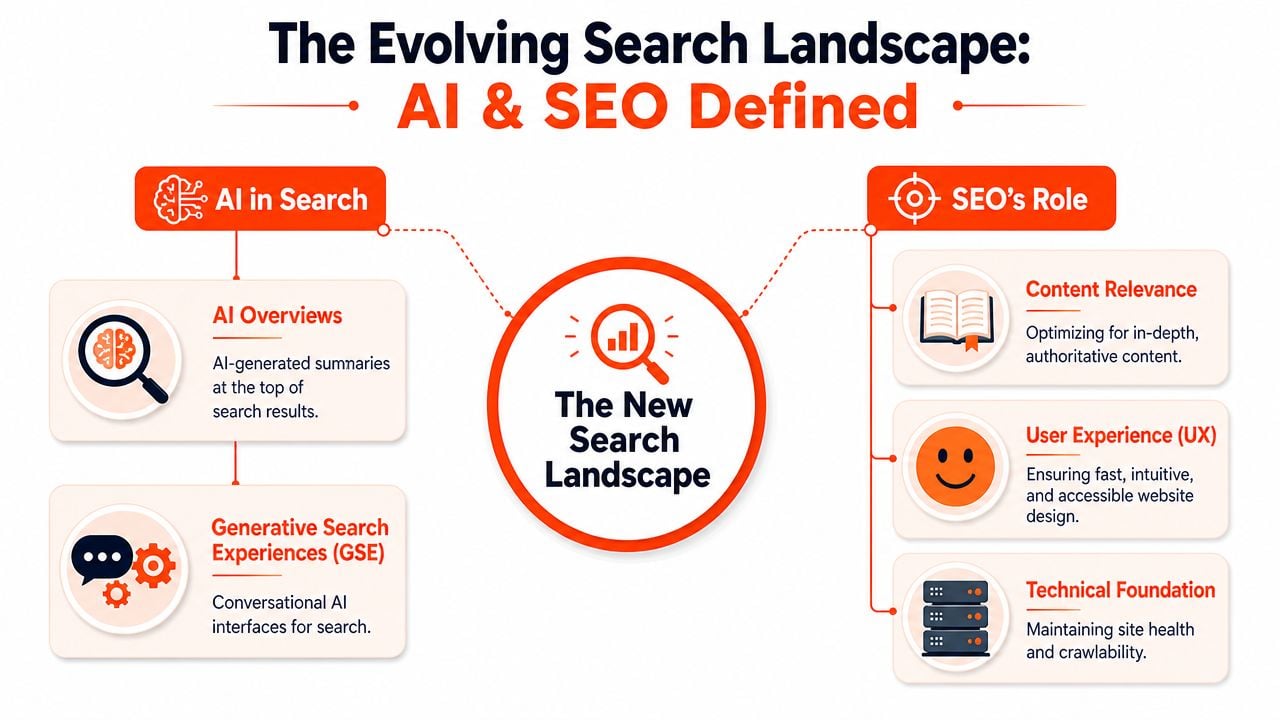
What AI in search actually means
When people say "AI search", they usually mean a mix of search features and interfaces that generate or assemble answers instead of listing pages. In practical terms, that includes AI summaries, conversational responses, and result layouts that compress research into a single interaction.
That doesn't remove the need for websites. It raises the bar for what websites must provide. AI systems still need crawlable pages, clear topic signals, factual consistency, and well-organised information. If your pages are vague, thin, or structurally messy, you make retrieval harder.
This is also why understanding Google's AI content policy matters. The issue isn't whether content involved AI. The issue is whether the page is useful, reliable, and aligned with search quality expectations.
What modern SEO means now
Modern SEO is no longer just a ranking discipline. It's a retrieval, interpretation, and trust discipline.
The technical foundations still matter:
- Site architecture helps search systems understand hierarchy and page importance.
- Internal linking helps distribute context across related topics.
- Structured formatting makes answers easier to extract and summarise.
- Topical depth gives your brand a better chance of being treated as a credible source.
Those are the same reasons many teams now combine classic optimisation with workflows built around AI for SEO services. The work isn't about publishing more words. It's about creating content and site structures that both humans and AI systems can interpret cleanly.
Search hasn't stopped being technical. It has become technical in more places.
Where businesses go wrong
The biggest mistake isn't using AI. It's assuming AI removes the need for editorial control and information design.
What doesn't work is flooding a site with generic pages, hoping volume creates authority. What works is publishing fewer pages with clearer entities, stronger intent matching, better supporting evidence, and sharper page purpose. AI increases the value of precision.
Which SEO Tasks Will Be Automated vs Human-Led
The easiest way to answer "Will AI replace SEO?" is to stop treating SEO as one job.
Some SEO work is already becoming routine production. That work can often be automated, accelerated, or heavily assisted. Other parts require judgement across brand, conversion, risk, and market position. That's where the strategic value now sits.
Industry analysis from Vested's view on whether AI will replace SEO points to AI automating routine tasks such as keyword research, competitor analysis, technical audits, and alt text generation, while people remain necessary for strategy, interpretation, and trustworthy decision-making.
SEO task evolution
| SEO Function | AI-Automated Tasks (The 'Co-Pilot') | Human-Led Strategy (The 'Pilot') |
|---|---|---|
| Keyword discovery | Expanding topic lists, clustering related phrases, identifying variants | Deciding which topics align with margin, sales cycle, and market position |
| Competitor monitoring | Summarising content gaps, tracking SERP changes, surfacing pattern shifts | Interpreting which gaps are worth acting on and which competitors matter commercially |
| Technical auditing | Flagging broken elements, duplicate patterns, metadata gaps, crawl issues | Prioritising fixes based on business impact, dev constraints, and broader site goals |
| Content drafting | Producing outlines, FAQs, metadata, alt text, first drafts | Injecting expertise, claims discipline, brand voice, proof, and conversion intent |
| Reporting | Pulling rankings, visibility snapshots, page group trends | Explaining why performance changed and what trade-offs to make next |
| Internal linking | Suggesting relevant anchors and related pages | Deciding hierarchy, topic ownership, and the flow that supports revenue goals |
Work that's becoming a commodity
If a task follows a repeatable pattern, AI will likely compress its value.
That includes:
- Initial research passes that gather broad keyword or topic candidates
- Template-heavy optimisation such as basic metadata generation
- Audit surfacing where the goal is identifying issues, not deciding priorities
- Bulk support content like product attribute copy, image alt text, or category variations
- Reporting assembly where tools pull and format data
For many teams, that means they shouldn't keep paying senior people to do junior production work. They should use systems and prompts to get to a usable first pass faster, then apply human review where it changes outcomes.
If you're publishing at scale, wRanks' guide to AI content for ecommerce workflows is useful for understanding where generated content can support production and where manual review still protects quality.
Work that keeps increasing in value
Many businesses underinvest in this area.
The hard part of SEO isn't generating possibilities. AI is already very good at generating possibilities. The hard part is making trade-offs:
- Should the team prioritise category pages or educational content?
- Which topics deserve original expert input?
- When should a declining page be improved, merged, redirected, or left alone?
- Which terms drive the wrong audience even if they bring traffic?
- How should a site balance informational authority with commercial clarity?
AI can produce options quickly. Strategy is choosing what not to do.
That's why the phrase "Will AI replace SEO?" leads people in the wrong direction. A better question is: which tasks in your current SEO retainer or internal workflow still create unique business value?
Why Your SEO Strategist Is More Valuable Than Ever
As routine work gets cheaper, the cost of bad strategic decisions goes up.
That's the part many businesses miss. They see AI drafting content, clustering keywords, or scanning technical issues, then assume the strategist is less necessary. The opposite is usually true. Once tools can generate ten plausible options in minutes, someone still has to decide which option supports the business.
ADMA Australia puts it clearly in its guidance on how AI is reshaping SEO: AI should be used as a "co-pilot, not an autopilot". That framing is practical because it reflects its failure points. AI can help fly straight. It can't decide when to change destination, when to avoid risk, or how to protect the brand when conditions shift.
Strategy sits above output
A senior strategist doesn't just ask whether a page can rank. They ask whether it should exist, what role it plays in the funnel, and what it must do once someone lands there.
That includes decisions like:
- Page priority when budget or developer time is limited
- Brand positioning so content doesn't sound interchangeable
- Fact-checking standards when AI-generated drafts overstate claims
- Commercial alignment so SEO supports revenue, not vanity traffic
- Cross-channel coordination with paid search, social, and CRM
For teams that need that level of oversight, working with experienced search marketing experts gives structure to decisions that AI tools can't make on their own.
The strategist's job has changed, not disappeared
The strategist now spends less time manually collecting inputs and more time on diagnosis, prioritisation, and quality control.
That shift is healthy. It moves SEO away from repetitive labour and towards higher-value problem solving. A strong strategist knows when AI is helping, when it's creating average content at speed, and when a recommendation looks efficient but weakens long-term authority.
Good SEO strategy now looks a lot like editorial leadership plus commercial judgement.
That's hard to automate because it depends on context, and context is where businesses either protect margin or waste effort.
Analysing the Risks and Opportunities for Your Business
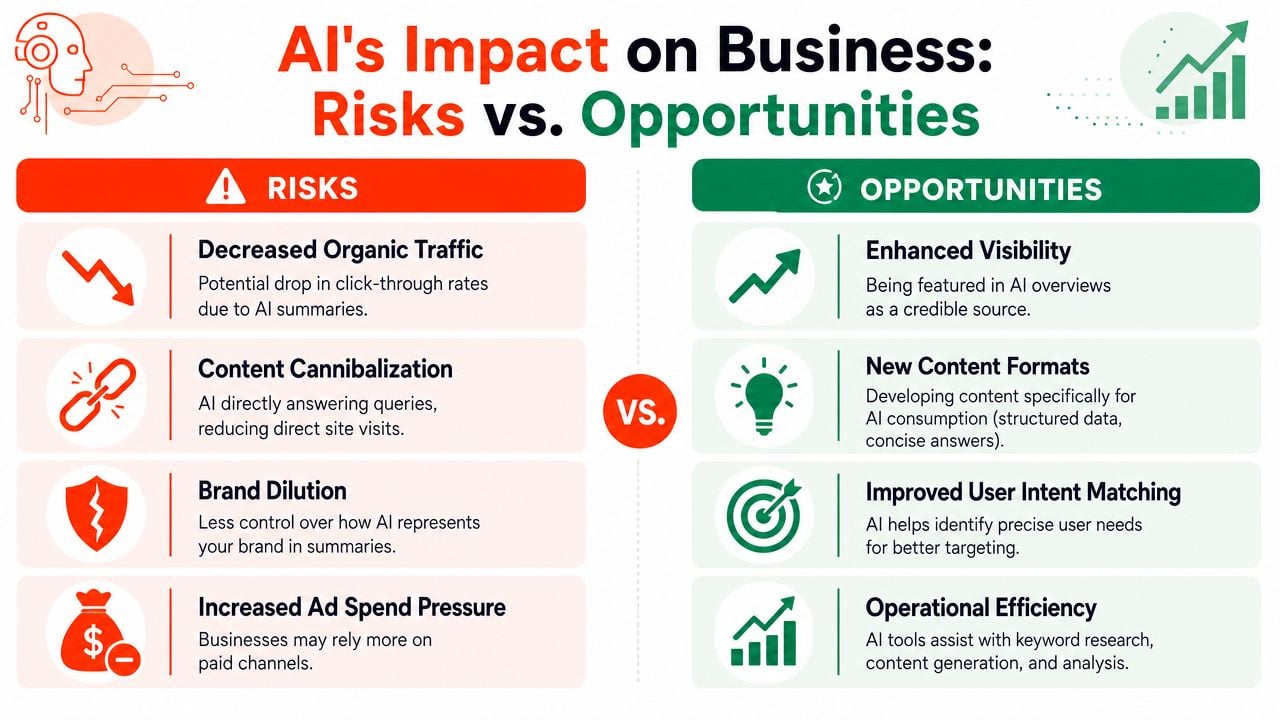
The business impact of AI search is uneven. Some companies will feel a direct drop in organic clicks. Others will gain visibility if they become a source AI systems retrieve and summarise well.
The risk is real. According to Taylor Scher SEO's roundup of AI SEO statistics, when an AI Overview appears, organic click-through rate drops from 1.76% to 0.61%. That changes the economics of content production, especially for businesses that relied on high-volume informational traffic to feed remarketing audiences or top-of-funnel lead generation.
The risks businesses need to plan for
A lower click rate doesn't mean lower demand. It means the path between search and site visit is less direct.
The main risks are:
- Fewer informational clicks even when your content informs the answer
- Weaker attribution visibility because users may convert later through another channel
- Brand distortion if AI summaries flatten your differentiation
- Budget pressure if teams try to replace lost organic sessions with paid traffic alone
For Australian businesses, this matters in a broader economic context as well. The same source ties the shift to a market where Australia's digital economy is targeting A$10 billion in additional annual value, which means search visibility still carries material business weight.
The opportunity side is stronger than it looks
This isn't only a defensive problem.
AI search also creates openings for businesses that are better organised than their competitors. Brands can benefit when they:
- Structure answers clearly so AI systems can extract them
- Publish expert-led pages that go beyond generic summaries
- Build branded demand so users search specifically for the company after initial exposure
- Own niche commercial intent where precise expertise matters more than broad surface-level answers
A lot of businesses still judge success only by sessions. That's too narrow now. If your brand appears in AI answers, influences consideration, and later captures direct, branded, or high-intent traffic, SEO is still doing its job. The measurement model just has to catch up.
The loss of a click isn't always the loss of influence.
Your Actionable Roadmap for an AI-First SEO Strategy
Most businesses don't need a total rebuild. They need a sharper operating model.
The immediate priority is to make your site easier to retrieve, easier to trust, and easier to measure in an environment where AI may answer part of the query before the user visits. Independent analysis from Duane Forrester's piece on how AI is reshaping SEO work argues that the primary shift is measuring whether content is retrieved and cited inside AI-generated answers, not just whether it ranks. That's the discipline many teams still don't have.
Start with the workflow below.
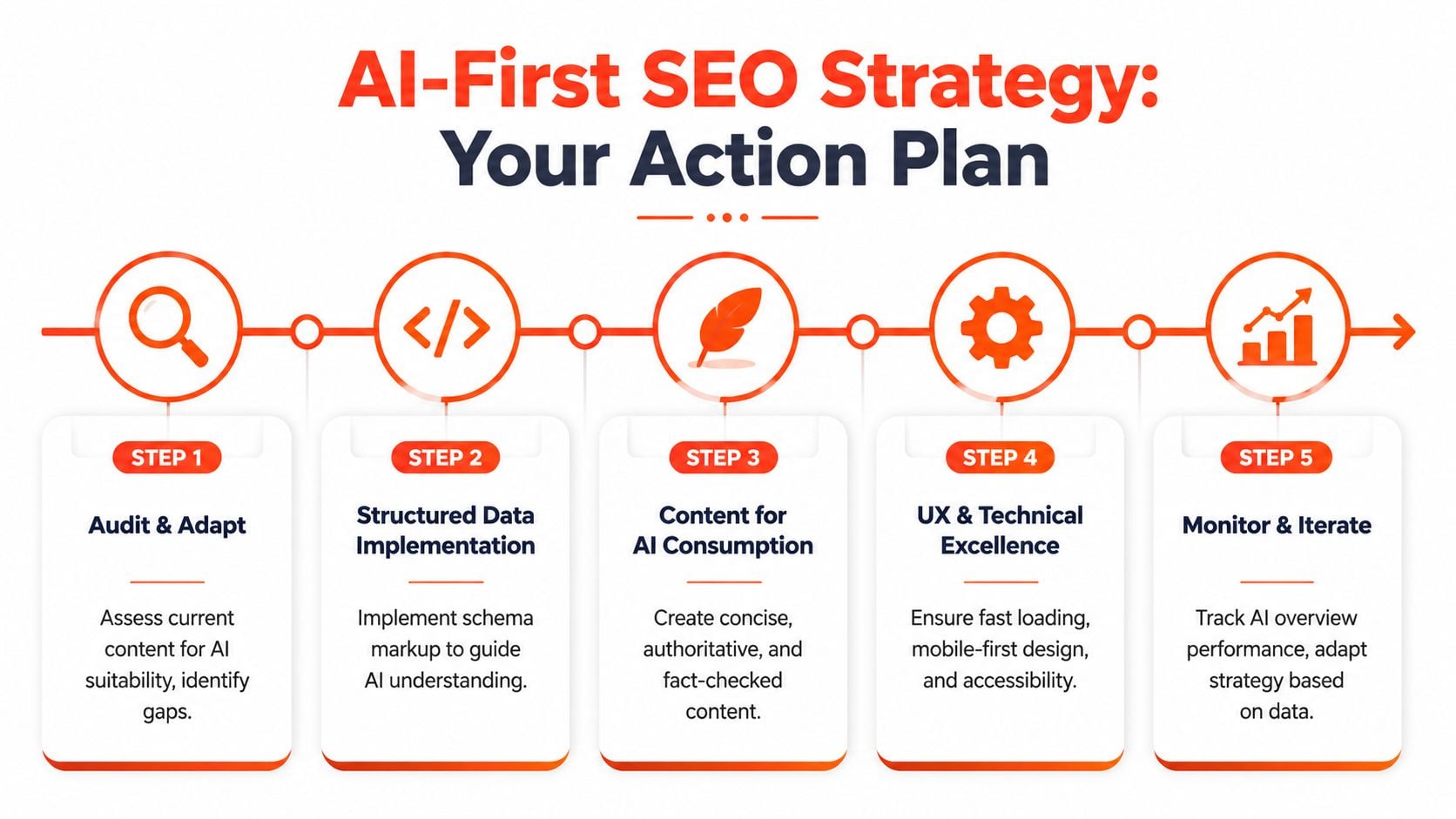
Audit what AI can commoditise
Don't begin by creating more content. Begin by finding wasted manual effort.
Review your current workflow and separate it into three buckets:
-
Automate now
Repetitive research, first-pass briefs, metadata drafting, internal link suggestions, and routine reporting often belong here. -
Assist but review
Content outlines, technical audits, FAQ drafting, and topic clustering can move faster with AI, but they still need editorial and strategic checks. -
Keep human-led
Content priorities, page purpose, conversion strategy, messaging, and final factual approval should stay with experienced people.
If you need a practical benchmark for combining editorial quality with search intent, a service model like SEO and copywriting support can help define where automation ends and decision-making begins.
Rebuild content around retrieval and clarity
Pages that perform in AI-shaped search usually share a few characteristics. They answer a specific intent cleanly, organise information logically, and avoid padded language.
Focus on:
- Clear page purpose so each page owns one job
- Strong headings and summaries that make extraction easier
- Expert review on any page that affects trust, legal exposure, or commercial credibility
- Consistent entity signals across product, service, author, and brand references
- Supporting evidence where claims need qualification
This is a useful explainer to watch while reviewing your current process:
Upgrade technical SEO from maintenance to enablement
Technical SEO still matters because AI systems don't retrieve messy inputs well.
Prioritise:
- Crawlability
- Clean internal linking
- Logical taxonomy
- Fast, accessible templates
- Structured formatting that helps systems interpret page sections
If the site architecture is weak, AI-assisted content production just creates more disorder.
Measure beyond rank tracking
Most dashboards still overvalue rankings and undervalue presence.
Track new signals such as:
- Whether key pages are being cited or summarised in AI answers
- Whether branded search demand strengthens after informational visibility
- Which non-click impressions still influence assisted conversions
- Which content themes produce downstream enquiries or sales, even with lower direct traffic
Many businesses need a mindset reset. If clicks drop but qualified leads hold, your SEO programme may be healthier than your old dashboard suggests.
Frequently Asked Questions About AI and SEO
Should I cut my SEO budget because of AI?
Usually, no. You should reallocate it.
Spend less on manual production that software can now assist with, and protect budget for technical improvements, expert review, content planning, and measurement. Cutting SEO entirely because AI changed search is like cutting analytics because attribution got harder.
Is it still worth creating blog content?
Yes, if the content has a defined job.
Generic blog posts written to fill a calendar are getting commoditised fast. Content still works when it supports product discovery, answers real objections, captures niche intent, or builds authority around topics your buyers care about. If a page doesn't serve a user need or a business need, don't publish it.
How do I choose an SEO agency in the AI era?
Look for an agency that can explain trade-offs, not just tools.
Ask how they separate automatable work from strategic work. Ask how they measure visibility when AI answers reduce clicks. Ask who reviews facts, who decides content priorities, and how SEO connects to leads or sales. If the answer is mostly about pumping out more content faster, keep looking.
If your team is rethinking what SEO should look like in an AI-shaped search market, Click Click Bang Bang can help you separate commodity tasks from strategic work, then build an AI-first search approach around technical clarity, stronger content decisions, and measurement that reflects how people discover brands now.
Read NeXt
Or Read Our Latest
- How to Set Up Google Ads in Australia: Complete 2026 Guide
- Google Merchant Center Setup: The Complete 2026 Guide
- Business Manager Setup Facebook: The Complete 2026 Guide
- Google Ads Account Setup: Expert Guide for 2026
- Search Ads Optimisation: A Practical Guide for 2026
- Manual vs Automated Bidding for PPC Success
Click. CLick. Subscribe.
Get our best PPC insights, industry updates, and power moves delivered straight to your inbox. No fluff, just high-caliber strategies that actually work.
Don’t Leave Just Yet
Try Us For 30-Days,
Risk Free!!
We guarantee that you’ll love our work within the first 30 days, if not you’ll get your money back.
What have you got to lose?